I have a tendency to fall into anecdotal rambling when I try to write about a project I find especially moving. This achilles heal is most inflamed when a song makes me cry – which does not happen super often – but when it does, I have to fight the urge to cite my own tears. It’s usually a desperate attempt to articulate the gravity of a track without turning to some dry technical dissection, but it doesn’t matter. No one gives a shit about the time I cried at my roommate’s roller blading competition, seated in a patch of grass above the park with Shallowater’s There is a Well in my ratty noise-cancelling headphones. So I will not tell you about it.
What I will say is that Houston based Shallowater is not doing anything new. At least not in a way I can cite on paper. Their soundscapes are familiar and rather organic, and I could write a laundry list of band comparisons ranging from emo and posthardcore to alt-country and slowcore, and they would all be valid. I suppose that is the real root of this apprehensive music journalism crisis I have so generously decided to include in this single review – the chasm between the abstractly unprecedented feel of a band and a reality that they are not technically doing anything unheard of. But perhaps that is the foundation for the most touching projects; an ability to pull from motifs seen countless times before and churn it into something that stops you in your tracks.
Today, Shallowater shared “Sadie”, the second single off their forthcoming record, God is Going to Give You a Million Dollars. The track starts on a gentle note, finding its footing in drawn out enunciations and a cautious rhythm section. As vocals grow in urgency, the soundscapes inflate into an eventual riff –lathered with mucky distortion, indulgent percussion, and a suffocating amount of poignancy. In the span of seven and a half minutes, Shallowater pursues this sort of escalation more than once, leaving you unsure of which buildup is the buildup. Perhaps the answer is neither? Perhaps the mud-slides of twangy sludge are less a destination than they are a means of amplifying slivers of delicacy and desperation between them. In the case of “Sadie”, soft vocals tend to cut deepest when they follow moments of sweeping cacophony. It’s enough to subdue even the sturdiest of poker faces.
You can listen to “Sadie” everywhere now, and pre-order God’s Gonna Give You A Million Dollars on Bandcamp.
“They also have seasonal shake thingies, and they’re just… I mean it’s melted ice cream. It’s ‘mint milk’. I think they also have a creamsicle one. They make you feel so sick. Just 900 calories of milk based drink.”
Peter Lukach of mall goth is discussing the delicacies available at Stewart’s – a gas station dispersed throughout Upstate New York. It was the first I had ever heard of this institution, despite the fact that I also grew up in “New York but not New York”.
What constitutes “Upstate” is a tired debate. Some deem it anything between the final stop on the Wakefield-241st St. bound 2 train and the Canadian border. Others believe in more complex distinctions for non-metropolitan New York, arguing that it consists of Western and Central New York, Upstate, and my home territory of ‘Downstate’. Some give the debate – and the idea of New York beyond the five boroughs – little to no thought at all.
If you have read any features I have done in the past, you might notice a pattern of questions about a band’s respective home. It usually stems from a place of my own curiosity; sometimes I find myself more intrigued by the idea of a scene than the actual music the scene in itself nurtures. The ways an environment can be reflected in the contours of a band’s melodies, or how influences of other artists in the vicinity can pull an unexpected sound out of a project. I also ask from an idyllic place – hoping to hear the ways in which a band’s surroundings have marinated into their art, optimistically seeking some confirmation that the internet has yet to push this notion into extinction.
My conversation with mall goth was seasoned with Upstate trivia. I learned the apple cider donut was invented in Albany. They sometimes serve a raspberry sauce with their mozzarella sticks. Binghamton has an exciting music scene, though it often feels fleeting given the rapid member turnover that is inherent to a college town. Albany is more robust in that regard, home to projects that have cultivated beyond a four year term and a community with a good heart.
From my intel on local scenes, I have also become familiar with certain rites of passages that triumph variables like whether you took a subway or yellow bus to middle school. Falling in love with an album and building relationships from the seed of shared music interest is one of the most prominent. In the case of mall goth, this was initially Plumtree, though as their inner band relationships have grown and expanded, so have their auditory pallets. They told me about their intrinsic love for “loud-quiet” dynamics in guitar-forward bands, citing Weezer and the Pixies as mutual staples. They also enthused about short term phases, which helped to paint a picture of their curious natures as individuals, as well as the influence of their enthusiasms have on each other.
Their latest EP is the band’s fullest release yet – both sonically and in a more abstract sense. It ventures down an experimental and emotional path, clearing space for individual inspirations and perspectives while ultimately remaining grounded to the project’s sturdy spine. Out last week, Heather’s Exit is a vulnerable reflection on how even the simplest lived experiences shape us, as mall goth molds imagery of old Tupperware, rainbow sprinkles and white mildew into a cathartic listen, bleeding with honesty and nuance.
We recently sat down with mall goth to discuss the project’s roots, inspirations and Heather’s Exit.
This interview has been edited for length and clarity.
Manon: I’m so excited to talk about this EP, it is so fun and such a confident and full version of this sound that you have been cultivating, but first I would love to hear about the background of mall goth. How did you all start playing music together?
Ella: Peter and I met in a music theory class in college. He posted a song by Plumtree on his Instagram Story.
Peter: I swiped up and was like “I love Plumtree!” And [Ella] was looking to make a new band. I was in a band but it wasn’t very serious and I was not super involved in the creative process, so I was looking for something different.
Ella: Yeah I stole him. I was also living next to a friend named Sam so the three of us started playing and then I met Kensho and stole him from a friend’s band too, as our drummer. The four of us started playing, and as the years have unfolded, we’ve just gone through a few lineup changes. Katie has been drumming with us for about a week and a half – she’s really fucking good. Justin has been playing with us since the fall.
Manon: How long have you been in Albany?
Ella: I have lived in Albany my whole life, but we officially relocated in June.
Manon: So is Heather’s Exit your first release since you moved?
Ella: Yeah. It’s funny because we mentioned our lineup has changed so much, so the EP process took a lot longer than we anticipated. But we’re excited for this chapter and to just put this music out there, we have been sitting on these songs for about a year. So we are excited, and having Katie join us has brought a different vibe to the songs – it made them feel fresh again in some ways.
Manon: Heather’s Exit has such a great coming of age feel – there is so much change, growth and nostalgia all wrapped up in a jangly, dream-pop sound. I know you mentioned you have been sitting on these songs for a while,
Ella: In terms of writing lyrics, it’s probably the most honest and raw I have ever been. It felt good to just talk about things that make you the way you are. I was really inspired by Wednesday’s Rat Saw God when I was writing. I just love how Karly Hartzman is so honest, and every song unfolds a story. That was the biggest inspiration for “Crawl Space”, also “Ribs” by Lorde. When we were working on Heather’s Exit, I really wanted to make sure the synths were building large soundscapes.
Manon: All of that certainly comes through on the EP. Your imagery is so intense and I also like the way it tends to parallel the soundscapes – I like the rainbow sprinkles and flowers against the melodically upbeat nature of “Your Garden”, versus the mentions of spoiled food on the darker and more experimental “Heather’s Exit”. I did want to ask about that one specifically, and why you chose to end the EP on that track?
Ella: That’s a great question. I feel like the EP descends from happy into, almost scary.
Peter: I think the lyrics helped propel it to that point too.
Ella: Yeah, we felt like although “Your Garden” has some gloomy undertones, it mostly feels like a sugarcoated, candy song. “Crawspace” is then a good bridge into “Marionette”, which is just loud, quiet, loud, quiet. I wanted that one to have imagery of a puppet getting ready in a dressing room – just this idea of being guided by what others think of you. As for “Heather’s Exit”, that one is kind of hard to put into words. There is a lot of nuance, and I ultimately want the music to speak for itself, and for people to have their own experience when they listen.
Manon: The EP has such gorgeous cover art too, who did it?
Ella: My friend, Eliza Waylon. I know her from high school, she is a fantastic painter and I thought that piece really fit our aesthetic perfectly. I’m so grateful she let us use it.
Manon: I know you mentioned some lineup switches. Would you consider your songwriting dynamic collaborative, and if so how have those changes affected it?
Ella: When we started the band I had some songs under my belt, so initially I was like “hey, do you guys want to play these songs I wrote?” Since then we have definitely built upon it, and in terms of what things ultimately sound like, everyone adds their parts. I am really excited to see what happens going forward, and we definitely want it to become more collaborative. We were really chasing a dreamy sound, and have since been returning to our roots which has been very inspiring.
I would say my familiarity with the concept of a “baby tee” is above average. That may be the strangest brag I’ve put to paper, but after nearly two years working as a copywriter for a clothing brand bearing 2000’s roots, I feel I have earned the right — if you can even consider it a “right”. However, as frequently as “baby tee” has infiltrated my day to day endeavors, monopolized conversations and more or less paid my rent, it was not until my conversation with Em Margey that I considered the concept in a matter that went deeper than the seams. I left our park chat pondering the implications of an adult shirt that intentionally fits like a child size, of the influx of Depop sellers scouring Goodwill’s youth section for a cheeky graphic tee, of the nostalgic appeal behind the brand I work for.
Sentimentality motivates into behavior far beyond wardrobe choices. Though not inherently a bad thing, the line between nostalgia and comfortability is thin. When is holding on a sign of fortitude, and at what point does it begin to hold us back? These questions are a few of the ruminations that fuel Em Margey’s project, Youth Large. Toeing between tender yearnings and angsty insolence, Youth Large is an ever changing capsule of growth, change and acceptance. As deeply personal as Em often gets, their songs ultimately lean familiar – offering an experience that feels lived in, beautifully calloused and refreshingly human.
Em began creating music when they were twenty years old, the DIY spirited seeds of their project tracing back to a guitar purchase and open mic nights in New Jersey. “I just kind of got a guitar one day and then started writing songs, pretty much immediately,” they tell me. “Before it was Youth Large my project was called Emma Blue Jeans. And as angsty as my stuff is now – which I would say is really angsty – it was times a hundred back then. I was subjecting random groups of people in suburban New Jersey to some intense stuff.”
A huge part of the learning curve is tied to valuing community and leaning on friends for help, despite the vulnerable nature of their music. Their bandcamp claims most of their songs begin as introspective lullabies that come to life with the help of friends, an experience that Em deems “really heartwarming.”
“If I bring a song to a friend who plays in my band, it feels like you’re explaining an idea for a movie and then someone else starts to make the movie in front of you – that’s what it feels when they start playing parts on their instruments,” they explain. “At the same time it can be a scary thing because it’s so personal. I think I can have a really specific vision and it’s very sensitive to tell your friends what to do and how to play while also giving them creative free will, it’s a fine line.”
Friendship also plays a role in Youth Large’s live form, which has evolved in its own ways over the years. “I love performing. It’s my favorite part of the project,” they tell me. “Usually when I write a song, I’ll kind of sing it around my room, and pretend I’m on a stage. Playing it life does feel like I’m just moody and in my room and expressing myself. I think it has taken a while to find what my stage presence is, not that I’m thinking about that all the time. Not having to play guitar and being fully in my body on stage has been really freeing, and I think it makes me feel a lot more connected to my songs on stage.”
As much growth can be detected through Youth Large in the project’s five years of existence, Em is far from done pushing themselves. “I’m definitely working on an album right now. It’s in its early aughts. I have been writing a lot more, but I also still really like the songs from the EP. That’s a new feeling for me – to still resonate with stuff I have put out,” they explain. “I kind of want to make a mini EP completely by myself as a challenge, because I think I lean on a lot of people for support and to understand how music works, because I truly have no background in it. I have been just figuring out as I go in a DIY way, which is cool, but I did want to challenge myself and make a project completely on my own.”
When I asked Em about their decision to rename the project, they explained Youth Large had been the name of an early EP they released, though they felt the notion fit the core ethos of their music perfectly. “Thematically, most of my music aligns with overgrowth childhood experiences pouring into what we all feel, so I felt it was a good umbrella term for the project.”
Although my little tangent on baby tees ties into Youth Large in a very literal sense, it is less about the physical article of clothing than a series of curious threads that hold them together. As angsty as Youth Large can be, the project is ultimately grounded by two ethos; patience and acceptance. For Em, Youth Large is a means to dissect, warp and rework. Sometimes, this means testing how far things can stretch, molding fragments from and giving them a chance to thrive in a sensical new form. Other times, it is a means of mourning, internal conciliations, and letting go for the sake of growth.
You can listen to Youth Large’s latest EP, Honeysuckle, below.
Written by Manon Bushong | Photo by Angelo Capacyachi
Every Wednesday, the ugly hug shares a playlist personally curated by an artist/band that we have been enjoying. This week we have a collection of songs put together by Tijuana-based musician Daniela Sandoval of the project Surcarilita.
As a duo, including collaborator Ana Cossio on drums and singing saw, Surcarilita invites you with open arms into their singular space, a hand-crafted diorama of the world around us built with sonic tinkerings, melodic reflections, glitter and a whole lot of magic. The tunes of Surcarilita play like a coloring book, where distorted guitars doodle outside the lines and Sandoval and Cossio’s colorful textures and loose melodies bring a new and exciting life to an already existing image. These are songs that feel like the unpredictability of a bowl of alphabet soup, a handmade home for creepy crawlies to catch some z’s, a nursery for growing pains and cat therapy, the pure joy of individual success and the love for creativity.
About the playlist Daniela shared;
ever since i realized i could be in a band, i’ve wanted to be in a band. these are some songs by bands that would have accelerated my urge to be in a band had i heard them when i was 15. they are sweet, short and you can sing them in the shower if you like
Sometimes the most harrowing heart break tracks are not necessarily the most immediate. Rather, they draw from a wound that is neither fresh nor healed, loitering in a state of emotional limerence and nourished more by romanticized illusion than reality. Think Yo La Tengo’s “My Heart’s Not In It” or “Antenna” by Sonic Youth. What makes these narratives so brutal lies in their inward nature – when dust settles and time dulls at the ration behind a relationship’s dissolution, there is space from a “what if” shaped hole begging to be filled with one’s own yearning. Or, in the case of bloodsports, patched up with a surge of jagged percussion. Out today, “Rosary” nods to the wistful sensitivity that lies beneath an enamel of exasperated song structures and tough sounding band name, as bloodsports paves a robust buildup sure to knock out even the worst case of self-inflicted longing.
“Rosary” comes as the lead single for bloodsports’ debut record, Anything Can Be A Hammer, announced today as well. The track builds on feats found in bloodsports’ existing discography – the melodic tensions that grip their self titled EP, the pensive lyricism bottled in 2024 single “canary”, the potency of their live sets. It also veers into new textures, leaning into a sharper sound and hinting to the dynamism we can anticipate on their debut.
I noted the nature of their sets, but for those who have yet to experience bloodsports live, I will emphasize that the four piece is well versed on the impact of oscillation. They have a knack for suspense through contoured structures, assertive drumming, and compelling buildups. The latter serves as the foundation for “Rosary”, which leads with tender vocal harmonies over bare chord progressions and ends on a blazing riff. The track’s gentle onset is armed with unease, inciting tension as you wait for an impending sonic inflation.
About the single, Sam shares, “This song was written about a relationship that I ended, and reminiscing about the feelings months after the fact. Lyrically, it’s a very bittersweet song. It looks back positively on the time that was spent but there’s also a layer of regret about the things that never quite came to fruition. It’s strange to sing live now because the relationship that it’s referencing has since been rekindled but I can still connect to those feelings from back then.”
Anything Can Be A Hammer is set to come out October 17th via Good English Records. It marks the first release for Good English, a New York and Nashville based label dedicated to creative freedom and a DIY ethos.
You can pre-order Anything Can Be A Hammer on Bandcamp.
Minneapolis-based she’s green combines achingly sweet vocals with lush, nature-inspired synth-scapes in a discography toeing the line between shoegaze and dreampop. In our interview with the band, the band’s members explained how they developed their own terminology–“moss music–to describe a shoegaze sound that captures the sensation of being immersed in nature. Cinematic guitars and achingly sweet vocals painted the band’s early efforts in 2022 with “Mandy” and “Smile Again,” culminating in the release of the band’s debut EP, “Wisteria” in 2023.
she’s green has announced their upcoming EP, Chrysalis — their first project in over two years — set for release on August 15, 2025. Ahead of the EP, she’s green shared single “Willow” today, accompanying the release with a music video. We had the opportunity to speak with she’s green about their evolving sound, sonic and natural inspirations, and plans for new music–keep reading to hear more!
This interview has been edited for length and clarity.
Chloe Gonzales (ugly hug): You guys are from the Midwest, love the representation. I was wondering how the Midwest scene compares to the other scenes that you’ve seen since touring.
Raines Lucas: We were just talking about this not that long ago, because it’s pretty different. I don’t know if we have a great idea of the scene, but we were comparing it to LA a lot because we were there for a week. And generally, I think the take home points were that there’s a lot more DIY stuff. But also the DIY community is like one whole community, it’s a big enough city to have a vibrant music scene but small enough that all the different genres and artists know each other and play together, it’s genuinely very tight knit. And talking to bands from other cities, I think that they haven’t had the same experience.
Teddy Nordvold: From what I’ve heard from other musicians from different scenes, is that the Minneapolis scene really seems to be so much more interconnected with each other and with a sense of everyone. Maybe a weird analogy, but everyone is kind of doing it for the love of the game, everyone really puts down for each other simply as a means onto itself, just because they love the fact that they’re making music in their own scene together, just lifting each other up. And I think that’s really beautiful. There’s a really huge breadth of different genres and people with talent and multiple disciplines of art forms. It’s super creative, super welcoming, and it’s beautiful to be a part of.
CG (ugly hug): Are there any other genres that you guys tap into in the community?
TN: I myself have been really loving the wave of hardcore and metal core that kids are doing now. There’s bands of high schoolers who are like 15, 16 that are absolutely blowing my mind. There’s this band of teenagers from Minneapolis called xSERAPHx and they’re all like 14, 15, 16 years old. The vocalist of this band, his dad was a metalcore artist in the 90s and 2000s. These kids just put out this EP and it kicks ass. I went to the release show for the EP and my jaw was on the floor, I could not believe what I was seeing.
CG (ugly hug): Was the crowd moshing and everything?
TN: Yes, and they were just as young as the kids in the band. I was like, “Holy shit, the kids are alright.” It was incredible.
Ava London (ugly hug): Super cool– I feel like right now we are seeing discourse about how young people just don’t have any concert etiquette because COVID took everyone out of live music for so long. That’s cool that kids that age can use that outlet.
How do you guys find yourself balancing these sort of nostalgic sounds? I definitely picked up some influences perhaps My Bloody Valentine, Lush, sort of that shoegaze-y 90s sound. And then how do you balance that with what you have coined moss music, this new take that you’ve developed as a band?
Liam Armstrong: We are definitely into more ambient music, at least myself, and I’ve always loved movie scores and things like that. So I think a lot of where my influences come from are from film or visual art.
Zofia Smith: It’s definitely more of a cinematic sound and there’s a lot going on in our music, which I love, but it can be hard to have that perfect balance. We want it to feel kind of like you’re dreaming or there’s this whole scene that you’re envisioning in your mind.
RL: I feel like the dreampop stuff is more of the sound style, but the moss music is like the sound feeling if that makes sense. It might sound like shoegaze, but a lot of shoegaze has different vibes, like it would sound good if you were in an empty warehouse or something. It’s [moss music] more like if you’re hanging out in a forest by a river. Teddy said moss music out of nowhere, but it kind of stuck, because moss just brings the same kind of vibe that I feel like we bring to songwriting sometimes.
LA: I think we want every song to feel like a microcosm, like you’re looking down at this piece of moss and it’s like a miniature forest.
CG (ugly hug): You guys mentioned in another interview that you have a sonic medium for nature and I was curious about what soundscapes you wanted to encapsulate now. It seems more forest and I wondered if seasons played into it, etc.
LA: I think it’s all very encompassing. We draw from this aesthetic of nature but at the end of the day we are all part of it and existing in it.
TN: I would say that, at least for me, some of the songs that we’re working on now for this next release, they’re giving more prairie than forest. For some of the other songs, they’re feeling a lot more like grasslands.
CG (ugly hug): Would you say “Figurines” is more [prairie]?
RL: That one’s honestly giving me nighttime.
LA: I think of like a musty basement with a bunch of dolls in it.
ZS: Yeah, it’s in a different place than I can mention but— wow I’m looking at a field of dandelions right now and this is making me think of a couple of new songs that we have coming out. [ZS is sitting in a park]
LA: To add one, we did a lot of these songs when it was still winter so I think a lot of them do reflect more scarce, more barren soundscapes.
ZS: I feel like they have nighttime music too, because a lot of times right in the winter, it’s very introspective because we’re inside a lot and we just have to look inward. Wintertime is also just very gorgeous but I think for some reason like nighttime is an introspective time for me.
TN: I’d agree with that. Some of these songs came from the cabin session, right? We rented a little cabin in Lake Superior in Wisconsin for a little bit. Some of the songs that we’re working on right now that are gearing up to release came from those sessions, which was in the wintertime. Another one of the songs that we’re still working on right now, I remember listening to a take on voice memo and was walking to get food from my old place in uptown. It had just snowed that night and so everything was all sparkly with the street lights in the moon and listening to that just in that reflective, shining environment, It was like real life synesthesia almost. It was so cool.
ZS: We have a lot of emotional nature moments whatever time of day and whatever season. It’s hard to pick a certain part of that but we’re tapped into Mother Nature.
AL (ugly hug): You guys teased a little bit about music potentially coming out soon and I wanted to follow up– you guys signed to Photo Finish [Records] earlier this year and I’m just curious about how much you can tell us about what’s coming next! Anything that’s coming and growing with you guys since that signing, which is super exciting.
LA: I think we’re all super excited to be touring as much as we are, we have like two tours lined up. And I feel like since we signed, it was kind of this milestone where we’re in this now and going to really take it seriously, this is what we want to do.
RL: We do have new stuff coming out soon, sooner than people think.
LA: I think we’ll always have visual elements to every release that we do because we’re just really into that.
TN: I got to give props to Liam’s visual eye as well. He’s a very accomplished visual artist. An amazing eye, capturing the essence of what the vibe is or what we’re going for.
CG (ugly hug): I’m glad that y’all mentioned visuals because I wanted to talk about them – looking at your Instagram it’s very cohesive and definitely goes back to nature, such as your photoshoots. You guys have an eye for what you want.
LA: That’s good to hear because I think sometimes we’re a little worried about how good [it looks].
CG (ugly hug): I also love the photographer you guys worked with!
RL: Our label connected us with Jaxon, he’s the best.
AL (ugly hug): I was gonna ask how it was working [with him]. Just being LA based, we see him everywhere shooting the scene that he shoots. I just thought that photoshoot was super beautiful.
RL: We were nervous, but it was by far the best photoshoot we’ve ever done. He’s the chillest guy.
CG (ugly hug): I thought of Twilight for some reason in that photoshoot. Is there a movie that you guys would love to score?
ZS: That’s funny, Jaxon had mentioned that people say his photoshoots look like they’re in Twilight.
I really love Portrait of a Lady on Fire, but I feel like that’s very slow. That would be fun to do a piano score.
LA: There’s a nature documentary that’s about smaller microbiotic things, that would be cool.
TN: Going off of that, I’m a huge fan of the Planet Earth series, specifically the Blue Earth, the ocean based underwater documentaries.
LA: I feel like we could also kill something in the vein of Donnie Darko or something.
ZS: I really love those 90s, like witchcraft movies, like The Craft.
AL (ugly hug): I was doing a bit of digging and saw you guys released “Graze” earlier this year. I saw somewhere that you guys had the opportunity to work with Slow Pulp’s Henry Stoehr. I was curious if having that sort of collaboration affected your sound, if at all. I feel like listening to “Graze” you get a lot of textures and layers. What was the influence and how did that go for you?
RL: I always steal this question, because I’m his biggest fan. He’s a great guy. We met in Madison and met his mom and got connected, then just started to become acquaintances over time. And he was always very supportive of she’s green. He would slide up on my stories and be like, “This song bangs! This is great.” So, he has always been a really nice guy. But we needed to record these songs and we were thinking about who to record them with. And the story goes, Zofia and I saw Slow Pulp in Madison, Wisconsin and were very inspired. One of my all time favorite bands, no doubt. But we were very inspired and on the way back we were listening to demos of songs we had never worked on. And there was one called “Graze” that was sent a long time ago, almost a year. We were like, “How have we never worked on this, this is cool.” And we went back and worked on it and we’re definitely inspired after the concert and then we got to record it with the dude who records and plays in Slow Pulp. So it was a very full circle moment. Very cute story I would say.
ZS: It was very comfortable and it was funny because he felt like like one of us when we were recording with him. Just felt like he was in the band with us, which was so great. Such a good guy.
AL (ugly hug): That’s super cool that you guys had that collaboration opportunity and that mentorship! By any chance will he be making a return to she’s green projects in the future.
Every Wednesday, the ugly hug shares a playlist personally curated by an artist/band that we have been enjoying. This week we have a collection of songs put together by Philly based musician, producer and audio engineer Lucas Knapp.
As a substantial player in the vastness that is the indie music universe, Lucas has more than likely had a toe in the game on one of your favorite records from the past few years. Most recently, his work consisted of recording fool’s errand by Theadoore, recorded and mixed Caveman Wakes Up by Friendship and helped record and produce Eyes Like a Mirror by Carmen Perry (just to name a few from the past two months). Lucas has also worked with artists such as Hour, Lindsay Reamer, Izzy True, Nina Ryser, Spring Onion, Thank You Thank You, Florry, Joey Nebulous, Anne Malin and many more. You may have also seen Lucas on tour playing in bands Hour, Spring Onion and most recently with 2nd Grade.
About the playlist, Lucas shares;
I wanted to throw some light on songs from a lot of friends from different points in my life, and strangers too. I built the playlist on Bandcamp and bought everything if I didn’t own it already. The fidelities are all over the place song to song; feel is what matters. All these songs are important to me. I hope they become important for you too.
Last month, Asheville’s own Idle County, the project of Ben K. Lochen, shared Offerings, a hasty, yet hardy collection of songs that find the songwriter getting back to basics. Now almost a year since the release of his self-titled debut EP, Lochen has brought in new collaborators, Caelan Burris and Will Elliot, members of the formidable Asheville band, Tombstone Poetry. Tapping into a new recording setup, Offerings is fully indebted to the space in which it occupies. Recorded in one room with two guitars mic’d up, “playing free with feeling” as Lochen explains it, these songs are minimal, but their subtlety does not get lost in the weeds. Its lush, wooly instrumentation of robust acoustic guitars and jangled mandolin strings stick firmly to the hide that’s stretched out over the backs of these stories.
“Gods going to talk through our gee-tars”. He just might be.
Lochen’s words are intuitive, tugging at the strings of rich tradition in southern storytelling, where stories of heartbreak and connection are just as natural to this world as a roaring river or a knot in a tree. “I saw my face in the water, heard my name in the wind. I had nothing to offer, so I reached out my hand. And I felt it pull me in”, he drawls with sincerity as “The Offer” plays to life’s loose ends. And is it God that’s really in those guitars? It’s hard to say. But Lochen’s trust in these songs makes these big questions, like, ‘why is it like this?’ or ‘how did we get here?’ feel more convenient, more inherent to what their answers might be. And as these songs unravel and the hardship and loneliness stain the tabletop, the aged cedar blushed with little rings from glasses raised and lowered with habit over the years, Idle County looks for what we need in the basics of what’s around us.
We recently got to chat with Ben K. Lochen over email about Offerings, working with Caelan and Will, and writing a song that feels right.
With just two guitars mic’d up, what sort of things do you think you got out of these songs by the way you recorded them? Do you feel like it had a hand in the way the songs came to be?
There’s a conversational element that two acoustic guitars can have, especially when there’s someone like Caelan playing alongside you. I’d wanted to record that way with them ever since we started playing together because there’s just a freedom and joy that comes out and it’s super present and expressive. I just love the way they play guitar. Will Elliot, who played Mandolin and Pedal Steel, can play pretty much any instrument and brought some real depth to the tunes as well.
Recording our guitars at the same time in the same room was really important to me, and really the guiding idea behind the whole session. We didn’t end up doing many takes at all. What made it special was the rawness and the immediacy of the performance.
You brought in a new crew to help you out on these songs. How did this configuration come together and what did you find worked best for these songs?
I’m super fortunate to have met the people I have in the short time I’ve been making music, and these recordings came together in the most organic way. Lawson Alderson engineered, mixed and mastered these tunes (they’ll record the LP as well) and they have such an awareness of the moment and ability to execute a vision. I’m not great at communicating exactly how I see something coming together, but they took my weird, piecemeal ideas and patched them together in a way that was full and unique. They’re a true pro and a genuine human as well.
Offerings is made up of three songs recorded and released before you plan to head into the studio. Why did you choose to release them now, and where do they stand with you coming off of your debut EP and into what you have planned for the future? Did these songs find you somewhere in between?
Well, it’s been almost a year since the debut EP came out and I honestly just wanted to put more music out there. I get pretty caught up and anxious in trying to do everything the “right way” when it comes to releasing, but I’m getting more comfortable with just going with what I feel is true to me and the music because that’s the thing I love about it; writing it, making it, and putting it out in the world.
My songwriting could never be just one kind of thing because truthfully I haven’t figured it out yet in the least bit. It comes and goes and the way the songs sound sort of ebb and flow with that. I try to approach writing rock songs and country songs the same way, and I love doing both.
We’re really excited about recording in September. It will be Idle County’s debut LP and we’re hopefully doing it at Drop of Sun Studios here in Asheville.
How did your songwriting shift when taking on these songs compared to your last EP? Did you find yourself trying anything new or focusing on different aspects of storytelling?
I feel like an area I’ve grown in and tried to focus on in songwriting is not letting myself get caught up in what a song “has to be.” I’ve been trying to have fun with it and just let them go where they want. I thought that when I first started writing my songs had to be these intimate, dramatic folk ballads and sometimes they would end up sounding disingenuous. It works occasionally but only if the moment is right. The songs on “Offerings” came in a very spur-of-the-moment way and the music and the chords inferred what ultimately came out lyrically.
There feels to be a lyrical focus on the natural world and how that can be connected to your own life. What sort of stories were you drawn to tell in this intimate setting?
I think that’s where I find the most peace. I’ve never been too good at taking things directly from my own life and putting them into a song because it feels like I’m almost doing them a disservice. Certain moments or certain people. I have definitely written about my life or stories from my life, but I always end up inserting a character in my place. At least that’s how I see it in my head.
Growing up in the South exposes you to so many different facets of life and there’s a ton of inspiration to draw on. It’s where I’ll always feel more comfortable and it informs most of the writing. There’s so many small details that happen day to day and those details can really be the driving force behind a song.
You can listen to Offerings out everywhere now via I’m Into Life Records.
Mila Moon has always been a project that decomposes any sense of formulation, grifting amongst Isabella Feraca’s innate intuition and maturing senses. Beginning as a solo project back in 2021, finding solace in the new sounds that she would create on a whim, Mila Moon has since found new meaning in her life. And as of a few weeks ago, Mila Moon shared “In Transit”, the fourth album from the Pittsburgh-based songwriter, finding the project coming into full harvest as Feraca continues to define the space it occupies as something more reflective of where she is now.
“In Transit” becomes a vehicle in and of itself, trekking through soundscapes of genre-bending fascinations, as Feraca makes thoughts and goals feel like destinations to be met and explored. As a listener, we are taken along for the ride, accompanying the various new routes that Mila Moon travels down; finding the alt-country nods of “why” and “less” play out like familiar landmarks, while the electronic backbone of “Reprise” becomes a scenic route to the more hearty and boisterous guitar work of songs like “Bored” and “Drive Through”. It’s an album that beams with confidence as In Transit also finds Feraca bringing in a few collaborators, including a duet from Chicago’s Henry Tartt of Memory Card on the opening track “The Half”.
We recently got to catch up with Feraca to discuss the heart of In Transit, the practice of writing a ‘song’, and continuing to grow with Mila Moon.
This album has been edited for length and clarity.
So it’s now been a few months with In Transit out there. How are you feeling about it all? How’s it sticking with you?
I feel really good about that album. We’re preparing for a few shows and finally playing some of those songs live. I feel really good about the feedback that people have given me, and I’m excited to keep going in that direction and write more.
This album definitely feels like you’re really coming into this project with a lot of confidence, like exploring different sonic avenues or bringing in a few collaborators. What aspects of making this album are reflective of where you’re at in your life, both personally and as an artist, too?
Well, bringing in collaborators is definitely reflective of my life creatively. Before this record, I was trying to do everything myself. I don’t know why, I guess I had an image of how I wanted things to sound, and I really just wanted to do it myself. But for this record, I wanted to break out of that because I became aware of the limitations that exist in doing it that way. So, at this point in my creative life, I was trying to work on that and bring in other collaborators so I could go outside of those limitations and just make a better project overall. Personally, I just feel like I’ve been moving between different locations and spaces, in transit literally [laughs]. That’s what a lot of the record is about. It’s about literally physically being on trains and planes, and then also feeling that way mentally and emotionally as well.
So you had a clear vision for this project, so when it came to discovering your own limitations creatively, was that something that was easy for you to accept?
I mean, it took a couple of projects, but it’s hard to say. I guess part of why I was not really looking to collaborate that much is because a lot of the records were being recorded in my room whenever I had a chance. I didn’t like sitting on songs that much, so I would just record everything in one take. For this album I sat on songs and showed them to people and got input and recorded demos and then took in other people as well. It did take a little bit to accept, but it was more just looking to approach this project completely differently.
What sort of things did you want to approach differently?
Definitely the songwriting aspect. I feel like on previous records, I wasn’t really writing full songs, just music. But this time I was looking to write songs that could be recorded and reproduced. It was more trying to write the actual song, and maybe just recording a simple demo, and then coming back to it and figuring out how I want the final recording to sound.
It’s a very expansive collection of sounds, exploring bits of alt-country, some electro, methodical interludes, and really just more boisterous guitar work than your previous work. What things did you find yourself wanting to explore more sonically, and what new avenues were you finding comfort in that you explored?
I was definitely wanting to explore the alt-country sound. A lot of Wilco, Frog, Neil Young, and all of that. I’ve gotten to a point where I really like that sound and I like how it suits me. A lot of times my music takes shape in what I’m really into. So that’s probably why I did find comfort in that. And as I’ve started writing other new music, I’ve been exploring different sounds on different projects. But I’ve definitely found comfort in these new things, and it’s something that I want to pursue going forward.
As you said earlier, being more comfortable sitting with these songs longer, did that spark any of the different avenues that you explored, and maybe wouldn’t have originally thought to go down before?
I can remember writing a song, sitting with it, and then later, coming back to it and adding something crazy to it. Like that song “Reprise”, the last bit of it is this really insane electronic stuff that I was just playing with. I was sitting on that song for a while, and I re-recorded it like three times. I just really liked the chord progression. It’s a reprise of the second song on the album, “Scratch”. I was really unsure of how to finish it and make it exciting. But that song is definitely a product of sitting with it longer.
Does it feel finished to you now that it’s got a new life to it?
Honestly, yeah. When I added that part, I was like, ‘this is it’ [laughs]. I thought it was fun, and a lot of this album was just me trying to have fun and to play with it a little bit, just not take it too seriously.
Does it feel like you accomplished that?
Definitely. I feel like it’s a really good mix of playfulness and also seriousness.
I know the instrumentals of a Mila Moon project are very crucial, where the lyrics weren’t necessarily your biggest priority when you were first starting to write. Do you find yourself putting more weight on the lyrics that you write now to accompany these instrumentals?
Definitely. I think that goes with what I was saying about trying to write songs, where a lot of them started out with either just words or me on the guitar, just really simple bare bones stuff. Whereas Prior, when I wasn’t really focusing on the lyrics, it would be a lot more about recording an instrumental that I really liked, and then just adding words that sounded good to it. So this time there’s a lot more weight on the lyrics and just making them cohesive songs.
With the idea of being in transit a lot, what stories did you want to get across when pairing your focus of instrumentals and newfound focus of lyricism on this record?
A lot of the stories are about movement. There’s a lot of songs about me riding the train from my house here in New Jersey to New York. I was just on the train a lot, and it would be this bridge between here and the things happening there that were also in my life. It’s kind of a mosaic of different stories of my life from the past year or so. It’s not a concept album or anything, but more just pieces of things that were happening. But I was really focused on trying to translate things from my life into a song, rather than the more abstract lyrics that I was writing before.
Okay, so you’re in New Jersey now?
I go to school in Pittsburgh, which is usually where I’m based. But I’m home right now in New Jersey and every time I’m in New Jersey I’m going into the city for various things.
Do you feel settled at all? I know you’re still moving around, but with this album out, are you feeling settled as a project, or just where you’re at?
Honestly, yeah. I think before, I wasn’t really sure of what direction to take. I wasn’t even sure if I wanted to keep the Mila Moon project, or just abandon it because it’s so old. I started it when I was 16, and it’s just taken so many different forms that sometimes I don’t even know if I want to keep with this or just start something else. But I think with this record, especially with the love that it’s gotten, I’m going to keep going in this direction and see what happens.
I understand wanting some distance from something you made when you were 16. So how did this album help you get over that hesitation and decide to keep the name?
Mila Moon has sort of become less of my alter ego and more of a project that incorporates other people, which is what this album was about. I think that helped me to grow into it more. And having my friends who are in the band really embrace the name has really helped me feel more attached to it, and just feel better about what it is, and less of my 16-year-old alter ego. It’s become more of a project that’s growing and putting out records that I’m proud of.
You can listen to In Transit and all other Mila Moon projects out everywhere now!
Written by Shea Roney | Photos Courtesy of Mila Moon
“I guess for me personally, I didn’t have any goals for the album or any distinct visions. I was kind of just doing what came out at the time, and we never planned to have any type of sound,” Angie Wilcutt explains of the latest Artificial Go record.
Without much context, the notion could be perceived anywhere from bashful modesty to a major case of ‘too-cool’ slacker nonchalance. However, if you were to watch a video of a live Artificial Go set, of Angie Wilcutt prancing around in a vintage marching band outfit, you would know this band has little interest in diluting themselves, let alone feigning apathy. Though some bands may find comfort in concrete visions or fitting into the confines of a niche, the members of Artificial Go view this sort of structure as artistically suffocating. Their vibrant sound blooms from a deeply intrinsic place, one that can only be achieved when rigidity is rejected. In a fizzling of ambiguous accents, whimsical pop structures and sheer wit, Musical Chairs is the latest triumph out of Cincinnati’s thriving post punk scene, as Artificial Go shrugs off expectations for the sake of genuine, self-guided experimentation.
Composed of Angie Willcutt, Micah Wu and Cole Gilfilen, Artificial Go is a fairly young project, releasing their debut album just under a year ago. “Artificial Go just started as a recording project between Cole, Micah and I. We recorded the album Hopscotch Fever at Cole’s apartment and then when it was finished, we decided we wanted to perform it live. So we found someone to play guitar and then we decided we wanted to tour and did that, then came back and wrote a second album. It’s just been a pretty natural pace,” Angie tells me of the band’s origins. They nurtured this organic approach on Musical Chairs, prioritizing their maturation as artists over any external expectations of the project. “I think our vision for the second record was just to build off the first, just keep growing our skills as musicians and songwriters,” Micah says. “We don’t wanna latch onto something just because people like it at the time, so we’re trying to stick to that if nothing else.”
Though the members of Artificial Go have minimal interest in cementing the project’s identity, Musical Chairs is anything but haphazard. Nimble social commentaries dance in and out of shimmery pop melodies, and the album’s wit grows more prominent with each listen. An emphasis on domesticated pets parallels the band’s ‘free-spirited’ ethos and aversion to being pigeonholed, as Artificial Go cartwheels around the line (or cage) that separates animal from human. There is also a complex thread of fashion imagery, an idea that presents as both empowering in the buoyant “The World is My Runway”, and a burden in “Playing Puppet”, where Angie somberly notes that “no sense of self is always in fashion.”
“That song is definitely a commentary on growing up as a woman,” Angie tells me. “As a child, I always felt like I had to behave a certain way that my brother didn’t. I think that’s an experience for a lot of women, and that song is just touching on the girlhood experience, and of what is expected from you.”
By outlawing external expectations, whether placed on them from an industry or learned from childhood, Artificial Go carves a space for Angie, Micah and Cole to prioritize their own fulfillment above anything else. The safety net this approach offers them exceeds any comfort found in external validations, and the creativity it encourages extends far beyond the contagiously fun songs they put out. From the playful graphics that Angie creates, to the lucky marching band outfit Micah picked out for her on a prior tour and hid in the car trunk, an air of love and acceptance lingers in every crevice of the project. Artificial Go operates unapologetically, and on Musical Chairs, they encourage you to do the same.
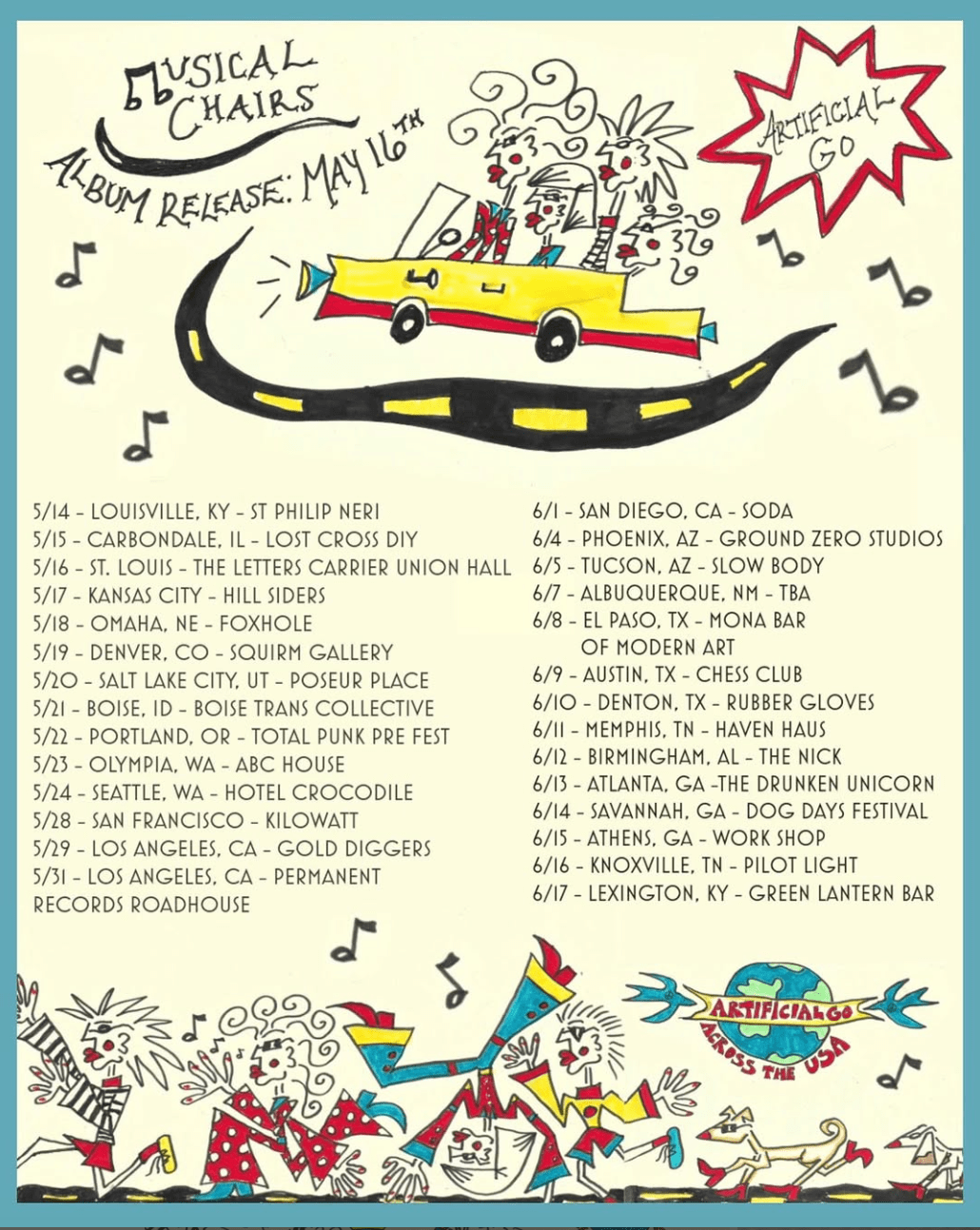
Artificial Go is currently on a five week long tour, fueling themselves with food they cook outside as they share the juices of Musical Chairs at a range of venues and DIY spots across the country. You can catch them on one of the dates above, and purchase a copy of Musical Chairs on their bandcamp.
Written by Manon Bushong / Photo courtesy of Artificial Go


 the ugly hug