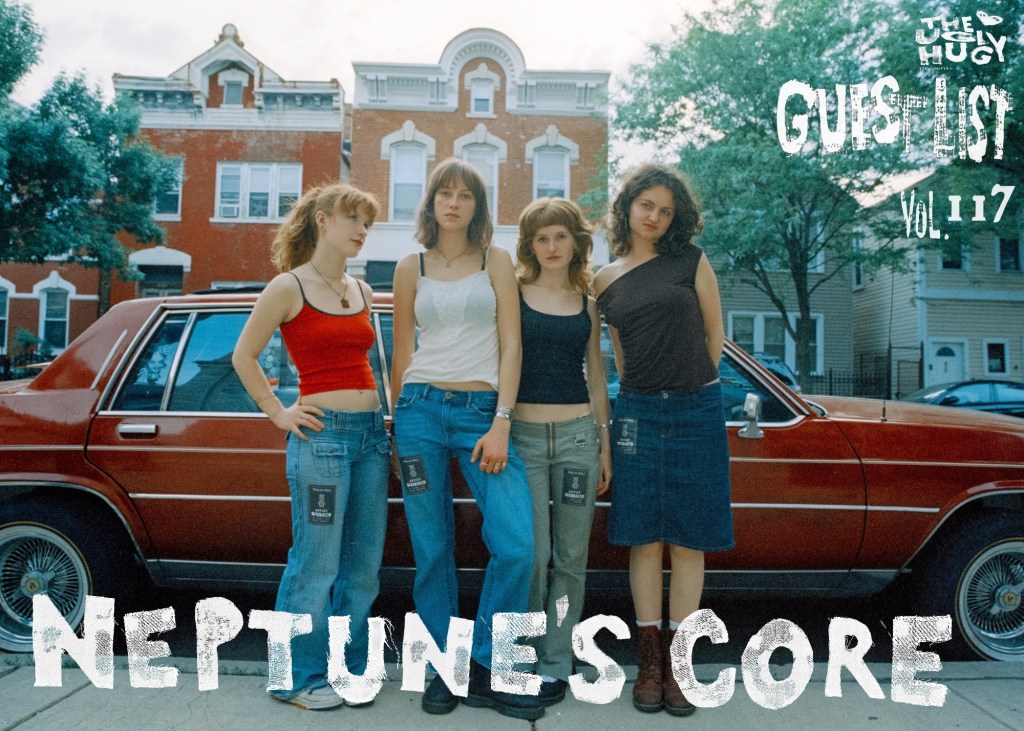
Written by Josie Guzzo | Photo by Miles Kalchick
Every week, the ugly hug shares a playlist personally curated by an artist/band that we have been enjoying. This week we have a collection of songs put together by the Chicago-based band, Neptune’s Core.
Along with this week’s playlist, Josie Guzzo got the chance to interview the band about their new album, Pivot.
Listen to their playlist HERE
About the playlist, the band shared;
This playlist is comprised of songs that we listened to throughout the creation of our newest album “Pivot” as well as just growing up. Each track holds a special place in our hearts and we hope you love them just as much as we do.
Read the full interview below.
It wasn’t long ago that I found myself in a Chicago coffeehouse discussing cooking tricks with the two girls sitting across the table from me. One of them raves about the addition of lemons to her creamy tomato sauce, describing it as “that moment when you’re sewing and you pull the thread and everything just works together.” Her enthusiasm led me to realize my own secret ingredient to combating the warm grief that August’s changes bring, one with the same lemony brightness: Pivot.
Sisters Jackie and Kaitlin Cywinski team up with Hannah and Sofie Richter to form Neptune’s Core, a band that has carved a niche in Chicago’s music scene for nearly a decade. After an eventful summer playing across the city, including opening for the return of beloved scene staple Twin Peaks, the band is releasing their debut album produced by Scott Tallarida (Friko) under Shuga Records.
Pivot is no mere feel-good “girl group” excursion. Its variety of tracks– slow, brooding, upbeat, tender–ride the knife’s edge of sugary indie pop and hardline alternative rock in a fusion genre they’ve coined lemon rock. It’s a classic coming-of-age and a mature hero’s journey rolled into one, the culmination of years of songwriting blending into a perfect story of self-reflection.
We sat down with Sofie Richter and Jackie Cywinski, the lead vocalist and lead guitarist of the band, to talk about the making of Pivot and break down each track.
Pivot opens with “Mind Blinker,” a haunting, layered siren song less mourning what might have been and more celebrating the liberation from an old, restricting mindset. In Richter’s words, “Mind Blinker” starts the record “because it’s about taking things for granted. A lot of the record is about a search for happiness.” Bare save for sparse guitar and soaring vocals, the track asks if “to find joy, feel love, and be glad” is enough to completely let go of negativity and embrace gratitude.
Its slow dirge shifts rapidly into “Lemon Car,” a wildly upbeat track nearly impossible not to sing along with. Jackie Cywinski’s bendy lead guitar is the highlight of this dreamy lament to someone who isn’t quite easy to love, but even harder to resist. Of the track, Richter said, “I feel like a lot of music is written about romantic relationships, which is so valid because that’s a matter that’s so close to the heart and so often tumultuous.” But what she wants fans of “Lemon Car” to know might be surprising: there’s nothing romantic behind it, despite what the “will you be my…?” plea may suggest.
“Lemon Car” is also the origin point for what the band calls ‘lemon rock’, a genre they’ve pioneered. Jackie Cywinski explained that while lemon rock is citrusy, with a bright, poppy element, there’s a bedrock of grit underneath it. “All of our songs are very raw and emotional. We always have some dirty
guitars, but a fun, catchy underlying melody.” Sofie Richter added that the freshness of lemon rock is where its value lies. “We’re not trying to recycle old genres or old bands. We’re really just trying to create our own sound.”
“Bent Down Loving More” is a catchy romp that rides the wave of “Lemon Car” with an earworm of a hook and a slick guitar part. On its surface, it’s the soundtrack to a late summer afternoon, with its crescendoing vocals like leaves blowing in the breeze. It’s also about the demise of a relationship that in turn allows greater individuality. Richter noted of the lyrics, “Even though you’re ending this bond with someone, now in turn you have more energy to give to your bond with yourself.” “Bent Down Loving More” also illuminates a classic Neptune’s Core tendency: almost every song must have a good bridge. Cywinski explained that Scott Tallarida, the album’s producer, “said that the album should be named A, B, A, B, and sometimes C, because we put a bridge in everything.” Richter came to the band’s defense, saying that “it doesn’t feel complete without it. You have to have a story for each song, you gotta be fair.” The bridge solidifies the track as a smooth, yet victorious reclamation of one’s own identity.
The thread of interiority and self-reflection in the mix of other relationships continues in “Cut My Garden Bare”, which speaks to an inherent ease in a fresh start rather than just “trimming the weeds” that might be holding one back. Sofie Richter wrote “Cut My Garden Bare” about the process of transitioning from high school to college– “having to uproot what you know, plant yourself in new soil, and ideally grow.” The track illuminates the freeing and excruciating nature of rebirth, one of the through lines of the album.
The capacity to make a danceable, subtly showstopping track that asks “Can I ever win with the whole world watching?” is uniquely Neptune’s Core. It’s accentuated by the range on Richter’s vocals from otherworldly whisper to throaty belt. Kaitlin Cywinski’s graceful, seemingly boundless energy on the
drums provides an unconventional heartbeat to this track originally slated to be the album title. It’s a humming, wiry confession tinged with careful optimism.
“Arc” is a large part of the album’s heart and soul; it’s a fantastic indicator not just of where Neptune’s Core has been, but where they might be going. It’s characterized by rousing, layered production with unconventional elements hidden in the soundscape. The riotous drive behind this track isn’t where you’d expect to hear synthy guitars, horns, or a clapping kickdrum beat, but they fit like puzzle pieces against Hannah Richter’s steady, rhythmic bassline.
The lyrics pack a punch, in keeping with the tone of the rest of the album– “I’ve got everything I need, nothing can keep me from loving my life and everyone around me.” Sofie Richter explained that the insistence of the bridge isn’t necessarily about a true sense of self-assurance, but more about faking it until you make it. “Whatever the character is trying to convey is that everything is fine. But then you kind of realize, why are they saying that?” Richter emphasized that though Pivot comes from a lot of true feelings, none of the songs Neptune’s Core writes are 100 percent autobiographical, hence the phrasing of ‘the character.’ She elaborated, “I am my conscious thoughts. Who you know me to be is what I’m giving you. And I think what this music comes from is more my subconscious.” Even if the emotions are dialed
up for the sake of art, “Arc” in particular showcases the band’s capacity to reinvent power pop with a grungier, richer feel.
As if the drive behind “Arc” wasn’t strong enough, “Tethered” shows some of the greatest depth and power behind Neptune’s Core. Sofie Richter’s growling, bluesy vocals are nothing short of electric, drawing inspiration from legendary performers like Ella Fitzgerald and Nina Simone. She discussed exploring her lower register on this track, saying, “I have so much respect for a female who sings lower because that’s looked at as some sort of masculine territory. Everyone wants to be a soprano. But that gave me more reason to love being an alto. No one will say it, but alto parts are the secret ingredient.”
“Tethered” and its live performance are hypnotizing, with Jackie Cywinski describing performing the song as being put in a trance. Richter regains control over the narrative of a former relationship with a track that bewitches any room it’s played in. Though the lyrics shed the skin of a past lover, they don’t just concede, but scream of an inherent weakness behind that process. Richter reflected on writing the song her sophomore year of high school, saying, “ I’m proud of it. It’s a really soulful and powerful song,
and I’m surprised that I wrote it when I was very young and not developed, you know?”
“Cavalry King”, a sweet song about a soldier and his horse separated from each other, lightens the feeling of the album but not the tone. The band’s only completely fictional story in their current catalogue is a deceptively upbeat, anthemic track. There’s a cultural capital surrounding whimsy in this present moment. This track goes deeper than that passing fancy, turning that sense of whimsy on its head– there is a true hopefulness and depth of emotion contained within its bouncing instrumentation, even if the lyrics point to loss.
“Cavalry King” is followed by “More Than Yours”, a track that slowly blooms. It’s a song about wanting the ability to define a relationship beyond the typical terms of possession, and more importantly a subversion of typical love songs. It’s a showcase of the band’s subtle lyrical defiance, with a powerful message of self-governance and individuality. Both Cywinski and Richter discussed the importance of remaining independent within the context of relationships, especially as young women. Cywinski noted,
“even when you’re in a relationship, you need to always know you’ll be okay without the other person.” Despite this confidence, there’s an underlying caution consistent with the rest of the album, as displayed in the layered lyric “cue every moment breaking down.” Though it refers to the process of breaking down your own walls in getting to know someone, it’s also about the moment of the other shoe dropping, of caution leading to the demise of the relationship.
“Wash” is characterized by low, rhythmic vocals alongside quieter, twinkly guitars that build into an intense chorus. Its vocal effects and synthy sounds reminiscent of Yeah Yeah Yeahs overlay lyrics that tell a tale of persistent rumination. “Wash” is special because of the window that it gives into Richter’s songwriting process, as well as the band’s thematic explorations. The “no longer gone” lyric in “Wash” mirrors “now I’m gone” in “Mind Blinker”– an unintentional callback that provides a resolution to a
storyline of gratitude and presence within the album, made even more serendipitous by the fact that “Wash” was written first.
“Easel”, a song about the start of what it feels like to love someone, is deceptively lo-fi at its beginning, with crooning, old-school vocals. It sits in direct conversation with “More Than Yours”, transforming the narrative from one of refusing to succumb to the power of love into “everything means something when it’s you.” In the band’s mind, these ideas can coexist without diminishing the meaning of each track. Much like its lyrical arc, “Easel” is a slow burner with an out-of-this-world conclusion. The retro sensibilities of its opening develop into a perfectly undone ending, grabbing hold of the listener’s attention with intense honesty and refusing to let go. This honesty and insistence on going beyond the surface is vital to Neptune’s Core and their music. Richter said of the process, “I think we can create beautiful songs, but what’s most important is honesty. And that doesn’t always translate into beauty in this socially acceptable way.”
This honesty shines in “Skeleton”, which finishes the album with an acoustic, melancholy feel. It’s drowsy, hollow and yet it feels like a warm hug. It’s the last few dregs of coffee at the end of a rainy day where it’s difficult to get out of bed. The Jackie Cywinski-sung track came from a struggle with long
mono, leaving her exhausted and anxious. “The lyrics almost sound like they’re not literal, like ‘turn off the lights, and you’ll be fine,’ but that was me literally saying these things to myself. My vision got all f—-d up, and I would actually have to dim the lights so that I wouldn’t dissociate.” There’s the inevitable pivot at the end of the song, and an excellent sign-off for the album in the words “turn around and find something better.” It closes the loop that “Mind Blinker” begins: the journey of feeling like an outsider in
one’s own life into finding new growth.
This emphasis on reinvention, delivered with signature two and three-part harmonies, is key to understanding where Pivot takes Neptune’s Core. Though the band looks back on their past work fondly, Cywinski made it clear: “we wanted Pivot to be a pivot for us. We want people’s first impressions of us to be this album and this vision.” With years of classical training and two archived albums under their belt, Neptune’s Core has learned through growing up with each other.
The synergy in their sisterhood has proven to be one of the band’s biggest strengths, especially as they evolve past the image of younger performers. Richter said that “I’m able to bring such vulnerability [to the band] because we’ve been so close for a long time. Hannah’s my sister, and Jackie and Kaitlin are sisters, and I’ve known them for such a long time. We’re all kind of sisters.”
But the magic of Neptune’s Core isn’t limited to their unique sisterhood, or about their success at a young age. It even goes beyond the strengths and challenges of womanhood. It’s about the strength of growing and moving forward together as a band. Cywinski said that while she’s proud to be a young woman making music “with the superpower of sisterhood,” there’s also a hidden condition. To her, it’s frustrating when the band is underestimated, or gets feedback along the lines of ‘you guys are good for a young female band.’ “We can just be good and a young female band. But it’s pushed us to work harder and brought us closer as a unit.” Richter echoed this, reaffirming that the band is all about giving it their all on stage and rebelling against people’s assumptions. Though there’s the implicit expectation of what the image of an all-girl band may be, “the stereotype pushes us to fight against it. And I think that fight is where a lot of our fire comes from.”
For Neptune’s Core, that fire is still burning. Though August brings the beginning of college semesters and changes, the release of Pivot ushers in a new era of the band surpassing and subverting expectations. Cywinski is looking forward to the vinyl release of the album with several special variants, while Richter is excited for their album release show on December 29th at Lincoln Hall– the largest venue the band has headlined yet.
There’s an impact Neptune’s Core has beyond the warmth they exude as we sit and sip tea together. To best encapsulate this impact is to watch my not-yet-teenaged younger sister’s face as I play this album to her. Though she doesn’t say much besides asking me to “play the lemon car band again,” I can see it on her face. It’s the same sort of power I felt listening to generational mainstays like Debbie Harry and Hayley Williams at the same age. To listen to Neptune’s Core is to be hypnotized by the boundlessness of what sisterhood can be. It’s triumphing through growing pains and settling into a satisfying new sense of self.
You can listen to Pivot out now as well as purchase on vinyl via Shuga Records.
 the ugly hug