Written by Lexi Howard | Photo by Cameron Garrison
M sits leaned back in his chair, dressed casually in all black. He’s got on a pair of trousers that even a JNCO wearing zoomer would admit are baggy. Deep in thought, he watches strangers walk by through the coffee shop window as late afternoon sun pours in. He looks at me and picks up where he left off. “You always know what you should be doing, what you have to do. You know in the moment; you’re not stupid. Anything else is an excuse. And still we toe the line and sometimes cross it,” he says as a matter of fact. That’s the ethos behind Purgatory, the debut EP from Boston-based project Pew Pew, a release that touches on themes around humility and guilt over six churning, beautifully dissonant post-punk tracks. Or as M put it, “the dissonance between what should have been and what is.”
Sonically, M described Purgatory as being “very tight with repetition that degrades and then disintegrates.” But through the middle stretches there’s always a nice melody. “Every song has to have one thing that I go, yes, that,” he says pointing emphatically. “If the song doesn’t have that, then there’s no point.” Take the title track, for example, which first lays a pattern with M’s vocals mixing melodically with bassist Tanya’s over 90 seconds before establishing a new, darker set of riffs and harsher vocals. Finally, a synthesis emerges as Tanya’s sweet vocals return and the two previous melodies, guitar riffs, and drum parts merge imperfectly and teeter on a razor’s edge before falling off.
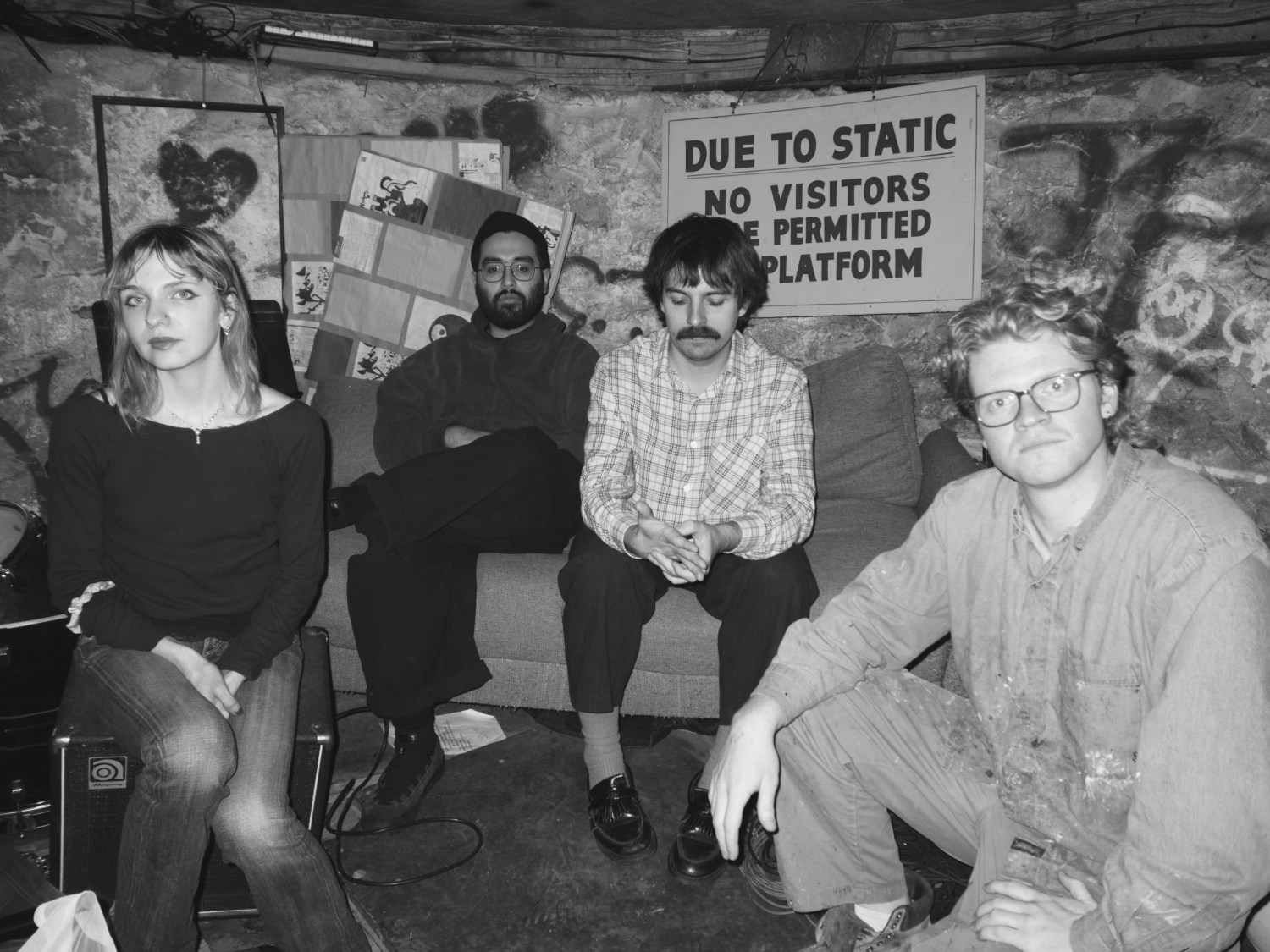
Pew Pew started over 2 years ago after an impromptu jam session when drummer Eamonn Burke showed up to a cancelled practice that was scheduled for Boston omnichord rock band Ohio State Fair, on which he also plays with M. The duo played a couple of riffs together and “that’s pretty much when the band started.”
Through community, M knew that Night Moth and Squitch bassist Kit Malmberg might be available as the latter project wound down. “I think I asked them if they like Protomartyr or something like that.” They were down. “And then I wanted another guitar player and Kit was like, I know this guy, Jon.” Jon Wallis, of Jonny Tex and Hereboy. The four-piece worked out a handful of songs together, led by M. “I write the skeletons of the songs but I am hesitant to call them mine,” said M. “A lot of the most productive stuff was when we were getting tired of each other. We were like, let’s just swap instruments. Kit would grab a guitar. And then, ‘oh, that’s what we needed’,” M said of Kit’s contribution to the outro on one of their early tracks, “Cheers”.
That summer, less than six months after forming, the group got in the studio to record. The group released a couple of tracks from those sessions — “Cheers” and “Gank” — but M felt that some of the songs weren’t quite ready to release. “It was just maybe a little early to record.” So the group sat on those songs. Then Kit moved to New York, and M connected with Ohio State Fair and Dino Gala bassist Tanya Orlova to fill the vacancy.
After almost a year of performing together, the reconfigured group got a last minute studio spot. “Little Nice Studio posted that they had a last minute cancellation and said someone can take it for cheap.” The group played a 5 band bill in Boston, then got up the next morning and drove to Rhode Island with recording engineer Nate Scaringi. “That [it was last minute] was honestly good because I probably would have kept over thinking it otherwise,” said M.
The four-piece recorded the EP in its entirety live in about 9 hours. “We just went in the room. No fancy stuff. One amp each,” said M, noting that they recorded vocals separately in their practice space and during mixing sessions. “I wanted it to sound grittier than the first stuff that we put out, which was more high fi. I think [recording it live] added to how the whole thing sounds because it’s very raw.” The EP was mixed by Ian Norris, who M was excited to work with. “Ian has written some of my favorite music of all time with his band Taurus Judge, and he has a great ear. He’s a great engineer. It felt good to have someone very excited about this style of music.”
Purgatory is made up of songs that the group came up with after Tanya joined, plus one that they re-recorded. M noted that his bandmates each bring a unique element to the songs. “Practice is where we flesh the songs out. Each of them has something that someone else came up with that made the song. Like the drum part on ‘Purgatory’. Eamonn came up with it, and it’s incredible. I love it.” said M.
M added that the group takes melodic inspiration from Tanya’s vocals. “Even the guitar parts often come from the harmonies that Tanya [came up with]. [On the song ‘Purgatory’] I think all of Jon’s guitar part and the whole ending came from Tanya singing the chords that they wanted to hear,” said M. He added, “It was stuff that we weren’t hearing ourselves, but they have the ear for that. They’re trained, they’re a musician,” he said. “We both missed Kit and we were also happy that Tanya got to take over that spot.” M also noted that Jon has come up with a guitar tone that gives the band a unique sound: “Jon has figured out this kind of odd, distorted guitar. It can be very harsh and sound off when sound checking alone, but then with the band, it works. It’s those little things like that. I couldn’t imagine coming up with a song and then not having those tools at our disposal.”
M said that his experience touring with Brooklyn-via-Boston slowcore/shoegaze band Joyer and Alexander, the project of Boston songwriter turned poet Alex Fatato, helped build connections that turned to friendships in the DIY scene across the northeast and midwest. “I met people years ago that are helping us book our debut tour now [in the Northeast] and in Detroit, Chicago, Pittsburgh. They remember me and they’re like, ‘I’ve heard you’re in this band. We should help you out.’ It was a godsend to start a project of my own after already having some experience in other people’s projects.” He added, “I mean, it’s a little corny, but it does speak to the value of this whole DIY network, this community. I wouldn’t have had that same luck [booking this tour] otherwise.”
He went on about how so many folks in the local scene have gotten Pew Pew exposure despite having little recorded music. “In terms of the local scene, getting to meet Jason [Trefts] from Illegally Blind [has been impactful]. That guy believes in us. It’s great to have him help us out, put us on his own cool shows. We got to play with [Western, MA-based] Landowner and [Philadelphia bands] Eraser and Mesh before we had music out. It felt crazy,” said M. “Ian [McGregor] who books Deep Cuts, [under the moniker] Eye Design, he’s also brought us some good bills. We opened for FACS, a Chicago band. Jon kept joking, ’This is like opening for The Foo Fighters for us’. That’s kind of how it felt.”
Maybe it is corny, but from the beginning, the story of Pew Pew is one of community. “It’s kind of shown that it ultimately just matters to meet the right people,” said M. “It doesn’t have to be the right people in an industry sense, just someone who has good taste by your own definition. That connection can align you with others who share your taste.”
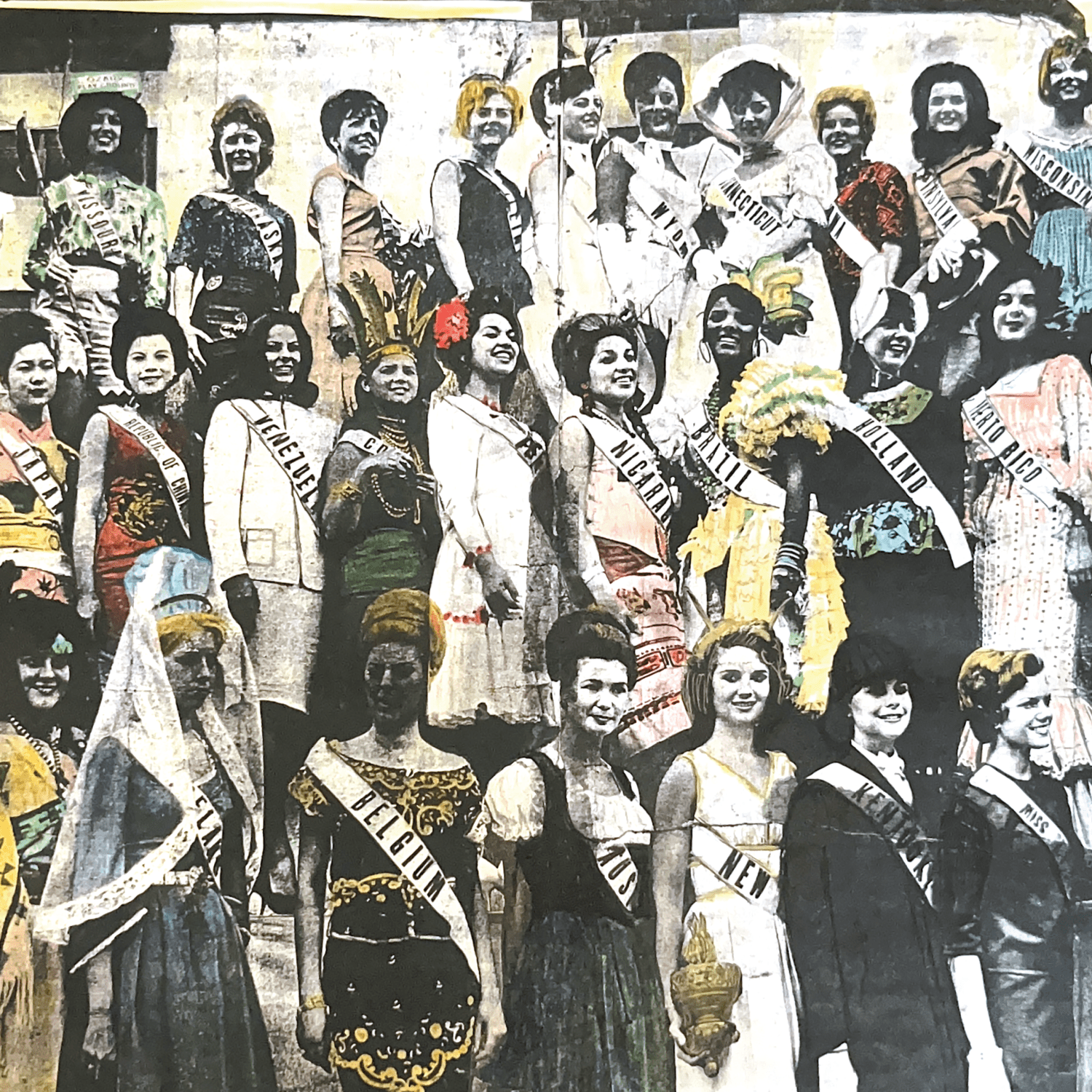
M leans back again. “I sent you the art, right?,” he asks. I pull it up on my laptop. “That’s my grandma in the middle, with the red flower. It’s a picture of the contestants of Miss International, Long Beach, California, in 1964, and my grandma participated as Miss Peru. It was a newspaper cutout or something. My grandma does this thing with all her black and white pictures, she’ll be like, ‘It didn’t look like that. Let me color it.’ And then she colored it, and it just looked perfect.” Who said purgatory couldn’t be sweet.
You can listen to Purgatory out now.