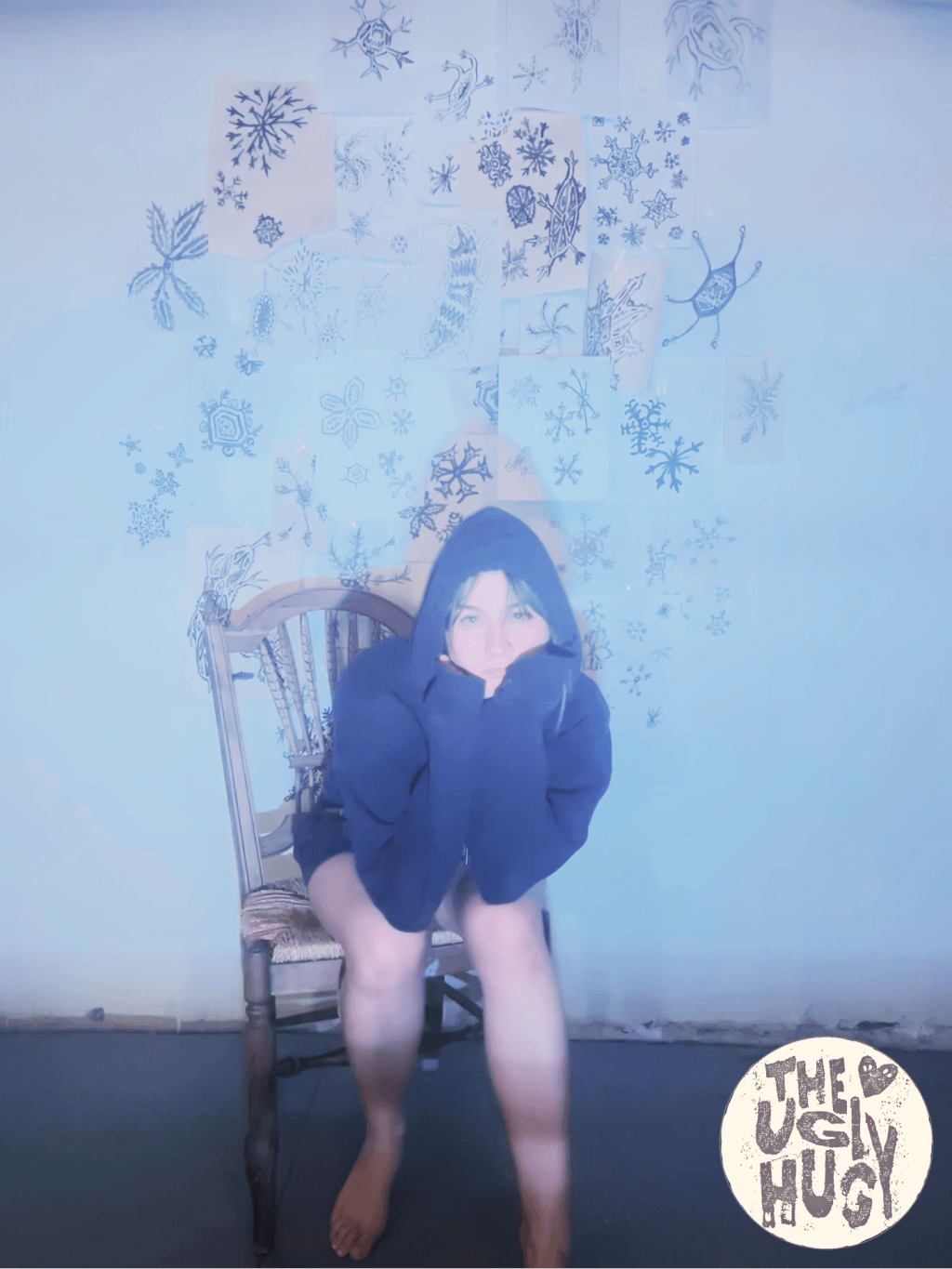
Written by Emily Moosbrugger | Photo Courtesy of Shep Treasure
“I saw the first flakes falling, I saw your t-shirt crawling,” Sabrina Nichols sings on “Cold Air,” the third song on her recent album Blanket under the moniker Shep Treasure. Like much of Nichols’ lyricism, the line depicts a moment that feels featherlight and shrouded in mystery. A detail from a memory so subtle it seems sacred, brushing past with the fleeting delicacy of the soft gust of wind that brought it into focus.
Nichols started drawing before she ever picked up an instrument. Her background in visual art is embedded in her approach to songwriting, both lyrically and sonically. When she started collaborating with other musicians, she relied on an intuitive musical vocabulary made up of textures and images to communicate the sounds she heard in her head. “I’ll say ‘oh, this should be spikier, or ‘this pattern should look like this,’ or I’ll pull up specific images of things I’ve seen,” Nichols said. Since her debut, 500 Dead Or Alive, her recording process has become increasingly independent as a result of a push from her collaborator and partner James Keegan, who makes music under the moniker Kitchen. In the process of recording Blanket with Keegan, she learned to mix and record on her own, making for a smoother process of translating those mental images into sounds.
A “spiky” sound, Nichols explained, is what she had in mind for the lead solo keyboard part in “Fired and Expelled,” describing the prickly exterior of a horse chestnut seed. The notes pierce through a thick veil of distortion like blades of grass through snow, setting the icy backdrop for Nichols’ callous delivery: “Watch me growing old/ I just wanna be gold/ and when I’m not/ I want to leave the world.” The atmosphere is dense, forming a dizzying fog around an apathetic narrator whose impassivity cracks just enough at the chorus to reveal a restless unease: “I’m in hell/ I want to be fired and expelled.”
Creating atmosphere is one of the things Nichols does best – there’s not a song on Blanket in which you can’t feel the harshness of the climate, or the movement of the air around you. “I love extreme temperatures,” Nichols said, noting that temperature and wind help her visualize specific moments with precision, and elicit the feeling of the memory in her music. One of the ways Nichols does this is by building space. The guitar melody that opens “Dove” loops with a dull sense of foreboding, the air around it echoing a deep, wintry emptiness. On “Tornado,” Nichols lets her thoughts “all blow away.” Her voice drifts delicately with the gentle strum of her guitar before it’s left behind, swept out into an open, quietly trembling expanse.
The serene, contemplative stillness in these parts of Blanket is mirrored by Nichols’ process of writing it. “For this album, I kind of got stuck on playing one note and looping that one note and listening to the subtle wave changes,” Nichols said. “It became pretty meditative, because I normally record everything in my basement of this apartment, and if I went down there and started looping one note, the rest of the day would be gone, and I could just be there. It made a new atmosphere kind of instantly.”
There are times on the album when the narrator and setting become so closely entwined that their separation becomes blurred. In “Omnipotent,” Nichols takes a celestial form above the clouds, singing from a bed of “concrete pillows” at the gates of heaven: “In the sky soft light falls down into my throat/ filling me up so that all I do is shine and glow.” Nichols explained that the album’s title is symbolic of the way she felt at the time of writing it: “It kind of felt like there was a blanket over my mind and I couldn’t see my thoughts,” she said. The otherworldliness of “Omnipotent” sets it apart from the rest of the album, but there’s an eeriness in the narrator’s unnatural surroundings and cold detachment that replicates this feeling – like she is caught in a fog, stuck somewhere just out of reach.
Nichols said she also associates the album’s title with temperatures, and that it can be a reference to a fresh layer of snow, or the warmth from under a literal blanket. That warmth can be felt on the album’s enchanting closer, in which Nichols’ sweet, whispery harmonies drift with her into sleep: “Close my eyes/ Gonna sleep another night/ I have secrets in my sight.” There’s a sudden sense of trust that seeps into Nichols’ delivery as she repeats the closing line with a comforting certainty: “If I have it, then it’s mine.”
In her writing of Blanket, Nichols relied on a similar hopefulness as a way to embrace positivity, channeling a recent intuition she had that everything would turn out all right. “Whatever positivity there is, I really had to lean into it,” Nichols said. “A lot of times I’ll get into this emotional despair and the only thing I can do is write a song about it to feel better. But now that’s been happening for so many years that I know whatever it is I’m going to get through it. So, I tried to focus on that, like ‘this is going to be fine, I’m just going to get through this and try to put some of that in here.”
You can listen to Blanket out now as well as order it on cassette and CD.

 the ugly hug
One response to “Shep Treasure Creates Climate to Evoke Memories on Blanket | Interview”
[…] writer and creative, who consistently shares well written and earnest interviews with artists like Shep Treasure, runo plum, 0 Stars and h. […]
LikeLike