Written by Shea Roney

“It was the morning after I had done a release show for the first record I ever did called Black Hole. I remember all my friends were just so supportive about it. But, I was basically living in a closet and I was pretty much on my way out of Brooklyn to go and study music therapy, so I just needed a change for a lot of reasons. But it was hard to leave”. Goldberg continues, “I had a dream that I was with some of those friends at this cabin in the snow. As I set off away from those friends at the cabin, a bear appeared in front of me. We had a standoff. The bear whacked me with its paw, and I was dying in the snow, but I remember thinking to myself, ‘I don’t regret this’”.
The Spookfish, the project of Maine-based musician Dan Goldberg, recently released his latest project, Bear in the Snow, off of We Be Friends Records. As a songwriter, Goldberg is a collage artist of sorts, encountering sparse folk music and lo-fi electronic fixings in a layered and textured sonic world. As a project, Bear in the Snow finds Goldberg in an extension of his natural self; the part of him that no longer has a place on this earth, but with full acknowledgement to his physical journey in the natural world. The album is also accompanied by its own video game created by Goldberg that follows that path of self discovery. Calling from his home in Maine, Goldberg opened up about his recovery process after a tragedy that led to this alluring and earnest project.
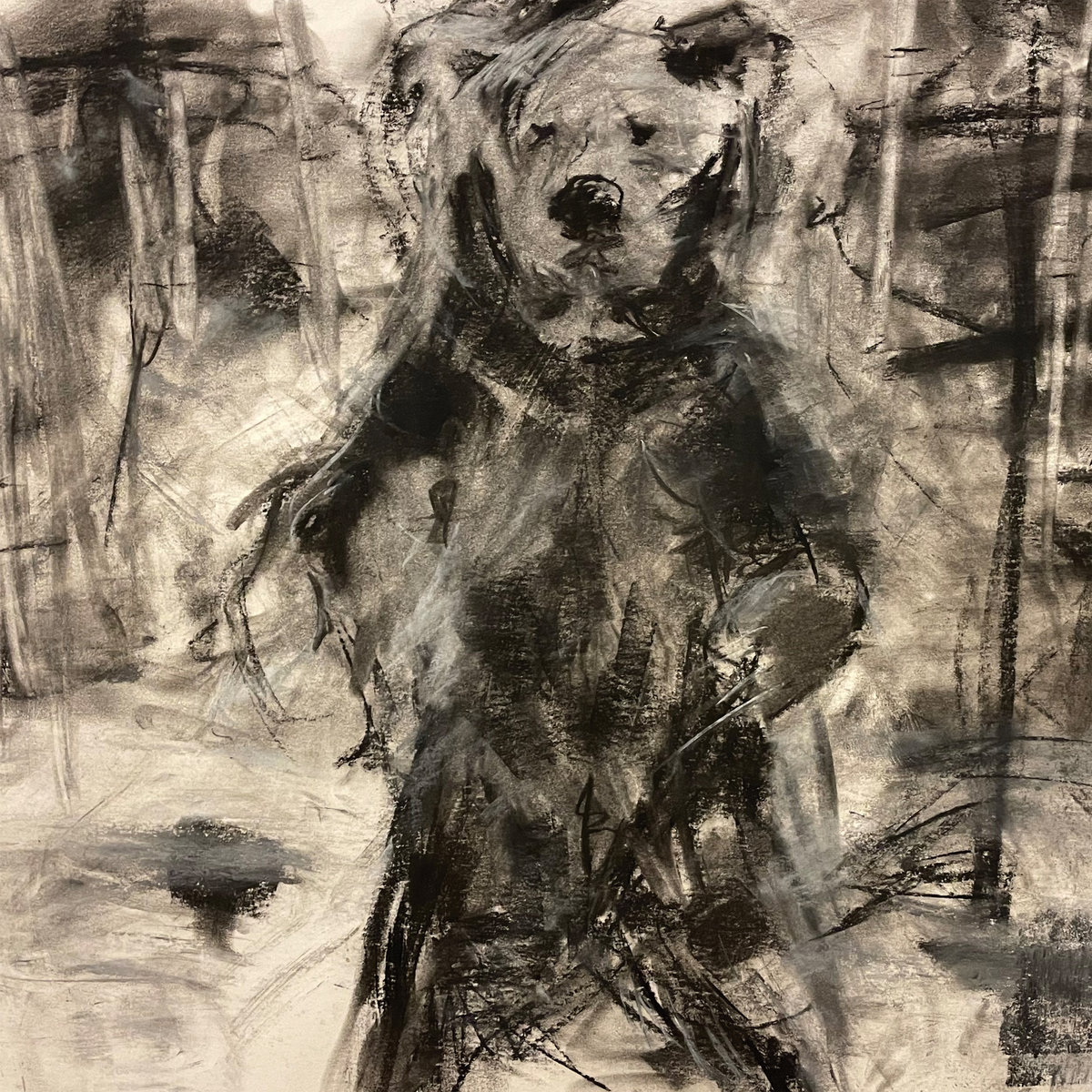
To fully grasp the personal aptitude and eternal understanding that went into the writing and producing of Bear in the Snow, it is crucial to know about Dan Goldberg’s last few years. With life turning events facing a family tragedy, on top of a heartbreak and moving to a new state, Goldberg was pushed into the externality of our human fragility. Referring to a lyric he wrote for the track “Misanthropy”, Goldberg kept coming back to the phrase, “the world’s not going to miss us when we’re gone”. In a bleak state, Goldberg explains his “frustration at the way that western values and capitalism can get in the way of human life,” while he adds, “if it killed us, the animals would not miss us. They won’t be like, ‘oh, I wish they did more economic development in their time,’” he laughs, but it is clear there is some weight behind it.
Having studied and practiced to be a music therapist, Goldberg made an effort to find effective ways of recovery through his own creative outlets. In textures, Bear in the Snow is a deeply expansive listen, embodying layers of familiarity and subtle sonic tensions. “I would go to this cabin and it would be these moments where I wasn’t gonna get an emergency call for an hour. I was just completely hidden in these scary woods,” he says. “I would really enjoy making sounds that soothe my brain and then playing them back,” Goldberg shares. Breaking away from structural soundness, “I think I was able to find a little bit of freedom to move the music away from my normal patterns”.
Beyond the primitive and experimental instrumentation that Goldberg creates, Bear in the Snow serves as a kind of natural field recording, following the sounds that make up his world. “Coyotes”, as simple as it sounds, is a recording of a pack of coyotes as they howl and laugh to the open sky. To some, this is an external noise that doesn’t grasp at any deeper meaning, but to Goldberg, this inclusion stands as an expansion of personal sense and growth. “As a small child I was horrified by everything. I was horrified by the woods, and I felt like everything was haunted. I’m sure that’s just being a vulnerable little being that could easily be eaten by anything,” Goldberg laughs, but with slight sincerity to his younger self. The inclusion of “Coyotes” was a thoughtful addition into an already deeply personal record. “I guess I wanted to revisit that childhood feeling” of vulnerability to the world. “That particular recording, I was walking back from a hike, and it had gotten dark. I was just immersed in that feeling and I recorded it as a journal entry”.
Recalling the time he went on a solo hike on Devil’s Path, one of New York’s most difficult trails to hike in the Catskills, Goldberg brings up a fractured process where he admits, “I would try to exhaust myself into feeling better”. As the sun set on the treacherous trail, Goldberg found himself lost and with no cell service. As the old tale goes though, follow running water and you will find a way out (which Goldberg says that this is an irresponsible action and that it is safer to stay put). Soon coming upon water supply land and flag markers, Goldberg ended up on a highway, where he came face to face with a mama bear and her cubs. “She scowled in my face before shooing her cubs in the woods and leaving,” Goldberg says. Eerily similar to the dream he explained earlier, Goldberg admits, “I feel like that was when I was like, ‘Okay, I need to focus’”.
The video game, a visual extension to the album in which Goldberg also titled “Bear in the Snow”, is a personally rooted piece of art representing Goldberg’s understanding of his path to recovery. “Well, I was working at a soap factory while I was in school. I was just drinking coffee, putting soap into boxes, and the idea just popped in my head,” he says in suit of mindless busy work. Goldberg describes the game’s concept, in which “you’re this little ghost character. I came to see that as my own ghost,” referring back to the dream, “because the bear killed my sense of self”. Enriched with these beautiful and introspective beings, the game is a haunting exposé of Goldberg’s eternal conflicts. As he continues, “my ghost is floating around, and each of those places in the game and each of those song titles is a place where some really significant things happened”.
These significant places are highlighted with a storybook instruction manual that refers to Goldberg’s travels. Put together by his partner, Saffronia Downing, the manual explains specific paths, locations, creatures, and myths that expanded Goldberg’s perception of self. As the ghostly character, you encounter this cathartic journey, redefining your own place in the world.

As a world traveler, Goldberg has been on the move for years. But he finds himself comfortable with where he is at now. “I think that I feel like I’m set,” he tells me with confidence. Having graduated and spent years in practice as a musical therapist, he has found a love for helping others in their own recovery process. “I’m really interested in combining outdoor therapy with music therapy. I would like to have a place that I could build relationships with the people that I work with,” he says.
When living in Brooklyn, Goldberg would host events that he called the ‘Mountain Shows’. Taking a group of musician friends as well as a group of listeners up Mount Taurus, the mountain became a sanctuary of redefining personal roots, not only in the natural world, but internally as well. “I think a big reason for the mountain shows was to give people different ways of looking at being in the woods, especially in New York City where a lot of people hate hiking,” he says. Goldberg developed a remarkable way in which people can experience both kinds of therapies. “I would say that the interesting thing about both fields is that they let people have moments of not speaking”. He insists, “I don’t necessarily or rationally believe in ghosts, but, some part of me feels the ghosts. Some part of us is feeling things that we aren’t thinking”. In the search for understanding, those inner ghosts can come out when least expected when given a moment to breathe and “it can share really valuable information about [people’s] lives,” Goldberg finishes.
Returning to his dream, as Goldberg laid dying in the snow, the bear stood defiant and remorseless in its actions. A nightmare of sorts, but in the end, the bear is the least important facet of this dream. A narrative, told through the simplicity of closing his eyes and the complications of REM sleep, broke down an impossibly difficult decision into a clear answer. Goldberg recalls a moment where, “it felt worth it to try and do what I needed to do, even if I got killed by a bear within five minutes”. Bear in the Snow stands as a complementary parallel to the valuable information given by the ghosts that find home in our physical bodies, as Goldberg tells me he decided right then and there, “I’m gonna do this change, even if it fails”.
“Bear in the Snow” Video Game: https://the-spookfish.itch.io/
You can support The Spookfish here: bandcamp
 the ugly hug