Written by Shea Roney
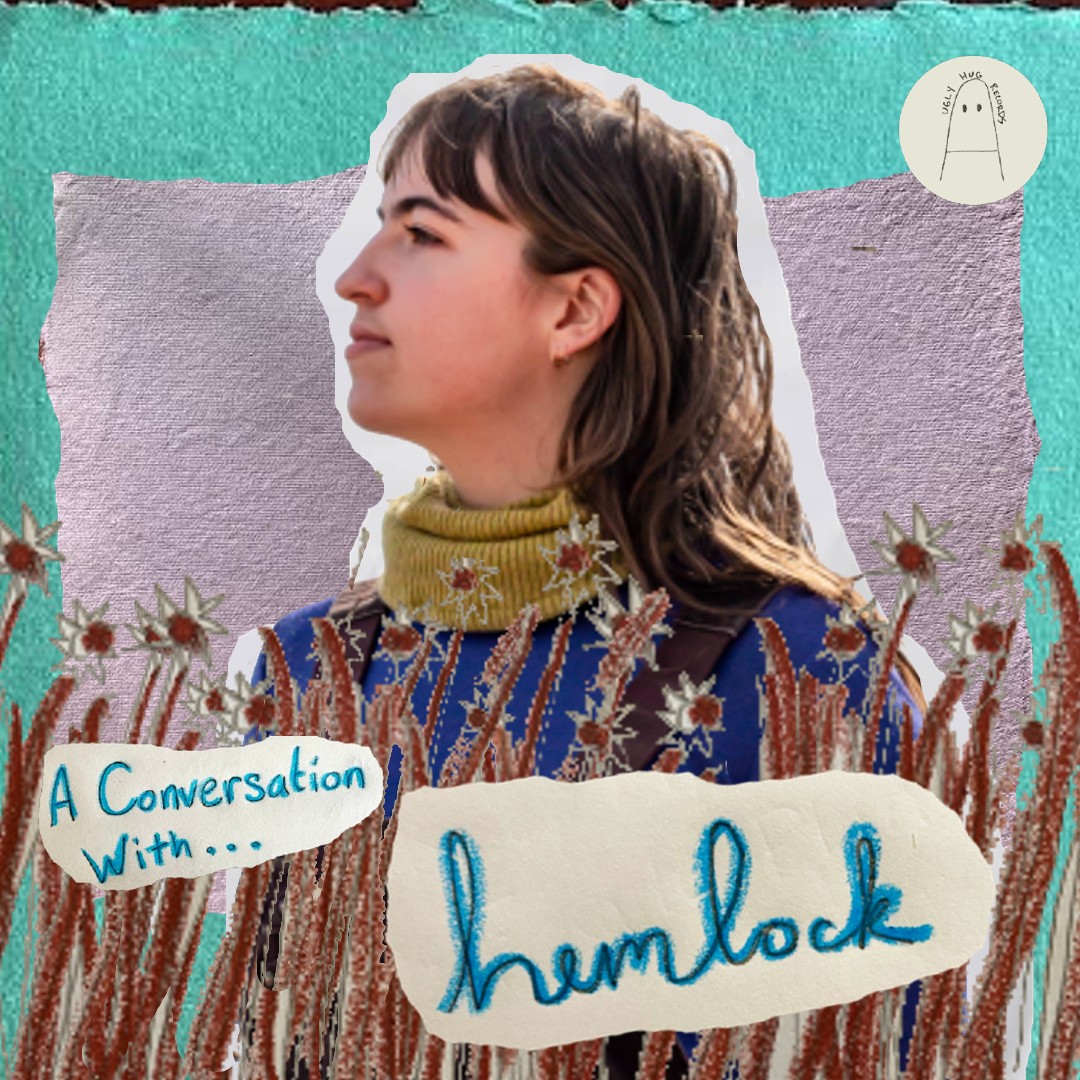
I met Carolina Chauffe after one of their shows at Chicago’s Sleeping Village. Since then we have kept in touch to put together this interview.
When Carolina and I began our Zoom call, I noticed a painting of a Baltimore Oriole centered on the wall right behind them. As a bird enthusiast, I had to give it a nod of fascination. “Thank you! Yeah, my grandmother painted it” they told me. “I took the painting when she passed, and I’m not an avid birder, so until a friend pointed it out to me I actually thought it was a robin haha!”.
Carolina Chauffe, known as their project hemlock, has become an important facet of not just the Chicago music scene, but a friendly contributor beyond. Being from Lafayette, Louisiana, Chauffe grew up in a pretty condensed scene. Looking to move out of their hometown, the first opportunity that presented itself was an internship at a record label in Seattle. But as the pandemic exhausted that plan, they spent some formative time in Astoria, Oregon before eventually moving to Chicago. “Since then I just kind of heed the signs when a friend, or someone that I care about offers me housing, I just kind of run with it if it feels right” Chauffe explains. “I’m trying not to be in the business of saying no to gifts that are offered.”
| I know you grew up in church and chamber choirs. But when did you first start writing songs? So my dad is a couponer and he got this coupon for guitar lessons at a local Baptist church for one month of free guitar lessons. So he bought a cheap Walmart guitar for me that was pretty much impossible to play, and I went, and I did this month of free guitar lessons. I learned to play a Taylor Swift song I think. And then the coupon ran out, and so we stopped doing the lessons. But even before that, there have always been little diddys that would come to me. I mean, I can remember writing songs about my crushes in middle school and high school. But the first song that I ever performed in full for an audience was at a high school music showcase and I remember some of the lyrics were, ‘I’ve been holding my breath over bridges that I should have burned so long ago.’ It was really teenage angsty, about some fresh heartbreak, and I remember my parents were concerned after which, also, is still a through line, like my parents are always asking, “are you okay? We listen to your music haha”. |
With this opportunist mentality, Chauffe has been making lasting connections with people all over the country. As an artist, this is imperative to their work. As someone who claims to be a very solitary song writer, Chauffe pushes themselves into collaboration as a set goal. “Collaboration with different people always opens up these new windows, sonically and emotionally, of what each body of work can be” says Chauffe. It’s not that collaboration is unwanted, it’s more complicated than that. Art is personal and exposed and to place it in the hands of someone else can be uncomfortable. “If I’m being totally honest, I still like to yield a lot of control over the recording process”, Chauffe expresses, but “opening my heart to that deep trust that comes with letting someone into the very vulnerable world that [I’ve] built”, has worked to push personal boundaries.
hemlock’s career has been something different than the commonplace musician. With a catalog consisting mostly of demo-records, Chauffe has been adamant on redefining the idea of what a “finished” song is. Embarking on ambitious ‘song-a-day’ projects, Chauffe has worked sonically and socially to rewrite the limits of what a song can be. “I’ve just allowed myself to break more and more of the “rules”. Or the more time goes by, the less strict I am with myself. because I believe that music is play”, they say. With five ‘song-a-day’ albums representing entire months of time, the songs are purely explorative. They can represent short thoughts (even if not complete), a piece of characterful instrumentation, or field recordings of the world around them. Almost like postcards, these projects represent where they were, who they were with, and what they were going through in the generalist terms.
In a way, a song is never finished. “There’s a short term finish where it feels good in the moment to walk away from,” says Chauffe. “But then, long term speaking, I don’t know that a song is ever finished, cause I just think it’s malleable. It’ll keep shifting”. It’s something that is representative of the moment and the memory of the time it was written. But, over time it can grow and model with you. Even with hemlock’s established songs and professional recordings, Chauffe told me, “none of them are ever finished, because I believe that songs lead their lives, and they keep evolving. If you keep breathing life into them, if you keep playing them, they’re allowed to be whatever form they’ll take in that moment”.
| You are headed off to New York tomorrow to do some recording. What do you have in mind going into the process? I don’t really write a body of work with the idea of it being an album already. I kind of just write as they come, and then if they fit together, then cool. I’m going into it just with a body of work that I want to be captured. And then I trust Ryan [Albert] (of Babehoven) to be able to dream up something that feels really good for us to do together. But we’ll shape it together. I don’t really play my own music around the house very often. I’m bad at practicing which is something that I’m okay with being bad at now. But when I record it it gives me the sort of opportunity to get to know what my songs are a little bit better, and to expand what they can be. |
hemlock released their first full-band LP titled, talk soon, in 2022. Written all over the country from 2018 to 2020, the thoughts behind talk soon traveled with Chauffe over those years. With soft exposés of folk tunes, the album is an intimate conversation of change, heartbreak and acceptance that Chauffe trusts in us to share with. When listening to this album, what stands out are the handful of voicemail recordings that Chauffe uses almost as narrators. Hearing the love and support from their pawpaw, a song sung by their mother or just friends calling to check in is, in sorts, representative of people we have in our own lives. Having never met any of these characters before, I still found my heart twisting with what they had to say. It’s this natural drive for intimacy and connection that draws on these voicemails and clings to what it needs to. “In some ways [the voicemails] are the string that ties everything together. Those songs were written in so many different years and so many different places that it helps to track this nonlinear web of memory”.
As humans go, though, I think we take memory for granted until it starts to slip. Memory is more than just remembering our postal code, what we had for breakfast or directions to the nearest convenience store and to buy the toothpaste we need once we get there. It’s also names, faces, laughs, morals, friends, moments of sadness and love and the ability to feel those moments again. What it comes down to, memory is a preservation of our own beings.
Memory, or more this preservation of memory, is not only important to what Chauffe is creating, but it has become something more personal. Memory is instinctive to human nature, but when it becomes fleeting, it easily becomes disposable. That’s fucking scary. As I watch my own grandmother currently lose herself in a world that doesn’t make sense to us, I have had time to watch what slipping memory has the dynamism to do. Finding solace in each other as we talked about our own personal grievances, Carolina opened up about their family history. “My whole family, we are prone to forgetfulness,” Carolina shares with me. “My granny on my dad’s side is a documentarian. She was the first person I saw who constantly had a camera taking family photos” they said with an enthusiasm in engaging with moments. “And then on my mom’s side is where this loss of memory is very prominent”. As they deliberate on what to say next, Carolina’s head couldn’t help but to turn back to that simple, yet incalculably beautiful painting of the Baltimore Oriole centered on the wall.

Song writing to Chauffe is very archival. To them it is “very much with the ethos of trying to capture a moment, capture a memory without smothering it, and being able to let it glow in a way that feels true”. Subconsciously, music, and art in general is a representation of our memories. The time it’s made, the personal state at which it is made, and who may have had a hand in it, all stick with that piece. The meaning can become malleable as time goes on, but the initial identity of the piece stays forever. Chauffe though, makes it a point to acknowledge the full story of their process and continuance. It can be seen in the endless collaborations with the people that they trust and love. It can be seen in the voicemails they furnish talk soon with. It can be seen in the ‘song-a-day’ projects that take the pressure off of honestly capturing a moment in time. It can be seen in the “unfinished” songs that shift and meld into the performative moments they are meant to be. It can even be seen in the simple act of hanging and preserving a painting of a Baltimore Oriole on the wall in the center of their living room. “And yeah, I’m terrified of forgetting and its inevitability” Chauffe confides in me, “but I want to be clear that it’s not that I’m fighting against the forgetting, but coping with it. That’s often what songwriting is for me”.
You can support hemlock HERE: bandcamp
 the ugly hug
One response to “A Conversation With hemlock”
[…] Related: “A Conversation with hemlock” […]
LikeLike