It’s been a handful of years since Australia’s Olivia’s World shared new tuneage with us. But since their 2019 self-titled and 2021 Tuff 2B Tender EPs, Olivia’s World has functioned as a collaborative rotation of indie-pop charmers, recently landing on a lasting and invigorating lineup of musicians. Now with two singles out, the group is gearing up for their debut LP Greedy and gorgeous out next Friday, March 14th, and with that, Olivia’s World is offering just one more taste test with their new single “Healthy & wealthy” premiering here today on the ugly hug.
“Healthy & wealthy” is a tender rock ripper, balancing docile tones of distorted guitars with vibrant, sweet melodies as Olivia’s World revels through expectations of our most dubious inner and outer displays. “Are you TV ready?” guitarist and vocalist Alice Rezende asks with repeated eagerness, hopping into the momentum laid out by the band on the song’s chorus – the anticipation like the countdown before we run this show live. But as the crew plays out with their collaborative strengths and the melodies become embedded in our noggins, we watch as that camera light turns on, and Rezende makes you ask yourself…who is even watching?
Greedy and grogeous is set to release on March 14th. You can preorder the album now as well as vinyl copies from Little Lunch Records and cassette tapes from Lost Sound Tapes.
Every Wednesday, the ugly hug shares a playlist personally curated by an artist/band that we have been enjoying. This week we have a collection of songs put together by the electronically collaborative duo amigos imaginarios.
Arbol Ruiz (Paris via Columbia) and Caleb Chase (Worcester, MA) have been partners in crime since 2021, with two albums made electronically by sending files back and forth. Their most recent release, their TV-14 Recordings debut called Ice Cream, is a rather engaging and eccentric collection and the first composed in person since the duo’s initial launch. An amigos imaginarios listen is not one made for multi-tasking, as their delipidated ecosystem of trinkety hooks and experimental charisma offer a rewarding experience when you embark into their beautifully bizarreo world that they so graciously have invited us into.
About their playlist, Ruiz and Chase shared;
Our Playlist is Lunatics: Moon Pretty moon that goes around the whole world Tell my love that I still love her Tell her that I still have her photo smiling Streets full of people All alone Roads full of houses Never home Church full of singing Out of tune Everyone’s gone to the moon
Listen to amigos imaginarios playlist here;
Listen to an incomplete version of the LUNATICS playlist here.
You can listen to Ice Cream out everywhere now as well as purchase a cassette tape via TV-14 Recordings.
Written by Shea Roney | Featured Photo Courtesy of the amigos imaginarios
Quietly released on bandcamp in 2023, Philly-based songwriter Hughes Bonilla shared maybe you’ll find me under their project moniker theydevil. Full of vibrant synths and lush green patches of electronic tinkerings, Bonilla created a space in which they can explore with sincerity and confusion, however unequal those two parts may be. These songs feel giddy, easing through the charming hooks that they crafted with both intention and caution, but as a whole, the album’s beauty is indebted to lonely nights, witty interrogations, longing vocations and the ability to recognize how far they have come since then.
Beginning to work on these songs at 19 after moving to Philly, Bonilla’s writing was as reactionary as was vividly aware, compiling life’s influence into one very earnest yet complicated world. Experiencing the gut jab that is being in your early twenties, navigating rogue relationships and shifting identities, these songs became intertwined within a sense of self. Emphasizing presence and perspective, Bonilla’s songs are just as lasting as the bits of yourself you look gracefully back on with a laugh and a sigh.
Now almost two years later, theydevil is reissuing maybe you’ll find me with the help of UK favorites Devil Town Tapes as an exclusive run of tapes. We recently got to sit down with Bonilla to discuss the new life brought into these songs, learning to accept grace and reflecting on maybe you’ll find me with new light.
Self Portrait by Hughes Bonilla
This interview has been edited for length and clarity.
Shea Roney: So tell me about how this reissue with Devil Town Tapes came to be?
Hughes Bonilla: Jack and I had been following each other for a hot minute, and I had been secretly manifesting something would happen. Then he reached out to me about doing the reissue back in November and he was just like, ‘I personally want this on tape. So, it would be really cool if we just did like a whole thing so that I could have this on tape’ [laughs]. And I’m like, fuck yeah, dude, let’s do like a small run of tapes. And he had the idea of having a bonus track that’s tape exclusive, which initially made me really, really nervous because I feel like there’s a reason why songs didn’t make it on the record, which is that I did not like them. But I sent him like 2 songs to choose from and we both agreed that the bonus track should be “Bruja”. He was really stoked about it and I’m really excited that it’s happening.
SR: Almost two years out now from its initial release, how does it feel to have these songs on maybe you’ll find me see new life? Especially with one that hasn’t seen the light of day yet either.
HB: It’s really exciting mainly because I didn’t expect anything to come of this record. When I put it out, I put it out very hastily. It was something that I had been trying to put together for a long time, and there was drama with my old laptop, like I lost half of the record because my old laptop died, and I just was not expecting anyone to listen to it or pay attention to it. It was something that I put out because I had spent years obsessing over it, and I think in order just for me to move on personally and be able to create other things, I just needed to have this out in the world so that I don’t have to think about it anymore. And now having it on a physical release feels really special. It kind of feels like all of the obsessing that I did was worth it. And it feels cool that it can kind of have a reach that it didn’t have before.
SR: Did losing those recordings change the outcome of the album from how you initially envisioned the project?
HB: It definitely did. There were only a few songs that I managed to salvage, ‘oh, honey’ and ‘the good part’. I basically started from scratch after that and the entire theme of it changed. This was also like pre-Covid, and then when I lost the songs, it was like in the thick of Covid. I had one hell of a time getting a new laptop and my life had changed drastically, too, because of Covid, so the whole record really changed and became something else entirely. Which I think was kind of a blessing in disguise. I think if I had released the other songs that I had been working on, I don’t think I would have been as happy with it. I think that it forced me to make music more intentionally.
SR: Is that where the obsessing came from? Making music with more intention?
HB: Yeah. I was frustrated because I felt like I had a timeline before, and that I was excited about, and then that was completely blown out the window. I had to come up with a new timeline. It was very much this obsessive thing of like, I need to recreate this and get this all together. And there are several songs on the record that came from other songs I had to rewrite and re-record, and there were certain vocal parts that I had lyrics for and really wanted to use, but I wanted to use them in a new way. But I felt like if I didn’t do it then I was just never going to do it. I put a lot of pressure on myself.
SR: In hindsight, do you think you would do it differently now? Would you allow yourself more grace to work with?
HB: Yeah, I’m actually working on stuff now. I kind of took a break from making music for a bit, because I think I did apply too much pressure. And now I’m allowing myself to take more time with it and not really put a timeline on it because I feel like when you apply so much pressure to yourself, at least for me, I started to hate the things that I was creating because I needed it to be perfect, or as close to perfect that I could have it. And then sometimes it was like, well, I can’t make this perfect, but I need to push this out by this date. And so maybe this recording isn’t exactly the way that I want it to be, but it’s out. This time I’m just taking it slow, taking my time and making sure that things are the way that I want them to be, but also kind of trying to keep in mind that I don’t have to sound like I’m recording in a studio, because I’m not. I’m literally recording songs in my bed so it can sound that way. It’s fine.
SR: Is this a sound that you have learned to embrace the more you write and record?
HB: I think so. I hear from other musicians, or something that I feel has become really popularized is trying to make something sound like it came out of a studio when it wasn’t recorded in a studio, so I feel like a lot of things are kind of overproduced in a way. I think that there is a lot of magic in having something not sound totally perfect and polished, which is hard for me because I taught myself how to record music, but I don’t actually know what I’m doing. It would be really nice if I knew how to fucking use auto-tune, but I don’t know how to use auto-tune and at this point I feel like it’s too late [laughs]. That was something that I was really caught up on for a long time. My vocals don’t sound really polished, and I think that that’s a huge part of my music. Maybe I’m hearing things that other people aren’t necessarily hearing, where my pitch here is not exactly great, but I also spent so many hours recording these vocals, so it’s fine. I’m trying to get over that.
SR: I think that goes hand in hand with the throughline of this record, a document of just where you were at that time in your life and creating this little environment that was so specific to you. I liked how you brought up the shift from pre and post pandemic, because this album was described as a very coming of age piece of work. What elements of these songs were intertwined with that time in your life?
HB: Around the time that I started writing I was 19 and had just moved to Philadelphia, and I was kind of trying to build my world, I guess. I dipped my toes in the dating pool here. I don’t know if you’ve heard about dating in Philly, but it’s not good. I think we were ranked like the number 2 worst city to date in America. I think Chicago was 3rd [laughs].
SR: Makes sense.
HB: But I was a very uncertain person. Uncertain about my identity and where I really fell in the world. I was also navigating my gender identity, all of these things, so that’s something that comes up a lot in the record, just navigating different relationships and my relationship with myself. I feel like there are like two uplifting songs on that record. It’s “skins” and “swimming song”, and “skins” was really about me trying to come to terms with just being the person that I am and not really worrying about pleasing other people, the ideas that other people may have had of me, or expectations that I may have had of myself. It was a really lonely time transitioning to Philly and that’s kind of what a lot of the record is about.
SR: Did tasking yourself with writing these songs help you define these relationships at all? Or was it more of a chance to kind of map them out more with a new perspective?
HB: Yeah, definitely. I think writing these songs just helped me map things out and just kind of better understand where these emotions were coming from. I don’t think the music is what gave me a better understanding of myself. I think it gave me an outlet for all of the processes that I was going through at the time. It also gave me a really safe place to put feelings of anger and devastation. I feel like music is my healthiest coping mechanism, so that’s kind of what I view this album as, it’s a coping mechanism for the times.
SR: I do want to ask you about the ‘sweetness’ factor that you once described your sound as, building out this duality of heavy topics and light sounds.
HB: I think a lot of it was accidental, honestly. I never go into writing a song with the intention of sounding like something. Music is very much a place for me to just explore, and I think that’s what it really was. It was kind of an exploration of sound and going into it with a sense of almost childlike wonder. I feel like I do tend to choose softer synths and try to make a sweeter atmosphere with sound because that’s just what feels good to me and sounds good to me. Even though I’m gonna go into writing a song, I know I’m gonna write something pretty emotional, and the sounds that I choose almost feel like a safety net. I do kind of write about pretty heavy things, and so to kind of have more whimsical sounding instrumentation, it’s a good way to ease in.
SR: How do these songs sit with you now? As you have changed and are more comfortable with your writing and who you are as a person, looking back at these songs, what do you feel?
HB: I think it’s bittersweet in some ways. I feel a little bit embarrassed about the songs, which is funny because one of the songs is called “get embarrassed”. But it’s solely because I wrote these songs when I was like 19 through 22. So obviously, it just feels very embarrassing from a 25-year-old perspective now, which doesn’t seem like a lot of time, but it definitely is so much time. And I do feel like a completely different person and a different writer, so sometimes I’ll look back on the lyrics and be like, ‘yeah. This was definitely written by a 20-year-old’. Very dramatic. But at the same time, I do feel very proud of the work that I put in, and I also just feel like it’s a really awesome way to honor the space that I was in before. There are songs on that record that I do feel like are bangers, whether other people agree or not, which is really cool to feel coming out of it years later. There are definitely songs that I’ve made in the past where I’m just like, I can’t believe that I put this on the Internet, and they’re not on the Internet anymore for that reason. But everything is still on the Internet, which is a great sign!
You can purchase a limited-edition cassette tape of maybe you’ll find me by theydevil via their bandcamp page or Devil Town Tapes. The tapes also include an exclusive bonus track called “bruja”. maybe you’ll find me is available on all platforms.
Written by Shea Roney | Featured Photo Courtesy of theydevil
Philly-based folk guitarist Kristin Daelyn’s songwriting feels just as effortless as it does emotionally intoxicating on Beyond the Break, her Orindal Records debut out today. A short yet fully settled curation of songs rifling through the in-betweens of longing and recovery, Beyond the Break flows so naturally out from Daelyn’s presence, unhindered by the cruxes of grief in which they stem from and the self-realization and love for which they are headed.
Recorded live at home by mostly Daelyn herself, Beyond the Break defines its spirit very holistically, built out from her intuitive guitar playing and steady vocal performances, each empathetic to the other’s expressional deliverance and playing towards her ultimate strengths as a songwriter. Although sparse in complexion, this graceful deliverance wields a gravitational draw, further brought out by additional tracking from Dan Knishkowy (Adeline Hotel), Danny Black (Good Old War) and Patrick Riley who offer stirring arrangements to these already moving compositions. Songs like the album’s opener “Patience Comes to the Bones” or “White Lilies” flow amongst layered harmonies that soothe the setting, trickling with loose and enduring melodies that bring an aching familiarity, like the feeling we get hearing the voice of a loved one after a hard day.
Substantively, this musical cohesion only further exposes the fervent tenderness of these songs to the still air, restoring our hope in the simple saying of “time heals all wounds”. “And do I break my heart to open it up,” she sings with a particular infliction on “An Opening”, annunciating the balance between what we want and what we need. And as the album goes, her use of language, pained yet unrushed and honest, lives within these little moments that blossom with unguarded trust. “Like a moon that hides its darker side behind a crescent smile,” illustrates those voices we often push aside on “Longing”, remaining precarious and heavy in the back of our mind. “It came to me then/How we will live/And live again,” she laments on the album’s closer “It Came to Me Then”, building courage from the layers of musical clarity rising up from below, before the movement settles, “With river in my palms/I drink and know what it’s like to be loved” – what a wonderful feeling.
You can listen to Beyond the Break out everywhere today as well as order a vinyl or CD copy from Orindal Records.
Every Wednesday, the ugly hug shares a playlist personally curated by an artist/band that we have been enjoying. This week we have a collection of songs put together by Columbus-based artist Winston Hightower.
Having toured and collaborated excessively since he was a teenager, Hightower’s songwriting is detached from all genre restrictions. Combing through countless sonic fixations and varying inspirations on his K records debut album Winston Hytwr released earlier last year, each track expands our concepts of both immediate and unsuspecting pleasure as Hightower further defines this exciting DIY world on his own terms.
About his playlist, Hightower shared;
The tracks I selected for my playlist consist of vibes past and present, many that I have been inspired by over the last year. I have been going through a musical switch as far as inspiration lately and each selection of songs is a testament to that.
Songs 1-4 deal with the subtleness of folk music and how its lyrical components can alter a simple chord melody into a deeply powerful and overwhelming masterpiece, something I’ve been trying to master the balance of myself with my work lately.
Songs 5-8 focus on the more villainous folk, that of which inspires me mainly in its combination of grit and grace to make a sweet and sour collective of sound.
Songs 9-13 are more of a vague mixture of tracks that TO ME just remind me of parts of the 90s that inspire me a lot in my song writing. Although some tracks are older than others, tracks from Fish Narc and Draag remind me of a sort of cadence that resonates with the undertones of 80s/90s/00s pop/grunge/ spun in a different web.
Songs 14-17 stem from my overwhelming obsession of 60s/70s twee and folk songwriting lyrically and stylistically. Really hope to write an album like Margo Guryan sometime in my life.
Songs 18-20 purely the heart of how using abstract vocal cadences and chord progressions alter songs in super powerful ways. I grew up loving bands like Animal Collective, Black Dice, etc due to how they could mix group chanting vocals with such acoustic melodies.
Songs 21-23 are simply tracks I’ve loved the past year and glimmer what I aspire to get my music too in a live setting.
Last week, FRANK/IE CONSENT and The Spookfish shared a collaborative recording titled no bottom pond, 34 minutes of ethereal folk experimentations from a series of sessions that took place in upstate New York where Dan Goldberg of The Spookfish was living last summer. Pieced together by The Cradle’s Paco Cathcart, the duo made use of a tape recorder and a camcorder, traveling between Goldberg’s house overlooking a pond to the heights of Harvey Mountain, where the two artists embraced pure moments of improvisation and collaboration.
Although one piece, no bottom pond can be split into different movements upon listening, like a collection of extremities that coerce the natural world in which this duo finds themselves expressing its creation. Passing a guitar back and forth, FRANK/IE CONSENT and The Spookfish spent these sessions improvising with whatever they had on hand. The clanking of porcelain, the crinkling of leaves, a melodic dance of looming guitars and breathy vocals, bits of laughter over folkish whimsy – at times these awakened expressions peel off from the vibrant backdrop, only to return as one – a return to the very presence of its makers as they too take into account the beauty of their surroundings.
You can listen to no bottom pond out on FRANK/IE CONSENT’s bandcamp page now.
Last month, Glaring Orchid was the first of five bands to play a California wildfire show hosted by Julia’s War at Trans-Pecos. The event’s flier made its Instagram debut a scanty 24 hours in advance, though neither short notice or the evening’s harsh wind chill hindered a punctual turnout; the Queens venue was lively by 7:30 while Dana DeBari’s sugary vocals drifted in and out of heavy grunge atmospheres. As each gritty layer of Quinn Mulvihill’s project came to life, there were moments you could detect a pin drop and moments too brash to hear your own thoughts. Obviously, no one is hearing a pin drop at Trans-Pecos, but the control the band wielded as they oscillated between tender and heavy (and the fact that it was only their fourth live show) felt deserving of all the cliche hyperboles in my arsenal.
Their first show was last April, playing alongside Ringing, Rat Palace and Pry at the TV Eye in Queens. For those unfamiliar with the venue, the stage features an opulent red velvet curtain that opens and closes between sets, “We made jokes about it for a while afterwards”, Mulvihill tells me, “We did a show in Philly after that which was really cool and intimate and we were like, ‘where’s the curtain? We need the curtain to set up”
Mulvihill has been playing music since his dad gave him a guitar for Christmas at 12, spending his teenage years recording songs on a free version of Ableton Live and recruiting Dana DeBari to sing on them. “Dana and I grew up together, she was not that into music, but she was just naturally good at singing, I thought. So, I was like, can you please come sing on this song,” Mulvihill recalls of the two’s earliest collaborations. “Yeah, in his loft bedroom. We were like, 16 years old,” DeBari adds. Glaring Orchid began a few years ago to satisfy Mulvihill’s craving to put out music that he could make on his own while he was working on boats and moving frequently, his first release a drum and bass heavy lo-fi EP in 2022, followed by a cover of “I’m So Tired” in 2023.
Last year Glaring Orchid released i hope you’re okay, a splattering of synthy lo-fi, grungy reverb and glitchy fragments that never present the same way twice. The release thickened the project’s identity, with production help by Tim Jordan and drum contributions from Jordyn Blakely and Alex Ha bending Glaring Orchid’s bedroom recording project roots into a charged experimental rock album. DeBari’s famously nice voice looms in nearly every track, chameleon-like in its tendency to adapt to the mood established by instrumentals it surrounds. In some tracks Mulvihill’s bristly vocals offer a dreamy counter-harmony, as the two drone about being under the influence in “buzzed in the basement”, eerie synths invading gradually as the song trickles further from reality. Though it frequents naturlistic imagery, i hope you’re okay is sort of like eating fruit in Sour Patch Kid form, processed in unpredictable ways to contort organic ideas into a surreal and potent experience.
the ugly hug recently sat down with DeBari and Mulvihill to discuss music inspirations, their creative dynamic and the history of Glaring Orchid.
Photo by Noah Lehman
This interview has been edited for length and clarity
MB: How long have you known each other?
DD: Since we were 12, same hometown.
MB: That’s awesome! When did you start Glaring Orchid?
QM: Glaring Orchid started a couple of years ago. I was away working a lot, and I started getting frustrated that I hadn’t put any music out. I was like, I’m just going to do something that I can do on my own and release, and that was the first EP – the drum and bass lo-fi one. It was very different from what I had always made but I just thought, maybe I can try to do this on my own.
MB: Were you living in New York then?
QM: I was sort of in Florida, I worked on boats so I was kind of moving around a bit, but at that point mostly in Florida, and Dana was either in New York or Boston. So for that first single, the cover we did, she was in New York and did a voice memo and sent it over.
MB: And then Dana, I know your involvement started with having a good voice. Do you feel like you’ve shifted how you approach music since the days in the loft bedroom?
DD: I feel like I’ve learned a lot, which has been nice, but I kind of just do what [Quinn] requests, and then we tweak it. I’m always groaning about something, being like, do I have to do this right now? So, it’s like that kind of dynamic.
MB: I’d also love to talk about I hope you’re okay! Quinn I know you mentioned you worked on boats, I was curious about the way you used the ocean and other eerie nature references in this record that often explores life and death. Was there an intention there?
QM: Honestly, there wasn’t really too much intention. I didn’t realize until way after – I read something talking about the songs, and I was like, ‘wow. Every one is about life and death.’ I didn’t mean for that to happen, and I don’t know why it happened.
DD: Your natural state of thought
QM: I guess so… There were a couple of songs that I did consider a bit more. Definitely “swimmer”. It was just post COVID when people were starting to go back to work, and everyone was miserable and that struck a note with me.
MB: Yeah that one definitely has a ‘post-covid’ feel to it. Have a lot of the songs on the record been with you for a while?
QM: Some of the songs are from a long time ago. I definitely start songs and then I put them away for a while and then I come back to them. “swimmer” I started in 2022 and then kind of hit a roadblock and wanted to do something else. I started working with Tim Jordan in May of 2023, and he helped me finish it by December.
DD: I like watching the process, kind of from afar. I see the early stages, and they get stuck in my head. I’m like, ‘when are you going to finish this’, because I want to hear the rest of it.
MB: Was there a song you heard early on that felt especially antsy about being finished?
DD: “swimmer” was always on my mind for sure, I just thought it was going to come out really good.
QM: She kept saying ‘you have to release this one’.
DD: Yeah, I was getting impatient.
MB: What song off the record came the easiest?
QM: I would say “blistered skin” was the quickest. I was visiting Dana in Boston. I brought my guitar and I just recorded a demo.
DD: And I heard it on like a loop
QM: Yeah that one I was really stoked about. “blurry2” too. That was when we were almost done with the record, it was one of the last ones and I was just feeling really inspired, so it came together easily. That one was Tim’s idea, like I brought it to him and he was like, ‘this is the first song’.
MB: Okay, so besides from going to work post-covid, what are some of your bigger inspirations?
QM: So much music! The obvious ones are Nirvana, and I love Sufjan. I’ve always kind of followed the local music scene. I love TAGABOW and all those Philly bands, all the New Moral Zine bands doing the grunge stuff, I mean all those bands are massively inspirational.
MB: The album has such a great balance of soft and heavy, that was really awesome during your show, there was so much control. Has there been any challenges with playing these songs live?
QM: The chords themselves are all simple, the hardest parts are the stopping and starting, and trying to make it quiet. Also not playing “sweater” for the first two shows. I think it was fun to do that for Chicago and then for Trans-Pecos. It was just me playing guitar in the first two shows, so bringing in a second guitarist made a big difference. It’s also hard because I don’t want to tell people what to do too much, but I’m trying to find the balance of letting someone do what they want and keeping some sort of resemblance to the album.
MB: How long have you been playing shows under Glaring Orchid?
QM: The Trans-Pecos Show was our fourth show, so it’s very new. The first two shows, we had a couple of friends from New Jersey that played with us, and the second was with some friends I met from here. It’s been kinda makeshift, the trickiest part is trying to get five people in a room together to practice and then play a show.
MB: It definitely did not sound makeshift! The songs translate so well live.
QM: Thank you. We did practice, we both really tried to make it sound good, and we were really happy with how it was.
MB: So your third show was in Chicago, how was that?
DD: So fun!
QM: That was, that was a lot of fun. Chicago was great. We played at Schubas – perfect venue. The whole experience was really great. I think we were all a bit nervous, but the first show was definitely the scariest one.
MB: Have you seen any good shows lately?
QM: I saw Melaina Kol before the Chicago show, and that was something that really surprised me. I love their albums, but the live shows are a whole different thing – really great. Seeing TAGABOW live is really cool, probably like the loudest band I’ve ever seen. I also saw Greg Mendez, and I didn’t know him at the time, but I saw him play and I fell in love with his music. It was special. It’s been cool discovering music that way, where you might go to just see one band and then find another that you fall in love with.
You can listen to Glaring Orchid’s 2024 release i hope you’re okay out everywhere.
Written by Manon Bushong | Featured photo courtesy of glaring orchid
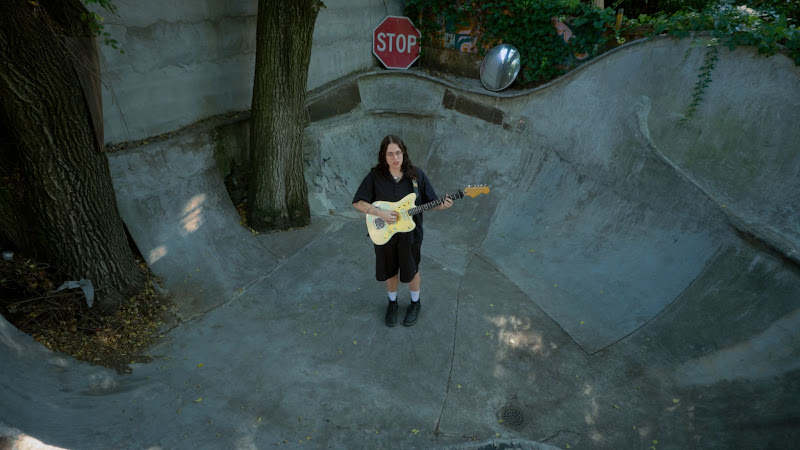
Step aside, OK Go. Claire Ozmun’s “Dying in the Wool” is about to dethrone “Here It Goes Again” for most iconic music video of all time, and it doesn’t even have any treadmills. What it does have is a concrete bowl that skaters have been dropping into since 2014. The Soul Bowl has been well-known and equally as beloved in the skating community for a decade, since it was poured by hand in the backyard of an unassuming Brooklyn apartment building. Multi-talented percussionist Immanuel Pennington of such acts as Poolblood and Captain Tallen & the Benevolent Entities holds it down there now.
On the day of the shoot, the band had just gotten back from the first leg of a two-week tour. Shows in Brooklyn, Philly, Poughkeepsie, shot the video, then left for the second leg 48 hours later. We loaded the car with gear and hit the road west-bound for shows in Cleveland and Chicago. (“We” because I got to play roadie-for-hire. Please hire me.)
To create the effect of the crowd moshing in slo-mo as they played, the band had to learn to lip-sync and play their instruments at double speed. During every take, director Ellie Gravitte reset the song and played back a double-fast sped-up version. While this had potential to feel like a quasi-Speedy Gonzalez cartoon (and it totally did at first), after everyone got used to it two takes in, the overarching crowd-feel quickly shifted from comedic to “Holy hell this is even cooler than we thought.” Seeing the band so tight even at 200% speed was wildly impressive. Keyboardist Catey Esler noted how solid the whole band felt playing “Dying in the Wool” at future live shows after having gotten it down at double-speed for the video.
Gravitte’s visionary, experimental camera angles are the product of insanely impressive balance and athleticism. She and her team balanced perched on top of the skate bowl wielding heavy camera equipment to get these shots. At the same time, Gravitte’s hurling necessary artistic directions like “Can you guys smile less? You all look like you’re having a blast, but this is supposed to be cool,” and “Just mosh like you’re all on ketamine.” (The whole crowd said “ohhhhh.”) Indeed, everyone in the bowl knows each other and loves each other and cares about each other’s lives, and it was a genuine challenge to not over-smile. A few weeks before, the same group chat of friends that sends “what’s poppin 2nite” texts gets a casting call like, “Hey we’re shooting a music video and we want you to all be in it. There’ll be pizza and beer.” And everybody came and it ruled.
Watch the video for “Dying in the Wool” premiering here on the ugly hug!
Ellie Gravitte, the video’s director, shares in a statement, “if you’ve been to a COB show, you know it’s all about community. Claire Ozmun loves her friends harder than anybody I know, so we thought it was only right to make a video with the homies at the center of the action. Throw in some Brooklyn skater vibes and you’ve got yourself a taste of that retro punk scene that this EP so beautifully evokes. We put this together in a single day in a backyard skate bowl in Bushwick, instructed all our pals to wear their best goth looks from 2009, and moshed our little hearts out. We hope it inspires you to do the same.”
Not only can Claire Ozmun write a generational battle cry, but she can also apparently serve face even at double speed. It takes a sturdy person with A Good Song to be able to sing into a camera and make it look not only natural but unbelievably cool. Watching her here feels like the first time a fourteen year old watches Kurt Cobain speak to an interviewer and feels that deep inner stirring. She is the icon this new generation of rock n rollers has been hungry for – assuming the position left empty by predecessors Kim Deal, Chrissie Hynde, and Grace Slick.
This video is an amalgam of supremely talented artists. But, the actual shooting came with minimal direction, because the entire cast had trained for this role with months or even years of method acting. We all knew how to shake ass at a COB show. Attend one show yourself and you’ll find it’s impossible not to start movin. The videographers put us in the bowl and just said “mosh” and we knew what to do. A few takes actually had to be redone because we had to dial it back from the level of enthusiasm that was our natural reaction/instinct to deliver. Everyone wanted to take an elbow to the chin for this band. Months later, everyone on set still refers to this shoot as “dying in the bowl.”
Ozmun’s “Dying in the Wool” video showcases the electric, thriving music community alive in Brooklyn, New York in 2024. This is a truly special, ageless capture of a time and place where a lot is happening and all of it is good – especially COB and their music. Melomaniacs worth their chops (or at least worth their CD collections) should keep their eyes on The Claire Ozmun Band.
As a small music journal, we rely heavily on the work of independent tape labels to discover and share the incredible artists that we have dedicated this site to. Whether through press lists, recommendations, artist connections, social media support or supplying physicals, these homemade labels are the often-unsung heroes of the industry. Today, the ugly hug is highlighting the work of our friends over at Lily Tapes and Discs.
Formed by Ben Lovell in high school as an open and engaging space for his and his friend’s music, Lily Tapes and Discs has become a treasured tape label out of Rochester, New York, housing a mighty collection of recordings founded on the passion of sharing music with others. Along with Ben’s own project lung cycles, Lily Tapes is a curation of many beloved and eclectic artists, such as The National Parks Service, Ylayali, Cla-ras, The Spookfish, German Error Message, Hour, Jason Calhoun, Adeline Hotel and many more.
We recently caught up with Ben to discuss Lily Tapes and its homegrown roots, celebrating its 10 year anniversary and the importance of sharing music with your friends.
This interview has been edited for length and clarity
Ben and Grayson (ligaments) performing as part of our short-lived noise duo “dry heave & neckbeards,” I think this was at a battle of the bands in a frat house? would have been around when we put out our split tape – iirc we emptied the room
Shea Roney: Your first release under Lily Tapes was back in 2014. What sparked the idea to start a tape label? Was there a particular moment or inspiration that made you take the leap?
Ben Lovell: It was actually way before that. I started self-releasing CD-Rs and stuff like that in late high school and early college and then moved on to tapes. I was doing enough self-releasing stuff that I figured I might as well put a name and a logo on it, but most of that stuff at this point I’ve sort of taken offline. It’s all kind of old. I was recording and self-releasing stuff as a teenager and discovering tape labels and DIY stuff, sending my stuff around a little bit to certain labels that I admired and looked up to and, as it usually goes, mostly either got silence or no’s. I realized I enjoyed putting the things together and making the artwork and all that, so I might as well just keep doing it myself. The first few releases were just mine and then eventually I started asking friends if they wanted to also let me make a tape of their stuff and it sort of became an actual label instead of just a logo that I was putting on all my own stuff.
SR: You had a lot of dual releases in the early days of the label. Can you tell me about that series and how those came to be? Who were some of the first people you collaborated with?
BL: The National Park Service was the first person that I did any sort of collaboration with. We know each other from a Radiohead message board that we both posted on as teenagers and have kept in touch. We made an album together where we were just sending Audacity files back and forth over Dropbox and then I put out a tape of his stuff called I Was Flying in 2013. And then that same year I started doing some split releases also, so the National Park Service and I did a split tape, and then one with my good friend Grayson who used to make music as Ligaments. And then the split tape sort of became a focus for a little while. I enjoyed the challenge of just thinking, here’s a friend, here’s the style of music they make, and pushing myself to make something that was not the same, but sympathetic to it. So, like Grayson made a lot of electronic beat driven stuff and I had fun making a more electronic sounding thing with him. After that was the one with Ylayali, which I enjoyed doing a more sort of scrappy, sort of hodgepodge, folky thing like he was doing at the time. But that was sort of what propelled it forward for a while. I never really sought out to make that a thing, but it just sort of became a series.
annabelle, the unofficial label mascot (featured in the artwork for the self-titled lung cycles album)
SR: You seem to have a trend of deliberate pairings when it comes to your music and other lily tapes releases when selling tapes. Is this something you like to focus on and what qualities do you think it further extends when enjoying these pieces of work?
BL: Yeah, that’s interesting. I mean, I got that idea just because when I was starting to collect tapes and follow a lot of smaller labels, the idea of just doing release batches was something that I found interesting and worked on me in a lot of cases. If there was one specific release I was interested in and it was being presented as part of a batch deal, I was like, sure, I’ll just buy the batch and maybe I’ll like the other stuff, too. I have friends who are able to work this way, but I’m not able to just have a bunch of different staggered releases going at the same time. I have to have something like, ‘these are the releases I’ve started, and I’ll finish them together, and then, when that’s fully done, I’ll move on to the next thing.’ And not that selling anything is like the important part, but I’ve found that if I’m releasing stuff by 2 or 3 different artists at the same time, maybe one of those artists will bring someone who hasn’t heard of the label before to check it out and they’ll end up hearing something else that they wouldn’t have heard if I had just put out that one tape out by its own. With this last batch especially, I mean German Error Message has a fairly large following, bigger than most of the stuff that I usually put out, and there’s been a lot of new names in the orders, and a lot of people are grabbing the whole batch, which I love.
SR: Yeah, that’s so cool. That recent National Park Service and Calhoun pairing felt very special. I blocked out an afternoon to listen to those back-to-back, and it’s just so intriguing the ways you can kind of draw lines between them, but it’s still two completely separate artists that are just doing their own thing. It’s like an assorted little cheese board or something [laughs].
BL: I love that! [laughs] When other people have asked me to describe the sound of stuff on the label I just don’t know how. I know some people do sort of run their label in that way or like to have a sound world that they operate in. But for me, it’s just stuff that I like and it’s my thinking that I don’t think it’s that far-fetched that someone else would have the same overlapping tastes.
SR: How do you find the artists you work with? Is there a special connection or sound you look for?
BL: They’re just my friends usually. It’s the sort of thing where I don’t really seek out or solicit releases. Unfortunately, I have to say no to a lot of possible release projects just because of the time and money and energy involved. So, if it’s a right time, right place thing where a friend brings a project to me, and I am not already in the middle of something else, or if they’re willing to wait a little while. I want to work on as many releases as I have the time and energy for in supporting people that I’m friends with and whose music I care about.
ben and jason calhoun on tour together in pittsburgh, 2018
SR: Do you have any collaborators that help you run the label, and if so, how does that shape the way the label functions?
BL: It is mainly just me. I have a few friends that are closest to it that I’ve done a lot of work with. My friend Jeremy Ferris (Cla-ras) is an insanely talented illustrator and printmaker. He’s probably done the most artwork for the label and someone that I can just send him music, or a vague idea and he’ll come back to me with something fully fleshed out. He just always has an intuitive understanding of what a project needs and is really good at making it work. I’ve done a lot of this myself and also sort of ripped him off [laughs]. A big thing for me is making the tapes feel good, using nice paper and doing interesting things with the printmaking and the paper stocks used. Just putting together a product that feels, not luxurious, but thoughtfully assembled.
SR: Are most of the tapes handmade?
BL: I’m trying to go more in that direction. At first it was mostly just chipboard and cardstock cases that I was buying in bulk and then decorating myself with stamps and watercolor paints and stuff like that. And then I started working with Jeremy, and he does a lot of screen printing, and I started doing some letterpress printing when I was in college. And then since then I had sort of moved around a lot and had less capacity for sort of intricate printing things, so I sort of moved more towards a lot of digital artwork and digital printing, but still trying to make everything look nice. But in the past year, and with the most recent batch especially, I have been trying to focus on getting back into the print studio and making that a bigger part of the label.
SR: Is this homemade feel and approach something that holds significance to you?
BL: It is. Especially because I haven’t made that much of my own music the past few years so that’s sort of where I’ve been focusing my creative energy, learning different printmaking techniques and just making things. This is a big tangent to go on, but I’ve only released my own stuff through other labels a couple of times, and there was one album that I put out when I was in college, I don’t really remember how it happened exactly, but this label in England put it out. They did this really big deluxe package and it was like an oversized cardstock case with all these photo prints inside and it was really expensive. It sold out within a day, and I also never got copies of it. They sent them to me, but the package just never came. I don’t know if it got lost or what. but ultimately, I had to buy a copy off Discogs for like $50 to get a copy of my own album. I don’t know anyone who bought it or got a copy. I don’t like the artwork, to me it felt like it had nothing to do with the music. The whole thing was just very strange to me in how fancy, elaborate and expensive it was, and I didn’t feel like it fit me at all. It made me think about how I want to make tapes that are thoughtfully assembled, and support the music as much as possible, but are also affordable. There’s a lot of really amazing work that you can do just by using different papers and inks and just very simple handmade touches that I think people notice and appreciate. The digital distribution is whatever, it’s an accessibility thing and people should have the bandcamp access and files on their computer, but the tape is the thing for me. I want to make objects that make it clear that this isn’t just an afterthought, like the packaging and presentation of the artwork is the album too.
SR: And that stuff lasts, too! I have specific sections in my collection of just all releases from a singular tape label.
BL: Right! Same.
hour live at small world books in rochester, ny, 2018
SR: How involved are the artists in the process of putting the tape together from the start to the final product?
BL: Pretty involved. It’s obviously different from one to the next, but I don’t make any decisions without their approval. It’s pretty, I wanna say, hand-in-hand or hands-on or whatever. Every release has an email thread that is like a hundred emails long. It’s very important to me because these are my friends, and they feel like this is their tape as much as it’s just something in a catalog. I think there’s sort of a standard, you know like, we can do it this way. I can do the layout with the handwriting on the tape and all that, which works a lot of the time. Or we can do something different, or if they have an idea, then I’ll try and see where that goes. I’ve been getting back into letterpress printing and the studio here in Rochester that I do that work at has a massive basement filled with all sorts of antique metal types, so this most recent batch that I’m working on, I just sent people this spreadsheet of like 400 antique fonts and it was actually like a total coincidence that everyone chose the same font at random, which I loved, and it was a very cool font to work with, and I think it came out looking great.
SR: Can you share a few personal favorite releases or projects that you’ve worked on and tell us a little bit about them?
BL: I know I mentioned it earlier, but one of my favorites, and one of the earliest ones, was the split tape that my friend Grayson and I put out together when I was still recording as Squanto and he was Ligaments. Grayson was one of my best friends in college. We basically lived at his house, and we threw a lot of basement shows, but he also is just chronically not finishing things. It was my senior year of college and most of that year I was just listening to him work on these songs, and he would play them whenever he did a set in a show, and I just really got to know and love those songs. At one point I just had to say, ‘I’m setting a deadline for you. Give me this music, so I can put it on a tape.’ That was also the first release that Jeremy did artwork for. We didn’t know each other super well, but it all came together in a really nice way. I still have a lot of really fond memories of working on that tape together and hanging out at that house, which was also how I met Fran from Ylayali. His wife Katie’s band, Free Cake for Every Creature, played a show in our basement. and we just kept in touch, and it became a thing. He’s also one of my closest friends at this point, and I’ve sort of told myself that that is kind of the purpose of the label. I’m not great at keeping in touch with people just for the sake of keeping in touch. So, part of why all my email threads for releases are clogging up my inbox so much is because it is working on a release, but at the same time it’s also like, ‘how have you been? What’s new?’ It’s an excuse for reaching out.
yy by ylayali, 2017
The yy album from Ylayali, I just remember Fran had a very specific idea about how he wanted the artwork to be like Craigslist themed. So the tape itself is formatted to look like a Craigslist Ad. And for the product shots for the tape I found like my cell phone from high school and took blurry pics of it with that. And the release email was written like an unhinged response to a Craigslist Ad. I actually lost a bunch of subscribers, and a few people emailed back asking like, ‘what? Are you okay?’ But I love that album, and I stand by it. I still think it was really funny.
SR: The split tapes are interesting because it was very much the beginning of lily tapes, but it’s also people you continue to work with through the years too. So seeing both you and those artists develop in personal ways has been a really special experience when digging through your catalog.
BL: Yeah, I always feel like I’m not doing much, and then when I actually go back and take stock of everything I’ve put out, I’m always amazed at how much there is and how much it’s changed, and stayed the same over time. There’s a lot of things I keep returning to, and things that I forgot about, and I don’t wanna go nostalgia mode or anything but even at this point it’s very rewarding to look back on already.
SR: Can you expand on what you mean by change and stay the same?
BL: I hope so. that’s a tough one. I feel like there are just a lot of like… it’s hard for anyone who does creative work to pinpoint like, these are the things that I’m drawn to and here’s why I’m drawn to them. But there are sort of consistent things that you chase and think about chasing. and then, when you zoom out, in a broader sense, there are things that you don’t realize you were chasing that you see sort of pop up over and over. I guess I can mostly only speak to my own music, if I’m talking about the music itself. But across all the split tapes, there are certain qualities where I’ve sort of been chasing accidents. Like a lot of my own recording has been sort of trying to set up conditions so that something I may not have planned for can happen, or I can arrive at through, you know, layering different recordings and seeing what inspiration that gives me, rather than sort of coming in with something fully written and laying it down exactly like it is in my head. And the ways I’ve tried to make that happen over time have changed, but I think that I’ve been consistent in sort of seeking that out. I collaborate with a lot of people, but that’s all sort of remote, not really in real time. The actual work is mostly done alone, and most of the people that I’ve released music by are solo artists, and I think that’s something that a lot of us share. You sort of have ideas, and you’re executing them and handing them off, and in that process, they turn into something different.
house show with adeline hotel in rochester, ny, 2016
SR: Last year you released Window: 10 years of Lily Tapes and Discs. Can you tell me a bit about that project and the significance it had on you?
BL: I’m not very good at planning, like I’ve said, a lot of the time the way I work on releases is they kind of fall into my lap. But for this I completely forgot the label’s 10th anniversary. But once I realized, I thought it would be fun to sort of take a break and try and do something big by my standards. And I also did a year of retrospective stuff, like I reissued a few tapes that had gone out of print too fast, and like I said, the label has been a way to keep in touch and build friendships through working on things together and it was a way for me to sort of take inventory of where I was at with all of that. I don’t want to just keep trudging forward and risk forgetting or spreading myself too thin. I wanted to take a moment to just look at everything and check in with everyone and just sort of reflect on it together. It was a chance to reach out to the people that I hadn’t been super in touch with over the years and hear what people were working on, and I was sort of taking inventory of everyone that I wanted to reach out to about it.
I was very methodical in putting it together, and felt pretty lost at sea with it for a while until I got everyone’s tracks in and started fiddling around with an order. I very deliberately wanted it to be an intentional and digestible listening experience. I had no idea how to do that for a while, it’s 2 hours of music. But with the idea of making it a double tape and having each side be its own sort of suite helped it open up into a thing where I could sort of work on one side at a time. You don’t have to listen to the whole thing altogether. It’s morning, afternoon, evening, and night that are the four sides, and I wanted it to be something that you can take in pieces.
I also got really into the packaging and all that, trying to make it look cool. This was before I got back into the print studio, I was trying to do all this at home in my office, just buying different stamp inks and paper samples and trying to figure out the strip around the package was such a pain. I should have just asked someone who knows what they’re doing earlier, but I was super happy with the way it came out and I think that it’s a prime example of a very good feeling thing to hold. I hope everyone involved feels good about being part of it. Every part of it feels well considered to me. It didn’t feel like anyone was giving me their leftovers and it felt rewarding in that that’s something that comes out of what I’ve tried to foster in the label. It’s not just a compilation. It’s like a summation of what we’ve all done so far, and where we’re at right now, and what we’re trying to keep doing, and I think it shows.
house show with ylayali in hudson, ny, 2015
SR: For those who are looking to start their own tape label, what advice do you have for them and what do you wish you knew when you were starting out?
BL: I would say just do it is my advice. I think it’s good to just do stuff that no one cares about for a while, because no one’s gonna care about it at first, and then the longer you do it the more chances you have to sort of iterate on your process and figure out what you like, what parts of it you like doing, what parts of it you don’t like doing, and then eventually you’ll sort of arrive at something that you’re proud of, and you’ll be able to look back on the work that you did to get there and also feel proud of that. I feel like I’ve spent a long-time making stuff that very few people cared about, and to some extent I’m still doing that. Without getting into a whole diatribe about the state of music or whatever, I think this is true at every level, whether you’re a tiny tape label or someone who’s trying to make it. There are all these ideas of success that are very hard to not subscribe to and it’s one thing to know intellectually that not getting coverage from whatever site doesn’t equate to success. But, on the other hand, it’s hard not to take being ignored personally. Even now I feel like it’s a balance of telling myself that that stuff doesn’t matter and also actually feeling that that stuff doesn’t matter. And depending on how the day goes, you can go either way. But I just think if you want to do it, just do it and find out over time whether you enjoy it or not. And hopefully you’ll make some friends in the process.
There’s also so many different ways that you can pursue it too. Even now I’m constantly just rethinking things like, ‘do I wanna set this tape up the same way that I’ve done the past ones or do I want to do something radically different with the artwork,’ or just try something new just to see what happens. And the more experience you have to draw from, and the more friends you have who have seen you do the work and know that you’re not just making empty promises, the more leeway you have to try different things with it.
Every Wednesday, the ugly hug shares a playlist personally curated by an artist/band that we have been enjoying. This week we have a collection of songs put together by Brooklyn-based artist Renny Conti.
Last month, Renny released his beloved self-titled album, one in which the songwriter has been working on and compiling for the past couple of years. With a keen eye for observational obscurity, these songs brush open the curtains to a world unfiltered to the warmth, heartbreak, trauma and humorous oddities that make life so unique. Following his release, we asked Renny to make a playlist, in which he shares;
These are some of my most favorite songs that I’ve found in the past few years. They’ve inspired me to play and be vulnerable in my music and I can always turn to these artists and songs for both guidance and clarity.
Listen to Renny’s playlist here.
You can listen to Renny Conti out everywhere now.
Written by Shea Roney | Featured Photo Courtesy of Renny Conti






 the ugly hug