Through a type of personal introspection, one which flows with such grace and intuition, Carolina Chauffe of hemlock and Alexandre Duccini of Floating Clouds have always brought words to motion, recentering what matters most in the world with such simple fixations, open hearts and really good tunes. Now partnering up, along with Nick Meigs and Jakob (Dr. Sweetheart) Parsons, today the two share Campfire Singles, a pair of songs written and recorded on tour in Washington in the fall of 2024. As the tale goes, Carolina flew to Seattle to tour with no car and no guitar, “pushing the envelope of human generosity”; and there was plenty of it. Recorded around a campfire on an iPhone, “No One in Portland Says Howdy Anymore” and “Red Breasted Nuthatch” find hemlock and Floating Clouds in their most sincere habitat, as these two songs are a restful gesture that “music is play”.
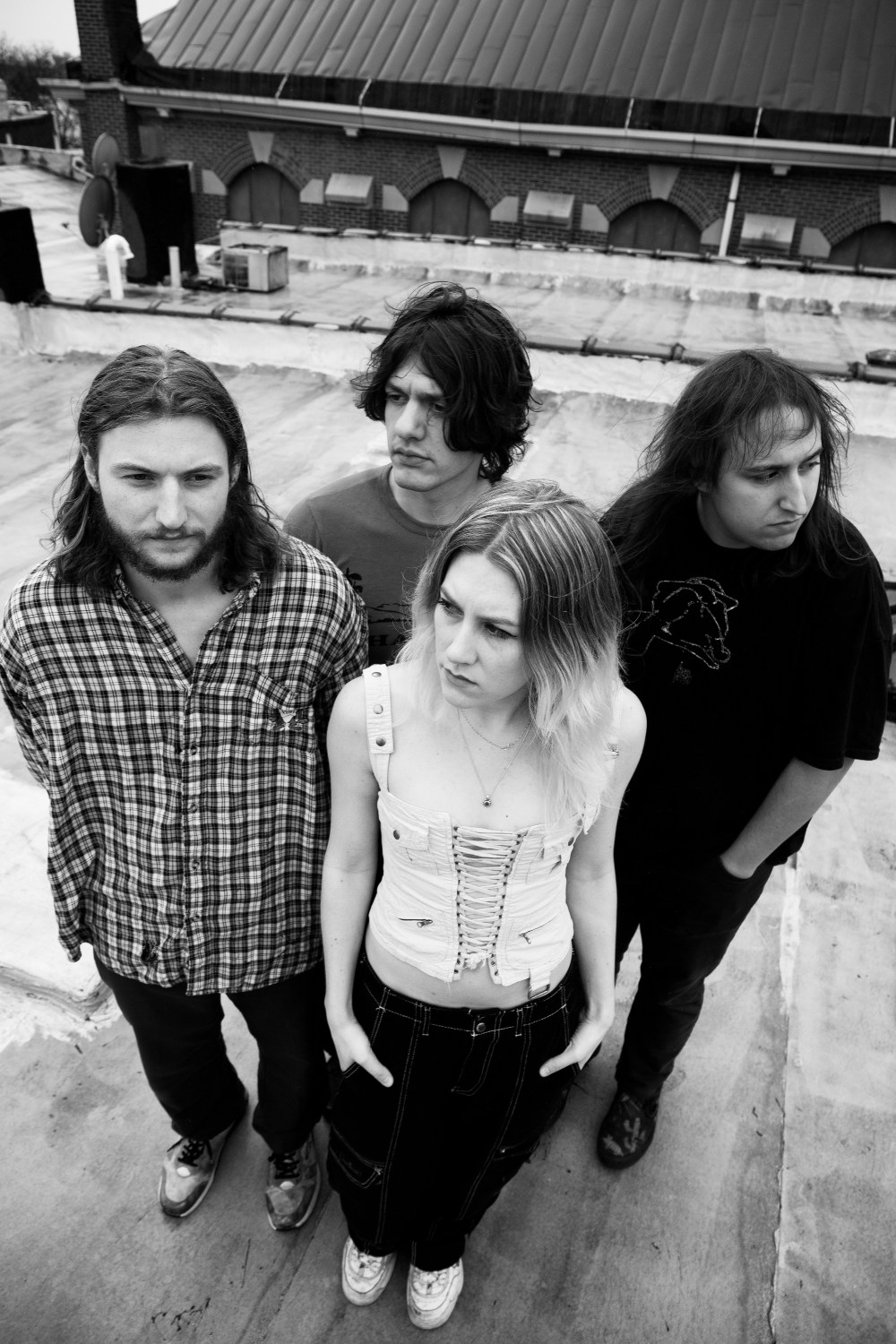
Photo by Alex Martinez
Upon contagious laughter blending into the crackle of a campfire, the uplifting spirit of a slide whistle brings in “No One in Portland Says Howdy Anymore”, as Alexandre’s rich voice establishes the tune amidst the open air. With a steady demeanor, the two songwriters share tails of drifting heartbreak and lamenting woes as “Howdy’ becomes a space where familiarity blends with presence and courtesy with understanding. The second track “Red Breasted Nuthatch” pushes curiosity into the smallest bits of beauty that surrounds our day-to-days, ushering in a call and response pattern, a dialogue of imagination, hoping to get some answers from a tiny-winged friend they made earlier that day.
These two tracks are less of a practical method and more of a practice in trust and intention. They are sweet and silly and a little rough around the edges, but that’s okay. What else could be more perfect when capturing genuine creativity? It’s a simple, yet powerful reminder of what makes creating such a special part of being human.
You can listen to the campfire singles out everywhere today, as well as check out Floating Clouds latest album With A Shared Memoryas well as 444 by hemlock.
“We were really heavy for a minute there. For Dizzy Spell and that era we were so hyper-focused on what we can get out of our amps and our pedals, just the sonic width we wanted live and the thickness we wanted”, Isaac Kauffman explains of Abel’s 2024 record, Dizzy Spell.
The Columbus based band released Dizzy Spell just shy of a year ago, a record armed with an arsenal anxious intensity carved with heavy guitar and hazy feedback. There is an immediacy to the listen, as Abel wastes no time reaching a heightened emotional state as they shred through ridiculously catchy pop structures and pedal suffocation. It is an intense album in an all consuming way, thought drowning sort of way. The lyrics are poignant and often heart wrenching, but they are approached in a manner that feels distant, as the album succumbs to a sea of shoegaze-fueled dissocoation. On Dizzy Spell, noise is a lifevest. On How to Get Away with Nothing, Abel leaves this cushion behind, exploring new ways to manipulate their soundscapes as they prod at what can be found, and more importantly, felt, when they slow down.
Released last week via Pleasure Tapes, Julia’s War and Candlepin, How to Get Away with Nothing marks Abels shift towards a slowcore leaning sound. The stylistic decision stemmed organically, pulling from a chapter the band was in whilst they made it. “My bandmates go through phases, and I think it makes the most sense to take those moments and run with them”, Isaac tells me. “It really lends itself to emotional music when you take things as just a section of your life”.
The authenticity that comes with this philosophy can be felt through Abel’s discography. While How to Get Away with Nothing leans away from the density and shoegaze feel of Dizzy Spell, it also attests to the strength of the project’s identity, and their ability to experiment with genre without alienating the feel of Abel. Their “phases” do not come at a cost to the band’s ability to extract beauty from a raw and gritty sound, a consistent pillar in their releases.
How to Get Away with Nothing boasts a sound that is expansive, challenging and profoundly textured. It leaves space for near silence. It toys with manipulations of pitch and speed. It flirts with the thickness of Dizzy Spell. It experiments with a hyperpop feel. All of this could be a recipe for auditory whiplash, but How to Get Away with Nothing is grounded by the deliberate and balanced nature of its structure. Abel maintains an equilibrium while exploring various means to express melancholy, as well as a range of vocal approaches. Volatile deliveries scrape away at minimal guitar arrangements on “Dusk”, while on “Parasympathetic” earnest and gentle vocals exist in the shadows of a track guided by imposing percussion.
The record commences with warm and earthy lo-fi track “Grass”, which features twangy contributions from fellow Ohio-based project Cornfed. As implied by the title, it’s a song about grass, though the abundant plant is viewed as a concept rather than a reality, as Abel admits to a laundry list of fear that comes with walking barefoot in the grass. Fear as a barrier is carefully weaved into both Dizzy Spell and How to Get Away with Nothing, though the notion finds itself more crushing on the latter release. As they adhere to a slowcore style, drawn out moments of instrumental minimalism carve space for ideas to be questioned, and for emotional paralysis to be expressed through achy chord progressions.
“I think taking that into slowcore and slower songs lended itself to offer more of a minor space for lyrics”, Isaac reflects. “Although the lyrics still take up emotional width, I think we wanted to focus on keeping those tones and atmospheres that we created in a slower sense, and that lended to the emotional guitar parts having to be pushed. I feel like we’ve always had this kind of disconnected vibe to our songs, and I think that leaves our own playing styles and emotions on the table while also keeping the atmosphere thick”
The most devastating tracks on the record are followed by songs that toy with elements of hyperpop, and although they still tackle heart-break and dwindling self assurance, the blow is softened by their twinkly, bedroom-dance-party shape. Isaac tells me though he usually does all of the production and engineering for Abel, for How to Get Away with Nothing, the band collaborated with Quinn Mulvihill from Glaring Orchid, offering him extra time and capacity to experiment.
“I think that with the extra mixing help, I felt like I had more space and time to put some weird mixing energy into a few songs, and I wanted to do that just to break up the album in a way that felt different than using interludes or something like that”, he explains. “I think my melodies always come out in a pop way, and I think putting that over slowcore stuff is really good a lot of the time, but there are certain melodies where you’re like, how will this work over an emotional, drawn out guitar riff? It was almost just the easy way out to make something more poppy and more straightforward.”
The humbly deemed “easy way out” elevates Abel’s already textured sound, as well as the How to Get Away With Nothing’s intricacy as a whole. The hyperpop motifs and eccentric sonic manipulations contort themselves into moments that feels mechanical or almost alien-like, offering a complex juxtaposition to the album’s organic bones and painfully human lyricism. “I think there’s always been this production heavy side of Abel simply because I’m still teaching myself how to do certain things and I need to try it before I feel comfortable. So I think those hyperpop songs are just a testament to handling my growth,” Isaac says.
While it stands as proof to their skills as songwriters and range as musicians, above all How to Get Away with Nothing attests to Abel’s exceptional ability to harvest a poignancy in all that they create. You can listen to it everywhere now.
Every Wednesday, the ugly hug shares a playlist personally curated by an artist/band that we have been enjoying. This week we have a collection of songs put together by Philly-based artist Carmen Perry.
As a member of the beloved band Remember Sports, Perry’s songwriting became a crucial part of many people’s lives, establishing rich, cheeky melodies with a type of emotional intensity and vulnerability that has stuck with so many. This week, Perry is releasing her upcoming solo album Eyes Like a Mirror via Mtn. Laurel Recording Co. It’s an album of intuition and curiosity, finding Perry embracing the simple things around her in order to help clear up life’s more complicated paths.
About the playlist, Perry said;
“I’ve been thinking a lot about the concept of the mirror, and everything it is often used to represent lyrically: self-reflection, identity, discovery, and transformation. I like the idea of a symbol that gets used by all different kinds of writers to mean essentially the same thing, but in a multitude of different ways. These are some of my favorite songs that take on the mirror, and the act of reflection, by artists that have really inspired me throughout my life. I tried to structure the playlist so that it takes the listener through a journey, and brings them back to where they started, but changed in some small way.”
You can listen to Perry’s playlist here as well as on apple music!
Eyes Like a Mirror is set to be released this Friday via Mtn. Laurel Recording Co. You can pre-order it now as well as on vinyl.
Written by Shea Roney | Featured Photo by Catherine Dwyer
“Climb the ladder in the cage,” Simeon Beardsley leads in the opening track of Pry’s debut record, Wrapped in Plastic. Gently packaged in a soft wall of synthy sound, the line is the first of several zoo innuendos the record maneuvers in its exploration of self-sanctioned confinements and external surveillance. These metaphors exist alongside other forms of stifling visual imagery, ranging from intrusive ghosts to grotesque feelings of frozen, refrigerated meat. Conceptually, it’s a suffocating story; though I write that under the assumption you are reading the lyrics to Wrapped in Plastic in silence. If you have caught any of the singles Pry has trickled out thus far, then you would know there is nothing suffocating about the soundscapes they pave. Or maybe there is, but it’s a different kind of suffocation. A pop-driven spattering of sound. Fervent spats of drumming and potent guitar riffs. A hotboxing of synthesizer. Moments of almost silence that exist just as loudly as their maximalist counterparts. Out tomorrow, Wrapped in Plastic finds power in its nuance, shying from insulated timelines and distinct personal details as Pry yields a malleable listen of juxtaposition, sonic dexterity and disruptive wit.
When I met Pry members Amara Bush and Simeon Beardsley – at a coffee shop that happened to share a name with a track off Wrapped in Plastic – they were both a bit tired. Amara from a night at Knockdown Center and Simeon from a day spent estate sale shopping, which concluded with the hauling of a pull-out couch up into a fourth floor walk up apartment. In the face of depleted energy and minimal sleep, the duo’s ability to elaborate on the history of Pry and their trust-driven creative relationship remained unscathed. Between sips of iced coffee, they told me about past variations of the project, sonic shifts and being briefly pigeonholed as a “New York Shoegaze Band” (they are not opposed to this label…it just does not align with their own perceptions of Pry).
“This was my first time ever playing music with anyone. Simeon was just so open and welcoming, and we decided that in whatever context, we should continue creating stuff together”, Amara reflects on the start of their friendship; which began a typical New York tale of haphazard mutual friend introduction, catalyzed through the act of an Instagram story slide up. Shortly after, the two began meeting in the back room of a coffee shop Simeon managed at the time, writing songs, programming drum tracks and dissolving Amara’s apprehensions to creating music collaboratively.
The record is composed of nine tracks, some predating Pry, some written early on in the project, and some that came together towards the end of the album’s recording process. On Wrapped in Plastic, these songs find their most confident and full iterations yet. “It was a very unique recording process for me, I feel like it was the most I have collaborated with the producer”, Simeon notes of working with Ian Rose. “I was so nervous before, I was like ‘I’m going to have to sing these takes over and over again, this is going to be so embarrassing.’ Ian was so encouraging and really helped me break out of my shell,” Amara adds.
Though I noted that the record represents these song’s strongest iterations yet, like many aspects of Pry this verdict is hardly crystallized. In fact, it’s likely subject to change later this week, when the band occupies the late slot at Nightclub 101 on May 31st for their album release show. “I think I will be screaming more. I think before when we were playing shows I wanted to sound like the recording, but now I just want to have fun up there. It’s been really sweet to have Simeon and our drummer, Dave, really encouraging me to push myself. I would only do that in a space where I feel really safe,” Amara tells me. “If something feels boring, we can just change it,” Simeon adds. “That has been really exciting because we want the live performance to feel fun, and maybe we do something we haven’t done in rehearsal. It’s nice to have total freedom and be in the moment and just trust that we have each other’s backs.”
The malleability of their live sets, and the perpetual growth of these tracks represents the ways in which Pry is a space where Amara and Simeon can nudge at previously defined ‘comfort zones’, paralleling ideas of self-inflicted cages that Wrapped in Plastic works to contend. As swelling sonic atmospheres and charged vocals dig the duo’s own personal ruminations into sugary pop hooks, Pry patches gaps between their own multiplicities, or at least creates a space where various sides of themselves can coexist. For Amara, who tells me she never considered herself a singer in the past, this has also meant experimenting with a range of vocal approaches. Her deliveries stretch from tender in tracks like “Greener”, to the hostile feel the duo embraces in “Tether You”.
“I played ‘Tether You’ for the girl I nanny for, and she was like, ‘That’s not you! You sound weird,” Amara says.
Pry probes heavily into this idea of multiplicity on “World Stopped Spinning”, a track where the duo follow an intense guitar solo with a heated dialogue relying only on the word golden. “I don’t know how it’s perceived by people who don’t know me, but I’m a pretty sarcastic person, and I think we want the way we’re singing ‘golden’ to feel sarcastic,” Simeon explains. “I think the repetition makes you start questioning like, is it golden? That’s the hopeful intent. When you say something so much, does it start losing its meaning? I think that song is a hundred percent about that, and having a frame of reference for yourself that with time, you hear the same thing over and over to the point it may not have the same hook into you it once did. I feel like using repetition really makes you curious about what’s being said versus the substance of what’s being said.”
The skewing of a word through delivery is just one of the many ways Pry cleverly dismantles their own cages. It is not necessarily your sanity that they beg you to question, but perhaps the rigid outline of what you deem sanity to be. Or maybe they just want you to get out of your own head and have some synth-filled fun. You can find out tomorrow.
Every Wednesday, the ugly hug shares a playlist personally curated by an artist/band that we have been enjoying. This week we have a collection of songs put together by Eli Raymer of the Asheville-based project Good Trauma.
Along with playing in other bands such as Powder Horns, Tongues of Fire, Idle County and Trust Blinks, Good Trauma is Raymer’s place to be fully enveloped in his own little world. Releasing his latest album In Succession last year, where he embraced more broken folk structures, Raymer’s writing is where tension and intuition link arms and sincerity and distrust break the hold, beautifully capturing that triumphant feeling of making it through another rough day while still looking forward to whatever is next.
About the playlist, Raymer shares;
Here’s a playlist I curated for you! I tried to capture my daily listening perspective from morning to night, Breakfast to the bar, sensible to foolish.
Listen to Raymer’s Playlist here;
Listen to In Sucession and other Good Trauma releases out everywhere now! Tapes available at I’m Into Life Records.
Little clicks recorded on a contact microphone submerged in a jar of water, digitized home movie footage from a gymnastics camp, slivers of early 2000s TV commercials and the ringing of a flower pot are amongst the samples that Patrick Zopff weaved into connect the dots, an album he released today under pity xerox. It is technically a debut for the project, though ‘pity xerox’ has held a role in Zopff’s life for years; a nickname for his visual art practice that eventually bloomed to an encompassing of the scrappier mixed media approach used in all his creative endeavors. It was natural to use the title for his “dream writing project” – given the parallels between a style of visual art meshing digital and physical media, and music that maintains a deeply organic feel amidst a variety of samples and technological elements. In eleven tracks of intentional sampling, twinkling synths and a grounded pop sound, connect the dots, patches growth, grief and love saturated memories into a stunning sonic collage grounded in optimism and acceptance.
“Others say I’m bashful, because I haven’t much to say”, Zopff’s warm vocals flood through in the album’s first track, “golden bough”. The notion finds a place tucked between a laundry list of other peoples’ perceptions, the gravity of which seem to dissolve each time Zopff’s shares his own narrative, manifesting as “I say life is a carousel, and we ride it round and round”, and “I say love is the golden bough, that we’re all hanging on.” It’s a staggering tale of finding comfort in oneself, and exists as the first of many tracks to counter discernments that Zopff has little to say.
“I think poetry is one of the most difficult art forms for me, and without music to ease the writing process, it would be impossible for me. Writing this album was extremely therapeutic for me in a time when i was very unsure of everything. I had no job, I was adrift in the world, and all I could think to do was record music. Many of these songs were written as they were recording their final draft. A few of them were composed and recorded instrumentally before any lyrics, and I think having a heartfelt instrumental makes a person write about some vulnerable things. I had no reason to hold back, I wasn’t sure these songs would ever leave my room.” Zopff explains of his approach to lyricism.
The album is sample dense, honing a variety of sonic texture while maintaining a gentle and warm listen. His use of samples range from a brief, calming swarm of seagulls in “connect the dots”, to a home recording that spans the entirety of “peggy”. Of the track, Zopff explains, “on ‘peggy’ the majority of the track is audio from my little sister Maureen’s baptism video. Later it cuts to audio from a scene with my mom, my sister, and I. Giving these sounds new life in song is really fascinating for me. I hope it’s interesting at least for the listener, but as an artist it’s an immense pleasure to revive these otherwise forgotten sounds as elements in music. Being able to hear my deceased moms voice on my album is huge for me, like I’m continuing our relationship somehow.”
While the bones of connect the dots emerge from deeply personal experiences, the ways in which Zopff seeps his own vulnerability into the innovative nature of his sonic style yields an album larger than one individual. There is a grandness to even the most delicate tracks, part of which can be traced from a slew of contributions made by trusted people in Zopff’s life, such as mastering by Isaac Karns from marble garden studio, drum contributions from CJ Eliasen, Clarinet from Matthew Wallenhorst, and vocals from Zoe Vanasse and Louis Martini. There is also something familiar about the underlying ethos of the record, and how it yearns for comfort amidst waves of uncertainty and doubt. This idea is tethered to the album’s title, of which Zopff explains, “As the themes and the shared sounds across the album began to emerge, it felt like completing a sudoku square, or a crossword, or a connect the dots puzzle. Finally I could see the image formed by the disparate elements in my poems. for the first time I could write about my grief, my heartaches, my uncertainty, with shameless drum machine rhythms and playful synths.”
You can listen to connect the dots on the pity xerox bandcamp below!
“I guess for me personally, I didn’t have any goals for the album or any distinct visions. I was kind of just doing what came out at the time, and we never planned to have any type of sound,” Angie Wilcutt explains of the latest Artificial Go record.
Without much context, the notion could be perceived anywhere from bashful modesty to a major case of ‘too-cool’ slacker nonchalance. However, if you were to watch a video of a live Artificial Go set, of Angie Wilcutt prancing around in a vintage marching band outfit, you would know this band has little interest in diluting themselves, let alone feigning apathy. Though some bands may find comfort in concrete visions or fitting into the confines of a niche, the members of Artificial Go view this sort of structure as artistically suffocating. Their vibrant sound blooms from a deeply intrinsic place, one that can only be achieved when rigidity is rejected. In a fizzling of ambiguous accents, whimsical pop structures and sheer wit, Musical Chairs is the latest triumph out of Cincinnati’s thriving post punk scene, as Artificial Go shrugs off expectations for the sake of genuine, self-guided experimentation.
Composed of Angie Willcutt, Micah Wu and Cole Gilfilen, Artificial Go is a fairly young project, releasing their debut album just under a year ago. “Artificial Go just started as a recording project between Cole, Micah and I. We recorded the album Hopscotch Fever at Cole’s apartment and then when it was finished, we decided we wanted to perform it live. So we found someone to play guitar and then we decided we wanted to tour and did that, then came back and wrote a second album. It’s just been a pretty natural pace,” Angie tells me of the band’s origins. They nurtured this organic approach on Musical Chairs, prioritizing their maturation as artists over any external expectations of the project. “I think our vision for the second record was just to build off the first, just keep growing our skills as musicians and songwriters,” Micah says. “We don’t wanna latch onto something just because people like it at the time, so we’re trying to stick to that if nothing else.”
Though the members of Artificial Go have minimal interest in cementing the project’s identity, Musical Chairs is anything but haphazard. Nimble social commentaries dance in and out of shimmery pop melodies, and the album’s wit grows more prominent with each listen. An emphasis on domesticated pets parallels the band’s ‘free-spirited’ ethos and aversion to being pigeonholed, as Artificial Go cartwheels around the line (or cage) that separates animal from human. There is also a complex thread of fashion imagery, an idea that presents as both empowering in the buoyant “The World is My Runway”, and a burden in “Playing Puppet”, where Angie somberly notes that “no sense of self is always in fashion.”
“That song is definitely a commentary on growing up as a woman,” Angie tells me. “As a child, I always felt like I had to behave a certain way that my brother didn’t. I think that’s an experience for a lot of women, and that song is just touching on the girlhood experience, and of what is expected from you.”
By outlawing external expectations, whether placed on them from an industry or learned from childhood, Artificial Go carves a space for Angie, Micah and Cole to prioritize their own fulfillment above anything else. The safety net this approach offers them exceeds any comfort found in external validations, and the creativity it encourages extends far beyond the contagiously fun songs they put out. From the playful graphics that Angie creates, to the lucky marching band outfit Micah picked out for her on a prior tour and hid in the car trunk, an air of love and acceptance lingers in every crevice of the project. Artificial Go operates unapologetically, and on Musical Chairs, they encourage you to do the same.
Artificial Go is currently on a five week long tour, fueling themselves with food they cook outside as they share the juices of Musical Chairs at a range of venues and DIY spots across the country. You can catch them on one of the dates above, and purchase a copy of Musical Chairs on their bandcamp.
Written by Manon Bushong / Photo courtesy of Artificial Go
Every Wednesday, the ugly hug shares a playlist personally curated by an artist/band that we have been enjoying. This week we have a collection of songs put together by Francie Medosch of the Philly-based project Florry.
This Friday, Florry is set to release their sophomore album Sounds Like… out via Dear Life Records, establishing the group in its fullest, and quite naturally, most rockin’ form yet. The music of Florry is pronounced in simplicity. Not of musical structure or emotional depth, but rather the way in which these songs stick to you and your surroundings with such ease; the simplicity of what can be the true pleasures in life. With rowdy guitar work and bona fide melodies, Florry plays like a shoot-the-shit with your closest friends, a pile of beer cans from the night before, a scenic route with good company, or a full tank of gas and no destination ahead.
Last month, Lafayette based three piece Kaleidoscope Crux released single “Galactic Door”, a gloomy swirl of rusty guitar, textured samples and fuzzed out yearning. It was the first single off of Through the Portal, their debut EP out late this summer via Julia’s War, Pleasure Tapes and Candlepin. If approval from a sludge-lovers holy trinity of DIY tape labels was not enough to lead you to their music already, Kaleidoscope Crux is back today with their second single, shredding through a state of emotional fatigue on “Guided Away”.
The tone of “Guided Away” is instantly set with corroded vocal harmonies burgeoned by walls of heavy grungy goodness as Max Binet proclaims “it takes everything I have to keep holding on, hanging by a thread”. Sonically, the track mimics a sort of breaking point; a state of overstimulation amplified by blistering guitar riffs, unbridled vocals and tense percussion. “Self medication creeps into a lot of my lyrics, and this song is no different”, Binet explains of the track. “It deals with waking up and realizing that you’ve made an ass out of yourself. I came up with the first few lines during a shift at a kitchen job in early 2024, after a night that ended in a particularly chaotic manner.”
You can follow Kaleidoscope Crux on Bandcamp and check out the music video for “Guided Away” below.
Today, New York based noise outfit Docents released their latest EP Shadowboxing via Ten Tremors. A turbulent and tightly packed five track listen, Shadowboxing is a fervent push and pull, eliciting a ragged fun house of eerie post-punk experimentation as Docents obscures the line between controlled and erratic.
The earliest rendition of Docents traces back to Noah Sider (guitar / vocals) and Matthew Heaton (drums) playing together in college upstate, adding Will Scott (guitar / vocals) in 2018 and Kumar-Hardy (bass) in 2021. The project is driven by an emphasis on noise that feels almost sentient, toeing drastically between minimalist and maximalism without being haphazard. “There’s a pendulum that swings between writing straight-ahead-ish punkier “rippers” and, at the other end, maybe some “thinkers,” and a lot of our songwriting sessions constitute where we’re trying to place ourselves now”, Heaton explains. “There’s no principal Docents songwriter – these are very much struggle sessions, and there’s a lot of material in the discard pile. Our favorite tracks tend to either take six months to finalize or half an hour.”
The EP starts with the melodically winding “Garden”, where jerky sonic elements find grounding in assertive omens and warnings of “the land will pass judgement, it’s body keeps the score”. It’s unclear if the track “Shouldn’t We” is posed as a question or a proclamation, as Docents fervently chants the statement over a swelling of pulse-raising noise. The EP ends with “Workout”, where Docents offers both a resolution to the disorientation and a new dose of unease. An abrasive clutter of “what ifs” are countered by tranquil utterances of “then what, what now”, the dialogue unraveling against pounding walls of foreboding and flammable sound.
“Shadowboxing is our first release that feels like a cohesive unit since our first full-length from 2023, Figure Study. We recorded Figure Study to sound like a really clean version of a Docents live set – our incredible engineer Sasha Stroud ran a tight ship – Dan plays more of a producer role in our sessions. This led to more experimentation and iteration in-studio, especially on Shadowboxing”, Heaton says of the release.
Shadowboxing is out everywhere today, and can be purchased on CD via Ten Tremors.