Last month, Asheville’s own Idle County, the project of Ben K. Lochen, shared Offerings, a hasty, yet hardy collection of songs that find the songwriter getting back to basics. Now almost a year since the release of his self-titled debut EP, Lochen has brought in new collaborators, Caelan Burris and Will Elliot, members of the formidable Asheville band, Tombstone Poetry. Tapping into a new recording setup, Offerings is fully indebted to the space in which it occupies. Recorded in one room with two guitars mic’d up, “playing free with feeling” as Lochen explains it, these songs are minimal, but their subtlety does not get lost in the weeds. Its lush, wooly instrumentation of robust acoustic guitars and jangled mandolin strings stick firmly to the hide that’s stretched out over the backs of these stories.
“Gods going to talk through our gee-tars”. He just might be.
Lochen’s words are intuitive, tugging at the strings of rich tradition in southern storytelling, where stories of heartbreak and connection are just as natural to this world as a roaring river or a knot in a tree. “I saw my face in the water, heard my name in the wind. I had nothing to offer, so I reached out my hand. And I felt it pull me in”, he drawls with sincerity as “The Offer” plays to life’s loose ends. And is it God that’s really in those guitars? It’s hard to say. But Lochen’s trust in these songs makes these big questions, like, ‘why is it like this?’ or ‘how did we get here?’ feel more convenient, more inherent to what their answers might be. And as these songs unravel and the hardship and loneliness stain the tabletop, the aged cedar blushed with little rings from glasses raised and lowered with habit over the years, Idle County looks for what we need in the basics of what’s around us.
We recently got to chat with Ben K. Lochen over email about Offerings, working with Caelan and Will, and writing a song that feels right.
With just two guitars mic’d up, what sort of things do you think you got out of these songs by the way you recorded them? Do you feel like it had a hand in the way the songs came to be?
There’s a conversational element that two acoustic guitars can have, especially when there’s someone like Caelan playing alongside you. I’d wanted to record that way with them ever since we started playing together because there’s just a freedom and joy that comes out and it’s super present and expressive. I just love the way they play guitar. Will Elliot, who played Mandolin and Pedal Steel, can play pretty much any instrument and brought some real depth to the tunes as well.
Recording our guitars at the same time in the same room was really important to me, and really the guiding idea behind the whole session. We didn’t end up doing many takes at all. What made it special was the rawness and the immediacy of the performance.
You brought in a new crew to help you out on these songs. How did this configuration come together and what did you find worked best for these songs?
I’m super fortunate to have met the people I have in the short time I’ve been making music, and these recordings came together in the most organic way. Lawson Alderson engineered, mixed and mastered these tunes (they’ll record the LP as well) and they have such an awareness of the moment and ability to execute a vision. I’m not great at communicating exactly how I see something coming together, but they took my weird, piecemeal ideas and patched them together in a way that was full and unique. They’re a true pro and a genuine human as well.
Offerings is made up of three songs recorded and released before you plan to head into the studio. Why did you choose to release them now, and where do they stand with you coming off of your debut EP and into what you have planned for the future? Did these songs find you somewhere in between?
Well, it’s been almost a year since the debut EP came out and I honestly just wanted to put more music out there. I get pretty caught up and anxious in trying to do everything the “right way” when it comes to releasing, but I’m getting more comfortable with just going with what I feel is true to me and the music because that’s the thing I love about it; writing it, making it, and putting it out in the world.
My songwriting could never be just one kind of thing because truthfully I haven’t figured it out yet in the least bit. It comes and goes and the way the songs sound sort of ebb and flow with that. I try to approach writing rock songs and country songs the same way, and I love doing both.
We’re really excited about recording in September. It will be Idle County’s debut LP and we’re hopefully doing it at Drop of Sun Studios here in Asheville.
How did your songwriting shift when taking on these songs compared to your last EP? Did you find yourself trying anything new or focusing on different aspects of storytelling?
I feel like an area I’ve grown in and tried to focus on in songwriting is not letting myself get caught up in what a song “has to be.” I’ve been trying to have fun with it and just let them go where they want. I thought that when I first started writing my songs had to be these intimate, dramatic folk ballads and sometimes they would end up sounding disingenuous. It works occasionally but only if the moment is right. The songs on “Offerings” came in a very spur-of-the-moment way and the music and the chords inferred what ultimately came out lyrically.
There feels to be a lyrical focus on the natural world and how that can be connected to your own life. What sort of stories were you drawn to tell in this intimate setting?
I think that’s where I find the most peace. I’ve never been too good at taking things directly from my own life and putting them into a song because it feels like I’m almost doing them a disservice. Certain moments or certain people. I have definitely written about my life or stories from my life, but I always end up inserting a character in my place. At least that’s how I see it in my head.
Growing up in the South exposes you to so many different facets of life and there’s a ton of inspiration to draw on. It’s where I’ll always feel more comfortable and it informs most of the writing. There’s so many small details that happen day to day and those details can really be the driving force behind a song.
You can listen to Offerings out everywhere now via I’m Into Life Records.
Mila Moon has always been a project that decomposes any sense of formulation, grifting amongst Isabella Feraca’s innate intuition and maturing senses. Beginning as a solo project back in 2021, finding solace in the new sounds that she would create on a whim, Mila Moon has since found new meaning in her life. And as of a few weeks ago, Mila Moon shared “In Transit”, the fourth album from the Pittsburgh-based songwriter, finding the project coming into full harvest as Feraca continues to define the space it occupies as something more reflective of where she is now.
“In Transit” becomes a vehicle in and of itself, trekking through soundscapes of genre-bending fascinations, as Feraca makes thoughts and goals feel like destinations to be met and explored. As a listener, we are taken along for the ride, accompanying the various new routes that Mila Moon travels down; finding the alt-country nods of “why” and “less” play out like familiar landmarks, while the electronic backbone of “Reprise” becomes a scenic route to the more hearty and boisterous guitar work of songs like “Bored” and “Drive Through”. It’s an album that beams with confidence as In Transit also finds Feraca bringing in a few collaborators, including a duet from Chicago’s Henry Tartt of Memory Card on the opening track “The Half”.
We recently got to catch up with Feraca to discuss the heart of In Transit, the practice of writing a ‘song’, and continuing to grow with Mila Moon.
This album has been edited for length and clarity.
So it’s now been a few months with In Transit out there. How are you feeling about it all? How’s it sticking with you?
I feel really good about that album. We’re preparing for a few shows and finally playing some of those songs live. I feel really good about the feedback that people have given me, and I’m excited to keep going in that direction and write more.
This album definitely feels like you’re really coming into this project with a lot of confidence, like exploring different sonic avenues or bringing in a few collaborators. What aspects of making this album are reflective of where you’re at in your life, both personally and as an artist, too?
Well, bringing in collaborators is definitely reflective of my life creatively. Before this record, I was trying to do everything myself. I don’t know why, I guess I had an image of how I wanted things to sound, and I really just wanted to do it myself. But for this record, I wanted to break out of that because I became aware of the limitations that exist in doing it that way. So, at this point in my creative life, I was trying to work on that and bring in other collaborators so I could go outside of those limitations and just make a better project overall. Personally, I just feel like I’ve been moving between different locations and spaces, in transit literally [laughs]. That’s what a lot of the record is about. It’s about literally physically being on trains and planes, and then also feeling that way mentally and emotionally as well.
So you had a clear vision for this project, so when it came to discovering your own limitations creatively, was that something that was easy for you to accept?
I mean, it took a couple of projects, but it’s hard to say. I guess part of why I was not really looking to collaborate that much is because a lot of the records were being recorded in my room whenever I had a chance. I didn’t like sitting on songs that much, so I would just record everything in one take. For this album I sat on songs and showed them to people and got input and recorded demos and then took in other people as well. It did take a little bit to accept, but it was more just looking to approach this project completely differently.
What sort of things did you want to approach differently?
Definitely the songwriting aspect. I feel like on previous records, I wasn’t really writing full songs, just music. But this time I was looking to write songs that could be recorded and reproduced. It was more trying to write the actual song, and maybe just recording a simple demo, and then coming back to it and figuring out how I want the final recording to sound.
It’s a very expansive collection of sounds, exploring bits of alt-country, some electro, methodical interludes, and really just more boisterous guitar work than your previous work. What things did you find yourself wanting to explore more sonically, and what new avenues were you finding comfort in that you explored?
I was definitely wanting to explore the alt-country sound. A lot of Wilco, Frog, Neil Young, and all of that. I’ve gotten to a point where I really like that sound and I like how it suits me. A lot of times my music takes shape in what I’m really into. So that’s probably why I did find comfort in that. And as I’ve started writing other new music, I’ve been exploring different sounds on different projects. But I’ve definitely found comfort in these new things, and it’s something that I want to pursue going forward.
As you said earlier, being more comfortable sitting with these songs longer, did that spark any of the different avenues that you explored, and maybe wouldn’t have originally thought to go down before?
I can remember writing a song, sitting with it, and then later, coming back to it and adding something crazy to it. Like that song “Reprise”, the last bit of it is this really insane electronic stuff that I was just playing with. I was sitting on that song for a while, and I re-recorded it like three times. I just really liked the chord progression. It’s a reprise of the second song on the album, “Scratch”. I was really unsure of how to finish it and make it exciting. But that song is definitely a product of sitting with it longer.
Does it feel finished to you now that it’s got a new life to it?
Honestly, yeah. When I added that part, I was like, ‘this is it’ [laughs]. I thought it was fun, and a lot of this album was just me trying to have fun and to play with it a little bit, just not take it too seriously.
Does it feel like you accomplished that?
Definitely. I feel like it’s a really good mix of playfulness and also seriousness.
I know the instrumentals of a Mila Moon project are very crucial, where the lyrics weren’t necessarily your biggest priority when you were first starting to write. Do you find yourself putting more weight on the lyrics that you write now to accompany these instrumentals?
Definitely. I think that goes with what I was saying about trying to write songs, where a lot of them started out with either just words or me on the guitar, just really simple bare bones stuff. Whereas Prior, when I wasn’t really focusing on the lyrics, it would be a lot more about recording an instrumental that I really liked, and then just adding words that sounded good to it. So this time there’s a lot more weight on the lyrics and just making them cohesive songs.
With the idea of being in transit a lot, what stories did you want to get across when pairing your focus of instrumentals and newfound focus of lyricism on this record?
A lot of the stories are about movement. There’s a lot of songs about me riding the train from my house here in New Jersey to New York. I was just on the train a lot, and it would be this bridge between here and the things happening there that were also in my life. It’s kind of a mosaic of different stories of my life from the past year or so. It’s not a concept album or anything, but more just pieces of things that were happening. But I was really focused on trying to translate things from my life into a song, rather than the more abstract lyrics that I was writing before.
Okay, so you’re in New Jersey now?
I go to school in Pittsburgh, which is usually where I’m based. But I’m home right now in New Jersey and every time I’m in New Jersey I’m going into the city for various things.
Do you feel settled at all? I know you’re still moving around, but with this album out, are you feeling settled as a project, or just where you’re at?
Honestly, yeah. I think before, I wasn’t really sure of what direction to take. I wasn’t even sure if I wanted to keep the Mila Moon project, or just abandon it because it’s so old. I started it when I was 16, and it’s just taken so many different forms that sometimes I don’t even know if I want to keep with this or just start something else. But I think with this record, especially with the love that it’s gotten, I’m going to keep going in this direction and see what happens.
I understand wanting some distance from something you made when you were 16. So how did this album help you get over that hesitation and decide to keep the name?
Mila Moon has sort of become less of my alter ego and more of a project that incorporates other people, which is what this album was about. I think that helped me to grow into it more. And having my friends who are in the band really embrace the name has really helped me feel more attached to it, and just feel better about what it is, and less of my 16-year-old alter ego. It’s become more of a project that’s growing and putting out records that I’m proud of.
You can listen to In Transit and all other Mila Moon projects out everywhere now!
Written by Shea Roney | Photos Courtesy of Mila Moon
“I guess for me personally, I didn’t have any goals for the album or any distinct visions. I was kind of just doing what came out at the time, and we never planned to have any type of sound,” Angie Wilcutt explains of the latest Artificial Go record.
Without much context, the notion could be perceived anywhere from bashful modesty to a major case of ‘too-cool’ slacker nonchalance. However, if you were to watch a video of a live Artificial Go set, of Angie Wilcutt prancing around in a vintage marching band outfit, you would know this band has little interest in diluting themselves, let alone feigning apathy. Though some bands may find comfort in concrete visions or fitting into the confines of a niche, the members of Artificial Go view this sort of structure as artistically suffocating. Their vibrant sound blooms from a deeply intrinsic place, one that can only be achieved when rigidity is rejected. In a fizzling of ambiguous accents, whimsical pop structures and sheer wit, Musical Chairs is the latest triumph out of Cincinnati’s thriving post punk scene, as Artificial Go shrugs off expectations for the sake of genuine, self-guided experimentation.
Composed of Angie Willcutt, Micah Wu and Cole Gilfilen, Artificial Go is a fairly young project, releasing their debut album just under a year ago. “Artificial Go just started as a recording project between Cole, Micah and I. We recorded the album Hopscotch Fever at Cole’s apartment and then when it was finished, we decided we wanted to perform it live. So we found someone to play guitar and then we decided we wanted to tour and did that, then came back and wrote a second album. It’s just been a pretty natural pace,” Angie tells me of the band’s origins. They nurtured this organic approach on Musical Chairs, prioritizing their maturation as artists over any external expectations of the project. “I think our vision for the second record was just to build off the first, just keep growing our skills as musicians and songwriters,” Micah says. “We don’t wanna latch onto something just because people like it at the time, so we’re trying to stick to that if nothing else.”
Though the members of Artificial Go have minimal interest in cementing the project’s identity, Musical Chairs is anything but haphazard. Nimble social commentaries dance in and out of shimmery pop melodies, and the album’s wit grows more prominent with each listen. An emphasis on domesticated pets parallels the band’s ‘free-spirited’ ethos and aversion to being pigeonholed, as Artificial Go cartwheels around the line (or cage) that separates animal from human. There is also a complex thread of fashion imagery, an idea that presents as both empowering in the buoyant “The World is My Runway”, and a burden in “Playing Puppet”, where Angie somberly notes that “no sense of self is always in fashion.”
“That song is definitely a commentary on growing up as a woman,” Angie tells me. “As a child, I always felt like I had to behave a certain way that my brother didn’t. I think that’s an experience for a lot of women, and that song is just touching on the girlhood experience, and of what is expected from you.”
By outlawing external expectations, whether placed on them from an industry or learned from childhood, Artificial Go carves a space for Angie, Micah and Cole to prioritize their own fulfillment above anything else. The safety net this approach offers them exceeds any comfort found in external validations, and the creativity it encourages extends far beyond the contagiously fun songs they put out. From the playful graphics that Angie creates, to the lucky marching band outfit Micah picked out for her on a prior tour and hid in the car trunk, an air of love and acceptance lingers in every crevice of the project. Artificial Go operates unapologetically, and on Musical Chairs, they encourage you to do the same.
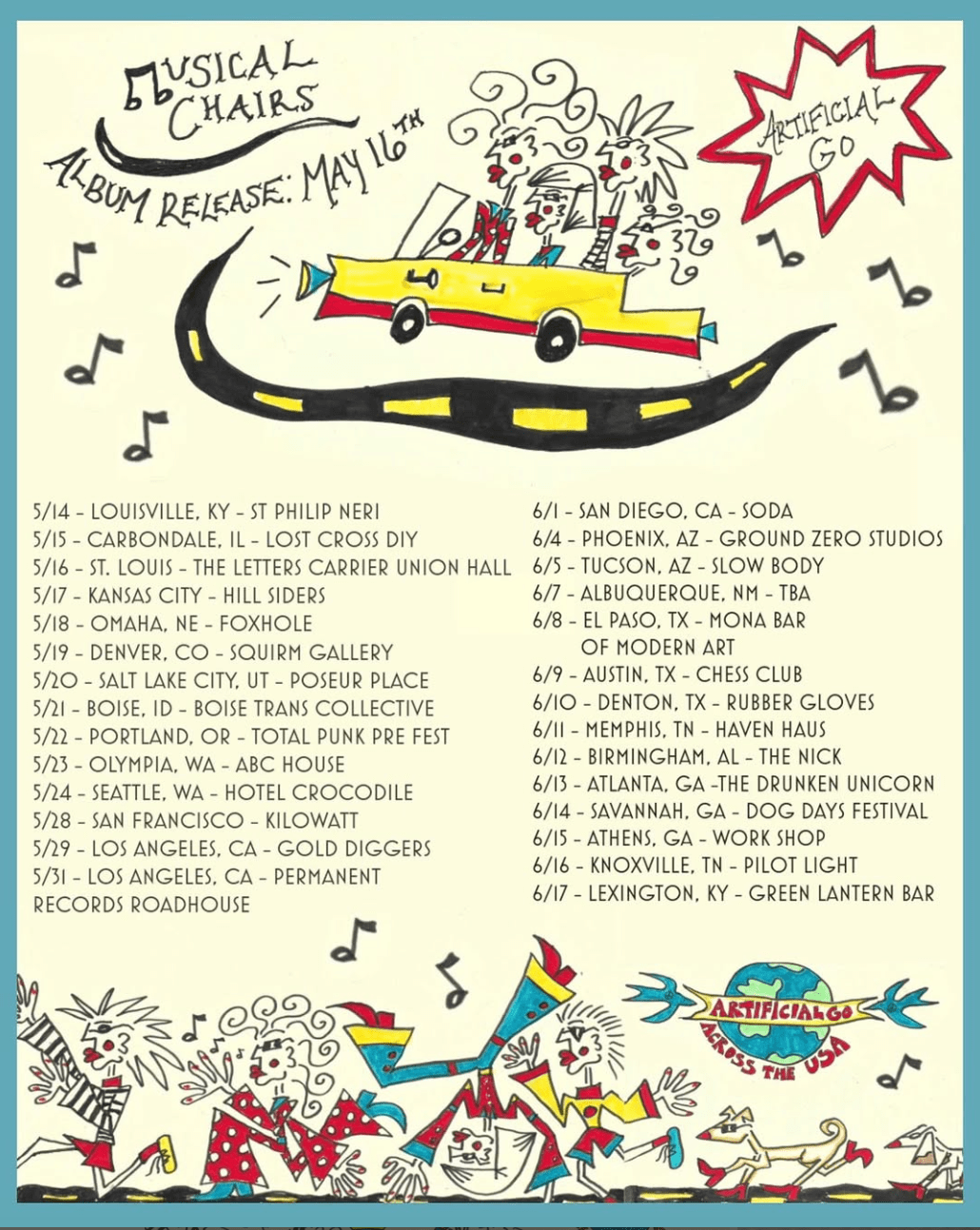
Artificial Go is currently on a five week long tour, fueling themselves with food they cook outside as they share the juices of Musical Chairs at a range of venues and DIY spots across the country. You can catch them on one of the dates above, and purchase a copy of Musical Chairs on their bandcamp.
Written by Manon Bushong / Photo courtesy of Artificial Go
Today, New York based noise outfit Docents released their latest EP Shadowboxing via Ten Tremors. A turbulent and tightly packed five track listen, Shadowboxing is a fervent push and pull, eliciting a ragged fun house of eerie post-punk experimentation as Docents obscures the line between controlled and erratic.
The earliest rendition of Docents traces back to Noah Sider (guitar / vocals) and Matthew Heaton (drums) playing together in college upstate, adding Will Scott (guitar / vocals) in 2018 and Kumar-Hardy (bass) in 2021. The project is driven by an emphasis on noise that feels almost sentient, toeing drastically between minimalist and maximalism without being haphazard. “There’s a pendulum that swings between writing straight-ahead-ish punkier “rippers” and, at the other end, maybe some “thinkers,” and a lot of our songwriting sessions constitute where we’re trying to place ourselves now”, Heaton explains. “There’s no principal Docents songwriter – these are very much struggle sessions, and there’s a lot of material in the discard pile. Our favorite tracks tend to either take six months to finalize or half an hour.”
The EP starts with the melodically winding “Garden”, where jerky sonic elements find grounding in assertive omens and warnings of “the land will pass judgement, it’s body keeps the score”. It’s unclear if the track “Shouldn’t We” is posed as a question or a proclamation, as Docents fervently chants the statement over a swelling of pulse-raising noise. The EP ends with “Workout”, where Docents offers both a resolution to the disorientation and a new dose of unease. An abrasive clutter of “what ifs” are countered by tranquil utterances of “then what, what now”, the dialogue unraveling against pounding walls of foreboding and flammable sound.
“Shadowboxing is our first release that feels like a cohesive unit since our first full-length from 2023, Figure Study. We recorded Figure Study to sound like a really clean version of a Docents live set – our incredible engineer Sasha Stroud ran a tight ship – Dan plays more of a producer role in our sessions. This led to more experimentation and iteration in-studio, especially on Shadowboxing”, Heaton says of the release.
Shadowboxing is out everywhere today, and can be purchased on CD via Ten Tremors.
“We’re informed by the dump we play in,” Spencer Morgan amuses towards the end of my conversation with Devils Cross Country. It’s kind of a beautiful sentiment, though in no way a hyperbole – the location where the band currently plays in Cincinnati neighbors a “Recycle America” facility. “It’s just piled sky high.” Connor Lowry explains. “The other day it looked like it was going to spill onto the street. A bunch of washing machines and plane parts.”
It is natural for a band to grow into its sound, and for their discography to reflect shifts as they inch closer to the music they are meant make. This can be a gradual phenomenon, or it could be as radical as a Frank Ocean remix project flourishing into a robust “four and a half” piece indie rock band. Devils Cross Country exists in the latter, and as drastic as that sonic shift may sound on paper, the project’s 2024 debut record affirmed that their current identity is by far their most authentic. Possession is Ninetenths tells a story of desire in its most innate form, the ethos of the album contrasted by a swarming of maximalist sound. The record is a tightly packed nine tracks, warped by a sea of synths and abraded by rusty samples that peel and chip at the ends. The listen is guided by a raw honesty, simulating the complexities of intense inner conflicts and and guilt-drenched longings through experimental song structure.
Amongst the many facets that shaped the current disposition of Devils Cross Country, the most salient was Patrick Raneses’ return to Cincinnati. Home to an animated post-punk scene, it was there that he enlisted drummer Spencer Morgan and bassist Connor Lowry, the three of them planting the project’s early seeds into hardpan Ohio soil. They shifted to a heavier sound – an outcome of existing in an environment where noise is as much a necessity as it is a stylistic choice. “When you’re in these environments, you physically have to play louder because some dude’s doing a Rob Zombie cover underneath us and there are screeching trains just ripping through outside,” Raneses tells me about the city’s impact. It was in these lighthearted moments and deprecating jokes that the members of Devils Cross Country’s relationship to Cincinnati felt the most fervent; as the three of them reflected on cracked foundations, greedy landlords and of course, “Recycle America”, their persistence to create and sheer love for their scene came across the loudest.
We recently sat down with Devils Cross Country amidst their recent east coast tour to discuss the history of the project, “trudge” music and their experience in Cincinnati.
This interview has been edited for length and clarity.
Manon: I know Devils Cross Country began during lockdown, I would love to start by hearing about the project’s initial roots and how it has evolved over the last few years?
Patrick: So I was in a band called Stem Cells at Fordham University with my friend Jake Lee and Frost Children. The last show we played was a day before lockdown, we did an acapella cover of “Numb” by Linkin Park, so we joked that we cursed the world with that one. Jake moved back to Phoenix and after graduation I moved back to Cincinnati, but we had always worked on remixes and that sort of stuff together so through the pandemic I was making music and writing songs that were definitely more indie rock oriented. I’ve known Spencer for a while, we were friends in high school and we started jamming together in 2021.
Spencer: Devils Cross Country became a band in 2022, when [Patrick] moved into our house. We lived in a house venue in Cincinnati, it was called “The Lawn”, it had AstroTurf in the basement that someone had stolen from the football stadium at UC and they kept it in the basement, at least that’s what the landlord told me when I moved in. Pat was looking for a room and then moved into our spot and the project just happened from there.
Patrick: That’s where Lawn came from. It was the perfect practice space and then we recorded that first EP there.
Manon: Do you still live in that house?
Patrick: No, they kept jacking the rent
Spencer: It doubled since we moved in, and the conditions were not worth it. Our house was falling apart and there were cracks in the foundation.
Manon: Okay so now you’re on your first tour since you released Possession is Ninetenths. Your music now has a lot of different layers and samples to it, how have these shows been, and how do you translate your recorded songs into a live format?
Patrick: We don’t feel super tied to like the recorded music, we are flexible and I feel like every show we have played has been different. We used to have two other guitarists in the band, and then we went to a three piece and now it’s kind of back to a five piece. Informally it’s a four and a half piece. I had come up with this plan a year and a half ago called the prosthetic plan, where we just add ’em on like extra limbs and it’s actually worked for the most part.
Our friend Nina, who is in another band in Cincinnati called Spoils, plays violin with us live now. It’s awesome, she was supposed to come on this tour with us but she got Covid on Sunday. I would say the past few months we’ve been working on a lot of new songs, we have a banjo guy too, Patrick number two, he is also named Patrick. It’s cool because we’re not reliant on them, but when they pop in it adds a lot.
Connor: Yeah, Nina and Pat can just jump into whatever we’re doing. Nina will just pick up a new song and instantly play the best she possibly can. It’s awesome, and a lot of what she does is straight improvisation.
Spencer: They need no instruction. Patrick and Nina are in another really cool band called Five Pointed Stars, it’s a slightly experimental dance project.
Manon: You mentioned you are working on some new music?
Patrick: Yeah, we played a couple of our new songs last night actually. I am trying to be more melodic because a lot of the songs on Possessions is Ninetenths are intense, so the new music is a bit happier and has more of a pop center, but still true to Devils Cross Country. I feel like Lawn was this bedroom pop, slacker rock EP and Possessions is Ninetenths went in a completely opposite direction. With the new stuff I want to push hard in both those directions.
Connor: Maybe in the middle somewhere
Patrick: No, other way. Stretch hard on both ends. Sometimes I’m like what genre are we even playing right now.
Spencer: Oh we’re playing trudge. That’s what we call everything, it’s a lax genre so we invented trudge. It’s a weird blend of guitar and electronic music and it sounds kind of blown out.
Manon: I like that, it beats you telling me some hyper-specific ‘-gaze’ with like four words hyphenated before it.
Connor: I feel like I struggle to understand any genre at this point, I just cannot process that information in my mind, so trudge makes it easier.
Spencer: It’s kind of just a lack of any real definition.
Patrick: We had been filming a music video for a song off Lawn called “Fishbone”, and were just driving back and some dude had gigantic boots on.
Spencer: And I was like, “that dude is trudging”
Patrick: Then the word just got stuck in my head.I feel like genre is not super useful anymore, but region can be. Like “Philly” music, that can be kind of trudge.
Manon: How would you describe the music in Cincinnati?
Spencer: There’s a big post punk scene there, a lot of hardcore guys. Corker is the other band I’m in, and a lot of the bands share members. The Surfs are there, Crime of Passing, also Feel It Records just moved there. Also, there are a lot of fresh faces, a lot of young kids making good stuff.
Manon: Do you feel like being in Cincinnati has a big impact on Devils Cross Country?
Patrick: Yeah for sure. When I started the project with Jake Lee, it wasn’t rock music. We were just fucking around, we made Frank Ocean remixes. Then [Spencer] put me on drums and I was in a hardcore band before this. Also, when you’re in these environments, you physically have to play louder because some dude’s doing a Rob Zombie cover underneath us and there are screeching trains just ripping through outside.
Spencer: They sound beautiful
Connor: Yeah they harmonize sometimes, it’s pretty cool.
Patrick: Some dude said it sounded like the studio was burning down where we were.
Spencer: We’re informed by the dump we play in
Patrick: Yeah, there is literally a dump right next to where we play
Spencer: Yeah recycling dump
Connor: Recycle America. It’s just piled sky high. The other day it looked like it was going to spill onto the street. A bunch of washing machines and plane parts.
Spencer: We are just practicing in the most bombed out areas of Cincinnati, but that’s cheap rent so it works. There are so many DIY spaces in Cincinnati, less houses these days but lots of gallery and warehouse spots.
Patrick: When we moved out of the lawn, we didn’t have a place to practice until we moved into this new place. We had to take a weird break, because you need space. I feel like a city’s DIY scene is so dependent on being able to have an affordable spot to make and play music. You need space to be loud.
You can listen to Possession is Ninetenths out everywhere now!
Dan Parr, the ever-expansive stamina behind the UK-based project The Last Whole Earth Catalog, has recently shared with us his second single of the year called “33”. Following the previous track “The Fruit Expert” released back in January, a more freeform and jazz-fueled character in his repertoire, “33” finds Parr deep within his most internal and conflicting moments, rearing both tough reflection and enduring gratitude as he grapples with his journey of being to hell and back.
Beginning amongst an array of rhythmic fixations, layering guitars that ring out with a familiar whimsy, Parr invites us into a deeply textured plane built out of his recording intuitions that have rarely led him astray. Enticed by the pacing in his lyrical phrasings, “33” focuses on the ideas of love and loss within the play of mental health, where it’s hard to show someone you love them if you don’t love yourself. And as phases of internal unrest rattle amongst persistent drum clicks and sharp-edged vocals, bringing out this journey in both fulfilling and very human avenues of grace and love, Parr sings, “Since I’ve been better, we’ve lived more than ever, this would not have happened if it wasn’t for you, I’m so proud of being a couple with meaning, a couple of ducks who just know what to do” — a song of rejoice more than anything in its final moments.
Listen to “33” out everywhere now.
Explore The Last Whole Earth Catalog’s expansive collection on his bandcamp!
Playing throughout the New York scene with friends, adding in cello and vocals wherever it may be needed, Tallen Gabriel is no stranger to the motion found deep within music and community. Captain Tallen & the Benevolent Entities is the Brooklyn-based project fronted by Gabriel, who as of today is sharing with us their new single, “Be So Nice”. This single marks the first release from their debut EP Easy, Then, set to be released May 2nd.
Introduced by a muted guitar, its fingerpicked pattern stagnant like drops of water on a hallow surface, Gabriel soon begins to collect a groove that lends itself to the emotional lens and stunning unravel of what it means to be wrapped up by sheer longing. Playing with the open space the group has so tactfully created, “Be So Nice” effortlessly shifts between conversational movements and drastic dynamic lifts, allowing the instrumentation to ground the track as harmonies swell and distorted accents rip through the landscape. At times their voice sounds mournful in its pacing, yet Gabriel’s deliverance is nothing short of empowering, bringing both a gripping presence and tender release to the here and now.
Listen to “Be So Nice” here!
Easy, Then is set to be released May 2nd via Sage Records.
Every Wednesday, the ugly hug shares a playlist personally curated by an artist/band that we have been enjoying. This week we have a collection of songs put together by Sabrina Nichols of the Rochester-based project, shep treasure.
The music that Nichols writes under shep treasure builds out from soft landscapes, lingering with haunting chord progressions and delicate melodies as the tunes become embedded into any environment that they are introduced to. Releasing music since 2018, shep treasure’s latest LP, 2023’s 500 Dead or Alive is both an organic and fragile experience, offering comfort to both our most primitive instincts and the view of the unknown ahead, encouraging us to take that first step in.
Listen to Nichols’ playlist here
You can listen to all shep treasure releases as well as order a cassette tape of 500 Dead or Alive on their bandcamp.
Written by Shea Roney | Photo Courtesy of shep treasure
“Old Friend” is a love letter to people looking over the edge penned by a person looking over the edge, or who has at least spent a good deal of time looking over it before. The edge of “what,” exactly? There’s the proverbial cliff, or perhaps more applicable to modernity, the roof ledge. But, holistically to the modern world at large, the edge is less a razor-line than an amorphous amalgam of youth, love, doubt, hope, disappointment, fear, exhaustion, beauty, trust, and once again, deep, all-encompassing love. What it means to grow up or at least grow older and see some ideas you thought you had about the world and the people in it fall away, and what that means, and how destabilizing that can be. How to step out of that years-lingering mushroom cloud.
“Old Friend” is the debut album from Hazel City, the brainchild of Clay Frankel, guitarist and vocalist of Chicago-based Twin Peaks. (This album also features some tasty upright bass from fellow Chicagoan Liam Kazar of “Shoes Too Tight” acclaim). Time has only made this capsule sweeter. When the album first dropped in June 2023, I came to it very happily entrenched in this-changes-everything romantic love, and found plenty of tender lines herein to feed my affliction like “Are you looking for a husband or just someone to get drunk with? What you want is never wrong. I could do both or either one. I could see us holding court at night or you holding our son.” Now, I revisit “Old Friend” in the early days of an equally life-changing breakup, and there are plenty more morsels waiting in these lines for me this time around – stuff I missed on the first pass, or more accurately, wasn’t ready or able to hear. Frankel’s record is a lyrical kneecapper, brutal in its simplicity and unflinching in its sincerity.
“Rain” (the opener) is the star track for me, followed closely by “Dirt.” The piano composition on “Rain” is jaunty and impressive, tones that make this gloomy ballad wildly poignant instead of weighing too one-note sad – and this is a sad, sad song. It opens with radio static and rain sounds, immediately evocative of Edward Hopper’s “Nighthawks,” and the singer is telling a similarly domestic story. He’s pacing from the living room to the kitchen to his young daughter’s bedroom waiting for his lover, late, to arrive back home. Our speaker is sadly, patiently, even a little worriedly waiting while, outside, it rains.
This album is unexpectedly orchestral in scrumptious pockets the listener doesn’t see coming – like “Snow,” an interlude that contemplatively heralds the next song (“Gorgeous”), not unlike “Behind the Wall of Sleep” into “N.I.B.” on “Black Sabbath” Black Sabbath. When it arrives, “Gorgeous” is cheerful but not naive. It doesn’t forsake a lively beat to lean self-indulgent or heavy-handed, but it’s still enough to break your heart. (“I knew that you were someone that I wanted to get to know, and now I know you, but I don’t know if you’ve done me any good.”)
No rest for the wicked! Next track “Really” rips in with another kneecapper, “What am I so dumb that I don’t know? Haven’t I been good and beautiful?” backed by dreamy effects keys from strawberry chimes to space bells. One song later, our singer lays the heater “No one remеmbers what we did. No one was еven looking. No one knows we almost made it. No one knows how close we were.” Holy shit! Ow! Not the Face!
“Rain 2” is clearly the answer to “Rain,” the cryptic counterpart of the earlier story-song sung by a piquant chorus of vocalists Emily Neale, Lillie West, Quinn Tsan, and Elizabeth Moen. But, in subtler ways, “Root” is the response to “Dirt.”
“Root” is a vote of encouragement to keep fighting the good fight – an intensely sincere, even desperate plea for loved ones to just try, try again. Its non-naive world weariness prevents this track from being gratingly optimistic. (If there’s one thing people on the edge historically respond well to, it’s a “Hang in there!” cat poster.) Instead, Frankel posits, “I know it’s hard they’ve saddled you up with a heavy heart, well ain’t that a weight we can share.” This is a track that recognizes that the world is fucked, and that at the end of the day the Everyman’s antidote to surviving it is just living the best you can from day to day, loving other people, and letting them know how deep and life-affirming that love really is. Frankel is speaking here about the type of love that is only earned after years of walking the rock beside a person – which might be where the album title “Old Friend” comes in. For the rest of us, “Old Friend” offers an answer to the sempiternal background question that takes on an especially tooth-shaking volume in eras such as ours: “What now?”
As a small music journal, we rely heavily on the work of independent tape labels to discover and share the incredible artists that we have dedicated this site to. Whether through press lists, recommendations, artist connections, social media support or supplying physicals, these homemade labels are the often unsung heros of the industry. Today, the ugly hug is rolling out a new series called the tape label takeover, highlighting individual tape labels that we have grown to love, with our friends over at Anything Bagel kicking us off.
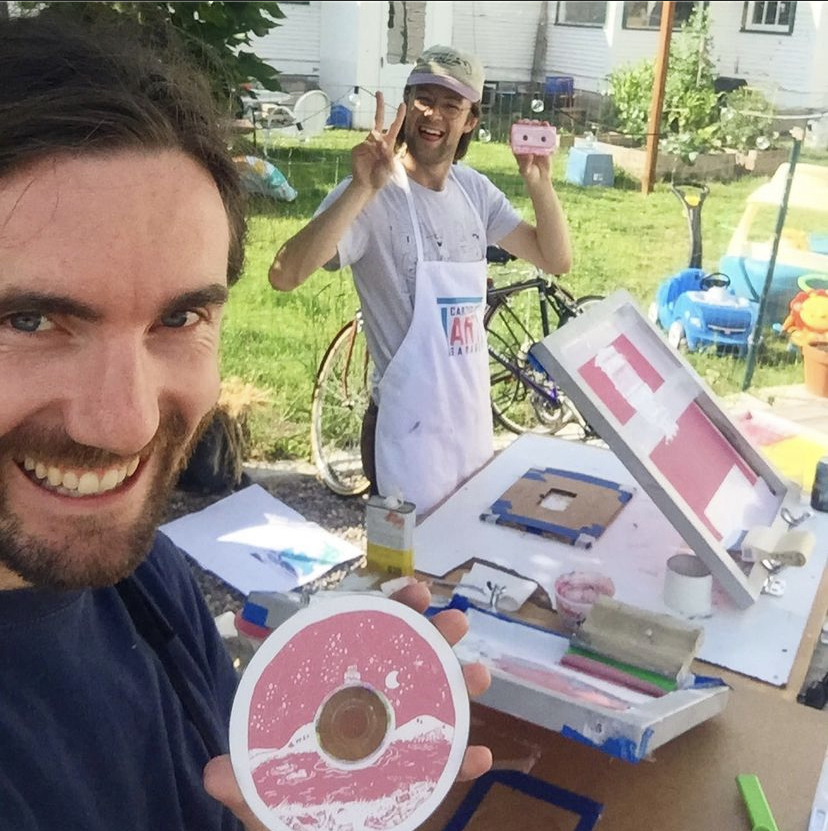
Anything Bagel, a vibrant tape label run by Jon Cardiello and Sandy Smith out of Butte, Montana, is driven by a deep passion for DIY music and community. This duo produces limited-edition, screen-printed tapes that capture the spirit of DIY craftsmanship. With a focus on small-batch releases, Anything Bagel has cultivated a distinct identity that resonates with music enthusiasts, offering something truly special in every release. In this interview, we explore their journey, creative process, and the inspiration behind their one-of-a-kind label.
Jon Cardiello and Sandy Smith
This interview has been edited for clarity and length
Kat Curey: What sparked the idea to start a tape label?
Jon Cardiello: I think it was 2015-2016 when we were getting into the DIY music world, and I had lived in New York for a little bit and we were kind of following a couple cool little tape labels. MT. Home Arts was one that we really liked that was making these screen printed tapes out of New York. We were also into Sleeper Records out of Philly and there were some in the Northwest that we were into, but it didn’t really feel like there was anybody we knew doing it in Montana that our bands could put projects out on. I felt like kind of being voyeurs into other people’s scenes but there wasn’t really anything in our scene that was doing this and so you know I think it was with my first solo album, Placid Lake, that we were finally like, well maybe we should just take the jump and just do it so that we’d have something to release our bands projects on, and also our friends’ bands.
Sandy Smith: We also wanted to get into screen printing as a practice, and it was kind of an excuse to learn more in that world. Jon had done some printing stuff before but we had a couple of friends in Missoula who were incredibly talented screen printers, Max Mahn of Twin Home Prints, and then Foster Caffrey. Foster especially helped us with specifically printing on tapes, and how to translate some of the stuff to record label-specific printing, and Max is just an all-around whiz and so invaluable, keeps teaching us stuff; he is incredible because he’s really, really good at it, isn’t annoyed when we have beyond beginner questions like, okay, “I understand that’s how you’re supposed to do it, but what if we wanted to do it like really cheap and shitty in a basement, how would we do it then,” and he was even willing to help us figure that out too.
KC: Can you share the story behind the name of the label?
JC: I feel like we were trying to think of something that felt representative of our friendship, and at that point in time, I wasn’t living in Montana, I was either in Seattle or New York and I would always come and crash for extended periods of time in Sandy’s basement to do music stuff and I think we just ate a lot of bagels is why that came up.
SS: Like one a day, 1.5 a day average; there were a lot of days with more than one bagel.
JC: We both really like bagels so something bagel-related was one of the many brainstorm ideas. And then I think we also just liked the idea of a label name that doesn’t necessarily sound like a label.
KC: As a duo, how do you divide the roles between each other, and how does that shape the way the label runs?
JC: The screen printing we always do together aside from a few exceptions when one of us was too busy or something, but I feel like it’s incredibly time consuming to do it that way. That keeps us kind of going at a slow enough pace where we can’t take on too much, which I think that’s been good for making it sustainable. We just always end up getting together to hang out and screenprint, which is fun. And it just reinforces the parts of it that we like most, which is the art, the music and the community, even when it’s just us two hanging out getting excited about music.
SS: It’s fun. We listen to cassette tapes and print together. I think we get a lot out of it.
JC: It’s always good for filling the tank of why it’s all worth putting in so much time into this passion project. Generally I do all the design stuff because I have a background in that. Sandy duplicates all the tapes and generally folds and glues the packets after we print on them. Sandy has kind of taken over the press department. We used to do that together.
SS: We still mostly do it together [laughing].
JC: Yeah we do a lot together.
SS: Jon has been dealing with most of the uploading and digital distribution stuff. And it’s a whole thing. There was a time when Jon’s job was really chill and it was a fun thing to do in the day. Now Jon’s job is less chill so we might be reconfiguring slightly.
KC: What motivates you to keep the label alive, especially with how digital music dominates today’s scene?
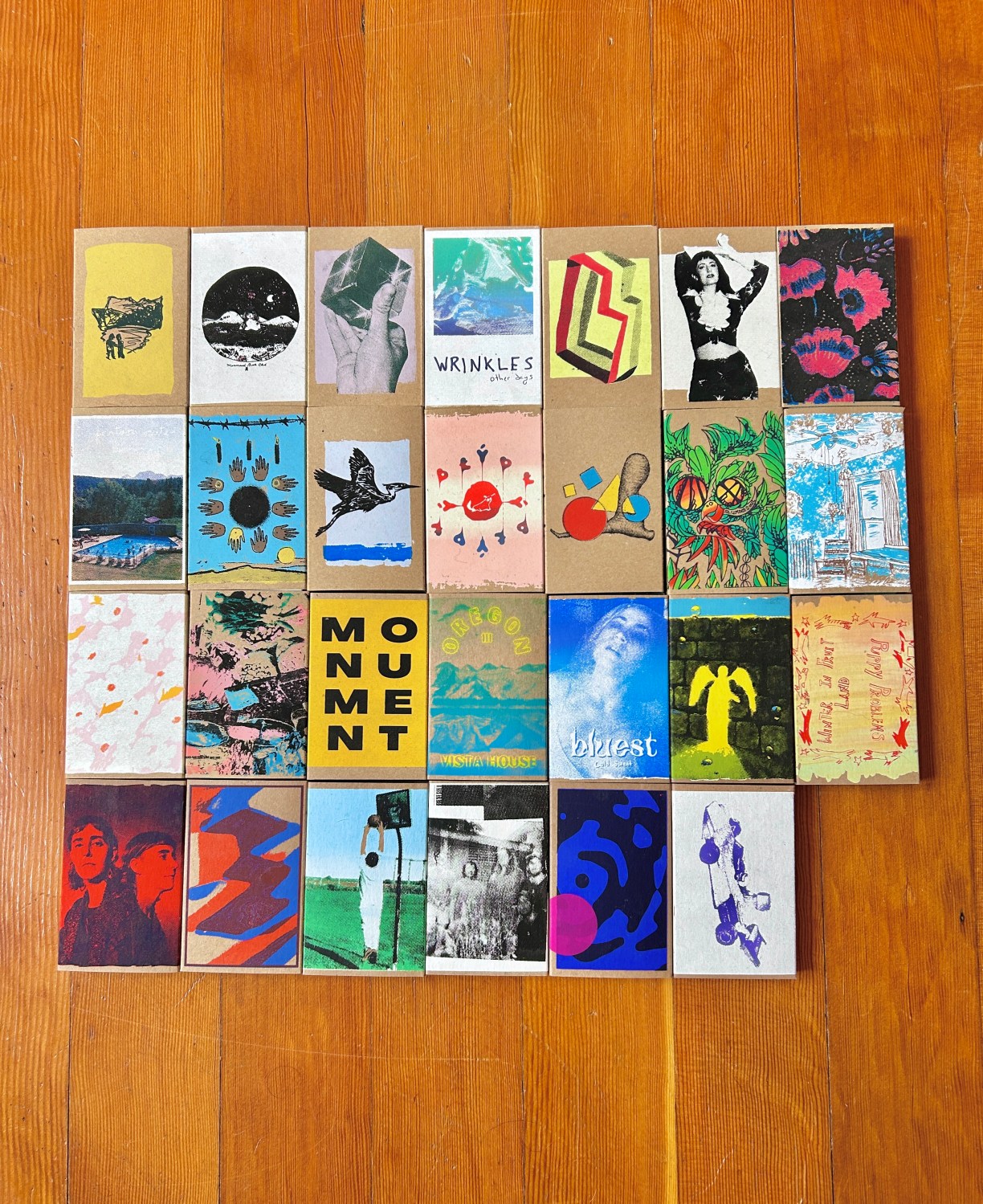
JC: Yeah it’s kind of amazing that now we’re at release 28, but we’re still sticking to the exact same cassette tape runs that we started with. I feel like we really like the art aspect of making physical merch, we know how helpful it is as a band to be able to sell merch on tour. I feel like if there wasn’t a physical element of it, we just wouldn’t do it. And for me in terms of buying tapes and stuff these days, I feel like my main reason is in direct opposition to the streaming world where I think I just literally would forget about albums, or I do all the time if I don’t have a physical copy of it. Where it’s like ‘oh, that was one of my top 20 albums of that year but I totally forgot about it because I didn’t buy it.’
SS: I think that some of the art object thing is also just a physical object that someone had to put an inordinate amount of time to make the thing exist and it feels precious. But also it’s not like fully giving it away, but it’s close. The tapes don’t really make much money. They’re more there as a representation of the music and the object as a playable thing that actually produces a cool sound. It’s as much the thought of the thing for me that does it.
KC: How do you find the artists you work with? Is there a special connection or vibe you look for?
SS: Well, I’m A&R on the team and let me tell you, it is difficult [laughing]. It’s nice now we’re going to be putting out some recurring artists. We’re going to put out a Zinnia album. We’re going to put out Jon’s album, and we’re putting out the next Vista House, which is really exciting.
JC: It’s nice that right now there’s a little bit of a roster and not necessarily room, we’re already penciled out well into the middle of next year with releases. But fortunately it’s mostly been in the past year or two, people reaching out to us to see if we would put stuff out. It definitely makes life a little bit easier, but we tend to listen to the project and usually do not have any room or time to do it, but then if it is something that we just like so much we try to figure out a way to make it happen.
SS: Like with Levi Minson who we just put out, is someone who actually just reached out to us via Instagram. They had submitted their last album and we were psyched about it, thought it was great, but we didn’t have the bandwidth to do it at the time. And then they sent us this most recent album, Violet Speedway and we both loved it. They were flexible enough that we could go far enough out into the year that worked out for us and for him. So to answer your question, it’s that right now, mostly people are submitting stuff to us.
JC: It very much started out super close to home with our bands, our partner’s bands, our sibling’s bands and Missoula bands. And then it kind of chugged along and took a couple jumps into different scenes which has been neat. An original goal of ours was always to tie the Montana scene into a greater network of bands.
SS: DIY bands, especially.
JC: Yeah. So it’s cool that it’s spread out quite a bit since the beginning.
SS: Now there are little pockets. There’s some bands from the Northwest, there’s a little pocket in Montreal and Toronto and some Philly bands too. And then we’re going to help release a split seven inch record with a bunch of labels around the world for a French band, which will be the first European band.
JC: There’s a Tokyo label, a German label, some French labels and us [giggles].
Anything Bagel Label Sampler
KC: What’s it like bringing a tape from concept to reality? Are there any parts of the process you particularly love—or find challenging?
JC: That part is a pretty fun part of the process. I guess in the most literal sense, we order blank tapes with no music on them and then we make a master tape at home. I upload all the music onto Logic and then burn it on to a master tape that we used to duplicate. We used to have this super sketchy duplicator and it would do one tape at a time.
SS: Our new duplicator is still one at a time and it still ate some tapes on the last run [laughs].
JC: Yeah it usually eats some tapes. We order a few extra [laughs]. And then we order blank card stock so it’s like an unfolded jacket that we screen print onto them. And that process is pretty fun where I’ll work with the artists with whatever the digital art is for the album and we’ll kind of come up with a screen printable version that somewhat references the album art, but it doesn’t have to be exact. Then we print them, fold up the jackets, glue them, and ship them out.
KC: How many do you produce per album? Is it different depending on the album?
SS: Usually 50. We’ve done some that are a little smaller. But usually 50. We like to do limited runs, where 50 feels like a good number. We usually just keep 10 to sell and ship the rest to the artist. Just because we know how nice it is to have merch to sell. But sometimes it’s a different model per release.
KC: The screenprinting aspect of your label is really impressive. Could you tell us more about how that process works?
JC: Well, it did start in extremely sketchy circumstances where we didn’t know what we were doing or have any of the equipment. And so it started when I lived at the farm and we would do it in the basement and we tried to expose screens with just a single light bulb.
SS: With a single UV light bulb. Like a small regular lightbulb.
JC: There was always just so much trial and error in that process where it’d be like we were both working and would get together after work to try to do this thing and it would just fail and we’d have to re-wash out the screens to try again the next week or whatever. And there was a lot of time spent without a washout sink where I’d be in my alleyway in the freezing cold washing out screens. There were definitely times where it felt incredibly ridiculous to do that as part of it. Most tape labels just print out J cards off of a printer which makes a lot more sense.
SS: Which makes so much more sense than the way we do it. The way we do it is so much work.
JC: I think we stand by that. I think that actually it turned out to be an art practice for us too, which is really fun. We fully learned how to screen print and now finally I have a washout sink in my basement that we don’t have to go out into the alley. This’ll be the first winter where we don’t have to go out into the alley.
SS: Seven years in and now we don’t have to go out and do an alley wash. That took a long time [laughs].
JC: We used to just not be able to print tapes for a couple of months, weather dependent.
SS: Yeah, we used to just not do releases from like December until March, mostly.
KC: Anything Bagel seems really community driven. How do you go about building those relationships, and why does that mean so much to you?
JC: I think that that’s the coolest part of it all, I think we felt really fortunate to have been around Missoula when we were getting introduced to this DIY community of bands coming through town to play shows. Then you’d make a friend on the East Coast, and then maybe eventually tour to where they live and get to play and see them again, and I feel that is the neatest part of music really. It’s finding all these people around the country that share this incredibly niche excitement over the same kind of music. And that happens on the internet too, but it’s really cool with music, getting to meet people and those friendships in person have been really cool.
SS: The community aspect started out literally where the first bands we were putting out were our friends’ bands and bands in the Missoula scene that we were really excited about. It’s not so much literal as physical, where it was all about proximity. It wasn’t the only driving factor, but there were a bunch of things we were really excited about that were really close to us. And there’s still a bunch of really exciting things that are happening close to us. But some of them have different homes and different people already doing the things. And it’s been really fun establishing a community that’s more based around the idea of the thing, that isn’t just physical. For example, even this Levi Minson release, he was excited about some of the other music we had put out and knew about it from that. Some are people that we have met physically, in real life, but live halfway across the country. But I do think that the community part of it is an incredibly important driving part of the whole reason we want to do it. And it is mostly just these people who are excited about making music, making art that they care deeply about and that they’re willing to put their time and an insane amount of effort into something that enriches their community and the lives of other people who happen to listen to it.
JC: I feel like when we were in Wrinkles and it was a relatively active band for a while we loved meeting people through touring and making those connections. But since then we haven’t been in bands that are really sending it with touring all the time, I feel like it’s really neat where this project has kept us connected in that way. Getting to meet really awesome, like-minded people around the country doing the same thing as us in different places. But since we don’t really get the chance to tour all that often, it’s cool that this is another avenue to make those kinds of friends.
KC: How does the DIY spirit influence what you do? Is there a part of that ethos that really resonates with you?
JC: I feel like it’s been something that we’re always talking about, because it’s really tempting to always try to level up as a label, to maybe take the next jump with distribution and different label things that feel very businessy. I think coming from DIY music communities, where it’s kept us rooted in the things that we really care about, which is the music, the art, and the people, that’s kind of kept us grounded in making sure it’s always still a really good deal for the bands and not trying to get too crazy with it. Which I think has made it more sustainable at least for us to keep doing it.
SS: Yeah, it’s probably actively making what would be bad business decisions, but just for the sake of having it be something we like to do and that makes sense for us and the bands to still do it. Like economically, it doesn’t make sense, we’re not paying ourselves as labor at all. We’re not doing anything for money, and yet understand that the things we’re making, hopefully are able to make the band’s money. And then it’s a matter of putting in all that time and effort and still balancing it with having a life and needing to work jobs that do make money and figuring out how to have that all balance out. And most of the time that works out alright. Every now and then it’s a little much, but I don’t think that’s anything we want to stop doing anytime soon.
KC: What keeps you going and excited about what you do, especially on the challenging days?
SS: I think it’s loving the thing and just caring about it. We really do treasure this stuff and it’s always exciting to be a part of a release and the whole thing is ultimately such a rewarding and positive thing. Someone put in all this time to make this music and put it out into the world, and you get to help them realize that and I think that’s at least a big part of what keeps it going for us.
KC: Difficult questions but can you share a few personal favorite releases that you’ve worked on?
SS: We kind of love them all, it’s like picking a favorite child. Every parent does have favorite children [laughs]. I’ll start with the New Issue record. The last one that we put out, it’s so good. Absolutely love it. Adore that band. They’re also our friends in Anacortes. We’ve been out there a couple of times to record and have genuinely become friends with them and really like them as people.And they kind of told us that they had this album they’d been sitting on for a long time and we insisted they let us hear it and then insisted on helping put it out into the world and they’ve been great to work with and we really love that music.
JC: I feel like another cool one was Puppy Problems last year. That was another one where we were fans of Sammy’s previous 2018 album, when it was on Sleeper Records. That was truly one of our favorite labels that we were inspired by and so it’s really cool to put out bands that were Sleeper bands at one point. Sammy is just such a talented artist and person.
KC: For those who are looking to start their own tape label, what advice do you have for them and what do you wish you knew when you were starting out?
SS: Do it.
JC: Do it.
SS: Just do it. I think to do it and to try to take steps to make it something you can do for a while. It’s just a matter of fitting it into your life in a way that makes sense and putting out stuff you love.
JC: It is a lot of work, but it’s been incredibly rewarding and worthwhile. I feel like we did a lot of legwork in the beginning, years of ironing out the parts that we really wanted to put our energy into. It kind of took a few years for it to feel like that was working, even with the screen printing and trying to do little bits of press outreach here and there. But I guess, just stick with it. The first couple years might be slow going until it creates a thing, but we just need more and more little labels, because there’s so many good albums coming out all the time. And I feel like, if there are parts that you don’t wanna do, just don’t do ’em.
SS: Yeah whether it’s like making a certain type of physical media press, if you don’t wanna screen print your tapes, lazy [laughs], but understandable. No, but set it up the way you wanna do it, and then do it.
KC: Last but not least, if you could hand select a variety pack of bagels, what would be in it?
SS: Okay, start out with the classic, you know, like there’s an everything bagel in there.
JC: There’s got to be a Helena Bagel Company jalapeno cheddar bagel with plain cream cheese.
KC: Yeah, like an inordinate amount of cream cheese.
JC: I still stand by Helena Bagel Co., it is like one of the best bagels I’ve found west of New York.
KC: Yeah, I know. It kind of goes hard.
JC: At least best in Montana, I’m saying.
SS: Definitely. The tough thing would be, do we actually put in any sweet bagels? I’m not opposed. But next on the list you gotta get an Asiago bagel. They smell a little bit like farts when you toast them, but they’re so good.
JC: I don’t know if we were going to go sweet, though, I would say a cinnamon raisin.
SS: Yeah, cinnamon raisin is good. I like a blueberry bagel. I don’t know, maybe it’s not everyone’s thing but I like that.
JC: That was in my head, too. Toasted with strawberry cream cheese.
SS: Yum. That’s good.
KC: Get your fruit serving of the day.
SS: Ooh I think a poppy bagel is maybe a little bit underrated. I think I would almost always rather have an everything bagel than a poppy bagel, but they’re good. What I’m picturing would actually play well on both of them, but a poppy or an everything bagel with sun-dried tomato cream cheese.
JC: Yeah. Pretty good. Can we say six bagels with their toppings? Because I feel like that’s important.
SS: What’s on the everything bagel? The beauty is it works with so much because it is everything. Anything and everything.
JC: I think lox.
SS: That’s an option?! I thought we were just doing cream cheese! Oh yeah, definitely lox.
JC: Lox and capers.
SS: I mean, that one is the one I’m choosing every day for eternity.
KC: But what about the cinnamon raisin bagel? Did we discuss that?
JC: You know what? It’s really sweet, but toasted with frosting.
SS. Okay. I’ll go with it. I was going to go with just butter on that.
SS: I’ll admit that the frosting is actually very good. It’s just pretty indulgent. But sometimes you need to be.
Final verdict after much deliberation: Everything bagel with lox and capers, Jalapeno Cheddar with plain cream cheese, Asiago with Pesto, Cinnamon Raisin toasted with butter or frosting, Sesame with sundried tomato cream cheese, Blueberry with strawberry cream cheese.
Interview conducted and written by Kat Curey
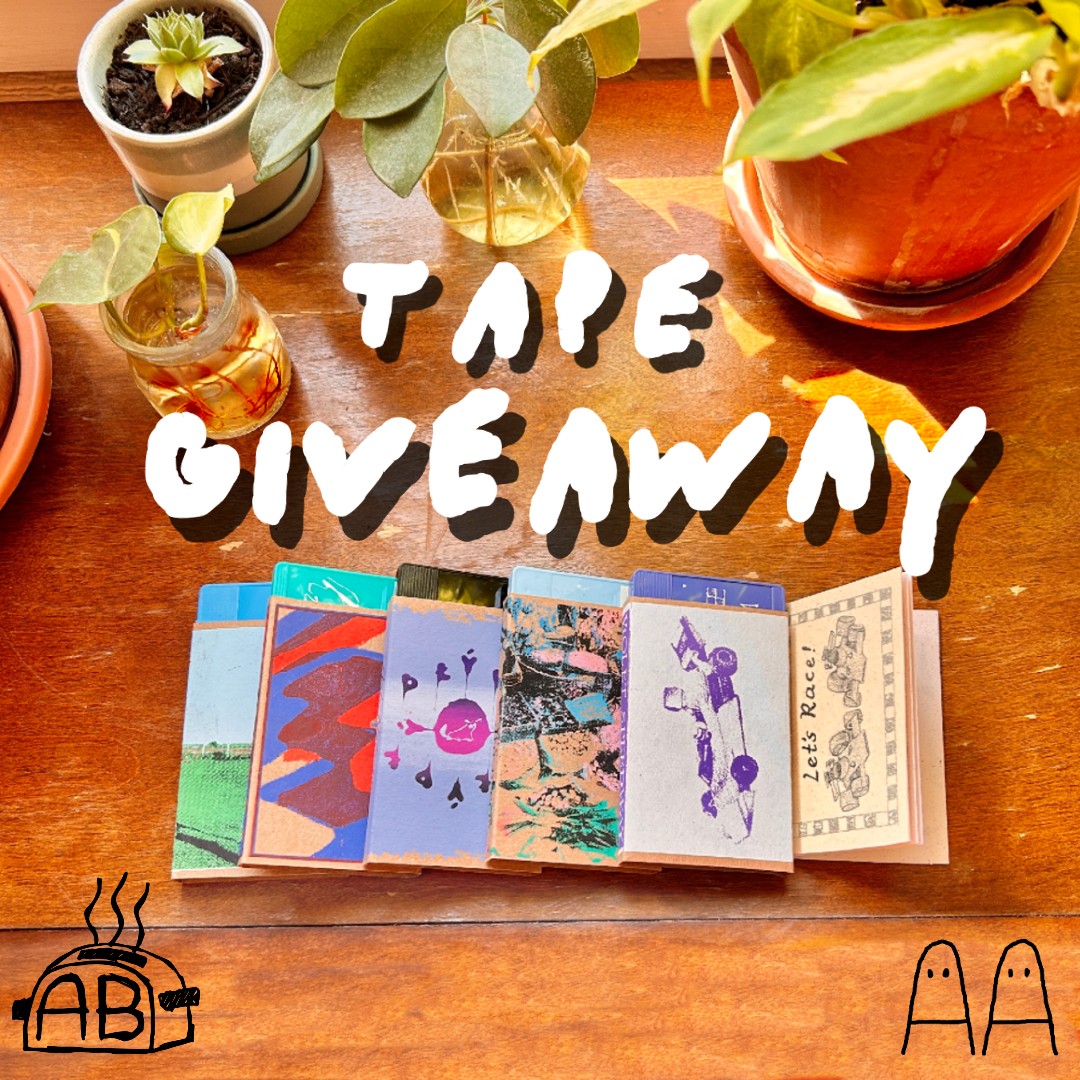
Along with this series, our friends at Anything Bagel are offering a five tape bundle giveaway in celebration of independent music and journalism! The bundle includes the albums Violet Speedway (2024) by Levi Minson, Sun Into Flies (2022) by Joyer, Exit Music for Exit Wounds (2021) by Ash Nataanii, Lagrange (2023) by Panther Car and ionlyfitinyourarms (2023) by Pompey.
To enter the giveaway, follow these easy steps below!







 the ugly hug