Written by Joy Elizabeth | Photo by Vanessa Valadez
Chicago-based group Dendrons’ third full-length offering, Indiana, couldn’t be more of a product of its origins. The title track begins the album, calling listeners to “dissolve yourself,” a refrain cushioned between droning guitars and optimistic lead melodies. There is notable, intentional restraint in the composition, a precipice never quite summited. It makes the LP feel like a dream, somewhere between the grounded real world and the heady, psychedelic swoon of something otherworldly.
While lead singles “Tuck Me Under,” “Monsteras,” and “B4” invite the audience into this abstract sonic landscape, it is the shorter tracks that really complete the picture. “Liminal” and “Opening Play (Make Haste)” (all of 43 second and under 2 minutes, respectively), bridge the gap between heavier, fuzzier compositions and cleanse the palate for the main event.
I caught up with Jarvie to dive into the themes of Indiana, its “fractured” development, and how the group metamorphosizes restlessness into a punch.
Dendrons has been described as a collaboration of two childhood friends who reconnected later in life. With tracks like “B4” exploring the haunting nature of the past (memories stored in location), would you say that Indiana is an ode to home?
Dane Jarvie: I would say Indiana represents a lot of things to me personally. It is my origin in the sense that my grandparents on my mothers side came from there. For me it exists, partially, as a liminal space. A perpetual ground between loss and reinvention. A cosmic purgatory. A place that I find myself in throughout most of my life. I think there is a strange beauty to it that I find intoxicating. A lot of Indiana feels so familiar to me even though I had never grown up there.
On a physical level, it is probably one of the states that I have driven through more than any other. It is omnipresent.
Lead single “Tuck Me Under” nearly hits the 6 minute mark, cascading between lulls and frenetic breaks. What was the process like composing this?
DJ: The majority of songs on this album were written in fractions here, fractions there—piecemeal. Ableton demos that were pitched by members of the band were re-imagined, re-arranged and built back up as a unit—sometimes bearing little resemblance to the original tune. Then the songs would evolve again when we went to the studio. Everything was always in flux until literally the last moment.
“Tuck Me Under” was constructed in a similar fashion. It started as a short demo of some acoustic improvisations and electronic embellishments, and it was run through the grinder, going through many different shapes and shades.
The sprawling, acoustic, ethereal end section was pitched by Tony, our engineer and co-producer, as a concept, and I remember during the pre-production stage, we stayed up in a windowless basement till 4 or 5 am, hammering out chords on a nylon string guitar and singing melodies. That part was written in Normal, Illinois. The original demo for the end section had us putting violin bows over guitars, and we spent a long time creating hypnotic feedback.
We were so sleep deprived when we recorded these ideas that when we listened back to what we wrote, it felt like it came from someone else entirely. I think this all contributes to the overall feel. As far as how the vocals went for this album, melodies came first, and the lyrics were arranged at the very end of the writing process.
There is a restless energy that blankets the album, an eagerness to break through monotony felt particularly in “Monsteras.” Where does this come from, and have you found that channeling these thoughts into your work helps release them?
DJ: I think this album was created in a state of uncertainty. I think a lot of us were yearning for a reinvention creatively, but there was not a specific road map for how to get there. It was all new territory for us. There is an inherent tension with the tunes. There are a lot of heavy creative forces at play in these songs—Every member of this project has a different vision for how something could or should sound. A lot of compromise had to be made in order to make things fit. Sometimes the clashing ideas were left in the music and made as a creative choice, as a statement. I think those moments are important to represent in an honest way.
You’re credited as co-producers on the album with Tony Brant. Do you feel like having your hands on production keeps you in the driver’s seat of each project?
DJ: I think we all consider production, and the creative choices associated with tone and sonic palate, to be a large part of the artistry for us—a large part for the recipe that makes this band what it is. Taking ownership of this is emboldening.
Tony played a huge part in it too, keeping things moving and adding a coherence to things.He added a certain technical prowess that we really appreciate. Everything is mostly collaborative, though. We play specific instruments on the stage, but as far as writing goes, we are multi-instrumentalists in every sense. Sometimes I would write parts for another member, or they would write parts for me, or maybe entire sections with all instruments of one section were structured from one person’s Ableton demo beforehand. It didn’t matter who wrote what part. We tried to put egos aside as best we could. The most important thing was did the part sound good coming out of the speakers? It didn’t matter through what person (or avenue) it was achieved. This was the prevailing attitude while writing the record.
You’ve noted the Chicago DIY scene as pivotal in your career. How has it supported you and how does it fit into your story now?
DJ: Chicago is where the band was started and it is always gonna be the home base for most of us. We are a product of the environment we grew up in. I do, however, think a big part of our sound is also the product of us finding ourselves on the road, touring, and getting outside of our comfort zones—interacting with communities all across North America. We are very much a band that is informed by our experiences traveling, and I have always appreciated that aspect. I want to honor that.
You can listen to Indiana out everywhere now via Candlepin Records.
“I’m self obsessed / I think real hard and I do my best, to do my part,” Dexter Webb sings on the aforementioned “I’m Self Obsessed”, the second track off of his latest album It’s All For Me self-released this past September. You can often find Webb playing guitar in the touring band of Indigo De Souza or playing in various live musical configurations around North Carolina. But back in 2024, Webb shared So I Lost My Shot!, a debut album of lost sounds and ideas that took a long time to feel complete after its initial release. It’s All For Me had to be released cut and dry for both its own and Webb’s sake to move on to whatever’s next.
Throughout Webb’s figurative stylings, accumulating tinkerings with instinctive sonic fulfillment, It’s All For Me sounds like striking gold in the junk drawer; the lost forgotten treasures of yesteryear that now take on a new meaning. Action figures who peaked in high school, AAA batteries with a bit of juice left, old baseball cards where the players all seem to wink at you with profitable intents; each track runs fast and with harsh familiarity as Webb writes with such classic strains of pop hooks and instrumental progressions, yet still maintains to be fully and remarkably individual. “But that ain’t me / at least for now I still wanna be right off of the track / where I can’t hear the train and all of my friends are just doing their thing”, he continues on “I’m Self Obsessed”, lighthearted amongst the chimes of bells and glitching inputs. It’s All For Me does feel like it was written for an audience of one, and to its credit, that’s what makes it so special. It’s both confrontational and comforting, gripping tightly to the dichotomy between the act of making art and sharing art, as Webb continues to define pleasure, space, and voice in what he does.
We recently got to ask Webb some questions about the album, the struggles of working solo and his ever-shifting writing process.
It’s All For Me is your latest album to be shared with the world. How does it feel to have it out?
Feels positive to be out from under one thing and crawled up under another. It’s generally good for me to have less to consider, and I haven’t thought about those recordings much since that day I put it up. The process of making it felt important, but not sure how I feel or what it means otherwise.
You have participated in several other NC bands over the years, either offering guitar work or helping with recording services. When did you want to start releasing your own stuff? What did your time working with other artists bring to your own work, and what does it mean to have something entirely your own?
I always wanted to, but it can be psychologically complicated to be alone in that process. With friends, I can at least take comfort in the simple truth that playing music with people I love is GOOD. That’s more than enough a reason to do it. For whatever reason I have some elusive, ghostly shame around my own public creative existence.
Photo by Charlie Boss
Like you said, having these songs to sit on and to consider and to put out, does that feel like a chore or a task to complete for you? What makes you put out your own work despite the ghostly shame?
No, never a chore. I don’t want to force it. Feels like I can’t afford to let the good thing go sour. There’s always fun to be found in it, it’s just a matter of if I can let myself go there.
Your approach to releasing music on bandcamp is fairly loose, being comfortable making changes and trying new things. Did the making and releasing of It’s All For Me differ in the way you released So I Lost My Shot?
Two very different experiences. So I Lost My Shot! was a yearlong roll out of whatever I was finding on old tapes and my couple broken computers. I found myself looking around for something when I felt down and didn’t know why. Usually took one or two manic flurries for another batch of songs to get thrown up. I’d take it down when it felt weird, and every once in a while, throw it back up with another half hour or something. I’m far enough away from it now. It’s All for Me came from my first time not having a home recording setup and sitting around writing songs was my only option. As soon as I could plug shit in, I recorded them as fast as I could and put it up.
Do you think that initial reaction to write first and then quickly record and share all at once affected how this album came out in the end? Whether that be creatively speaking or the way you were able to put it out and let it be?
It did. I could’ve easily strangled it into something else, if I didn’t learn my lesson the first hundred times. More time with something usually allows more of those self-destructive thoughts to show face. Music I’ve made that I “loved” the most and spent the most time with had to be destroyed. Better for me not to get too attached, because I can and will. I have more creative self-trust now that I will just write more and keep doing what works. The shame doesn’t have much good to say, it’s just that part of the brain that if you listen too close it can push you to complete nonexistence, probably best to do the opposite of whatever it says
There seem to be instances of grappling with perception of self and the way you are perceived by others. Where were you writing from for this album? Were there any themes you found yourself writing to?
Mostly writing about confusion, my death, and trying to make myself laugh.
You also work a lot with video and animations. What is your relationship to visuals? Does it influence the way you approach making music at all?
Not so much anymore. I had fun while I was doing it. I think it came from being on tour all the time and editing video was something I could do in the van. I’ll probably play with clay again, but it takes a warm space for my hands, and I find myself currently bouncing from cold to colder.
Written by Emily Moosbrugger | Featured Photo by Noa Francis
Last month Minneapolis-based songwriter runo plum released her debut album “patching,” after five years of self-releasing a series of singles and EPs. Joined by co-producer Lutalo and instrumentalist and girlfriend Noa Francis, runo recorded the album in two weeks in a cabin in rural Vermont. The resulting 12 songs were described by runo as “emotional fragments” of her healing process compiled into one project.
Rooted in the aftermath of a recent heartbreak, “patching” places its trust in life’s natural cycles. As early as the opening line, runo’s plainspoken, cool delivery echoes a calming sense of patience amidst her growing anxieties: “As long as it doesn’t mean it’s a big sickness/ Mighty fine with me, I’ve been already through this.” The record moves through the ebbs and flows of emotional reconstruction, drifting from daydreamed fantasies of sweeter times to soul-baring introspection. “There’s gotta be a way to get out from under the mud,” she sings on “Pond” with a yearning for clarity. It is moments like these that define “patching,” in which runo makes clear that even in her deepest melancholy, she is held together by a faith in her natural ability to be put together again.
Photo by Alexa Vicious
Congratulations on your first record release? How does it feel to have it out?
Hello! It’s surreal, and a big relief.
You described these songs as “emotional fragments” of your healing process patched together into one project. In addition to writing these songs, do you feel like sharing them with the world is part of your process of healing?
Absolutely, it feels like the final step in some way.
You mentioned you had written enough material for three records at the time of writing “patching” – how were you able to separate these songs from everything you wrote at that time?
The main two are split between the more “folk” ones and the heavier more “rock” ones. The third are just shitty sappy discarded songs that I will probably never use lol!
I read that you put out your first release through Bandcamp in 2020. You’ve been able to gather a community of listeners from around the world since then – has having a community like this impacted your relationship to music making?
Totally. It’s definitely kept me going during certain moments. It’s really touching to be able to make something that is meaningful to more than just myself.
Had you been writing music for a while before you started releasing your songs?
Never consistently. I would write occasionally since I was like 14 ish. Maybe like a dozen songs in total in my teen years. Then I really started writing in my 20s.
How do you feel your songwriting and recording process have changed from the time you started putting music out to now?
My songwriting especially has gotten a lot more meaningful to me. I’ve had a hard time being able to access that in the past, and being able to properly articulate how I was feeling. In the beginning I had a lot of songs where I wasn’t really saying anything, I was sort of just rambling about random things. I still write like that sometimes but generally it all feels more cohesive to me.
For recording, in the beginning I had no idea what I was doing. I taught myself how to produce and record for the first couple years, and then Phillip Brooks came along and helped me record the early stuff I have out. But we were really just both figuring it out as we went. A lot of the songs on ‘patching’ feel like the sound I was trying to get to for many years.
One of my favorites on the record is “the Quiet One” – You open with the line “how can I make this as vague as I possibly can?” – I love that because you touch on wanting to come off strong to your subjects yet your songwriting is so intimate and raw. How would you describe your relationship to vulnerability within songwriting?
Oh wow, yeah. That one is somewhat of a black sheep of the album that I made fit in. It’s funny because I started with that first line, and then it turned out to not be so vague. This song was a place for me to put my feelings about a short lived thing I had with someone. I never shared it with them, so having it out is definitely pretty vulnerable, but I think that is just a part of being an artist, and especially a writer. It is all just very human feelings and I know so many relate to this stuff so that makes it easier to share.
The outro stands out from the rest of the record both lyrically and instrumentally – can you tell me a little bit about that imagery and this song?
Yeah! This was originally a poem I wrote during a really beautiful walk I had last summer. It was one of those weird weather moments when it was slightly raining and also sunny. It felt very representative of the contrast I was feeling in my emotional world. At that point I was falling in love again after the breakup that was the catalyst for patching, and I had reached a level of beauty and peace that felt really unexpected.
You can listen to patching out everywhere now as well as grab it on vinyl, CD or cassette via Winspear. Catch runo plum on her first headlinging US tour starting in February.
Interview by Ella Hardie | Photo Courtesy of Gren Bee 4/20/2025 at Empty Bottle.
The first time I saw MaryMary! perform live was in 2023 at a short-lived DIY venue in Avondale called “The Rabbit Hole,” with her nest of wires, synthesizers, and pedals set up on a couple of folding tables. This was among the first house shows I’d attended in Chicago, the very first electronic show I’d ever seen, and one of the first times I’d seen Mary, my coworker at the time, outside of work, though this wasn’t Mary’s show—it was MaryMary!’s show. Her backdrop could’ve just been the basement’s paint-chipped walls sparsely adorned with band stickers, sharpie’d declarations of love, and duct-taped fliers from shows past, but she turned the space into a spectacle: on her left, neon green lasers swirled on the wall and live camcorder footage of herself was projected on her right. These visuals and an epic cover of Big Thief’s then-unreleased “Vampire Empire” made for a night to remember (and be forever immortalized via blog).
A lot’s changed since: Mary and I haven’t worked together in a hot minute, she released two singles in October, and she just headlined Empty Bottle for the second time this year. MaryMary! is a Chicago-based experimental synth-pop artist, though using the term “experimental synth-pop” for her work feels a bit limiting. There are a lot of words you could use to describe MaryMary!’s music: intricate, delicate, heavy, staticky, glitchy, bubbly, jangly, industrial, innovative, super fucking awesome, etc. It’s hard not to cast a wide net when trying to pin down an artist whose personal mantra is “I CAN DO ANYTHING.” Maybe it’s better not to pin her down at all… In the years since that basement show, MaryMary! has cemented herself as a fervent advocate of DIY culture and a fixture of Chicago’s prolific electronic music scene. With her knack for elaborate, meticulously planned live shows, her inimitable stage presence, and a repertoire of covers ranging from Big Thief to Ween to obscure 1970s alt-disco artists who don’t even have Wikipedia pages, MaryMary! is a force to be reckoned with.
Photo from MaryMary!’s 4/20/2025 show at Empty Bottle by Noah Sebek.
This interview has been edited and condensed for clarity.
Mary finds me by the bar wearing a Celebrity DUI sweatshirt over her stage outfit with an Old Style in her hand. We scurry upstairs to Empty Bottle’s green room, which has less of a punk-rock vibe and more of a cozy millennial office vibe than I was expecting. Her friends and fellow performers—one of which is dressed up as a nun—sit on the couch while Mary and I take over the end of a large wooden table, sitting in swivel chairs. We chat for a few minutes before the “formal” interview begins, but we’re in a bit of a time crunch because the first act is on in a little over half an hour.
Overlapping chatter in the background. I move my phone on the table closer to Mary and start recording:
E: So… tonight is a big night…
M: It’s the MaryMary! Rock Show here at Empty Bottle! I’m very excited.
E: How long have you been sitting on this and planning this night?
M: This show in particular has been kind of a vague sketch of an idea for a few months, and only over the past few days has it fully materialized…I dunno, this is my second headlining show here at Empty Bottle, and the first one was a HUGE spectacle that I put, like, everything I had into—well, I’m certainly throwin’ a lot of myself into this one too—but that first one I did, pretty much every single detail was planned in advance. I had a lot of stage design and costume design and choreography and a five-piece band… Now there’s gonna be three of us onstage, it’s a little bit less going on… I took the remnants of the things I thought worked for that show and stripped it down a bit so it didn’t have to be a thing that took over my life for months. But it still has a degree of spectacle beyond just, like, a show that I just get thrown on, y’know?
[In classic Mary fashion, this show still had giant tentacled inflatables, flashing light sequences, and multiple tv screens onstage.]
E: Did you also put the bill together?
Mary nods and smiles.
E: Is it friends… or…?
M: Some friends… WOOF, who play before me, I don’t know them super well personally, but I saw them play at a friend’s house party a while ago and was really into them. I thought that they’d make for a great vibe. And then Celebrity DUI, who play before them, are dear friends of mine. Morrigan, who’s the singer and guitar player, played in my band back in April. All good people, great performers.
E: I’m curious about the “Rock Show” part specifically tonight, what’s different about this show? Is it the partial band aspect? The general vibe?
M: Partial band aspect, partial vibe… We’re really leaning into our more punk arrangements, just very grunge-y in vibes. We’re playing a lot of covers tonight, re-vamping a lot of songs, still with the “Mary Flair” —
E: With the Classic Mary Flair, of course—
M: Exactly. This is kinda my excuse to pick a lot of, like, rock songs that I’ve always thought I would love to either hear live or play live, and just do it, y’know? And those will be interspersed with some of my favorites of mine that are more guitar-centric.
E: Can you tell me what any of the covers are…? Or you could leave it a surprise, it’s up to you…
M: Yeah, I’ll do artists! I’m covering a song by Ween—
E: OH MY GOD, what song?
M: “Doctor Rock?” From “The Pod!”
E: YES! YES! I’ve gotten really into Ween in the past, like, month and a half—
M: They’re the best, they fuckin’ rock. All in on Ween.
E: You don’t even have to say any more, I’m sat—
[More chatting about Ween that I have to cut for time.]
M: Yeah, we’re opening the show with our Ween cover, we’re playing some Harry Nilsson, we’re covering this great song by Ingrid Mansfield Allman, who’s a great alt-disco artist of the 70s and 80s; she also just went by “Ingrid,” and she played in Ian Drury’s band, The Blockheads. There’s a song of hers I’ve been playing for a year at this point, pretty much at every one of my shows. It’s a cover—y’know, because I didn’t write it—but I kinda rearranged it from the ground up. It’s called “Stop Wasting Your Time, You Could be Wasting Mine,” and I dunno, it’s just one of my favorite songs. The original is more of a disco-funk, alternative synth-pop kind of thing and the way I arranged it is a more grunge-y, feedback-y, more post-punk-y situation.
E: Oh hell yeah. How do you pick a song to cover?
M: I’d say, more often than not, it’s a song that I hear and I think, “Oh, I think I could have a fun handle on this.”
E: More people need to think about covers that way…
M: 100%! The Harry Nilsson cover tonight [“Jump into the Fire”] is the first time I’ve ever approached a cover being like, “I just wanna play this straight.” I just want to play it how the song sounds, ‘cuz it’s a song I’ve seen LCD Soundsystem play a cover of before and that rocked my shit. They just kinda played it as it’s recorded on Nilsson Schmilsson, so I may as well just carry on that tradition.
E: Yeah, sometimes it’s more of a “don’t fix it if it ain’t broke” situation.
M: Exactly, exactly. But then, I’m also playing a cover of one of my favorite songs, “The City,” by Dismemberment Plan, and that’s a song that I’ve been playing a cover of since… God, what year is it…? I’ve been playing that song for four years at this point… It was one of the first songs that I arranged when I first got into step-sequencers and drum machines. That song is a math-y emo song from the late 90s, and I rearranged it as a synthesizer-based dance pop song. That’s like, the closest I get to purely pop music tonight, but y’know, I figured I’m covering a grunge-y emo band, so I might as well loop it in there.
[I had no idea this song was a cover… I’ve been under the impression that “The City” was an unreleased MaryMary! original for years… ]
E: Are you planning to play either of your two newest singles?
M: Yes! I’m gonna be playing the B-Side to the single I just put out, “Self Love in the Time of HRT,” which is one of my favorite songs I’ve ever written. The song that’s the A-Side, “Never Ever Ever (kms)” is a song that I have a lot of fondness for, and I kinda put this show together thinking, like, “Well, I’m putting out these two singles, I’ll find a way to work them both into the set,” and then… I just didn’t really find a way to work in the A-Side…but I’m very excited to play “Self Love.”
E: Mary, that song is so beautiful! It starts so slow and lulls you into… I dunno if it’s necessarily a “false sense of security,”but the complete vibe-shift in the middle is SO disarming and awesome, I was just talking to Aphra about it today—
M: Yes! Aphra Jane, who is the best in the world and who, for the reader at home, masters my stuff. She’s a fucking creative genius—
[We spend the next couple minutes gushing over Aphra Jane and her work. I also have to cut this for time but WE LOVE HER.]
E: I want to talk more about those two recent releases, which are very timely in a number of ways, and this is a super general question—perhaps a bit of a loaded one—that you can take however you want to, but: What’s the story behind these songs?
M: “Self Love,” the song I’ll be playing tonight, has a little bit more of a longer history… That was a riff I was playing on the acoustic guitar for years before I worked it into a whole thing. I think this last November, especially post-election, I had a Crisis of Self where I was like, “What am I doing if I’m not making art about the fear that I feel in this moment, but also about the affirmations I need to give myself?” And “Never Ever Ever” is kind of an escalation of that. I wrote that over the course of, like, one day in February where the news was just getting worse and worse, specifically in regards to trans rights, and I was spiraling really hard. I kinda wrote that song as an affirmation of, “Well, they can fight as much as they want, I’m gonna stay alive, I’m gonna keep doing my thing and do a really good job at it.” And then I sat on it for a while and didn’t release it until earlier this month. I still have a lot of love for that song, but I feel the immediacy kinda left? When I wrote it in February and played it live for the first time the week after I wrote it, that was the best I’ll ever play that song. It was so fresh and I think the energy in the room was just really feeling it. While I definitely think it’s a song that I need and a song that will do good by people, I also think nothing will top the first week after having written it and playing it live. I released them as a dual-single ‘cuz they both celebrate similar—well, not “celebrate,” but they both explore similar themes while varying pretty greatly in tone and sonic style. “Never Ever” is more electronic pop-country—we’ve got a pedal-steel solo and the primary instrument’s the acoustic guitar on that one—while “Self Love” is more creepy synths and acoustic guitar that explode into a grunge thing…
She trails off to find the words:
M: It’s hard to explain that one, but, y’know…
E: Everyone should probably just go listen to it—
M: Yeah, it’s more acoustic… into grunge… with an electronic backbone. But I feel like the two songs are split sides of the same coin—
E:Spiritual sisters, if I may…. M: Yeah, definitely. I think “Self Love” is going to end up on my LP that I’m working on finishing right now, which I’m very excited for. I’m not sure about “Never Ever” yet, I’m still debating…
4/20/2025 at Empty Bottle.
E: You touched on this a little bit earlier, but in response to the fucking shit show that’s going on right now, you’re someone whose social media presence—and just in general, knowing you as a person—is so community-oriented and always boosting other people’s stuff. I feel like half the time you’re on Instagram like, “I’m doing this cool thing!” and the other half is, “Look at this cool thing my friend is doing!” Which I think is super awesome and you’ve put me onto a lot of things I never would’ve found on my own. To you, what’s the value of creative communities, going to live shows, and generally turning to art in the face of all the… awfulness, I guess, for lack of a better term?
M: I feel a lot of conflict with that. There are times where I kinda feel guilt and shame throwing so much energy into art while there’s so much targeting my community and so many other groups. Chicago as a whole is… kind of a mess right now, but being able to platform other queer people or trans people, or just anyone being targeted by this horrible administration, just feels very… It feels very great to know that we’re going to continue doing this and making this, and by doing so establishing that we’re all here for each other. The connections keep growing and the love keeps growing. I also sometimes worry that it’s a distraction, to an extent, and a big thing I’m trying to grapple with is how to be a little more politically minded about how I do this. I love elevating my fellow artists, but also I need to make sure that I’m not just, like, doing the plot of Cabaret, y’know?
This last line gets me good. Mary pauses while I chuckle.
M: Which is a thing that I think a fucking lot about, like, art spaces are very important in times like this, but also I can’t let this serve as a distraction of what’s going on outside of those art spaces.
E: That’s so true. Of course, there’s so much to be said about art being a grounding thing in these moments, but it’s only one part of a bigger thing that needs to happen and is happening—
M: Oh, absolutely! I don’t think we should all put away our instruments or whatever, I’m still putting on these shows, but I guess it’s more about refusing to ignore reality. Like, right now in Chicago, ICE is sweeping people off the streets—I almost said “indiscriminately,” but actually very discriminately… They’re doing nothing but selecting people based off the color of their skin to detain, kidnap, whatever verb you wanna use, and it’s hard not to feel extremely bogged down and scared every second of the day watching this happen—
Mary gets interrupted by A HUGE (obviously unrelated) wave of laughter rippling over the musicians sitting on the couch across the room. We all lose our trains of thought.
A beat.
M: I dunno… I don’t know where I’m going with that, but shit’s horrible right now and I just don’t want to forget the reality of what’s going on, even if I know there’s importance to making art at this time.
E: It’s a hard line to walk and, like, no one is doing it perfectly, and I think even the fact that you’re thinking about it this much and talking about it during an interview about yourself says a lot.
Mary sighs.
M: Well, thank you.
E: Thank you. And not to be super corny, but at the end of the day…we all have each other!
M: We’ve all got each other. So I guess another part of putting shows like this on is just being intentional about who I book and making sure it’s folks I can stand by. Not only their politics, but knowing I’m not taking the easy way out with who I platform. Like, I have a lot of friends who I could put on the stage with me and I want to make sure I’m venturing outside of who I hang out with on a daily basis.
E: That’s actually a perfect segue into my last question… Back in the day at the ol’ Trader Joe’s—
M: Yes, when we worked together at Trader Joe’s—
[2022-2023]
E: Yes, the things we bonded over immediately were, like, Big Thief and Adrianne Lenker, Talking Heads, a bunch of different movies, all those things. One of your tags on Letterboxd—which has a ton of movies on it, by the way—is your “dope and inspiring” tag…
Mary beams.
M: YES!
E: I just love that. And I associate that phrase with you so much—
M: That means the world to me! I love art that is dope and inspiring!
E: It’s just such a quintessential Mary phrase, and any time I’m stumped on what movie to watch I’m like, “lemme see what Mary liked…” I seriously reference that list all the time—
M: Ugh, that’s a dream, that makes me so happy to hear—
Now we’re both beaming.
E: So the question with that is, and I’m sure you can guess where this is going: Who are some artists you find dope and inspiring? It doesn’t have to just be Chicago, but—
M: I can stick to Chicago people! Some of the most dope and inspiring artists out there are, well, everyone on the bill with me tonight—not to play the politician—but WOOF and Celebrity DUI for sure. My dear friends Future Nest and Anne Helen Wells are incredible… Sulffffffur and her group Anti-Soul Organization…Sulffffffur spelled with six F’s, by the way—
E: Yes, yes, I remember her set from that show you played in [____]’s basement!
M: Yeah! Oh my God, wow…
E: That was a while ago—
M: But her work and her group’s work in particular is some of the most forward-thinking electronic music I’ve ever heard, like, fucking incredible stuff. It’s so felt, it’s so organic, but also it’s so well intentioned and articulated, stuff I could only dream of making. Bloodhype’s a great local duo who make very fun, dope and inspiring music… Let’s see…oh my gosh, so many people that I’m probably forgetting… Ishtar Sr! She’s not a Chicago person, she’s based in Philly, but her record, wifef*cker ultra, is some of the coolest shit in the fucking world. I bought it on a flashdrive when she came here on tour. Um… Yeah… And I also want to shout out the films of Edward Yang! He died years ago, but I’m not gonna stop shouting out A Brighter Summer Day and Yi Yi, some of the most dope and inspiring shit I’ve ever seen!
E: Hell yeah! Any last closing remarks…?
M: Fuck ICE, Free Palestine, and listen to music by trans people.
You can find MaryMary! anywhere you listen to music.
Back in August, songwriter Jake Brower shared his latest album Long Term Wave via the Athens, Georgia label, Attaboy Tapes. Releasing colorful home recordings since 2014, Long Term Wave is just as much about the process as it is about the product for Brower. Following the release of his previous album Psychofunky Dancing back in 2023, prior to his move from Athens to Chicago, Brower brought to these songs a challenge to reshape what he considers to be his given perspective; a statement of being stuck in the here and now and being okay with that for once.
Performing in a more stripped-back nature, Brower brings both conscious and explorative poise to these gentle tunes, enduring melodies and engaging simplicity, as he sets out to define the feelings and beings that he takes inspiration from in his day-to-days. “Every little task is made up of a million other little annoying tasks. The pressure from the cooker hits the looker at last” – Brower’s convoluted melodies are no more of a chore than they are a natural progression, where movement and language swirl together like a potion, a remedy, a blend of simple ingredients that perform such a poignant task in such a short time. But it’s in these transparent moments, regardless of how fleeting, where Brower’s musical instinct paints a picture much larger than we could have ever expected.
We recently got to catch up with Jake Brower on a cold Chicago day to talk about exploring his expressions, alternate dimensions and how his neighbors shaped the way Long Term Wave sounds.
This interview has been edited for length and clarity.
You recently put out Long Term Wave, which is not your debut, but your first full length in a while. Is that right?
I released an album in 2022 called Psychofunky Dancing that I kind of consider to be a debut, but I’ve been recording and releasing music for over a decade now. Psychofunky Dancing is more of a fun, psychedelic album that sort of propels the listener into a weird alternate world. I made it almost 100% on the GarageBand app on my phone, so it’s very lo-fi and poppy. And then Long Term Wave is sort of like a response to that I think. I wanted to challenge myself to write songs that were rooted in my real day to day experiences, and have them be very direct and stripped down.
Coming into this record with the intention of writing something that’s more personal, more rooted in yourself, was that a challenge for you? Did it feel weird at first?
It was definitely a challenge. I spent about three years working on the album. It’s not that the recordings or songs themselves are super labored over, they’re very simple and bare bones. But it just took me that long to figure out how to shift my songwriting and style to be able to convey what I wanted. Over those 3 years I wrote about 30–40 songs, and experimented with tons of different versions and variations of things. And then the 13 songs that ended up on the album were the ones that really rose to the top of that group.
I mean, just by sheer numbers of songs you were working with and practicing, what sort of things were you picking up on that you knew you needed to work on? Were you able to decompartmentalize what you wanted to hear vs. what you were hearing?
I really wanted the songs to have an emotional directness to them and wanted them to speak to the real dynamics of my everyday life. I also wanted to make sure that they were still playful and funny while at the same time being emotional. So, out of all of the ones that I was working on, the ones that I ended up prioritizing were the ones that came as close as I could to that balance.
That’s funny, I wrote humor and heart in my notes. Even though these songs are so strikingly personal to you, it creates this place that people are able to feel comfortable in. Where does that humor sit in your way of expression?
I think the humor for me is an important counterpoint to the emotion in the songs. A lot of the challenge for me is in trying to write songs that are rooted in feelings, but that avoid sentimentality or the typical tropes of emotionality. Another way I think I do this is by rooting the songs in banal domestic experiences. So it’s like, okay, this song is about laundry, but it’s emotional at the same time.
Does it create new depth for you? To be able to explore the ways that you could describe doing laundry, almost characterizing it as you slow down? Does it help you to be present, rather than approach laundry with indifference?
Yea, that’s exactly what I was trying to do. I really wanted a listener to be able to gain a sort of heightened perspective on the everyday. And it’s also personal for me, too, where the process of learning how to write these songs meant that I had to learn to attune myself to those little dynamics that are going on all the time. There’s this song on the album called “Can’t Play Tambourine,” that came out living in a multi-unit apartment building, and not wanting to disturb my neighbors when I play music. There’s a line that’s like, “my upstairs neighbor likes to play the acoustic guitar. I hear the way it sounds when it comes through the walls, and I don’t want to be like that”. It’s about the self consciousness that I’m feeling as I’m playing and recording the song that the listener is hearing.
That says a lot about you too, like how you explore your place in the world. I like how you said alternate dimensions, with this album being very much stuck in the dimension that we have. Was that something you were searching for prior to this record? Were you trying to understand something that just wasn’t super comprehensible to you at the time?
Yea, I think I was looking for a way for my songwriting to help me tap into the present. Like opening up portals in routine experiences.
Do you think your writing is more of a method of exploration or explanation? I mean, do you feel settled at all when you finish? Or do you feel like it pushes you further down the rabbit hole?
That’s a really good question, I think it’s both. I do feel like when I finish a song, especially one that resonates more deeply, it feels like a little token or something that I can have and carry with me. But that process never really comes to a resolution. I’m always churning and I love writing songs. So, it’s a good problem I would say!
Do you find comfort in that? That there’s always more work to be done? Or maybe the comfort in that there’s always gonna be the next one?
I think so. I mean, I think right now songwriting for me is sort of like a life practice. My songs are always basically written in my head, while going about the daily tasks and work of my life. I never really write a song by picking up a guitar and strumming and creating something intuitively like that, like Paul bashing out “Get Back” in the documentary. It’s something that I just kind of carry with me through the day. I love how writing is portable, like a language game that I can play. A lot of the time I’ll write a song completely in my head over the course of a few days, and then only after it’s fleshed out I’ll get my guitar and figure out what the chords are. I’ll do that in front of a mic, and then the recording that ends up on the album might be one of the first few times I’ve played the song.
And you just self-record in your apartment?
Yes, I just self-record. It’s important to me that it feels true to the small bedroom that I record it in, so there’s no drums or instruments on this album that weren’t true to that space.
Do you think your worry of disturbing your neighbor influenced the way the album sounds?
Very much, yes [laughs]. I wanted to adapt my music making to my life, rather than trying to find a way to get to this ideal sound that wasn’t really related to my circumstances. Playing at a softer scale so I didn’t disturb my neighbors ended up very much shaping the aesthetic of the music.
Have you been playing shows in Chicago?
No, I’ve been playing and collaborating with some friends, and we might try and start playing some shows together. But performing isn’t really a huge driving motivation for me. I’m also a painter, and I almost think of my music as similar to painting, where it’s just this experience of making this thing, coming back to it and layering over time. Writing and recording are the things that I connect deeper with, rather than performing.
So, how do you feel when something gets put out once it’s out of that creating process and considered finished?
A lot of the time when I put something out, I feel like I just really want to make the next thing to correct for what I could have done differently on it [laughs]. With this album, it was such a process of figuring out a new method of writing and working. Now that it’s done, I can see the bigger picture and feel like I’ve gained some confidence from that. I feel excited to keep exploring.
You can listen to Long Term Wave out now via Attaboy Tapes.
Rug is nothing new to the Columbus scene, having been frequent participants in their local live show circuits for some time now. But just recently they became the latest in the cities calvary of creatives with the release of their new self-titled EP back in October. Made up of members Alice Wagoner (guitar, vocals), Jenna King (guitar), Elliott Hogue (bass, production, mixing) and Jonah Silverman (drums), Rug also brought in Abel’s Isaac Kauffman to help record and mix these tracks, laying it all out within their type of midwestern rock n roll fluency, where the blend of dynamic noise and earnest storytelling find revelries in the caricatures that foster life in the middle country.
These songs are reluctant for any immediacy, each track wholeheartedly animating the tiny yet tricky grievances of growing up, dragging its feet towards any concrete answers before lost to false memory or arbitrary nostalgia. “What’s this for, being so sore and so tired? Do I really feel this way or just or is it comfortable?” opens both the EP and the song ‘2%” with a blank space; a moment to revel and resent, to formulate and to sabotage, to break and to heal in your own time, at your own pace. Throughout it all, Wagoner’s voice drips from the tracks like blood from a freshly scrapped knee; the combination of rumbling distortion and sincere melodies both holding a place of fondness for rebellion and self-determination in the loathing territory between young adulthood and foolhardy youth.
We recently got to ask Rug about their self-titled EP and how the project came to be.
This EP has been a long time coming for you all. How does it feel to get this project out?
It feels really great to get this project out. These songs are what really catapulted Rug into a project so they mean a lot to us as a band. We wrote these songs back in 2023 and have been sitting on them since so it’s been a long time coming.
I know this group has gone through some changes since the initial formation, making the move from Athens, OH and joining the Columbus scene, as well as a few lineup changes. How did you embrace these shifts in the project, and did they have an effect on the way you approached making and releasing this EP?
Yeah we have had a lot of changes since the start! In 2024, our drummer moved out of state, and Elliott, who played bass, switched to drums. I knew our new bassist through her solo project, Coralilly, and it all just kind of worked out. When we first switched up the lineup we were worried things wouldn’t mesh the same as they did before, but any worries we had really faded away when Cora joined, she’s the best.
Joining the Columbus scene has been really great– everyone we’ve met has been super supportive and we’re really happy to be a part of this community. We honestly got super lucky with meeting some great people who really try to lift us up, so it’s been a really smooth transition.
Joining the Columbus scene really helped push us to put out the EP. Like I said, we had been sitting on the songs/recordings for a while. Athens is a college town which means a lot of the bands around here are temporary, so it’s really easy to get caught up in playing shows all of the time instead of recording and giving more longevity to your work. I think since the move we’ve really been prioritizing taking a step back from shows to hone in our skills and songwriting, as well as put out the EP and beginning to record future releases.
You included a lot of big players from the Columbus area to help bring this record to life. What was your introduction to that scene and what influences did you bring from those you worked with into this EP.
I think the people we can give the most credit to are our friends from Villagerrr and Abel. We recorded the EP with Isaac from Abel and he mixed it as well– so he is to credit for that whole process and we can’t thank him enough. We had played a couple shows with Abel in Athens when we first started playing out, and thought their recordings sounded great. He reached out and asked about recording a single for us, that being 2%, and then we later recorded the EP at his house because we were really happy with the way things turned out. All of their recorded stuff is fantastic, and they were really our first leg into the Columbus scene.
As for Villagerrr, we had all been huge fans of them for years. We ended up playing a couple shows with them in Athens and just built a relationship with them over time. Eventually, we ended up doing a weekend run of Ohio shows with Villagerrr back in March, and that was a great experience. We also had some mutual friends from another Columbus band, A-Go-Go. So we all just kind of ended up quickly building this community of all of these talented people pretty quickly.
You have been playing shows for quite awhile now, both full band and as a solo acoustic outfit. Where did these songs live in the live shows you played and did the back and forth of full band and solo influence the way you sit with these songs now?
We’ve been playing shows for a couple years now, which is crazy to think about. Most of our shows are plugged in with distortion and loud drums and the whole thing, but the root of all of our songwriting comes from just playing on an acoustic guitar. I think that’s why we love playing the occasional stripped back and all acoustic show– it allows us to return to the origin of the songs in a collaborative way. A lot of our inspiration in songwriting comes from folk and country music, so it’s really exciting to reimagine our songs in a new way each time we play an acoustic set.
What has putting this EP out meant to you all? Has it offered new things to explore in your lives as individuals and as a creative group? What are you looking forward to as Rug continues to grow?
Releasing this EP means a lot. Although we have been sitting on these songs for a long time, they are the first songs we wrote and performed for Rug and it’s cool to put that out into the world. We’re all at a very different place now then we were when these songs were written and recorded and our songwriting has developed so much as a band, so I think we’re just excited to keep moving forward. I think this has offered new opportunities in a way that we have something to show for ourselves now. Even though these songs were written a long time ago, we all think it’s important to have a physical record of the progress we’ve made over time. It’s also been rewarding to complete and release old Rug songs so we can move on to recording our new stuff. I know we’re all really interested in touring and playing more shows out of state as well, and are really excited to get back into playing shows in 2026!
Last week, Boston-based Main Era explained to me that their ability to cultivate cohesion within a sonically extensive record is akin to the complexity and dimensions of a human being. They were matter-of-fact about the idea, and I suppose it should feel like somewhat of a derivative notion; people can be multifaceted without bursting at the seams and presenting like a pile of disheveled dissonance, of course the music they create can too. However, in a climate where art is so heavily ambushed by pressures to fit into a niche, to confine into algorithm-approved margins, to be cunning and different but still palatable, the mere act of remembering that music can be a compounded reflection of the humans who create it is grounding. Main Era views the project as a functioning organism rather than a flat canvas. They refuse to tether it to any aesthetic or vision or purpose, and, based on the diverse nature of their discography, they also refuse to tether it to itself.
“I do not know if we have arrived at ‘a sound’ because I don’t even know if that’s the point. I am not sure if there is a destination,” Willie Swift explains. “Since the beginning, I think this band has had an ethos of creating a living, breathing sort of project – something that was growing with us and had its own life. This project may be in its adolescent years, it still has a bit of that teenage angst, but I think it’s really starting to gain its own consciousness perhaps.”
Main Era consists of Willie Swift, Maeve Malloy, Jack Halberian, and Gigi Greaves. It also consists of their mutual and individual excitements and, feeding off of the chapters of their lives, phases, states, interests, etc; occasionally freezing them into the form of recorded music without ever freezing Main Era itself. When Willie and Gigi began the project four-ish years ago (I suppose this would be Main Era’s fetal – if not prenatal years) it honored their then-excitement about rapping and trap beats and served as an outlet for mutually experienced breakup woes. They added Jack around the time they decided to start playing shows, and then Maeve cemented the project in the summer of 2022.
“If you go through the discography, there is definitely an evolution and there are still older tendencies or ideas that we used before that we expanded or improved upon, and then also newer things that we were inspired by,” Maeve notes. “We’ve never been like, “oh we’re going to be a rock band”, or “we’re going to be a shoegaze band” – though we did just inevitably fall under that umbrella and scene because it made the most sense sonically. But still, there has never been a goal like that, and, at least for me, I love the idea of just creating your own thing.”
Main Era is set to share new record Four of Wands next month. The record features tracks mixed by Nate Scaringi and Cameron Woody, as well as cover art by JJ Gonson. They shared first single, “Double Dragon”, last month, and the entire record will be released January 23rd via Interluxe Distribution – an independent tape label that Main Era runs out of Boston.
Four of Wands is comprised of four tracks; three of which teeter around ten minutes in length, and one that sits just under two minutes. Averting from the standard ten-or-so track record of three to four minute songs reflects an insolent ‘do whatever the hell you want’ ethos owned by likes of Sonic Youth, one of the bands that Main Era cited as an inspiration while creating Four of Wands.
“Sonic Youth has always been a muse of this band.” Willie notes. “At this point, it is less about the exact sound and more about making whatever you want and playing it however and by any means necessary, regardless of your skill level.”
Alongside Sonic Youth, they gushed about a handful of artists they were excited about amidst writing and recording Four of Wands, which ranged from Electric Wizard and Boris to Jay Dilla and Sprain. Main Era also heavily centers the importance of live music; citing their tour with Brooklyn-based Wiring and a show they played with Kansas-based Flooding as heavy inspirations as well.
Passion and excitement serve as a sturdy compass for the music that Main Era creates, though not because they merely replicate whatever record is stuck in their head at the time. Rather, they find success in the authenticity that parallels honoring one’s own interests. They use enthusiasm as a fertilizer for their own art instead of appealing to what may be expected of them, or what might get them on a curated playlist titled “Shoegaze Now”.
“It’s such a thing that when bands change their sound, people get upset, and they’re like ‘well this isn’t the band I know and love’,” Maeve tells me. “For us, if you are into Main Era, you just have to know it’s going to be different each time.”
Their ability to compound themselves as individuals into a band that’s a multidimensional entity of its own is largely a result of their comprehensive approach to art, of which spills into how they write music as well. “It’s like putting a puzzle together, and finding out what ideas go well together,” Maeve explains. “We also take inspiration from the concept of creating a composition as opposed to writing a song. With a composition, you are telling a whole story and there is really a beginning, middle, and end. I think having that idea creates a more seamless flow between tracks.”
By centering composition in their songwriting and binding the record through cohesive instrumentation and tones, Main Era paves an avant-garde outlet where their ranged ideas and excitements can flourish in a sensical way. The record jumps from moments of stifled sludge to stripped back acoustic stretches to frenzied patches of discordant instrumentals. It touches on a ridiculous amount of textures and emotions and styles of music, and yet, it still manages to surface as an effortless listen. Not in a palatable, outlet-mall-music way; but in the sense that it’s hard to detect when one song ends and another starts. It all just feels like one holistic experience, and one distinct story.
“A loose concept story behind the lyrical content and flow of the album follows this character that undergoes a procedure to remove his memory,” Willie explains of the story within Four of Wands. “By some mistake, his memory is retained, but his identity to everybody else is removed. Like a ghost.”
Although they have no interest in a hardened sound for Main Era, the band is excited about the direction Four of Wands has taken them in, and how it bridges gaps between their live sets and recorded music. “Hopefully this is the first time that people actually like the recorded music as much as the live performances,” Maeve jokes. The band always prioritized their live music, and although they may feel some of their streamable discography does not live up to what they bring to a DIY show, there is something deeply refreshing about this (self-proclaimed) incongruence. Main Era prioritizes connection and tangible experiences over cultivating an online reputation. It’s a refreshing ethos, and one that’s certainly present on their forthcoming release.
“I just really love that we can make something that [causes] real reactions in people, and real emotions.” Jack notes. “It’s very beautiful, and artistically, that’s what I feed off of the most.”
The next opportunity to experience Main Era live is this Thursday, 12/18, at a benefit show and food drive in Boston. The show was put together by Maeve, and Main Era will play alongside wedding gift, makeout palace, DINOS, Ashy Finn, and K.O. QUEEN, raising money for Warm Up Boston, LUCE Hotline, and Food Not Bombs. You can find more information on the show below.
Amongst Chicago’s most invigorating and animated scenes comes the band P. Noid, founded by Saskia Lethin and Jack Abbott, who just over a year ago released a tape called Penelope Noid via GIANT—BEAT. These songs are wiry, but tough as the drums kick rocks and the melodies linger, live and prosper in the divots of whatever was dented on impact. It’s a crash course in infatuation; live fast, dream big, die hard, where pop songs have acne scars and the cigarettes taste like those leftovers you’ve been dreaming about in your fridge all day. Having played in several other bands around the city’s dentures, heralding fame from Bungee Jumpers, Answering Machines and several more, Lethin and Jack write songs with loose charisma, unrestricted in the realms of lo-fi recordings and day-job-daydreams. P. Noid revels in the genuine excitement of rock and roll, generous enough to capture it in a jar and share it to the rest of us to sway, thrust and jump to till the morning comes back around for one more hit.
We got to ask Saskia and Jack about one year of Penelope Noid, blending mediums and saving any residue that may be left behind.
Approaching one year of your album Penelope Noid, how do those songs fit in your lives where you’re currently at? What does that project mean to you now that it’s been out and about for a while?
Putting it out was like popping a big pimple. It was a lot of angst but now we’re feeling more feisty. And we wanna replicate what we did for the recording where we did it all in one night because the songs do well with like low-stakes spontaneity. But more rocking less rolling. Penelope Noid will forever be cherished within our hearts but it’s time to put something new out for sure.
Did you have any goals when you went to make Penelope Noid? Anything you tried out or wanted to come across?
No. Like we said low-stakes and spontaneous punk rocker vibes. But what happened happened. And life is an experience you can’t really control how the dice roll you know? Because it’s all in gods hands at the end of the day.
Do you two have prior experience making music? If so, how did that come together when starting p. noid?
We’d already written songs for Bungee Jumpers before this. I, Saskia, used to write these atrocious gay songs and it didn’t ever feel like i improved. Jack came out of the womb with an guitar and has literally never stopped shredding so honestly he legally has to play in bands because otherwise he’s just annoying and loud. After we did bungee jumpers I gained some confidence and then wrote this stuff and since jack wouldn’t shut up so i put him behind the drums. And he gets paid a hell if a lot like you don’t even want to KNOW how much money this guy rakes in.
You both are involved in different creative mediums outside of your music. Do those experiences inspire what goes in and comes out of your music? Is there anything your interested in experimenting with?
One of the most fun things about being in a band is getting to make the art. Life is an experiment and the artwork is the residue of Experience.
Playing shows frequently around the city with both local and touring acts, do your songs find their way through live shows? Do you use the space to try anything new?
Fun’s residue is simply intoxicating. Which means that wherever we go and whatever we do… Fun will follow! And rock ALWAYS follows fun. So when we’re playing shows it’s a fun time. You should come see us. We are playing at the metro tomorrow. Who knows what lies ahead. All we know is 1. Money 2. Fun 3. Residue 4. Women
The phrase “man power go” is both sampled on the album and is used in your instagram bio. Where did this phrase come from and how have you utilized it to fit what p. noid is to you?
Because sometimes a man should use his power to get out of here. But we use our power to go crazy and rock. It’s just a sentiment and a thought. A bit of residue perhaps. It used to make us laugh a lot but now it’s just sinister.
Do you have anything planned for the future? Anything you’re excited about?
Bungee Jumpers tour P Noid new tape. Actually, new tapes for everybody. In the next coming months. And we’re starting several new bands. Lock in. We’re jealous of you because you get to experience all the residue. We’re just here for the money and women.
Just over one year ago, a band called Meredith released a one-off album titled Seventeen, a ferocious, yet endearingly mindful collection of songs that now lives on as moment captured in time. Formed by Carolina McPhail (guitar and vocals) and Leon Gateley (guitar) as a way to jam and experiment with noise during lockdown, Meredith became a full force with the inclusion of Jake Haslam (drums) and Lucas Saunter (bass and production). Parting their separate ways prior to its release, the beautiful boldness of Seventeen has lurked in the corners of Bandcamp, sometimes let slip by word of mouth for over a year now, deafening those ears that are lucky enough to stumble upon it.
McPhail, originally from Jersey in the Channel Islands, now lives in New Orleans, where she is getting her PhD in French. Before Meredith was even an idea, McPhail had a project of her own called Allison’s Gate, that was as seamless in expression as it was engrained in McPhail’s messy creative process. Bare, yet empathetic, Allison’s Gate builds upon the opportunity of open space, where tinged guitar strings rattle and sullen pianos play protected in its lo-fi voicings. Meredith, on the other hand, found its footing in the immediate depth of gripping feedback and melodic wear and tear of welting guitars so pervious you can pick at them like scars. Writing about her time in boarding school, the songs simmer with that teenage potency, where emotions sometimes feel too big to put into words. But while new textures form underneath and each sonic strain plays out with gradual depth, Seventeen leads its bruised temper step-by-step with the nuance only acquired by care, patience and time.
We recently got to chat with McPhail about the making of Seventeen and where it lives one year later, starting her own label, Daughter of Pearl, and what’s next in her creative world.
Carolina McPhail
This interview has been edited for length and clairty.
You recently just passed one year of Seventeen being out in the world. How did it feel just initially getting it out at that time, and how is it feeling now?
I was really happy to get it out there, because we had had it for a really long time, more or less finished. It took a really long time to sort out the mastering and was hoping to release it with a small bandcamp type label, but the communication became a bit weird, and I thought, why don’t I just release it myself? So I started this small label, Daughter of Pearl, initially just to release this Meredith record, and I was glad that I did it in that way. It was difficult to figure out how to get people to listen and notice that it was out there. I have quite a lot of friends who make music, so it was nice to share it with them, because that’s kind of my community, both here in New Orleans and back home in London. The first music I released was under the name Allison’s Gate, which is probably now 10 years ago. They were all demo-y type songs that weren’t really designed to be played live, so I’ve started to enjoy the recording of a particular moment or a particular time. But it was just nice to put something out there again and see that it was there, and complete. It has kind of become a bit of an artifact, really, because me and Leon [Gateley] met during the pandemic and made a lot of music. And then I went back to England, and then he eventually moved to England later, but by that time, I’d already moved to the States. So it was this very particular time that we were making this music, and I wanted it to be recorded.
I was gonna ask about Allison’s Gate, because that was a project created primarily to play off of your own creative spaces, catching something that happens in the moment, as you said. Was Meredith something that came from that same mindset? Did that early stage of the project reflect that process or was it a shift for you?
It was definitely a shift for me in a lot of ways. Leon and I started playing in his apartment, just jamming these long, open-ended songs with two guitars. I hadn’t really played music in a while before that period of time. I had a few pedals that my friend Ryan had made and sent me and I wanted an opportunity to play with them and make lots of noise. We would go to this practice space that Lucas [Saunter] had in Jersey and would just make a lot of noise every week until it just became these songs that were really fun to play. I’d never really just played a lot of guitar and messed around with it in that way. I also got more into those kinds of heavier sounds through what Leon was listening to, and then later through what Jake [Haslam] was also listening to. But we didn’t have a goal or anything at all. It was mostly, you know, we can record these songs, so we recorded them. It took forever to put it out, and now we all live in different places. But it was just so much fun — Leon, Jake and Lucas are just unbelievably talented. I think what was so much fun about that period of time was just having that kind of chemistry when you’re jamming — the things that you come up with complementing the things that someone else comes up with in that moment, it’s this weird chemical moment that happens.
Did you guys get a chance to play live? Did that feeling of fun translate into other spaces beyond the practice room?
We played live maybe three times, I think. The first ever time we performed live was in someone’s garden. This was when it was just me and Leon, and then our friend, Misha Phillips [Smoking Room], played drums with us. It was in Lucas’s garden as part of this festival called Roselle Fest, which is basically just Lucas’s house, and a lot of musicians in Jersey. And that was really fun. And then we played once at the Blue Note in Jersey. And then we played once at Ivy House in London which was really fun. More so the fact that we were playing there and I got to show my friends than the moment of the rehearsal transferring to the live moment. When you’re rehearsing or jamming, your just in it so much more, you’re not thinking about it as much. I’d like to eventually get to a space where I can immerse myself in that type of playing even though I’m in public.
On your bandcamp, there is a very noticeable practice of gratitude in what this project became. You thanked those venues that billed you, the people who housed you, all these very specific things. Did that thorough practice of gratitude influence how these songs came to be, or maybe even what they are supposed to be in their own time?
In a way, I think some of the gratitude definitely came from a place of being sad that it was over. We knew we weren’t really going to continue, there was no possible way really to continue. There were a couple of differences that we had, but besides that, I was sad it was over. It kind of became a roll call of, like, thank you for this, and thank you for that. Not a roll call in like, a shallow way, but I’m really glad all these things happened and thankful for the people putting their faith in it, even though it wasn’t a huge thing. I guess I’ve been making music in different ways for a while, and I just kind of felt like I had different relationships with different people that had come through this and I just wanted to say that I appreciate them.
A majority of these songs are about your time in boarding school. Does it feel fitting, or even kind of weird, that this project is a one-off? That this project, which encapsulates that time of making it for you, came out of or was inspired by another important period in your life?
It’s funny that it’s not a solo album, you know? For me, it just kind of spills out. I genuinely think that what you’re deciding to make art about is often not really your decision. With most of these songs, we’d be playing in practice and I would just start singing, and then either the lyrics would be slightly written down already, or they would be completely improvised the first time that we play them. So, I don’t really choose to sing a song about my first relationship, or whatever it may be, it just kind of happens and materializes like that. At least that’s one of the ways that I have worked historically. It was funny because I didn’t want to sort of take ownership because the songs were songs that I had written the lyrics for, but it meant so much to me in a creative way that it felt very personal at the same time. But, we didn’t really have that much discussion about what those songs were about. We just made a lot of noise. And then when it was all done and dusted, it was like a ‘this is what these songs are about’ kind of thing.
Right, I guess if you’re always waiting for the right time, it’ll just never happen. Those feelings would just never come out.
Yeah, and I don’t really plan things out [laughs]. I’m starting to try to plan things a bit more. But with a creative project, it kind of falls together, in a way. But what I enjoyed about this project is the way that Leon and I both leaned towards the same kind of structures, and the same kind of sounds in a way that just gelled really well. There are songs that originated from me, there are songs that originated from him, and you can’t really tell. I definitely didn’t set out to make a coming-of-age album, or what my particular thing that I’m gonna try and say would be, it’s just going to happen that way.
Just embrace the mess?
Yeah, basically [laughs].
Do you have anything you’re working on musically? Or is it primarily label stuff for you these days?
I have two small Alison’s Gate EPs that I want to put out at some point. At first, I was thinking I should make more of a concrete project or whatever, or maybe I should just carry on the sort of personal tradition of making it quite scrappy. I’ve got demos from the past which I want to draw together and put out. And then I have a new project with my partner, called Time, but we haven’t done anything yet [laughs]. We’ve written a couple of songs, but we actually now have a practice space in New Orleans, which is fun. I have a few other friends who I’m gonna release things from on Daughter of Pearl, but I’m taking a bit of a break from it. I’m just quite disorganized, really, but I would like to do more. I’ve been lucky to watch some friends of mine, whose music I’ve seen grow in the most amazing, beautiful ways. But I’ve always been a bit more of a bedroom person. The most fun that I have is when I’m just producing at home. Not even necessarily playing or writing, but recording and jamming by myself. I just like capturing a particular moment — not really a live moment, but an intimate moment. But I did love making [Seventeen], and I feel very happy with how it came out in the end. I think it has become that artifact that I kind of wanted it to be. I wasn’t sure if anyone would find it. I sometimes get random messages on Instagram, and they’re asking when the next album is coming out? There was this guy, I think he was from Indonesia, and he was like, ‘can’t wait for more!’ [laughs].
I habitually watch shows from the back of the venue. Partially, because I am six foot three and a bit self-conscious about my predisposition for view obstruction, and partially, because I believe it’s the best place to absorb the crowd. There is an interesting dichotomy between the nature of music consumption as a solo act and as a live experience; throughout the day, I watch people with headphones wedge themselves between strangers on a train car, each tuned into their own self-serving listening campaign. Of course, there is a beauty to listening alone, and to the way it can help us make sense of our own minds – but I think music is at its most invigorating when you can experience the vulnerability of someone else’s art alongside a stranger. I love standing in the back as if the crowd in front of me is half of the event, and I love witnessing the collective catharsis that live music can generate. However, sometimes a set moves me enough that I subconsciously detach from the corner, absorbing the energy of the crowd from within it instead of observing with my back velcroed to the sound booth. I assume this would have been the case at the release show for MX Lonely’s “Beauty Lasts for Never”, although I will never truly know. I got stuck crammed next to the stage on my way back from outside, standing an arms distance from the stage (and unfettered by any unease that the proximity would otherwise trigger within me) at what was undoubtedly my favorite set of 2024.
I wrote that last year. It was shortly after I saw MX Lonely at Trans-Pecos on November 23rd, and I stashed it in a Google Drive folder of music thoughts that have never seen the light of day. November 23rd of this year, I spoke to MX Lonely on a cocktail of video chat platforms – using up my thirty free Zoom minutes before continuing our conversation about their forthcoming record via Google Meet. I wanted to reference my own stockpiled captivation; not merely out of the coincidental November 23rd novelty of it all (and certainly not because I was itching to leak an entry from my digital diary), but because throughout my conversation with the band, I was reminded of those feelings. Of how, for thirty or so minutes, I somehow forgot I was an uncomfortable person. Or at least, I forgot to let that self-assessment plague me. The most powerful thing music can do is alleviate us from ourselves – to siphon the weight of our own insecurities and anxieties, to help us feel less alone, or to even just help us feel anything at all; perhaps by thwarting into states of numbness and pulling us out of emotional auto-pilot. While any band can easily declare that they hold these ethos and intentions, from every experience I have had at their sets, I can attest that MX Lonely truly sees them through. “The band is named after my own little sleep paralysis demon. I would say that the monster that is most prevalent for me is loneliness and isolation and feeling disconnected, and I like to think that’s who we make music for, people who feel like that”, Rae Haas tells me. “To be able to have community and space for people who all relate to those themes is so incredibly rewarding. Selfishly, because that’s what I need, and unselfishly because it is bringing all these people together. You realize there is space in music for everybody.”
Brooklyn-based MX Lonely consists of Rae (synth/vocals), Jake Harms (guitar/vocals), Gabe Garman (bass), and a cycling of drummers over the years. They started the project about five years ago, and, in the fashion of most great bands, initially conceived it as a “for fun” endeavor. They began by learning a solo record Jake had released under the project HARMS, telling me the band did not come to fruition until a year or so later – around the time they collaboratively wrote “There’s Something About You That I Don’t Believe In” (which prompted a sort of “oh shit…” moment) and began playing small shows around New York.
Now, they self-identify as “Loud as Fuck”, which I would say is pretty accurate, though I find it necessary to emphasize that their noise never poses as inadvertent. There is something soft tucked neatly within MX Lonely’s propensity for swelled volume, as if the project is begging to subvert any predisposed notions you hold about music that is “Loud as Fuck”. They pull tunings from Elliot Smith, they take stage presence inspiration from drag artists, they harvest emotional delicacy from the subdued depths of their own minds. “I feel like we all [try to] take emotional music and make it pretty heavy and visceral and more of a shared experience. I think music this heavy and personal generally becomes something that is folky or more insular.” Rae explains.
MX Lonely’s emphasis on the potentials of live music and the shared experience it can offer is equally potent in their recorded music as it was in my gushy Trans-Pecos introductory anecdote. They are set to release All Monsters early next year, and while you cannot listen to it in full until February, every single track had been experienced by a crowd prior to recording. “I think it was nice we got to road test it, and also just focus on preserving what we consider to be an authentic, ‘band in a room’ sound,” Jake explains of the songs, of which all center the live experience of MX Lonely. “It’s essentially a magnified version of what the songs sound like when we play them all together.”
The result is not only a magnified version of what MX Lonely sounds like live, but a concentrated punch of the catharsis their live shows in packaged form. All Monsters is equal parts relentless and rewarding; it starts on a fervent note and maintains its intensity until the last second of hypnotic final track, “Whispers in the Fog”. Although the record is an undoubtedly charged front to back listen, it’s also far from monotonous, serving as a canvas for MX Lonely to explore various routes of heavier songwriting that all lead to the same destination (cascading emotional purge). Some tracks are cushioned by velvety, fuzzed out soundscapes, while others take on a drier form, owning their jagged edges and ever so slightly scalding you with them.
“I think it should feel cathartic in some way, but maybe not necessarily good while it’s happening, sort of like shadow work.” Rae notes. “A lot of people have described some of the songs on All Monsters as being racked with anxiety, sort of like this fist clenching thing that lets go.”
The record dismantles a lot of notions surrounding monsters, which serve as an all encompassing idea for the various antagonists that besiege our day-to-day. Some are external, but most come from within; they range from anxiety and addiction to loneliness and isolation, and they are far more daunting than any under-the-bed creature you may have conceptualized as a child. These are themes MX Lonely has explored before – found in the dysphoric haunting of “Too Many Pwr Cords” on their 2024 EP SPIT, and amidst the heartbreaking pleas of “Paper Cranes” on their 2022 record Cadonia, but on All Monsters, it feels as though they have achieved a resolution. Not in an overt way, you can’t expect MX Lonely to feed you secrets to fulfillment on a silver spoon of distortion lathered in magnetic bass lines and frothy synths. Rather, it feels as though the band have eradicated their monsters by merely acknowledging that they exist. Instead of running or attempting to suppress them, on All Monsters, MX Lonely confronts their own fears and vices head on; armed with some of their most cunning and dynamic songs yet and liberating years of shame in a thirty-seven minute, total adrenaline rush of a record.
We recently spoke to MX Lonely about their relationship to live music, building their own studio, and All Monsters, out February 20th via Julia’s War.
This interview has been edited for length and clarity.
Manon: Jake – I read that you wrote “Blue Ridge Mtns” in high school, and put it away because it felt too vulnerable at the time. Over the last five years, how have you grown MX Lonely, not only as a project, but as a safe creative space and collaborative outlet where you are able to revisit old material or chapters that you may not have been comfortable doing on your own?
Jake: I feel like the band is definitely a pretty safe space for me to try ideas out, and there is a lot more reception for bringing in more vulnerable, emotional material than I have had in previous projects. Nobody has ever made fun of me for bringing an idea that was too “weenie”, I mean sometimes Gabe will be like “that’s pretty emo”…
Gabe: Yeah, but we know how to work it.
Rae: I feel like that was from the start. Everyone’s pretty open, everyone writes on the records, everybody brings in songs and ideas and as well as being critical and editing a lot, we try to be receptive to the vulnerability in the songwriting.
Manon: When you’re writing and recording, do you think about playing the songs live a lot? Is considering that experience very front of mind?
Jake: I would say so, I mean this album was cool because there were demos that existed since probably 2022, 2023, that were part of the crop of demos that became SPIT. But then we were touring really extensively for the first time, so we got the opportunity to play all of these songs, some of them many times prior to recording. Every song on the record was played live on those tours, and we got to see how people reacted to them. I don’t know how much it necessarily changed the structure, but it does change how you think about them.
Gabe: I definitely feel like when we were making the record, there was a lot more of the thought of “I don’t know how that will work live”, and that may have affected what we did. Whereas when you are just making music on the computer for a very long time, you might think about that less. Both SPIT and this record were very live focused. The next record might be like that, or it might not.
Manon: I also saw you recorded live versions of several of the songs, and you just put out one for “Big Hips”. Was that important too, to have maybe an alternate live version accessible at the same time as some of the songs and just having that out right away, or that was just maybe more for fun?
Rae: I think both. I think one day we would like to do an Audiotree or a KEXP, but until that opportunity happens for us, we figured we would just do it ourselves. I guess it was in lieu of, I don’t know, making TikTok videos or something stupid. We are all builders and do a lot of stuff in house so I guess that was our version of making a TikTok dance for “Big Hips”.
Manon: You guys also just built your own studio too, right? I would love to hear about that and your relationship to DIY as a band.
Rae: Gabe, you wanna lead on building the studio?
Gabe: I don’t know if this will make sense, but I feel like because of who we are as people, we are always a step behind where we should be, but it’s because we love having control of our situations and we love being able to do things ourselves. Like Rae said, we’re all builders. I’ll personally take on any project where I get to create something with my hands and I think there are always limitations with going to a studio that we didn’t want to have. We just wanted to have our own space where we can create things, even if it isn’t the most high end studio with a million dollars worth of equipment inside of it. We had the ability to do it ourselves, so we built it, and now we can make some records in it.
Rae: It’s nice not being at the whim of like other people too. Our band is not really a major music corporation’s dream, the stuff we make is weird and none of us are super rich or hot or cool, so opportunities are not going to come slamming down the door. But what’s so amazing about DIY and being able to build is you have the power and control, you’re not relying on somebody else’s studio or show or whatever it is. I think that’s really special.
Jake: We’d rather fail through the process slowly on our own, than have our hands overly held. A lot of bands in our position have management, all we have is a booking agent that helps us get some better deals and a platform to negotiate. But Rae does all our graphic design, Gabe does accounting and engineers the records, I do the sort of day-to-day emailing with people and keeping up with things, and I would say from that sense we are pretty DIY. And we also all grew up going to shows, for how built up Brooklyn is, I do feel like all of us have experience going to DIY shows when we were younger. I feel like that’s not as prevalent now, but there’s probably still stuff going on. Probably shit we don’t even know about.
Gabe: Yeah we’re not cool enough
Jake: We’re like “what about Trans-Pecos”
Manon: I love the way you approach the concept of monsters on this record. You inject a lot of nuance into something that, I think when you consider a more juvenile perspective of, can be a very black and white, good or bad, sort of thing. I’d love to hear more about, and why you chose All Monsters as the title for the record?
Rae: I like to think of monsters as the things that haunt us, the things that you personally need in your life to kill. A lot of this record feels like shadow work to me, but also I think you can have a lot of vengeance and just feel as though something is haunting you and sometimes that just needs to be released. So that’s the idea, releasing them to heaven, “all monsters go to heaven”. I think a lot of times, songs or a record all come through you, you feel sort of like more of a vessel or something and the shape, the image of what you’re trying to say becomes more clear. This definitely felt like one of those, where all these things kept coming up and as each song fell into place, I realized it was all about darknesses or things about yourself that you hate and want to kill.
Manon: As for shadow work – I know that is something that’s pretty prominent in your lyrics, but how do you feel that the style of music you make plays into shadow work as well, maybe as a catalyst for that process?
Rae: I like to think of the music as very releasing. You know when you’re really sad and you put in a record and cry? Maybe you’re going through something and you’re like, ‘I need to listen to Elliot Smith and weep for a second’, because he is really just harping on this emotion. I like to think of MX Lonely as music for someone who is neurodivergent and racked with anxiety or depression or whatever it may be, and then puts on MX Lonely and is able to feel those emotions with somebody else. It’s less lonely.
Gabe: MX Less Lonely
Manon: What are some of your biggest music inspirations?
Jake: People are scared to come across like a weenie saying Radiohead, but I think Radio Head, Pixies, Elliot Smith are my top three.
Rae: There are a lot of contemporary people I am interested in and inspired by. I think synth-wise, there’s an artist, Caroline Rose, they are a guitar player but they are also an incredible synth artist and an amazing album curator.
Gabe: I mean Radiohead, Pixies, but I also think there are a lot of newer artists that we are definitely inspired by, at least for this record. Curse the Knife, Downward, Trembler, Trauma Ray. But we also definitely like our nineties rock.
Jake: Yeah we can’t underline enough how important Pixies are to us as a band. Also Elliot Smith – we use the Elliot Smith tuning.
Rae: And the Kurt Cobain vocal tracking technique
Gabe: I thought you were going to say you use the Kurt Cobain tuning on your synth.
Jake: We do the blind double. It’s like when Butch Vig tricked Cobain into doubling, tripling, quadrupling all of his parts by saying ‘oh, you didn’t get it, can you do it one more time?’
Gabe: No he kept saying there were technical issues, he was like ‘ah, it just didn’t record.’
Jake: Yeah so that’s what we do with Rae, except they know it’s happening. But yeah, definitely the nineties, we also all like heavy music in general. Gabe and I love listening to really abrasive, terrifying, black metal and hardcore.
Gabe: Especially when you’re driving 80 miles an hour in the van and there’s a wind tunnel around you and you have been driving for ten hours. When you listen to really aggressive music you enter a different realm. The most important bonding point between me and Jake was when we first met, we were working together and we went on a twelve hour drive straight to Chicago to drop something off and we were just listening to music in a truck that had no ceiling. There was just wind gushing the whole time. I think that made MX Lonely what it is today.
Jake: It influenced the aesthetic of the sound.
Rae: For this record in particular, I was watching a lot of Dragula, which is a show by the Boulet Brothers. But I am inspired by a lot of drag artists, and the idea of monsters stemmed a lot from that. I also take a lot from drag artists performance-wise, like Hoso Terra Toma, A’Whora. My friends run a really cool collective, Sissy Fist Productions. There are tons of really incredible performers in Brooklyn right now, and that’s very exciting and cool.
Manon: I would love to hear a bit more about that, especially in the context of MX Lonely sets. You are so phenomenal live, and your shows have so much energy – what are some ways drag has inspired that, and also what do you hope to bring to a live set in general?
Rae: There are so many things that drag artists do, but when it comes to a lip-syncing, they really carry the songs more than anyone. I think I try to pull from that ethos when I step away from the synth. I almost think of it like a possession or exorcism – just really allowing for a space for a full body experience to happen and for it to be different than the record. I think there are a lot of performers that sound just like how they do on their records, and I have so much respect for that, but I also like to let the energy of the room and wherever we are and the emotionality of the music be a bit more paramount. I am thinking more about how it’s hitting people emotionally than getting everything pitch perfect, at least from a vocal perspective.
Jake: I’d say it’s like that in general and from a band perspective too. The best shows we have ever played are usually not the ones that are not-for-note perfect, they’re the ones where there is crazy energy in the crowd or the flow is really dialed in. You have also created the runway, I feel like that is a callback to drag.
Rae: Absolutely. I think a lot of times you can see music and get a bit dissociative, and I think the runway is a cool way to break people up. I also love when people aren’t necessarily watching you, maybe they are watching each other and moving with each other. That’s exciting to me.
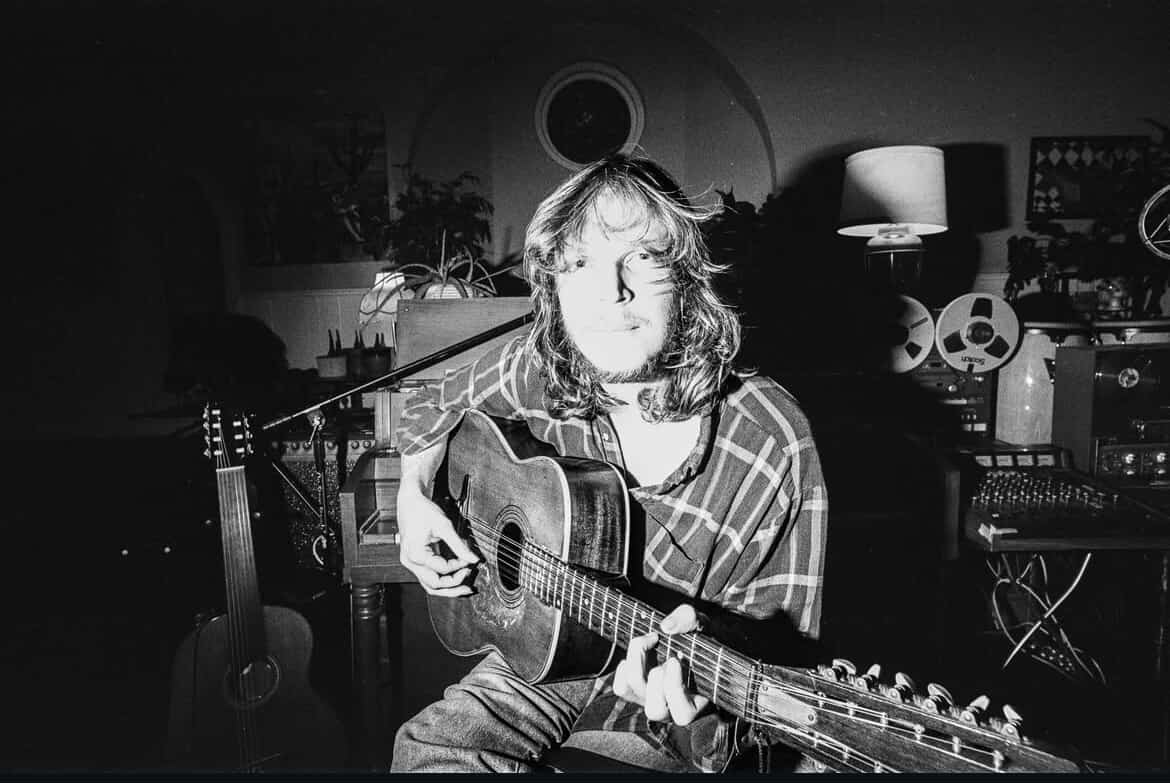

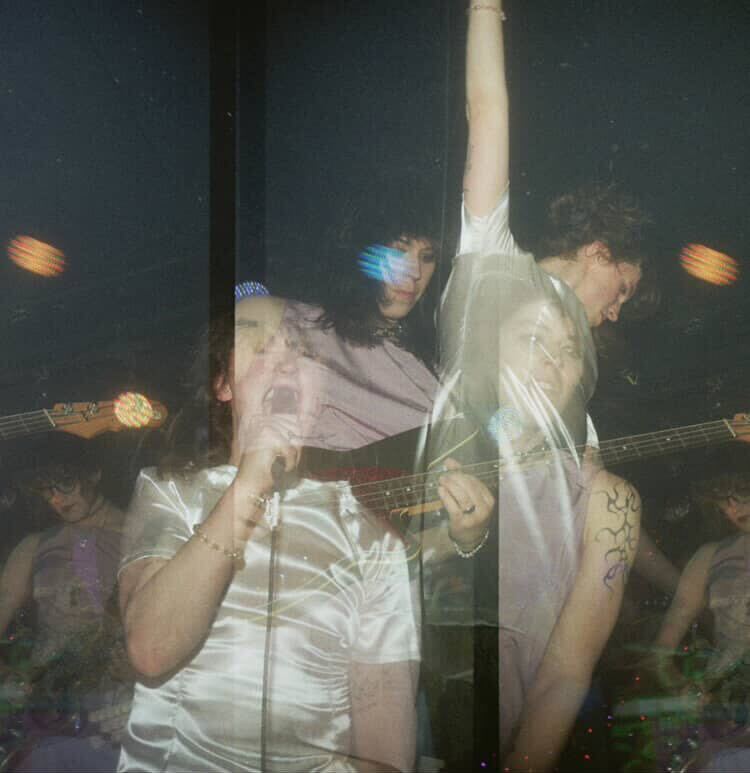
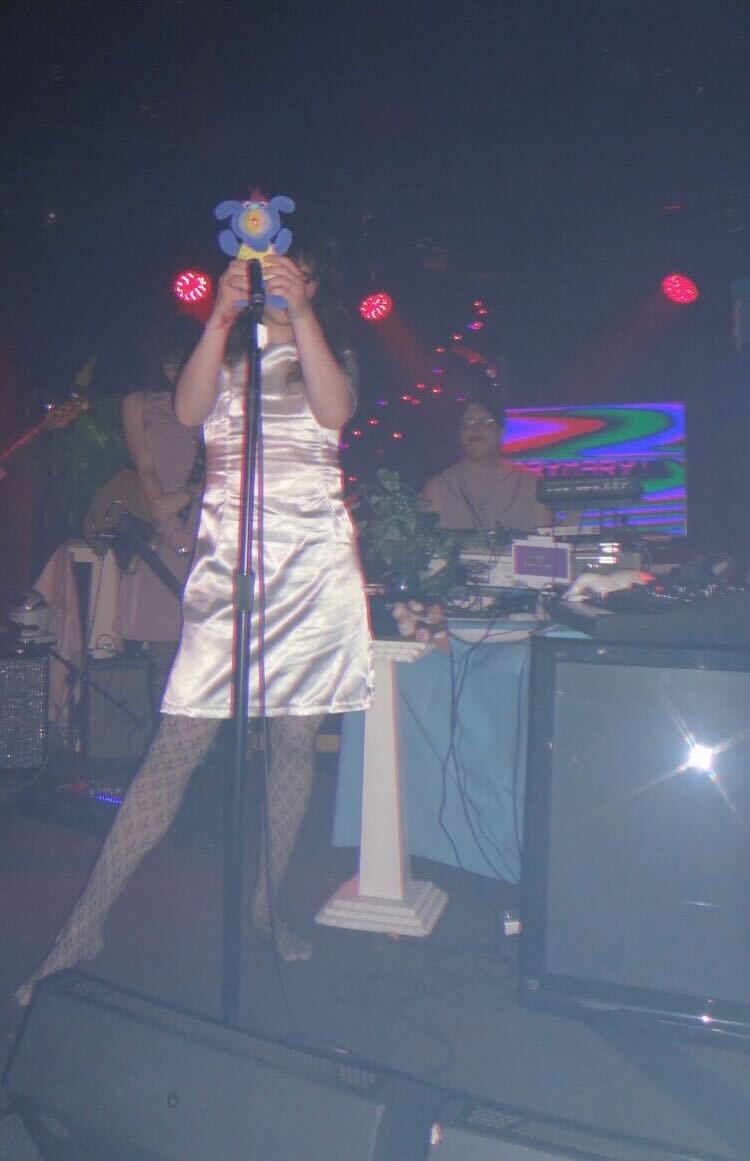
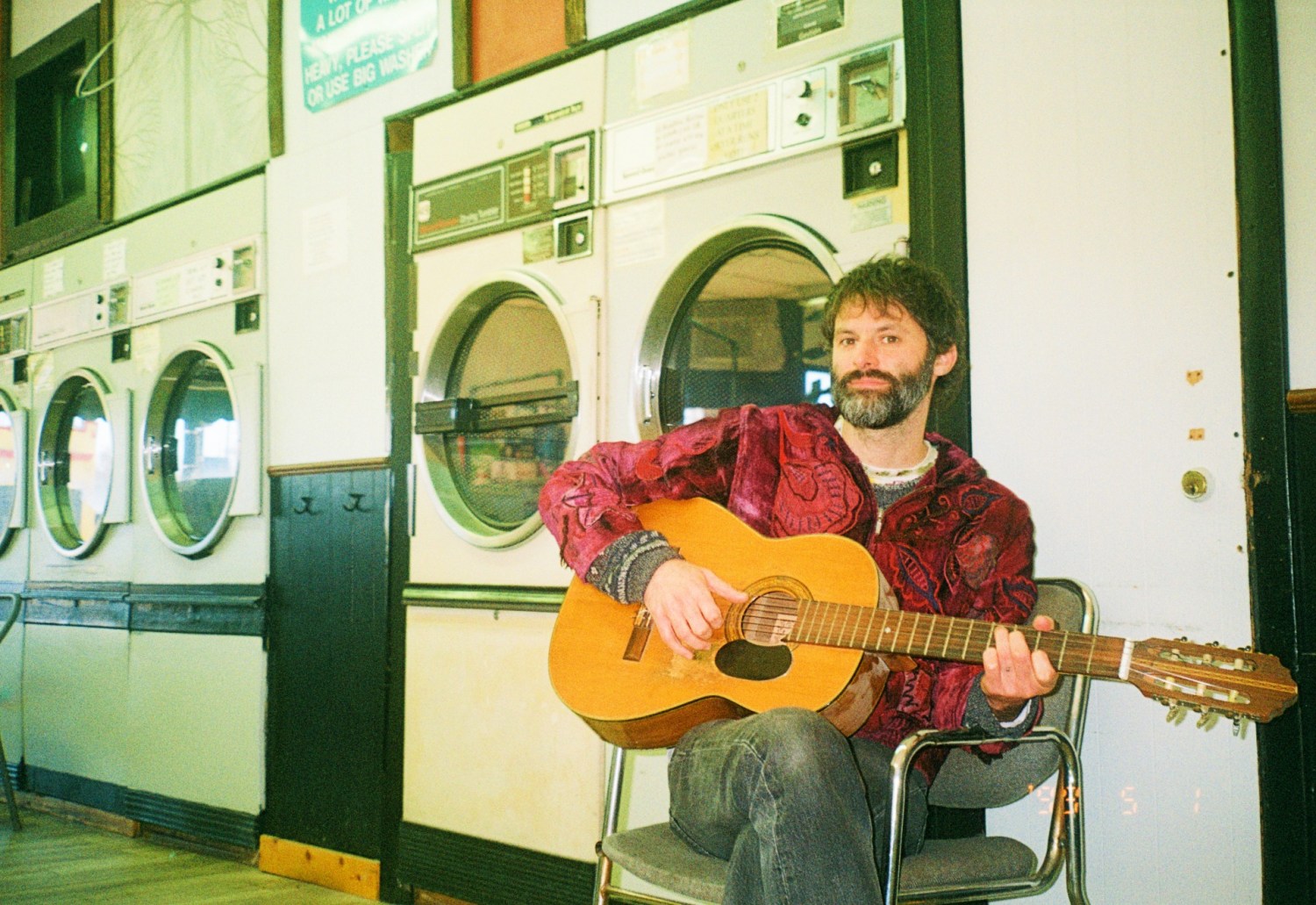
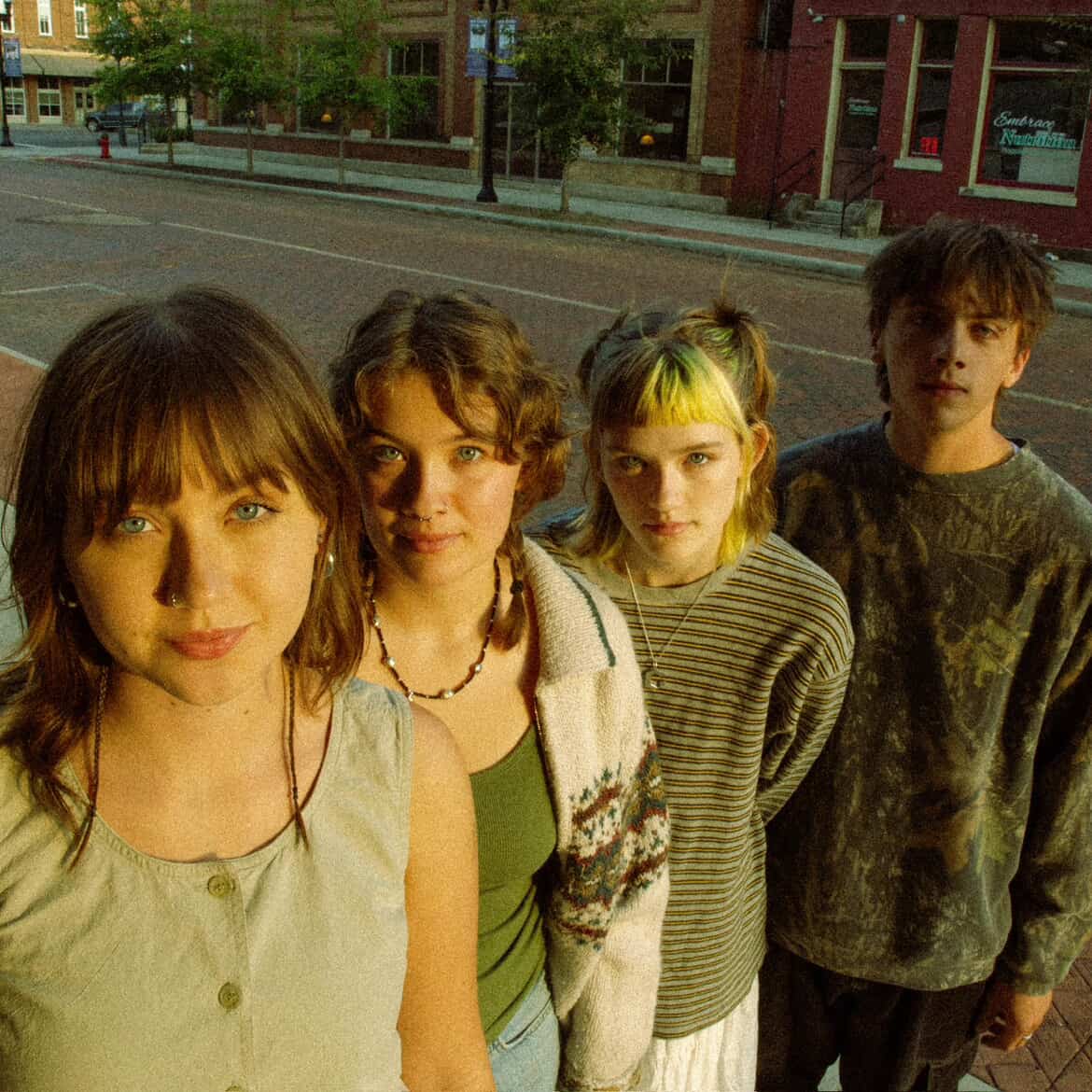
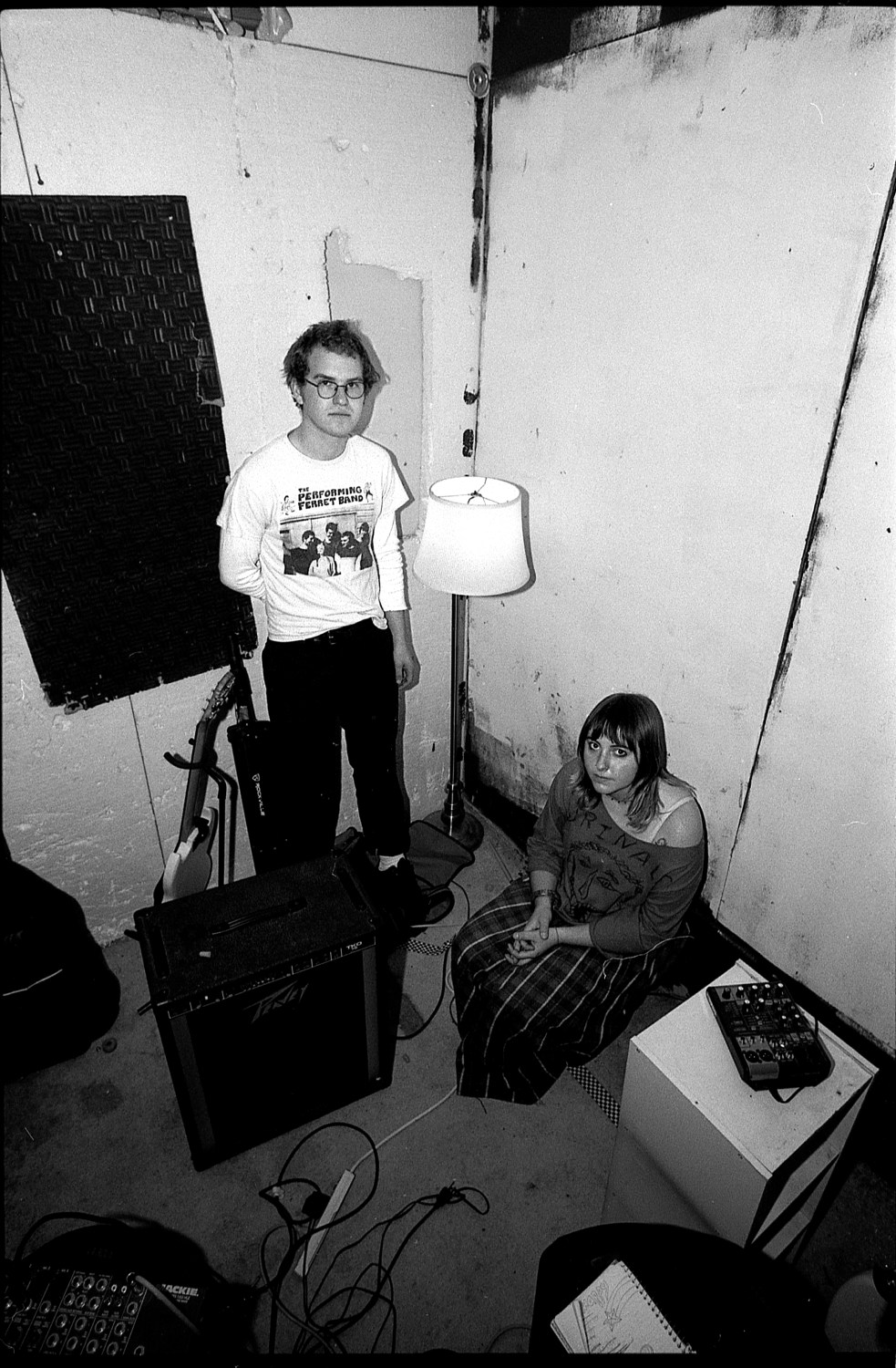

 the ugly hug