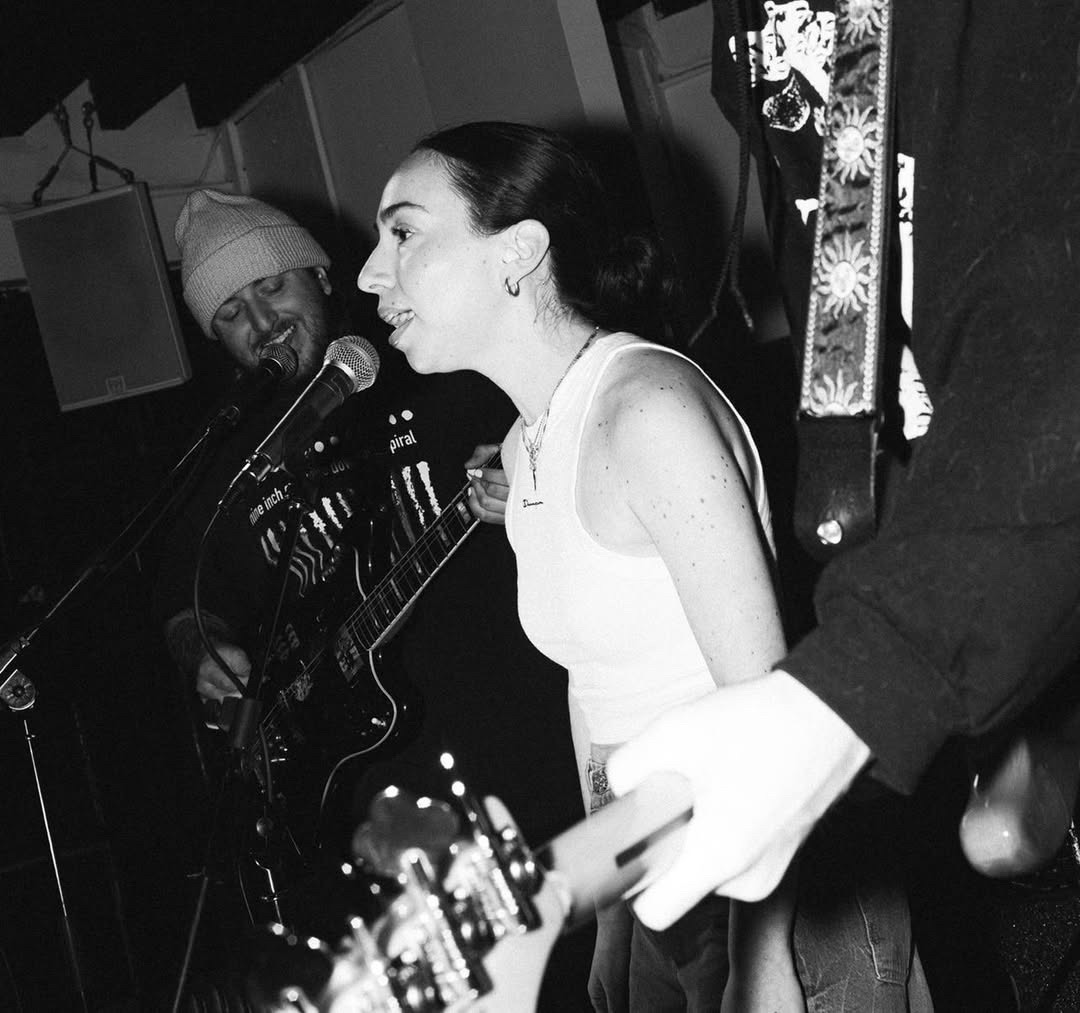
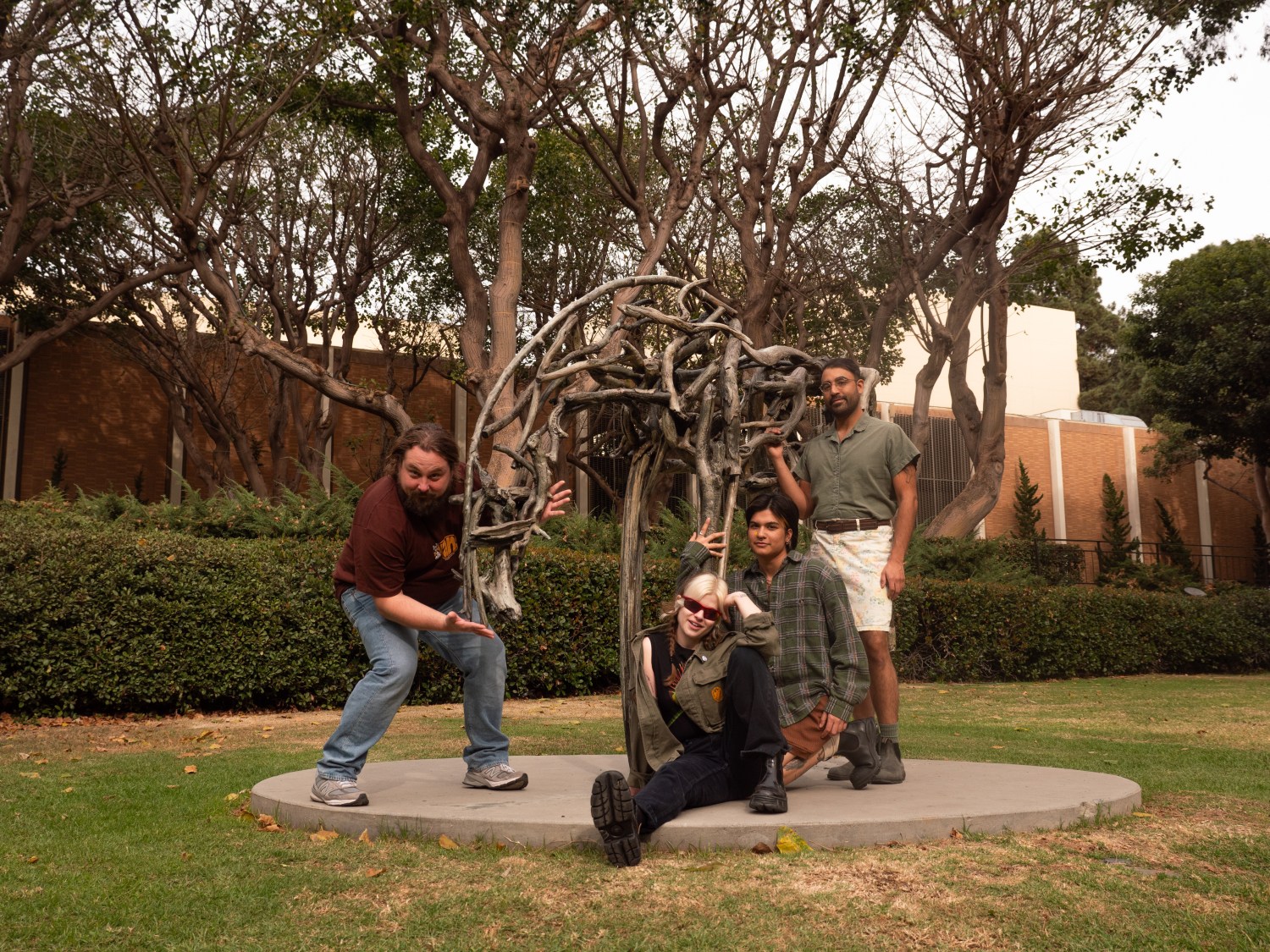
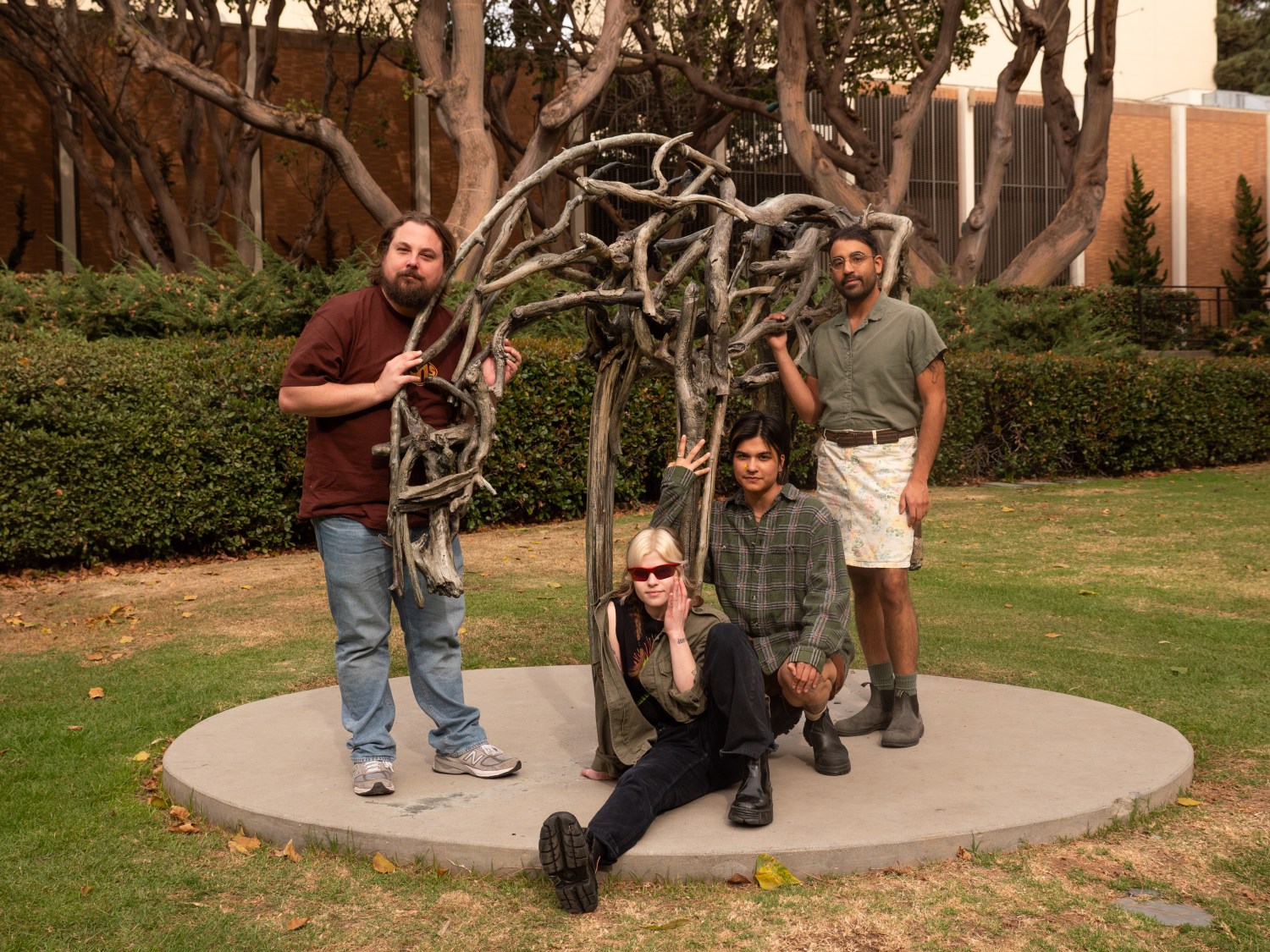
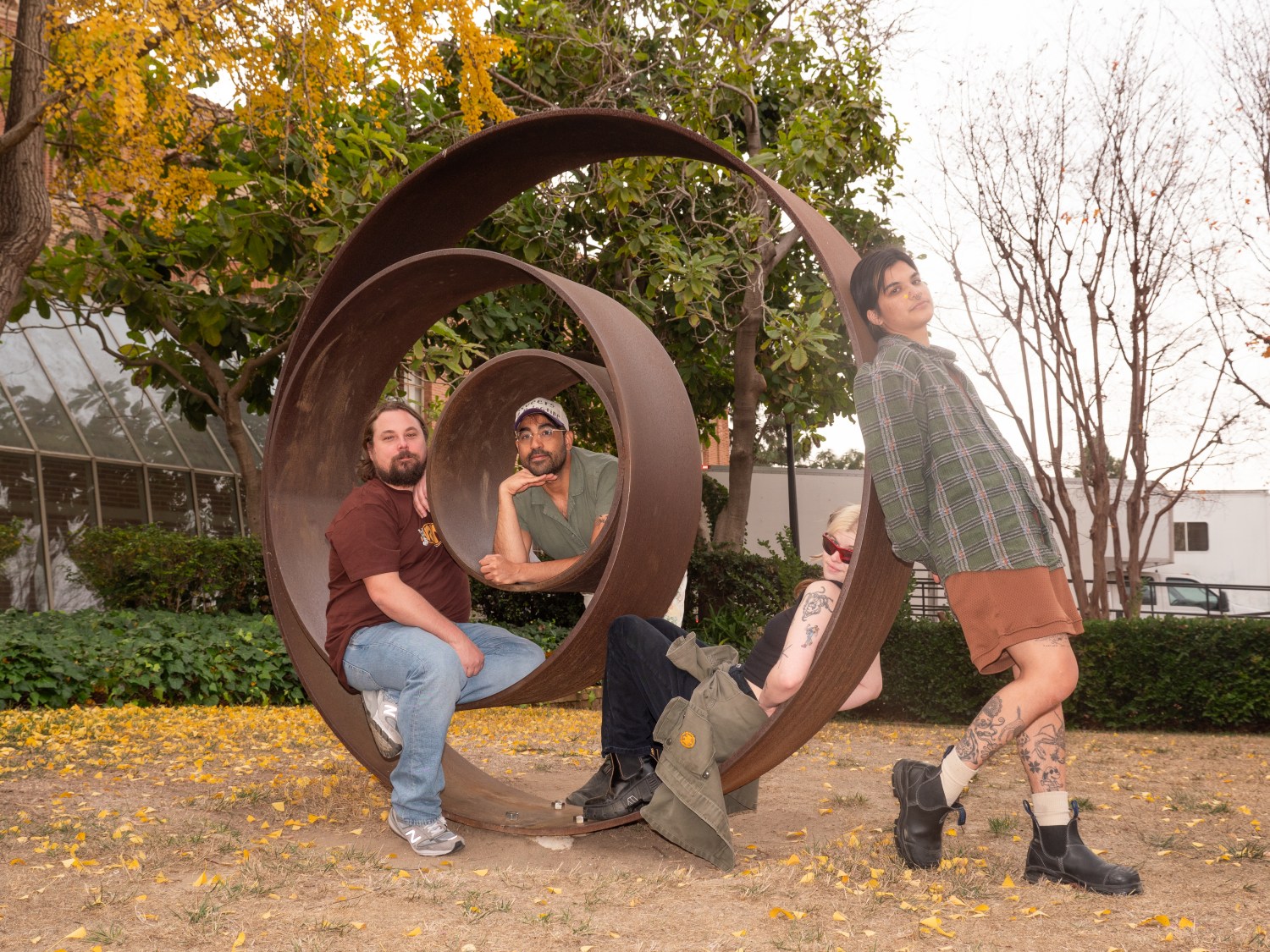
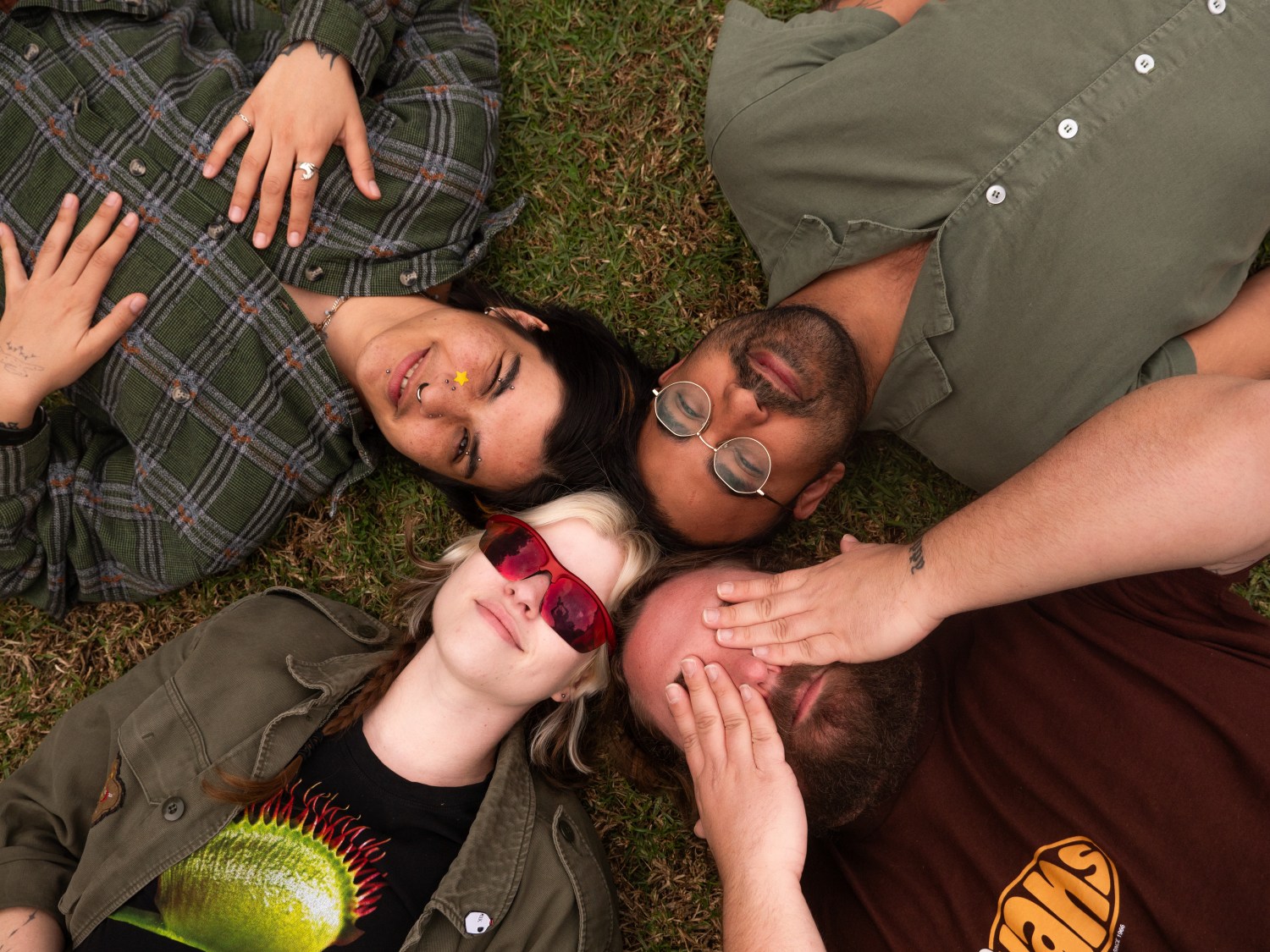
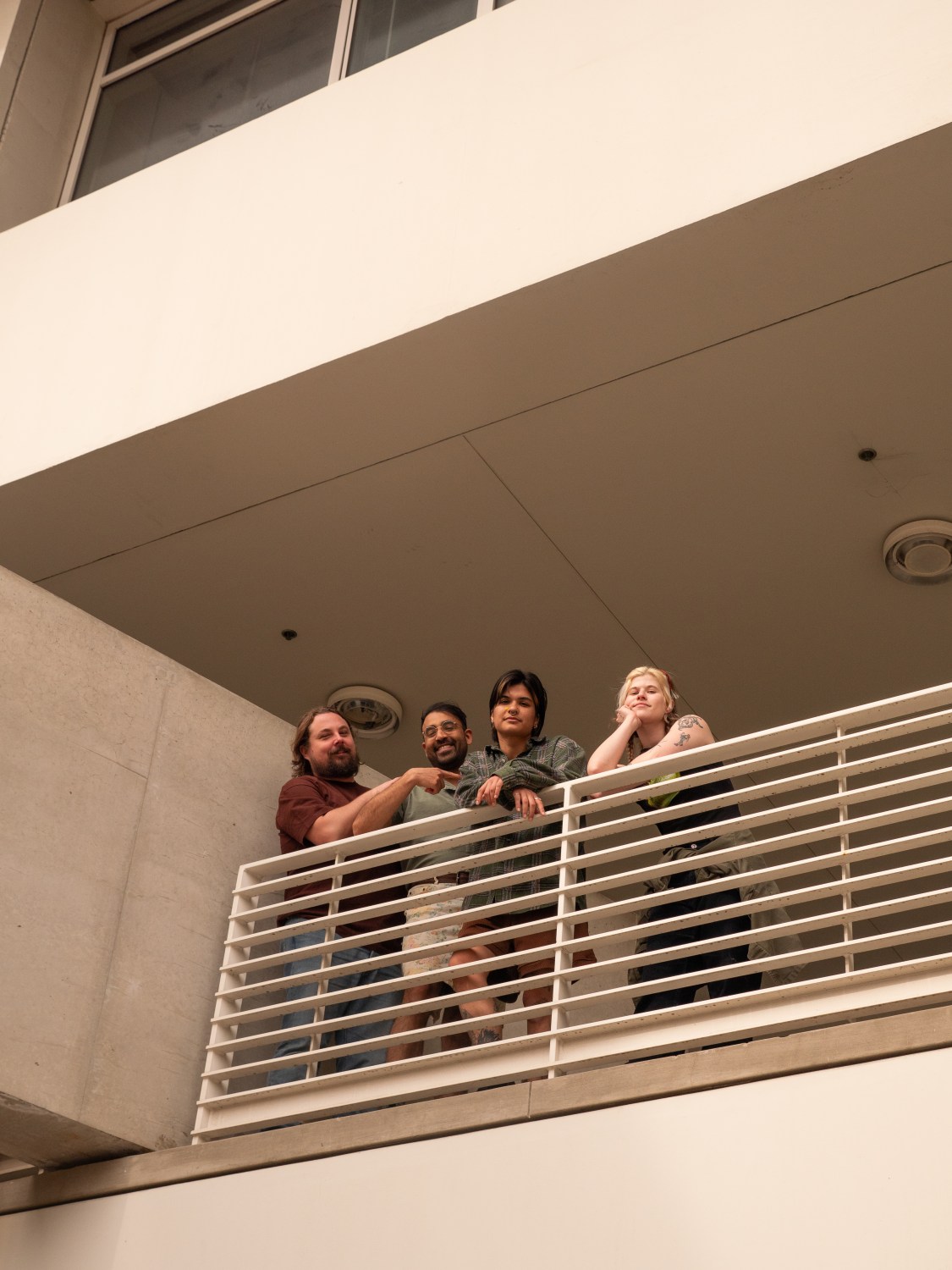
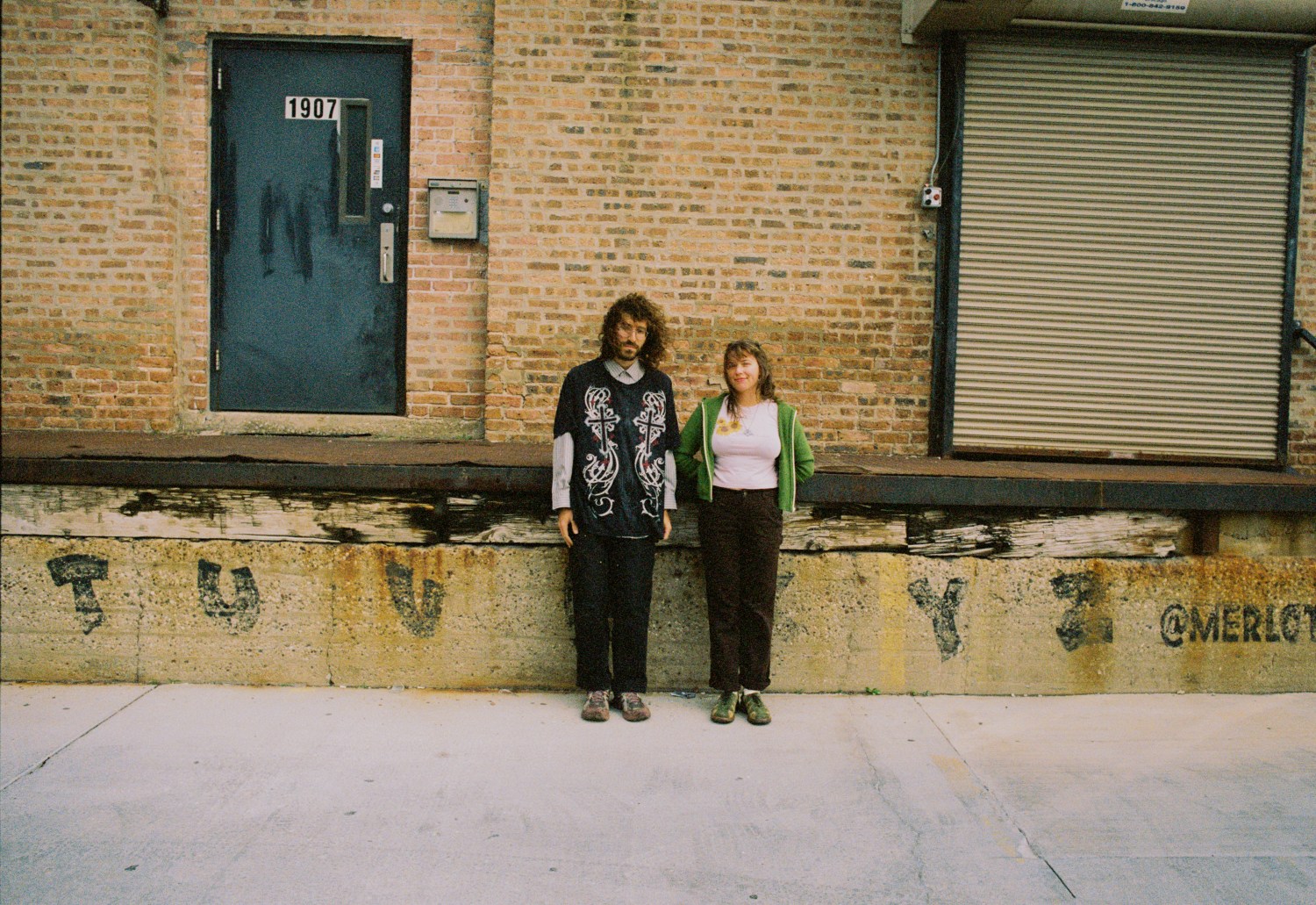
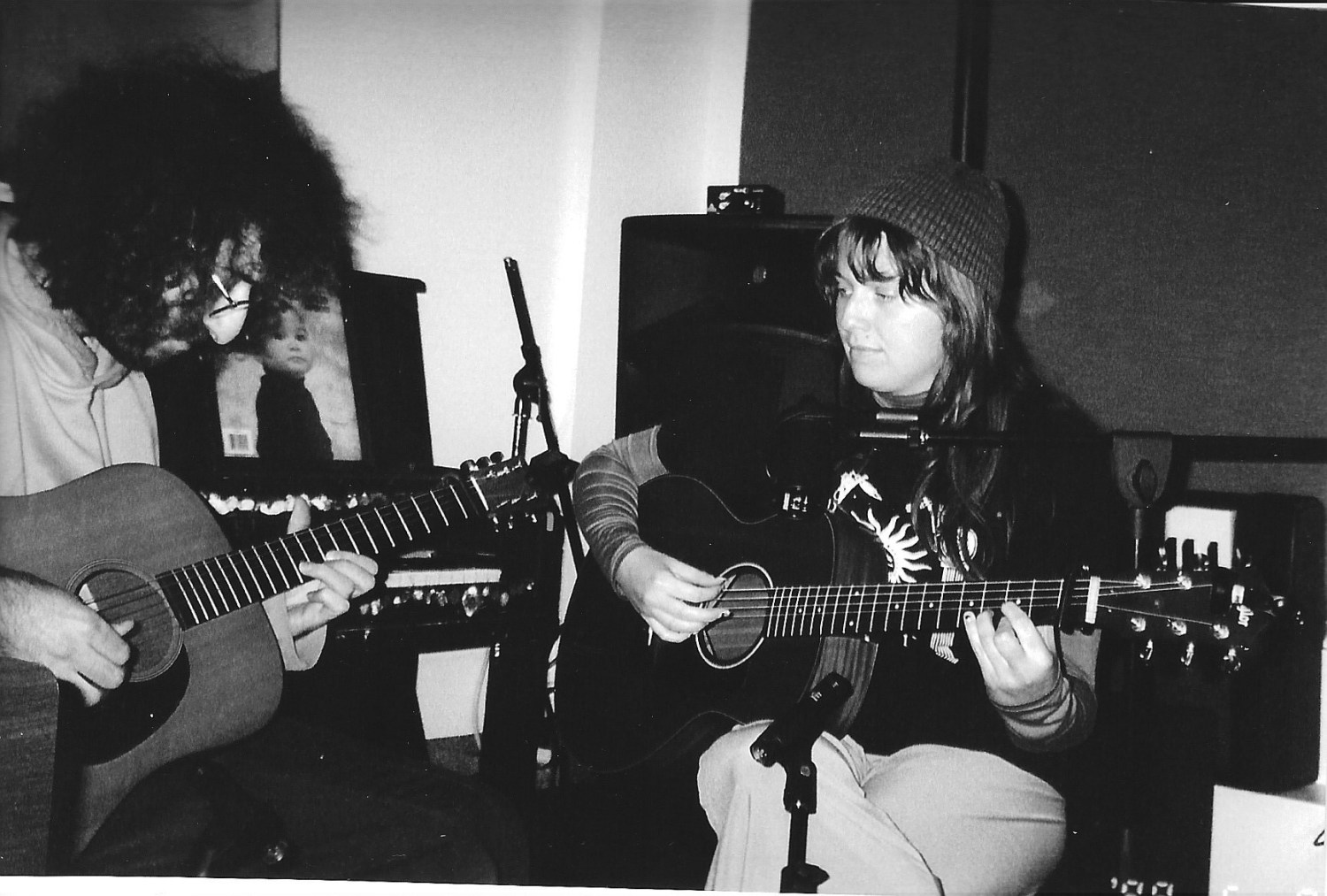
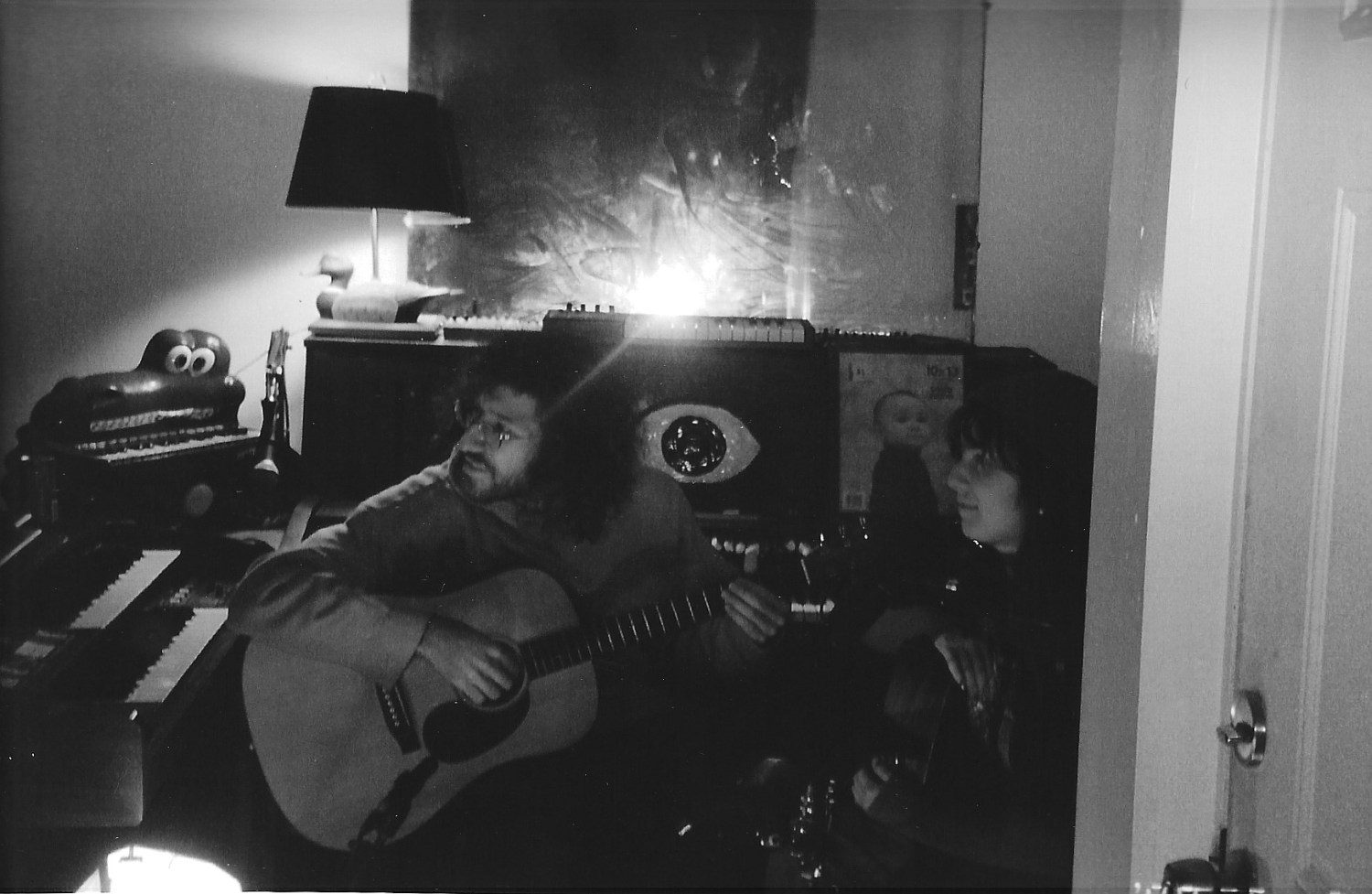
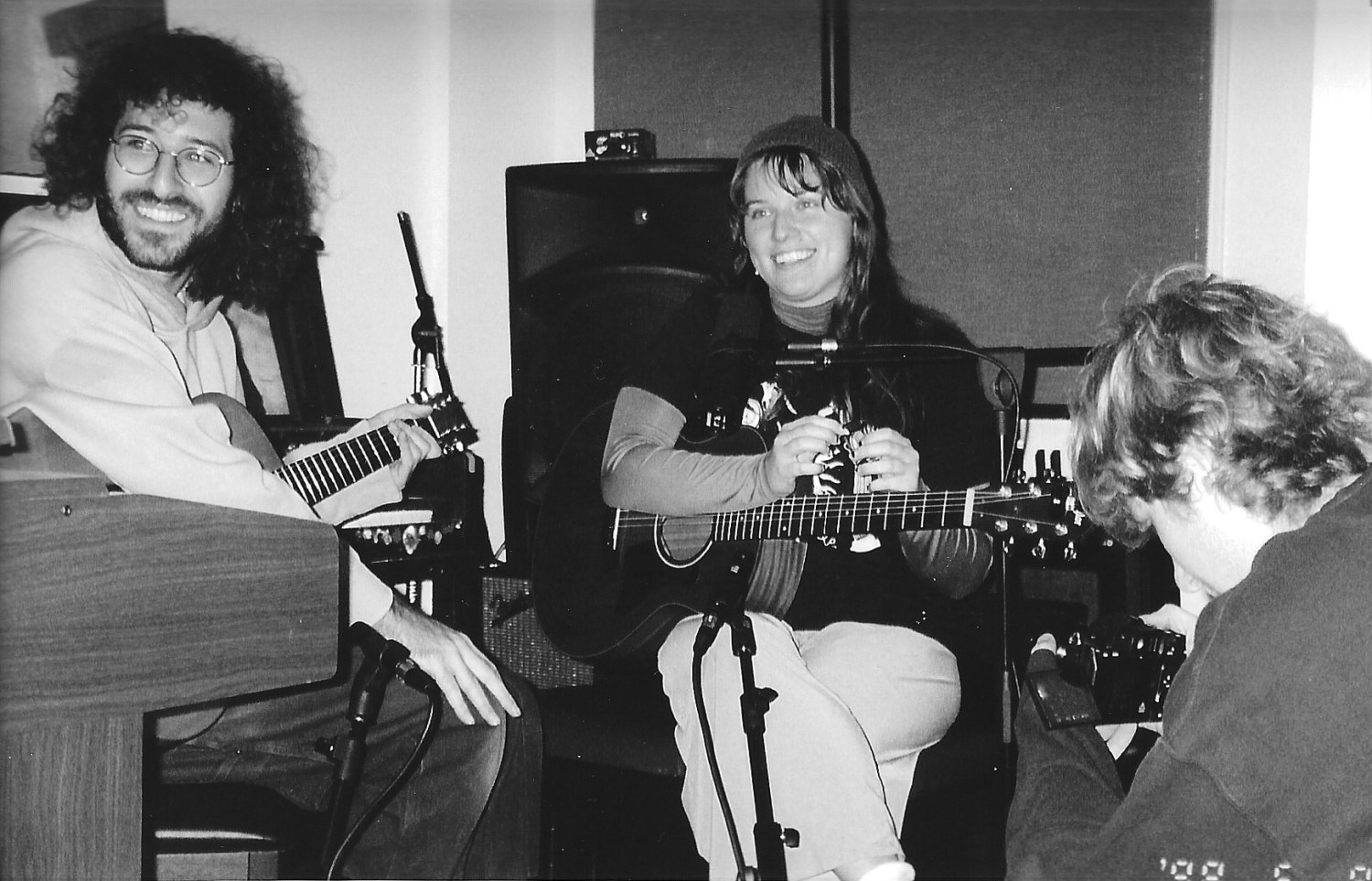
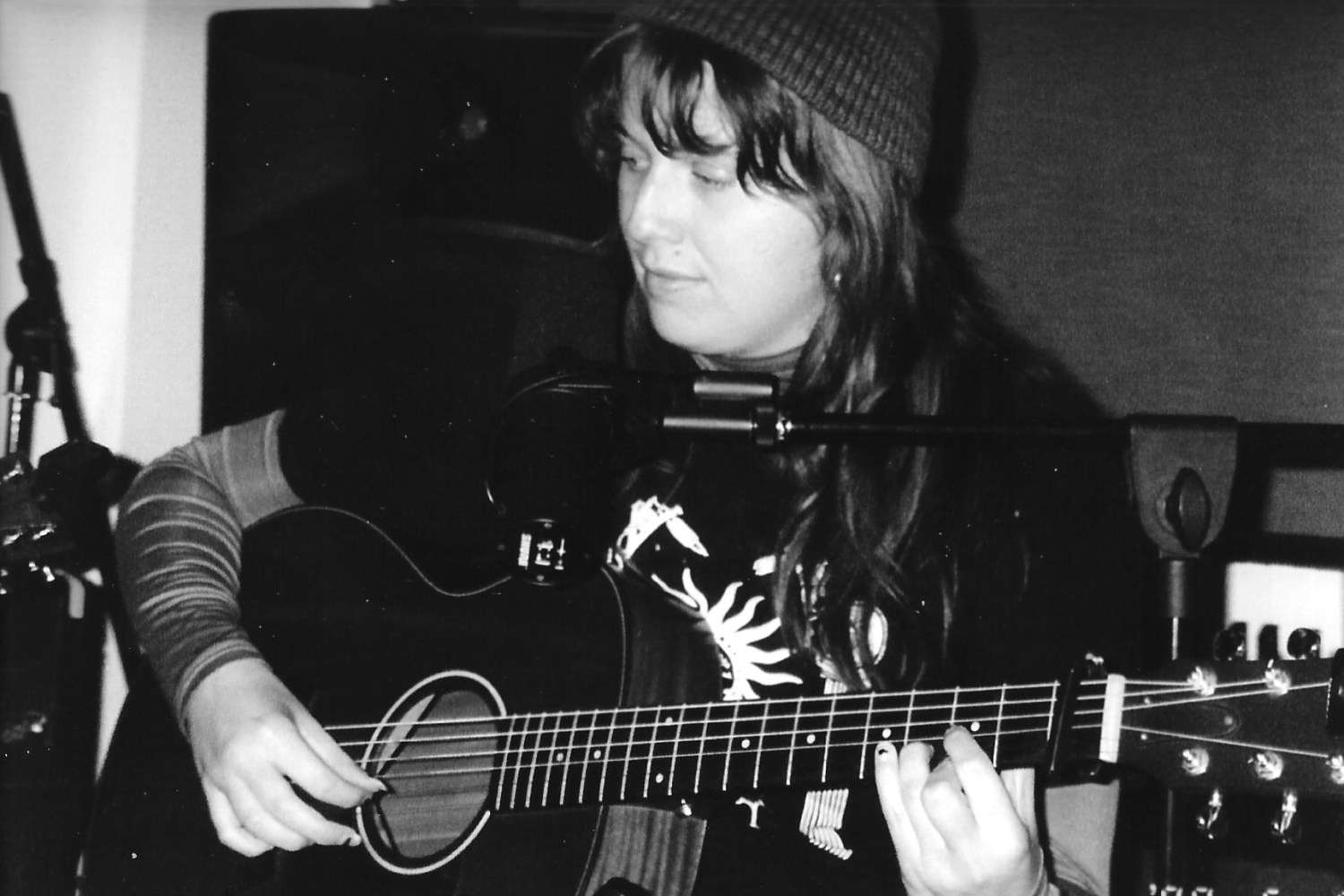
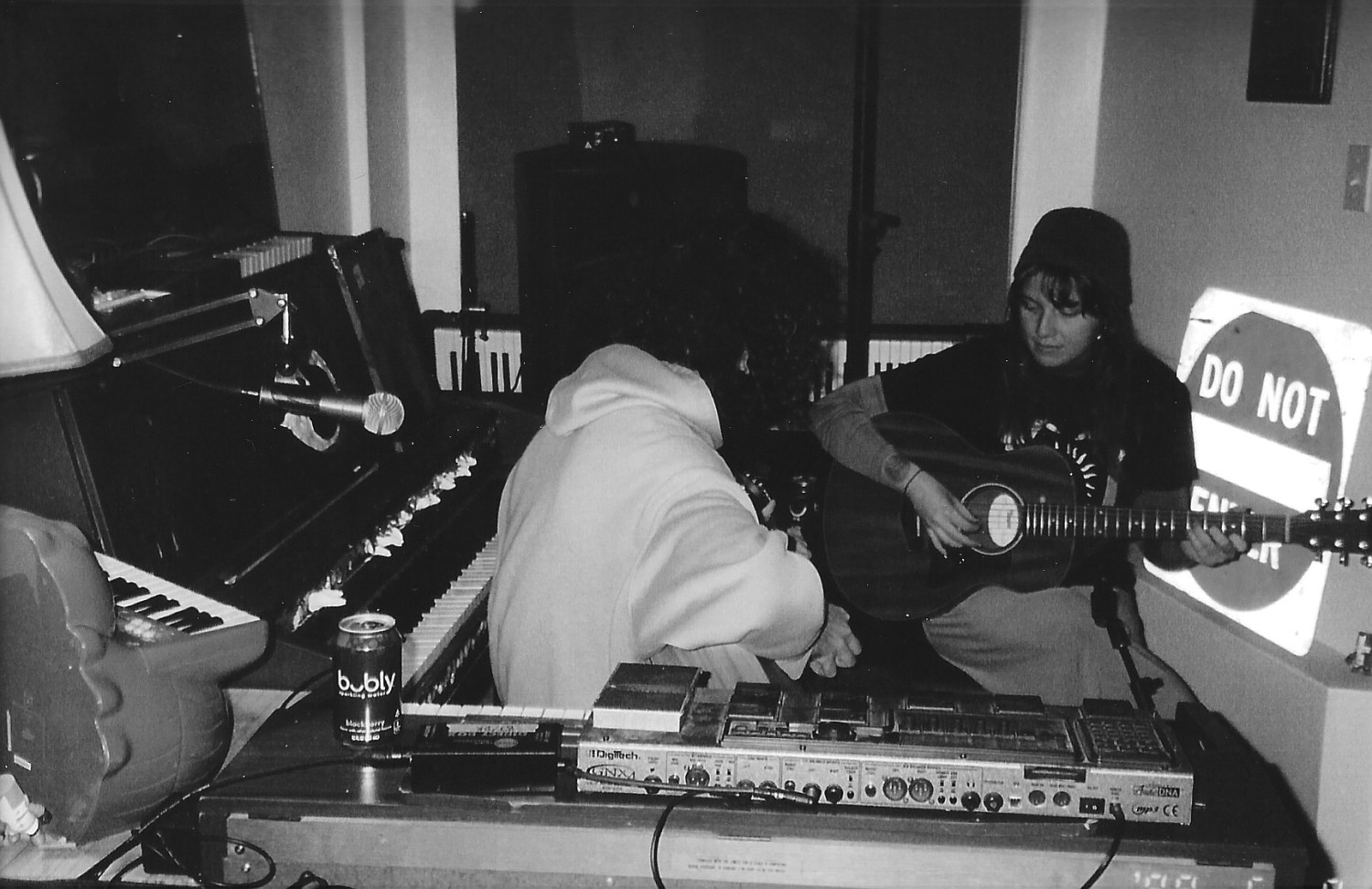
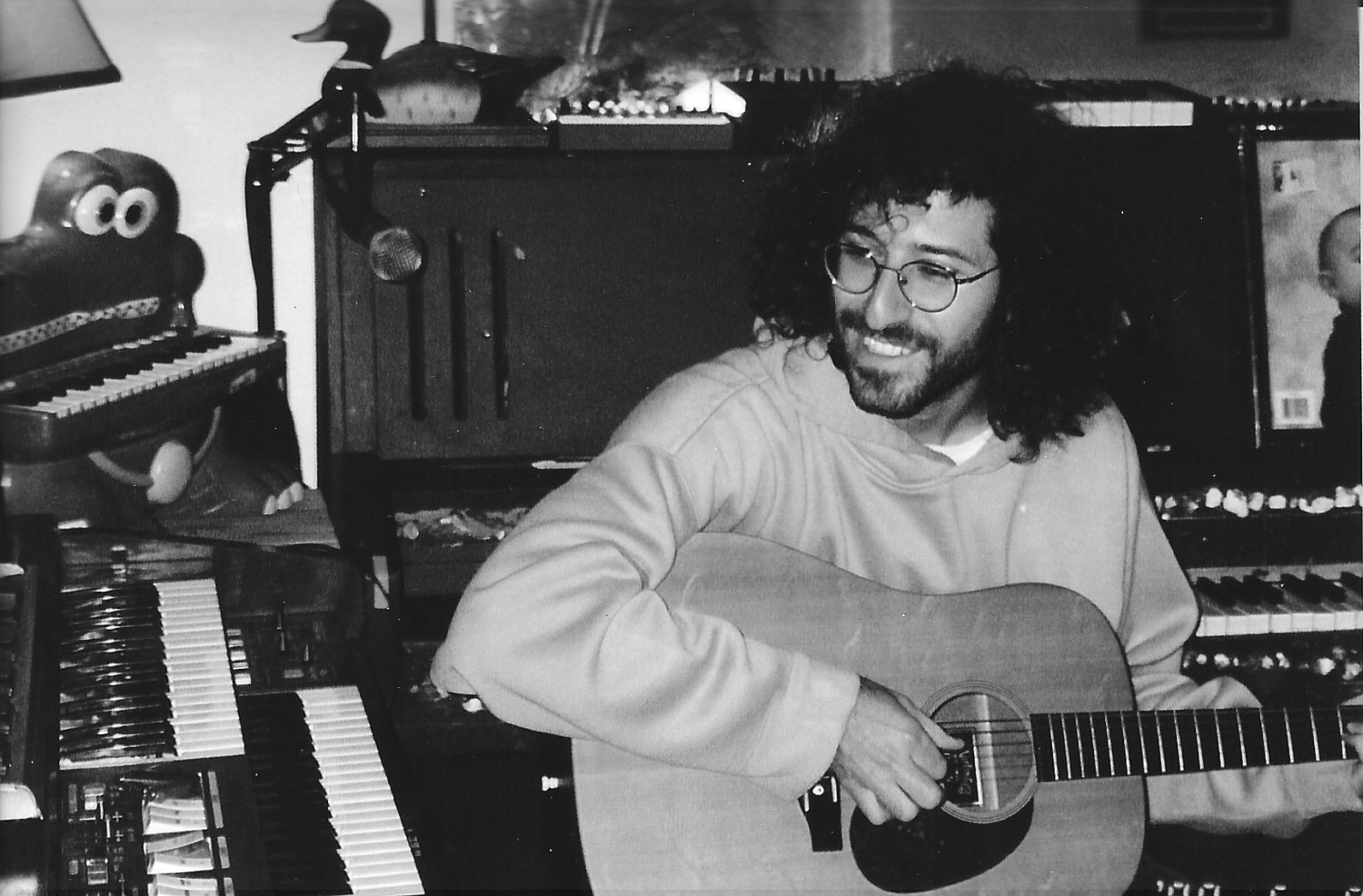
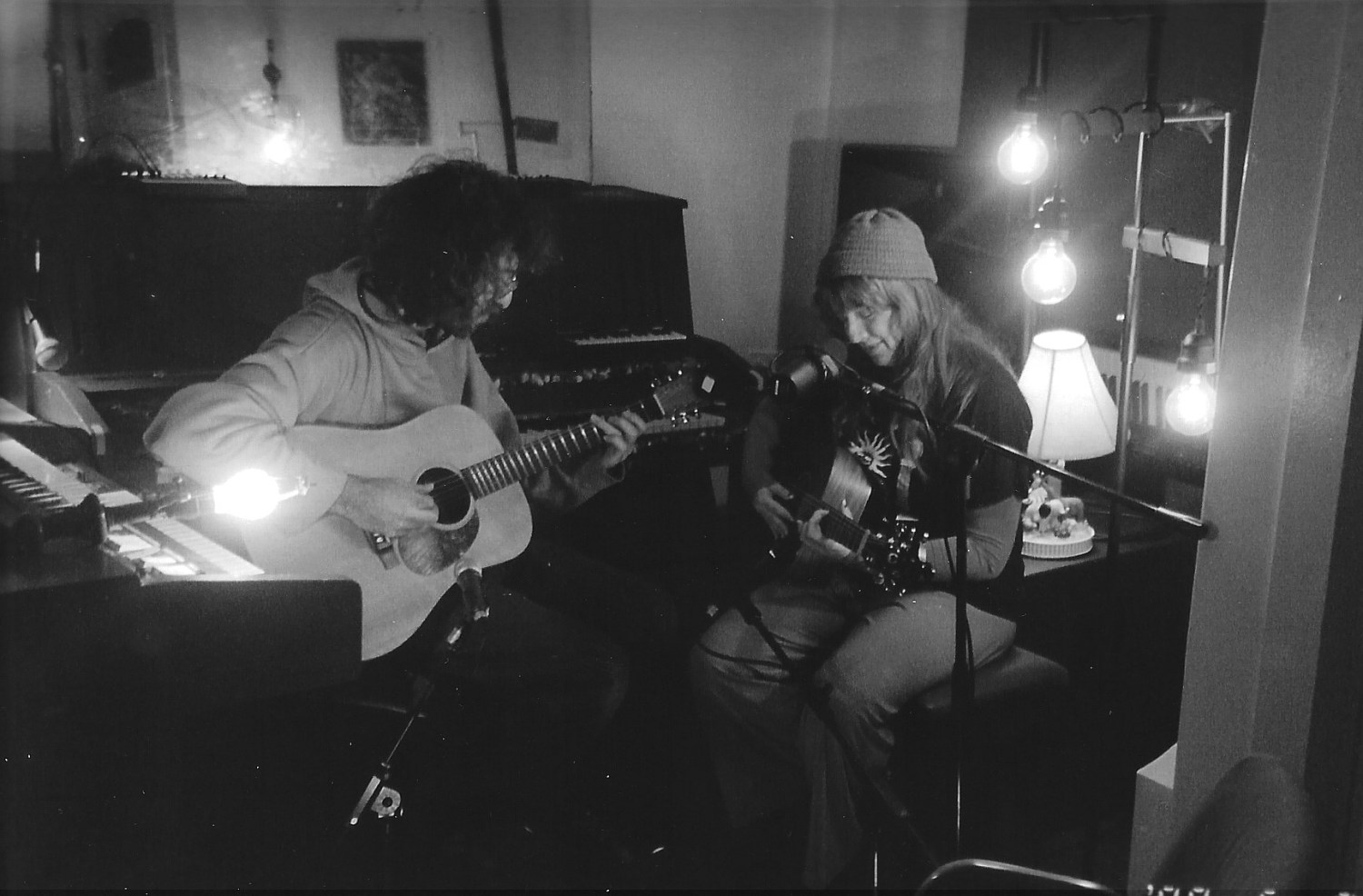
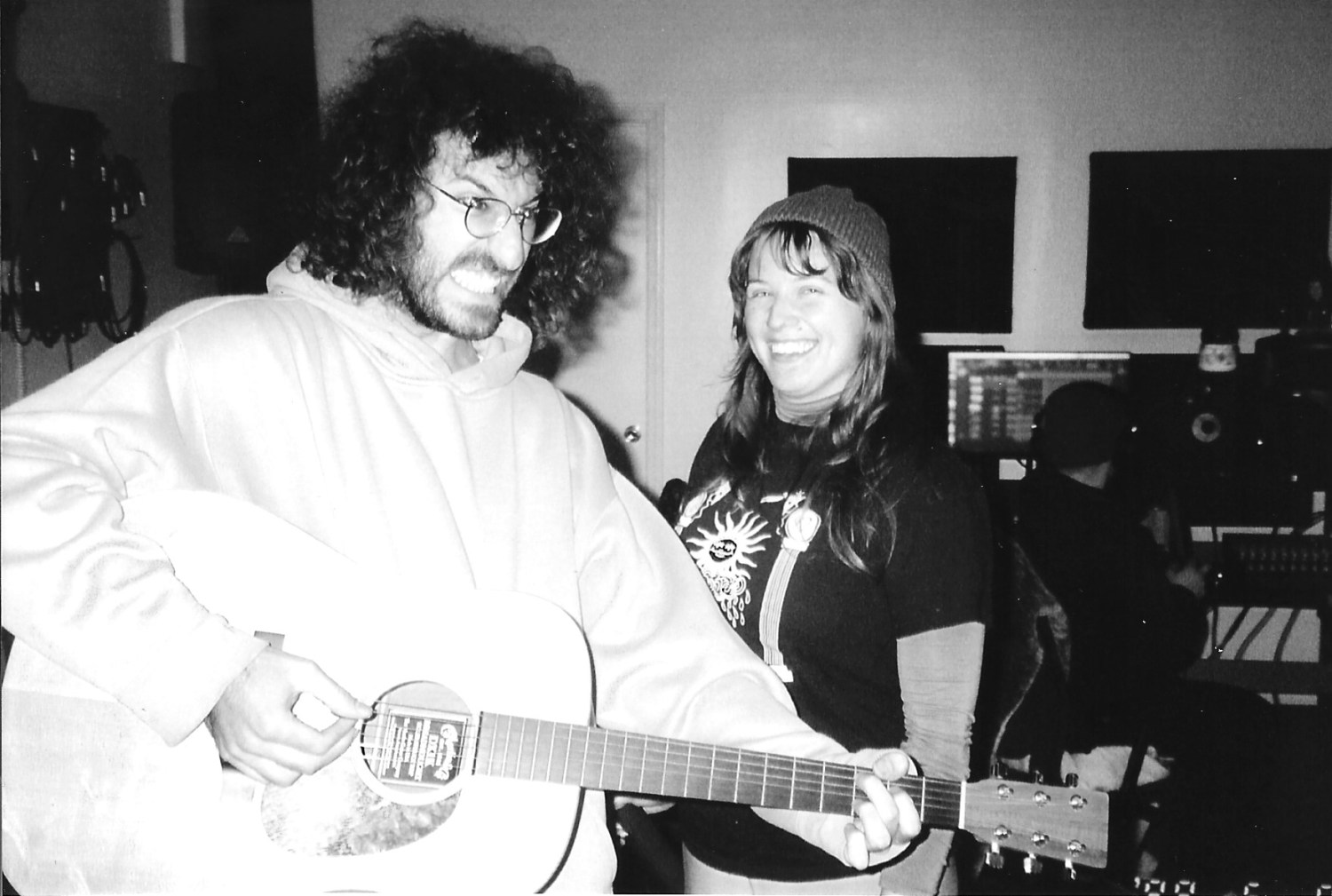
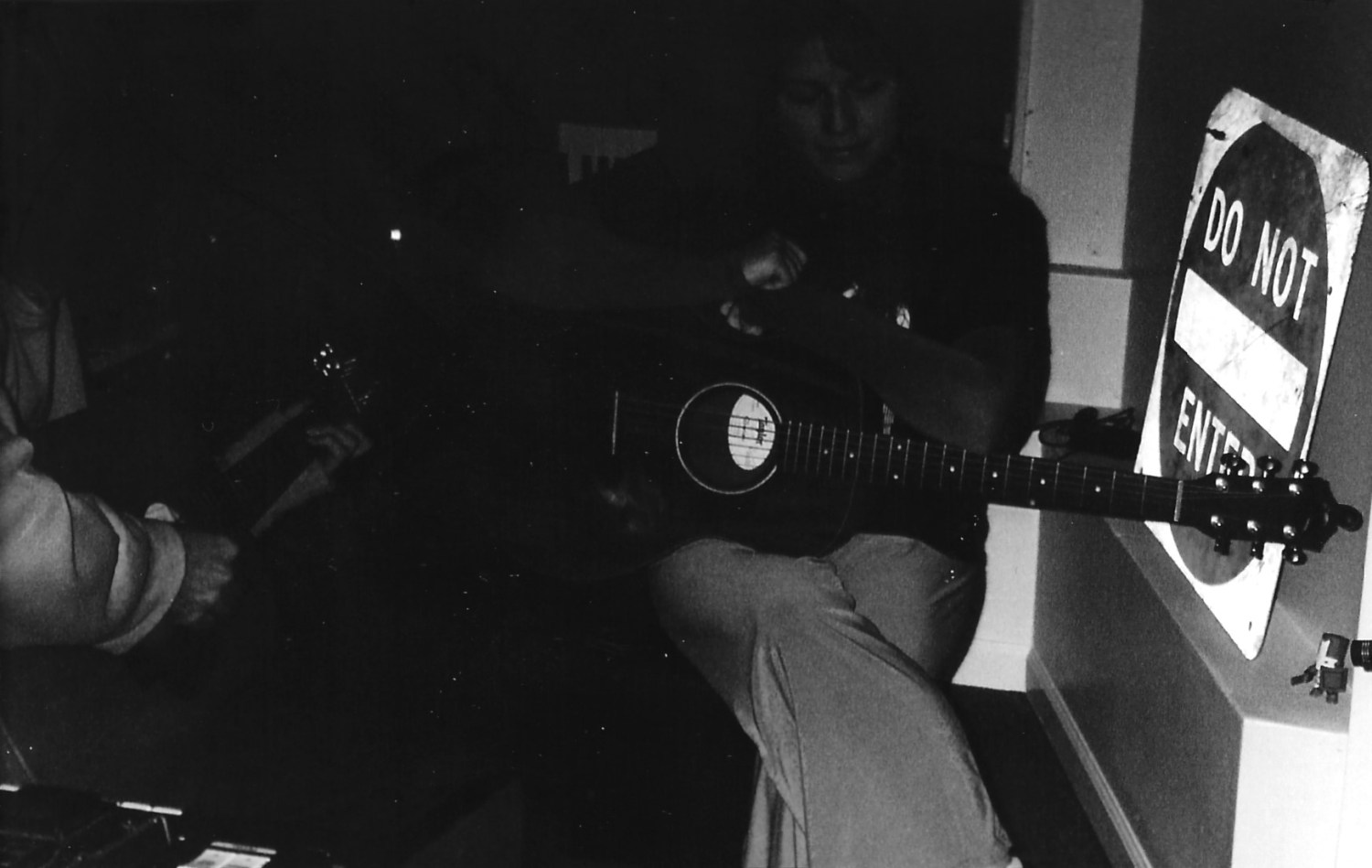
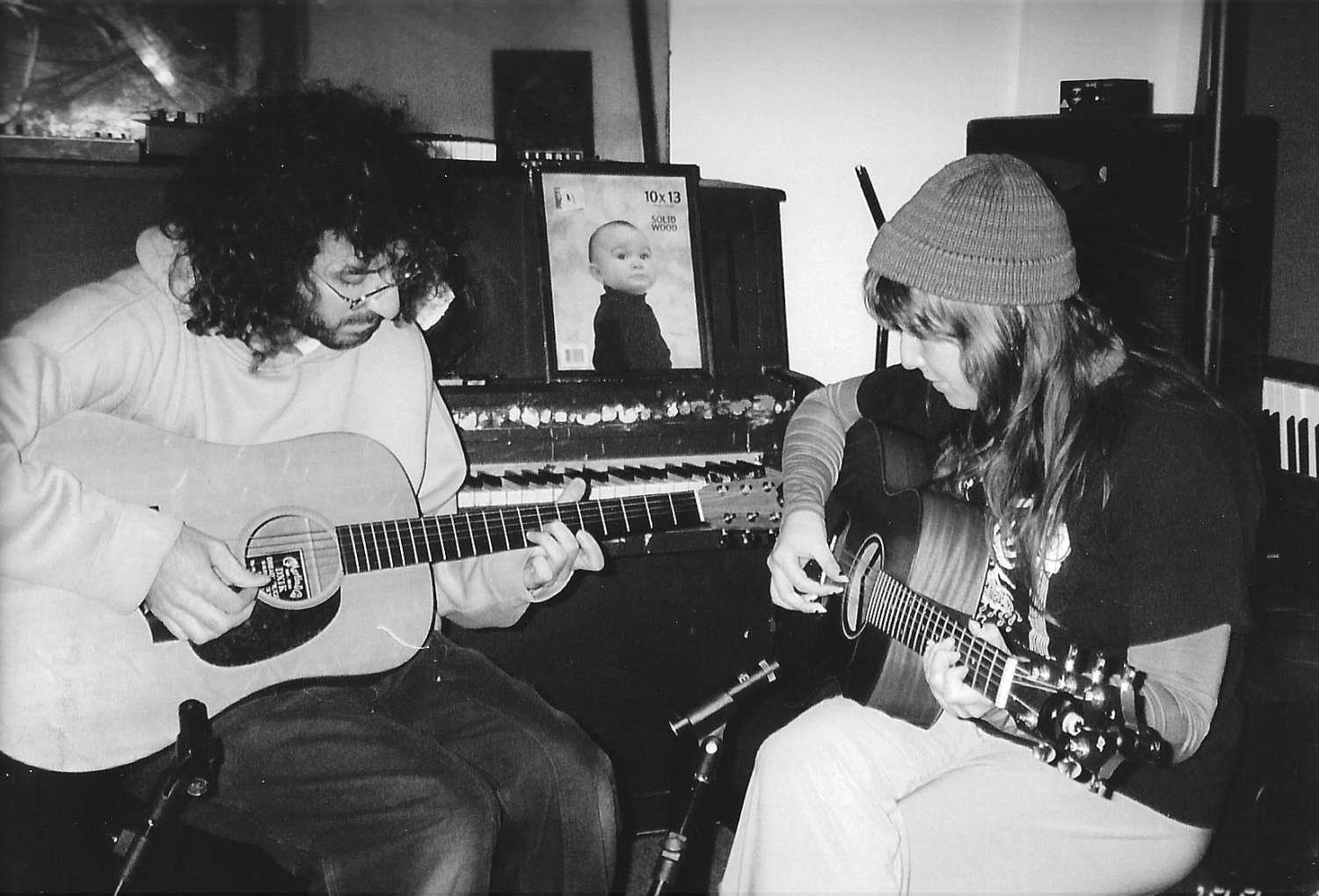
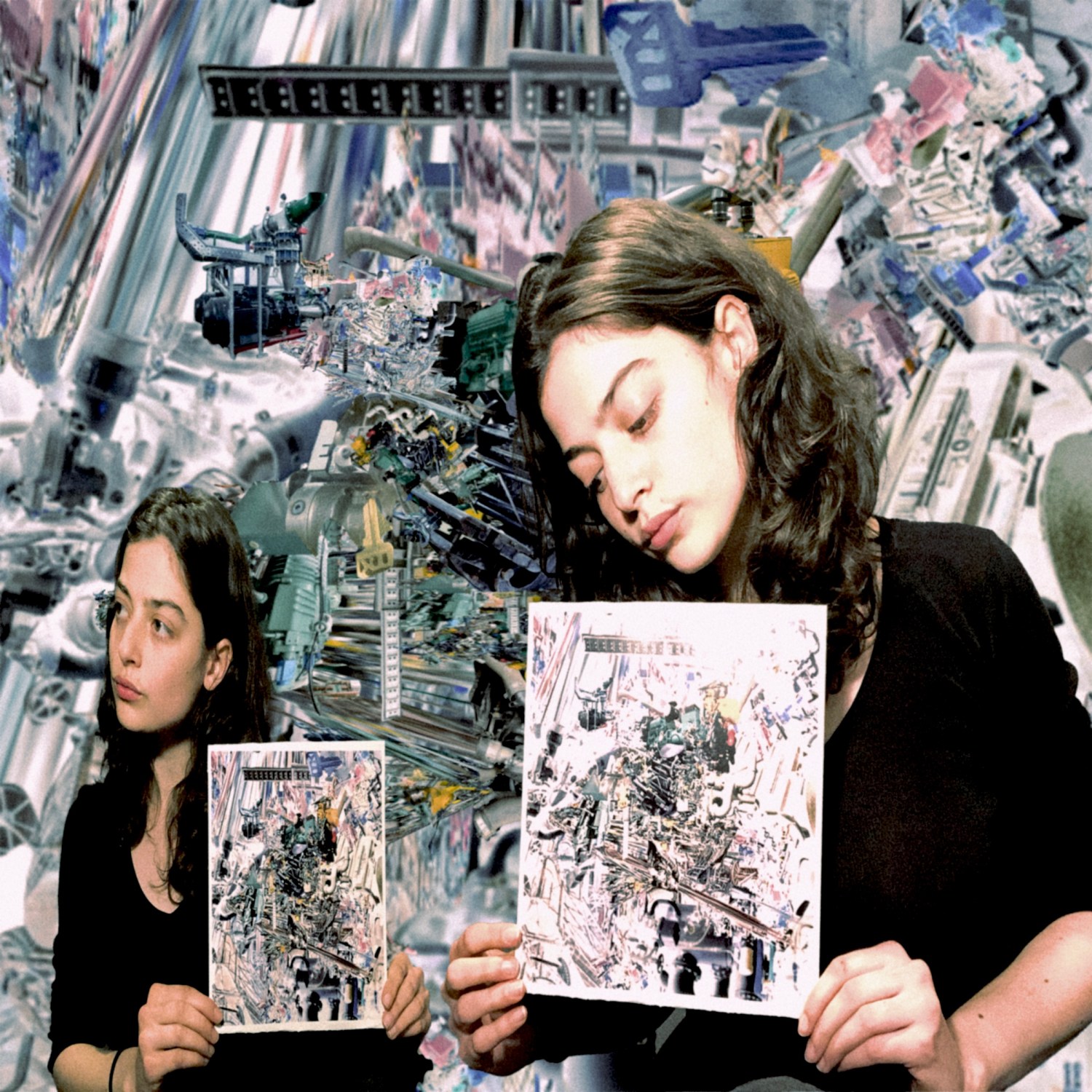
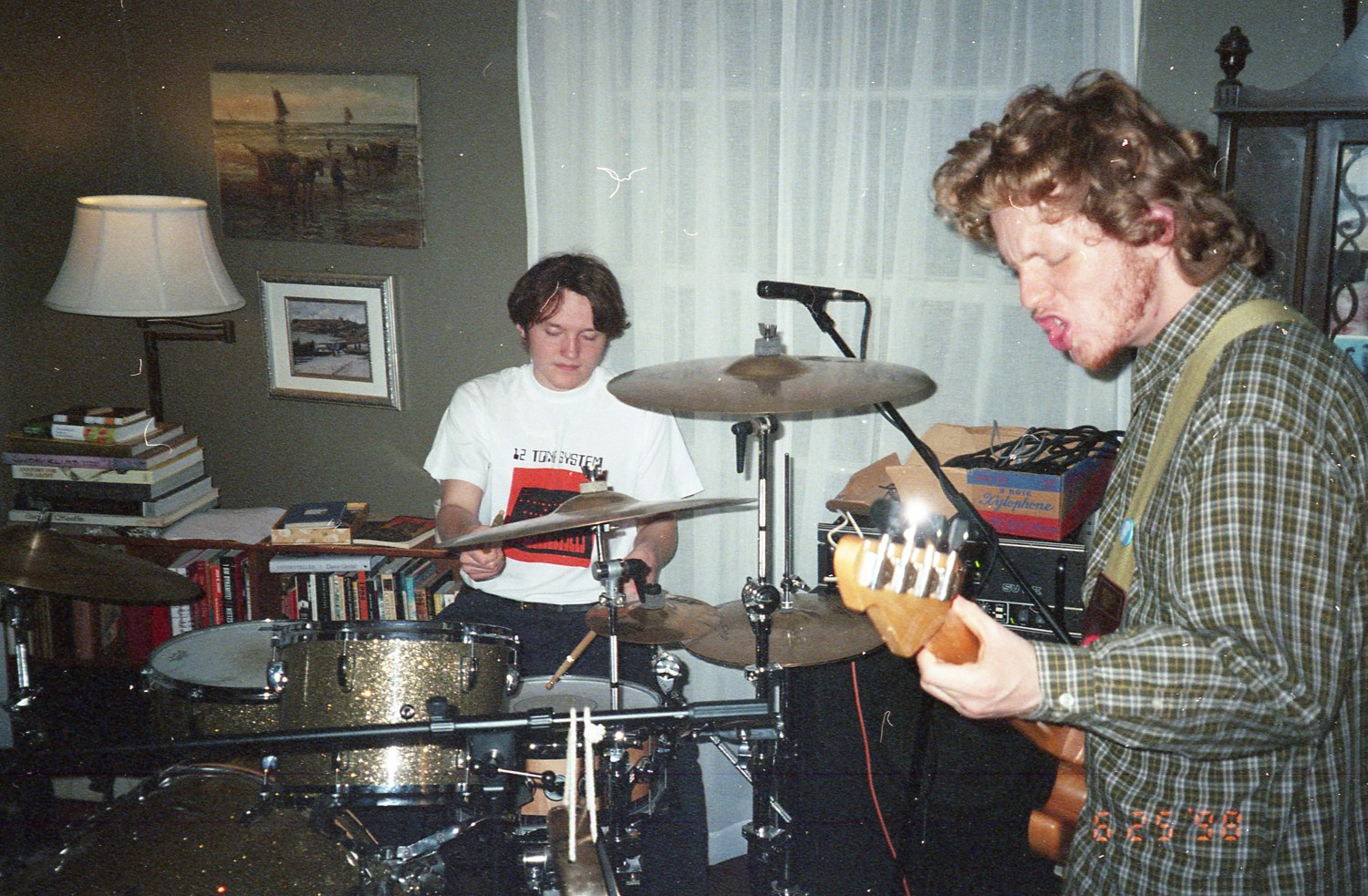
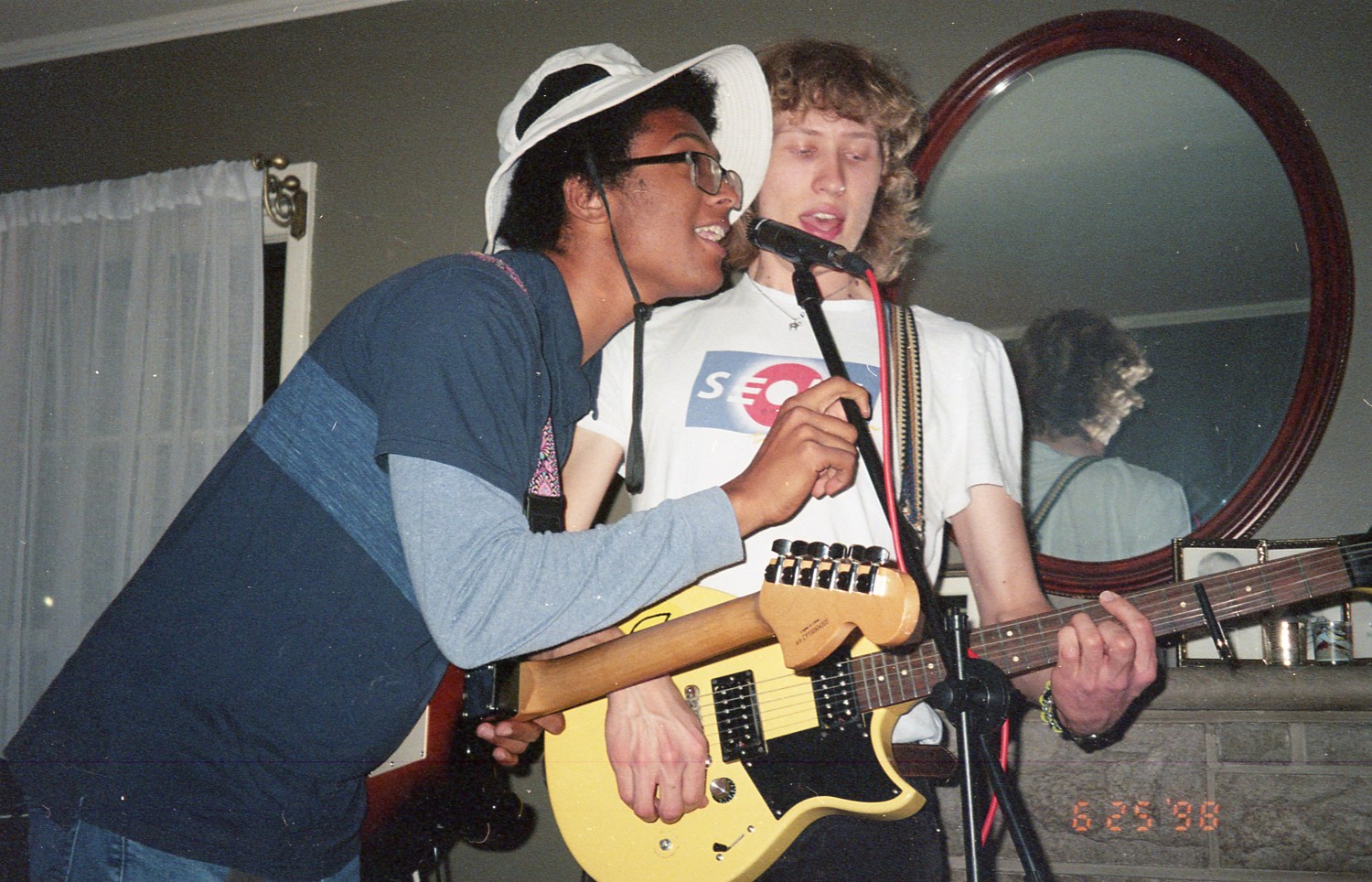
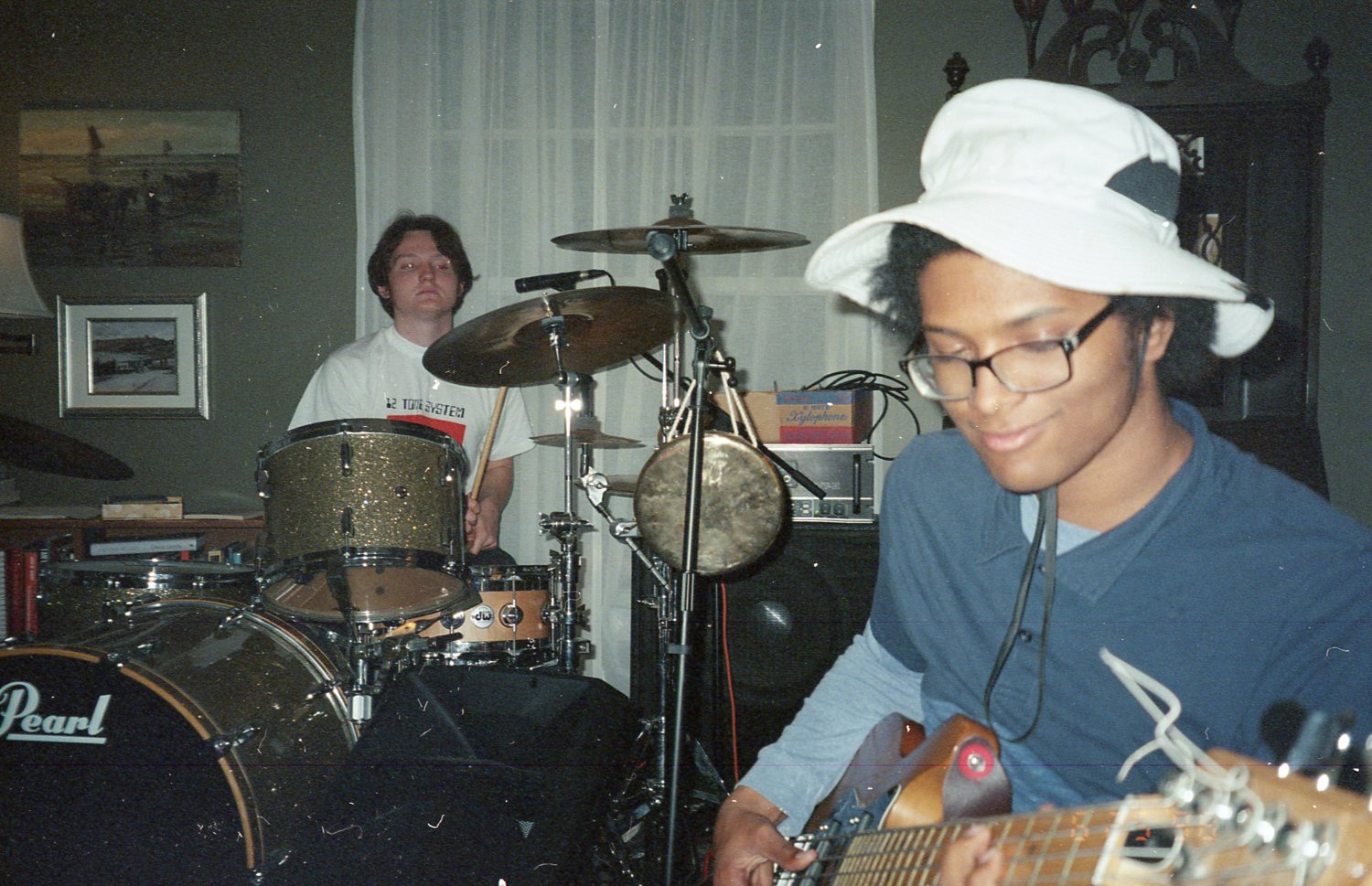
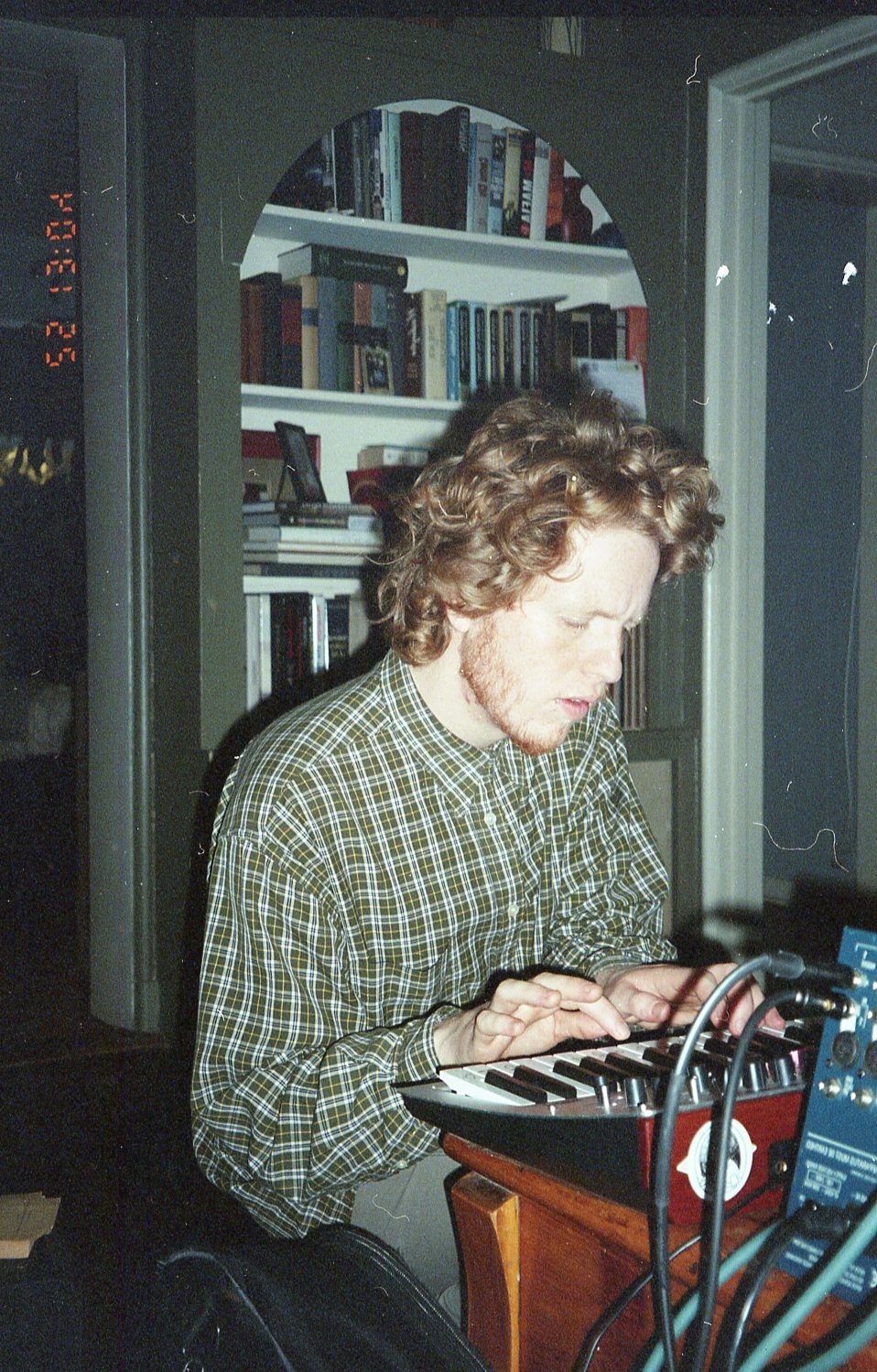
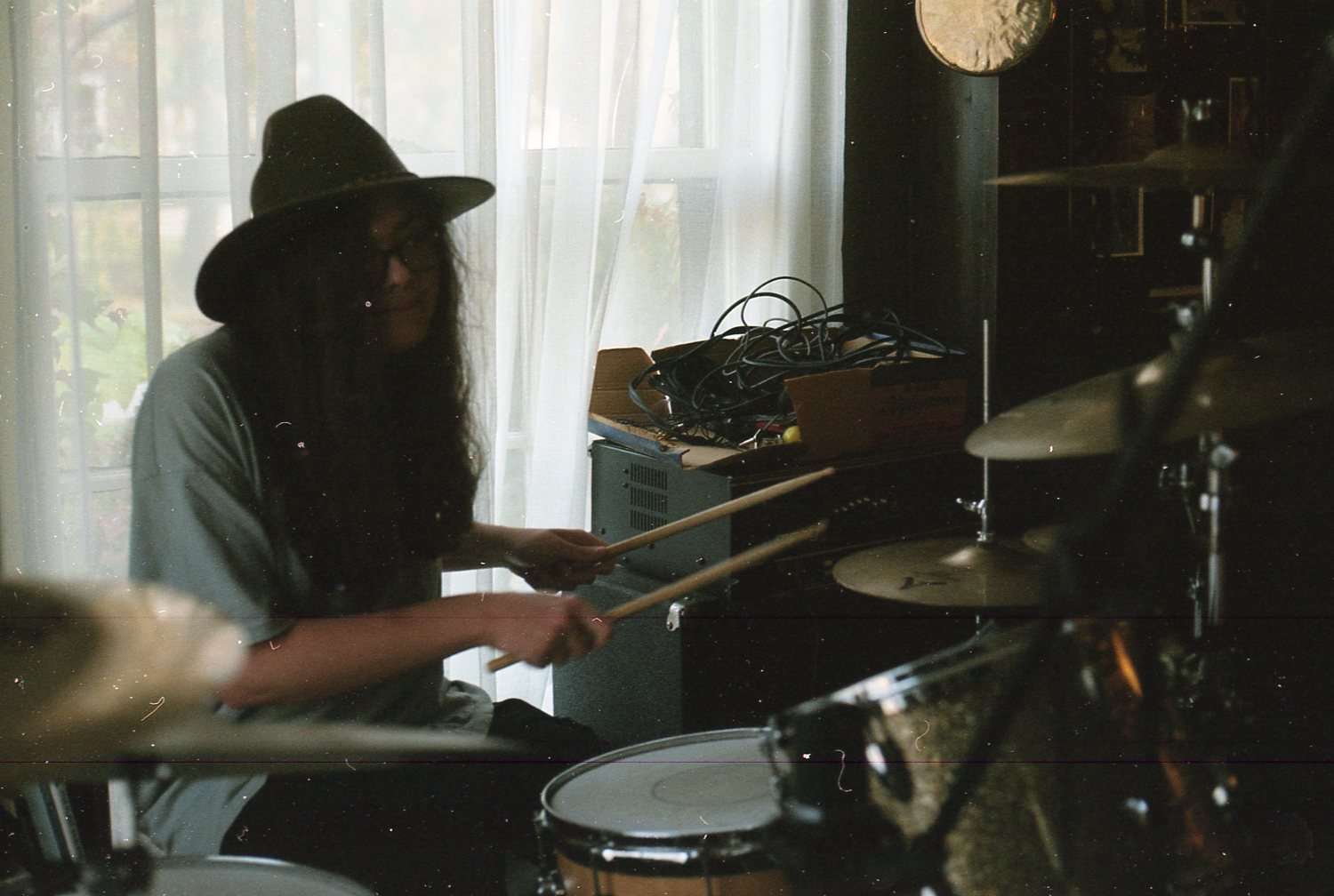
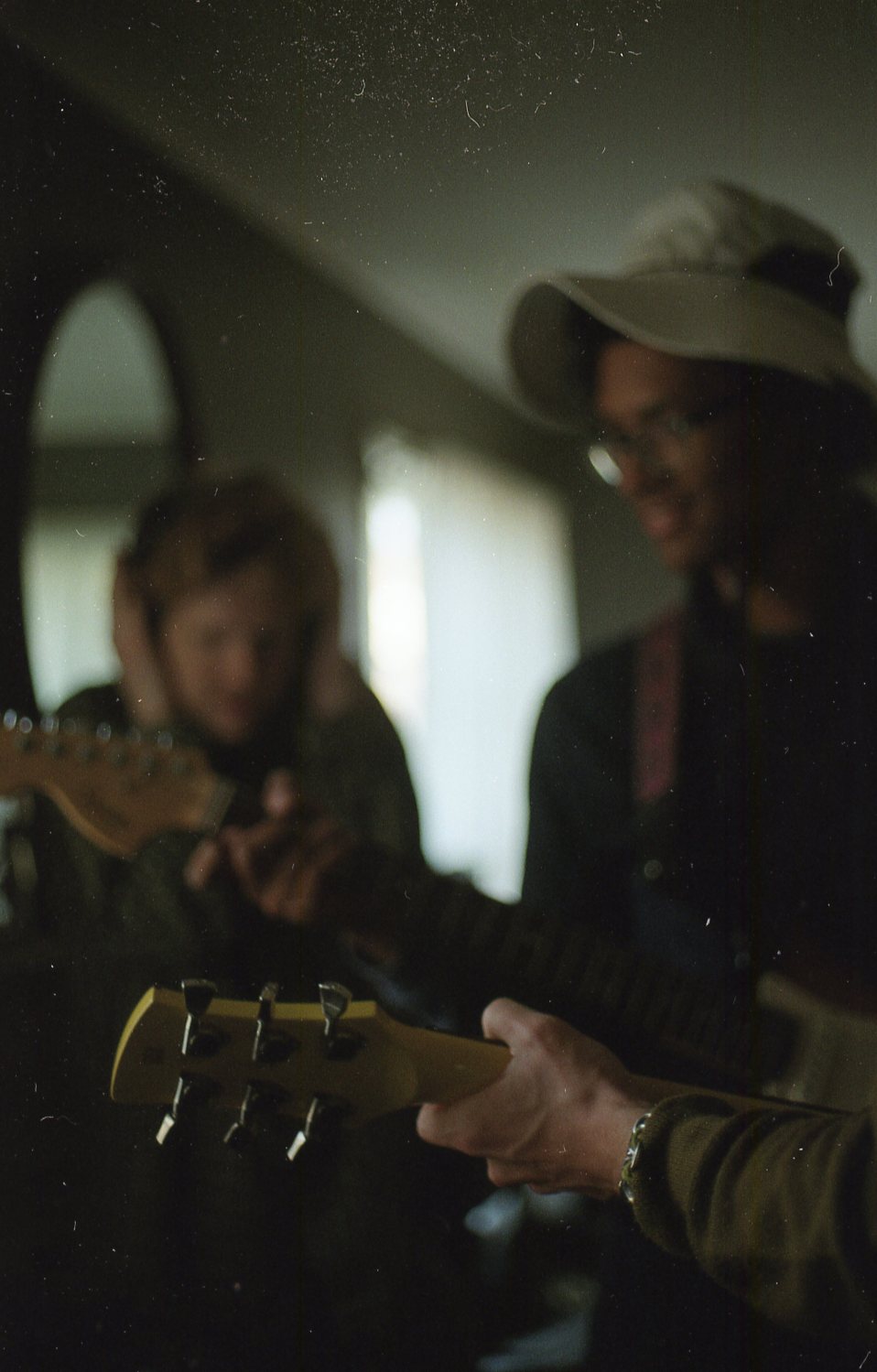
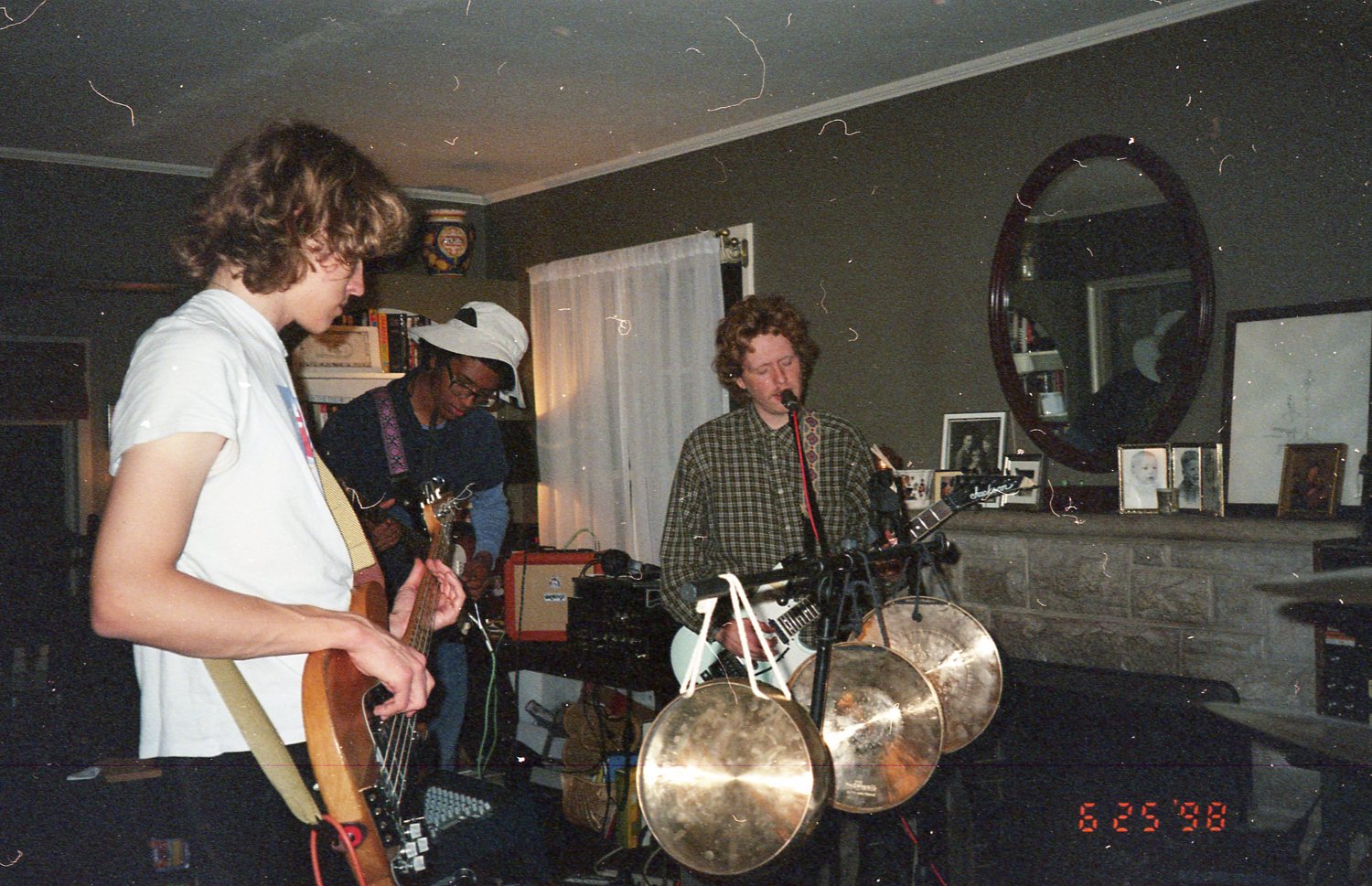
Last month, Glaring Orchid was the first of five bands to play a California wildfire show hosted by Julia’s War at Trans-Pecos. The event’s flier made its Instagram debut a scanty 24 hours in advance, though neither short notice or the evening’s harsh wind chill hindered a punctual turnout; the Queens venue was lively by 7:30 while Dana DeBari’s sugary vocals drifted in and out of heavy grunge atmospheres. As each gritty layer of Quinn Mulvihill’s project came to life, there were moments you could detect a pin drop and moments too brash to hear your own thoughts. Obviously, no one is hearing a pin drop at Trans-Pecos, but the control the band wielded as they oscillated between tender and heavy (and the fact that it was only their fourth live show) felt deserving of all the cliche hyperboles in my arsenal.
Their first show was last April, playing alongside Ringing, Rat Palace and Pry at the TV Eye in Queens. For those unfamiliar with the venue, the stage features an opulent red velvet curtain that opens and closes between sets, “We made jokes about it for a while afterwards”, Mulvihill tells me, “We did a show in Philly after that which was really cool and intimate and we were like, ‘where’s the curtain? We need the curtain to set up”
Mulvihill has been playing music since his dad gave him a guitar for Christmas at 12, spending his teenage years recording songs on a free version of Ableton Live and recruiting Dana DeBari to sing on them. “Dana and I grew up together, she was not that into music, but she was just naturally good at singing, I thought. So, I was like, can you please come sing on this song,” Mulvihill recalls of the two’s earliest collaborations. “Yeah, in his loft bedroom. We were like, 16 years old,” DeBari adds. Glaring Orchid began a few years ago to satisfy Mulvihill’s craving to put out music that he could make on his own while he was working on boats and moving frequently, his first release a drum and bass heavy lo-fi EP in 2022, followed by a cover of “I’m So Tired” in 2023.
Last year Glaring Orchid released i hope you’re okay, a splattering of synthy lo-fi, grungy reverb and glitchy fragments that never present the same way twice. The release thickened the project’s identity, with production help by Tim Jordan and drum contributions from Jordyn Blakely and Alex Ha bending Glaring Orchid’s bedroom recording project roots into a charged experimental rock album. DeBari’s famously nice voice looms in nearly every track, chameleon-like in its tendency to adapt to the mood established by instrumentals it surrounds. In some tracks Mulvihill’s bristly vocals offer a dreamy counter-harmony, as the two drone about being under the influence in “buzzed in the basement”, eerie synths invading gradually as the song trickles further from reality. Though it frequents naturlistic imagery, i hope you’re okay is sort of like eating fruit in Sour Patch Kid form, processed in unpredictable ways to contort organic ideas into a surreal and potent experience.
the ugly hug recently sat down with DeBari and Mulvihill to discuss music inspirations, their creative dynamic and the history of Glaring Orchid.
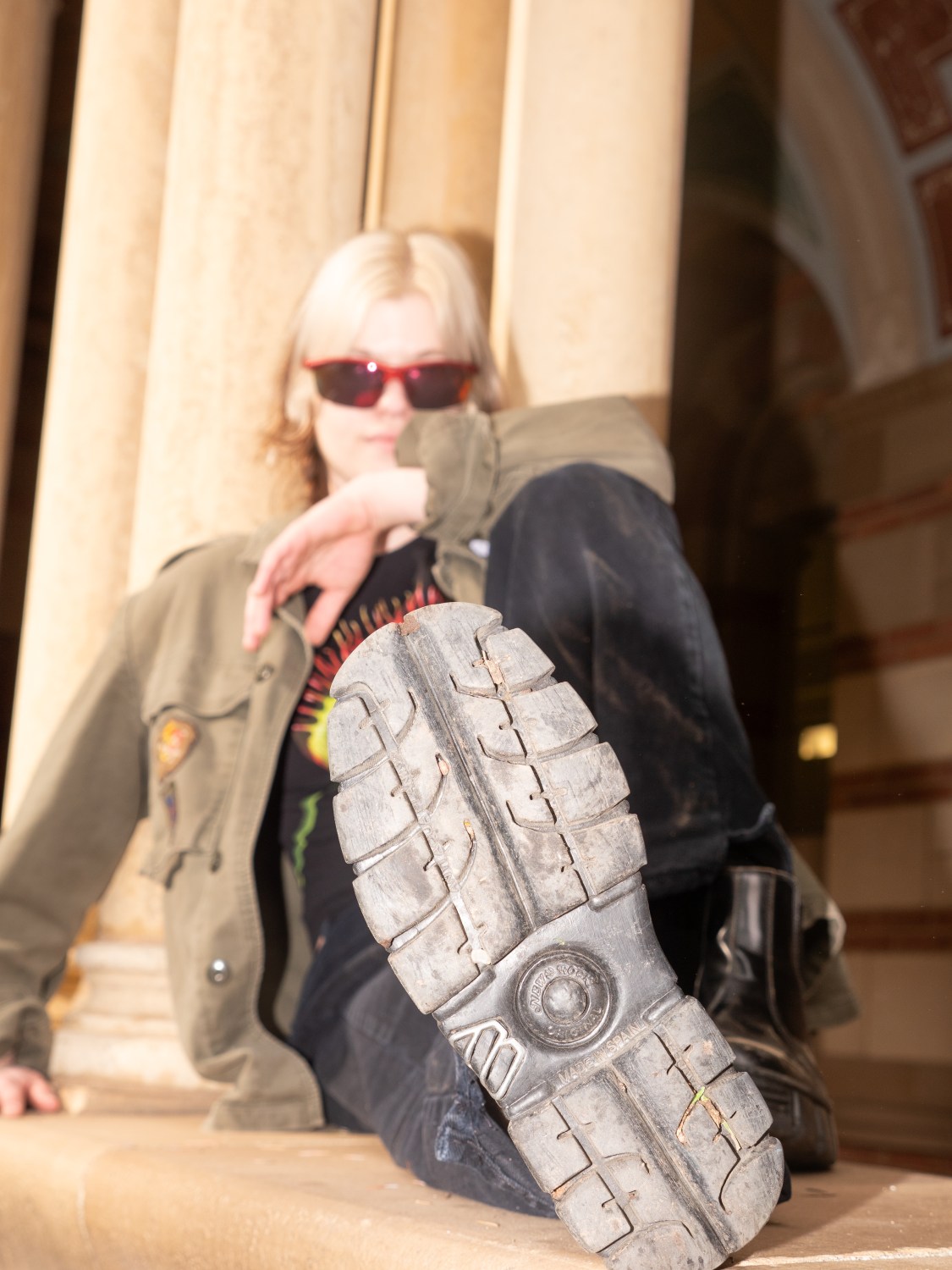
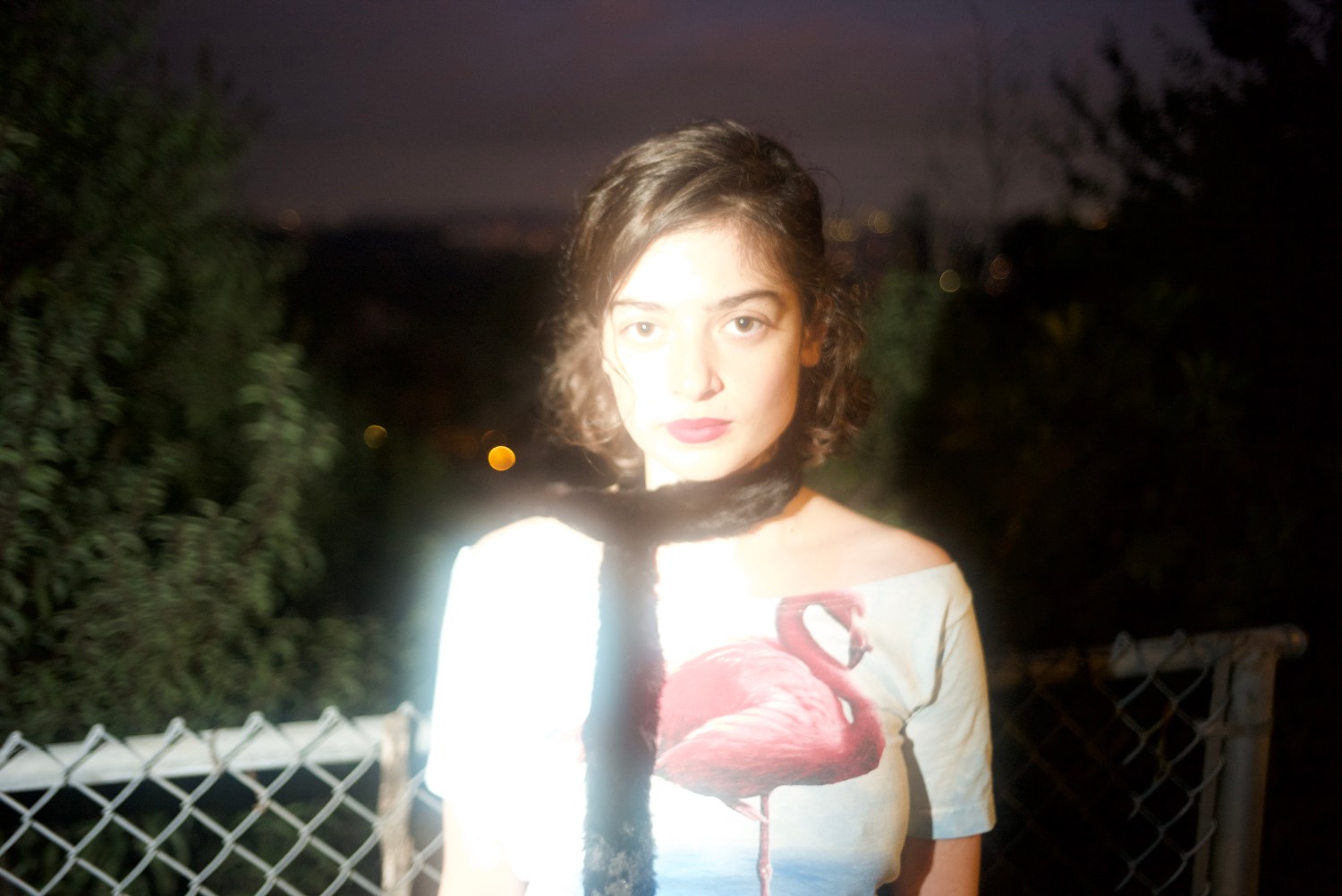
Photo by Noah Lehman
This interview has been edited for length and clarity
MB: How long have you known each other?
DD: Since we were 12, same hometown.
MB: That’s awesome! When did you start Glaring Orchid?
QM: Glaring Orchid started a couple of years ago. I was away working a lot, and I started getting frustrated that I hadn’t put any music out. I was like, I’m just going to do something that I can do on my own and release, and that was the first EP – the drum and bass lo-fi one. It was very different from what I had always made but I just thought, maybe I can try to do this on my own.
MB: Were you living in New York then?
QM: I was sort of in Florida, I worked on boats so I was kind of moving around a bit, but at that point mostly in Florida, and Dana was either in New York or Boston. So for that first single, the cover we did, she was in New York and did a voice memo and sent it over.
MB: And then Dana, I know your involvement started with having a good voice. Do you feel like you’ve shifted how you approach music since the days in the loft bedroom?
DD: I feel like I’ve learned a lot, which has been nice, but I kind of just do what [Quinn] requests, and then we tweak it. I’m always groaning about something, being like, do I have to do this right now? So, it’s like that kind of dynamic.
MB: I’d also love to talk about I hope you’re okay! Quinn I know you mentioned you worked on boats, I was curious about the way you used the ocean and other eerie nature references in this record that often explores life and death. Was there an intention there?
QM: Honestly, there wasn’t really too much intention. I didn’t realize until way after – I read something talking about the songs, and I was like, ‘wow. Every one is about life and death.’ I didn’t mean for that to happen, and I don’t know why it happened.
DD: Your natural state of thought
QM: I guess so… There were a couple of songs that I did consider a bit more. Definitely “swimmer”. It was just post COVID when people were starting to go back to work, and everyone was miserable and that struck a note with me.
MB: Yeah that one definitely has a ‘post-covid’ feel to it. Have a lot of the songs on the record been with you for a while?
QM: Some of the songs are from a long time ago. I definitely start songs and then I put them away for a while and then I come back to them. “swimmer” I started in 2022 and then kind of hit a roadblock and wanted to do something else. I started working with Tim Jordan in May of 2023, and he helped me finish it by December.
DD: I like watching the process, kind of from afar. I see the early stages, and they get stuck in my head. I’m like, ‘when are you going to finish this’, because I want to hear the rest of it.
MB: Was there a song you heard early on that felt especially antsy about being finished?
DD: “swimmer” was always on my mind for sure, I just thought it was going to come out really good.
QM: She kept saying ‘you have to release this one’.
DD: Yeah, I was getting impatient.
MB: What song off the record came the easiest?
QM: I would say “blistered skin” was the quickest. I was visiting Dana in Boston. I brought my guitar and I just recorded a demo.
DD: And I heard it on like a loop
QM: Yeah that one I was really stoked about. “blurry2” too. That was when we were almost done with the record, it was one of the last ones and I was just feeling really inspired, so it came together easily. That one was Tim’s idea, like I brought it to him and he was like, ‘this is the first song’.
MB: Okay, so besides from going to work post-covid, what are some of your bigger inspirations?
QM: So much music! The obvious ones are Nirvana, and I love Sufjan. I’ve always kind of followed the local music scene. I love TAGABOW and all those Philly bands, all the New Moral Zine bands doing the grunge stuff, I mean all those bands are massively inspirational.
MB: The album has such a great balance of soft and heavy, that was really awesome during your show, there was so much control. Has there been any challenges with playing these songs live?
QM: The chords themselves are all simple, the hardest parts are the stopping and starting, and trying to make it quiet. Also not playing “sweater” for the first two shows. I think it was fun to do that for Chicago and then for Trans-Pecos. It was just me playing guitar in the first two shows, so bringing in a second guitarist made a big difference. It’s also hard because I don’t want to tell people what to do too much, but I’m trying to find the balance of letting someone do what they want and keeping some sort of resemblance to the album.
MB: How long have you been playing shows under Glaring Orchid?
QM: The Trans-Pecos Show was our fourth show, so it’s very new. The first two shows, we had a couple of friends from New Jersey that played with us, and the second was with some friends I met from here. It’s been kinda makeshift, the trickiest part is trying to get five people in a room together to practice and then play a show.
MB: It definitely did not sound makeshift! The songs translate so well live.
QM: Thank you. We did practice, we both really tried to make it sound good, and we were really happy with how it was.
MB: So your third show was in Chicago, how was that?
DD: So fun!
QM: That was, that was a lot of fun. Chicago was great. We played at Schubas – perfect venue. The whole experience was really great. I think we were all a bit nervous, but the first show was definitely the scariest one.
MB: Have you seen any good shows lately?
QM: I saw Melaina Kol before the Chicago show, and that was something that really surprised me. I love their albums, but the live shows are a whole different thing – really great. Seeing TAGABOW live is really cool, probably like the loudest band I’ve ever seen. I also saw Greg Mendez, and I didn’t know him at the time, but I saw him play and I fell in love with his music. It was special. It’s been cool discovering music that way, where you might go to just see one band and then find another that you fall in love with.
You can listen to Glaring Orchid’s 2024 release i hope you’re okay out everywhere.
Written by Manon Bushong | Featured photo courtesy of glaring orchid
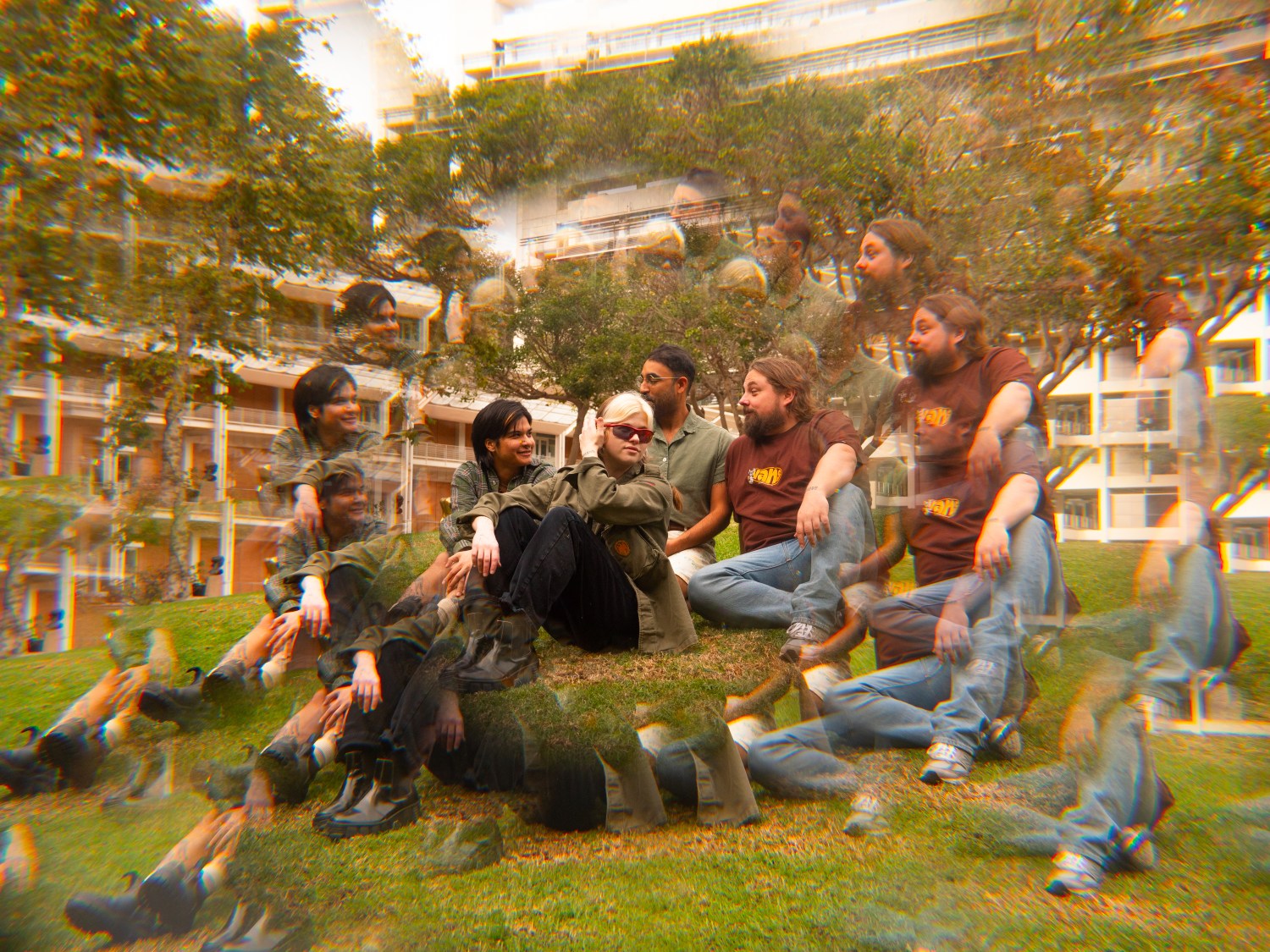
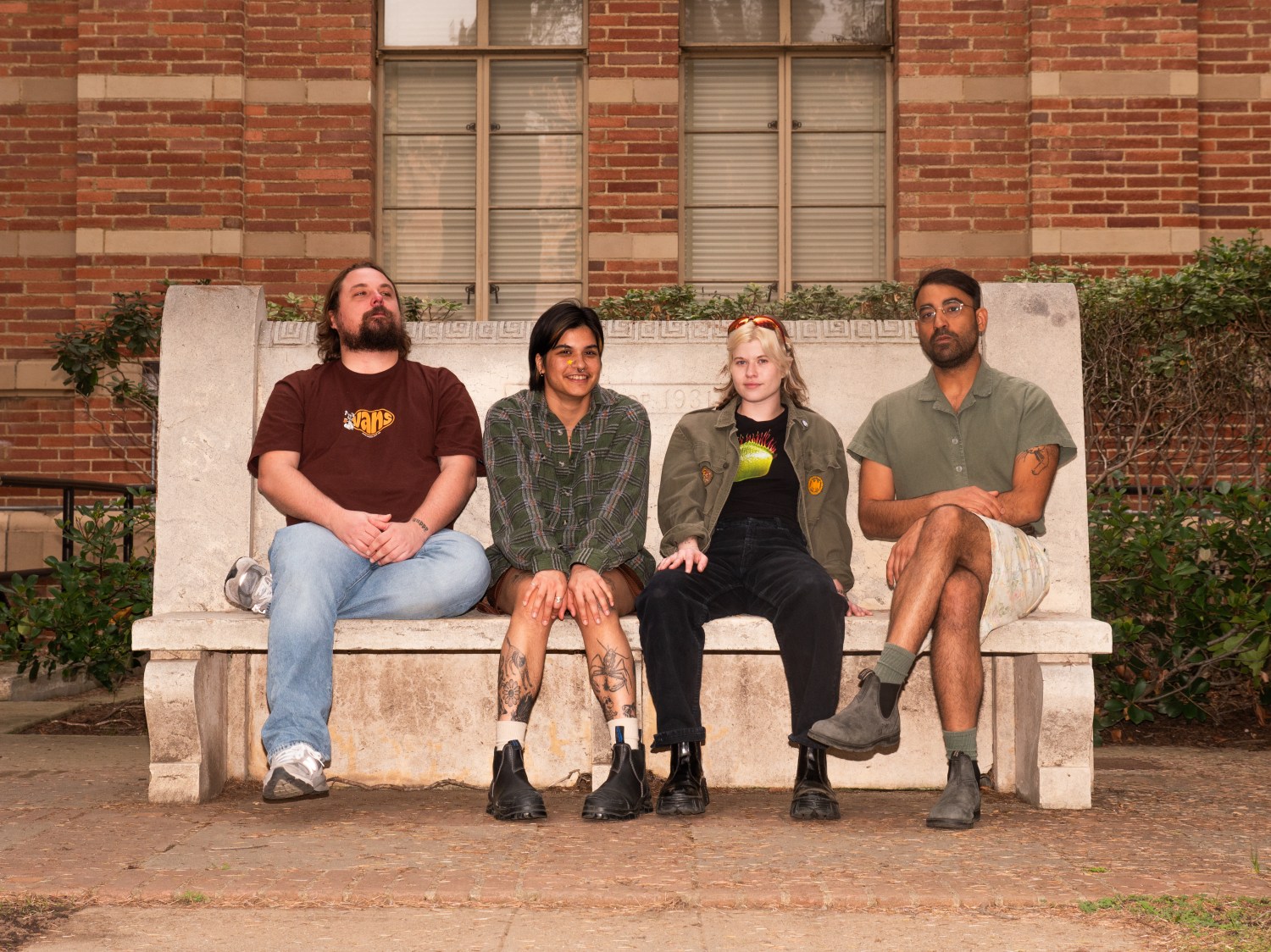
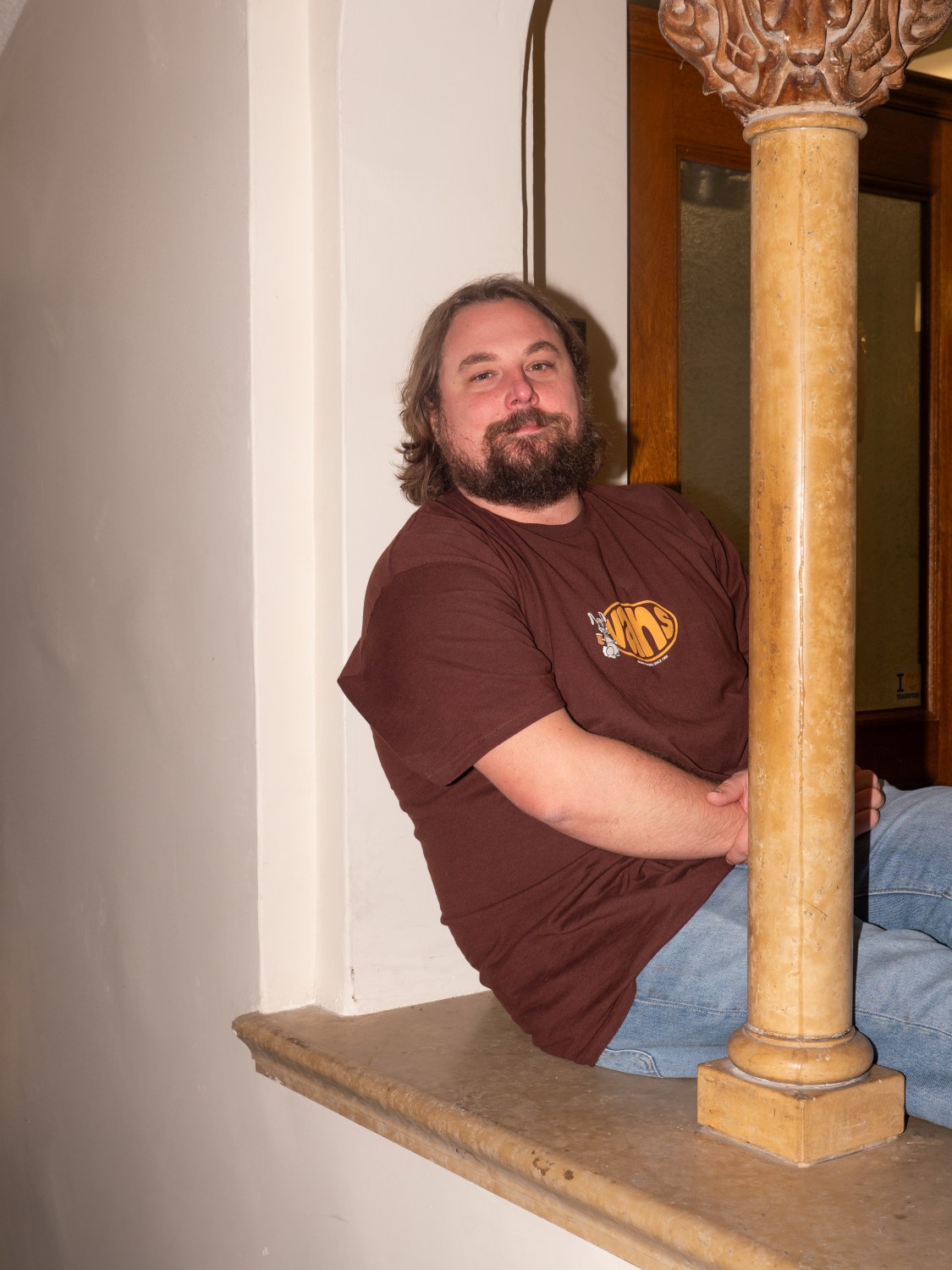
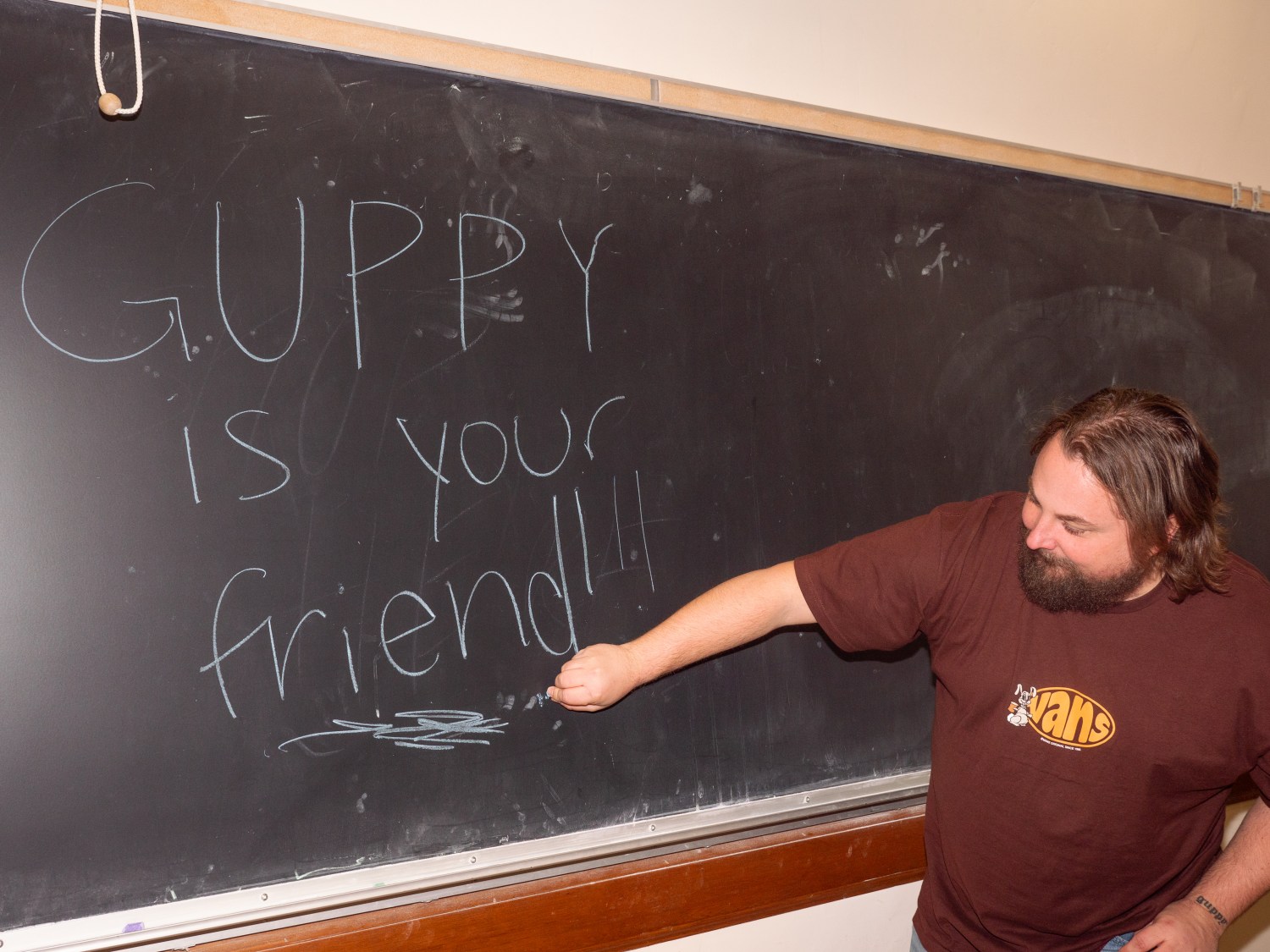
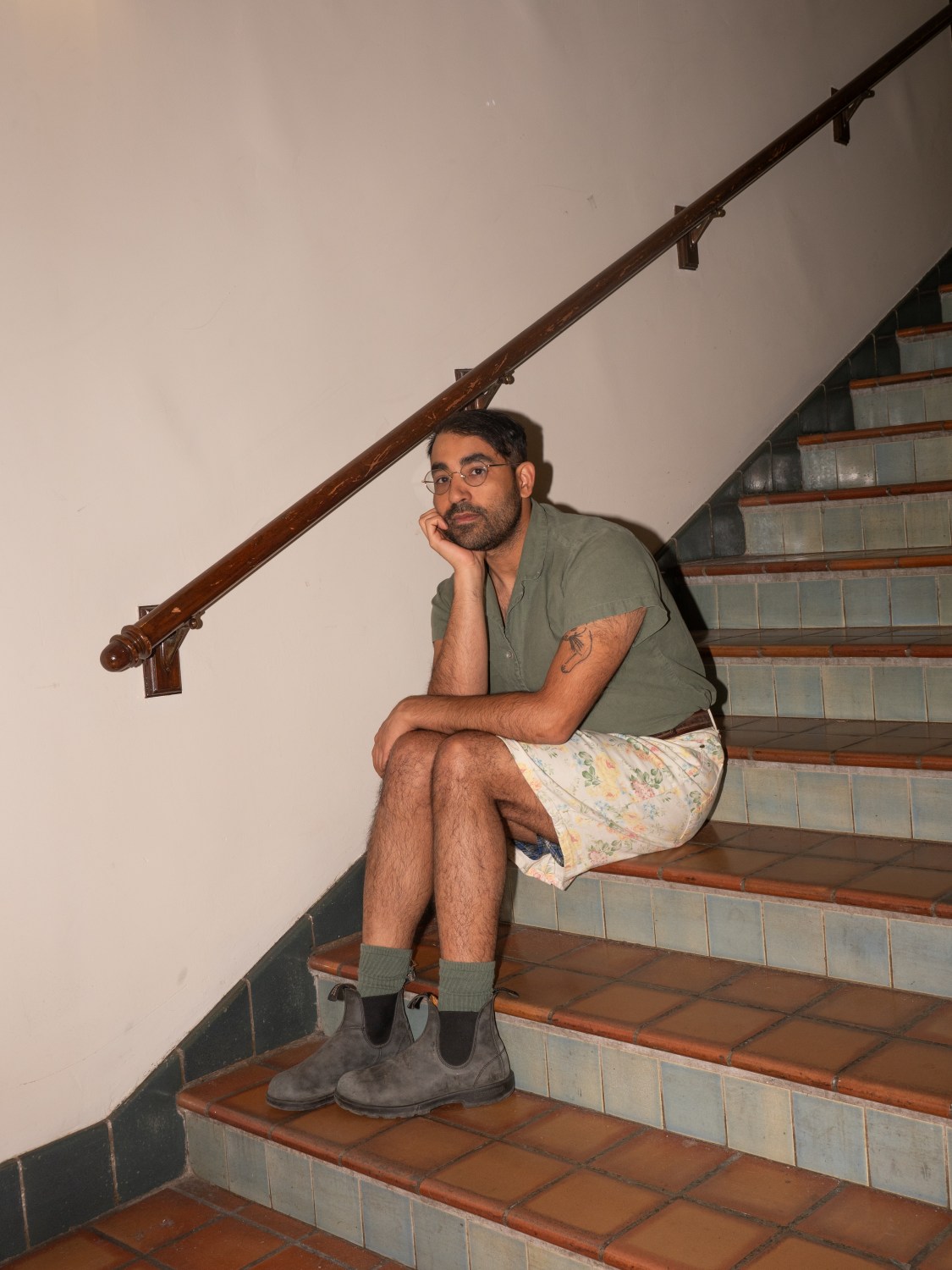
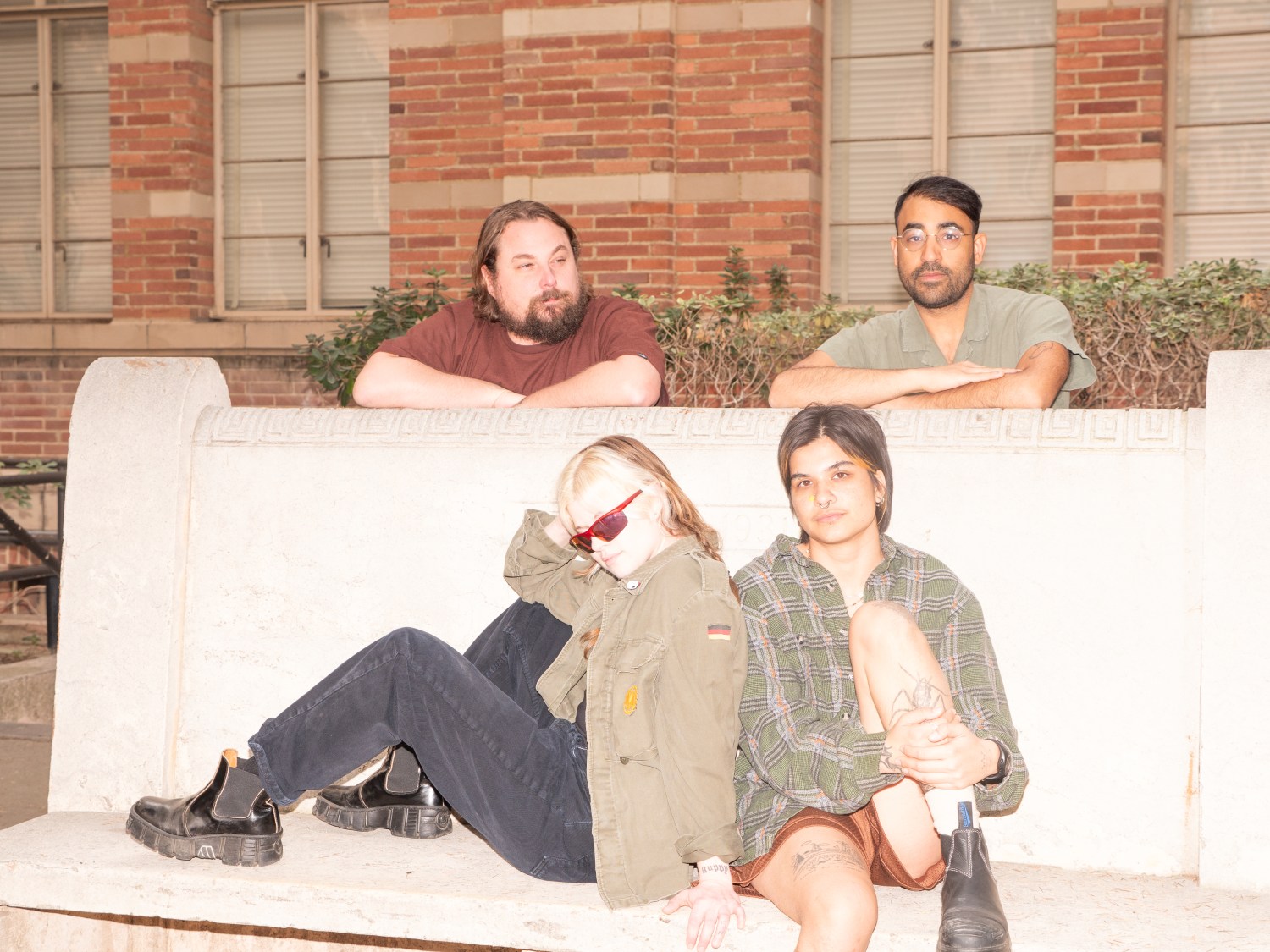
I first met Guppy in a small east LA venue, to which I recognized them for their song “Texting & Driving.” A year later, we sit side by side in booths of my college radio station to discuss the becomings and more of the band. While Guppy identifies themselves as a indie rock band from LA, there’s something to be said about their lyricism and the way they present themselves. Listen in to the world of Guppy and hear us talk about their inspirations, albums, and more!
This interview was conducted by Chloe (DJ Adderall Spritz) at ucla radio. Listen to our conversation with GUPPY below!
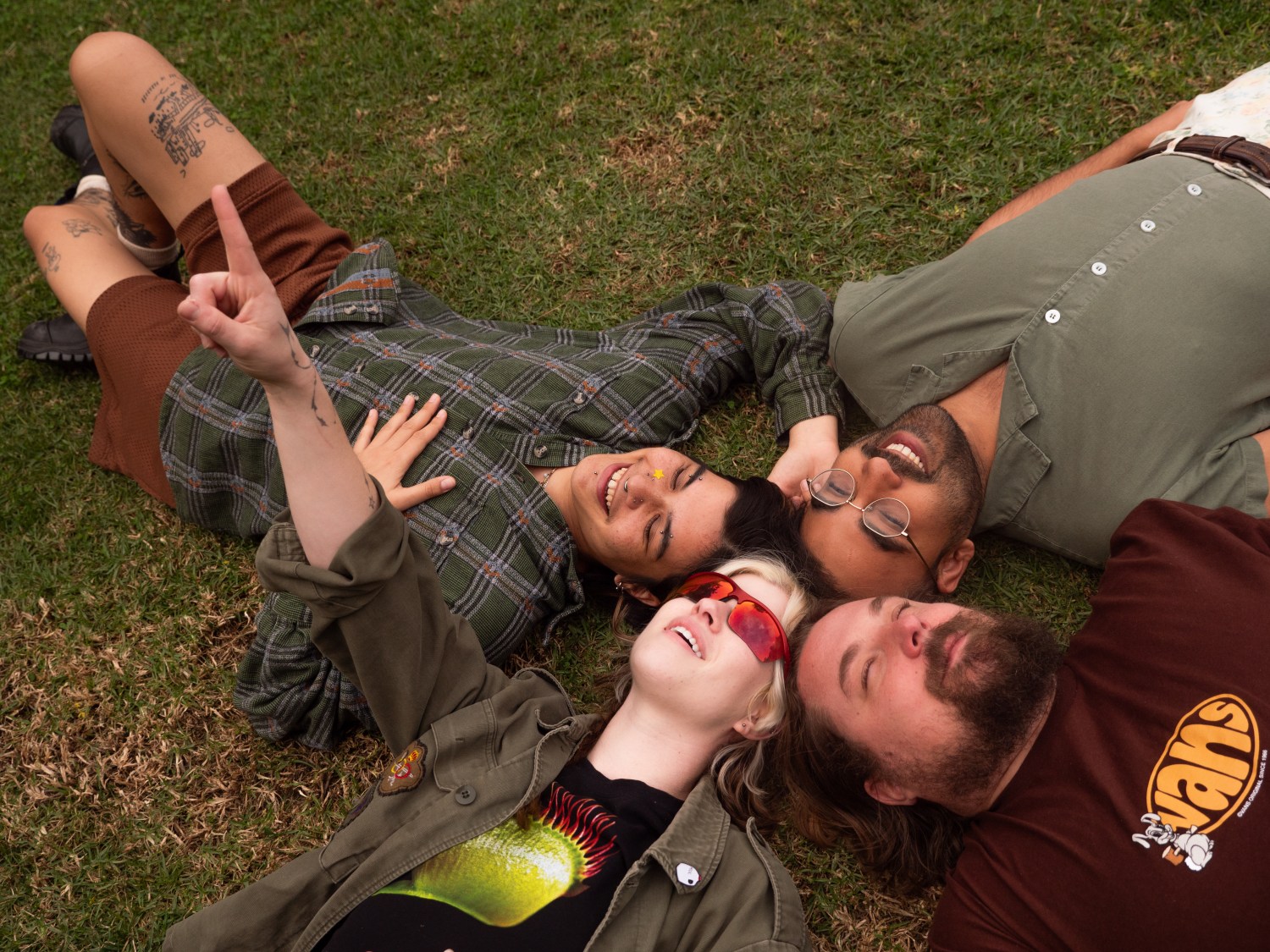
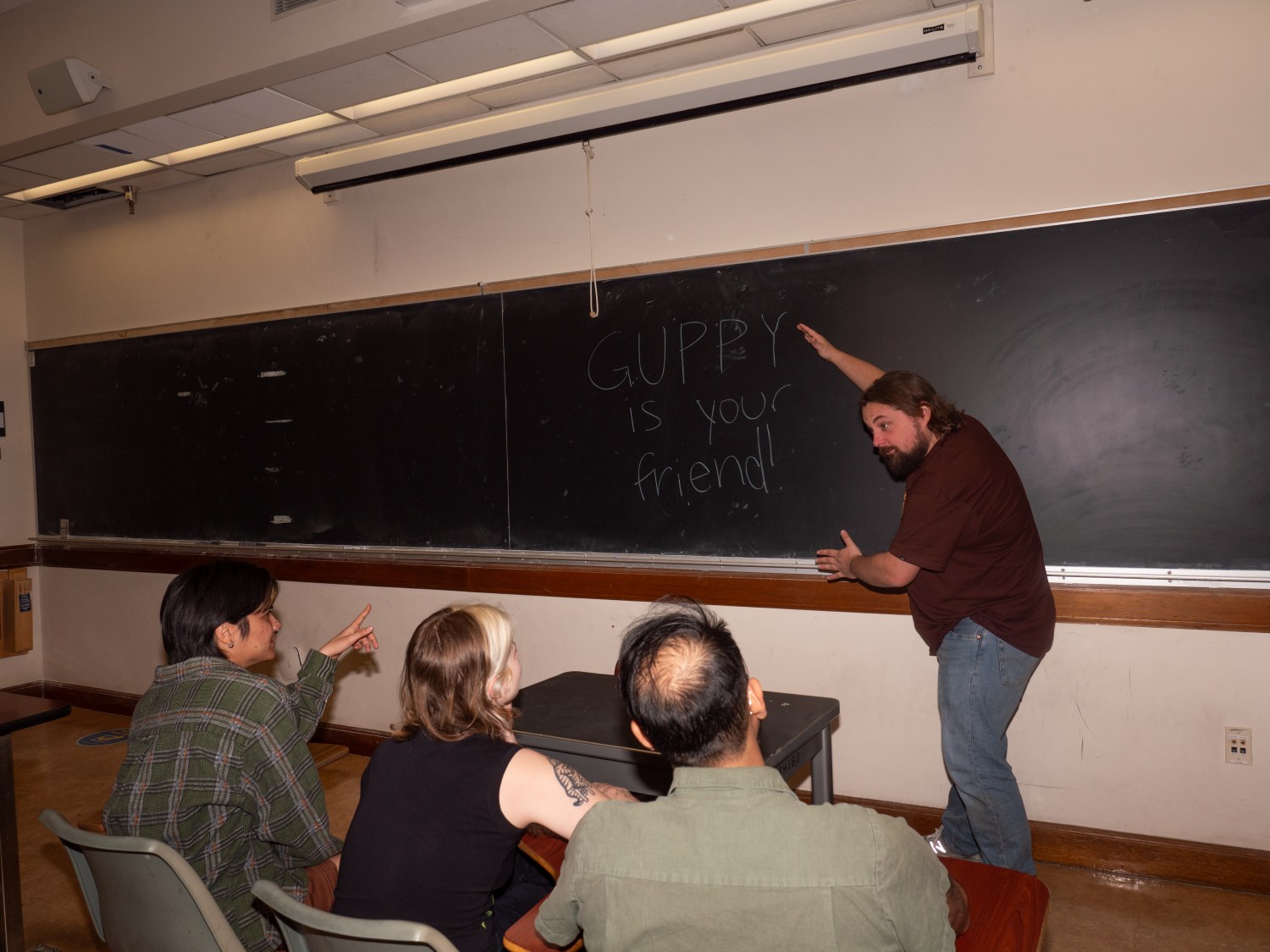
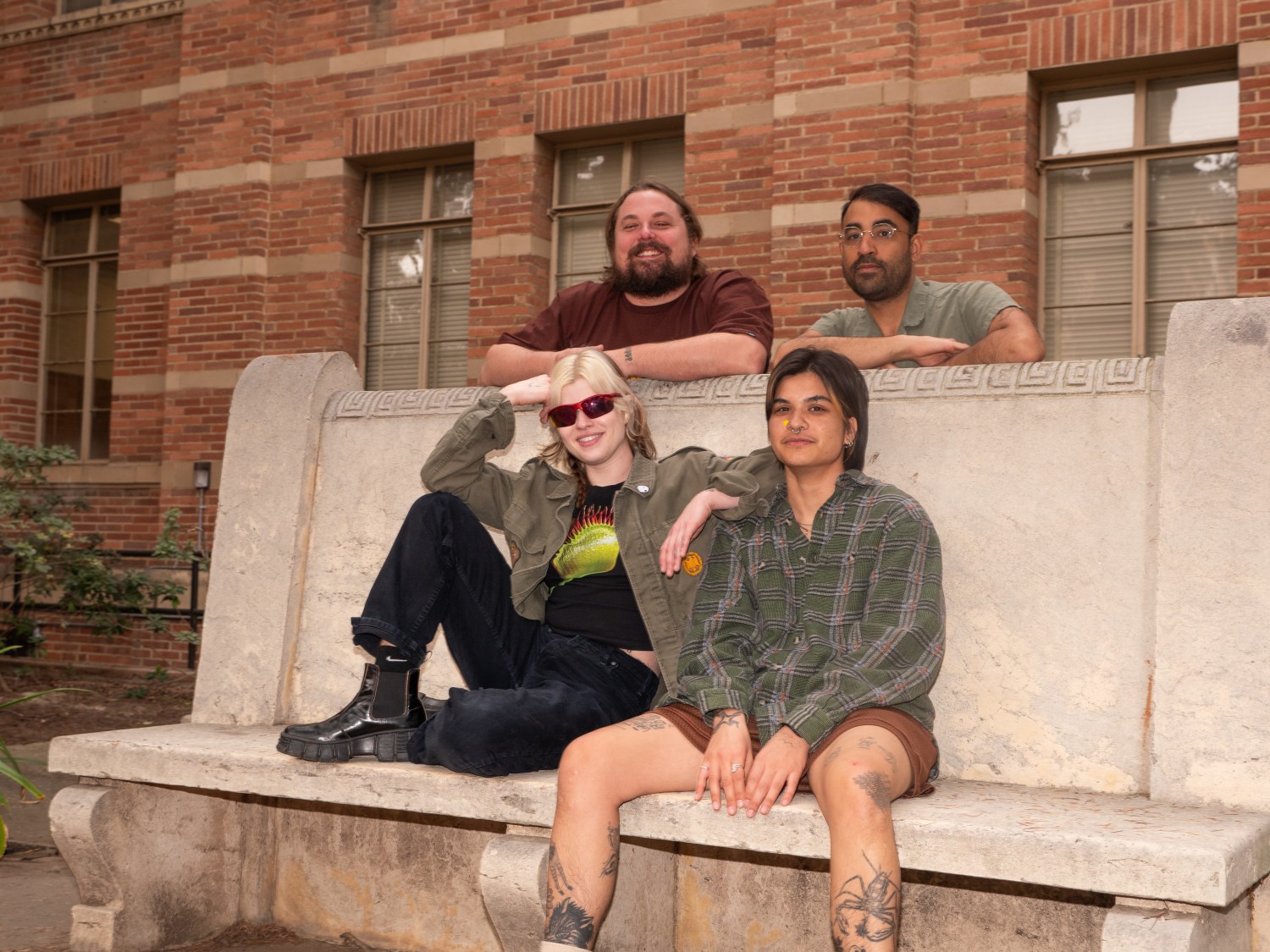
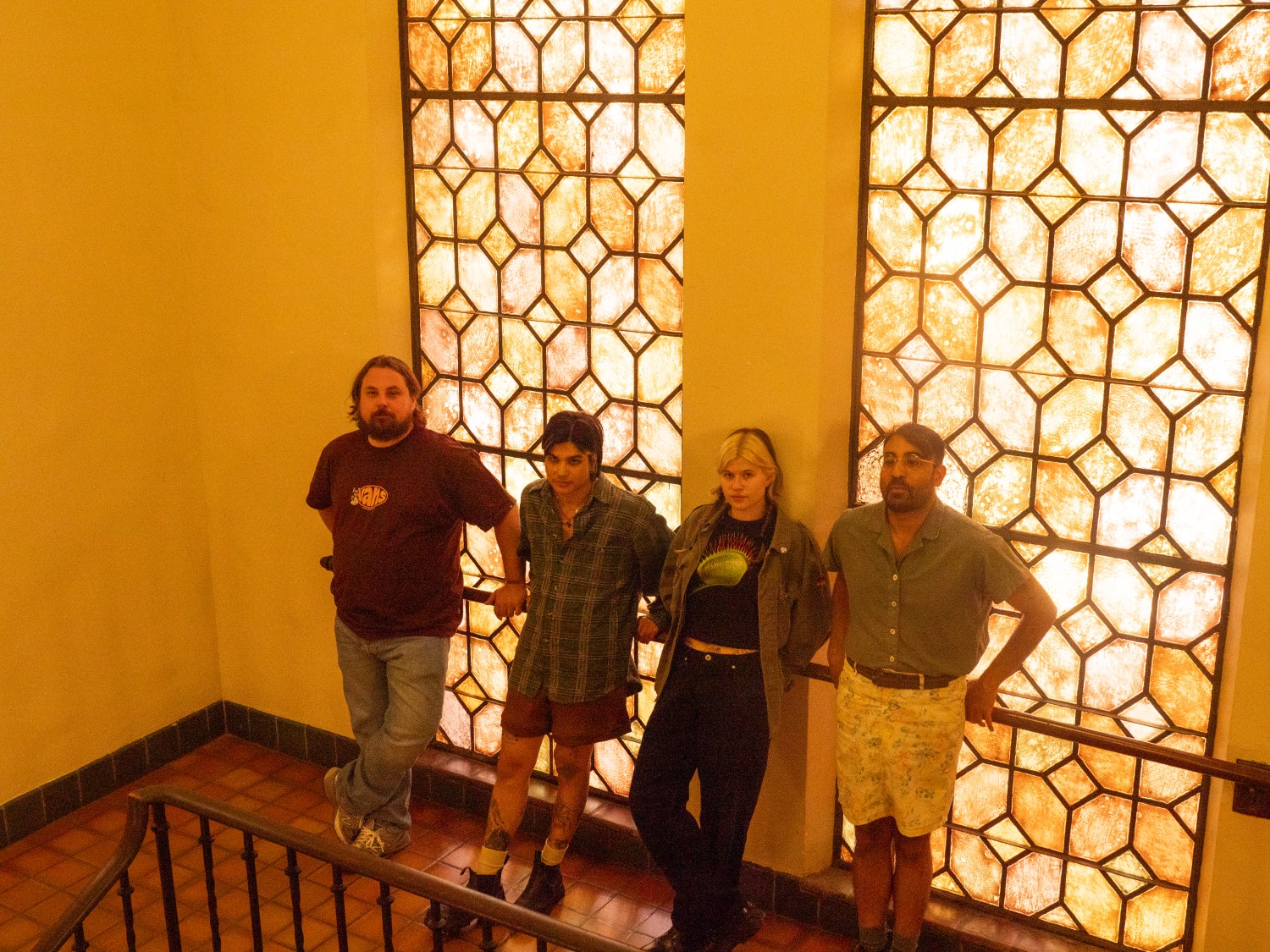
Scroll through to see more photos of GUPPY!
You can listen to GUPPY’s most recent release Something is Happening… out on all platforms, as well as vinyl and CD.
Interview and photos by Chloe Gonzales | Interview conducted at ucla radio
“I’m gonna go off topic for a second” Nara Avakian prefaces before pivoting into a story from their day at work at a school in Elmhurst, Queens. We had been discussing the impact of taking Nara’s Room outside of the physical parameters of ‘Nara’s Room’, and while they assure me the anecdote will circle back to that point, I am hardly worried. Avakian details an art class activity where they prompted students to complete a ten minute automatic drawing followed by a more intentional piece of art on the other side of the paper. “I saw the ways that their subconscious kind of came out. I mean, they’re all twelve, thirteen, so they’re not overtly thinking, but I could see the connections that were being made,” Avakian explains.
One student had drawn a Yin and Yang symbol during the brief ten minutes, explaining to Avakian it was an element of another lesson she had that day. For the second part of the assignment, she drew a chameleon, likely inspired by the cover of a textbook in the classroom. “Because she drew the chameleon in marker, when you flipped it over it bled through and it was perfectly symmetrical with the Yin and Yang symbol. I feel like that instance is how I perceive my own songwriting and performing, it’s my subconscious flowing out and it just ends up almost experimental. I bring it to the boys, and they process it in their own ways. They evolve the meaning and turn something that is very private to me and very singular into something that is so much more nuanced.”
Avakian is the front person of Nara’s Room, a Brooklyn Based band that boasts a grungy catalogue of tracks that fizz in your ears and yank at your chest. Their experimental sound glides over achey introspections like Vaseline, forming this healing liminal space where pain has to be felt, perhaps even danced to, before it can be truly let go. The deeply cathartic essence of Nara’s Room is one of the band’s biggest triumphs, though it was not necessarily intentional from conception. Avakian began Nara’s Room at a time they were still nurturing their own confidence as a musician, initially envisioning something along the lines of “Joni Mitchell, Tim Buckley singer- songwriter”. They found bandmates Ethan Nash and Brendan Jones after posting on Craigslist for ‘non men players’ who liked the Cranberries, Galaxie 500, and the Sundays. “Lo and behold, two of the most boyish of boys responded”, Avakian jokes before tenderly reflecting on the significance of Nash and Jones in their life, “They ended up becoming my chosen family.”
The band fosters an extremely pliable approach to creativity, allowing them to harvest depth from anything. As Avakian reflected on the subsconscious driven exercises of their middle school art class, I thought of a track off Glassy Star that is somewhat centered around a bottle of juice. Recalled amidst the anguish of a parasitic relationship, “Grape Juice” is a standout example of the band’s knack for achieving emotional complexity without a need for explicit articulation. When I asked if the song was based on reality, if perhaps a decayed bodega beverage was a means to reach something darker buried in Avakian’s mind, I tried to resist posing the question in an overtly personal way. In retrospect, I think the times I have dropped what I was doing to vehemently sing along to the agonizing delivery of “a moldy bottle of Welch’s juice, I left in my closet, I forgot to drink” has less to do with me than it does the band’s ability to inject pathos into, well, anything. This dexterity wields songs that beg to be weathered by the relationship of a listener; as the stories told by Nara’s Room are meant to be felt more than understood.
Avakian explains that while the moldy grape juice story was true, it was initially someone else’s, one told via Spongebob voice filter on Instagram Reels. “At the time, I was friends with someone who was the classic case of just taking advantage of a friendship. The moldy bottle of Welch’s juice line came up, and I hate that this is the reference, but I guess it goes to show that you can find that value in anything,” Avakian explains, “I was scrolling through Instagram Reels, I don’t know if you know this guy but he tells these stories through the autotune SpongeBob filter, he has a beard, whatever. He came up, and I don’t watch everything, but for some reason I was just in a mood where I was just kind of rotting, and he talked about this story where his mom wouldn’t let him drink grape juice, so he ended up grabbing a bottle from the fridge and hiding it in his closet. He forgot about it, and then it got moldy, and that kind of just stuck with me. It was not something where I saw the reel and was like, I need to make that into a song, but I took it into my subconscious and it just kind of flowed out and really defining the mood and feelings of the song”
That Reel was just one of the many fragments of life that shaped Glassy Star, mingling in the record alongside a line delivered by Laura Dern in Blue Velvet, a copy of Kurt Vonnegut’s Bluebeard, a vinyl of Fleetwood Mac’s Live Ivory and a light up horse display in a bar in Bed-Stuy. Avakian often refers to these collaged references as “fixations”, though in the context of Nara’s Room, their purpose is ultimately a catalyst for stubborn emotional excavations. The band often knits their individual focuses into one, this creative symbiosis bridging Nash’s fascination with the New York City Transit System’s most elusive train and a poem Avakian wrote on a receipt at a comic shop in LA seven years prior on “Waiting for the z”.
There is also value in the intent behind what they choose to integrate into their art. The approach is deeply unpretentious, focused on exploring the notions that resonate regardless of their cultural weight. “That’s how I process what a fixation meant to me”, Avakian explains on their trust in their own subconscious, and how they rely on music to unravel it. Amongst the slivers of life and media that braided into Nara’s Room, an emphasis on the 2000’s holds a prominent slot in the band’s identity. Glassy Star odes heavily to the cultural landscape of the band’s formative years, the album’s visuals rich with contrast between aesthetics associated with innocence and lyrics that navigate the darker realities of growing up.
“I have this relationship with my childhood, where growing up I genuinely believed that every element in the early 2000’s would be that way forever. Like the idyllic world of a Disney Channel original movie. In my music, or at least with Glassy Star, it’s one of the dimensions. There’s so many. One of them is reconciling with growing up and change”, Avakian reflects on their focus on 2000’s media, “It’s my way of kind of returning back to the room in many ways, returning back to these things that are so foundational to who I am that don’t necessarily have a place in this world anymore.”
Their manipulation of nostalgia becomes particularly powerful in the music video for “Holden”, a standout track that purges identity uncertainties over buoyant guitar and hypnotic reverb. Avakian used various cameras for the video, which features a stop motion animation inspired by Nickolodeon’s Action League Now, and a visual narrative that unfolds in and out of a vintage television set. It exists somewhere between familiarity and fabrication, envisioning an uncanny realm that possibly cautions against stretching naivete into adulthood, though like most aspects of Nara’s Room, it leans into the abstract, holding more emphasis on emotion than rationality.
This sense of ambiguity is a driving force at their live shows. Creating the songs offers the band a means to make sense of their own minds, but through sharing them the music transcends the personal nature of a notes app entry or media fascination. The meaning becomes something entirely new, as their songs knock on the door of someone else’s emotional ruminations. “When you watch something of David Lynch’s, it’s not meant to be overtly understood, but rather experienced and felt,” Avakian reflects on preforming, “I think when I bring something out of the room, I only hope that people can enter this other space with me, and we can all kind of experience and feel something ourselves.”
You can listen to Glassy Star out on all platforms now. You can also order a cassette tape via Mtn. Laurel Recording Co. Nara also creates videos under the name foggy cow. Check it out here!
Written by Manon Bushong | Featured Photo by Mamie Heldman
This Friday, Sleeper’s Bell is offering Clover, their long-awaited debut LP via Fire Talk’s Chicagoland imprint label, Angel Tapes. Looking ahead to this release, we are excited to be celebrating Sleeper’s Bell week here at the ugly hug with two different features!
Originally formed by Blaine Teppema back in high school, Sleeper’s Bell was first found by many listeners with the release of her debut EP Umarell, released back in 2021 and having since been reissued on cassette in 2024 via Angel Tapes. It was a raw, and rather memorable collection, as its longevity is a sentiment to its articulation of heart, something that she so beautifully made mindful in its short run time. Fostering a reciprocal relationship with storytelling, Teppema’s presence within her words has always been one of desirable consciousness and stimulation – like biting into a citrus fruit and lingering with the reliving, sweet flavors while fighting with the stringy pith that’s left behind, stuck between your teeth. With the addition of Evan Green on guitar, Sleeper’s Bell became a project unknown to Teppema, not out of lack of recognition, but a rather new and open space with no defined limitations – a chance to strive for clarity where there was sometimes none before. With songs dating back almost a decade now finally in one place on Clover, the duo has taken every part of the process step-by-step, embracing a type of chronological association where both beauty and trauma hold the cards and Sleeper’s Bell decides when to slap them down.
Embracing the vivid talents of the Chicago scene, Clover also debuts the duo working with a full ensemble of notable players including Jack Henry, Max Subar, Gabe Bostick and Leo Paterniti, putting a newfound life into the already lasting structures of a Sleeper’s Bell song. But as Teppema and Green have spent the last two years recording Clover, building upon their trust as both collaborators and friends, this debut marks more than just the release of some rather beloved songs. It has become a full story, an almost novelistic dream of what it means to love and to be loved, to be hurt and to heal, and to simply make art with your best friends.
With Clover’s release this Friday, the ugly hug is featuring Sleeper’s Bell in two different ways today. One is a conversation in which we recently sat down with Teppema and Green to discuss the duo’s origin, vulnerability in sharing, friendship and the making of Clover. The second being the debut of a new series called the ugly sessions.
Watch Sleeper’s Bell perform in studio below.
This interview has been edited for length and clarity
SR: We are almost upon the eve of your debut LP, Clover. Looking over the edge now, how does it feel?
Blaine Teppema: I’m ready. I feel like I’ve been so up and down about the release process for so long, and now I’m finally in a stable place with it. It feels good.
Evan Green: It’s like the stages of grief, seriously, you know what I mean? At each part, there was like a mourning for the loss of the part before it. There were hurdles each step of the way and it definitely would feel impossible at times because it took us over two years.
BT: We were so new to every process. I’ve never recorded in a studio and I’ve never recorded with a band or really worked with other people besides Max [Subar], who was really hands-off with the process, so every time the band figured something out, we couldn’t sit with it or spend time thinking about it or really work on it. It was just on to the next part, you know? And now we’ve been able to sit with everything.
EG: We’ve come so far with the music and being a band. We were not even a full rock band before the record because it was just Blaine. And then Blaine added me to the project, just us playing duo for almost a year. And then when we started recording the album, we would get to the studio and literally I would play bass, Blaine would play guitar and sing, Jack [Henry] was on drums and Gabe was just in the recording booth pressing record, and we would just figure out arrangements for all of the full band songs on the record while it was recording. We only would play it ten times and then we’d just pick the best one.
BT: It was always the first or second one. That’s usually how it is.
SR: Was it weird figuring this out, you know, not allowing yourself to sit with pieces you just learned as you kept pushing through?
EG: Since we were at the DePaul studio, Gabe was like, ‘okay, I have this window of time for you guys to be able to record here for free’, before he graduated. We were like, ‘okay, we want this record to sound like this…’, and we just started doing it. So we felt this time pressure. We were all so busy. Eight songs done. We had those initial sessions and then we were still committed to working with Jack on the record, but he would go on tour and we would have to wait a month or two at a time and then get back to working on the record. We kept having to put things on hold, so we would have this moment where we would be working on everything and it would feel incredible, but then we would have time off. That kind of kept going until December of 2023 and we decided that Leo [Paterniti] and I were just gonna mix the record and we finished recording everything at our house and we mixed it all in our bedrooms.
SR: You can tell this album works like patchwork, but it fits so cohesively, especially knowing the whole ethos of this record piecing together old and new songs you had, Blaine. But this project has been your personal thing for almost a decade now. Was this how you envisioned Sleeper’s Bell would be when writing as a teenager?
BT: Hell no. I was so meek about music. In high school, I didn’t really show anyone my music and I didn’t like performing. I feel like it was something I would just get high and make a song on GarageBand and post it on SoundCloud, you know? And that was basically how I was able to function as a teenager – I would just record in my room alone all the time, and a lot of those songs I was so critical of, and a lot of them are gone. I would put it up and then I’d be like, ‘It’s so stupid, stupid, stupid,’ and I’d delete it. I thought that was me being humble or something, or, you know, having humility. But I think, in retrospect, it’s a form of ego to be like, ‘it’s not perfect, so it’s not me.’ Then I had these songs that I had written in college, and Max had a studio, so I felt like I should just record them and it was just gonna be a one-and-done thing to say that I did it. But I didn’t like playing shows.
EG: You did play a few shows though. I heard that Umarell EP through our mutual friend Lilly, and we were falling in love to Blaine’s music. It was really crazy because I was so in love with the songs and I was starstruck by Blaine. And when I moved back to Chicago, I was like, ‘I want to join the best bands. I just want to play music and be around other artists and other people that inspired me to write music and create.’ And ever since I heard [Blaine’s] music, my dream band would be to join Blaine in Sleeper’s Bell. It was a thought that I had, and then a few months later, Blaine hit me up to play a show. I was so scared [laughs]. I was terrified.
BT: Well, again [to Evan], you’re the reason that I like playing shows now. And I like every process that isn’t just sitting alone and writing. You’re the reason that I like sharing now.
EG: We had fun. The first practice was kind of… I feel like it was the perfect example of just how the rest of the journey would be when [Blaine] came over. I was nervous to play with [Blaine], and she comes over and goes, ‘oh, God, wait. I haven’t touched this guitar in months.’ She then takes out her guitar and strums it and it’s rattling. I take it and I turn it upside down and shake it, and dust bunnies just start pouring out of the sound hole [laughs]. It was like a magician’s handkerchief! It just kept coming off out and coming out.
BT: I wasn’t lying!
EG: And we just broke the tension. And then we played that show at the Golden Dagger, and everyone was just silent. It was almost sold out or something like that and we were so nervous. You could just hear a pin drop. We both felt high afterwards, we were shaking with excitement.
We just couldn’t believe it. That just kind of made it. After that, we just felt like we could do this.
BT: I had never really felt that way after playing a show because I was never prepared. I would go into playing a show and I would be fucking up and I wouldn’t have enough songs to have a whole set, so I would play for 15 minutes and be like, ‘I’m fucking done.’ But [Evan] helps me have discipline.
EG: I mean, you’ve grown.
BT: Yeah, I have to respect it all the time even if I’m not feeling it all the time. You know?
Photo by Athena Merry
SR: My first time hearing Blaine’s music, similar to your story, Evan, I was just, you know, completely enamored. I would even listen to it while I ran [laughs]. But it’s funny because I did an interview with Hannah Pruzinsky, and they were like, ‘what are you listening to?’ I was like, ‘have you heard of Sleeper’s Bell?’ They texted me later that day saying something like, ‘it’s so good! I just listened to it on my run.’
BT: [laughs] Oh my god! I love running to sad music. I think it’s because it makes me feel like I’m trying to get to the train station before someone leaves so I can profess my love to them. It’s like a mission.
SR: I completely agree! And then the first time I saw you was that insane four bill at Sleeping Village. It was you two, hemlock, Lily Seabird, and Merce Lemon.
BT: Was that the show where we came out and there was feedback immediately? Probably. That was also the show that I walked off stage with the cord still attached to my guitar.
EG: Some of those early ones were a fever dream. We didn’t have our tech stuff figured out, and running into awkward setups, and if people are talking it can be difficult. It’s a learning experience, but that show was a bit of a rough one for us.
BT: Also we just weren’t besties yet. That makes all the difference. Trust is huge.
SR: Blaine, this album is a constant dialogue between you and your younger self, responding to old journal entries and songs now as an adult trying to heal. What was this experience like in the beginning, and did it shift at all as this album started to become more feasible to you?
BT: I wrote the first song on the album when I was 16 and I wrote the second song on the album when I was 24. And then everything else is in between. But the last song, I wrote when I was doing trauma work in CBT, and a part of that was that I had to go back – I’ve been keeping a journal since I was nine. And as a true librarian should, I have them all archived and numbered on my wall. I never touch them. It’s like fucking dynamite – but as part of the therapy practice, I had to go back and really relive a lot of situations. That’s where the last song “Hey Blue” came from. It was part of forgiving, my inner child sounds so corny, but, you know, letting her know that I love her. But I feel like there’s a line that you tow with vulnerability, that you can give yourself away completely, and I did want to protect myself a little bit. So I did want the songs to be kind of a bop. I wanted them to be fun and energetic, so that I could play with that a little bit.
SR: In what ways did you play with rearranging the songs?
BT: Well, a lot of them weren’t like that when I wrote it.
EG: Oh my god, yeah, that’s where the grooves come in. When we first were playing these songs, they were slow and they were really, really sad. Kind of just meant for a duo setting. But we ended up taking all of those songs and sped them up, like, quite a bit, and the groove of the songs just came naturally.
BT: It just felt like a nice recontextualization. We were having so much fun, we’re in the studio, we’re joking. We were just so happy to be there and there’s nothing we’d rather be doing. I feel like that comes through in the music as much as whatever I was feeling when I wrote it.
SR: Working with the older songs, how much did you hold true to the original and how much would you change when it came time to putting this record together? When trying to hold that throughline between Blaines, what was that process like?
BT: I feel like once I write a song, I can’t change. I just don’t know how I would go in and change it, you know? If anyone else wants to try to change anything, you can, but my brain doesn’t work like that. I feel like we definitely had to doctor up the older ones a lot more because it was just, like, they weren’t as interesting.
EG: No, it wasn’t that they weren’t as interesting, but we were trying to make them fit with the other songs. Like the song “Over” just flowed so naturally. I feel like you can kind of feel it in a song, “Over” especially, how naturally things kind of flow, versus “Bored”, which was more of a puzzle, thinking, ‘how can we match this story that Blaine is telling to an arrangement?’ We have pedal steel, we have keys, we have acoustic 12-string doing these plucks, and all these elements kind of just weave together.
SR: This was also your first majorly collaborative release, quoting it as an ‘assemblage of chosen and real family’. What was this transition like as a solo writer to then a duo to now a fuller ensemble sharing ideas?
BT: Yeah, it was hard. It was really emotionally taxing, you know? I was afraid for a long time, in a similar vein of performing, telling people what I wanted. I realize now that that’s the most helpful and kind thing you can do is to tell someone exactly what you want, and that goes for anything in life. I still struggle with that, and [Evan] helped me a lot with that because I feel like we have a similar vision for it now, where it’s like we think the same things sound good.
EG: I feel like that has been maybe one of the most crucial aspects of our friendship and our musical partnership, the way in which we were able to build trust and help each other. We went from not having any experience and not knowing how to express our likes and dislikes or our preferences. It was just a whole process of growth and pushing each other to be honest. It took over two years to make the record, and we went from not knowing anything to we’re making every decision about this.
EG: But it was really hard. It takes a lot to trust, and at the same time we were making this record where [Blaine] is just being incredibly vulnerable with the lyrics and the stories she was telling, and we put so much love and care in the record. It was such an emotionally loaded experience because of how much we were enjoying it and it was so validating to have these moments of personal growth show in the record.
BT: It’s actually like, ‘this is what I really think because now I’ve been using that muscle, you know, one that I’ve been ignoring for so long.’
EG: Yeah because we were in the studio, we were like feeling confident, we were learning these skills and learning to trust ourselves and like, ‘oh we’re making a record and this is a legit thing we’re actually doing.’ And I feel like at the same time you were growing and learning to say no and stand up for yourself in relationships extending outside of the music process and that’s something. It’s not just like we were making a record, but we were deepening our friendship and deepening the trust between us and sharing these really vulnerable moments while also sharing the creative process.
BT: It was like the most fun I’ve ever had, and the hardest I’ve ever laughed. I was laughing so hard. It’s like we invented a language. I mean that happens when you have all your defenses down and you just want to make art with other people. It’s really just like a fast track to a shared language.
Scroll through photos from Sleeper’s Bell’s ugly session here!
Clover is out everywhere this Friday. Preorder your vinyl and cassettes via Angel Tapes. Sleeper’s Bell will be celebrating the release of Clover with a show at The Hideout in Chicago, Saturday February 8th. Get tickets here. If you preorder the vinyl, you will be entered into a free ticket giveaway. Winners will be picked 2/7.
Written by Shea Roney | Feature Photo by Athena Merry
“This is not a logical world we are living in! So maybe we should stop expecting it to be and just accept the absurdity. Fall straight into the magic bro,” reads a subsection hidden within the fixings of the machinery complex, titled “gave birth to a harddrive”. Earlier last year, Lily Piette shared her debut LP, titled Her Computerized Machinery Complex. Following the album’s release was a specially designed website – a placeholder to any physicality within this music – as a way to visualize and interact with the machinery complex in our measly three-dimensional human form. But in this computerized world, one fixated on intrinsic quarrels, generated visuals and lessons on quantum computing, there is a sentiment that runs through the album, a meeting point of the implausible and the actual that join, not with any profound coincidence, but rather more out of habit. Where big questions are asked and simultaneously answered with another question; the possibilities are endless and that’s okay.
Her Computerized Machinery Complex is both immediate and unsuspecting. Garnishing deep influences of nostalgic patterns and sharp instrumentation from the beloved Touch and Go era, these songs cut deep with both sincerity and cynicism, a heavily involved flavor that coats the palate unburdened by intentionality and experimentation. Taking on the duties of writing, producing and mixing, skills that Lily has been developing with two EPs prior, her artistic intuition bridges the gaps between preconceived notions and primal connections, as Her Computerized Machinery Complex navigates what we deem to understand as natural in the world around us.
Now several months out from its release, we recently sat down with Lily Piette to discuss the Machinery Complex, as well as blending visual art and music and redefining the world through vulnerability.
This interview has been edited for length and clarity
Courtesy of Lily Piette
Shea Roney: Now having some time to sit with it, how has it all been prior to releasing your debut LP?
Lily Piette: Yeah, it was great. It was the first full length thing I had mixed, produced and recorded everything myself, so I definitely think I had kind of gone a little crazy about it, and was really glad to have it out. But then, you know, I was just happy that people liked it, and because I think at that point, I had gone too deep, I was like, ‘I don’t even know what this sounds like anymore. Throw it out [laughs]’. But it was a relief.
SR: Of course, that makes sense. You take on these incredibly large world building-esque moments which I can imagine can be fairly easy to get lost in. What was your initial goal when you decided to make this record, and did it shift at all throughout the process?
LP: When I first started making these songs, I didn’t know it was going to be an album. At the same time, I started getting really into this kind of computer world. I was using Blender to make these videos about these machines, and I was really into quantum computing and all that. That was kind of separate in a way, but then it merged when I started to get to an album length and decided to just put everything together. I usually like to separate art and music, but it all just kind of happened naturally when I had the idea to make the website and just converge it all.
SR: Yes, you are also a visual artist. When you say that you try to keep them separate, are there any ways that you find this means of creation influencing the kind of music you make and your relationship with it?
LP: I’ve always felt blessed to have both because if I’m getting frustrated musically, I can just go paint and vice versa. I’ve always kind of separated them in my mind, though I think thematically I’m working kind of in the same worlds, like my paintings kind of speak to some of these same worlds I’m trying to create in music. But I felt like more so with the videos, and the things that I’m doing on the same computer that I’m making the music with, I feel like are more intertwined. That’s why I bridged more 3D modeling or video editing or whatever into this album because it’s on the same device, rather than going to paint in a studio.
SR: I want to talk about the website you made to accompany Her Computerized Machinery Complex, because you put so much effort and thought into building this visual place for the album to exist. What was the initial idea for this project?
LP: I just had all these videos I’d made from the last year that I needed to put somewhere, and this also aligned with the time I was working on the record. When I had titled it Her Computerized Machinery Complex, at some point I just wanted to create the complex – the machinery complex. It feels like a structure, probably more so like a building, but I can’t do that [laughs], so I made a website where you can go into these different rooms and spaces. I didn’t end up making the website till the album was getting mastered, which was a fun getaway from listening to the songs too much.
SR: There were a few parts that stood out as very interesting that I wanted to ask about. In a section in which you are describing the website you say “this website is an entity that has a soul and it yearns for you to understand. The website is sensitive and vulnerable and also kind of slow sometimes…” What does that mean?
LP: When I started to get into quantum computers and how they worked (the way they work is they can take every single possibility of any choice instead of 0 and 1. So it’s like 0, 1, and maybe. It’s basically the multiverse where you can think of any possibility) and it made me think, ‘isn’t that God level?’ I was looking at these pictures of quantum computers, and I’m like, ‘it looks like an angel. It’s so beautiful.’ In a lot of religious texts, it talks about the complexity of God. It’s so intense that you can’t even look at it because your brain is going to explode. I don’t know, I was just finding correlations between something divine and these machines. I’m not trying to make a statement about AI or anything like that, it’s more just that I think that they’re natural, too, just like houses are natural, and cars are natural, and we’re natural. These computers are natural, and they’re really stunning, too. I just wanted to bring back that idea that everything is nature, and everything is connected to the divine, including a quantum computer that we think is so sterile and inhuman.
SR: Another part that was really interesting was when you give birth to a hard drive, further explaining that “this is not a logical world,” building upon the absurdity in our lives. Can you tell me more about that concept?
LP: I wanted to explore these ideas of like, ‘maybe this computer feels embarrassed? Who knows?’ It feels like we’re living in a cartoon world where nothing makes sense and everything’s upside down and we all feel so upset about everything all the time, which is, you know, rightfully so, but there’s freedom in being like, ‘this is absurd. None of it makes sense.’ So why wouldn’t the computer feel embarrassed?
SR: You once brought up the similarities between the digital realm and the subconscious realm that we have as humans. In what ways do these metaphysical places connect?
LP: If we think about algorithms, or even AI self-learning algorithms, it’s taking in this unimaginable amount of information, and then it will come out in sometimes really strange and unexpected ways, which is the same way that our brains work. We live our whole lives, and we can’t access any of [the subconscious], and then it comes out in the choice of words we use, or dreams we have, or these repressed ideas about things. I mean, even when you use the AI image generator for an apple or something, it’s kind of distorted and strange. That’s due to all these complicated reasons and images and billions of pieces of information. So just like in the same way a Freudian slip would occur, it’s connected and linked to a billion different things, so it makes sense that it would replicate in that way. I just think it’s interesting that it’s hard to trace back where these things come from, in both realms, because it’s just unimaginable amounts of information.
SR: Did you make an effort to try and tap the subconscious at all when writing this record?
LP: Well, I would say the lyrics are the thing I struggle with the most, and it’s the thing I always put off till last. I struggle with being like, ‘okay, this is what I’m going to say, and I’m going to make it work phonetically as well. I always write a melody, and then I’ll sing gibberish or random words, and then I’ll try to make lyrics at the end, and oftentimes I’ll end up using whatever random thing I said because it sounded good. But I didn’t write it intentionally. Sometimes looking back at songs a while later, I’m like, ‘oh, I know exactly what I was talking about’, but I had no idea then.
Courtesy of Lily Piette
SR: There are a lot of thematic parts of this record that come from this feeling of grappling with connection in varying dimensions and relationships. Are there any ways in which referencing this digital landscape enhanced these themes?
LP: Even though I have this theme of the machines, most of the songs didn’t end up being anything about that, and are definitely about, you know, my own relationship struggles with people – betrayal, intimacy seeking connection. So, yeah, I feel like there’s this set out theme, but in reality, a lot of the songs are just about my regular life and regular emotional yearnings and everything.
SR: What we were talking about earlier, with this machinery complex being almost human-like with a soul, because technology is seen as so sterile, you’ve created this world that’s just so personable and warm, but through the lens of what we perceive as so distant and cold.
LP: Yeah, I feel like that’s what vulnerability is really. At the end of the day, that’s what I want to be as an artist. Being able to bring the idea that anything could be vulnerable, not even just to computers, but anything – a brick, a rock, or shoes, or whatever – and whether or not it’s true, it changes your relationship with the world and how you interact with everything. And I think it can only change it in a good way, approaching every single thing with compassion and love. I think that’s tied to that idea.
You can listen to Her Computerized Machinery Complex on all platforms now.
Written by Shea Roney | Featured Photo Courtesy of Lily Piette
Billy Woodhouse and Elliot Dryden finished their latest lots of hands record in a “very messy fucked up student room”. They hurled this description early on in our conversation, my context on the duo limited to that their evening itinerary consisted of rounds of Fortnite and pints of beer. For a moment I found it ironic that they titled the album into a pretty room, although, as they wedged memories of celebratory dance parties in between fond reflections of writing and recording in Woodhouse’s living room, the allegedly “fucked up” nature of the apartment held less and less of a contradictory effect. into a pretty room pursues a sort of haven that cannot be furnished with antique Danish chairs and wallpaper swatches pulled from Architectural Digest. With self-described “squealy chipmunk” vocals, delightfully weird patches of electronic production and lyrics that strip notions of grief right down to the bone, lots of hands’ forthcoming album is a stunning tale of growing up, and a testimony to the extents of beauty found in the unrefined.
In the last four years, Dryden and Woodhouse have continued their journey of stylistic experimentation whilst honing the project’s identity. A chronological listen of the lots of hands catalog corroborates their growth towards a gentler, ambient-folk sound, a progression that hits an exhilarating peak in their latest work. While past lots of hands’ endeavors have been the fruit of remote labor, relying on the modern technological miracles of online demo exchanges, into a pretty room marks their first truly collaborative work, a product of Dryden and Woodhouse thoughtfully collaging old work and writing new songs together in Leeds, UK. into a pretty room fosters an obvious ‘touching grass’ vibe, with lyrics like “breathing the country air” and “talking with the dogs and birdies” offering a glaring manifestation of their experience in the north England countryside. However, the most moving effects of the album’s collaborative nature are far less axiomatic, as their shared vulnerabilities intertwine into one deeply human and emotionally complex coming of age narrative.
Over the course of the 14 track album, twinkling instrumentals coat the achy revelations of growing up. It’s a story of defending ‘laziness’ to your mom before the word depression enters your vocabulary, of experiencing heartbreak and grief not knowing if you will ever feel okay again, of waking up and wishing you could have been born as someone else. While it sounds devastating, the longer you sit with into a pretty room, the more it presents like running your hand over a scar rather than the all-consuming sensation of a fresh wound. “Before we made this album, we were both in transformation phases, different parts of our lives” Woodhouse explains, “[into a pretty room] is reference to doing well for the first in a while, with work and mental health and identity and trying to find out what style of music you want to make and what kind of person you want to be”.
into a pretty room is set to be released as their Fire Talk Records debut on January 17th. I recently met with Woodhouse and Dryden via Zoom, where they spoke about what they’re listening to, the history of lots of hands and what a pretty room looks like to them.
This interview has been edited for length and clarity
courtesy of lots of hands
Manon Bushong: You are about to release your fourth album under lots of hands, but I would love to start by hearing about the project’s roots. How did you two meet, and how did lots of hands come to be?
Billy Woodhouse: I’d been doing it as a solo project until about 2020, when I got Elliot involved, we just met at a really terrible music course in Newcastle and just bounced ideas off each other. It kind of took Elliot a while to get into the scene that I was in. I was probably on the different side of the spectrum, so we kind of met in the middle in terms of style and taste and just started making music as a duo. But before that, it was just an acoustic, ambient project.
Manon Bushong: So you met in the middle… I’m curious about what these ‘opposite ends of the spectrum’ looked like. Can you describe your tastes when you first started?
BW: Elliot was very…
Elliot Dryden: I was very…[laughs] bear in mind we were like, 16. Very Britpop-y
BW: Oasis
Elliot: Those guys… We always had some middle ground, we liked the Beatles, Elliot Smith, Radiohead.
BW: I was listening to a lot of hardcore, and a lot of very heavy math rock that I probably wouldn’t be as interested in now. Eventually we found this sweet spot of folk and ambient that we just really enjoy making together.
MB: How about now, what were your favorite music releases from last year?
BW: Tapir!
ED: Yeah
BW: our good friends in Tapir! dropped an absolute banger of a record this year. It’s like folk music with a little TR 808, electronic drum in the background. I can’t stop pushing that album on every single person I speak to. It’s amazing, it’s kind of a concept album about a pilgrimage that they’re all taking. And, the new Horse Jumper of Love album was amazing, that came out this year.
ED: Mk.Gee, we went to see Mk.Gee
BW: Oh yeah, like a month ago. That shit was awesome. That shit was so awesome.
MB: You mentioned finding a sweet spot of folk and ambient. That is definitely present in your recent work, it has a very cozy, almost outdoorsy feel to it. Where did you write and record the album, and how did that influence the project as a whole?
BW: We recorded it in my living room when I was living in Leeds. I was studying illustration, and Elliot had just got this new job, so he was coming down and splashing his cash every weekend in Leeds. We’d kind of just have a day when we’d sit and write and record. I think just doing it in my house has always been good, but I feel like because it was away from both of our homes, it felt like a new chapter for both of us, and I feel like that translates to the music really well.
MB: It definitely translates well, there is a certain coming of age feel to the album and how you reflect on adolescence, grief and depression. Are the songs and the stories you are telling ones that have accumulated over time?
ED: There’s quite a few that have been around for a couple years, a few of mine that have been around for two, maybe three years, and then some that Bill wrote like two years ago. So half of it is kind of old music that would fit with what we were trying to talk about, and the other half was stuff we came up with recently – reflecting on where we were at the time as well.
MB: You mentioned this idea of ‘what you were trying to talk about’. I would love to hear about the title for this album, and how these tracks fit into your idea of a ‘pretty room’.
BW: With a lot of the songs being from three years ago and a lot of them being new, we tried to encapsulate that sense of moving forward with identity and grief, and just stuff we had been through. It felt like the only time we were able to sit down and work on it was in the living room. With the album, I think we were trying to get a coming of age feel, and a sense of a safe space that we both are in now.
MB: into a pretty room also has more words than your previous albums, though it also includes a few ambient tracks without lyrics. How do you approach creating songs with lyrics versus ones without, and what is the process for tying them all together in one album?
BW: There is, maybe not for the people listening, but in my head, a need for some breathing room because it felt like we were getting quite a lot off our chests in actually making songs with lyrics. I definitely had a lot more ambient tracks on the album on a first draft we created, and then Elliot said “it’s just a bit too much breathing room”. I think in a way, we are just dividing the album into three parts, not because it really changes, but just so you have a chance to breathe. I would really like to do another ambient project that’s just instrumental because that is the sort of music I enjoy making the most.
MB: Would you ever consider creating ambient music for another type of project, perhaps scoring a film?
BW: One of my bucket list goals is to score a film. Maybe when I get old, or whenever the offer comes to me, I’ll take it. For now, and I don’t know about Elliot, but I make music with scenes in my head
ED: I don’t
BW: He doesn’t.
MB: If you could create the music for any existing film, which would you pick?
BW: I would do where the wild things are. I love that Karen O record so much, but I just feel like my music looks like that film. I remember going to see that with my dad when it first came out, and it was actually life changing. All the puppets that they made for the film, it was just everything I needed to be creative in my head, it had all the inspiration. So probably that film, no diss on Karen O’s record though. It’s amazing.
MB: You have used a lovely series of paintings as the cover art for the single releases and the album. Who was responsible for those, and why did you pick them?
BW: I had the idea of barn animals for the cover, because we have the song “barnyard” that was initially going to be the main single. We got kind of caught in that country folk thing, we were listening to a lot of Hank Williams and a lot of country. Our friend Beef, and Harry Principle painted it and so I shot her a quick message and was like ‘please can I steal that for an album?’. It’s actually just one massive painting that she did that she got scanned, but I cut it into pieces because there’s so much going on. They did it by drawing over each other’s artwork, it’s a collaborative piece and then they started dating after, so it also has a cute little story behind it. Shout-out Beef and Shoutout Harry for making that cover, I think it just looks how the album sounds.
MB: Do either of you have a favorite song off of into a pretty room?
ED: There’s one that Bill wrote called “in between”, it’s really good. I like the lyrics, and it’s quite short and sweet and all acoustic, which I like. That one is my favorite
BW: My favourite is “barnyard” because it has everything I like in lots of hands’ songs in it, droning reversed guitars in the background, my squeally chipmunk vocals as well as Elliot’s very baritone, almost grainy vocals. We just kind of wrote it in about ten minutes, just like brainstorming together in my fucked up student room in Leeds. That was a good moment for us when making the record, because we made it, and then we just kind of had a little boogie to it for about half an hour, just being like “we just made this shit, we’re making a record right now”.
MB: What are you most excited for now in the coming months? Aside from album rollout, is there anything else exciting on the lots of hands radar?
BW: I’m really excited to play these shows. We’ve got some really good musicians on board for it, and it’s always good to see the other side of the country. We’re in a very weird place in the UK, it’s beautiful and it has a lot of history, but there’s just not much of a music scene here, so it’s always good to travel about and meet other musicians.
ED: Yeah, same with me. I’m kind of excited that we might be able to travel somewhere else one day, maybe America or just anywhere else. It’ll be quite fun, I’m excited and staying hopeful we’re gonna hit the US.
BW: Elliot, plug, plug, uh, our solo stuff.
ED: No, I’m not.
BW: Elliot’s got some solo stuff coming out at some point. Under Elliot Dryden
ED: So does Bill.
BW: Mine is under Uncle Red. We’re gonna be doing some side projects, mine is more ambient, his is more kind of singer songwriter-y. We’re trying to get the lots of hands universe going.
Today, lots of hands shares “barnyard”, the fifth and final single before the release of into a pretty room. Listen below!
into a pretty room is set to be released this Friday January 17th via Fire Talk Records. You can preorder the album, as well as vinyl, CDs and cassettes.
Written by Manon Bushing | Photo courtesy of lots of hands
As a small music journal, we rely heavily on the work of independent tape labels to discover and share the incredible artists that we have dedicated this site to. Whether through press lists, recommendations, artist connections, social media support or supplying physicals, these homemade labels are the often unsung heroes of the industry. Today, the ugly hug is highlighting the work of our friends over at Bud Tapes.
Bud Tapes is a tape label out of Portland, Oregon, started in 2017 by Emmet Martin, who also leads the free music project Water Shrews and previously the indie project World Record Winner. What began as happenstance for Emmet to release their own music has since grown into a small but mighty collection of recordings from an eclectic roster of artists.
Bud Tapes has become a staple in the Portland DIY music scene- a home for anyone making music for nothing more than the love of making music. The label’s releases are often imperfect in the best way—rough around the edges, experimental, and full of character. Each tape is a little snapshot of someone’s creative journey, and you never really know what you’re going to get with each new release, which is part of the fun.
Bud Tapes is about embracing the weird, and off-beat while still keeping it personal. It’s a label that values the physical side of music—putting the project into your hands in the form of a personalized tape, something you can hold, pop into a deck, and experience over and over again. Whether it’s something from Emmet’s own Water Shrews or another unexpected gem, Bud Tapes is all about capturing music in its purest, most direct form.
This interview has been edited for length and clarity
Emmet Martin | Photo by Kat Curey
KC: What sparked the idea to start a tape label? Was there a particular moment or inspiration that made you take the leap?
EM: Well, I’d always kind of wanted to start a record label, but I thought that you had to do something special to start one like you had to be someone or whatever. I had this record I’d been working on for a while, and I was starting a new band called World Record Winner. I was friends with a lot of people who were signed to labels at the time—people I knew who were kind of popping off—and they said, ‘You should send your record around to places.’ So I did, and everyone either ghosted me or rejected me.
Then I got this one email from Off Tempo, which is a label in Seattle. They put out a lot of stuff that’s kind of indie-adjacent, and it’s run by someone from Slashed Tires, which was a cool project. I was more tapped into the Seattle scene because that’s where I’m from originally. So, I emailed them asking, ‘Do you want to put out my record?’ and they said ‘this is just like a thing we stamp on our friends record’s so we can put it out’ I mean, they phrase it less like that, but that was the gist’.
Basically, they said, ‘You’re at the level where you should just put this out yourself. Make a fake name for your label and release it.’ I was like, ‘Oh, shit, you can just do that?’ So I did. That was kind of the impetus for it—putting out my record when no one else wanted to. And that’s pretty much the case for most people starting labels. They’d rather work with someone else than do it themselves, but in the end, you realize you kind of have to do it yourself. And you find all the joys that come with doing it yourself.
KC: Can you share the story behind the name of the label?
EM: I have a pin that I made at a Cool American show—which is Nathan Tucker’s project, you probably know him- he has so many projects. His partner, Georgia, had a button-making station, and I was in college and I was really stoned and I just wrote ‘bud’ with a little smiley face on a piece of paper and got it pressed into a button. I had it on my fleece all the time for like two years. Then I was like, ‘Oh, that’d be a very fun name for a record label or whatever.’ But it was way after I had made it. So that was also kind of an impetus—it was a fun, weird name that I had in the back of my head for a while.”
KC: Do you have any collaborators that help you run the label, and if so, how does that shape the way the label runs?
EM: I’ve always thought it could be fun to get people involved, but I just don’t know how. I can’t pay people to work and I feel bad asking people to do unpaid labor. So, I just do everything myself. I’ll have help duplicating tapes every now and then for bigger projects, like Greg Freeman’s album or Lily Seabird’s album. But everything else is just me for the most part.
KC: Who was the first artist you worked with and how did that come to be?
EM: Technically, it was just me at first, but I did one release for my friend Isabel. It wasn’t really a ‘real’ thing—she didn’t even want to put out the tape. I kind of made her, since we’d done these recordings together. Anyway, shoutout to Isabel. You can find it on the Bud Bandcamp. We got one write-up on a zine, and it’s a really good tape. She wouldn’t let me put all the songs on it, though, even though there are more that are great.
The first ‘real’ release I did for someone else was from a band called Flipchuck, which is my friend Addie’s band with my friends Leanna and Nikhil, who I went to college with. Right before COVID hit, I was at a show for my friend Jesse’s band, Happy Dagger, and Addie was there. We started chatting, and she had become closer with a lot of my friends, so I was seeing her around more. I asked her what was going on with Flipchuck. She said they were finishing something but weren’t sure if they’d put it out or just post it online. I told her, ‘Well, I’ve got this fake label, and I can make you a few tapes. I’ll give you a couple for free, and I can sell the rest online to pay myself back.’ She was like, ‘Wait, you have a label?’
So we made plans to release a tape in April 2020 and do a release show at my house since I was hosting house shows. Obviously, that didn’t happen because, well, 2020. But I ended up creating an Instagram for Bud and we released the tape in April or May. Since everyone was bored, I started doing live streams on the Bud Instagram, and that’s kind of how we ended up doing the Flipchuck release show.
That was the first time I worked with a ‘real’ band, and it went great. It helped people start to notice what we were doing. It’s a really cool tape, definitely worth listening to.
KC: How do you find the artists you work with? Is there a special connection or vibe you look for?
EM: Those live streams I did on the Bud page started with a group chat I created to schedule them and share the lineup. After each stream, I’d say, ‘Anyone in here can send me music, and I’ll put it out.’ It was kind of like, ‘You’re all my friends, and if you’ve got something, send it to me.’ A lot of people had records they’d been sitting on, waiting for the ‘right time.’ But then we were all stuck inside, and there was no ‘right time’ anymore. So, we just decided to put out music now that we had the time to do it.
That’s how I got a bunch of releases, like the first Babytooth album. Isabel played solo for one of those live streams, and that kind of kickstarted things. Now, people send me stuff randomly, but it’s also a lot of me hounding people, asking, ‘When can you finish that record and send it to me?’ So, it’s a mix of people sending me stuff they’ve been working on and me chasing them down.
I think, for the most part, I’ve always gone for the vibe or the ‘atmo’—I learned that term recently and I’m trying to use it more. It’s an alternative to vibe, you know, atmosphere.
KC: Oh I love that. ‘Vibe’ is so over.
EM: ‘Vibe’ is so overused, but it’s kind of like people who would be doing this regardless of whether there’s an audience or not. I’m usually trying to put out stuff where the artist would be making this music whether or not anyone’s listening.
It’s kind of a true folk approach, like folk music in the traditional sense—music that’s not commercially minded and not trying to fit into any particular scene or chase what’s hot at the moment. It’s really a cultural, community-based way of making music. So I’m usually trying to work with people who are in that realm.
Sometimes, I don’t do that and I put out records that are really good and I know the artist is trying to ‘make it’ or whatever. But for the most part, the artists I seek out and think, ‘Yes, this is something that should be on Bud tapes,’ are people making weird stuff that barely anyone listens to—but I’m like “this shit is fucking awesome”, I’ll make twelve tapes of it.
KC: What’s it like bringing a tape from concept to reality?
EM:When I started out, and still for most of my releases, I do everything myself. For the ones that are more high profile, which rarely happens, it’s different, but for the ones I’m doing from home, it goes like this: someone will make the artwork, and I either adapt it into a J-card or they’ll make one themselves. The artwork is usually square, but I have to adjust it so it fits into a rectangle for the front, and then leave space for the spine and side.
Once that’s done, the artist sends me all the master tracks. If I’m doing it at home, I’ll dub one tape onto my stereo, and then use that tape to duplicate others. I usually have a couple of high-speed double-deck stereo units, so I can put two tapes in at once, and just run them back and forth, hitting high-speed dub.
It’s about twice the speed of the album length, so if the album is 40 minutes, it takes about 20 minutes per tape. I’ll just hang out, watching TV with my partner, while she listens to the whirring of the tape wheels. It’s a specific sound.
Most of the time, I’m just sitting there with my cat on my lap, dubbing tapes and smoking weed. It’s not a bad setup.”
KC: Okay, I love all the band names. You have a good roster.
EM: There’s so many of them, like I’ve honestly done too much [laughs].
It can take a while just to get people to understand what it’s going to look like. We need time to send emails, get everything right, and make sure it’s all set up. It’s mostly about setting people up for when the release is actually coming out and what’s going to fall on the schedule.
But mostly, once I make the tapes, I’ve been trying to announce the release afterward. I’ve done too many times where I announce the release before I’ve made the tapes, and then I’m scrambling last minute trying to get everything done. So I’m trying to give myself more time to get everything ready before announcing.
It’s usually just about making the tapes, making sure the art is ready, maybe planning a release show, and that kind of thing. But honestly, it’s not a lot. I feel like a lot of labels have big rollouts, but for me, it’s not like that. It’s not like I’m doing vinyl or anything, and for the most part, I’m doing stuff that I know will sell a small number of copies—usually no more than 50. So it’s not like I’m ever going to be down and out or anything.
It’s really just about making the tapes and then trying to sell them.
KC: And you taught yourself how to do it all?
EM: Yeah, I had a duplicator I used to use, and it was super janky. Then I bought others, and they were even more janky. My poor partner, Bailey, saw me ripping my hair out, freaking out at these failing machines and trying to replace belts in them.
But it’s always just been me doing it. I eventually figured out a way that works with thrifted double tape decks. They usually make a pretty good copy, and I check every ten copies to make sure they’re okay.
KC: Are there any parts of the process you particularly love—or find challenging?
EM: Oh, I really like just sitting and dubbing the tapes, especially the master tapes. I listen to every record before agreeing to put it out, but then there’s this moment when I go to dub the master tape, and I think, ‘Oh, fuck, I’m stoked to put this out’’ That moment is always really good—like, okay, I’ve got to make these tapes, this is real, I’m dubbing the master tape, this is happening. It’s when I listen to it most in-depth that I get really excited about it.
As for challenges, it’s not so much the process itself, but the hardest part is saying no to people, in any way. Even if I’m putting out their release, and I have to say, ‘I can’t do this right now,’ that’s really difficult for me. But it’s the reality of it. People have all kinds of expectations about what it looks like to put a release out on a record label and setting expectations is hard.”
Photo from Emmet Martin
KC: Can you tell me about the Cosmic Bud series? Where did you get the idea and how do you put each series together?
EM: It was kind of a thing that I failed to do. Initially putting out experimental music seemed so different from Bud that I thought I had to create a separate imprint for it. So, I did a series of three CDs, mostly with experimental stuff happening in Portland—my friend Josh’s band Modern Folk, my friend Matthew Peppitone, and my friends Our Blue Heaven. I did CDs for each of them, like a batch deal.
I don’t know, it just felt weird to keep it separate, and people were confused about what that even meant. Eventually, I just thought, ‘Whatever, Bud is just me, I can do whatever I want.’ So now everything is just under Bud. That was kind of a failed experiment in trying to create something separate for experimental music, like a little imprint. But I realized I could just put everything under Bud, you know? It’s all going to be on the same Bandcamp page anyway.
Handstamp Cassettes of Waves of Higher Bodies by Spiral Joy Band
KC: You’ve done a few reissues or revitalized releases, the Spiral Joy Band that was just announced and the Clovver EP for example. Why are you drawn to this form of preservation and why do you think it is important?
EM: The ones I’ve done have mostly been projects people have asked me to work on, like the Clovver EP, which was super meaningful to me. That was a band I saw a lot back in the day, and the drummer passed away pretty unexpectedly. The singer is my friend Teal, along with my friend Elian. Most of them are in Pileup now—Elian and Grey both play in that band.
Clovver would always play, and it was super cool. The drummer, Andrew, was also in my friend Aaron’s band, Two Moons—I can’t even remember how many projects Aaron’s had over the years. He put out Balloon Club and a bunch of other things. And he also played in Clovver!! Anyway, I would see Clovver all the time, and I’d heard about a record of theirs they were working on. It never came out, so we ended up mixing it years later, after Andrew passed away. It was more of an archival thing.
It was really cool to put that out, but the hardest part about those kinds of releases is that there’s no active band to promote it. So, it’s out there, and I try to sell the tapes, but there’s not much context for it. If you have a media guy, they can lay out the story of how it was made, but I didn’t really know how to do that at the time.
Now, I’m doing a reissue for a band called Spiral Joy, which is a weirdo drone band originally from Virginia, then Wisconsin, and now Texas. I’m reissuing one of their really great records, mostly because I’m also putting out a new release from them. They reached out, saying they had an LP from a European label that only pressed a few copies, and now people have been asking for it. The shipping is so expensive that it’s hard to get it to people. So, they asked if I’d consider doing a US CD reissue to make it more accessible. I thought that sounded great, and it’s perfect because it ties into the new release I’m also putting out, so I can plug both at once.
I also really admire a lot of reissue labels, especially in Portland. Concentric Circles is a classic one. Jed, who’s been in bands like Helen (Liz Harris from Grouper’s band), plays drums in that and has also played in Jackie-O Motherfucker and other great bands. He runs Concentric Circles and also co-runs Freedom To Spend, a reissue label that does incredible archival work, digging through people’s families’ archives and finding amazing stuff. That’s the kind of work I’d love to get into, but I’m not sure how to go about it. Maybe one day I’ll figure it out, but I’ve already done a few reissues, so I’ve kind of broken the seal. I guess I could expand on that in the future.
Show Poster for How Strange it Is Album Release Show w/ Babytooth, Boreen and Tough Boys 3/09/22
KC: How long has Bud Tapes been around?
EM: I started in 2017 and did three releases over three years. Then in 2020, things really took off, and I ended up doing around 20 releases a year.
KC: What keeps you going and excited about what you do, especially on the challenging days?
EM: There are certain things that just happen, like this Spiral Joy Band release, which is really crazy. It features former members of a band called Pelt, who are the reason I got into weird, experimental music and drone music in the first place. They started in the mid-’90s and have been around a long time. One of the original members passed away, but they’ve kept going. Spiral Joy Band is an offshoot of that, and they’ve been releasing a lot in recent years.
I met my friend Rob Vaughn, who runs a label called Sound-O-Mat. He doesn’t put out a lot—just a few 7”s and CDs—but he’s been around for a long time and has worked with Pelt a lot as a sound engineer. When he found out I had a label, he said, “We should hook you up with Michael and do a Spiral Joy Band release.” I was like, “Yes, I do have a label, it’s real, whatever!” That kind of thing keeps me going—the fact that I can say, “I have this label,” and it connects me to more opportunities like that.
Now I’m kind of connecting it more with the Water Shrews world. I used to keep things separate because, with experimental music, people can be judgmental. I didn’t want people to look at it and think Water Shrews was some experimental project, or that we don’t get it. But I’m way more into that world now. I used to play in kind of indie rock, twee bands for a long time, with the whole “heart on your sleeve” thing. But now I’m just like, whatever—I don’t care what people think. I’m putting out stuff that I think fits within the same world I’ve created with Water Shrews, which is really exciting.
When I finally started following people on the Bud Instagram, I never follow anyone unless they follow me first, but I decided to follow all of my weirdo friends. And my friend Al, and a few others, were like, “What the fuck? How did I not know about this? This is so cool!” It was really exciting to see people so stoked on it. It’s a great way to make connections. You get to put on this weird hat like ‘I’m a label, I put out these records, and I could put out your record if you want’.
The Shrews hat is a little different, it’s a little more weird, and less thought-out. It’s like my “freak flag” hat.
KC: Can you share a few personal favorite releases or projects that you’ve worked on and tell us a little bit about them? Whether it’s because you learned something new, the process was enjoyable or you just like the music.
I love Shelter Music. They’re a group of folks who’ve played in a bunch of famous indie rock bands—kind of a supergroup. It’s Travis, who’s the lead of Naomi Punk, my friend Max Nordile (who’s played in a million bands in Seattle, the Bay Area, and New York), Dave, who plays bass in Milk Music (now Mystic 100s), and Steve, who played in Trans FX, a big band in Olympia for a while. Then there’s Anton, who played in Gun Outfit and a bunch of other bands. They’ve all been in so many different groups, but now they play together in Shelter Music, and it’s just this weird, free-form craziness. I always struggle to explain it, but it’s generally free music. They do a bit of hallucinogens and just make music in a park shelter in Olympia that has an outlet, which is why they’re called Shelter Music.
They started as a gathering where they would just hang out, meditate, and play. Max joined later—Max is funny because he’s totally not new agey at all, but some of the others are a little into that vibe. They’re cool about it, though. I recently learned the term SNAG, which stands for Sensitive New Age Guy, and they’re definitely SNAGs in the best possible way. It’s not the kind of weird New Agey stuff where people are trying to sell you things. These people are total SNAGs in the best way possible.
I’m super stoked on the Shelter Music CD I did called Live in a Tree. It’s a 50-minute long jam they did at an art swap in Olympia. I sat in with them before, which was both super exciting and nerve-wracking.
The Greg Freeman album was another huge deal for me. My friend Garrett Linck, who now plays in the band, had seen Greg Freeman’s band at a festival in Burlington. He was totally blown away, texting all of us, like, “You gotta hear this!”. He told me about the song Tower, which was the only song Greg had released at the time. I thought, “Wow, this is really cool.”
I don’t know how, but Greg ended up sending me his record directly—not through Garrett, because they hadn’t connected yet. I think Will from 22 Degree Halo might have helped connect us. Will ran a label called Sleeper Records, and he sometimes refers people to BudTapes when they reach out to him, saying things like, “I don’t do this anymore, but try Bud Tapes.” Greg has never confirmed that, but somehow, the record ended up in my inbox.
I was in New Mexico visiting my partner’s friends when I got the email. Normally, I wouldn’t respond to emails like that while traveling, but I was like, “Wait, this is Greg Freeman’s record!” So I wrote back immediately, saying, “Yes, this record is incredible. My friend Garrett told me about you when he saw you at the festival. I’d love to put this out.” Greg was down, and we set up a phone call to talk.
I always say to people who like Greg Freeman’s music: “He’s gunna be huge. Someone’s going to figure out how good his stuff is.” I’ll always tell people, “I’m happy to be the worst case. If nothing else works out, I’ll make a hundred tapes and we’ll make it happen.” Greg had sent his record to a bunch of places, kind of like I had done with my own stuff.
When Greg said he was waiting to hear back from a few places, I told him, “If something works out and you get a better offer, great! But if not, 100% I’ll put it out.” So that was a huge deal for me. It was the first record I put out where I didn’t know the artist personally, and it wasn’t like building a community type thing at first—but it eventually did.
It was so amazing to see Greg play in Portland and to see so many people come out to support him. It was like everyone I knew who had been involved with the label at some point came out, and it was just such a cool moment. People were so stoked, and it felt so good to see that support.
Cassette Tapes of Greg Freeman’s Debut Album I Looked Out
KC: For those who are looking to start their own tape label, what advice do you have for them?
EM: Just do it. You don’t have to have a big plan or be anyone special—just make a label. Set up a Bandcamp or Big Cartel, or start making tapes and give them to your friends. Then you have a label. Or CDs, or USB sticks with your album on it, or put stuff on streaming. Anyone can do it. It’s just about deciding that you want to do it.
KC: Is there anything you wish you knew before you started?
EM: I started when I was really low on money, so it’s been a bit of trial and error. But it’s all been fun figuring it out along the way. A lot of people go into something like this with a big plan, but I’m just happy that I’ve figured it out as I go. I’ve never been a perfectionist. If you ever get one of my tapes, you’ll see what I mean. This one’s actually a pretty good example, but usually they’re a bit stamped off-center or a little messy. I’ve never worried about making everything perfect.
The magic of doing anything creative is in the process that gets you to that point. Without failing and messing things up—like when your tape players aren’t working or you realize the stamp’s not sticking—the point is it’s a real person making tapes and trying to build community. It’s about being a person, making something, and trying to build a community. You don’t get that by planning everything out with a big team behind you. It’s just a real thing and I think people pick up on that. I’m not trying to be anyone or get anything out of this. I just want to connect with like-minded people and put out cool records. That’s what it’s about for me.
KC: Where are all of your releases out of?
EM: It’s mostly local stuff, but there are a few random releases here and there. Like, I did a couple from this group called Amigos Imaginarios, which is made up of this guy, Caleb who lives in Worcester, Massachusetts, and someone named Arbol, who now lives in France. That was actually a random submission, but it worked out.
Another release I did was for my friend Gabe, who lives in Chicago now but was the bassist in my high school band in Seattle. I did an ambient tape for him a while back. He went on to study sound design at the Art Institute of Chicago and now works in that field. He was in that program with Lula Asplund, who’s now a drone queen in the scene. She’s really popped up recently.
But yeah, most of the stuff is local, with the occasional random submission from other places.
KC: What’s on the horizon for Bud Tapes?
Yeah, there’s always a lot on the schedule. Right now, I don’t have a ton coming out, but I have three releases ready to go. There are also some long-awaited projects that will come out sometime next year. One of them is my friend Garrett Linck’s record.
Garrett’s a great guy—he plays in Greg Freeman’s bands and he’s been an old friend of mine since college. He hasn’t really made his own music in years, except for a few EPs back in college. He’s been playing bass in Hello Shark too, but now he’s finally working on a solo record, something he’s been talking about for over two years. He keeps setting deadlines and then it doesn’t happen. Normally, I wouldn’t be so patient, but Garrett’s one of my oldest friends, and honestly, he’s the reason I do what I do. So I’m just waiting, I really hope this next year is the year we put it out.
There are a few other projects like that—people I’ve told, “Whenever you’re ready, I’ll put it out.” They can cash in that token whenever. Garrett’s record is especially close, though—it’s almost done, just needs a few finishing touches. I really hope it’s out next year. With Water Shrews, we just record everything and put out tapes when we have too much material.
Along with this series, our friends at Bud Tapes are offering a five tape bundle giveaway! The bundle will include Self-Titled (2023) by Canary Room, 5 New Songs of Half Shadow (2023) by Half Shadow, Alas(2024) by Lily Seabird, Waves of Higher Bodies (2024) Spiral Joy Band and Massive Leaning (2023) by layperson, as well as an ugly hug tote bag and sticker.
To enter the giveaway, follow these easy steps below!
Holding the headphones to his ears so as not to not hear his bandmates talking to each other behind him, Deerest Friends member Nathan McMurray quickly turns around, “This is it! This is the sound, it’s perfect.” Frances Brazas and Ruben Steiner anxiously wait to take the headphones off of each other’s head to hear their recording come together. Huddled around the laptop they all share the same giddy expression, excited to keep recording.
Sitting on an old rocking chair in Brazas’ family’s home in the suburbs of Chicago, observing them minutes and even hours earlier I was unsure of how they were a functioning band. Lost microphones and mic cables left them using their iPhone to record the kick drum and one mic to record both lead and backing vocals live.
McMurray had the idea to balance an orange tube amp at the top of the staircase and put glass and beads on top to get a rattling effect from the synth as it echoed down the staircase and into the basement. Scared the whole time that the amp would fall down, I tried to look away and focus my attention on the living room where tangled and crossed wires ran through the air and headphone cables pulled at each end. The synth kept randomly turning off, a problem that occurred because the original cable was lost and a knock off was used as the replacement.
“It was completely unnecessary, it probably would’ve made zero difference to record it in a less circuitous way, but that’s what I like about this approach. Recording is very different from playing live. I think in the recording scenario you have theoretically infinite possibilities, and I couldn’t imagine it being enjoyable if you’re not exploring or actively engaging in some level of spontaneity” said Brazas.
Deerest Friends is a Chicago-based band centered around the songs of Nathan McMurray and Frances Brazas, but you’ll find dozens of names of friends from all over credited on Deerest Friends projects. Their songs come alive through the help of their friends, bandmates and rotating members.
On their recorded music, you can hear the voices of Desi Kaercher’s haunting piano and synth lines wavering over the tracks, their drums holding everyone together, Charlotte Johnston and Xochi Cortez’s emotive strings weaving tensely in and out of parts, and Will Huffman’s iconic twee vocals echoing a catchy melody round out the record.
If you’ve seen or get the chance to see Deerest Friends live you’ll probably notice that each time you see them they may be performing with a different lineup. Ruben Steiner of Lund Surk often performs with the band, playing guitar or keyboards, Will Lovell joins in on drums or Trumpet, and Erin Boyle drops in on Cello. Most of the time audience members will find themselves getting swept up in the magic of seeing Deerest Friends live and become an honorary member, singing their favorite parts on stage or jingling their apartment keys when conducted by the band.
“You can engage in the same level of spontaneity live, it’s just completely different because the spontaneity live comes from having these limited things to work with and a limited amount of time. You get a different kind of recorded spontaneity when you have infinite options and time” McMurray said. “When you record, you have the ability to do things with instruments and vocal layering that’s just not possible to do live. If you create this kind of intense or manic energy by doing a lot of layering and getting sounds that wouldn’t typically be allowed, you can get that same idea across live if you just sell it the performance. The manner in which you perform something live is a really big part of the arrangement, and you can capture a lot of what is presented by a recorded arrangement just in how you deliver a live performance.”
Instead of trying to take their recorded music and recreate it perfectly or as close to the recording as they can every time, the band allows their songs to take a completely different form live, using the performance as a way to see all the opportunities of where else the songs can go.
“Even if a song is released, every time we play it live, we’re sort of adding onto it,” Kaercher said. “For some of the new songs, the live versions and recorded versions are very different, and I really like that. Most of the new stuff we played on [our summer] tour didn’t sound anything like the album because we were using entirely different resources.”
The band has become such a tight unit that they don’t even discuss somethings about their live performances, instead they already have an inkling of what each member likes to do or experiment on, and what parts should stay the same, and everything magically syncs up on stage.
Over the course of the 12 hour day I spent with Deerest Friends, the band went from recording Lund Surk songs, to recording Deerest Friends songs, to practicing Deerest Friends songs for their upcoming tour. Before and in between all of that we made lunch, loaded the car with gear, drove an hour out of the city and to the suburbs, ate dinner at a local fast food place, said goodbye to a member as they had to head back into the city, stood on top of Nathan’s car to try and see the Juice Wrld mural on the second story of a local brewery, picked up another member from the train station, and packed the gear back into the car and drove home.
“I find being a part of Deerest Friends to be really fulfilling because I don’t feel that I can write stuff on my own anymore. It just feels way too unenjoyable. I kind of hit a wall at a certain point, and for most of the last year, I felt like I needed to be around other people, to write with other people, and to make music with other people to really enjoy it” Kaercher said. “I’m a lot less like Nathan and Frances, I’m not really self guided. I can do it alone, but I just don’t have the heart for it. Writing with Nathan during the period Deerest Friends had separated was genuinely really fulfilling, it feels really good which is rare.”
Their days together feel almost as chaotic as their recordings, sounds stitched together by outlandish ideas and the desire to let out lyrics and chord progressions that have been rattling around in their brains for months. Their love for each other, and every person who drops in to help them complete the project keeps them motivated to spend hours upon hours together actualizing their visions for their songs.
“A lot of the way we record has to do with the immediacy of it, too. If we’re practicing or recording, and we decide we need to record a specific percussion part right now, because we’ll never have another opportunity to do it, sometimes the only thing we have is like a box of screws and toy bongos, we make it work, even if it takes hours to get the sound right.”
On December 1st, the band released two singles “Dearest Friend” and “Camaraderie,” bookends to their debut album Lamb Leaves Pasture, and recorded almost exactly one year apart.
“Camaraderie” was the last song they ever recorded in the old studio that Kai Slater had, where most of their first record was recorded. McMurray noted the emptiness he felt in the room on the last day of recording in the studio with Desi as everything but the drum kit, a room mic, and a mixer was all packed away in boxes. This truly solidified “an end of an era” and the end of the Lamb Leaves Pasture era for them.
“‘Camaraderie’ was sort of a post Deerest Friends song. It was written in a period when the band had sort of separated. After the late summer, early fall 2023. It was the first song I had written after Lamb Leaves Pasture and I wrote it in my head and arranged it on my computer in a program initially. I was staying with my uncle and I didn’t have a guitar. I was using this app, but I didn’t really know how to read or write music at that point so I would just drag the notes around until it got sounding right. It’s like a digital score and I sent Desi the sheet music for it. When I had moved back to Chicago after the summer, I was living in my old place, and I drove this little car up from North Carolina so I couldn’t take all too much, and I recorded it in my empty living room, which was just the two acoustic guitar tracks. I had taken it to Desi because I had this whole arrangement written, but I wasn’t able to transcribe the drum part, so I beatboxed it to them.”
“Dearest Friend” was mostly recorded in a practice room in the Reva and David Logan Center for the Arts in Hyde Park. It was before the project or group even existed, “it wasn’t even a prefiguration of Deerest Friends existing” Brazas said. “I would record stuff on my own and be like, ‘I guess I need to be in a band now.’”
“The actual recording process leans into a sort of maximalism, which I like. For better or for worse, that’s what my work process is like. I’m extremely obsessive about recording things. I’ll record 25 tracks of percussion. For one of our newer songs I recorded a percussion track for three hours, hitting a piece of metal in slightly different ways and some of it made it on the song” Brazas added about their recording process.
No matter how much or little time you spend with Deerest Friends, you will leave feeling their shared sense of immediacy and passion for art. You’ll start looking at all of the objects in your room differently, ripping the sheets off of your bed and cutting them up to make funky curtains, you’ll start dancing around your room and write a song only with a tambourine, which seamlessly leads to you slicing up old magazines and books to create your single cover, and reluctantly passing out when you realize you have no more sheets on your bed. Tossing and turning in your bed you might try and figure out what is missing, and you’ll come to the conclusion that you’re missing collaboration and the close community that makes art and creating so beautiful. A strong sense of friendship radiates through Deerest Friends’ music, making it feel so familiar and comfortable right away.
The band asked me to end the interview with some fun questions. We went on a few tangents about our favorite pies, catching allergies from people, our fiber intake, liver health, how we eat apples, and the sexiest era of Leonard Cohen. If you feel like you didn’t get to know Deerest Friends well enough, Desi and Frances agreed on 2010s and Nathan said “he never looked sexier than Paul Simon when he looked like a medieval entertainer.” Feel free to debate them on this topic the next time you see Deerest Friends or ask them about their favorite dubstep songs.
Scroll through for more photos of Deerest Friends.
Deerest Friends released two singles “Camaraderie” and “Dearest Friend” earlier this month. Listen to them now on all platforms.
At the very bottom of the Virginia Creeper bandcamp page for their latest release, there is a Wikipedia link that takes you to the about of a cryptid-being known simply as the Loveland Frog. In its animated depiction, this limber amphibian stands on its hind legs, hunched over and stopped in its tracks at the end of a searchlight illuminating its presence – a riveting interpretation of a rather intriguing piece of Ohio folklore that still goes through the same rigmarole that both skeptics and believers hold to more well known beings like Bigfoot and Nessie.
Shea Roney: Can you tell me about the Loveland Frog? Why did you choose to include it along with the credits of the album?
Genevieve Poist: Yes! The Loveland frog is a cryptid that I am a fan of. We’re very pro-crypted in this band. We’re still trying to route our next tour so we can go to the Mothman Museum in West Virginia. There were a lot of little strange sounds and inside jokes and bits that made it into the record in different ways – we just recorded another album a few months ago, and the same thing happened actually – I think a lot of people do that. It’s the fun of making art obviously but I was trying to figure out how to appropriately acknowledge and credit them in the work. But I had been reading about the Loveland Frog, and specifically that rendering of the frog on the Wikipedia page, just really brought me into their whole aura. It’s fun to make the lore of the record lead to different lore, and one of my favorite things about being on the Internet is clicking and going down a trail somewhere, so I wanted to give that to whoever might find it.
People Love the Dallas Cowboys Because They Want to Love Themselves artwork by Genevieve Poist
Genevieve Poist fronts the Austin-based project Virginia Creeper, who after a few years of writing and touring, have finally released their long awaited debut record People Love the Dallas Cowboys Because They Want to Love Themselves. Beginning as a solo endeavor, Virginia Creeper has since become a cavalry of creatives – familiar faces out of the music scenes from the American South that have contributed to a wide range of beloved indie recordings and touring acts. As a whole, the album plays with a witty liveliness, finding its own pacing amongst memorable hooks, expansive instrumentation and charming stories of personality and community, establishing the core repertoire that Virginia Creeper has worked to compile over the years. But to Genevieve’s efforts, this project has become a force of understanding, where each track is a composite of both presence and perspective within the song’s lasting life and the people behind its creation.
We recently caught up with Genevieve to discuss the new record, what it means to love yourself as well as the Dallas Cowboys and the act of finding and keeping the lore within art.
Photo by Tommy Reed ft. Aaron Zachary, Aaron Arguello, Marshall Pruitt, David Stimson, Genevieve Poist, Mason Parva, and Rosie the dog
This interview has been edited for length and clarity
SR: A lot of these songs on this record were written a handful of years ago. Can you give me a rundown on the timeline of making this record?
GP: The earliest songs on the record were probably written in late 2018 and into 2019 when I started playing with my friend Aaron Zachary (former Virginia Creeper member), and then at the end of 2019 is when we were thinking of recording a lot of these songs. But as everyone knows, we were supposed to start recording that weekend when the world shut down, so essentially that stretched and changed everything and we ended up writing and recording over 2020 and 2021, primarily at different intervals, so I would guess it was over four years.
SR: So now that these old songs have finally gotten to see the light, some in which you have said marks a special time in the VC lore, in what ways are these songs representative of that time and are there moments in which you see you and the band growing with these songs?
GP: Personally, for me as a songwriter, a lot of the subject matter that I was writing about or processing had to do with my mom passing away in 2019, so a lot of these songs, and even if it wasn’t directly about that by any means – the images and experiences – you know, were really concentrated in that universe. When you experience loss, you’re kind of writing about that forever, so I don’t really think that that’s necessarily going to change. But I do think that it was a very fresh and interesting place to be in relation to that event. And then, as a band and group of people working together collaboratively, the years around making this record were the first time a lot of us met, and not only began making music together, but even became friends. It kind of forged this musical and creative community that we have now with the current Virginia lineup, and then some other friendships and other musical projects that have come out of that. It was really unique and interesting to reflect back on how the different threads were woven together in that moment, I was trying to pay homage to whatever that was.
SR: Can you tell me about the rotation of characters that make up Virginia Creeper? How did this lineup come to be and do they influence the songs you write?
GP: Before we started the process of writing and recording this record, Virginia Creeper was sort of just me, and then different collaborators that I had worked with at different moments in time throughout my life of making music under that moniker. But now, Virginia Creeper is very much a band, with the people that are in it, and then sort of this little rotating group of people that we’ve recorded with that are still playing with us sometimes, as well as just friends that were on the record. That for me was essentially the first time that I was collaborating with a group of people on stuff that I had initially made in private or independently, which was a really informative experience – definitely very positive and fruitful for me. I have always liked music because it’s an art form that is inherently collaborative. Whether it’s an audience, or you and other people, I feel like this is one of the first times that I really was living what had appealed to me.
Virginia Creeper live set goose named Ginny (taken by our friend Giovanni Ventello)
SR: Did there come a need to document or preserve that time of your life? And in that case, how did you approach that type of preservation of feelings and memories through your music?
GP: I like this question because I feel like I am almost problematically obsessed with preservation and documentation. I definitely feel like a lot of my compulsion to create comes from an impulse to record, keep, or preserve a memory, especially with memories that seem really significant to me that are very vivid, but are maybe not accessible – maybe the other people that have lived those memories aren’t present anymore to reflect upon them with me, or maybe the memory itself is actually really sort of niche or minor. But for whatever reason my emotional connection to it feels really strong and I am really motivated, or compelled, to write those down or make something out of it through a song or other art forms. That is a big driving force for me, which also extends into other aspects of my life. My friends are always making fun of me because my phone doesn’t have any space on it, because I have like 40,000 voice messages and 50,000 pictures and I don’t delete my text messages, so there’s a physical reality to that issue as well. I have so many sentimental little objects that are probably considered trash by most people, but all of that to me feels really important to living life.
SR: Yeah for sure, and on a personal level, this record revolves around some very intimate feelings of grief and identity. What have you found yourself embracing when bringing new life into these songs while also having the time to now grow with them before they were released?
GP: I think a lot of the delay in releasing the music, I mean, it did take a long time to finish it, but then there was this time after the fact where I was grappling with like, ‘oh, this doesn’t seem to be a good representation of who I am, or who we are artistically right now’, and we were asking, ‘should we even release it?’ I don’t know if the rest of the people in the band felt as strongly, but you know, I think just by nature of me having the most familiarity with those songs, I think it was just harder for me to deal with it. And then when finally releasing the record, I didn’t really listen to the songs for a large period of time, and once it was released, revisiting them and talking to people about them kind of gave me this cool sort of bookmarking, like, ‘okay, we did that.’ And now you can kind of see, at least for me, how we got over here, and it’s nice to have this sort of thread that’s a visible record. I think it gave me an appreciation for being able to see a process and sort of have experience to think, ‘oh, I don’t know if I like that’, but then think, ‘okay, actually, I can see it with this removed lens to where I can appreciate it at a distance from myself a little bit.’ It feels nice.
SR: Is there a different direction you’re thinking of going with your songwriting or are you just talking mainly about your emotional connection when you say it doesn’t feel like an accurate representation of where you are right now?
GP: I think more so kind of just the sonic palette or genre. The music that we’re exploring as a band, and in a really reductive or simplistic way, those songs on that record and the music that I had released previously, a lot of it came from writing in a sort of limited space either by myself or not being able to be really loud. Since the time of that record’s creation, writing with the band and being able to play together resulted in different sonic terrains that we’re exploring in terms of being louder, or just having different clothes that it’s wearing. It’s not really that crazy different, I mean, we play with different bills now, but I don’t really think it’s that wild.
SR: So no glitch pop for Virginia Creeper?
GP: Well [laughs], we do play some various types of glitched beats in our live sets right now, but it’s not really glitch pop, it’s more just like a weird sample from the Internet that we manipulated and made sound weird. But who knows what’s next?
SR: “People Love the Dallas Cowboys because They Want to Love Themselves” is obviously a very intriguing title. Being from Texas yourself, what was the inspiration for this phrasing and does this title ring true in your own life?
GP: Okay, first of all, I have a prop. I had a birthday party this weekend, and my friend Jason, who is basically where the phrase “people love the Dallas cowboys because they want to love themselves” came from in a conversation we were having once several years ago via text, he gave me this book for my birthday paying homage to the title, so I can’t wait to read about the outrageous history of the biggest, loudest, most hated, and best loved football team in America. The phrase is kind of about how people place a lot of their personal identity and self-worth in the things that they like, sort of why we have stan culture, where people get personally upset if you critique something that they’re interested in – that phenomenon is just really interesting to us and we’re trying to figure out why we do that and if it has intensified recently. Well, Jason and I were talking about how the Dallas Cowboys are sort of emblematic of that notion. Anyways, I’m not a Cowboys fan, so I like to antagonize Texas sports fans, especially football.
But to your second question, I do think it’s true. I think most things that we love, we are loving because we’re wanting to be like them or we are seeing ourselves in them – it’s somehow connected to wanting to love ourselves or receive love ourselves in a way. So I do think that that is a true phrase, right now at least, but I’ll report back as time passes if I think differently.
SR: You just finished a super brief tour recently? Was it the World Series themed tour?
GP: Yes it was!
SR: Not to keep the conversation on sports, but what a bummer that series was. What was that?
GP: Dude, I know. We joke that half of our songs that we play now are about baseball, so we’re always saying we’re a sports band. But yeah, it was such a bummer. Kyle’s really into baseball, and the rest of us have kind of embraced it when we’re all together. Yankees vs. Dodgers to begin with, is kind of the most lackluster series, and then the way that the series played out wasn’t even exciting, so it was kind of a downer.
SR: You recently helped put together a compilation album called ATX x AVL with Love made of all Texas artists benefitting Hurricane Helene victims in western North Carolina. How did that compilation come to be, especially coming together so quickly?
GP: Well it started with Lindsey Verrell of Little Mazarren. They are always joking that they are self described ‘not good at the Internet’ [laughs] even though they’re way better than they think they are. So, they texted me with this idea, presented what they wanted to do, and then I sent out a call to as many people as I could think of that would be down. I think we messaged people on Thursday or Friday, and then got all of the submissions by Tuesday morning, and then it was like a one week turnover which was awesome. I’m always kind of nervous asking people because it is kind of daunting to either record something new really quickly or find something and make sure you’re okay with putting it out. But people were super generous and excited about it, which was awesome. I’m continually very inspired by how active people are, whether it’s for Palestine and doing things to raise awareness and protest the genocide that’s happening, relief for the hurricane, or even a few years ago with a comp that we put something on for abortion access when a lot of that stuff got restricted. People’s industriousness and just willingness to do so much when most artists aren’t even making any money from the base level stuff that they’re doing – and then adding this on top of it – it’s just really inspiring.
SR: I am such a fan of very niche concept compilation albums. I know that Toadstool Records just put out one that was all Beach Boys covers.
GP: Woah, that’s so cool! There’s just so much stuff that reminds me of how just much fun and play there is in making music, or any type of art for that matter. It’s all just a fun art project with your friends or people you know, and I think there’s such a pressure to make stuff so streamlined and presented and packaged in a certain way because of how stuff is right now, but anything that is deviating from that, or just like existing for the sake of existing because people wanted to do it, is just really refreshing.
You can purchase People Love the Dallas Cowboys Because They Want to Love Themselves here as well as stream it on all platforms.
The Fruit Trees is the moniker of California songwriter and multi-instrumentalist Johnny Rafter, who upon releasing his debut record Weather in 2023, quickly followed it with We Could Lie Down in the Grass, the hour-long, 24 track sophomore record that rang in the end of summer this year.
Although these tunes feel worn in, The Fruit Trees, and Johnny’s writing in that case, is still a rather fresh journey, but also one of exposure and accessibility – a place to step in and step out and come back around much wiser. Like a small collection of bugs, gently caught and kept in a rinsed out pickle jar, We Could Lie Down in the Grass captures and culminates curiosity towards the most minute details that surround Johnny’s day-to-day. As the glass tinkers and buzzes with life, experimental folk voicings playing amongst warm melodies and memorable structures, this little ecosystem grows with each additional moth or pill bug – each witty one-liner or field recording – as these songs become part of a much larger story.
Through email correspondence, Johnny took the time to answer a few of our questions about We Could Lie Down in the Grass, finding placement in his changing world and embracing all bits of creativity.
Photo by Hannah Ford-Monroe
Shea Roney: We Could Lie Down in the Grass is your second album in just a little over a year. In what ways do you find comfort in your writing process that you can still rely on, as well as where did you find yourself changing course and trying something new when compared to your process on Weather?
Johnny Rafter: My writing and recording practices sort of feed into each other. Usually I find some chords and see what feelings or images they unearth. That leads to maybe a word or two, and then the lyrics spiral out from there. I find it awkward to write words separately and just sing them over chords. It’s nice to feel like the words sort of blossomed out of the music and it feels better to sing words like that for some reason…
My writing seems to naturally go towards simple language, the passing seasons and my own blurry sense of the inner and outer world. Working alone, it can be challenging to record songs in ways that feel organic and have a sense of performance, but I tried to strive for that this time. My lack of musical understanding and skill makes mistakes and messiness inevitable, so I try to embrace it and allow things to be loose.
This time I was a little more competent at recording, so I spent less time digging through the internet trying to figure out what compressors do. There was more of a leisurely flow to the work… I think that helped me access more resonant ideas without getting tripped up on technical stuff… It might be worth saying that my first album Weather was my first time writing songs and recording, so it’s kind of a messy testament of my own learning and curiosity about songs and recording. This new album was a continuation of that but with a little more confidence and momentum. I think the songwriting on this second album is more potent and direct.
SR: We Could Lie Down in the Grass is a rather extensive project, 24 songs and running over an hour long, yet still flows naturally amongst themes and sounds that create a welcoming and unique environment. What do you think this album was able to accomplish in part due to its length?
JR: I’m glad that it comes off as cohesive! And has a flow to it… I didn’t really think about the length… It was just— “Well these are all the songs that came to me over the past year”. It would’ve felt strange to release them separately or never at all. I think it’s good to just release stuff so you can move on and not overthink it. I’ve been trying to embrace “good enough” and “might as well”.
I’ve tried to make writing and recording a casual part of my daily life. Something lightweight I can work on at home after work and on days off (I was inspired by Kieran Hebden’s approach “good music is about ideas not gear”; also I heard the poet CA Conrad suggest trying to write poems at your job— fitting it into the reality of your life and not waiting for some ideal situation). The advantage of that is you can make a lot of work, even if the production value might never compare to studio recordings. I think of the songs more like drawings in a sketchbook or collages — something handmade and imperfect. So this was just a longer sketchbook.
I tried to interweave the lyrics with images, ideas and words across the different songs. At some point I started to see the whole album as one long text, so it made sense to have the songs speak to each other. With the length, I was able to explore lots of approaches to making songs and just try lots of fun stuff. The process is the good part for me, though it’s cool when the fog burns off and you get to look back at everything you made as a whole. Some people told me to cut songs, but honestly it didn’t feel like it mattered. For my own emotional wellbeing, I need to stay in a 100% hobby mindset and put zero pressure on myself. So there’s no right way to go about things. I’d just like to keep writing songs as a lifelong practice/process and be unfettered about it and see where it goes.
SR: The Fruit Trees is taken on as a mostly solo endeavor, although you worked with a handful of others to complete this record. Where did you find your vision for this album enhanced by the people who helped work on some of the parts? How is that different from going fully solo to you and your creative vision?
JR: When I started a few years ago, I didn’t know anyone making music, and I’d never been part of a music scene or anything like that. So just out of necessity I recorded and mixed myself. Naming it “The Fruit Trees” was in hopes that it would turn into more of a collective situation. The hope with the first album was that maybe if I made something interesting enough it would help me find people to make music with.
Luckily that’s been my experience— The songs sort of feel like magic spells or beacons that have brought me closer to people after a pretty lonely chapter of my life. Over the past year new friends and bandmates have sort of come into my life in a beautiful way. I think that’s an awesome thing about sharing your art even if it’s on a casual local level, it opens up life a lot.
But yeah, the collaborations so far have been kind of light, and my intention is that future albums will have deeper collaborations. My awesome friend Ben (who plays bass in our band) and I have a really close friendship that’s slowly turning into a deeper musical collaboration. I’ve realized you can’t rush these things. I think it has to be based in friendship and trust, and also you gotta work with people who make you laugh!
SR: There are a lot of instances where you piece together field recordings, almost making this album sound like a found footage video of the world around you. What did setting mean to you when piecing this album together? Were there any throughlines that you tried to build through themes and environment?
JR: I definitely hope to create some sense of an environment or a space— like an album as a place you can go for a while. For this album I imagined an old house and the songs were in different parts of the house like the kitchen and the yard and the porch and the attic. Some of the songs are down the street.
One way I felt like I could have the world permeate the songs was to include some field recordings from my life. Like opening the windows and letting the wind blow in. I love sounds… Like just sitting in the park and hearing the different sounds— the wind, the birds, the engines, the voices and the ways those are perpetually changing and interacting in new ways. The surrounding environment is sort of always bleeding into my inner experience (or maybe it’s the other way around?) and so I think I try to create a similar sense in my recordings.
SR: Each song feels like its own moment that can be expressed in a million different fleeting feelings, yet your writing is so concise in its expression. Were there any stories or feelings that you found difficult to articulate when writing, and did fleshing them out through the process help define their meaning further in any way? What were some of your favorite stories to tell?
JR: It feels risky to write sincerely and simply. That feels scarier to me than ironic distance and wit, but possibly more important nowadays… That being said, I hope to find a sense of whimsy in the songs, so there’s heaviness and levity happening at the same time.
Honestly writing songs is also just so cathartic and fun, and it does help me make some meaning of my confusing little life. I hope to not only write from that therapeutic place but also imagination and humor and things like that. Not just about me and my turbulent inner life but also about how wonder and pain-filled the world is.
The song Collar was a favorite— it was based on a neighborhood dog I saw that wasn’t looking so good. I was really worried about it, and this little story from the dog’s perspective appeared in my mind. To me it feels like a fairytale or a fable or like a tarot card which I like. I hope that dog’s okay.
Photo by Hannah Ford-Monroe
SR: Continuing, the articulation of singular moments, the feelings and images that you bring a focus to, are often moments overlooked that hold a sense of beauty and an edge to what it means to simply be alive. Do you find that there is a consciousness in your creative worldview that embraces this simple beauty, or does it come from some sort of disconnect that needs to be tied together again to build that clearer picture?
JR: That’s cool it comes across that way. I think perhaps it is branching out from whatever my worldview is and from the way I try to live— appreciating smallness and the mundane everyday life stuff, paying attention to my senses and how we don’t really need that much to be content. How the best things are simple like sharing time with people and eating food, or playing frisbee. Joy is always there underneath. But I also go through waves of horrible feelings of loneliness and disconnection, dissatisfaction, fragmentation, grief, separation, shame… I guess the interplay of those different states creates a lot to explore. There’s a lot of paradoxical things to hold all at once, and I think songs are good for exploring that.
SR: There is an element of timelessness that floats through this record, both in style and writing, that a lot of people gravitate towards when they listen to your music. Do you find any sense of preservation in your work, whether that be of memory, stories, people or places? And if so, do you personally feel a need, or an obligation, to make something that will be long lasting?
JR: Honestly I don’t think about making things long lasting. I guess some people want to make art or achieve greatness or whatever so after they die there’s something left of them? I don’t really care about that, and it seems like a sick pressure to put on yourself. I remember a line from the Tao Te Ching that was like “To live as long as you live and then die is enough”. Plus things I make don’t really feel like “me” anyways.
But on some level I guess I do see it as sort of residual evidence of who I was, what I felt, what I saw, where I was, etc. I think I fear wasting my time, not in a productivity sense, but not living fully enough— dissociating and missing the actual details and reality of my life. Maybe making songs is a way to help me pay attention and ask questions, and a way to stay a little weird. It sort of feels like gathering a bunch of small beautiful things into a basket and then leaving it on a friend’s doorstep. I just enjoy the gathering and the giving… It does seem like an interesting experiment to sustain this as a lifelong practice and then get to look back at all these words and sounds. A lifetime of music and poetry!!
SR: What’s next for The Fruit Trees?
JR: Waking up before dawn; time in and around bodies of water; playing more shows; I’m gonna go see Simon Joyner next week; also Agriculture; an ambient/instrumental album is almost done (a collaboration between me and Ben); two more albums in conceptland— one is a full band sort of indie rock album and the other is a classical guitar based album in a tuning I made up that I’d like to record somewhere with snow; lots of biking around, soaking up the sun and getting as silly as possible; making lots of soup; a small Pacific Northwest tour with our friend Ash’s band Swinging next January; doing chores; baking bread.
You can now purchase cassettes of We Could Lie Down in the Grass via Jon Shina’s label, Flower Sounds out of Greenfield, MA. Find more of their releases and curations here.
Written by Shea Roney | Photos by Hannah Ford-Monroe