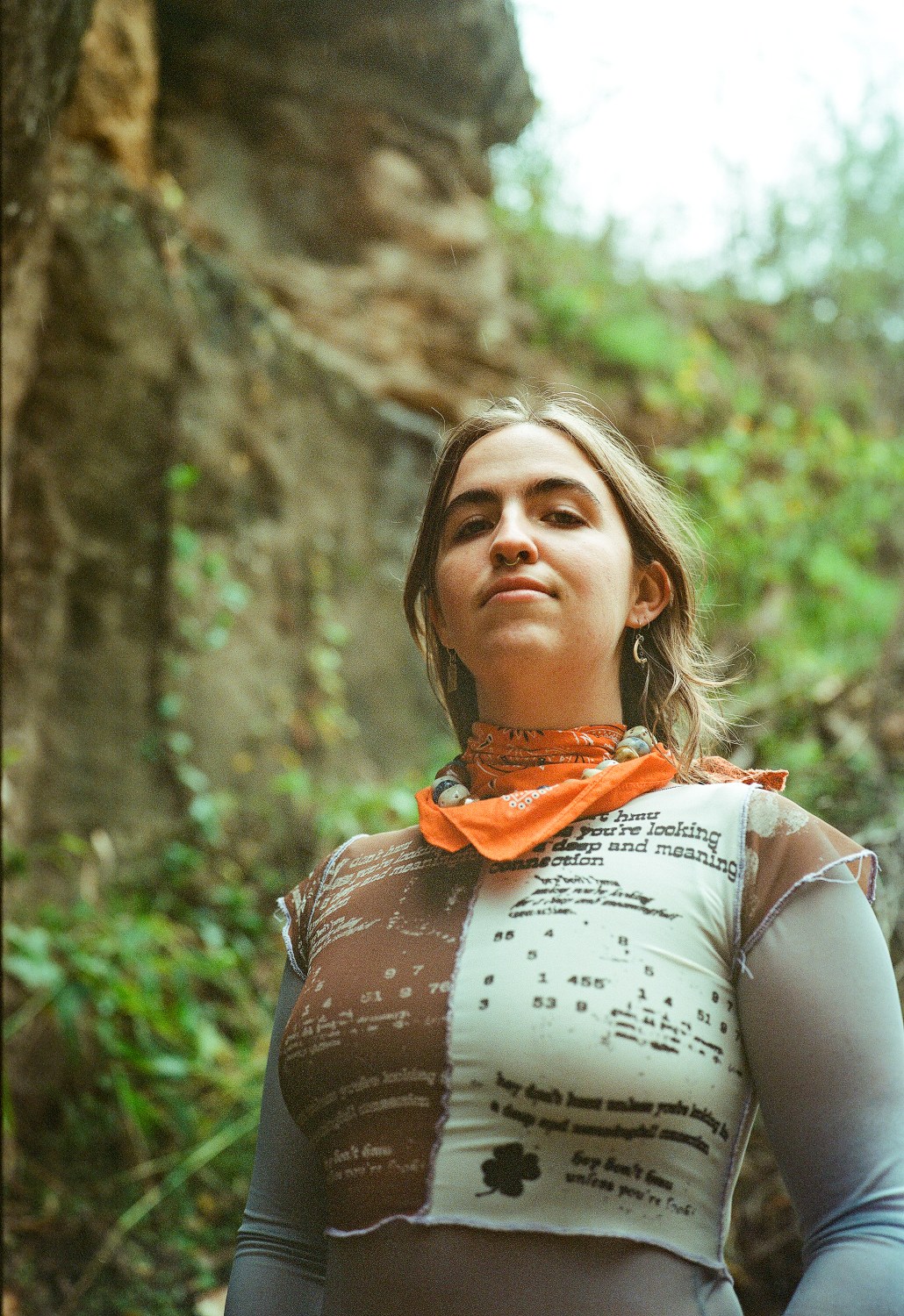
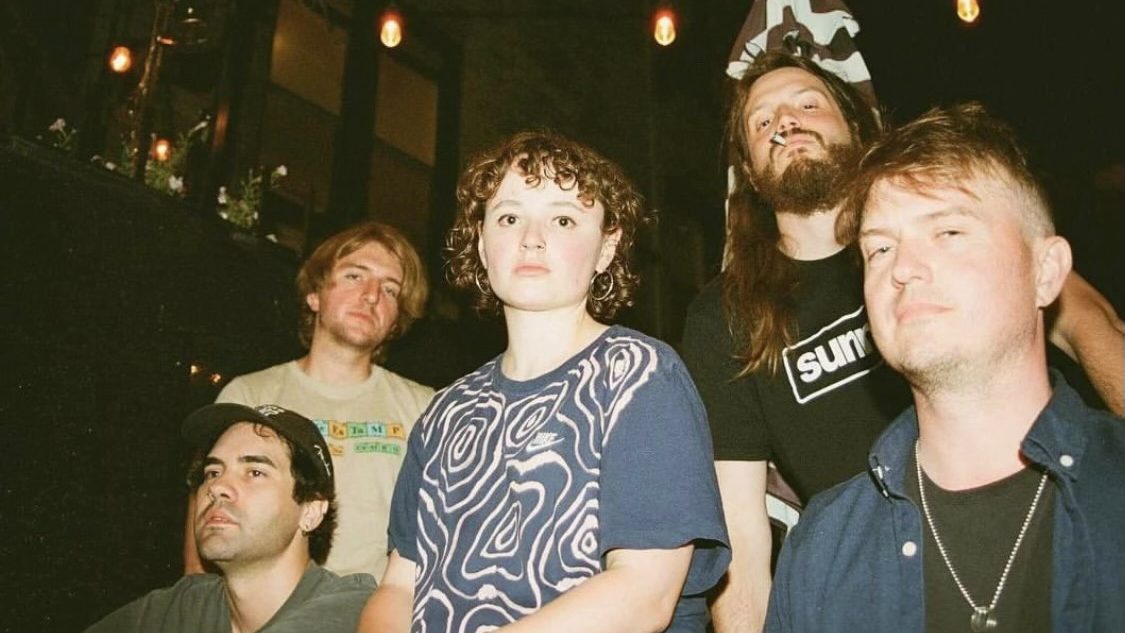
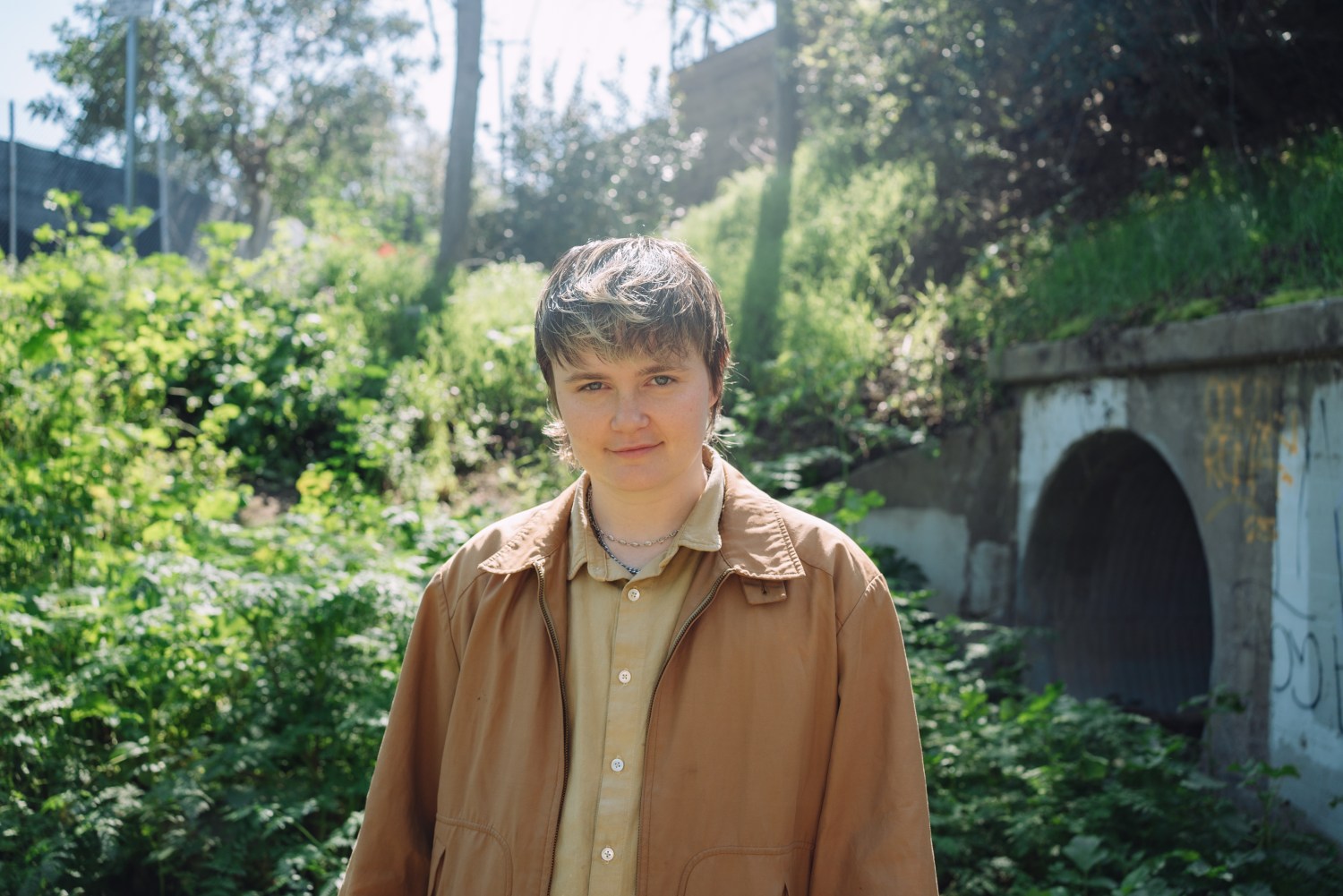
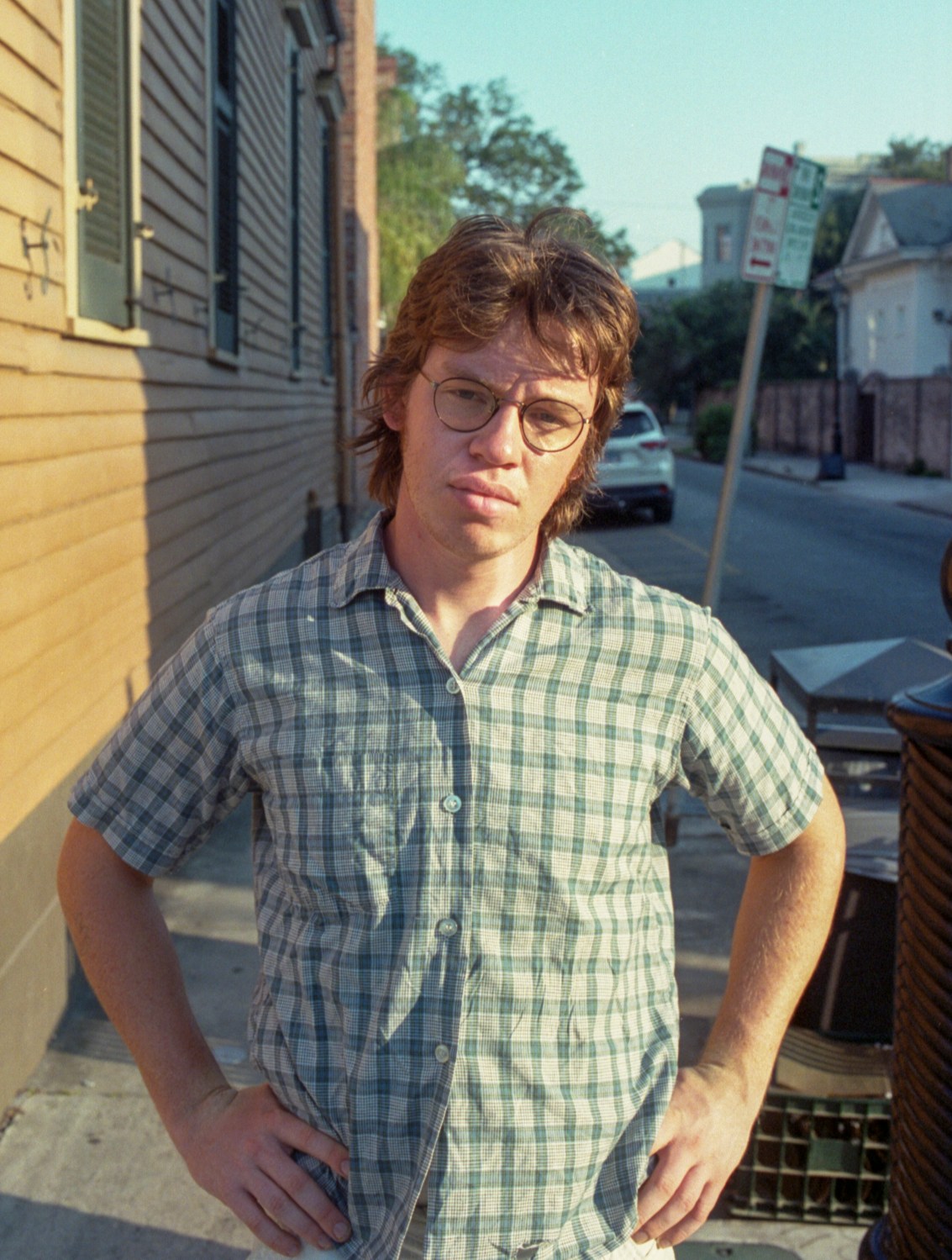
“I think, when it comes down to it, people get into three things as they grow up,” Blair Howerton proclaimed from the stage at Chicago’s Lincoln Hall. In no particular order, she lists out, “sports, birdwatching, or spirituality”. This odd, yet endearing list sparked some chuckles from the audience, then comically rang more true to a lot of people as murmurs like, “holy shit, I just got into birdwatching,” spread throughout the packed hall.
Blair Howerton fronts the Austin/Brooklyn band Why Bonnie. Following the release of their critically acclaimed 2022 debut full-length, 90 in November, an album that defined a childhood spent growing up in Texas, the band looks to ride this momentum forward. Gearing up to announce their next album, Why Bonnie doesn’t hold on to much of the past anymore as they try to shape the future and find steady ground in these trying times. I recently got to chat with Blair Howerton in the midst of this transition period, opening up about where she is at in life, including her own roaming spirituality, a new era of the band, and what the next Why Bonnie album is shaping up to be.
With their second album not yet announced, Why Bonnie took advantage of this most recent supporting tour, with S.G. Goodman, to showcase a lot of the new material. With notable themes revolving around money frustrations, growing/diminishing empathy, and systematic uneasiness, Howerton shares, “I was really interested in the relationship between micro and macro issues and how that kind of plays out in our personal lives.” To the effect in which large issues can bleed down to simple and communally felt points of discomfort, Howerton’s storytelling remains as vivid and authentic as ever through this shift of focus. For as much as 90 in November found a personal home in Austin, Texas, this next Why Bonnie project is a bit more dissociated. Since having moved to Brooklyn, Howerton expresses, “you’re all kind of living on top of each other, so you can’t escape, and you can’t really turn a blind eye, which I think is a really cool thing. It’s definitely a lesson in empathy.” Where this environment has led creatively, she shares, “this is a much more inward looking album. I think it’s bigger than just where I’m at. I think it’s trying to reach everyone.”
Voicing from the Lincoln Hall stage that night, Howerton remarks that she has begun to reassess her personal spirituality, which is a focus point in some of the new songs. Without putting a label on it, she adds, “I’m a very imaginative person, so I like to believe that there’s something else, and that there is something somewhat magical going on.” Although she’s not committed to anything in particular, there can come a sense of comfort when uncertainties are given possible answers. “I have a puny little human brain. We all do, and no one knows anything, and that makes it all that much more interesting.” That’s kind of where Why Bonnie is at these days; “what’s my place in this world,” a considerate and mature question, doesn’t hold the weight it once had.
As Why Bonnie plans out the next few months, the band finds themselves down a player. Kendall Powell, who has played keys with the band since its formation, has taken a personal step back. “We’ve been playing music together for 6 or 7 years, and have been best friends since we were 2. She’ll always be in my life,” Howerton responds when asked how she has adapted to this change. You will still be able to find Powell’s work on the new Why Bonnie project, as “the new album has a lot of great synth on it. We haven’t gotten to show it in our live set yet, but I’m really excited for everyone to hear it,” she shares. As the band looks forward, “we’re moving into a new era, if you will,” Howerton claims. “We don’t exactly know what the future looks like, but we’re just happy to play music together and tour together. It brings us all a lot of joy.”
“Going back to spirituality,” Howerton relays, “something I’ve really been thinking about a lot is just how deeply similar people really are; how we experience a lot of the same emotions. Maybe different situations, but the way we feel them is all really similar.” This is not only true through unfortunate and systematic commonalities, but it’s also why “sports, birdwatching, or spirituality” is such a genuinely accurate statement. With found joy, communal support, and empathy, suddenly something as simple as stopping to watch a bird or being part of a team offers some sort of confident placement in such a despondent world. As Why Bonnie prepares to move forward, Howerton remains assured, as she voices, “I wrote this new album from a place of, I don’t want to say despair, but just really grappling with all these issues in the world and how to stay hopeful when it’s really hard to be.”
Hannah Pruzinsky, known for their solo project, h. pruz, and the effectively vulnerable Brooklyn trio, Sister., has released a surprise single off of Mtn Laurel Recording Co. today. The single, “Dark Sun”, is a rich composition of atmospheric comfort and folky lament that tells a story of the complexities of love. But in juxtaposition to the title “Dark Sun”, these complexities are entitled to areas of growth and self condolences when shadowed by damage. I had the honor to talk to Pruzinsky, in which they opened up about the emotional progress in writing the new single, their comfortability of collaboration, and the stories found within the natural world.
“Dark Sun” is the first song to see daylight out of what will be the next h. pruz record out sometime next year. Following the release of their debut EP, again, there, Pruzinsky found some steady ground in the turmoil of memories, whereas “Dark Sun” finds them going a step further into these moments of contemplation. “It’s basically a song about obsession,” they share. “I wrote it in a time where I was feeling a lot of guilt for feeling those feelings, and I think it was self permission to lean into what it looks like, and I guess, to lose yourself within it”. That self-permission is an odd habit, in which you feel as if you always have it, but it’s easier said than done. “This idea of self-permission and permission to decide what I want for me without having it be echoed with other people”, Pruzinsky shares was a big self discovery in the writing process.
Artwork by Sarah Bradley
As an extension to again, there, in its vulnerable approach to sound and story, “Dark Sun” takes new strides in which Pruzinsky thought, “what if I wrote a song about falling in love?” To which they specify, “there is still a shade. It’s not just clear good love”. With production help by Felix Walworth (Told Slant, Florist) the atmospheric chord voicings and the steady brush strokes of the snare drum offers a lightness when Pruzinsky sings, “And forget everything else is real / We’re here / In the sun”. That particular warmth of new love, although not explicitly perfect, still fills the track with the innocence and hope of realistic potential.
Growing up in Pennsylvania, the natural world stood testament to Pruzinsky’s practice of self and spirit. “When I was younger, I think [nature] held a place of resentment, because usually I would be working outside pulling weeds.” They continue, “as I got older, I think it took on more of a meditative space.It became really important for me to feel a connection to my younger self in a way that felt really tied to nature”. To this extent, Pruzinsky has found a larger meaning to their place in the natural world, to the degree in which their interpretation turns into vital storytelling. “I think [nature] reflects change, which is something that I both romanticize and always desire. I think it’s really easy to see how things can return to a way you once had known,” Pruzinsky shares. “In this newer body of work, the idea of destruction within the lens of the natural world” has found narrative importance in their writing as well. “I’m your dark / Hiding place / Crush me up / Take a part,” they sing in the cadence of this double-edged feeling of love.
As one third of the band Sister., Pruzinsky is almost a month off the release of their astounding debut full-length, Abundance. Becoming more of a personal focus to conquer in their life, writing music is a process of exchange to them. Sister., as a collaborative project with long-time friends Ceci Sturman and James Chrisman, Pruzinsky tells me, “there’s a big sense of pride that I have when I get to make something with my besties, cause it’s not easy”. They continue, in response to writing lyrics with Sturman, “it’s really special to also be like, ‘wow, we both felt this thing and both got to immortalize it in a way.”
Photo by Felix Walworth
But when it comes to writing alone, Pruzinsky admits, “I remove my rose colored glasses when I start writing, and sometimes I’m not ready to do that”. Art in general is a process of give and take, but effectively raw art happens when the give becomes a vital takeaway. “I’m good at repressing things that I am not ready to see in my life,” Pruzinsky admits. “But being able to write songs about those things is the first way that I’m like, ‘Oh, wow! This is something that clearly isn’t okay”. Continuing to the effects of the upcoming album, they say, “it feels so vulnerable. Am I ready to potentially alter my life in a large way, at least with this record? It’s not always that dramatic, but it was for this one.”
You can catch h. pruz on a supporting tour this December where they are hitting the road with Portland, Maine artist, Dead Gowns. “I’m playing with a new band and excited to be a little more rocking than usual,” Pruzinsky tells me. You can listen to “Dark Sun” out now.
Work Wife, the creative project of Meredith Lampe, has become a facet of the Brooklyn DIY scene, both as a band and as a community patron. Coming up on a supporting tour with Husbands and new music to be released in 2024, Meredith Lampe and newbie member Isaac Stalling, called me from their rock climbing gym to discuss lyrical goals, building a community, and functioning as friends who also happen to play in a band together.
After moving from Seattle to Brooklyn, Lampe was a member of the Brooklyn trio, Colatura, but with too many songs to share, she began her own project, calling it Work Wife. Upon the release of her 2022 EP, Quitting Season, Lampe added Cody Edgerly (drums) and Kenny Monroe (bass) to the project, allowing Work Wife to find its fullest pop band potential. “Ever since then I’ve been thinking of it more as a band rather than just my project,” Lampe shares. “There are some things that are easier with just me, but it isn’t nearly as fun.” After meeting Stalling on tour, when it came down to it, Lampe and the band said, “we should get that fun kid from Oklahoma City,” and soon Stalling was moving to Brooklyn.
As a musician, and a lyricist in particular, Lampe relies on the hidden details. Choosing brief moments to command feelings of both grief and comfort, Lampe’s writing offers up open arms. With songs that break down emotional trauma into digestible, and oftentimes, darkly humorous stories, tracks like “Brian Eno” and “Apathy” are on the cusp of perfection. With a song like “Too Young To Understand”, a nod to a family caught up in addiction, Lampe is able to form years of distrust and heartbreak into a four minute song. “When I wrote [“Too Young To Understand”], I had no intention of putting it out, which is, I think, the right way to go about writing a song that is so sensitive,” Lampe admits. “To just say, I’m never going to put this out, I’m gonna give it the honest treatment and then decide after the fact,” allows for more sincerity and less internal deliberation. “I think being honest like that can be really fucking scary,” Lampe says, “but everyone always handles it better than you think they’re going to, as long as you have a one-on-one conversation with them about it. And in this case, I think it improved our relationship in the long run.”
Going from being an additional singer in Colatura and then transitioning to a solo project, Lampe is now the leader and front person of her own full band. “Now that I have these guys, we’re kind of figuring out this new writing process as we go,” she shares while adding, “it’s been so much better. The music is so much better now that I have people to work with.” With Stalling as the newest addition, he responds, “I felt so lucky to be added. Everyone’s just immediately chill and there is no proving grounds or anything like that.” For as tightly constructed the band sounds when playing both in studio and live, the environment of Work Wife could not be looser. “It’s funny as a front person”, Lampe says, “it feels like you’re always trying to balance showing the band that you know what you’re doing. You have to be artistically opinionated enough for them to believe in your leadership, but not so much that you’re a dictator or then it’s kind of like limp noodle vibes,” she laughs.
Photo used with permission from Work Wife
.
Sometimes it can be a fine line between work and play that can ruin a band, but in the case of Work Wife, the work has become the play. “Music is hard enough. It sounds like bullshit, but one aspect that is often forgotten is that we are very lucky to do this. So, maintaining a fun situation makes it a lot more achievable for longevity,” Stalling shares while Lampe adds, “the odds that you’re really going to do anything bigger are so slim that if you aren’t enjoying the process, you’re making a horrible bet.”
Having first seen Work Wife on a supporting tour with Fenne Lily and Christian Lee Hutson at Chicago’s Thalia Hall, it was clear that the band loves what they do. Whether that be sharing members amongst the three groups, crying and hugging to Hutson’s emotionally ripping songs behind the curtains, or sharing humorous stories on stage, as an audience member, I felt fortunate just to be there. That being the first time touring as a full band, Lampe and Stalling couldn’t hold back their excitement of remembering those shows and the time spent on the road. “This is just so hard to come by and with just newly joining the band, at the time, I felt so lucky,” Stalling says while Lampe adds, “it was kind of like when you are dating someone and you’re like, ‘is this just really good for me, or is this like actually really good?”.
Photo used with permission from Work Wife
The effects of a reliable and neighborly network are not lost upon the members of Work Wife. “If you have an idea of the community that you want, no one’s gonna make it for you. You just have to make it happen,” Lampe tells me. As roommates, Lampe and Monroe have turned their house into a venue called No Hassle Castle. Getting friends to play sets, the No Hassle Castle has hosted artists such as Fenne Lily, Katy Kirby, Sister., and They Hate Change along with many other Brooklyn staples and travel-throughs. With a welcoming and overtly cozy environment, Lampe and Edgerly have created a safe space for artists and fans alike to enjoy and build upon the Brooklyn music community. “After people started going to shows again, I was kind of the weird girl where you meet someone really briefly, but not well enough to hang out. And then I would be like, ‘hey want to get lunch?’” Lampe shares with enthusiasm. “Every time I did that, we ended up fostering a very close friendship.”
With an official EP set to release in the spring of 2024 and rumbles of the first Work Wife full-length in the works, Lampe shared what she has planned in the coming months. “I really wanna just sort of pare it back, which is, I feel, like the usual trajectory of someone’s music career,” she shares. In regards to the album, “I’m hoping we can record the full length this spring. It all depends on how fast I can write all the songs. But fortunately for the band, I just lost my job. So I’m on a roll,” she says as her and Stalling laugh.
You can catch Work Wife playing the Turkey Slamdown Benefit Show (11/11) for Make the Road NY as well as on tour with Husbands for their East Coast Run.
“It was the morning after I had done a release show for the first record I ever did called Black Hole. I remember all my friends were just so supportive about it. But, I was basically living in a closet and I was pretty much on my way out of Brooklyn to go and study music therapy, so I just needed a change for a lot of reasons. But it was hard to leave”. Goldberg continues, “I had a dream that I was with some of those friends at this cabin in the snow. As I set off away from those friends at the cabin, a bear appeared in front of me. We had a standoff. The bear whacked me with its paw, and I was dying in the snow, but I remember thinking to myself, ‘I don’t regret this’”.
The Spookfish, the project of Maine-based musician Dan Goldberg, recently released his latest project, Bear in the Snow, off of We Be Friends Records. As a songwriter, Goldberg is a collage artist of sorts, encountering sparse folk music and lo-fi electronic fixings in a layered and textured sonic world. As a project, Bear in the Snow finds Goldberg in an extension of his natural self; the part of him that no longer has a place on this earth, but with full acknowledgement to his physical journey in the natural world. The album is also accompanied by its own video game created by Goldberg that follows that path of self discovery. Calling from his home in Maine, Goldberg opened up about his recovery process after a tragedy that led to this alluring and earnest project.
To fully grasp the personal aptitude and eternal understanding that went into the writing and producing of Bear in the Snow, it is crucial to know about Dan Goldberg’s last few years. With life turning events facing a family tragedy, on top of a heartbreak and moving to a new state, Goldberg was pushed into the externality of our human fragility. Referring to a lyric he wrote for the track “Misanthropy”, Goldberg kept coming back to the phrase, “the world’s not going to miss us when we’re gone”. In a bleak state, Goldberg explains his “frustration at the way that western values and capitalism can get in the way of human life,” while he adds, “if it killed us, the animals would not miss us. They won’t be like, ‘oh, I wish they did more economic development in their time,’” he laughs, but it is clear there is some weight behind it.
Having studied and practiced to be a music therapist, Goldberg made an effort to find effective ways of recovery through his own creative outlets. In textures, Bear in the Snow is a deeply expansive listen, embodying layers of familiarity and subtle sonic tensions. “I would go to this cabin and it would be these moments where I wasn’t gonna get an emergency call for an hour. I was just completely hidden in these scary woods,” he says. “I would really enjoy making sounds that soothe my brain and then playing them back,” Goldberg shares. Breaking away from structural soundness, “I think I was able to find a little bit of freedom to move the music away from my normal patterns”.
Beyond the primitive and experimental instrumentation that Goldberg creates, Bear in the Snow serves as a kind of natural field recording, following the sounds that make up his world. “Coyotes”, as simple as it sounds, is a recording of a pack of coyotes as they howl and laugh to the open sky. To some, this is an external noise that doesn’t grasp at any deeper meaning, but to Goldberg, this inclusion stands as an expansion of personal sense and growth. “As a small child I was horrified by everything. I was horrified by the woods, and I felt like everything was haunted. I’m sure that’s just being a vulnerable little being that could easily be eaten by anything,” Goldberg laughs, but with slight sincerity to his younger self. The inclusion of “Coyotes” was a thoughtful addition into an already deeply personal record. “I guess I wanted to revisit that childhood feeling” of vulnerability to the world. “That particular recording, I was walking back from a hike, and it had gotten dark. I was just immersed in that feeling and I recorded it as a journal entry”.
Recalling the time he went on a solo hike on Devil’s Path, one of New York’s most difficult trails to hike in the Catskills, Goldberg brings up a fractured process where he admits, “I would try to exhaust myself into feeling better”. As the sun set on the treacherous trail, Goldberg found himself lost and with no cell service. As the old tale goes though, follow running water and you will find a way out (which Goldberg says that this is an irresponsible action and that it is safer to stay put). Soon coming upon water supply land and flag markers, Goldberg ended up on a highway, where he came face to face with a mama bear and her cubs. “She scowled in my face before shooing her cubs in the woods and leaving,” Goldberg says. Eerily similar to the dream he explained earlier, Goldberg admits, “I feel like that was when I was like, ‘Okay, I need to focus’”.
The video game, a visual extension to the album in which Goldberg also titled “Bear in the Snow”, is a personally rooted piece of art representing Goldberg’s understanding of his path to recovery. “Well, I was working at a soap factory while I was in school. I was just drinking coffee, putting soap into boxes, and the idea just popped in my head,” he says in suit of mindless busy work. Goldberg describes the game’s concept, in which “you’re this little ghost character. I came to see that as my own ghost,” referring back to the dream, “because the bear killed my sense of self”. Enriched with these beautiful and introspective beings, the game is a haunting exposé of Goldberg’s eternal conflicts. As he continues, “my ghost is floating around, and each of those places in the game and each of those song titles is a place where some really significant things happened”.
These significant places are highlighted with a storybook instruction manual that refers to Goldberg’s travels. Put together by his partner, Saffronia Downing, the manual explains specific paths, locations, creatures, and myths that expanded Goldberg’s perception of self. As the ghostly character, you encounter this cathartic journey, redefining your own place in the world.
As a world traveler, Goldberg has been on the move for years. But he finds himself comfortable with where he is at now. “I think that I feel like I’m set,” he tells me with confidence. Having graduated and spent years in practice as a musical therapist, he has found a love for helping others in their own recovery process. “I’m really interested in combining outdoor therapy with music therapy. I would like to have a place that I could build relationships with the people that I work with,” he says.
When living in Brooklyn, Goldberg would host events that he called the ‘Mountain Shows’. Taking a group of musician friends as well as a group of listeners up Mount Taurus, the mountain became a sanctuary of redefining personal roots, not only in the natural world, but internally as well. “I think a big reason for the mountain shows was to give people different ways of looking at being in the woods, especially in New York City where a lot of people hate hiking,” he says. Goldberg developed a remarkable way in which people can experience both kinds of therapies. “I would say that the interesting thing about both fields is that they let people have moments of not speaking”. He insists, “I don’t necessarily or rationally believe in ghosts, but, some part of me feels the ghosts. Some part of us is feeling things that we aren’t thinking”. In the search for understanding, those inner ghosts can come out when least expected when given a moment to breathe and “it can share really valuable information about [people’s] lives,” Goldberg finishes.
Returning to his dream, as Goldberg laid dying in the snow, the bear stood defiant and remorseless in its actions. A nightmare of sorts, but in the end, the bear is the least important facet of this dream. A narrative, told through the simplicity of closing his eyes and the complications of REM sleep, broke down an impossibly difficult decision into a clear answer. Goldberg recalls a moment where, “it felt worth it to try and do what I needed to do, even if I got killed by a bear within five minutes”. Bear in the Snow stands as a complementary parallel to the valuable information given by the ghosts that find home in our physical bodies, as Goldberg tells me he decided right then and there, “I’m gonna do this change, even if it fails”.
The story of how Ivy began was, in sorts, ideal to their DIY success. And the story of Ivy’s ending is equally as telling to the strength and depth of their legacy as a band. Consisting of Dominique Durand, Andy Chase and Adam Schlesinger, the trio defined a particular type of underground music that was both accessible and artistically compelling. With the passing of Schlesinger in 2020, Chase and Durand have come back to their early catalog, reissuing their 1997 album Apartment Life (as well as its demos) on vinyl. Now their 1995 debut full length, Realistic, is getting the vinyl treatment off of Bar/None records as well. Recently, I had the opportunity to chat with Chase and Durand, talking about the early days of the band, the processing years after the loss of Schlesinger, and finally coming full circle on the Ivy project.
Photo used with permission by Bar/None Records
In 1991, Chase posted an ad in The Village Voice, looking for like-minded musicians to form a band, in which Schlesinger responded. Dominique Durand, a native to France, moved to New York to study English, where she met Chase. Soon, Durand and Chase developed a relationship, eventually marrying down the line. With no intention of performing, or even singing for that matter, Schlesinger and Chase convinced Durand to sing on some demos and Ivy was formed. Putting out their first EP, Lately, in 1994, “we were just the three of us. Me, Dominique and Adam, just logging it away and figuring things out in my little semi professional recording studio”, Chase says with a clear excitement reflecting on the innocence of the early days.
Quickly becoming a close group of friends, Ivy was a place of learning and developing in real time. “I think the innocence was real”, recalls Durand. “First of all, we were beginners. We were not very professional and really had no idea what we were doing. We were in the learning process and every step was so exciting”. In regards to all three members, it was an experience of learning new instruments, building production techniques, and even just learning how to function as a band in general. “When you’re in your twenties, like we were, every week in the recording studio was like, ‘Oh, my God! I can’t believe how much better we are,’” Chase says animatedly. “And we didn’t have those ‘Oh my God!’ moments in our later records as much as we did on Realistic. We were really going from, I guess, infancy to adulthood,” he finishes.
Having signed to Seed Records for the Lately EP and the debut LP, Realistic, the band handed off some of their creative liberty, something that they worked so hard on developing themselves. “Realistic was like the perfect storm for us to ensure that the rest of our career we would do it ourselves,” Chase recalls. Determined to this DIY approach, the three became an indisputably well structured unit. “I think, in our DNA. The three of us were very autonomous minded,” Chase adds. Working to craft a relationship in which creative disputes were democratically handled, ideas were graciously heard and the process was true and patient, Ivy’s structural strength shined through their musical ventures. “In a way we just love to be able to do everything, because I think we really love each element of making a record,” Durand says.
When it came to an Ivy album, you would just find the band Ivy as the fully credited songwriters. When asked how the creative process was divided, Chase shared, with regards to his and Schlesinger’s other bands, “clearly there was a filter that any idea would go through that was so powerful, that it was unrepeatable outside of Ivy. So the easiest way to credit that alchemy was to just say all songs written by the three of us”. In a move that has been found fatal in many bands, Ivy thrived in this shared creative involvement as Durand says, “because we are three very strong minded people, we had arguments, but always in good spirits. And at the end, you know, we always ended up compromising in a way that was fair and okay with everyone”.
As Schlesinger’s other band, Fountains of Wayne, as well as his commercial success in movie soundtracks began to take off, Ivy always remained a constant in his busy life. Although finding success in their sophomore album, Apartment Life, as well as having a song in a Volkswagen commercial and in the 1998 film, Something About Mary, Ivy never reached that heightened commercial success. “I think with Ivy, he didn’t have to think in terms of ‘is this gonna be a huge commercial band’, because we didn’t sound like that,” Durand recalls. “And so, in a way, with us, he was more relaxed, and he was really more focused on just being more creative in terms of production arrangements and writing. I think he needed that in his life”, she finishes while Chase adds, “it’s like coming home”.
Schlesinger’s passing in 2020 due to COVID-19 was a shock and a huge loss to the music world. But to Durand and Chase, it was more than losing a bandmate and a contemporary. Schlesinger was part of the family. As the private people they are, it wasn’t until some time had passed that Durand and Chase released a tribute video. With intimate home footage of Schlesinger in the studio, critiquing Chase’s choice of sweaters, playing guitar in a freezing apartment, and gag after gag on stage, Durand and Chase crafted a meaningful and personal celebration of life and contribution that he had shared with the world. “It took us a year and a half at least, to even publicly comment in any way,” Chase admits. “And [the tribute video] was our way of publicly commenting”.
Around the same time of Schlesinger’s passing, Ivy’s record label, Network Records, called up to tell them that their fifteen year contract had expired and they now owned all of their master tapes. With this new possession, the band held years of demos, voice breaks, and multi-tracks of their music; all relics of their late friend. Taking a contemplative pause, Durand shares, “after [Adam’s] death, for at least a year and a half we couldn’t even listen to [the masters]. We couldn’t even think or do anything about it. It was our own personal mourning”.
As time passed and mourning turned to reminiscing, Durand had an idea to reconnect with Mark Lipsitz, the man who first signed them to Seed Records back in 1994, giving the band their first shot at success. Now working at Bar/None Records, a personal excitement for the New York indie musicians, Lipsitz graciously took them on with plans of fully reissuing their early projects on vinyl for the first time. But that would mean listening to the hours worth of tapes and demos that the two have avoided for so long.
When asked in what way these master tapes affected their recovery process, Chase quickly says, “if you always appreciated somebody, and then they’re gone forever, you can’t help but to delve back into what those things were that you appreciated [about them]. And then you discover all over again how vast it was”. Each taking turns to share their favorite moment re-lived within these recordings, it was clear that this reissuing process has become a unique source of healing for the two of them. And as it goes, remembrance becomes an opportunity to find comfort and closure. “It’s not painful anymore. It’s actually really joyful. I love hearing his voice. I love thinking about him. I love remembering him,” Durand shares.
Photo used with permission from Bar/None Records
Ivy is one of those bands that has transcended the 90s, avoiding that unsavory time stamp given to decade defining acts. With a sound that is both breathy and expansive as well as tight and articulate, the band defied pop rules; a point to which a lot of groups these days seem to still be capturing that Ivy influence. Although unsure to what extent the Ivy project will continue past this point, their musical contributions are attested to how definitive and essential the group has been to underground music. As Durand and Chase prepare for the reissue of Realistic, there comes a comfortable book end to this significant group. “So it gives us that closure. We started our career with Mark and now we’re ending the Ivy story (in a way) with Mark,” Chase discloses. “It ended up being a beautiful story, because it really felt like we were going back to the roots,” Durand adds. “Here we lost a member, but we are going back to the person who discovered us. It sort of made sense to us. To feel like we are, you know, not reborn, but it’s making sense emotionally”.
With a sound that is fortified in pop facets, experimental awareness, and sweet undertones, Combat Naps, the project of Neal Jochmann, is fully demonstrative of the boldness and sheer joy that comes with making and performing music. With preparation leading towards the release of his new album, Tap In, Jochmann took the time to talk to me about being a home grown musician, reimagining Combat Naps live, and the freedom that comes with writing music.
Naming the project Combat Naps in 2016, Jochmann had a deep love for music while growing up. With a creative emphasis in his household (and a mom who spent the 80s singing in bands), the desire to make music came early and it came with energy. Notably, “I was really excited about the Frank Ocean album [Blonde] that came out that year [2016],” Jochmann shares. “I remember just feeling really overwhelmed with excitement because there were so many possibilities that it opened up. It’s just a very freeing piece of music”.
Unlike Frank Ocean though, Combat Naps became a musical factory, pushing out pop song after pop song, all to a degree of musical exploration and focus. Starting in the Chicago scene, Combat Naps released a string of EPs and LPs that embraced a lo-fi sound, but kept this undeniable sense of maximal lightness to it. On top of that, Jochmann spent time balancing a side project called Hippie Johnny with friends, Guatama and Connor, putting out a handful of releases. But as of 2018, Jochmann relocated to Madison, Wisconsin, quickly becoming a hometown staple and a familiar face to many. Finding a large and supportive outlet for Combat Naps to thrive, as Madison goes, “it’s a nice little test tube scene, you know”, Jochmann tells me as we share our mutual love for the city and its musical caricatures.
With help from friends and local Madison musicians Tim Anderson (of Able Baker), Marley Van Raalte (of Loveblaster), Ivette Colon (of Field Guide, Original Citrus, and others), and Madison guitar mainstay Ilych Meza, the band takes Jochmann’s sweet and offbeat recordings and interprets a new potential of what Combat Naps can reach when performing live. Hearing the effect to which Colon’s and Jochmann’s harmonies envelop a sense of pop-elegance is only a mere extension to what the full band brings to the shows. Unbeknownst to Jochmann, with an outpour of assurance and borderline feral attitude towards performing, the band revealed a punk nature to the live shows that wasn’t heard before on the recorded material. Telling me about an idea for a future project that would contain both live and studio recordings, Jochmann excitedly shares, “it will be a jump, and there will be just a big sonic difference in what the songs sound like”. But with Jochmann’s knack for manipulating sound, he continues, “that imbalance kind of makes it take an interesting form, like a novel with an incongruous kind of introduction by some other person”.
Tap In, the newest release by Combat Naps, is a harmonious plunge into Jochmann’s versatile and vividly scenic world. With songs about your typical themes of heartbreak, redemption, satisfaction, and even some heroic bravery, Tap In is as ridiculous as it is personally heartfelt and creatively moving. But where Jochmann’s typical songs of dire love or painstaking heartbreak goes, there is always a curveball to the story. “There are so many songwriting tropes”, Jochmann explains, “and then there’s like songwriting anti-tropes that you then learn about, after having learned the initial tropes that are just as traditional as the tropes you were trying to avoid” he laughs as he tries to push out the sentence.
When it comes to his lyricism though, Jochmann sees it as a collage, mad libbing fiction into the real stories of feel-good sadsacks, misfortunate heartbreakers, and eccentric hobbyists. “This approach is really attractive to me. It allows [me] to write stuff that is 100% meaningful because it has images from my life”, Jochmann states. “But it also has gaps of unspoken things and mysteries for the listeners, which can be potentially very impactful as well”.
For instance, take the track “Up To The Task” off of the new release Tap In. A story about an ex-girlfriend starting an indie-pop band with low budget-film dreamboat, Michael Cera. Jochmann’s lyrical approach brands his extensive imagination by portraying commonly felt emotions into a story that forces you to consider the whole spectrum of things you may be feeling. “You occasionally get slapped on the wrist by yourself though, by asking, ‘what the hell is this about?’ Or a friend saying ‘that’s really weird’, what’s that about? And you’re like, ‘yeah, of course this is just nonsense’” Jochmann laughs. “But then you’ll rein it in and go back to, you know, ‘Peggy Sue, oh how my heart yearns for you? Oh, Peggy Sue’. It’s just kind of a rinse and repeat thing”.
As Combat Naps go though, with his extensive collection of bandcamp releases, there is a lot of ground to cover. Whether or not that means that Jochmann has a hard time sitting still with a project, it is indisputable that he has a work habit like no other. Being fully self produced and home recorded, Combat Naps holds a very grand and melodramatic sound that is hard to come by in most DIY recordings. “I have aspirations in composition and in performance,” Jochmann says with an emphasis on polyphony. There might be a fear of writing and producing something that is perceived to be boring. But, looking past that, there is a much stronger drive to make something as exciting and fresh as possible.
With these grand productions and nonstop sonic experimentations, it seems almost inappropriate to try to box this band into a specific genre. “That’s just kind of part of the musical project,” Jochmann discusses. “It’s more than any specific sound. Just be honest and do whatever it is you feel moved to do”. What Jochmann’s music envelopes is this sense of freedom to any predetermined structure or rule to songwriting, genre, or DIY production. It’s prevalent in live shows, it’s there in the home studio, and it’s very clear in any Combat Naps release. “I have so many corny, sappy and sweet little things in my songs” Jochmann expresses. “But this is like a punk music experiment you know, like, make it sweet. Make it obvious. Make it do that. Don’t shut that out. It might lead to an impression of, you know, a nice impression of versatility”.
Combat Naps is a clear and animated response to Jochmann’s creative spirit and a passion to fill in the gaps of undesirable silence. With more releases already planned for the future, “It’s like the modern equivalent of some sort of religious devotion” , Jochmann says as the conversation takes a contemplative pause. “It’s like a religious devotion basically to what that process can reveal. Cataloging it, dealing with it. just reckoning with it. It’s really cool”.
DOMINO, the new record from Diners,has become a top contender on a lot of people’s end of the year list. It’s an album that hits the ground running into the adulation of power pop, retro tendencies and a love for life that never gets old. I had the honor of interviewing Blue Broderick of Diners as she was in the middle of a large national tour for the new album. Calling from her hotel room in Georgia, we discussed collaboration, being on wholesome status, and the possibility of starting at square one.
Growing up in Mesa, Arizona, Broderick developed a love for rock ‘n roll in a slightly prohibited way. Finding her dad’s guitar hidden away in the attic, Broderick waited until he was out of the house before she would begin to practice. Once her dad found out and accepted it, she played in several bands growing up and connected to the Mesa/Phoenix DIY scene. Broderick’s first release under the name Diners, Throw Me A Ten, was released in 2012, and since then she has released several records that expand over sounds of retro pop and eclectic ballads.
DOMINO has been issued through the press as a completely new Diners outfit. In a way, that is true. If meaning the first full record that leans into fuzzed precision and splintering snares, then yes. DOMINO, both sonically and personally is somewhat of a fresh start for Broderick, but it’s not that she hasn’t been experimenting with these power pop sounds before. With six albums already under her belt, Broderick has worked to manipulate the Diners’ sound time and time again, with each record taking on a new fashion. But with DOMINO, “I’ve been wanting to do a louder rock record for a while now,” says Broderick. “I kind of just didn’t know how to do it. Some of that is just not being able to collaborate” she tells me.
Photo by Rachel Lewis
Bringing in friend and contemporary, Mo Troper, to help record and produce the new album was what Broderick had been looking for. Having become really close “around the time the Abbey Road Box Set was released”, Broderick and Troper developed a relationship through a deep love of music. Troper is, in sorts, a power pop guru, with his own career of pop melodies eaten up by distortion. “He’s so much the real deal when it comes to music” says Broderick. “You want to work with somebody who has opinions and is gonna be firm”. Collaboration has become something of value to Broderick’s artistic processes. “I think I am so over doing things alone,” she expresses. “I just feel like my music always tends to be so much better when I collaborate with people”. With mixing by punk engineer Jack Shirley, giving DOMINO an extra edge to nail down, Broderick’s songs and performances are only brought more to their fullest potential. With the entirety of the album recorded at Trash Treasury in Portland, Broderick says “there was a lot of chaos in the studio while recording it, but I think it was all a part of the ride. And actually, that’s the way that it needed to happen in order for it to turn out good”.
You once tweeted, “All perfect albums have one skip”. Can you give me an example?
This is going to be controversial, because I really love The Beatles, but they have way more than one skip on every album. And I think that’s the beauty of them. Each album from beginning to end is like a roller coaster of, ‘this is the best’, ‘this is amazing’, ‘this is so great’, to like, ‘why would they do this?’. I actually think it’s very cool that one of the best bands of all time is not a perfect band.
Currently underway on a large national tour, Diners is lighting up audiences night after night with the new fuzzed up and heartwarming pop songs. Having written these songs by herself, there was no way to know how they might translate to a live, full-band setting. “I mean, with those songs, it’s not like we were a rehearsed band, and then we went into the studio. I made demos, sent them to Mo and our friend Brendan [Ramirez], who played guitar, and then the three of us got together three days before going into the studio and figured out what most of the parts were gonna be like” says Broderick. Catching a Diner’s show is something special, but this tour seems to offer a new sense of vulnerability and excitement to the live performances. “I do on some level feel like I am trying to recreate a record live, which I think is interesting because it’s never gonna sound like the record, especially this record”, Broderick expresses. “It makes me accept that it’s not gonna sound like the record, but in the moment that I am playing, it’s gonna be its own thing”.
Photo by Rachel Lewis
Diners, especially on DOMINO, has an undeniable nourishing exuberance to it that so easily refreshes the heart and bops the head. This album in particular touches upon dreams, promises, self-love and an implicit allure for the world around us. With an album that is being hailed as so joyous, Broderick opens up and says “I think that one of the issues that I’ve always had with playing for people is this feeling of, ‘Oh, Diners is so wholesome, and Diners is like Mr. Rogers’”, she laughs. Although it’s awesome that people can rely on Diners for comfort, Broderick says, “I think that it’s never that I was ever trying to be wholesome, and, in fact, I think I have a lot of songs about making fun of being wholesome, but nobody really accepts it, haha”. Although sometimes subtle behind a filter, Broderick’s writing is just as vulnerable to life’s harder times as anyone else’s. “I think that I want to be okay with talking about disappointment because that’s such a real thing in my life”
After coming out as trans in between her last two releases, Four Wheels and the Truth (2022) and DOMINO, Broderick was faced with the possibility of starting at square one. “I think that the reason why DOMINO sounds the way it does is because I was truly thinking it wasn’t gonna be a Diners record,” she expresses. Renaming the project would coincide with redefining herself, especially if the name Diners is attached to an identity that she no longer identifies with. “I was very concerned about what it would be like to publicly transition,” she conveys. Eventually, Broderick decided against changing the name Diners after all, and says “I just don’t think nearly as many people would have heard the record if I had changed the name. So I’m so grateful that so many people have heard it”. Despite a new direction in sound, DOMINO is still purely connected to who Broderick is, not just as a musician, but as a person as well. The slick lyrical wit, fetching pop melodies, and personable stories are only coincidental to Broderick’s heart, empathy, and contemplation of life. When asked about her feelings towards the name Diners, now on the other side of it all, Broderick just said “Oh, God! I’m so glad I did not change the name”.
Photo by Rachel Lewis
DOMINO is not necessarily about Broderick’s journey of coming out or her trans identity, but it definitely was animated with the joy that came with that experience. Having already begun transitioning by the time Four Wheels and the Truth was released, Broderick says, “I feel like those songs weren’t written when I was out”. But being able to articulate her newfound worldview and self-worth since then, she expresses, “I just don’t think I would have written [DOMINO] if I wasn’t on my path. My mind is just so much quieter. There’s just so much more harmony in my life”.
I met Carolina Chauffe after one of their shows at Chicago’s Sleeping Village. Since then we have kept in touch to put together this interview.
When Carolina and I began our Zoom call, I noticed a painting of a Baltimore Oriole centered on the wall right behind them. As a bird enthusiast, I had to give it a nod of fascination. “Thank you! Yeah, my grandmother painted it” they told me. “I took the painting when she passed, and I’m not an avid birder, so until a friend pointed it out to me I actually thought it was a robin haha!”.
Carolina Chauffe, known as their project hemlock, has become an important facet of not just the Chicago music scene, but a friendly contributor beyond. Being from Lafayette, Louisiana, Chauffe grew up in a pretty condensed scene. Looking to move out of their hometown, the first opportunity that presented itself was an internship at a record label in Seattle. But as the pandemic exhausted that plan, they spent some formative time in Astoria, Oregon before eventually moving to Chicago. “Since then I just kind of heed the signs when a friend, or someone that I care about offers me housing, I just kind of run with it if it feels right” Chauffe explains. “I’m trying not to be in the business of saying no to gifts that are offered.”
I know you grew up in church and chamber choirs. But when did you first start writing songs?
So my dad is a couponer and he got this coupon for guitar lessons at a local Baptist church for one month of free guitar lessons. So he bought a cheap Walmart guitar for me that was pretty much impossible to play, and I went, and I did this month of free guitar lessons. I learned to play a Taylor Swift song I think. And then the coupon ran out, and so we stopped doing the lessons. But even before that, there have always been little diddys that would come to me. I mean, I can remember writing songs about my crushes in middle school and high school. But the first song that I ever performed in full for an audience was at a high school music showcase and I remember some of the lyrics were, ‘I’ve been holding my breath over bridges that I should have burned so long ago.’ It was really teenage angsty, about some fresh heartbreak, and I remember my parents were concerned after which, also, is still a through line, like my parents are always asking, “are you okay? We listen to your music haha”.
With this opportunist mentality, Chauffe has been making lasting connections with people all over the country. As an artist, this is imperative to their work. As someone who claims to be a very solitary song writer, Chauffe pushes themselves into collaboration as a set goal. “Collaboration with different people always opens up these new windows, sonically and emotionally, of what each body of work can be” says Chauffe. It’s not that collaboration is unwanted, it’s more complicated than that. Art is personal and exposed and to place it in the hands of someone else can be uncomfortable. “If I’m being totally honest, I still like to yield a lot of control over the recording process”, Chauffe expresses, but “opening my heart to that deep trust that comes with letting someone into the very vulnerable world that [I’ve] built”, has worked to push personal boundaries.
hemlock’s career has been something different than the commonplace musician. With a catalog consisting mostly of demo-records, Chauffe has been adamant on redefining the idea of what a “finished” song is. Embarking on ambitious ‘song-a-day’ projects, Chauffe has worked sonically and socially to rewrite the limits of what a song can be. “I’ve just allowed myself to break more and more of the “rules”. Or the more time goes by, the less strict I am with myself. because I believe that music is play”, they say. With five ‘song-a-day’ albums representing entire months of time, the songs are purely explorative. They can represent short thoughts (even if not complete), a piece of characterful instrumentation, or field recordings of the world around them. Almost like postcards, these projects represent where they were, who they were with, and what they were going through in the generalist terms.
In a way, a song is never finished. “There’s a short term finish where it feels good in the moment to walk away from,” says Chauffe. “But then, long term speaking, I don’t know that a song is ever finished, cause I just think it’s malleable. It’ll keep shifting”. It’s something that is representative of the moment and the memory of the time it was written. But, over time it can grow and model with you. Even with hemlock’s established songs and professional recordings, Chauffe told me, “none of them are ever finished, because I believe that songs lead their lives, and they keep evolving. If you keep breathing life into them, if you keep playing them, they’re allowed to be whatever form they’ll take in that moment”.
You are headed off to New York tomorrow to do some recording. What do you have in mind going into the process?
I don’t really write a body of work with the idea of it being an album already. I kind of just write as they come, and then if they fit together, then cool. I’m going into it just with a body of work that I want to be captured. And then I trust Ryan [Albert] (of Babehoven) to be able to dream up something that feels really good for us to do together. But we’ll shape it together. I don’t really play my own music around the house very often. I’m bad at practicing which is something that I’m okay with being bad at now. But when I record it it gives me the sort of opportunity to get to know what my songs are a little bit better, and to expand what they can be.
hemlock released their first full-band LP titled, talk soon, in 2022. Written all over the country from 2018 to 2020, the thoughts behind talk soon traveled with Chauffe over those years. With soft exposés of folk tunes, the album is an intimate conversation of change, heartbreak and acceptance that Chauffe trusts in us to share with. When listening to this album, what stands out are the handful of voicemail recordings that Chauffe uses almost as narrators. Hearing the love and support from their pawpaw, a song sung by their mother or just friends calling to check in is, in sorts, representative of people we have in our own lives. Having never met any of these characters before, I still found my heart twisting with what they had to say. It’s this natural drive for intimacy and connection that draws on these voicemails and clings to what it needs to. “In some ways [the voicemails] are the string that ties everything together. Those songs were written in so many different years and so many different places that it helps to track this nonlinear web of memory”.
As humans go, though, I think we take memory for granted until it starts to slip. Memory is more than just remembering our postal code, what we had for breakfast or directions to the nearest convenience store and to buy the toothpaste we need once we get there. It’s also names, faces, laughs, morals, friends, moments of sadness and love and the ability to feel those moments again. What it comes down to, memory is a preservation of our own beings.
Memory, or more this preservation of memory, is not only important to what Chauffe is creating, but it has become something more personal. Memory is instinctive to human nature, but when it becomes fleeting, it easily becomes disposable. That’s fucking scary. As I watch my own grandmother currently lose herself in a world that doesn’t make sense to us, I have had time to watch what slipping memory has the dynamism to do. Finding solace in each other as we talked about our own personal grievances, Carolina opened up about their family history. “My whole family, we are prone to forgetfulness,” Carolina shares with me. “My granny on my dad’s side is a documentarian. She was the first person I saw who constantly had a camera taking family photos” they said with an enthusiasm in engaging with moments. “And then on my mom’s side is where this loss of memory is very prominent”. As they deliberate on what to say next, Carolina’s head couldn’t help but to turn back to that simple, yet incalculably beautiful painting of the Baltimore Oriole centered on the wall.
Song writing to Chauffe is very archival. To them it is “very much with the ethos of trying to capture a moment, capture a memory without smothering it, and being able to let it glow in a way that feels true”. Subconsciously, music, and art in general is a representation of our memories. The time it’s made, the personal state at which it is made, and who may have had a hand in it, all stick with that piece. The meaning can become malleable as time goes on, but the initial identity of the piece stays forever. Chauffe though, makes it a point to acknowledge the full story of their process and continuance. It can be seen in the endless collaborations with the people that they trust and love. It can be seen in the voicemails they furnish talk soon with. It can be seen in the ‘song-a-day’ projects that take the pressure off of honestly capturing a moment in time. It can be seen in the “unfinished” songs that shift and meld into the performative moments they are meant to be. It can even be seen in the simple act of hanging and preserving a painting of a Baltimore Oriole on the wall in the center of their living room. “And yeah, I’m terrified of forgetting and its inevitability” Chauffe confides in me, “but I want to be clear that it’s not that I’m fighting against the forgetting, but coping with it. That’s often what songwriting is for me”.
Through a career spanning almost a decade, Portland, Maine’s tender singer-songwriter, Liza Victoria, known as her project Lisa/Liza, illuminates her personal ghosts into a collection of albums filled with soft-spoken and honest self-regard. What feels at home on woodland walks or moments of solitude on a rainy day, Victoria’s work hangs from the branches of the patient and matured tree that her breathy folk songs are grown from. Utilizing her soft and afflicted voice, campfire guitar strumming and the combination of home and studio recordings, Victoria’s sound is not lost upon the feeling of loneliness and grief but is able to push a sense of warmth into the heart of it. People may derive different meanings to Lisa/Liza’s collection of work, and to an extent, this is the beauty that humanizes Victoria’s songwriting. There are no written instructions on how to deal with suffering, but Lisa/Liza’s songs are here in the meantime.
Recently, Liza Victoria took the time to answer a few of my questions. When I started posting for The Ugly Hug, Liza was one of my first supporters. As a college kid just trying to share his writing, this meant so much to me. It was an honor to work with her to put this piece out.
I know you used to live in Portland, Maine, but you recently moved out to Wayne, Maine. What has this change of scenery been like? What is the Maine music community like?
The Maine music community is very healthy and recently I’ve been reflecting on how much I feel held by it. I think there is a true communal nature to it. There are a lot of scenes within, that really just aim to support art and community, and it’s beautiful. At a lot of points I have felt really glad to have this space to make music and be part of this scene. There are a lot more places to play and communities opening up to DIY shows and scenes in rural parts of Maine now and I love that. Those are some of my favorite shows, out on farms or in unexpected spaces (ahem please invite me to your farm show). There is stuff going on right near me now, even though I’m far from Portland, I’m excited about that. I also still feel like Portland is my music-hometown, because it’s remained such a supportive and welcoming music community for me.
Your new album, Breaking and Mending is so full of transparency about your recovery from living with chronic illness and navigating mental health. When writing such beautiful songs about recovery, how do you approach the trauma? How do you approach the delicacy of your lyrics? Do the songs feel different now that they are released, as to say, when you were writing them?
Thanks for saying this, that is so kind! My approach is mostly that I don’t want to hide what I’m facing in my music and art, whatever it may be. There are a lot of spaces in society where it may not feel safe to delve into recovery or navigating mental health, but it feels like my music is my own, and I want it to be this little safe sanctuary for that, wherever I take it. That being said, it’s only reflective of those struggles because that’s what my life has entailed and it’s a very real lived experience that I was transmitting. I’m looking forward to a time when my music can reflect a softer place of joy and healing. But, I think life just holds what it holds, and art and music is a wonderful safe space to not shy away from the heavy things.
I approach lyrics sort of in mood, they kind of ebb and flow from the center of a mood or a feeling. The songs definitely change over time. They feel different after being released, and even different after years go by. It’s fun to see how their meaning shifts for me.
Your songs have such an interesting and beautiful structure to them. They are played in winding paths, that as a listener, we are not rushed to come to conclusions, but are given room to sit in your music and feel what we need to feel. How do you go about song structure when writing?
The song structure to me kind of comes naturally, but it’s also definitely something of my own making. I kind of think of it like a drawing or a painting, how sometimes when you keep working on a piece of art it can go too far. I tend to aim towards trying to let it resolve with some minimalism, or natural place. With my songs feeling sort of stream of consciousness, that is usually when the feeling of the song has come to some resolution.
Your lyrics are just as much about the present as they are about the past, and sometimes you are able to sit in this difference that makes your songs feel timeless. What tense do you feel is the most impactful for you to write in/about?
I love this question. I can’t say that either the past or the present is a more impactful place to write from. I know it’s helped me at times to reach back. I think at some point I need to write from the past or something. I think in some ways I’m trying to pull myself out of that. In this record I may be reflecting on that wish. I think there is always a use for nostalgia or memory, for the listener, and that’s impactful on its own. I think memory can draw from a happy place or a place of a lot of energy and excitement too, so it isn’t something that is always sad or holding grief. But in a lot of my songs it has been a way for me to process both those things. I’d love to sing more about the present. I think there will always be some of both.
You’ve released three albums off of Chicago Label Orindal Records, run by Owen Ashworth. As an artist, what do you find most appealing about this label?
Four actually! And several tapes haha. Owen is a great friend, so that is up there, I’m really grateful towards him. I am super in awe of his musicianship and the work he has done with this label. I was a fan before all this happened. I listened to Casiotone for the Painfully Alone first in my college dorm. It was on a mix cd from a friend and I used to play it on repeat so much that I created an enemy (not joking, haha). It’s been wonderful to be exposed to so much awesome and great music. The musicians on the label are all truly artists and interesting in a slightly outsider way that is so valuable and important. It’s hard to say what’s most appealing. I love all the music on it, I love that it’s small and stays focused on the artists. I love the friendships I have made with the other musicians on the label. I think the Midwest is really interesting and beautiful musically too, and I love having that connection to another music scene being all the way out here. I’m really grateful for the experience and support it has given me to be a part of it. And that’s an understatement. It’s just plainly had a great and beautiful impact on my life.
You are a big proponent for mental health care, accessible resources and being open to talking about your own struggles with it. As a community (music community), how do you think we should be there for others and keep the discussion around mental health open and destigmatized?
I totally think as a music community it should be a centered conversation. In my experience, musicians are very much at the forefront of the conversation, but you don’t hear a lot about it. I don’t know why that is. I think that has to do with stigma and with lack of resources, and with lack of discussion and information.
There is a lot that musicians are expected to push through and achieve with very little material gains, little profit for their careers, and a lot of expectation just to be content with very little, but to drive yourself to the edge of your ability. I don’t think it’s an exaggeration to say that it’s a recipe for trouble, for trauma, for exertion, for giving up healthy and important boundaries, and even giving up your health. I think it’s vital we are there as a community for each-other. But also, to be wary that it doesn’t become yet another expectation for musicians to hold on their shoulders, because it has a lot to do with capitalism, and with things just not being in place for so many.
What we can do, I believe, is to continue to work towards welcoming and supporting communities and spaces. To continue to believe in its impact and meaning. To include those who are stigmatized and marginalized most, is also extremely vital to this conversation. Having open conversations in your community or forums about mental health might be a way to start. Making sure people in your music community have basic resources for crisis and safety. It sounds like a lot of work, but at the same time, it can take, literally, very little. Sometimes it’s just checking in.
Again, I don’t think this should be only on the shoulders of musicians. We need grants and funds and support to help to push and keep a lot of these communities going. There are so many ways to improve things for each other. It can really just be very simple as going to shows and buying merch. I think Owen Ashworth once said something to me along the lines of “buying music is a political act”. And I think about that a lot.
A lot of your imagery in your lyrics resemble things larger than humans, i.e, the world around us in nature. Would you say you’re a spiritual person?
I am definitely a spiritual person. I don’t have much to say about it, or a way to define it. I just find spirituality really interesting and it’s a key part of who I am.
I know that you use nature a lot as a way to escape. What are the ideal conditions for the perfect hike?
I think just somewhere that inspires. It doesn’t have to be a long hike or a difficult or harrowing one. Just anything that kind of brings that spark that’s like “aha, the world is much bigger than I realized, and it’s beautiful”. That would be perfect. Maybe in the Fall or Spring too.
Under the name of Yours Are the Only Ears, Susannah Cutler released her first single “Fire In My Eyes” in 2014. It’s a warm folk song where Cutler’s caring and whispery vocals are edged out with a heavy and sodden synth. On the track, Cutler expresses some distrust in herself. “Am I a good person?”, she recites, until the question becomes a heavy handed measurement. Cutler, as an artist, is something special. Hailing from upstate New York, she has made a name for herself with her whimsical aesthetic and soft approach to trauma and rage. On her latest album, We Know the Sky, Cutler embarks on an uphill hike to answer that question she asked 9 years ago, opening up about uncharted inspiration, navigating musical barriers and learning to trust herself again.
Growing up in a musical household, Cutler was environmentally disciplined in a specific lane of musical thought. With both her brother and dad as full time session musicians, Cutler described their influence on her as imposter syndrome; watching them destined to musical technique where she didn’t see herself fit. “It just didn’t fully dawn on me that you could be a musician in a different way” Cutler admits, “so I didn’t really feel like I was one until I started writing songs” in a way that felt comfortable and personally impactful.
Where did the name Yours Are the Only Ears Come From? It’s a really intimate name when you think about it. It’s actually from an of Montreal song on this album called The Early Four Track Recordings. All of the songs are named after Dustin Hoffman doing various things. The Song is called, ‘‘Dustin Hoffman Scrubs Too Hard and Loses Soap’’. I was so obsessed with that album around the time when I decided to give my project a name, and I just liked that line a lot because it conveyed how I wanted my music to feel.
Before she was a musician, Cutler was an artist studying both visual art and textile design at New York’s FIT. Being a skilled visual artist, she developed a style of quaint and organic folkish art that you can find on her album covers. But between visual art and music, Cutler told me that her creative thought processes are completely different. While visual art is purely aesthetic and driven with precision from her thoughts, with song writing, she says, to an extent, there is trust in not knowing where her inner sentiments will take thematically. “I have to let my emotions lead and take hold of the song. It just becomes what it’s going to be”, Cutler conveys.
This unknown is where Cutler thrives as a songwriter. Allowing herself to sit in her conscious and let it speak for itself is the most honest an artist can allow themselves to be. But it is not an easy task. “It can feel really scary when you want to control how something sounds or is presented to the world,” Cutler tells me. “I guess it’s also kind of cool that you can’t always do that. You just have to trust that something valuable and aligned will surface”.
I feel like you and I share a similar respect for nihilism in the world. I definitely feel like nihilism helped me so much with playing shows in the beginning. I used to have really bad stage fright, but thinking to myself ‘well we are all just going to die, so does it even matter if I completely embarrass myself?’. I feel like there’s some aspect of nihilism that is really freeing.
Sitting on songs for years, Cutler released her first full length project Knock Hard in 2018 off of Team Love Records. “I feel like I was ready to release music before I ever did”, Cutler says as she discloses the discouraging logistics of making and releasing an album. On top of the financial barriers of producing music, Cutler also went through the tedious process of teaching herself how to record and produce herself from scratch while still in school. “In terms of recording and releasing music it can feel like there are so many barriers to entry, which can be frustrating,” Cutler says.
But her most recent release, We Know the Sky, sonically speaking, was an ambitious project. Focusing on the minute details to make her most extensive landscape yet, Cutler created an album littered with guitar fills, wind instruments, resonated harmonies, and subtle percussion that paints a fairytale-perfect natural world tampered with stories of abuse and distrust. Although proud with how it sounds, “it was a little too much to be so perfectionistic about everything and I dont think it’s always helpful for the creative process,” Cutler admits. “I think for the next record I will probably try to be somewhere in the middle”
A lot of your themes are driven through your connection with nature and animals. What are some personal connections to the natural world around you that have inspired you the most? I’ve gotten really into medicinal herbs. Right now I work at an herb farm/shop, and I’ve been learning about common plants that grow all around us. Some of them are considered weeds, but all plants have healing properties. I feel like this also helped ease my nihilism, because especially when I was younger, I felt like everything was chaotic and meaningless. But just knowing that there are all these plants growing everywhere in abundance that can heal us, it’s wild. I think just having that pillar of faith in something bigger than me, even if it is just a plant or the intelligence of plants, is helpful for me to stay grounded and have faith that there is meaning. I can often feel ungrounded, but just knowing that nature is all around us and we are a part of it is calming.
In a sense, We Know the Sky is a love letter to Cutler herself. Although there is no denying that there is hurt behind these songs, the hurt is used more to push Cutler’s own personal understanding. After removing herself from a painful relationship, Cutler was faced with the undeniable reality of starting over. Relearning to love yourself is an uphill battle, full of doubt and a brandishing identity eager to be whole again. “I think the songs are kind of about that, ” Cutler recounts. “You can have so many layers that make it hard to fully access how you actually feel” that can come out when you begin to piece yourself together again. Although she can’t admit she is fully there, she tells me the biggest thing is to “put in the time and effort to show up and be there for yourself”.