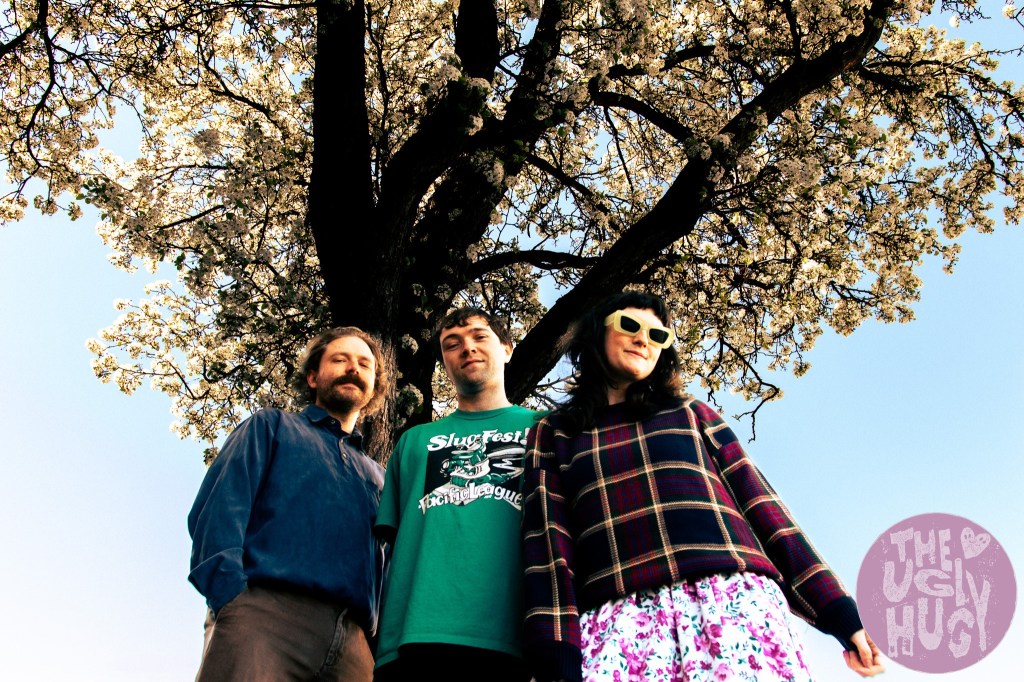
Interview and Photos by Lucie Day
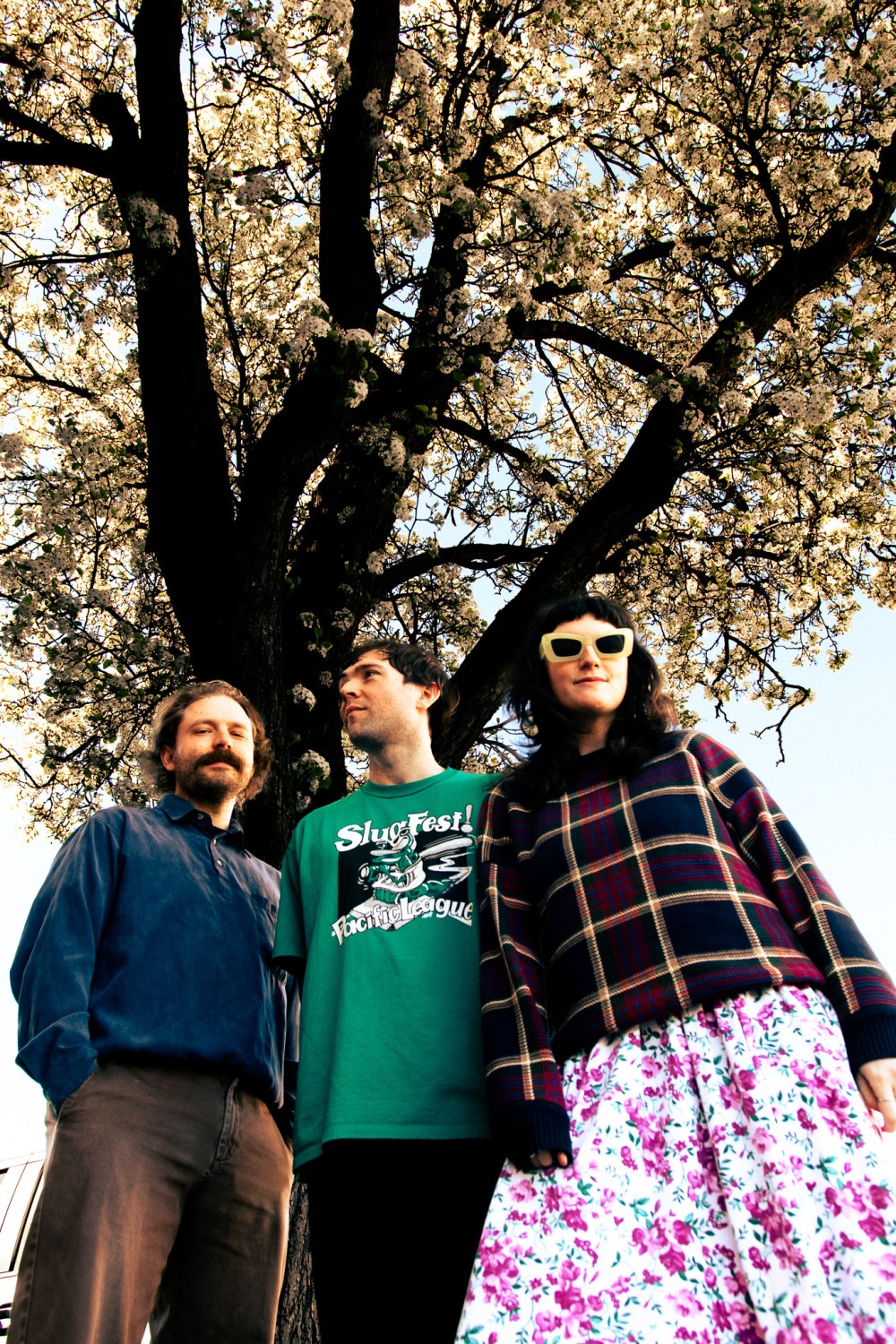
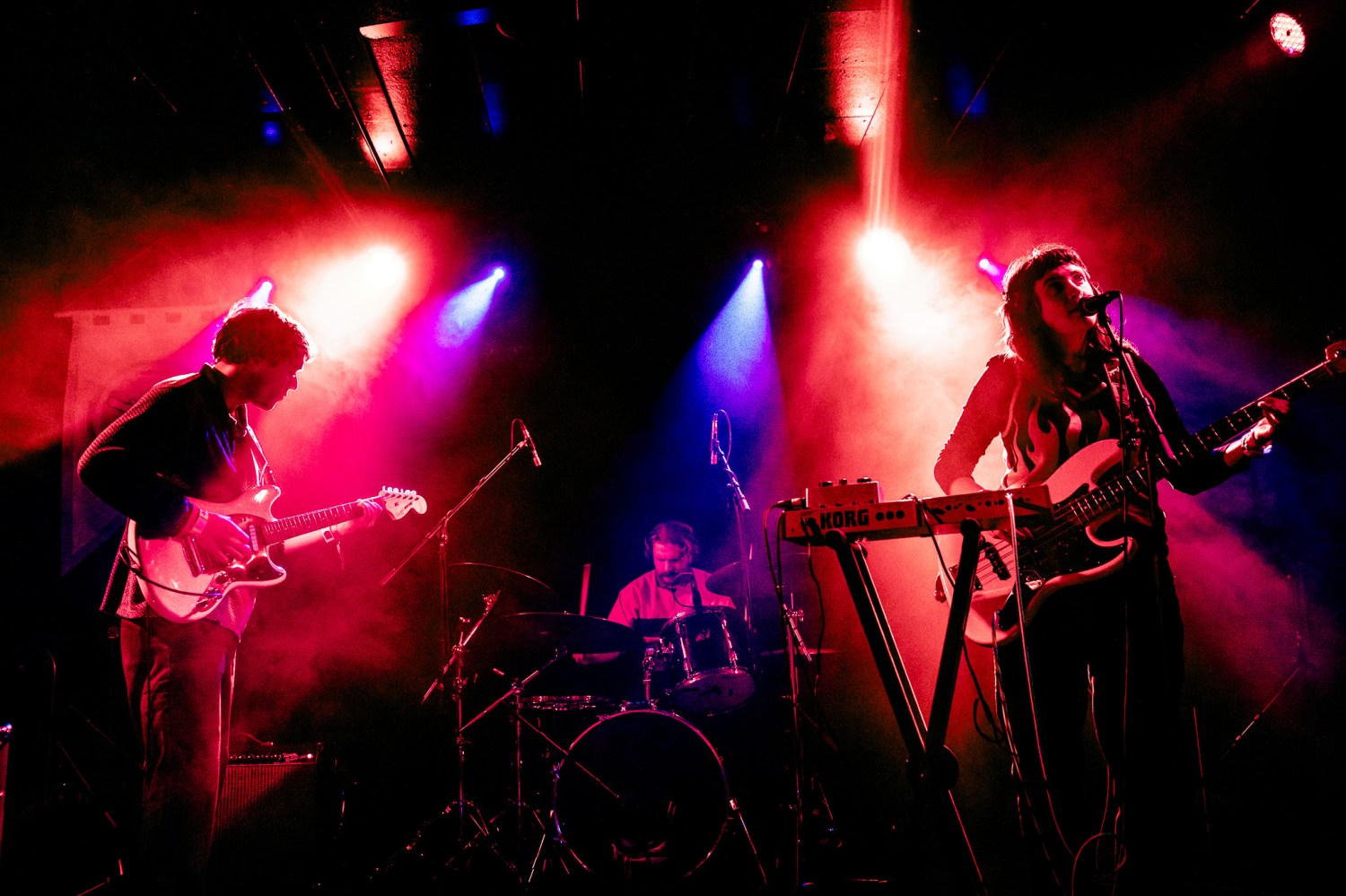
Amid the constant motion of Treefort Music Fest, Coral Grief creates a sanctuary. Their new record ‘Air Between Us’ invites the listener in with open arms and layered melodies.
We caught up with the Seattle-based trio during the festival to step into the album’s haze and talk about trusting your instincts, embracing abstraction, and letting songs evolve on their own terms.
This interview has been edited for length and clarity.
Lucie Day (The Ugly Hug): First off, welcome to Boise, Idaho! Congrats on the record, too. Something that you’ve talked about is collecting ideas and not judging them too early on. How do you know when something is ready to be revisited versus whether it needs a little more time to marinate? Is it just a gut feeling?
Lena Farr-Morrissey (vocals, bass, synth): I think it’s a feeling.
Cam Hancock (drums): When you know, you know.
LFM: I feel like with some songs, they click pretty fast. That’s kind of, like, the ideal situation for a song, right?
LD: When it’s easy.
LFM: Yes, ugh, right? But then for some, it takes a little bit more getting there. And you’re right, I feel like sometimes I have a tendency to overwork something or I’m like: ‘I don’t know if that was right’. I feel like then just bringing it to y’all – having other opinions – to ask: “What do you guys think of this? Could we improve on that’? I think working more collaboratively has helped to figure out when something works.
LD: I feel like I do get that feeling. You look at something, and it’s a head and a chest feeling of: ‘Yes.’ Which is really cool! But I feel like it’s so easy to run something into the ground when sometimes it does just need time to breathe, and you just need space from it.
LFM: And then you revisit it.
LD: It’s a whole other perspective.
LFM: We have a ton of demos from years ago that when we were in the moment, we were like, ‘No’. And then you can go back and revisit them and be like, ‘Oh, wait, I actually really liked the verse of that.’ Let’s just take that part and then move forward with it.
LD: Within the record, there’s a lot of documentation of places without fully explaining them and a lot of context that’s not necessarily direct and is instead implied. Do you think that, with that, the lyrics become preservative? Or something that’s more abstract?
LFM: I think I definitely lean more abstract and I’ve been learning how to ride that line of, ‘how can I paint this picture and give people a little bit more of something to hold onto, but still not be so obvious about it’? I feel like I’m still trying to learn how to toe that line. I feel like my goal with the lyrics on the record was to – from these different angles, paint a picture. Not have it necessarily be like: ‘This is about Seattle, Washington and my favorite streets and the streets that I hate’. Kind of just evoking the feelings and the moods that I’ve been feeling about things and trying to give some context, but I’m fine with it being more abstract. Because then people can assign their own kind of interpretation to it. I feel like everyone’s kind of going through the same shit.
LD: Aside from the direct inspirations, do you see a visual world that the music exists within?
LFM: Totally. I think that’s unfolding more and more as we make more music. I feel like it’s very grounded in a whimsical nature.
LD: It’s like world-building.
LFM: A little bit of a – I don’t want to say post-apocalyptic, but, just, a better world? A little bit more fantasy? If I were to build a dream world that this music exists in, it’s definitely not our current reality.
CH: I think there’s a lot of nature imagery and ideas of exploring your surroundings in a way that feels like a fantasy, but it’s also very real.
LD: Very tactile.
CH: Yeah, because we’re so removed from that. It’s so easy to be removed from that. I think we’ve talked about how it’s a great record to go for a drive.
LD: Yeah! You guys said something about “in movement”.
CH: When’s the last time anyone just went for a drive and put a record on? It’s a great idea, and people do it.
LFM: We don’t have time for that.
CH: We don’t have time for that. But, you know, maybe you’re on the bus, maybe you’re on the train, or going for a bike ride or something.
LD: All you need is a window.
CH: I think if it takes you somewhere, that’s great wherever that place is for you. You talk about the abstract lyrics- people bring their own ideas to it. They bring their own imagery to it.
LFM: There’s this philosophy term that says that everything is alive called panpsychism. Everything has a consciousness, all things have a mind or a mind like quality. I want to channel that more.
LD: If the things that you were trying to be conveying weren’t through music, what do you think would be the best medium associated with it?
Sam Fason (guitar, synth): For me, at least, the medium I feel most akin to is painting. In a similar way to music, you can get very abstract and gestural with it. In music you can convey stuff with notes and structure, but you can also convey stuff with tone and timbre. In painting, you can convey stuff with form but also with color, and other things more hard to define.
LFM: I like how music moves through time. I feel like film captures that similar itch for me and I’m like, ‘Oh, I like putting this sequence together and creating a timeline’. That’s something I really enjoy about music, so film is a fun way to explore that visually even though I’m not really good at it. But I like it. It’s fun to do. I used to make videos with my sister, she was my muse. She was like four years old, and I was like, ‘Okay, you’re the horror, the scary girl, and we’re gonna have you haunt the town’.
SF: I mean, you did a couple of our music videos and they turned out great.
CH: I think that they’re kind of getting at what we’re talking about, where it’s not just us in a room playing. Even the ones that are that, there’s a lot of other imagery going on. There’s a lot of nature scenes. I really enjoy that part of the process this time around and getting to work with folks who see our vision and are able to take that to the next step. Bringing in their own ideas, it all should be collaborative.
LFM: That’s the world I want to build. A world with our friends and other people that are just down for the cause.
LD: Lately I’ve been thinking a lot about what you’re saying: ‘It’s fun, but I don’t know if I’m that good at it’. I don’t think it matters if you’re good at it. I think it matters if it’s fun. Sometimes it can just be fun, and that brings a feeling with it. People can tell when something is coming from a place of pure enjoyment.
LFM: And not judging yourself. Just being playful with it.
LD: If there’s a theme within the record of holding onto things that are shifting and that “sand in-between your fingers” feeling, what do you feel like you’re holding on to?
SF: It’s becoming increasingly hard, but holding onto the hope that things might get better. Things can and do move in all directions, so if it’s possible for things to get worse, things can also get better.
LFM: I have a lot of perfectionist qualities in my life that I project outward and I’m trying to let go of that type of standard in general. Kind of what we’ve been talking about – just being more loose with everything and holding on to less judgment. I feel like I’ll be able to then interact with the world better and with the hope that I’m able to embrace things more.
CH: I was thinking about the things that I can control and the time that I have that is actually mine. It feels like you’re being pulled in a lot of directions, and it’s easy to just kind of lose yourself in the news, the internet, distraction, whatever. But having that time, it’s so nice to just go to a place like Boise and get out of town. Take an eight-hour car ride, and I can’t really read anything while I’m in the car, so I just kind of sit there, and it’s easy to just be like, ‘I’m bored,’ but also, I have nothing I have to do right now.
LD: Yeah, it’s very freeing.
CH: I’m really leaning into those moments. A lot of change in scenery helps that in a big way.
LFM: Yeah, I feel like through the band, that’s how we kind of hold on.
LD: It’s like an anchor.
LFM: Yeah, it’s like an anchor. We’re hurtling through the world figuring out how to navigate it all, and if anyone else wants to hop on then hop on.
LD: I feel like everyone I see who is feeling stressed about the ways of the world has found an anchor, whether that’s in a creative process or in a community. Using your medium as a form of resistance is a real thing, and I think that people attach onto that when they need it.
LFM: That’s the thing, though. You’ve got to cut to the root of what’s happening.
SF: Being able to have gone on the road and toured a good amount in the last year, it’s really reaffirming. There are people holding it down everywhere. It’s easy to feel like you’re on an island and things are pretty bleak out there, but there’s people who are everywhere and going through the same thing. They have the same values, and they’re doing something about it.
LD: Is there anything that you guys have realized about yourselves as artists recently that you didn’t necessarily understand when making this record or within the process of?
LFM: I think it’s crazy that we recorded that two years ago now. I do feel like I’ve changed so much since then, and I would do a lot of things differently.
LD: When it’s brand new to a group of people but it feels so far away from where you are presently, that’s a really interesting disconnect.
LFM: We’re going to go back into the studio in a month or so, and we’ve been working on new stuff. I want to get more experimental with it and learn how to build on it. What I was saying earlier about perfectionism– to see if I can just let the songs unfold and have less of a strict idea of what they need to be like. Let them snowball into their own.
LD: Let them be alive.
LFM: Yeah, let them come alive a little bit more.
SF: I feel similar to that. Sometimes if I’ve been working on a song or a demo, after that I have a hard time turning that part of my brain off. I hyperfixate on that, and moving forward I want to be able to put in that work but then also let it sit and marinate more. I think that’s a really important part of the process that I sometimes struggle with. I want to tinker forever. Sometimes the best results come from just letting things settle and taking your mind off it, and then coming back to it.
CH: I think that something I didn’t realize is that the first album at the time didn’t necessarily feel like a statement, but once it was all compiled together and we started to talk about it, and we started to have to talk about it, it did. That’s part of the process too, forming those ideas around it and hearing what each other feels about the work is really important. I didn’t realize that that would come about and inform this next piece only in the way that we’re, like, just more consciously thinking about what this next thing is. I feel like there’s sometimes a pressure for the second thing to be somehow related to the first.
LD: An expectation.
CH: You’ve done your thing and you’re out in the world now. There’s all these people who are now gathered around this thing that you’ve made, whether they’re listening or finding your music on Instagram or the radio or something. Do you have to be beholden to your investors, or do you just do whatever the heck you want— or somehow find a balance? I think we’re all really down to experiment a little more, and I’m really excited about that. So far, that process has yielded things that we enjoy. And so, if that’s the trajectory we continue on, I think we’ll be in a good spot.
LD: I think that that is a beautiful closer and a very optimistic end.
Listen to Air Between Us out now via Anxiety Blanket Records.
 the ugly hug