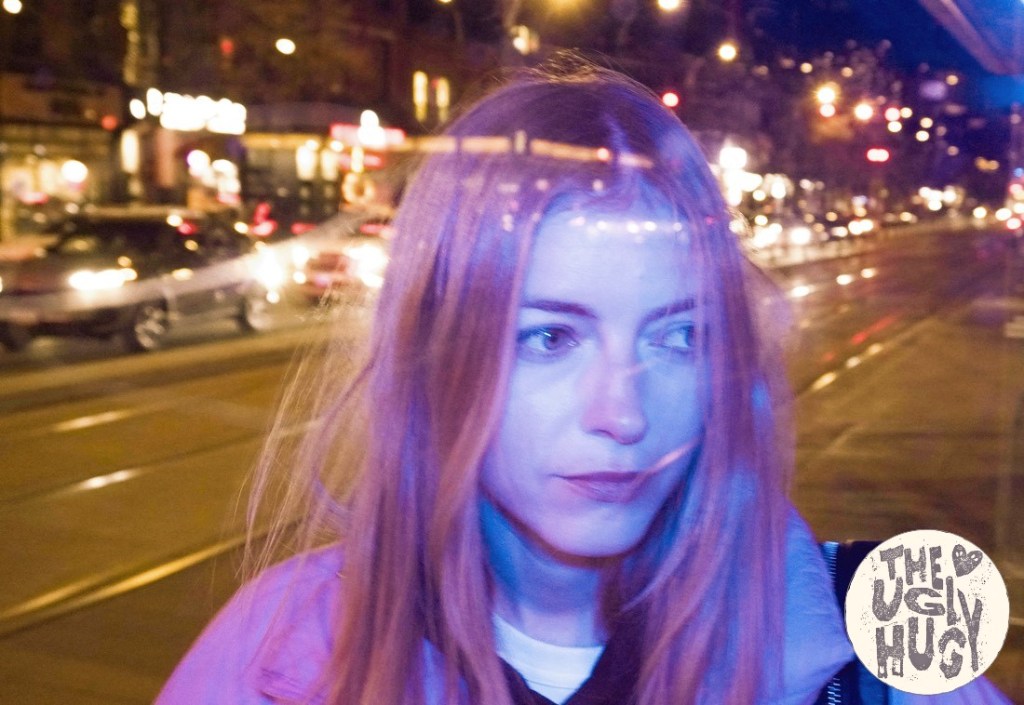
Written by Shea Roney | Photo Courtesy of Triples
“When I first moved to Toronto, I lived more in that area where there’s a lot of tall buildings and lots of glass and metal,” Eva Link says, our conversation wrapping up in the depths of melodically versatile reflections. “Just having that contrast, but also the nostalgia of being in those kinds of environments was interesting.”
It wasn’t long ago where Link found herself in a unique position, taking over as band leader and primary songwriter on her own for the first time ever. Originally formed as a duo with her younger sister Madeline, Triples was a force, glimmering and carefree, slinging pop songs that beamed with playful melodies and distortion that tangled up loose harmonies like a knot of twinkle lights. After the release of 2019’s LP, Big Time, Madeline found her other project PACKS taking up a lot of her energy and soon departed from the duo. To Eva, this wasn’t the end of Triples, but rather a chance to reimagine the project at her own pace.
Eva now returns with her new EP, Every Good Story, the first collection of Triples songs in five years. Every Good Story is a tried-and-true pop whirlwind – “door be propped, tunes be cranked”, as the saying often goes with these types of releases. These songs live in moments, flashes of thoughts and feelings scribbled on the back of crumbled receipts, unopened cereal boxes or the back of your hand with your freckles as guiding margins, just to make a note before the thought is running right past you and straight outta town.
“I end up writing a lot of songs that have a bit of a mantra energy about them, where it’s almost more aspirational than being 100% real about how things are at that moment,” Link shares, leaning into foundation rather than expectation of both her creative and personal growth. After moving to Toronto, becoming enveloped in the harsh angles of these looming skyscrapers, Link soon found the natural trajectory of what Triples could now become. And as these songs find their own place, Every Good Story is not just a statement on an old creative flame, but rather holding a marker to both an optimistic and joyous form of self-actualization that only comes around with patience and care.
We recently got to call Link to talk about taking breaks, being weird, pop song supremacy and her shifting use of the simple music video.
Every Good Story is your first collection since your last LP Big Time back in 2019. Let’s just start with how you’re feeling about where you and the project are at now?
I think it’s almost a bit surreal, because it’s been a while since I’ve put new stuff out. But in my mind, it feels like such a natural progression from Big Time. I’m not scared of how people are going to react to it because this was the natural next sound for us to have. It just came a little bit later.
Going from a duo to this full band, taking the time to do some reimagining of the project, what is that natural progression that you experienced?
To give a little bit of context since we released Big Time, we had our release show in November 2019, and then 2020 happened. It really made both of us reassess what we wanted to do with music. For [Madeline], it was really digging into her other project. For myself, I really just wanted to put a pin in this, to revisit when I feel like it makes sense to make more music. I went back to Ottawa, where I’m from, and it just felt like life wasn’t real. Nothing that I was doing previously I was doing that year. I think that that energy just carried over where I think it took a minute to get back into the flow of making music – and at that point, my sister wasn’t part of the project anymore. I needed to figure out how I was even going to play live. A lot of it was trying to wrap my head around collaboration, because I was so used to only collaborating with her, too.
When referring to that time of waiting as ‘once it makes sense again’, what were you searching for? What made sense to you?
Well, shows weren’t happening anymore during that period, it felt really natural to just take a break. I knew things will eventually feel like I’m getting the signs to pick this back up again, which did happen when I eventually came back to Toronto – I found some new bandmates and played the first show back since the shutdown. I really do feel that playing live gives that fuel to keep a project going. It’s one thing to generate your own motivation when you’re in your room recording demos by yourself, but it’s another thing to perform those songs and feel like you’re connecting with people.
Were you performing older Triples’ songs those first few shows back or were you starting to sneak some new ones that you had in your back pocket, that maybe you were looking to workshop through live sets?
It was a lot of Big Time songs, but then I also had a bunch of work-in-progress stuff that me and my sister had been working on leading up to 2020. So, it was just a matter of opening up my Voice Notes app and starting to arrange stuff. It had always been just the two-piece with my sister and I, so I was used to just arranging songs with drums and electric guitar and then singing on top of it. But when I started to collaborate with my friend Lucas (drums), that felt like a good jumping-off point of resurrecting these songs that I have. And then my friend Emily, who’s not in the band anymore, but added bass felt like the next step of just adding that little bit more depth to the songs. Having a fuller lineup has less pressure, too, honestly. When you’re a two-piece and you’re the only one playing guitar, it just feels scary.
Did that slow build of new instruments and collaborators open up what this project could be that you didn’t plan for previously?
Totally. Even vocally, I tend to write songs where my rhythm guitar playing was simplified in this way, where I almost had it in my head that my vocal melody would be acting as the top melody in the way a lead guitar could do. So, I would be writing songs where I’d be so out of breath at the end of a performance, because I was just trying to fill every little area with some more little vocal melodies. But then it was also a fun opportunity to write a song where if I don’t sing the entire way through, then what if we have some little breaks there’s a fun bass part, or maybe there’s a guitar solo?
Early last year, you released a one-off single called “So Soon”, making your big comeback, but you chose not to include it on Every Good Story. Where does “So Soon” fall into that progression of this project and what it would eventually become?
That song is interesting because I wrote that one during 2020, and really represents me trying to find both a new lineup, and then a new recording process. That song had many, many cooks in the kitchen from the recording to the mixing. I had it mixed by several different people while also working with a different label slash management at that time.
On top of the same track or each having their own try at it?
Different tries at it. That was an interesting learning experience for me in terms of being a project leader and really knowing how I want something to sound – being confident enough to say how I want it to sound. In “So Soon”, there’s a weird little remix thing, this really choppy part, and I remember working with the person who mixed it, and they were like, ‘why do you want that?’ I was like, ‘I don’t know, why not? It’s weird.’ It’s hard to communicate how weird you want something to sound. I’m happy with how it turned out, but it definitely made sense to release it as a one-off single and see how it does. Looking back, it’s interesting to listen to that compared to our new stuff, because I feel like it’s almost a little too polished.
These songs were written in a very intense emotional period for you, but you made it clear that you didn’t want to write from these emotions you were feeling. What was the need for you to craft a process like this? It’s kind of counterintuitive to what other artists would say.
Especially for the song “Gonna Be Good”, I end up writing a lot of songs that have a bit of a mantra energy about them, where it’s almost more aspirational than being 100% real about how things are in that moment. I really like songs that are not only reflecting on how things have been, but also having a little bit of a realization about yourself and where I want to try to make things better.
So in this space where you were able to create this distance, what felt natural when it came to writing these songs that tell a story and what turned you off creatively?
I do feel that my first instinct is to write a catchy pop song. And then I find that by playing it on my acoustic guitar and singing along to it, I end up coming up with little ideas that I can then expand upon. But what I’ve wanted to avoid, I don’t like songs that are just simply sad and living in that depressed space. I mean, I love Elliot Smith, but I think that someone like him, there is that other level of reflection. My songwriting approach is also not entirely planned, you know? Like, these ideas for songs sometimes just flow in this way, where it’s not my intention going in with what I’m going to write about this. Sometimes it’s just a journey of discovering how I’m actually feeling about life.
And through a really good pop song.
Yes!
I mean, with Elliot Smith, at its core, those are genuinely good pop songs. But there is so much depth, like you said, it’s not primarily sad, but rather weighs a lot. To you personally, utilizing a really good pop song, what makes that such an appealing vehicle for you to explore storytelling?
I find it’s like a puzzle, where you’re trying to make the melodies click in this way that just makes it a nice little package. I get pretty obsessive with things feeling neat. I mean, my songs are pretty short – they end up being 2-3 minutes long. But there’s a song on the LP that’s pushing 4 minutes, and I’m like, yay!’ I think Robert Pollard, Guided by Voices, is a good example of that kind of succinctness in writing little melodies that are just fun to sing. Writing short songs makes them really fun to perform, and especially as a band, we get the songs down pat.
Music videos are a core element to the Triples experience, having co-written and directed several fun ones with Madeline years ago. What’s the appeal of the music video to you and has it changed over this transition period?
Music videos are interesting, because it obviously involves you showing your image and your face and your vibe in a visual form. I love watching music videos, and I find that authenticity is something that I’m very critical about. So, I feel kind of scared when I make music videos, like, how do I make this come across as the most authentic? I think the approach definitely changed from when me and Madeline were playing together, where we would brainstorm and do it together, versus now, where I collaborate with Seamus, which is great. But when it was my sister and I, it was both of us in the video, so that was always a little less pressure, versus, now it’s just me. But I’m very obsessed with visuals. I’m a graphic designer and artist, and I get really into finding the right visual story to tell that will align with the song.
Going from having your co-conspirator in Madeline with you in the music videos to just you, how do you think that authenticity shifted? Or do you weigh authenticity differently now?
When you’re two people, there’s just a natural, fun dynamic that happens. Especially, you know, we’re sisters, and our banter and our energy allows us to feel like we can be a little sillier and amp each other up a little bit more. Now it really does feel like it has to come from me, and I think that goes back to the many different facets of the fact that I’m at the helm of this project now. I have to push things forward and I have to decide on the visuals. While I love having that control, I definitely miss having my sister to be in the videos and to perform with.
For this rollout, we wanted to keep it super, super simple. And, honestly, these videos are more so visualizers, and that’s kind of what I wanted. For “So Soon”, I did this whole production where I rented my friend’s space, and we planned all these different shots with the whole band in the video. But something that I have found in my experience is a simple video does the exact same thing, in terms of, we as musicians, we just need visuals to accompany the music. I find it interesting that artists, and in particular musicians, use their budgets and try to figure out where the money is best allocated? Is it photoshoots? And I think the recording is where to invest. Once you have your songs, you can make cool stuff no matter what. You can make a cool music video for $0.
With these music videos and visualizers, do they fall into that natural progression of the band that you experienced?
So, the EP titled ‘Every Good Story’ and the cover were inspired by the downtown Toronto buildings. That aesthetic to me, pairing that with indie rock, is just kind of fun. But, when I first moved to Toronto, I lived more in that area where there’s a lot of tall buildings and lots of glass and metal. Just having that contrast, but also the nostalgia of being in those kinds of environments was interesting. But all these music videos are shot around different areas of Downtown Toronto.
Those environments feel so grown up, so hearing the word nostalgia thrown in there is really interesting. It’s got depth [laughs].
Yes! The idea of being a young person, just plopped into this big metropolis, it’s interesting to think back on. I feel like a lot of these songs on the EP are written about being in your mid-20s and figuring out your place in a big city.
Every Good Story is out everywhere now. You can also grab it on cassette via the new Toronto label, Bleak Enterprise.
 the ugly hug