Written by Molly Friend | Photos by Sarah Franke
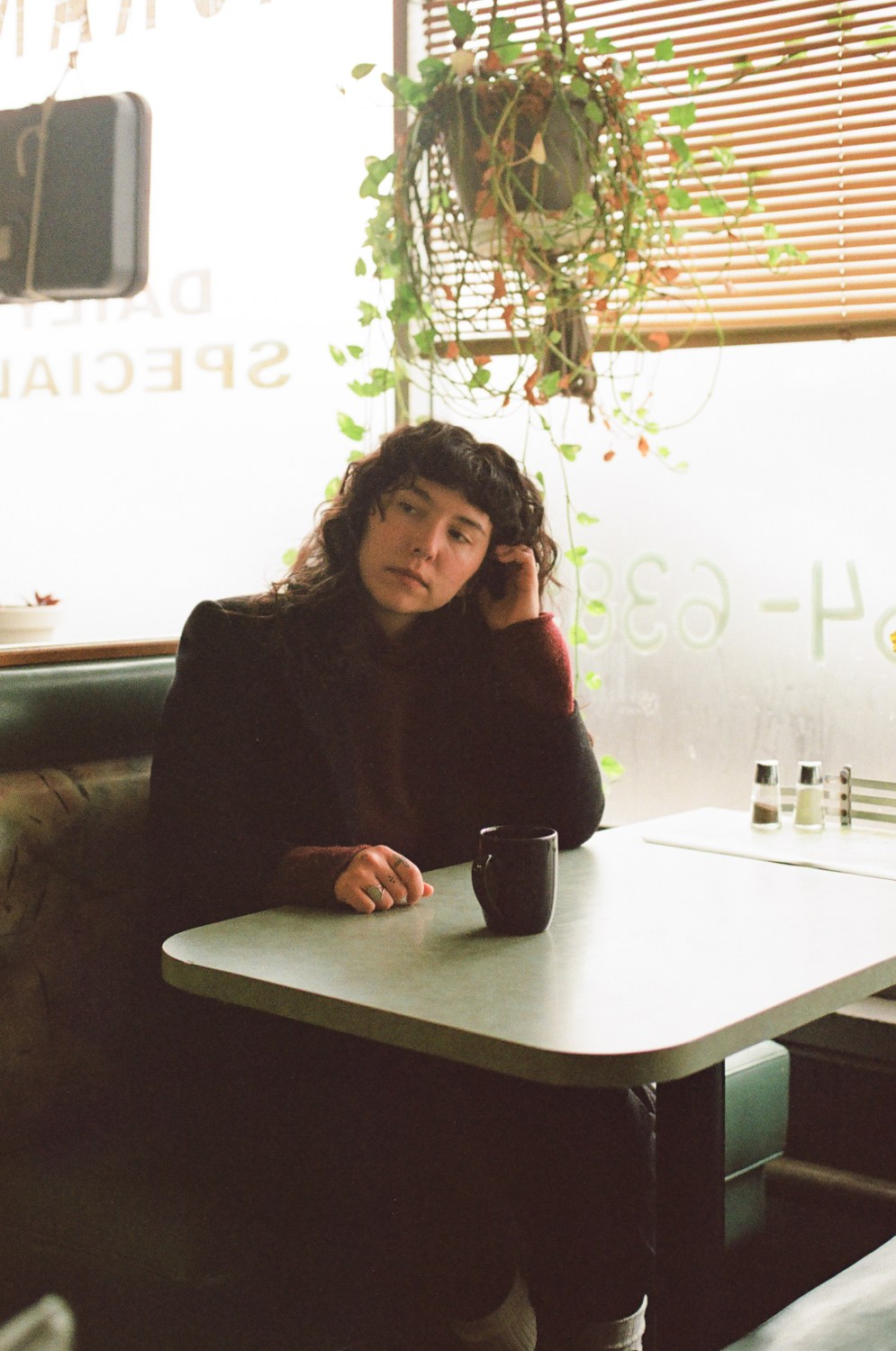
Last November, I called Faith Maddox of Virga to talk about their new EP The Perfect Freedom of Single Necessity. We spoke on Black Friday. “I can’t even go online right now because every ad feels like I’m being spiritually assaulted,” they lamented. Maddox, navigating the wake of a breakup and subsequent band restructuring, has been forced to reexamine their relationship to dependence, need, and desire. The transformation forced them to release their grasp on the scaffolding of the relationship they outgrew. This release became a new framework, one in which they could recognize the pitfalls of preoccupation – whether it be with a person, a substance, or retail.
The title of the record borrows a line from Annie Dillard’s essay “Living Like Weasels,” a foundational text for Maddox during the creation of these songs. Laudably, Dillard’s weasel has no preoccupations. It does not concern itself with what it wants to buy, what bar it wants to visit, or who it wants to fuck. Instead, it remains focused only on the aspects of life that keep it alive, and all else falls by the wayside. “The weasel lives in necessity and we live in choice,” writes Dillard. “A weasel lives as he’s meant to, yielding at every moment to the perfect freedom of single necessity,” she concludes. Like the titular weasel, who acts according to no being’s prerogatives other than its own, Maddox strives for clarity of purpose. The Perfect Freedom of Single Necessity embraces a kind of spiritual abstinence, and renounces that which does not sustain an attuned life. “All desires belie a spiritual deficit,” Maddox stated. “If you don’t stop and think about why you’re chasing what you’re chasing, you might not be actually pursuing what you truly want.”
Virga’s dedication to intentionality is audibly evident, too. Each track feels focused and determined, driven by to-the-point guitar riffs, crisp drum patterns, and full-throttle bass lines supplied by Maddox, Billy Orr, and Deegan Poores, respectively. Virga’s sound is clear-cut and polished off like a sun-bleached bone left long ago by some scavenger. Most distinct are Maddox’s up-close and deliberate vocals, sustaining notes in ways that make air feel like a non-renewable resource. It’s as if they’ve entered their lean season, not in the sense they don’t have enough to work with – rather, they’ve gotten rid of what they don’t absolutely need.
The band opens with unfettered energy on “Half Lie,” the EP’s first track that can only be described as a pre-breakup song. Poores and Orr push the rhythmic progression with an uneasy, twitchy momentum. “Isn’t it nice / to be desired?” the subject bays at the speaker, full of resentment. Maddox snarls this line with such bitterness that it’s hard to read the scene as anything other than a passive aggressive exchange that will precipitate a full blown fight. The song swims in the dullness and disquietude of a decaying relationship, of needs left unmet. Maddox belligerently pokes at the tension by unleashing a guitar solo shaped by harsh, unyielding intonation.
During our call, Maddox mentioned they picked up a cigarette habit on the road. “I allow myself one or two a week,” they said. “It feels powerful to have access to something, but only allow myself to have what I actually need.” It’s a self-disciplined tightrope walk of the line between desire and addiction, between need and want. I hear them waver: “I have asthma, I sing, I should not be smoking…I give a lot of them away,” they add.
Maybe I can hear this new habit in “Night Scene with Coyote.” Maddox opens the second and most audacious track with dusky, alluring delivery: “Do you hear it calling from deep inside? / Hollow, beneath the sternum, / open wide.” With more breath than voice, they conjure the familiar heartburn of fixation, and the temptation of answering that call, even if against your better judgement. They let the impulse carry them forward, like headlights feed your vision just a little at a time on a night drive down a deserted road.
Over a sludgy dirge, they warn, “It’s bottomless, that want / It’s bottomless, the urge,” sustaining the last word until they’ve pushed all the air out of their lungs and their voice creaks and expires.
It mirrors the emptying of the self that occurs in pursuit of something we’re convinced we can’t live without. Like shoulder angels dueling for influence, Maddox and Poores trade guitar and bass lines that propel the track into its climax, a realization. First, it is murmured: “I can’t get enough / of what I don’t need.” It’s a concise yet devastating maxim that illuminates the futility of pursuit. Things that aren’t necessary to your very being, to your soul’s existence, can never fully sate you, and will always leave you in the lurch of needing the next fix.

The climactic line comes from The Dry Season, a memoir by Melissa Febos that Maddox credits with completely changing their understanding of relationships. The memoir details Febos’s year of romantic abstinence and the self-possession she was ultimately able to reclaim as a result. “Celibacy as a method to understand desire is not an intuitive approach,” Maddox points out, but it is a revelatory one. How much of yourself will you empty in trying to fill a bottomless vessel? In this scene, we are the animal, living not in necessity, as the weasel, but in choice, as the proverbial coyote: emaciated, run ragged, risking life and limb to attain and devour our prey. There are other options available that might sustain us, but we insist on the roadrunner, the object of our obsession. We are beholden to a never-ending chase toward the mirage of satisfaction. Desire is a state of destitution.
Maddox repeats the line, this time letting it burst from their mouth. Their voice catches, and they are half pleading, half barking, reckless, frenzied. It’s the kind of ferality that surfaces when we reject the better angels of our nature and give over to the least honorable aspects of ourselves. “Leaning into the parts of myself that felt perverse or undesirable allowed me to make more honest and interesting art,” said Maddox. What is normally hidden, mired in shame, is allowed to break free, and the force is a powerful one.
Two summers ago, the band took a trip to Clark County, Kansas to visit a prairie preserve near the Oklahoma border. Maddox saw a patch of sorghum set against a murky pre-storm sky and snapped a photo. As the shutter clicked, a gust of wind blew them back onto unstable ground, and they lost their balance. They fell back into a ditch, and upon landing, heard a sickening crack as their ankle bent the wrong way. Being carried back to the car, they entirely lost their sense of sight and sound and had a seizure – a symptom of a lifelong neurological condition triggered by physical stress. “I kind of thought I had died. Not being able to hear or see was terrifying,” they told me. In this state of sensory deprivation, full of adrenaline, they became aware of an extrasensory presence, a kind of prairie spirit that stayed with them in their vulnerable state. When they came to, they saw a massive thunderhead coming over the horizon and smelled rain in the air. Maddox wrote “The Ditch” after this harrowing experience.
The whole scene is cinematic and transcendental. I can’t help but think of Christina’s World, the Andrew Wyeth painting of a woman dragging herself up a wheat covered hill without the use of her legs. Anna Christina Olson, the woman depicted in the painting, likely also suffered from a neurological condition that kept her from walking. It is a picture of disabled life both at the mercy of, and, in intimate communion with its natural environment. When we are cut off from our sensuous life, our desires are dwarfed, easily bowled over by a gale.
“Nothing can save you, / nothing cared,” they holler with a Gordonesque bellow, and begin to scratch at their guitar. Though it might sound nihilistic at first, “nothing” here is working as a subject, as in only in a state of nothingness can you be saved. If desires are indeed a symptom of a spiritual deficit, then deprivation must incite a spiritual influx. To detect and connect with a higher power, you must hold onto nothing, and allow the boundary between you and the vapor in the air before a storm to dissolve. When you are nothing once more, the land will take you back, not because it’s vindictive, not even because it wants to. It will swallow you whole because, like the weasel, that is its unthinking job in this world. There is salvation in the uncaring nature of the land. Reflecting on the event, Maddox said, “Some part of me did die that day, in a way that I think was positive.”
When we talked about the inspiration for the closing track, “Via Negativa,” Maddox said they wrote it while Poores was setting up a new pedal steel guitar, which lends the song a sweet reflectiveness that isn’t heard elsewhere on the EP. “I was feeling a lot that day,” they said. “Will I have both the creative success I feel is the primary purpose in my life – and – can I have love? You’re always sacrificing one for another especially if you’re in a relationship with a man,” they attested. They were haunted by the painful yet liberating nature of relinquishing the ideal of partnership.
They described their newfound solitude to me as being able to fully exhale for the first time. I don’t think I entirely understood what they meant until I was driving west out of Chicago. As I passed train yards and suburbs, the landscape flattened out, and I felt a sweet and familiar expansiveness return to me. Gazing out on flocks of geese balanced on frozen ponds, I was overcome with a sense of singularity that cannot exist when there is always someone right next to you. There was nothing before me except more road. It was a great field of possibility, and no matter how far I advanced, I found myself at the center of this field. Only in the middle of nowhere can you begin to understand your place in the world. This is via negativa, “the negative way,” a philosophical idea that you can define life, the Self, or God by what it is not.
“There’s nowhere to hide / when you’re out on the ice,” Maddox howls with lungfuls of air, with miles to go. With no distractions, no preoccupations, there is suddenly nothing left standing between you and your one, true, single necessity in this life. There is no destination except here and now, and no excuse not to be there. Here you stand in the wide open, in full awareness, with nothing. Well, not nothing. There’s you, the you that’s left when everything else is stripped away. “What would love feel like without an object at the center of it?” Maddox asks me.
I imagine it’s terrifying, being the only speck on the tundra, the prairie. Once you reach where you thought the oasis lay, only to realize you’re surrounded by thin air, fooled by an iceblink, it is devastating. But on the other hand, you can stop running.
You can listen to The Perfect Freedom of Single Necessity out everywhere January 30th. You can listen to the rest of Virga’s catalog now.
 the ugly hug