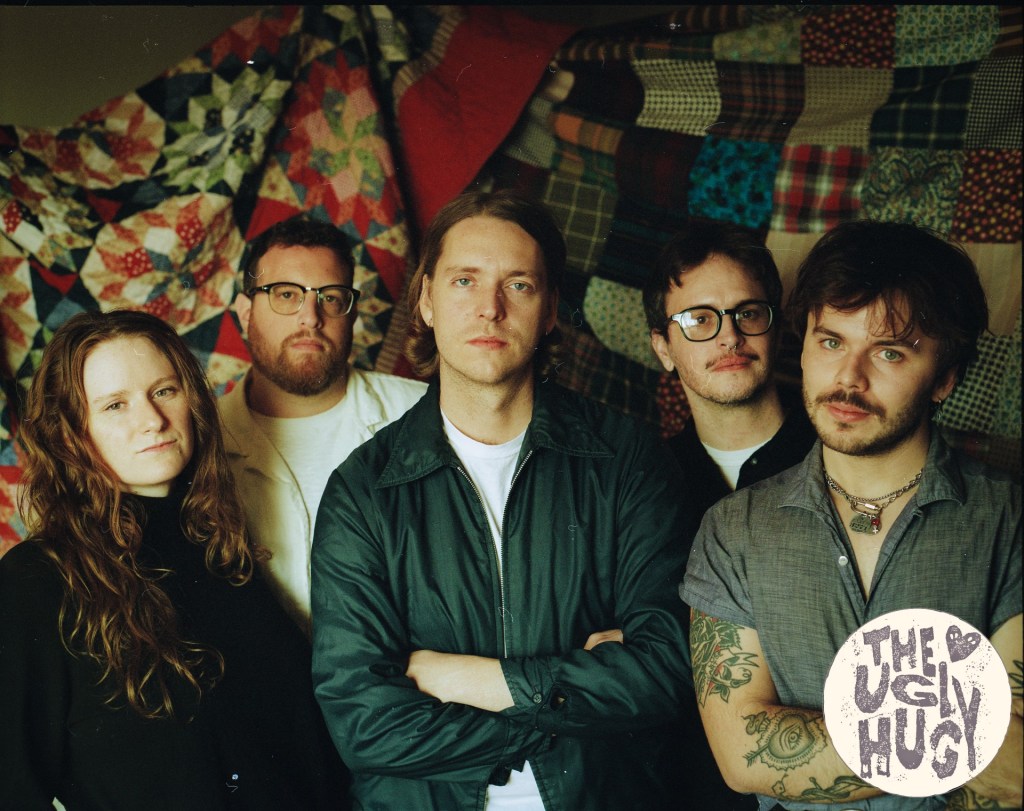
Written by Joy Elizabeth | Photo by Vanessa Valadez
Chicago-based group Dendrons’ third full-length offering, Indiana, couldn’t be more of a product of its origins. The title track begins the album, calling listeners to “dissolve yourself,” a refrain cushioned between droning guitars and optimistic lead melodies. There is notable, intentional restraint in the composition, a precipice never quite summited. It makes the LP feel like a dream, somewhere between the grounded real world and the heady, psychedelic swoon of something otherworldly.
While lead singles “Tuck Me Under,” “Monsteras,” and “B4” invite the audience into this abstract sonic landscape, it is the shorter tracks that really complete the picture. “Liminal” and “Opening Play (Make Haste)” (all of 43 second and under 2 minutes, respectively), bridge the gap between heavier, fuzzier compositions and cleanse the palate for the main event.
I caught up with Jarvie to dive into the themes of Indiana, its “fractured” development, and how the group metamorphosizes restlessness into a punch.
Dendrons has been described as a collaboration of two childhood friends who reconnected later in life. With tracks like “B4” exploring the haunting nature of the past (memories stored in location), would you say that Indiana is an ode to home?
Dane Jarvie: I would say Indiana represents a lot of things to me personally. It is my origin in the sense that my grandparents on my mothers side came from there. For me it exists, partially, as a liminal space. A perpetual ground between loss and reinvention. A cosmic purgatory. A place that I find myself in throughout most of my life. I think there is a strange beauty to it that I find intoxicating. A lot of Indiana feels so familiar to me even though I had never grown up there.
On a physical level, it is probably one of the states that I have driven through more than any other. It is omnipresent.
Lead single “Tuck Me Under” nearly hits the 6 minute mark, cascading between lulls and frenetic breaks. What was the process like composing this?
DJ: The majority of songs on this album were written in fractions here, fractions there—piecemeal. Ableton demos that were pitched by members of the band were re-imagined, re-arranged and built back up as a unit—sometimes bearing little resemblance to the original tune. Then the songs would evolve again when we went to the studio. Everything was always in flux until literally the last moment.
“Tuck Me Under” was constructed in a similar fashion. It started as a short demo of some acoustic improvisations and electronic embellishments, and it was run through the grinder, going through many different shapes and shades.
The sprawling, acoustic, ethereal end section was pitched by Tony, our engineer and co-producer, as a concept, and I remember during the pre-production stage, we stayed up in a windowless basement till 4 or 5 am, hammering out chords on a nylon string guitar and singing melodies. That part was written in Normal, Illinois. The original demo for the end section had us putting violin bows over guitars, and we spent a long time creating hypnotic feedback.
We were so sleep deprived when we recorded these ideas that when we listened back to what we wrote, it felt like it came from someone else entirely. I think this all contributes to the overall feel. As far as how the vocals went for this album, melodies came first, and the lyrics were arranged at the very end of the writing process.
There is a restless energy that blankets the album, an eagerness to break through monotony felt particularly in “Monsteras.” Where does this come from, and have you found that channeling these thoughts into your work helps release them?
DJ: I think this album was created in a state of uncertainty. I think a lot of us were yearning for a reinvention creatively, but there was not a specific road map for how to get there. It was all new territory for us. There is an inherent tension with the tunes. There are a lot of heavy creative forces at play in these songs—Every member of this project has a different vision for how something could or should sound. A lot of compromise had to be made in order to make things fit. Sometimes the clashing ideas were left in the music and made as a creative choice, as a statement. I think those moments are important to represent in an honest way.
You’re credited as co-producers on the album with Tony Brant. Do you feel like having your hands on production keeps you in the driver’s seat of each project?
DJ: I think we all consider production, and the creative choices associated with tone and sonic palate, to be a large part of the artistry for us—a large part for the recipe that makes this band what it is. Taking ownership of this is emboldening.
Tony played a huge part in it too, keeping things moving and adding a coherence to things.He added a certain technical prowess that we really appreciate. Everything is mostly collaborative, though. We play specific instruments on the stage, but as far as writing goes, we are multi-instrumentalists in every sense. Sometimes I would write parts for another member, or they would write parts for me, or maybe entire sections with all instruments of one section were structured from one person’s Ableton demo beforehand. It didn’t matter who wrote what part. We tried to put egos aside as best we could. The most important thing was did the part sound good coming out of the speakers? It didn’t matter through what person (or avenue) it was achieved. This was the prevailing attitude while writing the record.
You’ve noted the Chicago DIY scene as pivotal in your career. How has it supported you and how does it fit into your story now?
DJ: Chicago is where the band was started and it is always gonna be the home base for most of us. We are a product of the environment we grew up in. I do, however, think a big part of our sound is also the product of us finding ourselves on the road, touring, and getting outside of our comfort zones—interacting with communities all across North America. We are very much a band that is informed by our experiences traveling, and I have always appreciated that aspect. I want to honor that.
You can listen to Indiana out everywhere now via Candlepin Records.
 the ugly hug