
“I mean, I have too much stuff,” Dan Wriggins says. “Shit, I’ve got a van full of too much stuff here,” shifting the phone to offer a glimpse to what was behind his driver’s seat; chair legs astray, boxes stacked with potential means, comforters keeping it all secure from the rough bumps of U.S. highway driving. En route from Iowa City back to Philly, Wriggins was parked, discussing a line he had stolen from folk artist Kath Bloom, recalling a time going through her garage that was also packed with too much stuff; “everything we have is given to us”, she said to him, the phrase now living on the song “Free Association”. “That line is something I wrote down while hanging out with her years ago. The song has nothing to do with her. It’s about other stuff, if it’s about anything really.” He continues, “it should go without saying that songs are usually lies. They are not a direct representation of things that happened.” It’s not necessarily a farce, breaking a “write-what-you-know” structure that every writer has been told at least once, but rather becomes an acknowledgment of the craft and how to embrace a story worth telling.
Dan Wriggins fronts the Philly-based group Friendship, who are sharing their highly anticipated new album Caveman Wakes Up this Friday. Following 2022’s beloved Love The Stranger, an album of epic road trip caliber. Marking the second release on their label home at Merge Records, Friendship continues to push the bounds of storytelling as Caveman makes a break for their most expansive release yet. Going further into the looseness of alt-country and Chesnutt-esque melodic fixations, there is a lost familiarity that a Friendship tune brings out from its hiding – the crunching of an unmarked gravel path, the intensity of humming a tune you can’t quite recognize. Caveman Wakes Up is littered with these feelings that begin to fill in the little gaps that we didn’t know were missing, and quite frankly, didn’t know were ever there in the first place.

“I think of it in the world of a Gary Larson The Far Side comic,” Wriggins says about the album’s title; primitive, comprehensive, funny –- a moment from the opening line off the standout track “Hollow Skulls”. A lot of the humor that resides in Larson’s use of Neanderthals is in the irony of trial and error, a glimpse at the earliest stages of habits that we consider to be of modern normalcy. Whether it be a spear falling short of a wooly mammoth with onlookers yelling “airrrr spearrrr”, or putting on a suit and tie to count rocks and sticks with corporate intensity, these quips become universal to cursing out junk radiators or watching dark clouds cover your wedding day, as Wriggins asks, “did people before us have the same grievances and annoyances that we do?” The line widens the lens from minor frustrations to asking if we’ve ever really learned how to balance very human concepts like dreams and expectations. “It’s sort of a joke about universality,” he says.
That universality is embedded in telling a good story, one that is easy to pick up, toss around for a bit, and put in your pocket for later on. These characters, some love-sick, some lost, other’s balancing grief with rusty reflections, feel like someone we know, but more importantly, someone we can see ourselves in. Wriggins’ writing gets coined often for playing with the ordinary, writing love letters of sorts to the mundane and the underappreciated, but it’s not something he particularly looks out for. “I’ve never really understood that,” he admits, questioning the description. “What do other people write about then?”
Whether singing of devotion or defeat, humorous quips mixed with an unpredictability that resonates just as casual as it is damning to the restless feelings in these stories, Wriggins doesn’t romanticize the specificity in the language he uses. But what Caveman does is build upon the spaces to confront whatever it is these stories set out to do. Where a song like “Free Association” plays towards love, yet we don’t quite know where it will lead. “I thought I was wise, thought I knew about love”, he sings, striking this contradiction in the very first line. But as a Friendship song goes, we put trust in the companionship that these feelings become, following each path that appears on its own, learning to question what we thought we knew, and knowing that the outcome will be worth it in the end. “In a real basic sense,” Wriggins says, “I think of it as you gotta follow the song wherever it goes.”
“If you started writing something that happened and that was about something that you felt really strongly about, like, if I came up with these lines because they had to do with this heartbreak. But then I get further in and write some more and end up writing a chorus that really has nothing to do with heartbreak and has something to do with some other emotion that I feel like I can write about better, well, then you gotta follow that. You gotta delete the first part that perhaps was what you started off intending to write about,” Wriggins says. “In a way it feels like a very technical way of writing. I know some folks who don’t like to do it this way, but if something actually happened that does come through in the song, it might just be a coincidence, you know? I certainly would always prioritize a really good line over something that truly actually reflects something that happened to me.”
“Anything you’re writing ever, you’re always looking for balance,” Wriggins recognizes in practice. “Sometimes you need to be heavy handed, but a lot of the time, if you’re saying something that’s too intense, you often want to, not make it lighter, but make it more reflective of the truth, which is going to be pretty complicated. So you might add some other type of detail. I think a problem that I still have is trying to put too much into a song,” he admits, the complications not lost on him. “I mean, this might be kind of cowardly,” he continues, “but I’ve really come to believe that the medium of popular song is geared towards communicating one emotion really strongly. That’s what a pop or a country song can do really, really well, better than any other art form. And of course, sometimes you want to be ambitious and you want to push what it’s built for, but at other times I feel like, man, I want to get back to basics.”
Beyond Wriggins’ writing, Friendship’s sonic explorations are brought to life by the crew he has surrounded himself with for almost a decade now, consisting of Michael Cormier-O’Leary (Hour, Dear Life Records), Peter Gill (2nd Grade) and Jon Samuels (MJ Lenderman and The Wind, Dear Life Records). Songs like “Betty Ford” and “Wildwood in January” play with patient pacing, finding solace in the contradictions of tempered folk music and former first ladies. “Tree of Heaven” rips the album wide open with Gill’s harsh, static tones and Cormier-O’Leary’s conversational drumming while the grueling demeanor of “Resident Evil” creates a stirring awareness to the intuitive focus that the band accomplishes on this record. Especially the experimentation with synthesizers and saxophone at the climax of “Free Association” stands out as a fresh new taste to the already rich arrangements that reside on the album. “Often if you try something that’s really out there in the moment, you’re going to think, well, of course, we’re not keeping that. That’s just me experimenting.” Wriggins says, recalling Gill’s idea to add in these new voicings on the last day of recording. “And once in a while you do keep it,” he laughs.
But over the years, as Friendship continue to push the bounds of their sound, it’s noticeable that there is a type of sonic progression that solidifies each album in its own territory. “You got to be experimenting with new things, both for yourself and for listeners,” Wriggins says. “But you also have to still be including stuff you’re good at because you’re the expert. Over the years I’ve been developing this theory that you have a spectrum,” recalling a time he was talking to Kurt Wagner, the stamina behind the prolific project Lambchop. “On one hand, you can keep doing the same thing over and over again that you’re really good at, and on the other hand, you could do a totally new project every single time you make something. If the next Friendship album was that we all decided to make sculptures, it would be pretty crappy, because we’re not sculptors, you know? But the other side of just doing the same thing over and over again kind of sucks, too.”
“The process of knowing what is really good and what to keep and what to cut for the production and the arrangement is a kind of democratic thing,” Wriggins says, discussing the functionality of the group. Each member has spent the better half of a decade practicing their craft in their individual routes, but when it comes to Friendship, it’s a constant back and forth on ideas. “I kind of trust their musical impulses better than mine,” Wriggins laughs. “But when it comes to lyrics, I do really know what I think is good. I’m usually able to hear it myself and say, yep, that’s the type of thing I would listen to. Of course, you always are second guessing yourself and doubting things. But often the doubt is like, well, this is pretty good. Could I make it better?” He continues, “I think the other guys especially really liked recording this one more than other ones because we’re just better at messing around. And hopefully we just keep on getting better.”
Embracing the characteristics that defined their past albums — the tenderness of Dreamin’, the solitude of Shock Out of Season and the camaraderie of Love the Stranger, Caveman Wakes Up is a powerhouse of enduring complexions. As each track fills the open spaces with both intuition and intensity, building up a collection of all the stuff they found and all that was once given, this band once again breaks the divide between what it means to experience and live art; a capture of the subtly, grace and often after-thought beauty that has become synonymous with the stories told by Friendship.
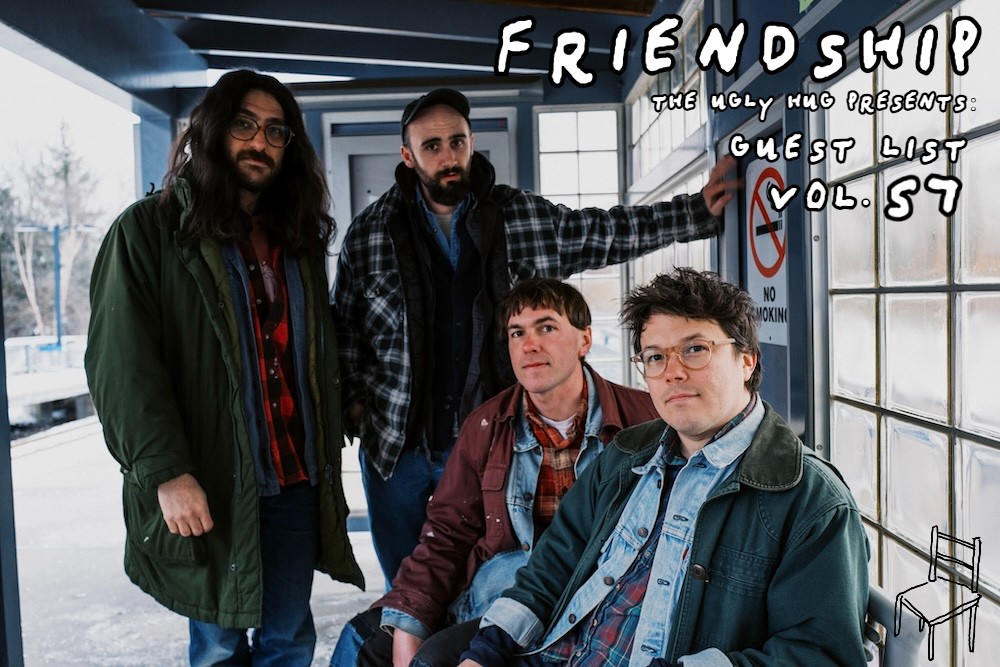
Along with this feature, the members of Friendship are taking over this week’s guest list at the ugly hug. Sharing The Cave Window, “three songs from each guy, all with some type of connection to the record itself, very loose inspiration.”
Caveman Wakes Up is set to be released this Friday, May 16th via Merge Records. You can pre-order the album now, as well as on CD and vinyl.
Written by Shea Roney | Photos by Charlie Boss
 the ugly hug