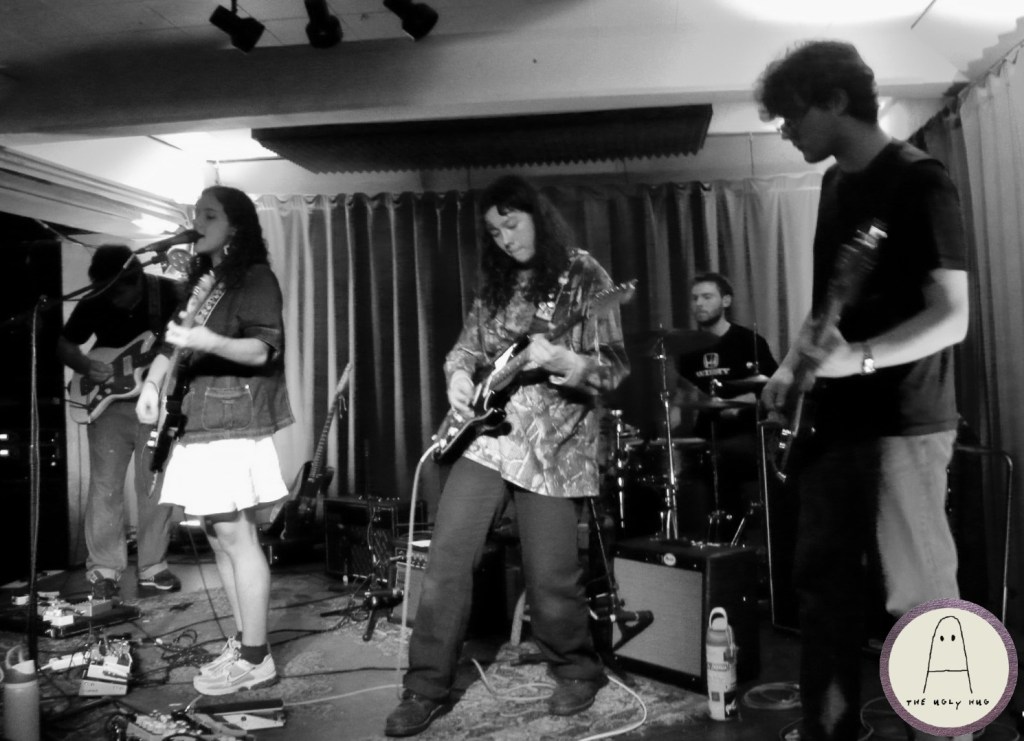
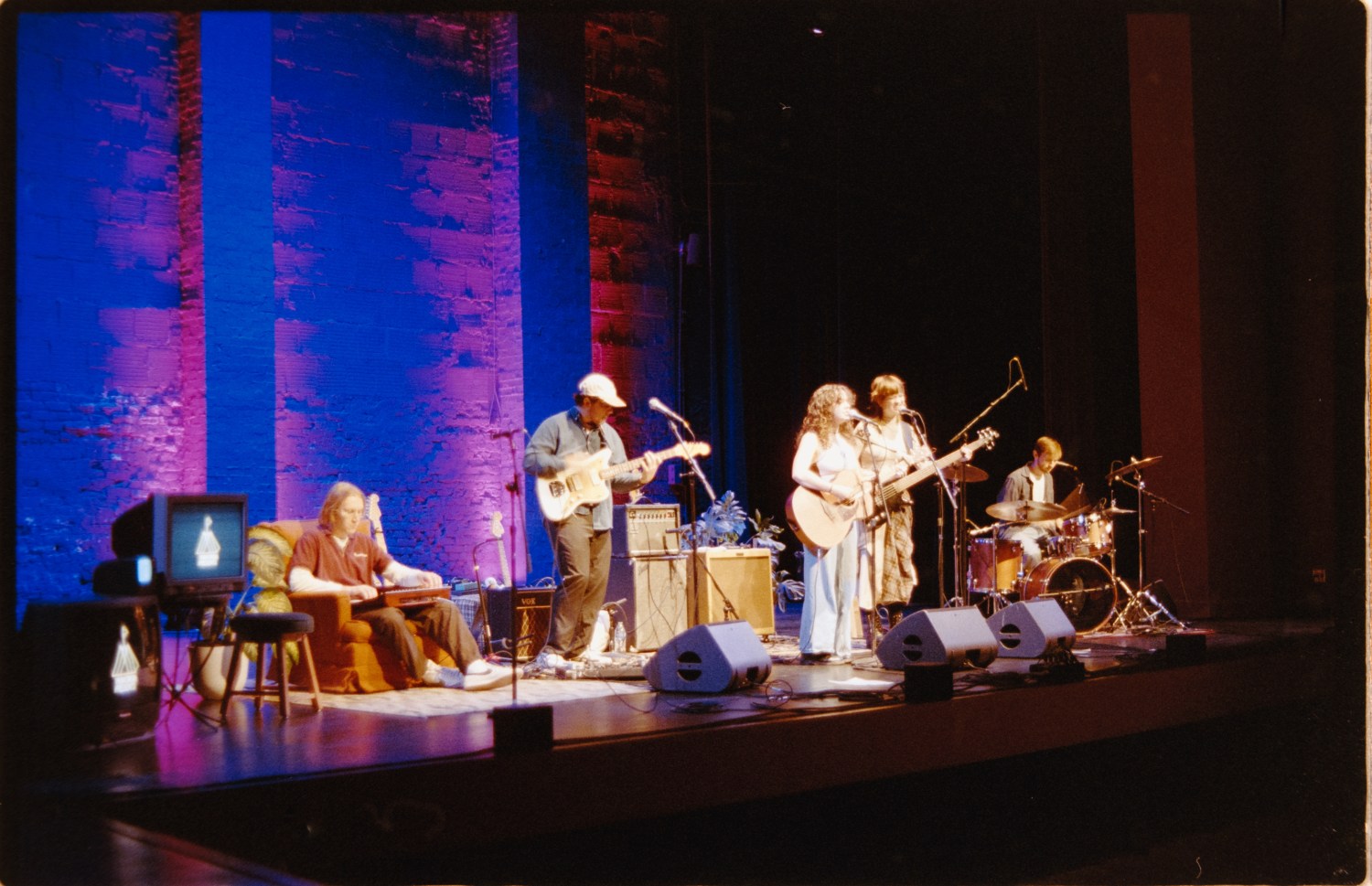
As I was working on a college radio playlist series for my radio station, I received an email about a band in the IU area. I plugged into the band’s music as I was leaving my home in Indiana. While the EP was a sweet three songs, it encapsulated so much more. Named Slug Rug, the band consists of sibling duo Audrey & Keegan Priest. I shared their experience of growing up in Indiana and got to pick their brain on their latest self-titled EP Slug Rug. Enjoy the conversation the three of us had on-air at UCLA Radio below!
This interview was conducted by Chloe Gonzales (DJ Adderall Spritz) in studio at SoCal college radio and has been edited for length and clarity.
Chloe Gonzales: Introduce yourselves!
Audrey Priest: I’m Audrey! I sing, write songs, and play rhythm guitar.
Keegan Priest: I’m Keegan, Audrey’s brother. I play guitar, we write songs together and do some production.
CG: Thanks so much for coming on UCLA Radio and ugly hug! Are you guys in Bloomington right now?
AP: Yeah!
KP: Right now, we’re on our first little tour, we went to Michigan and then Chicago, played a hometown one in Bloomington on Saturday, and we’ve got one last show tonight. People have class today, so we’re working around everybody’s school schedule at the moment.
CG: That’s an aspect about a college band. I’m glad you mentioned the tour because I was going to dive right into that. You guys have recently been going on tour in the Midwest for your newest EP, Slug Rug. How has that experience been, especially as a self-supported duo?
AP: It’s been awesome! The shows that we’ve played so far have probably been my favorite shows that we’ve ever played. And I think part of that is because we’ve never really gotten to play so many shows so close together, which we can really feel the progress of us getting better every night and being more comfortable as a band. It’s definitely been a little tricky. We don’t have a van or anything so doing shows with six people and traveling with everybody is hard, but really fun.
KP: It’s felt like one super long sleepover, which I can imagine if you’re doing it for six months at a time, by then end, it can be pretty excruciating. We all feel pretty tired already but it’s great to go to new places and meet people who’ve never heard of our music each night. A cool way to meet people in real life.
CG: It must be nice having an audience listening that doesn’t know your stuff like tapping their feet or something and be like, “Wait, this is kind of good. These cats are cooking!” That must be satisfying.
KP: We love playing in Bloomington with all of our friends, and all the people that are most important to us are here. But we play 13-14 shows a year here and eventually the same people are coming every time. So it’s great to have new people listen to us and get that in-person feedback.
CG: And you’ve been playing alongside other bands. Have there been any memorable moments with them?
AP: The first show we played with a band, Racoma, which was really fun, just because it was kind of hard. It’s been a long time in the making and a Bloomington show fell through. And so we were lucky that they asked us to play with them. That show is a really good encapsulation of how nice people were the whole weeknd. Racoma specifically were just so nice and everyone at the venue who put on the show were so nice. We had a lot of people come up to us after and were just so nice.
CG: And how did it feel like performing these newer songs live compared to recording them in the studio? Did playing them in front of an audience change the meaning or energy of the song?
KP: I think what’s interesting about the three songs that are on this EP is me and Audrey were a studio project for a really long time. It was mostly us writing songs together on a computer. I go to school at IU, particularly the music school, so I met a lot of audio engineers and a lot of them became band members and frequent collaborators. But these three songs were songs that weren’t just Audrey and I sitting down at the computer and writing. We played them live for a year before we started recording them, which I think really shows in the arrangement. And so at this point, I think we’re ready to move on. Honestly, we’ll probably play some of them for a pretty long time, but we’ve already got a lot of new songs written. It’s been fun to play the new stuff and it’s fun for people to know whatever the “old stuff” is because people in Bloomington have been hearing it for around a year.
CG: That’s nice that you’re in the music school, to be able to be surrounded by people who can help you out and foster those connections!
KP: I don’t think our project could exist the way it does without a lot of people who are multi-disciplined, whether that’s in different instruments or production or audio engineering, because all of that stuff is really important to us. And I think a lot of our members who play with us in the live band and who play on the record, they all have their own studio projects too. So it’s like a universe now. We’re playing on each other’s stuff and influencing each other’s stuff. I think this record in particular is a beautiful amalgamation of all that.
CG: You guys have like a little scene going on there. It’s like the Asheville scene of MJ Lenderman playing with Indigo De Souza and then him doing his solo stuff and also then playing for Wednesday. And they’re all kind of coming up together. I wonder and hope that will manifest for you guys.
AP: That’s exactly what we were talking about on the way to Chicago. I was talking about that with Ethan, our drummer, and Ella, who’s been touring with us this weekend, about how those are some of our biggest influences. And just talking about how special it is to have that, having a community like that in general. I think it’s really special.
CG: Having that community, does it ever feel like you can bounce ideas off of each other? And if so, does it ever feel like an echo chamber of the same things?
KP: I think we are all interested in similar genres of music. Audrey and I like to say that there’s a good level of friendly competition and I think that just really pushes us to just go that one inch forward. It’s been a positive reinforcement most of the time.
CG: Before we dive into your EP, I wanted to talk about you guys being independent. As independent artists and especially as college students, how do you navigate all of these roles of marketing, managing, et cetera?
AP: Keegan is really good at organizing everything!
KP: I think it can be really tough. There are certain weeks where I have school coming up and most of the time, to me, Slug Rug takes precedence, like it has to get done. I really enjoy the booking and marketing and making everything as cohesive as possible. Both Audrey and I grew up both obsessed with records and how they come out. I also worked at the radio station here for four years, WIUX, and I think I’ve learned a lot about booking and event planning and just general promotion. I’ve thrown a bunch of gigs in my life and being the booker and then being the bookie, I think I’m able to understand both sides of the process. And so I think it’s going to be a while until I give up.
CG: Very hard-headed, I like that. It’s very tiring but rewarding.
AP: Not that we’re even anywhere near that level of having someone be able to book for us. But if that were ever the case, the thought of someone booking a tour for you and telling you this is where you’re going on this date sounds kind of scary to me.
CG: Oh yeah, having that control previously and then giving that up, it can be scary. What has been the biggest challenge about being self managed? And what has been the most rewarding part?
AP: I think something hard about being self managed, maybe just being any kind of band or musician in this day and age, is that there’s just so much access now to the internet for everyone, which I think is the best thing in the world. Everyone can make music, consume music, and everything’s on streaming but it’s also one of the worst things in the world if that’s something you want to make your living in. Just because there’s so much out there, I think it’s really hard to find something or put yourself out there for people to find.
KP: I also think when you’re self managed, a lot of the times you get an agent or something. And the benefits of having one is that you’re co-opting a bunch of connections. And I think when you’re self managed, every single interview, every single band you play with, you have to be forming that connection. Your network is only going to get bigger if you work on it. Even getting this interview, a lot of the time you have to spend shooting shots in the dark and the ones that worked out are the things that end up helping you in the future. It’s a numbers game.
CG: Having connections is the biggest thing. It doesn’t even matter if you’re qualified, if you know someone you can get your foot in the door.
KP: Don’t mean to make it seem like we don’t care about the music, because that’s obviously the most important thing. But we can try our hardest, we can put everything into this, but at the end of the day, a lot of hard work comes in the before and after the fact.
CG: 1,000%. I also wanted to delve into your EP. It’s a three piece: “Lighter Fluid,” “Oh Man!,” and “Teenage Symphony.” I enjoy all the names of the songs, they’re very fun. Before we break them down, can you describe each in three words and give them a color?
KP: Lighter Fluid – Epic, progression, bite – Pastel yellow
AP: Oh Man! – Growing up sad – Maroon
KP & AP: Teenage Symphony – Spring, lush, encapsulating – Bright blue
CG: Random, but do you guys have a color scheme for Slug Rug? Is it green?
AP: It kind of turned into green, yeah!
KP: I think that’s what just happened? And I think Audrey and I are both interested in nature and stuff. I think nature definitely plays a role in our aesthetic and our sound. So I think by proxy it’s going to be green.
CG: Go green!! Let’s dive into these songs, first off “Lighter Fluid” – how did you guys conceptualize it? What’s the story behind it?
KP: I’m really interested in this movement in Manchester called Madchester with artists like Happy Monday and The Stone Roses, it’s just like a blend between alternative rock music and dance music. And I think the demo in different stages of it is more Madchester than others, but I was interested in the conception of the song. Like how can we make a dance song but still have it be explosive and powerful? And I think it’s a thing we utilize, a songwriting tool we utilize on all three songs, which is we just jam a lot. I think that’s a by proxy thing of really enjoying playing live with each other – we have extended instrumentals and jam sessions, so the breakdown at the end of “Lighter Fluid,” I think that’s one of our favorite things we’ve ever done.
CG: “Oh Man!”?
AP: I’d say this was our first band song. I wrote it during winter break our freshman year and sent it to Keegan and the whole band. And we were like “If anyone wants to think of parts for this, we can maybe play it live!” And we had rehearsal, and everyone was like, “Yeah we can try it out and play it live. We already played this together,” and we were like, “Wow, this is awesome!” So it was probably the first song I’d written with a band in mind. I mean with our last EP, like Keegan said it was totally a studio thing. Obviously we wanted to play it live, but we’ve only done a couple of live shows as a band in the years prior. I definitely wanted it to be a big wall of sound type song, which I think is what it ended up being.
CG: “Teenage Symphony”?
KP: So I think naming is an interesting part of our process, because I think we derive a lot of enjoyment in naming, but I don’t know if we can sit down and explain our process. I think a lot of the time it feels right, even if the song, like the actual word, has no association with the song or how it’s written. I just think that the way words sound or how they look are just as important as their meaning. And we just think it’s fun to name things, but I’m always curious about how Brian Wilson went crazy after Sergeant Pepper. If you know about The Beach Boys, he ended up working on the Smile album, and the Smile Sessions ended up coming out later. And I was just obsessed with the quote about how he’s making a teenage symphony to God. It’s just really interesting that a grown man is making a piece of art that’s supposed to be transcendent, or like it makes you feel like a teenager. And this was a bit on the nose, but one of my favorite songs ever is “Teenage Riot” by Sonic youth. So it was teenage to those two things, and I thought it would have been on the nose to stylize it like teen space underscore age symphony. SO we ended up just going with “Teenage Symphony.” But I think that’s a cool anecdote in a way that we think about naming in general.
AP: And I like this song so much, because usually we write a song and name it or Keegan shows me instrumental and I write melodies. But this song, Keegan made the instrumental and I was like, “I really want to name it this.” So with that name in mind I tried to think of a scenario that made something that was really formative or important to me when I was in high school, when I was a teenager.
CG: I love that so much. The backstory for that one, that’s sick. In general, does the songwriting come first or do you work on the instrumentals and then it comes to you through there?
AP: I think the best thing about Keegan and I is that it’s equally both. I think on these three songs, it was really 50/50 mix of sometimes I write a song completely and its guitar and me singing, and then Keegan will add literally everything else, the band will add parts. Or sometimes Keegan will come up with an instrumental and I add melody, lyrics, and maybe a couple of new parts.
CG: That’s beautiful. Do you think you have some sort of sibling telepathy?
KP: I think it’s a nature versus nurture thing. I think we were raised by the same two people and grew up in very similar environments and had very similar entries, that I think other people don’t understand my aesthetic the way Audrey does. I think we’re all kind of homogenizing that way. But I still think that Audrey, in this case, understands my intention for a certain part more than most people would.
AP: I also think Keegan is more detail oriented and I’m really big picture indeed which I think makes a lot of sense. I’m more of the song as the whole, writing out song structure and melody, and Keegan is better at adding the parts, hence why he’s also an audio engineer.
CG: That’s super cool. I also wanted to dive into the inspiration picks that you guys have been listening to during this era. Keegan I see that you have Kero Kero Bonito back there [in your room].
KP: I can talk about her, especially that album I think I put “Visiting Hours” on that playlist. I really like it because it’s so video game influenced, and playing video games growing up is very important to me. I think that they do a good job where you’re taking these nostalgic instruments and tonalities, and especially on that album, it’s practically a noise pop album. There’s awesome electric guitar layers and solos. Some of the songs at the end of the album are just static and also simultaneously very twee. Audrey and I love different variations of twee or pop music with light girl vocalists. I don’t know if it’s a direct influence but for both Audrey and I we like the way the album sounds, where it’s fusing electric guitars with synthesizers.
CG: I know you guys also put on George Clanton, which is popular here at UCLA Radio.
KP: George is making these super 90s influenced walls of sound with electronic instruments but doing it with a dance flair. Him and Hatchie, and a band called Wishy, they all do a very niche sub genre of 90s music that we really love.
CG: We also love Wishy here, oh my gosh.
AP: They’re from Indianapolis!
KP: Which is where Audrey and I grew up.
CG: Speaking of Indiana, since you guys are from there, has that influenced your songwriting at all? Just the experience of growing up there?
AP: We were lucky to get good concerts there, but I didn’t really know of a great music scene in Indianapolis.
KP: I think there’s something beautiful about living in the Midwest and the Internet age. I think if we grew up in NYC, Chicago, or LA, we might have become part of scenes a lot earlier in our lives. But I think being in the Midwest and being with people who like cool things, I think that spawned interesting cool things, but really not having a scene. I think it turned me especially more towards the internet, where I was able to find totally different types of music than people around me.
CG: Nice! Last question, shout out WIUX, but here at college radio people who have shows on the air have DJ names. What would y’all’s DJ names be?
AP: This is good because Keegan is a DJ.
KP: Both Audrey and I have had shows on WIUX. I like DJ Superstar right now.
AP: Oh I see, last I heard it was DJ Keegan. I don’t have mine but my radio show name is called Fork and Plate and I do it with my roommate and we say that she’s fork and I’m plate. So I’m going to say DJ Plate.
You can listen to Slug Rug’s self-titled EP out everywhere now!
Interview by Chloe Gonzales | Featured Photos Courtesy of Sug Rug

 the ugly hug