As a small music journal, we rely heavily on the work of independent tape labels to discover and share the incredible artists that we have dedicated this site to. Whether through press lists, recommendations, artist connections, social media support or supplying physicals, these homemade labels are the often unsung heroes of the industry. Today, the ugly hug is highlighting the work of our friends over at Bud Tapes.
Bud Tapes is a tape label out of Portland, Oregon, started in 2017 by Emmet Martin, who also leads the free music project Water Shrews and previously the indie project World Record Winner. What began as happenstance for Emmet to release their own music has since grown into a small but mighty collection of recordings from an eclectic roster of artists.
Bud Tapes has become a staple in the Portland DIY music scene- a home for anyone making music for nothing more than the love of making music. The label’s releases are often imperfect in the best way—rough around the edges, experimental, and full of character. Each tape is a little snapshot of someone’s creative journey, and you never really know what you’re going to get with each new release, which is part of the fun.
Bud Tapes is about embracing the weird, and off-beat while still keeping it personal. It’s a label that values the physical side of music—putting the project into your hands in the form of a personalized tape, something you can hold, pop into a deck, and experience over and over again. Whether it’s something from Emmet’s own Water Shrews or another unexpected gem, Bud Tapes is all about capturing music in its purest, most direct form.
This interview has been edited for length and clarity

KC: What sparked the idea to start a tape label? Was there a particular moment or inspiration that made you take the leap?
EM: Well, I’d always kind of wanted to start a record label, but I thought that you had to do something special to start one like you had to be someone or whatever. I had this record I’d been working on for a while, and I was starting a new band called World Record Winner. I was friends with a lot of people who were signed to labels at the time—people I knew who were kind of popping off—and they said, ‘You should send your record around to places.’ So I did, and everyone either ghosted me or rejected me.
Then I got this one email from Off Tempo, which is a label in Seattle. They put out a lot of stuff that’s kind of indie-adjacent, and it’s run by someone from Slashed Tires, which was a cool project. I was more tapped into the Seattle scene because that’s where I’m from originally. So, I emailed them asking, ‘Do you want to put out my record?’ and they said ‘this is just like a thing we stamp on our friends record’s so we can put it out’ I mean, they phrase it less like that, but that was the gist’.
Basically, they said, ‘You’re at the level where you should just put this out yourself. Make a fake name for your label and release it.’ I was like, ‘Oh, shit, you can just do that?’ So I did. That was kind of the impetus for it—putting out my record when no one else wanted to. And that’s pretty much the case for most people starting labels. They’d rather work with someone else than do it themselves, but in the end, you realize you kind of have to do it yourself. And you find all the joys that come with doing it yourself.
KC: Can you share the story behind the name of the label?
EM: I have a pin that I made at a Cool American show—which is Nathan Tucker’s project, you probably know him- he has so many projects. His partner, Georgia, had a button-making station, and I was in college and I was really stoned and I just wrote ‘bud’ with a little smiley face on a piece of paper and got it pressed into a button. I had it on my fleece all the time for like two years. Then I was like, ‘Oh, that’d be a very fun name for a record label or whatever.’ But it was way after I had made it. So that was also kind of an impetus—it was a fun, weird name that I had in the back of my head for a while.”
KC: Do you have any collaborators that help you run the label, and if so, how does that shape the way the label runs?
EM: I’ve always thought it could be fun to get people involved, but I just don’t know how. I can’t pay people to work and I feel bad asking people to do unpaid labor. So, I just do everything myself. I’ll have help duplicating tapes every now and then for bigger projects, like Greg Freeman’s album or Lily Seabird’s album. But everything else is just me for the most part.

KC: Who was the first artist you worked with and how did that come to be?
EM: Technically, it was just me at first, but I did one release for my friend Isabel. It wasn’t really a ‘real’ thing—she didn’t even want to put out the tape. I kind of made her, since we’d done these recordings together. Anyway, shoutout to Isabel. You can find it on the Bud Bandcamp. We got one write-up on a zine, and it’s a really good tape. She wouldn’t let me put all the songs on it, though, even though there are more that are great.
The first ‘real’ release I did for someone else was from a band called Flipchuck, which is my friend Addie’s band with my friends Leanna and Nikhil, who I went to college with. Right before COVID hit, I was at a show for my friend Jesse’s band, Happy Dagger, and Addie was there. We started chatting, and she had become closer with a lot of my friends, so I was seeing her around more. I asked her what was going on with Flipchuck. She said they were finishing something but weren’t sure if they’d put it out or just post it online. I told her, ‘Well, I’ve got this fake label, and I can make you a few tapes. I’ll give you a couple for free, and I can sell the rest online to pay myself back.’ She was like, ‘Wait, you have a label?’
So we made plans to release a tape in April 2020 and do a release show at my house since I was hosting house shows. Obviously, that didn’t happen because, well, 2020. But I ended up creating an Instagram for Bud and we released the tape in April or May. Since everyone was bored, I started doing live streams on the Bud Instagram, and that’s kind of how we ended up doing the Flipchuck release show.
That was the first time I worked with a ‘real’ band, and it went great. It helped people start to notice what we were doing. It’s a really cool tape, definitely worth listening to.
KC: How do you find the artists you work with? Is there a special connection or vibe you look for?
EM: Those live streams I did on the Bud page started with a group chat I created to schedule them and share the lineup. After each stream, I’d say, ‘Anyone in here can send me music, and I’ll put it out.’ It was kind of like, ‘You’re all my friends, and if you’ve got something, send it to me.’ A lot of people had records they’d been sitting on, waiting for the ‘right time.’ But then we were all stuck inside, and there was no ‘right time’ anymore. So, we just decided to put out music now that we had the time to do it.
That’s how I got a bunch of releases, like the first Babytooth album. Isabel played solo for one of those live streams, and that kind of kickstarted things. Now, people send me stuff randomly, but it’s also a lot of me hounding people, asking, ‘When can you finish that record and send it to me?’ So, it’s a mix of people sending me stuff they’ve been working on and me chasing them down.
I think, for the most part, I’ve always gone for the vibe or the ‘atmo’—I learned that term recently and I’m trying to use it more. It’s an alternative to vibe, you know, atmosphere.
KC: Oh I love that. ‘Vibe’ is so over.
EM: ‘Vibe’ is so overused, but it’s kind of like people who would be doing this regardless of whether there’s an audience or not. I’m usually trying to put out stuff where the artist would be making this music whether or not anyone’s listening.
It’s kind of a true folk approach, like folk music in the traditional sense—music that’s not commercially minded and not trying to fit into any particular scene or chase what’s hot at the moment. It’s really a cultural, community-based way of making music. So I’m usually trying to work with people who are in that realm.
Sometimes, I don’t do that and I put out records that are really good and I know the artist is trying to ‘make it’ or whatever. But for the most part, the artists I seek out and think, ‘Yes, this is something that should be on Bud tapes,’ are people making weird stuff that barely anyone listens to—but I’m like “this shit is fucking awesome”, I’ll make twelve tapes of it.

KC: What’s it like bringing a tape from concept to reality?
EM: When I started out, and still for most of my releases, I do everything myself. For the ones that are more high profile, which rarely happens, it’s different, but for the ones I’m doing from home, it goes like this: someone will make the artwork, and I either adapt it into a J-card or they’ll make one themselves. The artwork is usually square, but I have to adjust it so it fits into a rectangle for the front, and then leave space for the spine and side.
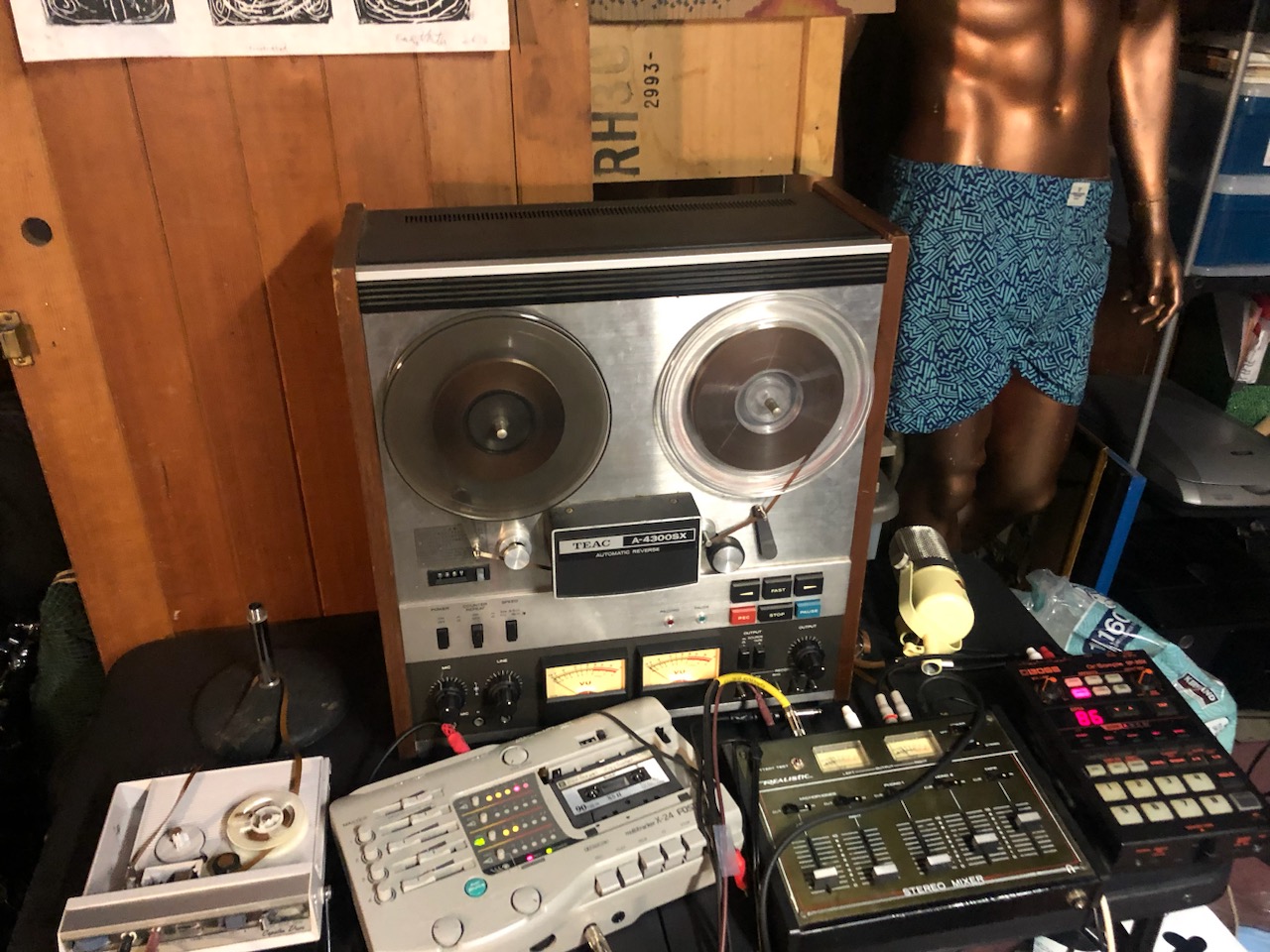
Once that’s done, the artist sends me all the master tracks. If I’m doing it at home, I’ll dub one tape onto my stereo, and then use that tape to duplicate others. I usually have a couple of high-speed double-deck stereo units, so I can put two tapes in at once, and just run them back and forth, hitting high-speed dub.
It’s about twice the speed of the album length, so if the album is 40 minutes, it takes about 20 minutes per tape. I’ll just hang out, watching TV with my partner, while she listens to the whirring of the tape wheels. It’s a specific sound.
Most of the time, I’m just sitting there with my cat on my lap, dubbing tapes and smoking weed. It’s not a bad setup.”
KC: Okay, I love all the band names. You have a good roster.
EM: There’s so many of them, like I’ve honestly done too much [laughs].
It can take a while just to get people to understand what it’s going to look like. We need time to send emails, get everything right, and make sure it’s all set up. It’s mostly about setting people up for when the release is actually coming out and what’s going to fall on the schedule.
But mostly, once I make the tapes, I’ve been trying to announce the release afterward. I’ve done too many times where I announce the release before I’ve made the tapes, and then I’m scrambling last minute trying to get everything done. So I’m trying to give myself more time to get everything ready before announcing.
It’s usually just about making the tapes, making sure the art is ready, maybe planning a release show, and that kind of thing. But honestly, it’s not a lot. I feel like a lot of labels have big rollouts, but for me, it’s not like that. It’s not like I’m doing vinyl or anything, and for the most part, I’m doing stuff that I know will sell a small number of copies—usually no more than 50. So it’s not like I’m ever going to be down and out or anything.
It’s really just about making the tapes and then trying to sell them.
KC: And you taught yourself how to do it all?
EM: Yeah, I had a duplicator I used to use, and it was super janky. Then I bought others, and they were even more janky. My poor partner, Bailey, saw me ripping my hair out, freaking out at these failing machines and trying to replace belts in them.
But it’s always just been me doing it. I eventually figured out a way that works with thrifted double tape decks. They usually make a pretty good copy, and I check every ten copies to make sure they’re okay.
KC: Are there any parts of the process you particularly love—or find challenging?
EM: Oh, I really like just sitting and dubbing the tapes, especially the master tapes. I listen to every record before agreeing to put it out, but then there’s this moment when I go to dub the master tape, and I think, ‘Oh, fuck, I’m stoked to put this out’’ That moment is always really good—like, okay, I’ve got to make these tapes, this is real, I’m dubbing the master tape, this is happening. It’s when I listen to it most in-depth that I get really excited about it.
As for challenges, it’s not so much the process itself, but the hardest part is saying no to people, in any way. Even if I’m putting out their release, and I have to say, ‘I can’t do this right now,’ that’s really difficult for me. But it’s the reality of it. People have all kinds of expectations about what it looks like to put a release out on a record label and setting expectations is hard.”
KC: Can you tell me about the Cosmic Bud series? Where did you get the idea and how do you put each series together?
EM: It was kind of a thing that I failed to do. Initially putting out experimental music seemed so different from Bud that I thought I had to create a separate imprint for it. So, I did a series of three CDs, mostly with experimental stuff happening in Portland—my friend Josh’s band Modern Folk, my friend Matthew Peppitone, and my friends Our Blue Heaven. I did CDs for each of them, like a batch deal.
I don’t know, it just felt weird to keep it separate, and people were confused about what that even meant. Eventually, I just thought, ‘Whatever, Bud is just me, I can do whatever I want.’ So now everything is just under Bud. That was kind of a failed experiment in trying to create something separate for experimental music, like a little imprint. But I realized I could just put everything under Bud, you know? It’s all going to be on the same Bandcamp page anyway.

KC: You’ve done a few reissues or revitalized releases, the Spiral Joy Band that was just announced and the Clovver EP for example. Why are you drawn to this form of preservation and why do you think it is important?
EM: The ones I’ve done have mostly been projects people have asked me to work on, like the Clovver EP, which was super meaningful to me. That was a band I saw a lot back in the day, and the drummer passed away pretty unexpectedly. The singer is my friend Teal, along with my friend Elian. Most of them are in Pileup now—Elian and Grey both play in that band.
Clovver would always play, and it was super cool. The drummer, Andrew, was also in my friend Aaron’s band, Two Moons—I can’t even remember how many projects Aaron’s had over the years. He put out Balloon Club and a bunch of other things. And he also played in Clovver!! Anyway, I would see Clovver all the time, and I’d heard about a record of theirs they were working on. It never came out, so we ended up mixing it years later, after Andrew passed away. It was more of an archival thing.
It was really cool to put that out, but the hardest part about those kinds of releases is that there’s no active band to promote it. So, it’s out there, and I try to sell the tapes, but there’s not much context for it. If you have a media guy, they can lay out the story of how it was made, but I didn’t really know how to do that at the time.
Now, I’m doing a reissue for a band called Spiral Joy, which is a weirdo drone band originally from Virginia, then Wisconsin, and now Texas. I’m reissuing one of their really great records, mostly because I’m also putting out a new release from them. They reached out, saying they had an LP from a European label that only pressed a few copies, and now people have been asking for it. The shipping is so expensive that it’s hard to get it to people. So, they asked if I’d consider doing a US CD reissue to make it more accessible. I thought that sounded great, and it’s perfect because it ties into the new release I’m also putting out, so I can plug both at once.
I also really admire a lot of reissue labels, especially in Portland. Concentric Circles is a classic one. Jed, who’s been in bands like Helen (Liz Harris from Grouper’s band), plays drums in that and has also played in Jackie-O Motherfucker and other great bands. He runs Concentric Circles and also co-runs Freedom To Spend, a reissue label that does incredible archival work, digging through people’s families’ archives and finding amazing stuff. That’s the kind of work I’d love to get into, but I’m not sure how to go about it. Maybe one day I’ll figure it out, but I’ve already done a few reissues, so I’ve kind of broken the seal. I guess I could expand on that in the future.

KC: How long has Bud Tapes been around?
EM: I started in 2017 and did three releases over three years. Then in 2020, things really took off, and I ended up doing around 20 releases a year.
KC: What keeps you going and excited about what you do, especially on the challenging days?
EM: There are certain things that just happen, like this Spiral Joy Band release, which is really crazy. It features former members of a band called Pelt, who are the reason I got into weird, experimental music and drone music in the first place. They started in the mid-’90s and have been around a long time. One of the original members passed away, but they’ve kept going. Spiral Joy Band is an offshoot of that, and they’ve been releasing a lot in recent years.
I met my friend Rob Vaughn, who runs a label called Sound-O-Mat. He doesn’t put out a lot—just a few 7”s and CDs—but he’s been around for a long time and has worked with Pelt a lot as a sound engineer. When he found out I had a label, he said, “We should hook you up with Michael and do a Spiral Joy Band release.” I was like, “Yes, I do have a label, it’s real, whatever!” That kind of thing keeps me going—the fact that I can say, “I have this label,” and it connects me to more opportunities like that.
Now I’m kind of connecting it more with the Water Shrews world. I used to keep things separate because, with experimental music, people can be judgmental. I didn’t want people to look at it and think Water Shrews was some experimental project, or that we don’t get it. But I’m way more into that world now. I used to play in kind of indie rock, twee bands for a long time, with the whole “heart on your sleeve” thing. But now I’m just like, whatever—I don’t care what people think. I’m putting out stuff that I think fits within the same world I’ve created with Water Shrews, which is really exciting.
When I finally started following people on the Bud Instagram, I never follow anyone unless they follow me first, but I decided to follow all of my weirdo friends. And my friend Al, and a few others, were like, “What the fuck? How did I not know about this? This is so cool!” It was really exciting to see people so stoked on it. It’s a great way to make connections. You get to put on this weird hat like ‘I’m a label, I put out these records, and I could put out your record if you want’.
The Shrews hat is a little different, it’s a little more weird, and less thought-out. It’s like my “freak flag” hat.
KC: Can you share a few personal favorite releases or projects that you’ve worked on and tell us a little bit about them? Whether it’s because you learned something new, the process was enjoyable or you just like the music.
I love Shelter Music. They’re a group of folks who’ve played in a bunch of famous indie rock bands—kind of a supergroup. It’s Travis, who’s the lead of Naomi Punk, my friend Max Nordile (who’s played in a million bands in Seattle, the Bay Area, and New York), Dave, who plays bass in Milk Music (now Mystic 100s), and Steve, who played in Trans FX, a big band in Olympia for a while. Then there’s Anton, who played in Gun Outfit and a bunch of other bands. They’ve all been in so many different groups, but now they play together in Shelter Music, and it’s just this weird, free-form craziness. I always struggle to explain it, but it’s generally free music. They do a bit of hallucinogens and just make music in a park shelter in Olympia that has an outlet, which is why they’re called Shelter Music.
They started as a gathering where they would just hang out, meditate, and play. Max joined later—Max is funny because he’s totally not new agey at all, but some of the others are a little into that vibe. They’re cool about it, though. I recently learned the term SNAG, which stands for Sensitive New Age Guy, and they’re definitely SNAGs in the best possible way. It’s not the kind of weird New Agey stuff where people are trying to sell you things. These people are total SNAGs in the best way possible.
I’m super stoked on the Shelter Music CD I did called Live in a Tree. It’s a 50-minute long jam they did at an art swap in Olympia. I sat in with them before, which was both super exciting and nerve-wracking.
The Greg Freeman album was another huge deal for me. My friend Garrett Linck, who now plays in the band, had seen Greg Freeman’s band at a festival in Burlington. He was totally blown away, texting all of us, like, “You gotta hear this!”. He told me about the song Tower, which was the only song Greg had released at the time. I thought, “Wow, this is really cool.”
I don’t know how, but Greg ended up sending me his record directly—not through Garrett, because they hadn’t connected yet. I think Will from 22 Degree Halo might have helped connect us. Will ran a label called Sleeper Records, and he sometimes refers people to Bud Tapes when they reach out to him, saying things like, “I don’t do this anymore, but try Bud Tapes.” Greg has never confirmed that, but somehow, the record ended up in my inbox.
I was in New Mexico visiting my partner’s friends when I got the email. Normally, I wouldn’t respond to emails like that while traveling, but I was like, “Wait, this is Greg Freeman’s record!” So I wrote back immediately, saying, “Yes, this record is incredible. My friend Garrett told me about you when he saw you at the festival. I’d love to put this out.” Greg was down, and we set up a phone call to talk.
I always say to people who like Greg Freeman’s music: “He’s gunna be huge. Someone’s going to figure out how good his stuff is.” I’ll always tell people, “I’m happy to be the worst case. If nothing else works out, I’ll make a hundred tapes and we’ll make it happen.” Greg had sent his record to a bunch of places, kind of like I had done with my own stuff.
When Greg said he was waiting to hear back from a few places, I told him, “If something works out and you get a better offer, great! But if not, 100% I’ll put it out.” So that was a huge deal for me. It was the first record I put out where I didn’t know the artist personally, and it wasn’t like building a community type thing at first—but it eventually did.
It was so amazing to see Greg play in Portland and to see so many people come out to support him. It was like everyone I knew who had been involved with the label at some point came out, and it was just such a cool moment. People were so stoked, and it felt so good to see that support.

KC: For those who are looking to start their own tape label, what advice do you have for them?
EM: Just do it. You don’t have to have a big plan or be anyone special—just make a label. Set up a Bandcamp or Big Cartel, or start making tapes and give them to your friends. Then you have a label. Or CDs, or USB sticks with your album on it, or put stuff on streaming. Anyone can do it. It’s just about deciding that you want to do it.
KC: Is there anything you wish you knew before you started?
EM: I started when I was really low on money, so it’s been a bit of trial and error. But it’s all been fun figuring it out along the way. A lot of people go into something like this with a big plan, but I’m just happy that I’ve figured it out as I go. I’ve never been a perfectionist. If you ever get one of my tapes, you’ll see what I mean. This one’s actually a pretty good example, but usually they’re a bit stamped off-center or a little messy. I’ve never worried about making everything perfect.
The magic of doing anything creative is in the process that gets you to that point. Without failing and messing things up—like when your tape players aren’t working or you realize the stamp’s not sticking—the point is it’s a real person making tapes and trying to build community. It’s about being a person, making something, and trying to build a community. You don’t get that by planning everything out with a big team behind you. It’s just a real thing and I think people pick up on that. I’m not trying to be anyone or get anything out of this. I just want to connect with like-minded people and put out cool records. That’s what it’s about for me.
KC: Where are all of your releases out of?
EM: It’s mostly local stuff, but there are a few random releases here and there. Like, I did a couple from this group called Amigos Imaginarios, which is made up of this guy, Caleb who lives in Worcester, Massachusetts, and someone named Arbol, who now lives in France. That was actually a random submission, but it worked out.
Another release I did was for my friend Gabe, who lives in Chicago now but was the bassist in my high school band in Seattle. I did an ambient tape for him a while back. He went on to study sound design at the Art Institute of Chicago and now works in that field. He was in that program with Lula Asplund, who’s now a drone queen in the scene. She’s really popped up recently.
But yeah, most of the stuff is local, with the occasional random submission from other places.
KC: What’s on the horizon for Bud Tapes?
Yeah, there’s always a lot on the schedule. Right now, I don’t have a ton coming out, but I have three releases ready to go. There are also some long-awaited projects that will come out sometime next year. One of them is my friend Garrett Linck’s record.
Garrett’s a great guy—he plays in Greg Freeman’s bands and he’s been an old friend of mine since college. He hasn’t really made his own music in years, except for a few EPs back in college. He’s been playing bass in Hello Shark too, but now he’s finally working on a solo record, something he’s been talking about for over two years. He keeps setting deadlines and then it doesn’t happen. Normally, I wouldn’t be so patient, but Garrett’s one of my oldest friends, and honestly, he’s the reason I do what I do. So I’m just waiting, I really hope this next year is the year we put it out.
There are a few other projects like that—people I’ve told, “Whenever you’re ready, I’ll put it out.” They can cash in that token whenever. Garrett’s record is especially close, though—it’s almost done, just needs a few finishing touches. I really hope it’s out next year. With Water Shrews, we just record everything and put out tapes when we have too much material.
Interview conducted and written by Kat Curey

Along with this series, our friends at Bud Tapes are offering a five tape bundle giveaway! The bundle will include Self-Titled (2023) by Canary Room, 5 New Songs of Half Shadow (2023) by Half Shadow, Alas (2024) by Lily Seabird, Waves of Higher Bodies (2024) Spiral Joy Band and Massive Leaning (2023) by layperson, as well as an ugly hug tote bag and sticker.
To enter the giveaway, follow these easy steps below!
- Follow both Bud Tapes and the ugly hug on Instagram
- Tag a music buddy
- Comment your favorite activity to do with your bud!
The winner will be picked next Friday December 20th and will be contacted through Instagram.
All of these releases can be found on the Bud Tapes bandcamp in limited quantities.

 the ugly hug