Not that long ago, New York was once a vibrant home for independent artists, musicians and creatives alike – all trying to find their place within a community of sustainability and support. With plenty of independent venues, promotors and journalists doing the hands-on work, the means to share your art were vast and obtainable. But over the years, the accesability to express yourself became more difficult, as corporations like Live Nation and Spotify cornered the market, show spaces and venues shut down and journalism became blocked behind paywalls, eventually leading to a large cultural and financial gap separating who is able to participate.
Temporary State University is a new non-profit organization that is dedicated to training the next generation of New Yorkers to throw their own cultural events. With an emphasis on educating and organizing through three workshops this fall, TSU will teach you how to plan, organize and execute a show in a fun, fair and safe way for all.
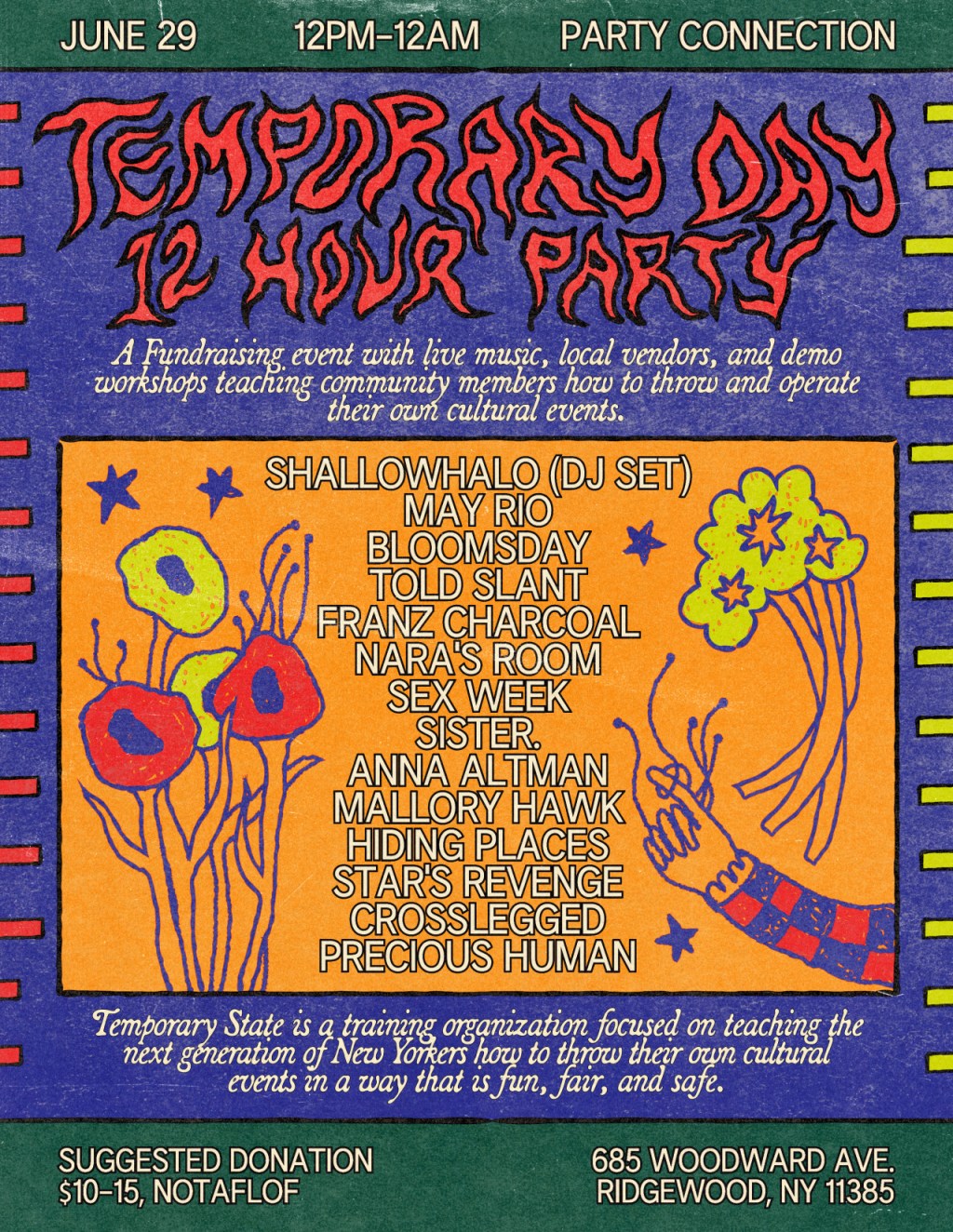
As they gear up for these workshops, TSU will be hosting the Temporary Day Party, their big fundraising drive this Saturday, June 29 in Ridgewood, NY. As an all day event, the Temporary Day Party will consist of a 12 hour, 15 act show of some of New York’s best musicians, a handful of local vendors, as well as a preview to the full workshops.
Jordan Michael is the founder and Director of TSU. Growing up in the show world, as well as once running the NY Showpaper, Jordan has witnessed a change of the recourses, accountability and access to safe spaces in New York over the years. With the help of Hannah Pruzinksky (GUNK, h. pruz, Sister.) and Ceci Sturman (GUNK, Sister.), TSU is building up their student body of new stakeholders and leaders to rebuild that once vibrant community.
We recently had a chat with Jordan to discuss the organization, talking about the needed public shift towards redefining a venue, sharing knowledge through workshops and the overall goal for Temporary State University in the NY community and beyond.
This conversation has been edited for length and clarity
Ugly Hug: Before we talk about this project, what is your background in the New York community and where did you get the idea to start TSU?
Jordan Michael: I grew up working doors and bar, booking shows, and sometimes doing sound at venues. I also had a bunch of sound equipment that I acquired and started renting out to people. I grew up in a very vibrant community of DIY spaces, independent promoters and bands that were homeless and just toured nationally. At the time, America had such a vibrant community of DIY venues and independent media that you could kind of just dedicate yourself to touring and playing shows in this network, creating a ladder that you could climb to build a career for yourself. Now that ladder, through a million different cuts, has fallen apart. And then the pandemic happened and it just felt like the long aging process brought out the natural death of the community I grew up in. When I started to see that there are these 23 year old kids who just moved to New York that have no connection to the community and who need the help – like the kids who want to do a DIY show under a bridge in industrial Queens – I want them to have a PA system to make it happen.
UH: You have been using a very unique social campaign that documents empty spaces with the words, “there can be a show here”. What is TSU’s approach to redefining these public places that wouldn’t typically be considered a venue?
JM: Public spaces are for the public and we are the public. A show is just a gathering of people in the same space, paying attention to the same thing. You can do that anywhere. When I saw the DIY community of our teens kind of die off, a lot of it was geared towards the closure of spaces and venues. I loved so many of those spaces, and it’s not that I don’t mourn their disappearance, but it highlights the fact that a lot of the problem is individual people with a lot of consolidated power. If bands email me because they don’t have a place to play, that’s a bad sign. You shouldn’t rely on somebody else to express yourself and you shouldn’t rely on small businesses to express yourself. I’m not against doing shows at venues, most shows happen in venues, but I intentionally want to get people out of the mentality that if something doesn’t happen at 8 P.M. at a bar then it can’t happen at all.
UH: The Temporary Day Party is going to be held at a place called Party Connection in Ridgewood, NY. What kind of space is that?
JM: In cities like New York where apartments are so small, there are a lot of places where you can rent out one of these halls as like a community living room. When planning this event I didn’t want to do it in a venue, I wanted to do it in a place that theoretically you could do a show in and show people how you take a place that isn’t a venue and turn it into one for the night.
UH: A 12 hour show is pretty epic, and I can only imagine the strategy and the energy that went into planning it. How did you approach such a task?
JM: I’m currently writing a whole zine about how you herd all the cats involved in a three person bill – I can’t even get into the logistics of doing it with a twelve hour show. You come up with a bunch of people you ask to play, you figure out when they can do it, you compile a list of all the different slots people can play, and then you just puzzle it together. You also just have to figure out what instruments people are going to play and the equipment you need. Then you announce it and hope people show up.
UH: You also plan to give a small preview of the workshops that TSU will be hosting this upcoming fall at the day party. What kinds of topics will the full workshops go over as you get people started and trained to host their own events?
JM: The workshops at the event will just give people a sense of what we are teaching and how we’re going to be teaching them. We will have a guest speaker that I will ask some questions and then the audience will have the chance to ask questions as well. But the full workshops are broken up into three sections. The first section is curating the show – when you have an idea for a show and you have all the bands, a venue and a date picked out. The second workshop is pre-production and promotion, which is getting ready for the show, making sure you have everything you need and you’re doing all of the things you need to do leading up. Then the final workshop is the day of the show, making sure nothing bad happens and dealing with something bad happening so it doesn’t become something horrible happening. We will also soon be releasing guidebooks on each subject that will be available on our website for free. It’s basically just a more condensed written version of what we’re going over at these workshops. They are meant to be picked up and read in one sitting to feel like you get a sense of what it is we are sharing.
UH: As you run these workshops in New York, what do you hope to see expand to other communities as you share these tutorials to the wide public?
JM: I have no ambition to expand whatsoever. I don’t even want to keep doing this project in a few years. The dream is total obsolescence. If this is just something that is common knowledge and people just know how to do it, then it doesn’t necessarily need to be taught to them. And if tons of different people are putting together different collectives to share resources to do shows, then this doesn’t need to exist and I can quit. That’s the dream.
You can find various ways in which to help TSU reach their goal here, including a monthly contribution, donating sound equipment or storage spaces and even professional insurance services. You can now pre-register for the official TSU workshops. Visit their website for more information.
Flyer design by Enne Goldstein

 the ugly hug