Every Wednesday, the ugly hug shares a playlist personally curated by an artist/band that we have been enjoying. This week we have a collection of songs put together by Nick Sullivan of the Brooklyn/Boston band, Joyer.
With the release of their new record Night Songs out this Friday, Joyer has spent a lot of time on the road. Just finishing up a leg of touring on the West Coast and a week at sxsw – while also preparing for a handful of album release shows in the next few weeks – the band has seen a lot of the country together.
In honor of the time spent in route, Nick curated a playlist of songs derived from their van’s growing CD collection. With a mix of celebrated rockers, charming deep cuts and demos, even some songs from their contemporary companions, this playlist is a reminiscence bump for a time filled with variety, uncertainty and comradery for a band doing what they love.
Every Friday, a staff member at the ugly hug curates a list of their five favorite new(ish) releases to share with us all. This week, our writer, photographer and “whine” snob, Manon Bushong, shares a list of heavy hitters and sweaty basement cathartics.
Forest – “Always Forever”
This song has been haunting me in the best possible way since the first time I heard it, and I urge anyone who also harbors a soft spot for a good scream to give it a listen. Forest’s frigid voice paired with compelling percussion and, of course, a series of sporadic shrieking in the latter half cements “Always Forever” as a must listen for anyone partial to the brusque nature of Babes in Toyland or eerie vocals of bands like julie and Double Virgo.
Interlay – “Lure”
Although Alexandria Ortgiesen could sing the Liberty Mutual jingle and I would without a doubt have it on repeat, I believe Interlay’s latest single is one of their best yet. The Chicago-based band has been a favorite of mine since the moment I heard Cicada; a powerhouse EP teeming with abrasive post-punk sounds and welcoming motifs of death and decay. With the release of “Lure”, Interlay reminds us not to put them in a box. The softness of Ortigiesen’s vocals, absence of the overbearing guitar of Cicada, and the song’s general melancholic nature pitches the band well into shoegaze territory. “Lure” evokes a resemblance to legends of the genre like Lush and Blonde Redhead without abandoning Interlay’s signature harrowing grunge feel.
MX LONELY – “Papercuts”
“Papercuts” is my favorite off of MX LONELY’s “SPIT”, an EP analogous to Wednesday’s “Rat Saw God” if you swapped the Asheville ethos and twang for heavy-gaze and Brooklyn grit. The lyrics recall a disturbing dream about killing a friend to end their paper-cut induced suffering, a morbid concept intensified by heavy guitar riffs and increasingly distressed vocals. Bonus points for a sinister 90s-esque music video.
Shitkid – “Dirty Guy”
Though Åsa Söderqvist technically retired from her solo project ShitKid in 2021, she recently spoiled us all with the release of an alternate studio version of her debut LP “Fish” (appropriately titled “Rejected Fish”). “Dirty Guy” is a previously withheld track that explores the innate desire and internal battle attached to pining after a person who’s bad for you. My favorite quality of ShitKid’s work that feels especially present in “Dirty Guy” is her ability to hone the perfect whiny vocal. An allegiance to the discographies of Bratmobile, Emily’s Sassy Lime, and Heavens to Betsy have made me a “whine” snob, but I can attest that ShitKid has mastered this eclectic craft in a way that’s both raw and euphonious.
Kim Gordon – “I’m A Man”
Though I applaud the entirety of Gordon’s new solo album, “I’m A Man” is the chilling lo-fi track of my dreams. Gordon is no stranger to critiquing masculinity, yet she is perpetually up to date in terms of content, delivery and sound. “I’m A Man” is a hysterical commentary on the way male toxicity manifests today, referencing painted nails and skirts as a means of absolving blame and singing from the perspective of a character who wants us all to know it’s NOT his fault he was born a man. Though it’s undoubtedly divergent from her prior work, the Sonic Youth co-founder’s distinctive droning vocal style layered over trap beats on this song could have easily catapulted Gordon into a career of SoundCloud virality or Brooklyn DJ niche fame.
Splattering hot oil from the fryer; burning and boiling, New Orleans based project, STEEF, have self released two new singles today, “Frozen in Place” and “That’s How I Feel”. Founded and fronted by Stevie Spring, these songs are acting one-offs for more STEEF material to come, as they shift their sound towards apocalypse energy, proving time and time again that if you can’t handle the heat, then get out of the kitchen – before it comes to life and destroys you.
During the pandemic, Spring had an urge to make the “perfect” pop record. But the word “perfect”, bearing weight in its undertones, became an obsessive; hyper fixated on critiques and changes to the point where music wasn’t fun for him anymore. Trashing it all and starting over lead to 2022’s, Post F, a sonically offbeat, stress free and notably fun record that brought out a new urge – to trust the gut. Spring knew that somehow, somewhere in the acidic lining of his stomach were beautiful characters of freaky sounds, stringy apple-peeled pop hooks and a love of creating again that brought out all of the things that STEEF could be.
These two new songs lead with cynicism, playing into cyclical patterns and harmful noises that we are often exposed to in the modern world. “Frozen in Place”, introduced by a bass line stuck in commute with a poised click track, feels stuck as the edge of impending doom begins to speed towards us. “I perceive it all burning down”, Spring repeats, almost in a plea before the song is smothered and consumed by the same click track – power hungry in its own ability to control time.
“That’s how I Feel” is the embodiment of the voice that lives in Spring’s head, echoing internal dialogs, faults, and intrusive thoughts around the walls of his cranium. With a blend of hyper electronics and a tight Minutemen-esque rhythm section, “That’s How I Feel” is stiff, yet potently lethargic as Spring uses his most fatal flaws in the name of persistent betterment.
STEEF is announcing a limited edition run of 30 tapes by Kiln Recordings in New Orleans upon this release. You can stream “That’s How I Feel” and “Frozen in Place” on all platforms.
Every Wednesday, the ugly hug shares a playlist personally curated by an artist/band that we have been enjoying. This week we have a collection of songs put together by the Brooklyn based singer-songwriter, Leah Rando.
Recorded up in the Catskills, Leah Rando’s latest EP, at least sometimes, feels enveloped in an intimate isolation – yet, its warm being freely moves on its own within the record’s instinctive patience and ravishing stillness. Written and played in chronological order, at least sometimes displays Rando in terms of vulnerability, pain, and eventually healing, as she searches for ways to define and grow within her own spaces.
Today on the ugly hug, Leah Rando offers a collection of songs that feel utterly absorbing; redefining the sounds, feelings and beings that we can take inspiration from in our own daily spaces.
Every Friday, a staff member at the ugly hug curates a list of their five favorite new(ish) releases to share with us all. Starting us off is our co-editor and graphic designer, Audrey Keelin and this variety filled list.
Blue Ranger – Close Your Eyes
This entire record has me delighted, but the last song on the album, “Stoned Reply,” blew me away. With the anthemic qualities of an indie heater but sitting at eight minutes and 30 seconds, Blue Ranger establishes their place in contemporaries like Fust, Sluice, and Hovvdy. If you like any of these artists you’ll be sure to lose yourself in the slow-burn artistry of a constant rise like “Stoned Reply.”
mary in the junkyard – “marble arch”
The whimsical mary in the junkyard, another incredible act to make its way up and out through south London’s iconic Windmill Brixton scene, delivers magnetic, whispery vocals, stank-face percussion, and punctuated melismas. With a fascinating set of music videos, mary in the junkyard have been consistently providing a mysterious, fascinating image for listeners, releasing small bits of music leaving us begging for a full album. Listen if you like Fiona Apple melodies, post-rock rhythm, and the lyrical visceral imagery of bands like Black Country, New Road.
The Last Whole Earth Catalog – “Have You Ever?”
Dan of LWEC blesses us with yet another act of prolific music making with his new song, “Have You Ever?”. Since catching a LWEC set in North London in 2021, I’ve been sitting on the edge of my seat, with awe at Dan’s constant craft and flowing, stream-of-consciousness creativity. His act of rhythmic surprise, his tendency to layer vocals like a sweet sandwich, and his mastery of warm, almost visual, acoustics create a dynamic scene unlike anything else I’ve ever heard. Please listen for a journey of surprise and sincere genre-defying magic that somehow manages to resolve quite comfortably.
Ugly (UK) – “Icy Windy Sky”
Ugly has consistently made me feel validated in the face of the beauty of grief. This new tune, “Icy Windy Sky,” carries the energy of a bossa standard I’d hear at a weekly dive-bar jazz jam but manages to compile influence from traditional English folk, ultimately carrying the familiarity of a song I thought I always had the chance to listen to but never knew I needed. Listen if you like the Dirty Projectors, Fairport Convention, dissonant harmonies, beautiful cover art, and a driving bassist.
Masakatsu Takagi – “Marginalia #151”
I’ve recently become really obsessed with new releases from Masakatsu Takagi, namely works from his “Marginalia” series. Known for writing scores, namely making music for the Studio Ghibli documentary The Kingdom of Dreams and Madness (2013), Takagi’s music instantly makes your life into an animated film, slows down your heart rate, and adds romantic vibrancy to the world around you.
“For such a long time I think we’ve been defined by our proximity to being teenagers,” Peppet admits. This is clearly a thought that has been on her mind for some time now, bearing visible weight with its built in expectations. Spencer Peppet is the singer and songwriter for the Cincinnati band, The Ophelias, who released their first LP, Creature Native back in 2015, now almost 9 years ago. “We were 18 when we started. Mic was only 16”; all of them still attending high school. “We were very young and that was part of our thing.”
Today, The Ophelias have released their self produced EP, Ribbon; a five song collection that marks a big turning point for the band. It’s their first bit of new material since 2021’s full length album, Crocus, one that followed a narrative path encircled within a toxic relationship. Now on Ribbon, Peppet takes back autonomy, not only redefining the expectations of a band trapped in youth, but one that puts the responsibility of redefining themselves into their own hands.
Album Art by Jo Shaffer and Spencer Peppet
As a four piece, Peppet (guitar/vox), Mic Adams (drums), Andrea Gutmann Fuentes (violin), and Jo Shaffer (bass), The Ophelias have referred to themselves as an “all girl band” upon the their formation, but over the years, they now call themselves a joyfully queer and trans band. Being spread out across the country, it feels like they are the broken mold for collaboration, regardless of the distance between them. With three albums amongst their nine years, with fairly large gaps of time in between, there have always been identifiable points of transition when it come to their sound. But in their foundational spirit, the four members have found a way to reinterpret dynamism, each playing to their own stamina, colorfully animating a blend of sounds; yarn-tied folk tunes, glittery bedroom pop ballads and peeled cinematic clementines that feel rich in flavor, often picking out the bitter pith from between their teeth.
But when it came time to track Ribbon, “I think we realized the music we have recorded and released doesn’t sound like what we sound like live,” Peppet describes, which takes on a much heavier, much more sodden sound than what’s perceived of the band. “It’s funny, Jo always jokes, ‘call me chill one more time,’” she says, wagging her fist in the air with cartoonish irritation. “But I think when played live it translates differently and we’ve really leaned into that recently. The new music that we have on both this EP and other stuff that we’re working on kind of solidifies that and we now can say, ‘okay, this feels accurate.”
Alas, earlier this year The Ophelias released “Black Ribbon”, the first single dedicated to this cycle and the most sonically contrasting song in their catalog as of yet. Starting off in their classic melancholy meander, the song settles into a moony night drive, picking up speed and tension as it hits the straightaways, only prompted by the line, “What do I do now / Will you kiss me again / Am I doing well?” to be blanketed by the plumage of static distortion and pounding drums. This ravenous climax is head turning to say the least, but it doesn’t compare to its final release – leaving a pounding heart to catch up with the stillness upon the songs closure.
Comfortable in its mere three minute run time, “Black Ribbon” marks a huge step forward for Peppet, not just in redirecting the band’s sound, but it freely explores topics of identity and intimacy as the song is a relic to her journey of coming into her queerness; a time that simultaneously occurred with her partner [Jo] Shaffer’s transition. “I honestly didn’t know if I was ever gonna put that song out,” she shares. “I had to check with Jo, of course, before I did, because I was like, ‘this is not only personal about me, it’s also personal about you. Are you cool with that?’”
With two thumbs up from Shaffer, “Black Ribbon” was a chance for Peppet to present her authentic self as she navigated not only a new relationship, but a healthy one as well. “I’ve been with the same person for 7 years now so break ups aren’t really the topic anymore,” she says with reflection. “Of course you’re going through teenage heartbreak and teenage angst, but as I’ve gotten older, you know, in this long term relationship, I’ve been very excited to see that [my songwriting] has not just stopped and that wasn’t the only thing I could write about.”
“I have a tendency to think of things as very black and white. That’s something that I need to work on, because it turns out everything lives in the middle,” Peppet says, stepping back and taking into consideration a much more full picture of her life. “Everything is in the gray area.” As a thematic through line, she defines this “gray area” as the in-between places; “the moments that feel like they don’t fit into good or bad, friend or foe,” as she explains them. “The stuff where it’s like, ‘okay, why does that feel weird?’”
Peppet currently resides in Brooklyn, having propagated herself since moving away for school. “This is where I have my full adult life,” she explains; a nice little community with her partner, her work, and a sustained life of neighborly interest. But in regards to her Middle America roots, she will easily admit, “I also still feel deeply connected to Cincinnati” – best put as a slogan you can slap on a t-shirt; “you can take the girl out of the Midwest, but you can’t take the Midwest out of the girl.”
The percussive and externally gratifying track, “Soft and Tame”, feels like a lump in your throat, casually inept to go down with each persistent swallow of Peppet’s lyrics as she narrates a time she took a post-grad visit to Cincinnati after a significant absence. The song organically and exceptionally shifts between anger, apprehension, and clarity, while its poignancy is clearly towards one individual; “there are people I don’t want to see,” obviously, “but I’m not gonna scream ‘get the fuck away from me’ at them in person, you know. That’s why the song exists.” But in the end, those emotions begin to feel like a sincere level of displacement that bleeds into Peppet’s own life as she juggles this shifting idea of home. “I don’t belong / I’ll make my own / Giving up love in the south of Ohio,” she sings, sifting through the breadcrumbs and pebbles left behind in hopes they go the right way.
There is a certain infatuation that comes with homesickness that holds both time and place on a pedestal – a habit to use memories that feel true to its only existence. But as she grows up, changing into who she needs to be, Peppet has found that Cincinnati has come to represent a piece of her that no longer exists. “I remember in either late 2021 or early 2022,” she begins, “I went back to Cincinnati and realized that I didn’t know any of the bands playing. There were restaurants that were gone, and new things that I hadn’t gone to. You know, the little things, but also they’re the things that I felt were reflective of my larger experience of still considering this home.”
In no way, though, has the city become a point of contempt for the songwriter, but a unique impression to understand the functionality of her adulthood. “There’s a lot of history in that city for me, and sometimes I’m there and I get to experience it with everybody. And then sometimes I’m watching from afar and being like, ‘okay, why does this feel weird? Especially in the couple years right after college, I had this feeling of like, ‘okay, life is happening in Cincinnati and I’m not there for it, because I don’t live there anymore.” But as she grows and builds upon her life in New York, Peppet still travels back to Cinncinatti every so often. “I’m still in the same place, but it’s me now, right? It’s not high school me. I don’t have to be her anymore and I’m thankful for that. That’s the comforting part.”
Ribbon is less about rebranding The Ophelias as a teenage band that has become an adult band, but rather an opportunity to redefine themselves on their own terms, both as an undeniably strong and creative group as well as maturing individuals. Although they are in the midst of completing their next LP, these songs on Ribbon had to enter the world first. “I mean, Nick transitioned, Jo transitioned. We all graduated, and there was a lot of stuff that’s happened since our last release. This just felt like a good time to reintroduce ourselves.”
Through it all, Peppet wants to be clear that not all of these “in-betweens” are inherently bad, but a spectrum to consider when the time comes. “These songs are me kind of wiggling around in there,” she says while mimicking a very determined worm of sorts – one either destined to seize its opportunity and make it to the other side of the stretch of wet sidewalk or be left to dry up in the sun, imprinting the concrete in the name of effort and betterment. “I think just by the nature of time I guess it has to be in hindsight,” Peppet describes this bit of sincere wiggling. “I’m not as chaotic as I was as a teenager. I feel much more settled in myself, and now I just look at the world and think, ‘okay, what’s going on here?’” she laughs. “I highly recommend it.”
Every Wednesday, the ugly hug shares a playlist personally curated by an artist/band that we have been enjoying. Starting us off, we have a collection of songs crafted by the Queens based singer-songwriter, Hannah Pruzinsky.
Last week, Pruzinsky released their stunning debut LP, No Glory, under their growing project, h. pruz. In a celebration of patience and space, No Glory builds upon this dire urge to stay present, regardless of the shifting ground and passing reflections that disrupt our existence.
In spirit of the record, Pruzinsky offers a collection of songs, some transitional, some instant, others invincible, that they have used to feel rooted into their surrounding world.
There’s a feeling of bottled euphoria and catharsis built into the new single “Rabbit” by Minneapolis-based indie rock band, Creeping Charlie.
“Built a world of rabbits and sea urchins/ And I’m a little girl in a nightgown/ Chasing sun spots up the stairs,” lead singer/ songwriter Julia Eubanks sings, airy and mellifluous, on the song’s opening.
There’s angst and a touch of melancholy, but those emotions ebb and flow until they’re released in a wave of explosive joy on the song’s chorus.
The band is led by sisters Julia (guitar/ vocals) and Esmé Eubanks (bass), along with drummer Jack Malone and guitarist Harry Miles.
There’s a definite 90’s alternative rock influence to Creeping Charlie’s sound. They describe themselves as “soft grunge,” drawing on influences from alt-rock staples such as Mazzy Star and Nirvana.
But some of their musical DNA on “Rabbit” seems to draw inspiration from another Twin Cities punk/alternative rock band – The Replacements. That comparison is most noticeable in the band’s steady and tight knit rhythm section that constructs an earworm of a beat.
There’s substance to the 90s musical style that Creeping Charlie draws on. This is a rabbit hole that invites listeners to explore again and again.
Late last year, the ugly hug had the honor of featuring a new single called “Crown of Tin” by the Asheville/Brooklyn group Hiding Places. The first time I listened to that song, linked to its protected SoundCloud file, I was pressed up to the window of the express train from Chicago headed to my hometown of Aurora, IL. As the train pulled in, exhausted from its own journey, I immediately called my best friend of seventeen years – not necessarily to discuss the song, but to shoot the shit as we haven’t done for a while. He brought up this game that we made up when we were ten called “Bob” – a tag style game that included a museum and a tour guide who was in cahoots with a monster named, predictably, Bob. The tour guide, creating a cohesive exhibition of our woody backyards, would give us a tour that inevitably led the unsuspecting gallery goers to Bob’s hiding spot. Then all hell would break loose. Caught up in the movement, a combination of the loose direction my life was headed, the staunch unpredictability of the locomotive’s lurches and the eerie familiarity I absorbed from “Crown of Tin”, hearing my friend’s voice again was the liable push towards contentment that I didn’t know I needed.
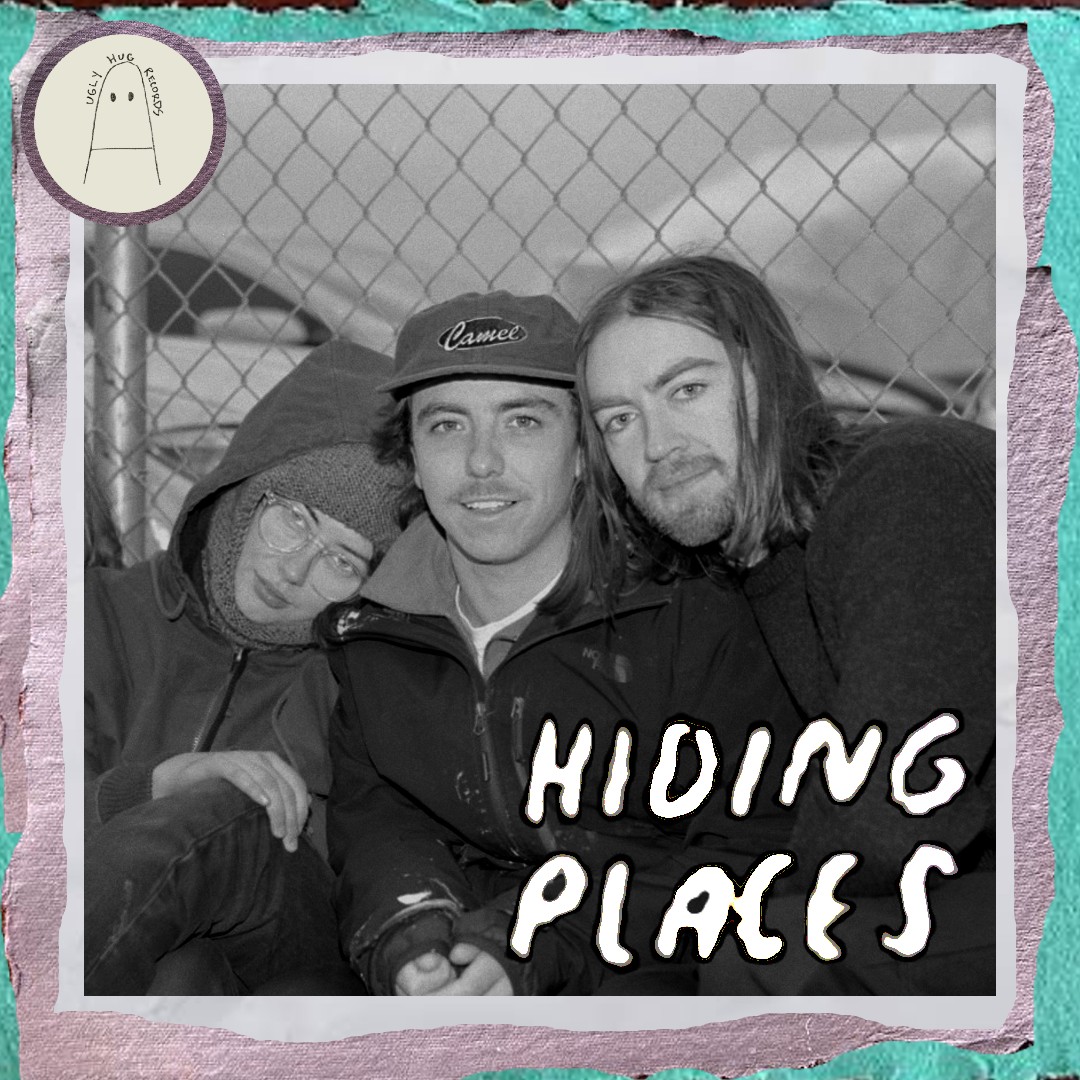
Today, Hiding Places have released their third EP, titled Lesson, off of the independent Brooklyn-based label HATE TO QUIT. Since forming, the band has cultivated and perfected a unique blend of hushed folk melodies along with the crushing subtlety of Elephant 6 style production across two EPs and a handful of one off singles; taking a cult classic poise amongst the most taught folk knots and rock n’ roll softies alike. As they have come to release these new songs, most of which were recorded in London at Angel Studios, Lesson reflects on the teetering compromises of adulthood, showing a young band embracing their imaginative and collaborative spirit to confront the duality of getting older, both through immense individuality and as a excitingly new and creative group.
Cover art: Matthew Reed (TV Beaches) and Kristen Kershaw
As a three piece, made of Audrey Keelin Walsh (guitar/vox), Henry Cutting (drums) and Nicholas Byrne (guitar/vox/synths), Hiding Places’ initial lore comes from UNC Chapel Hill’s student-run radio, WXYC. Their story, to be told through the style of on-air lingo; DJ Arts + Crafts (Byrne) and DJ Silicon Based Life Form (Cutting) needed a photographer for a party they were throwing, to which they found DJ Tidy (Walsh) in the radio listserv. Quickly building a professional relationship – strict artistic business – they inevitably became good friends, and, soon enough, Byrne was offering to record some of the demos that Walsh had been piecing together. With the addition of Cutting on drums, the three recorded and eventually released Homework and Heartbreak Skatepark as the first Hiding Places singles in 2021.
Since leaving Chapel Hill in recent years, the members of Hiding Places have never lived in the same place at one time. While Byrne and Cutting moved to Brooklyn, Walsh stayed in North Carolina before heading to London to study abroad. “It definitely is an adjustment,” Cutting was the first to admit. “You get used to a lifestyle where you’re hanging with these people all the time and then they leave.” Going long distance, a struggle enough for young lovers migrating to different colleges, it is a profound geographic feat of sorts for a young band honor-bound to create something genuine and collaborative. Though they make the most of it; planning to write and record in quick trips to predetermined destinations, something in which Walsh considers to have only enhanced their creative relation; “there’s the intentionality, and the comfort, and this element of trust that happens that is just so rare,” they articulate sincerely. Managing that kind of creative relationship, though any relationship for that matter, distance – as Walsh continues, “just reflects a commitment to each other. A commitment to knowing what we are hearing, what we have to say, and being curious about what we each have to say.”
Photo by Alec Peyton
That sentiment rings true as Hiding Places has only ever functioned as a fully collaborative group, dividing amongst them royalties, recording say and especially writing responsibilities – utilizing three different perspectives for each and every project. While living separately offers a unique and sequential opportunity for individuality, the band has come to embrace the perspectives of localization into a cohesive synthesis of style and story. “I feel like for the entire existence of Hiding Places we’ve had geographical influences from multiple places at the same time,” Byrne says, continuing, “I think that has allowed us to really explore different kinds of sounds as far as how they relate to our daily lives.” While Wash was in London, recalling, “I got to see a lot of local artists who made music that sounded much more grim than the local music of the South that I had grown up going to see,” at the same time, Byrne and Cutting were experiencing their first harsh New York winter – northern environmental standards when vitamin D deficiency feels like seasonal betrayal; “I just wasn’t used to feeling sad in that way;” Byrne admits.
Lesson, as a whole, does have a much darker, much more contemplative deliverance than past projects, leaning into more serious topics of fate, grief and the the new responsibilities that come with aging. Though, the band’s approach has not changed. What sticks out in a Hiding Places song is the ability to comprehensively build upon a perception, pinpointing the exact feelings that sprout in our gut rather than force it’s hand to be present. For instance, “after image” was written by Byrne during that first winter in New York. In its nature, the track plays with the idea of stillness as the guitars flurry down in uncoordinated patterns like snowfall on a windless night whilst Byrne and Walsh’s harmonies grow and deplete like a series of deep breaths – a clear play of dynamism built with trust and accents built from pure addiction. The title track “Lesson” blooms from an outburst of love and genuine benevolence, as an overt sense of warmth ebbs and flows where it sees fit (reminiscent of songs like “Sun Was” and “Skatepark Heartbreak”). The track soon revolts into a second act; grim, dynamic and hopeless as Walsh witnesses joy, so distant through the lens of grief and vice versa. The band doesn’t see it as a depressing matter, but rather an opening to new opportunities of expression, as Walsh responds, “feeling allowed to make sad music, or to make music that is honest and runs the whole landscape of emotions is very cool,” they say, before finishing, “I feel like we are kind of low key going in an Evanescence direction in some sort of way;” said only half jokingly.
At the time of our call, Walsh was currently diving into the novel, Lapvona, the most recent work of author Ottessa Moshfegh – notorious for the light reading material of My Year of Rest and Relaxation. Taking place in a corrupt medieval fiefdom, Walsh explains, “in the book, humans use imagination to lie, steal, murder and do really hurtful things.” But to their point, they share, “imagination is a gift that as a human I have the privilege to access, one that my dog does not have in the same way, so I might as well use it for something good.” With everything that Walsh finds creatively moldable, whether that be songs, stories, photographs, the arts and the crafts, even their doodled car has become synonymous with the band’s image. With this rich and lovely DIY aesthetic blended with hints of fantasy and natural exploration, there is a pure wonderment that the band omits. On the track “Elephant Key”, the story explores the capacities of different animals’ self agency while also referring to Walsh’s own accountability as a human. There is no thought of what is realistic or probable, playing with references to a “fish king” and a clairvoyant elephant, but Walsh’s approach to songwriting isn’t based in the grips of reality, but how far can we utilize imagination to push the novel feelings and experiences, those singular to being human, into a more comfortable place of understanding?
“Crown of Tin” was written in 2019 during Walsh’s first year at Chapel Hill. The song spent years being recorded and scrapped, just never feeling to have been done justice. Until Cutting suggested using the original vocal and guitar demos that Walsh had made underneath their lofted dorm bed, it may still have never been completed. But in its finalized form, it’s a simple track, a meandering verse to verse style, as Walsh narrates their experience with homesickness. It’s not a song that grapples with being physically alone, but more of drifting through a changed environment; new people, places, and things that haven’t been defined yet. But that simplicity of production allows the demo tracks to excel in their significance, as Walsh expresses, “I think that the sentimentality behind it is very much rooted in honoring the exploration and the wonder that comes from just realizing that you can make something.”
On its own, “Crown of Tin” is a lullaby of Walsh’s own vocation; setting boundaries between real expectations unmet and those that we create – made to be resourceful to our wellbeing. “I have been thinking a lot recently about how most of my emotions either fall under joy or grief in some form, and usually at the same time,” Walsh explains. “Often if I am angry, I am grieving an expectation I imagined.” It’s not out of convenience or habit that these feelings arise, but an effort to revert back to a sense of self that feels in control. The opening verse of the song sets the scene; “Counting down the seasons till I see you again/Winter is me singing in my room it never ends/Taking a short dance under the sun when I can/Going on some picnics with all of my new friends”, a relic of a blushed and lonely reality of a first year student. As the song comes to an end though, the last verse takes a turn; “I wanna live inside a cabin or a tent/Animals will smile at me, will make conversation/I’ll climb trees and look around and wear my crown of tin”.
As I sat with this song for a few days, overwhelmed with this stunning sense of nostalgia it left me with, I was reminded of my childhood bedroom that I shared with my two younger brothers; three parallel twin beds – every night in the fashion of a structured summer camp (or juvie) – as my mom read us the book, Where the Wild Things; not intimidated to use the grumbly voices, but rather encouraged by her three baby boys. Maurice Sendak, the author and illustrator of that book once described, “children do live in fantasy and reality; they move back and forth very easily in a way we no longer remember how to do.” To get older, when imagination isn’t just for kids, but extended to those who have to live by the rules of capitalism, heartbreak, apartment leases, catalytic converters, sell-by dates and homesickness, why not make the reality of it all just a little bit easier? “[Crown of Tin] was a very momentous song for me,” Walsh conveys with sincere recognition. “It was the first song that I recorded on my own and it’s a reminder to myself that the reason I like to make music is because I like to explode my imagination everywhere.” As simple as that.
At the time that this piece is published and Lesson is pushed out into the wild, Walsh will have moved and settled down in Brooklyn, joining Byrne and Cutting; all together for the first time in a handful of years. “We’re excited about increasing the pace in which we’re writing and recording and releasing songs,” Byrne says. “I think we’re in a really good position to do that because we’ve already figured out how to collaborate when it was much more difficult.” With more songs already recorded, full band shows in the works and the excitement of just being together again, it could be safe to assume that Hiding Places is just getting started, yet it feels like they are already so timeless.
Lesson also features Anthony Cozzarelli (bass/guitar/vox), Malik Jabati (saxophone on “Lesson”), Lucas F Jordan (flute on “Elephant Key”) and Frankie Distani (clarinet on “Elephant Key”).
hemlock is the swamp-raised and untethered (Chicago / LA / Texas) project of Carolina Chauffe who, as of today, is celebrating the two year anniversary of their album, talk soon. To commemorate the anniversary, hemlock, alongside Ghost Mountain Records, is announcing the release of a limited pressing of talk soon for the first time ever on vinyl as well as a new music video for the song “garbage truck”.
With a brush of gradual guitar, Chauffe begins, “I’ve always been so afraid of the things I can’t control / Like accepting that you couldn’t stay, and the sound of the garbage truck.” This line, opening the song “garbage truck” with a gentle admission, sets both tone and desire in the wake of a relationship while also putting weight on the things that feel inevitable. As the track goes on, with a steady heartbeat behind flourishing instrumentation, the music begins to drive with purpose – Chauffe admitting with sincerity, “I wanna be a better person to you.”
Two years after its original release, “garbage truck” only feels stronger in its deliverance, both towards its confessional imperfections and the confident strides of growth that hemlock has so genuinely crafted in their career. “I’ve always been so afraid of the things I can’t control,” Chauffe repeats one last time, before affirming, “But I am not bound to make the mistakes I did before.” With accountability, reassigning the things that we can control, soon, the conditioned racket of the garbage truck outside begins to feel less harsh in its composition – our unfavorable habits are no more foundational to who we are as is the stuff that is hauled away every week by that same darn truck.
To celebrate the two year anniversary today, hemlock has shared a DIY made music video for “garbage truck” compiled of footage shot back in 2021. With a bike basket full of flowers, Chauffe rides around the city of Chicago in hopes to hand out the beautiful bundles to the people at the helm of these dynamic machines. You can watch the full video for “garbage truck” premiering here on the ugly hug today.
The limited double LP pressing of talk soon is pressed on coke bottle clear vinyl. It also contains the bonus track, “Monarch” added in its original intended position on the track list. Side D has an etch designed by Carolina Chauffe. You can preorder the vinyl on hemlock’s bandcamp or at Ghost Mountain Records.







 the ugly hug