• About
  • Interviews and Features
  • Singles
  • Guest List Playlists
  • Album Reviews
  • The Gallery
  • Tape Labels
  • Home

the ugly hug

  • Work Wife talk Waste Management and Indie-Rock Basketball | Interview

    May 16th, 2024

    Meredith Lampe: I think there’s a 20% chance that Isaac [Stalling] pulls up in the van as we’re sitting here. He borrowed the van because he’s on tour with Greg Freeman.

    We were all curious as to if the universe would allow such a coincidence to occur – to see the Hot Wheel emblemed Work Wife van pull into town on this dreary New York afternoon.

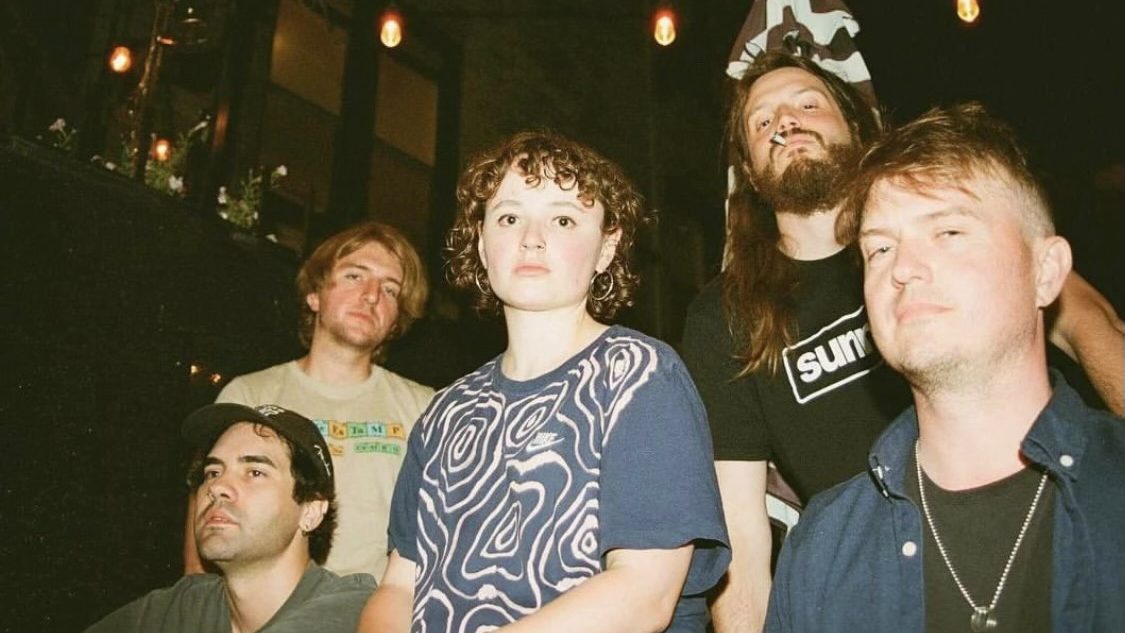
    A few weeks ago, Brooklyn-based band, Work Wife released their latest EP, Waste Management off of Born Losers Records. Started by Lampe as a creative bedroom project back in 2021, Work Wife has found its fullest, most collaborative form yet. With the edition of Kenny Monroe (bass) and Cody Edgerly (drums) for 2022’s Quitting Season, Isaac Stalling (guitar/banjo) is the most recent addition to the Work Wife business.

    I met up with Lampe and Monroe recently at a café in Brooklyn, New York, to catch up and discuss the new EP, writing love songs and indie-rock basketball.

    Photo Courtesy of Work Wife

    SR: So you guys just released your second EP, Waste Management, a few weeks ago. This is also your first release as a fully formed group. Can you tell me about the recording process a bit? 

    ML: This time Cody and Kenny were much more involved, because I always forget to show them the songs before we record them. The way that the Toledo guys operate is they don’t want to hear anything beforehand – they work more like, ‘let’s just get in the room and then we’ll do whatever we feel like’. This time they had actually rented a studio space in the Navy Yard in central Brooklyn and Kenny, Cody and I went there together for a full weekend before we recorded and we worked the songs out and learned them.

    KM: Yeah, a little bit. Not too much though.

    ML: No, not too much. But yeah, this time there’s a couple more collaboratively written songs. I feel like Kenny wrote a lot more of the guitar licks. This thing will happen where Kenny will come up with a bass part that’s super sick and then Dan and Jordan, our producers, will be like, ‘oh we’re gonna actually play that on the guitar,’ and I feel like your bass part gets stolen. It’s the melodic stuff, he can hear it – that’s your superpower, Kenny. But I wrote most of the lyrics and structure for all the songs, and then they wrote the parts.

    KM: Arranging the songs is a very fun process after Meredith writes them.

    ML: I think that writing is more fun than arranging. Arranging feels like work to me.

    KM: Then it all works out in the end. I think Dan, Jordan and Cody like arranging equally. They seem like they’re really in their bag when they’re arranging.

    ML: The way they record is we’ll be working on a song and everyone will kind of have something that they’re messing around with, and then when Dan hears something that he likes and he’ll yell, ‘TRACK IT’. So, Jordan will be playing the guitar and I’ll be turning all his guitar pedals and Cody will be shaking something weird and then Dan will yell, ‘TRACK IT’, and then we run to put the mic over there and then we track it. It’s kind of stressful.

    KM: It’s loose, you know, kind of chaotic. But there’s definitely a method to the madness. We have great chemistry, though. Especially when young Isaac joined us – we became a full unit. 

    SR: Yeah that’s one thing that I wanted to ask about, because your performances, and the song structures themselves on Waste Management feel looser, like you are all just having fun with it. Are you feeling more connected as a collaborative and creative project? 

    ML: Actually, Cody and I were just talking about this recently, because we’re at the stage where some opportunities we’re saying yes to and some we are saying no to, versus the beginning where we would do anything. But with the previous bands I played in it felt like we were very goal oriented, always pushing to get the record deal and having to grind until we get there. And in my math brain, I always thought the probability of us doing this is so low. So if we are not having a good time, then that is the worst bet we’ve ever made. So when I started this band, I thought, number one, we just have to have a good time and not do things that make us feel bad, and then everything else can come after. 

    SR: Has that made having to make creative choices easier? 

    KM: Well, for “Downtime”, Meredith had a demo that was really cool. It was in a weird time signature and it was really disjointed and had a very strange melody and we really wanted to make it a full song. So what happened was we took that demo, which was like one verse and like half a chorus, and then we recorded an entire instrumental that had a bunch of new parts. And then we gave it back… 

    ML: Well, then I thought you wanted me to rewrite the entire song! So I rewrote the entire song with completely different melodies and lyrics. Then they were like, “no, that’s too much, go back to the beginning!”  And I had this whole other song with the “Downtime” instrumental that actually says waste management, and there’s this whole thing around taking your trash out and emptying your brain and I was like ‘oh, it’s so cohesive!’ Then they were like, ‘no no the other one was better.’ Someday I’ll take that melody and slap it on a different piece of toast I guess.

    KM: That was a funny multi-step process.

    ML: It felt more like what it’s like to write with a band, as opposed to me just being like, ‘this is what the song is.’

    KM: Yeah, it felt like an experiment. It sounds like an experiment too.

    ML: That song is so polarizing. People either love it or they never address it. They just don’t bring it up.

    SR: And you were okay when they approached you, when you thought they wanted you to rewrite the whole song? 

    ML: Yeah, well, the song wasn’t done in the first place, but, yeah, it’s way more fun that way. It’s way better to have the input. Writing by yourself is boring. It’s lame. 

    SR: Waste Management deals a lot with, not necessarily loneliness, but solitude with yourself, which is an interesting juxtaposition when compared to the harsh magnitude of the city that you use as a backdrop. What were some ways you worked through this theme and were there any feelings that came out in the process?

    ML: When I was writing these songs, I think it was shortly after I had moved back to New York. I think I was just, at that point, having to rebuild my whole social circle. I wasn’t playing in Coltura anymore, and I kind of got tired of the scene I was in. But I think what I was trying to figure out was when growing up I was surrounded by people a lot and have never established an independent routine that felt good. I think it’s because when I was younger my parents put me in a lot of stuff – playing sports, piano lessons, and doing homework – I was just a highly productive child. So I never really learned how to have a fulfilling home life. It’s like the curse of the American productivity complex, but we’re all just trying to figure out how to relax a little bit – and I’m still dealing with that. So, “Downtime” and “Control” are about that, and “Strangers” a little bit, too. The thing that I’ve found that’s been really grounding is just creating lots of routine. You get so much decision fatigue, especially here in New York, about what to do with your time. 

    SR: One thematic step that I really resonated with on Waste Management is the focus on other relationships beyond just the romantic kind. Can you tell me a bit about that choice?

    ML: Yeah, I mean, they’re more important than romantic relationships. I go back and forth about this a lot with all the songwriters here, about love songs and like, should we keep writing love songs or not? Fenne Lily, who’s one of my closest friends, will always say, ‘there’s a reason that the best songs are love songs. You have to continue writing love songs because that’s when you have the strongest feelings.’ But I get really tired of it after a while, you know? I think that writing about other relationships has a lot of nuance, and oftentimes, the relationships are much longer. I’ve been trying to write a song about my best friend Natalie for years. And I can’t figure out how to even begin to describe all the different facets of it. But I think it will be a much more interesting song, perhaps, than a love song about someone who I just met and feel interested in or something. Or like with “Something’s Up”, which is about my best friend’s mom, it’s like that is someone who’s known you for your entire childhood, so I think it makes for a more interesting song. Maybe not quite one that has so much depth of feeling, like extreme sadness or extreme happiness, but there’s more to say.

    SR: Yeah of course, can you tell me more about “Something’s Up” and that relationship with your best friend’s mom? It’s such a unique lens to write a song from.

    ML: Well, one year I had gone to Dallas for Christmas with my ex, which is where he’s from. One night, we went over to his best friend’s house. I think for him, growing up, he would go to his friend’s house as an oasis. The woman who I ended up hanging out with was his best friend’s mom. They just had this crazy year and were sitting around in the sun room smoking cigarettes as a celebratory thing. I think I wrote that song right when I got back to New York, because it was just a really impressionable conversation I had that night. And when a parental figure gives you a cigarette, something happens in that moment where you’re like SHIT – this is kinda cool. I sort of took that, and then the verses are more about my actual childhood friends and their parents. 

    SR: Was your friend’s house an oasis for you when you were growing up as well? Was that an environment you resonated with?

    ML: I feel like this family that I’m writing about is really fun to be around but has some really intense shit going on. There are always fights because there’s a lot of kids and there are always random people staying over at the house. In my house it was just me, my sister and my parents and everything was very calm. There was never a lot of action, so whenever I went over there it was like, this is life! This is crazy!

    SR: Can you tell me a bit about the matching EP artworks and the idea behind those photos? 

    KM: I can’t remember when I shot the winter one, but it was just in my archive and we needed artwork for Quitting Season. It was taken at my parent’s place up in rural Wisconsin.

    ML: You take the best photos, Kenny. Most of the things that Kenny does, he’s very good at and no one ever knows.

    KM: Jack of all trades, master of none. But yeah, I have a pretty good archive of cool photos. So I sent like 20 or so photos for single art and cover art and everyone liked the truck. The truck was the winner. And then I thought, ‘I’m going to go take that same truck photo in the summer for the next EP.’ 

    ML: Yeah, you nailed it

    KM: It was the same day the truck went to the dump. The truck is gone now.

    ML: It went to the dump?

    KM: It went to the scrap. It wasn’t really working, and our neighbor came over to maybe buy some of the parts off of it, so he and my dad were there talking about stuff and looking in the hood and that’s what I took the picture. Took a bunch of photos of them doing that and then that dude scrapped it. 

    Photo by Justin Buschardt

    KM: Do you know about Indie Basketball? It’s a podcast from Chicago where your favorite indie rock musicians talk about the NBA. If you ever meet these guys, tell them Work Wife really wants to be on it. 

    SR: I haven’t, but I definitely will, that sounds incredible! You started your own basketball music fest/fundraiser, didn’t you?

    ML: Bandsketball!

    KM: I’m working on getting the venue right now! I’m trying to get the parkour gym to do it, because they have this huge parking lot with hoops. But they have their concerns.

    ML: Isaac maybe had the worst day of his life at last year’s Bandsketball. Well, first off, we were all hungover for some reason, but it was also really hot and we were not dressed appropriately for it. We got smacked by this band called Monograms who brought their own matching jerseys and had their own plays that they were running. 

    KM: Yeah, Isaac was playing in boots and overalls. 

    ML: He actually thought he was going to die, like he thought he was going to have a heart attack. And then we had to play our set after and I knew he was fucked up, but it was hard to tell because he was still shredding. But he was dead in the eyes. 

    SR: How many bands participated in it?

    KM: We had 16, but there were a lot of people who were interested. This band called Henry Flower won. His record came out the same week and he said it was the greatest week of his life. 

    ML: It was a big deal. He said he and his band had not been having band practice because they were practicing basketball. 

    SR: Off the record, which band had the worst team? 

    KM: Probably Work Wife, you can leave that on the record, we were terrible – just awful. But we were only our band. For a while we were going to play with Helenor, but Dave [DiAngelis] fielded his own team, which was probably good for him. 

    ML: We talked a pretty big game, but we were shockingly bad for how often we play basketball on tour. But I still love the game. 

    SR: How was this past headlining tour you just finished?  

    ML: It continues to amaze me that anyone wants to come to these shows. Before we started doing these headlining tours, I was thinking that I really don’t want to do this. You hear so many horror stories of these bands playing headlining tours that are just like empty show after empty show. But the tours have been great! A bunch of people show up to every show. I don’t know who they are but they know who we are and it makes it feel like we can do this. Touring is highly inefficient, though. Hauling around all these humans and equipment to play for like 30 minutes, sometimes to an empty room, you think, is this really the best way to do this? But I think we’re the type of band where the live show is a big part of what we do, so we’ll keep doing it. But we are going to take a touring break and then start playing shows in the summer again. 

    SR: Does Work Wife have anything coming up that you are excited about?

    ML: We’re working on a full-length now which I think will be a little bit different than the old stuff. Now we have Isaac, so the stuff that we’re writing I think has a bigger influence coming from his country rock and blues stuff. He’s just been sending me a ton of music and I feel like my taste is slowly changing for the better. 

    KM: We recorded demos. There’s like one electro-pop kind of thing which we’re doing as well.


    ML: Yeah, the thing I can’t figure out is where to put it. It’s kind of like folk-rock, but there’s some electronic stuff as well. It’s a continual journey of deciding how much to incorporate that, because I always love pushing two things that don’t belong together and trying to make it work. But I don’t know, we will keep trying. Once the summer hits then it’ll be back to the bangers.

    Written by Shea Roney | Photo by Justin Buschardt

  • Audrey Keelin x ugly hug | Guest List vol. 6

    May 15th, 2024

    Every Wednesday, the ugly hug shares a playlist personally curated by an artist/band. This week we have a collection of songs put together by Asheville-raised, Brooklyn-based artist, and ugly hug contributor, Audrey Keelin, of the band Hiding Places.

    Audrey’s songwriting and creativity comes from a place of nostalgia and comfort, carving a unique path of understanding their present surroundings. With this curation, Audrey explains:

  • Helenor shares “Bad2” | Music Video Premiere

    May 14th, 2024

    Brooklyn-based project Helenor emboldens the sensations of grief on the new music video for “Bad2”, out today. Conceived by visual artist Indie DiMartino, you can watch the video for “Bad2” now premiering on the ugly hug. 

    Helenor is the creative DIY project of David DiAngelis, who, last month released his sophomore record, A public place, off of Mtn. Laurel Recording Co. After dropping everything and moving to New York as the pandemic let up, A public place is representative of this wandering – a buffer between where he’s been and where he’s going as the world seemingly blows by. 

    Opening A public place, “Bad2” grows from a mellow haze – an episode of brain fog reluctant to part as DiAngelis feels fated to grief’s plot. Though his life appears to be static, the song presses onward with a blend of grounded acoustic guitars and revitalizing synthesizers.

    “This song is a soundtrack for pretending you have the ability to be present, so for the video we wanted it to feel like an erratic playback of memory,” DiAngelis says. 

    The music video consists of an impressive and sensory fulfilling array of filming techniques and artistic mediums, as DiMartino, the video’s creator, explains:

    “The film for Bad2 exists as an erratic playback of a memory. To portray this feeling of messy dissociation, its process pulled from an array of experimental analog compositing practices and mediums. The project’s footage and titles were shot to 8mm film, with some shots relying on in camera mattes and rear projection. Just as well, some of these film scans were manually scrubbed through and reshot on an old LCD the width of a thumb. A quarter of the project’s runtime was physically printed and rescanned frame by frame. A technique was implemented to further distress these selected sequences by “hand-blooming” the highlights with paint and charcoal.”

    Although these styles transition and blur, creating a feeling of disconnection between settings and sensations, the one thing that remains consistent through it all is DiAngelis’ presence, no matter how disorienting it may appear. 

    Helenor will be playing a Palestine Benefit Event along with Katy Kirby and Jules Olsen on May 21. You can stream A public place on all platforms as well as purchase it on vinyl or CD.

  • Feller Share “New Cotton” and “Air Mail Tablet” | Single Premiere

    May 14th, 2024

    Today, Feller, the Chicago-based post-rock duo, share two new singles from their forthcoming debut EP, Universal Miracle Worker (due May 28 via Angel Tapes/Fire Talk). Both tracks are accompanied by a visualizer made by Brady Sheridan, and you can listen to “New Cotton” and “Air Mail Tablet” premiering on the ugly hug.

    Feller is composed of drummer Ethan Toenjes (Sleepwalk, Old Coke) and guitarist/vocalist Pete Willson (Cafe Racer), whose concise, far-reaching and captivating sound has found a comfortable home in Chicago’s expansive DIY scene. Making no sacrifice to their individuality, though, Feller stands out in their unique disposition; heavy, eccentric, patient, volatile – and every which reactionary pleasure that they feel fits in the moment.

    “Air Mail Tablet” and “New Cotton” showcase Feller as a rock n’ roll assemblage; embodying the most endearing parts of post-punk, post-rock and post-hardcore that still feels fresh in delivery and irresistible in nature. “Air Mail Tablet” is a fever dream, energized by an instrumental groove that floats between loose guitar layers, haunting vocal manipulations and Toenjes’ snug and propulsive drumming. “New Cotton” demonstrates the duo’s natural ability to shift and build around a centralized idea. As patterns melt and mold, showcasing the duo’s extensive knowledge of rock music structures – and lack thereof – the song always returns to its melodic, and often restorative, center.

    Universal Miracle Worker will be available on limited edition orange cassettes via Fire Talk’s extension, Angel Tapes.

    Written by Shea Roney | Photo by Kevin Allen

  • I’m Green by Mali Velasquez | Album Review

    May 13th, 2024

    Written by Kat Curey

    Debut album, I’m Green from Nashville based singer/songwriter, Mali Velasquez welcomes you into her inner world of grief, heartache, and shame. You’ll find your own sorrows conjured up alongside Velasquez’s, uncover some of the wisdom that lay beneath suffering, and leave with a sense of solidarity that is rare to find in a world that often feels so disconnected.

    I first listened to this album last fall when I had just moved to Portland, Oregon, greeted by skies draped in a perpetual grey. As winter’s chill settled in, the poignant motifs woven through I’m Green became a comforting presence amidst the city’s collective sense of gloom. Now as spring emerges, and the city teems with blossoming trees and flowers, I resonate more with the transformative nature of this album, turning anguish into wisdom, and shame into acceptance. 

    Opening track “Bobby” invites us into Velasquez’s world of loss and contemplation and ends with instrumentals that bleed seamlessly into the second track, “Shove”, as she delves into interpersonal turmoil driven by fuzzy guitar tones and a droning drumline. Velasquez’s swaying vocals capture the depth of feeling that she offers throughout the entirety of I’m Green. 

    This album never fails to engage and evoke with palpable pain throughout each song and Velasquez’s knack for creating vivid imagery inviting the listener into a fully fleshed out and deeply aware world. “Medicine”, is one of many stand out tracks that opens with subtle instrumentals, allowing the listener to connect to the demanding emotion expressed in Velasquez’s warbling voice. You’ll feel this depth in lyrical moment’s like “your mom seems so proud of you, well mine’s in the ground” on “Medicine” and “Did I bite a hole in your neck and then drain you dry?” on “Shove”. 

    I’m Green has a knack for evoking emotions that sometimes lay dormant in a way that fosters productive introspection. I was fortunate to catch her and her band live, opening for A. Savage at Mississippi Studios in Portland, OR earlier this month. They opened with Decider, a moving ode to living in the depths of hopelessness and despair, setting the tone for a particularly impactful live show. The band shared three new songs that surely won’t disappoint when released.

    Discovering an artist who courageously invites you into the intricacies of their experience is a privilege – one of many qualities that have left me completely smitten with Velasquez’s work. With finely crafted indie folk compositions seamlessly harmonizing with Velasquez’s narrative, the album offers profound solace found in the shared experience of suffering and creative expression.

    For me, I’m Green turned out to be more than just an album; it became an affecting exploration of life’s trials and uncovering one’s capacity for acceptance and compassion – building on reflections that are all at once brutal, tender, and empathic. It’s a rare gift to leave an album with a deeper sense of connection and greater understanding of the human experience and I’m Green gives the gift of deliverance and catharsis you won’t want to miss out on.

  • Cassidy’s Hi-5’s!

    May 10th, 2024

    Written by Cassidy Byrnes

    Every Friday, a staff member at the ugly hug curates a list of their five favorite new(ish) releases to share with us all. This week, our writer Cassidy put together a list of indie-folk heartthrobs, twangy love songs and bedroom pop spinners.

    “Right Back to It” by Waxahatchee (feat. MJ Lenderman)

    Ugh, I just love achy country twang songs. Waxahatchee, the project of Katie Crutchfield, has become one of my favorite artists over the past couple of years. Listening to her album Saint Cloud took my life in a new direction, and that direction was my return to loving country or country-adjacent music. She recently released her sixth solo, full-length project, Tigers Blood, which is where “Right Back to It” resides. This track features MJ Lenderman of the band Wednesday, whom we love here at The Ugly Hug. In the way of production, the bass line offers a swing-and-sway and allows for a haunting little banjo melody to peak its way through. As the title implies, this song is all about falling back into the arms of a past flame. The comfort that appears when you’re around someone who knows you so well, while also knowing all the reasons it never worked out. A vicious cycle.

    “Leave” by Phoebe Go

    Phoebe Go popped up on my radar back in October with her release “Something You Were Trying,” and then, serendipitously, she ended up opening for Briston Maroney on the first half of his U.S. tour at the end of 2023/early 2024, which I was in attendance for in Milwaukee, WI.
    Building up to her first album release, Marmalade, on May 17th she has been releasing absolutely stinger singles. I would say banger but everyone has given me some extreme heartburn while listening. “Leave” is the third single released in this circuit and holy smokes. The guitar work along with the easy-going drums make a perfect canvas for a devastating self-analysis of relationship insecurities. Asking the question, “Are you gonna leave me? / Tell me what’s it gonna be?” There is a little “huh” that adds an extra pang during the chorus, and I just love production treasures like that.

    “Heart Shaped Locket” by Shallow Alcove

    If this song came out in 2019/2020, I genuinely think it would have ruined my life. “Heart Shaped Locket,” offers a devastating narrative about growing up and leaving the comfort of home. The gorgeous harmonies created by the band of friends make the deep ache of letting go grow exponentially. I highly recommend listening to this one horizontally with a box of tissues nearby. Check out Shallow Alcove’s most recent release Keepsakes.

    “Chariot” by Babehoven

    Babehoven has easily become a staple in my rotation after seeing them open for Slow Pulp back in November. “Chariot” is a part of their new project Water’s Here In You released last Friday. This song feels like a hug after a long day of doing something you didn’t enjoy. I often listen to it on my walk home from work and it just puts me at ease. The mellow guitars and laid-back bass lines offer a warm tenderness which is also reflected in the soothing lyrics, “This time, you’re moving through it, you’ve found a way out / And you’re gonna keep it close / This time you’re clean, between and you’ll be / Sparkling even through the chaos.” It’s like a hype song without the hype.

    “Sadness As A Gift” by Adrianne Lenker

    This one was hard to put words to. Adrianne Lenker has a pure talent for writing the most gut-wrenching songs while leaving enough space for the listener to apply their own experiences to them. “Sadness As A Gift” was the second single released in preparation for her new album Bright Future, which dropped back in March. Lenker takes us through a break-up in the span of this 4-minute and 19-second track, and while not going into too much detail, allows the listener inside of the relationship with her intense lyrics. Starting with, “You and I both know / There is nothing more to say,” in order to take us on this journey of acceptance and understanding. Rather than leaving in anger, she leaves with an appreciation for everything the relationship was.

  • Tex Patrello and a Modern Greek Tragedy | Featured Interview

    May 10th, 2024

    Dallas based musician, actress and visual artist Tex Patrello is an anomaly in many ways. After the release of 2017’s short EP, yellow curse, her musical career has flourished in the celestial outers – but once you discover it, her artistry becomes impossible to look away from. Expanding our comprehension of what a bedroom musician can be, brandishing her own style of dysfunctional and twisted pop music, Patrello has always pushed the boundaries of what we consider capable by an individual.  

    Last week, Patrello finally released her highly anticipated debut full-length, Minotaur, off of Texas label, View No Country. After spending seven years in the making, Minotaur was conceived with the mindset of a musical, accumulating characters, thematic squirmings, suggestive imagery and the sheer magnitude of interpretations that make for a project of grand proportions. Overt patriotism, body objectification, attentive despondency – the world that Minotaur exudes feels obsessive, sinful, and sexy, yet utterly revitalizing at the same time. Patrello, who embodies herself throughout the album, encounters various characters that direct her decisions; Ricky the football player, Lou the matured suitor, and The Beast. Minotaur, as a whole, is a manipulation of reality, a mere delusion that Patrello has manufactured herself for the pure purpose of understanding where and what she is truly connected to. 

    Photo by Tex Patrello

    With ten engaging songs, some creeping over the six minute mark, Minotaur is reluctant to let up. With a continual build of haunting avant-pop contusions, waltzing, hollowing lows and high spiritual frenzies that fluctuate with Patrello’s throbbing heart, Minotaur squeezes out as much expansive, and oftentimes charmingly offensive, production styles as possible. At its core, songs like “Panda Express”, “Wichita Falls” and “Anything Goes” still seamlessly flow with whimsy over shifting patterns and arcing instrumentation that Patrello bundled into the prog-like folk style of yellow curse. But beyond that, Minotaur is magnetic, clinging to new sounds of ravaging orchestrations, acrobatic vocals and electronic decays as Patrello’s posture wavers through song structures, molding from one idea into the next with such strategic thought and execution.

    Breaking down her process, Patrello is patient when shaping melodies. “I find whatever makes me feel a high at that moment. I extract that, and I end up joining those extractions together.” As far as the individual songs go, she continues, “I tend to keep building upon them – making sure I love every corner and turn in it. I just didn’t want to have anything I didn’t love in this album.” In its full construction, “I would say that there is no song on this album that’s under 50 tracks. And there’s some, I think, that are 400 tracks.” She recalls, “it’s two different projects, because it wouldn’t even work if I had it in one. My computer wouldn’t work.”

    Spending seven years endlessly working through these configurations, flexing through instrumentations and concepts as well as learning to mix and master on her own, this magnitude of time and intensity is vital in the name of Patrello’s artistry. There are multitudes of shifts and changes, blending patience with needs, as personal tribulations sway her perception of reality. “I knew a story I wanted to tell, but I didn’t want to push anything. I wanted to write a musical, but have every song come naturally – as if I wanted to make a movie, but every scene happens to me before I put it in.” 

    Patrello’s world is strikingly unique and personal, pulling us in with cartoonish characters and tropes that only further intensify the situations. These characters are structured within convoluted juxtapositions that feel distressed within her own being as she experiences them in real time. “I feel like one of my biggest sources of inspiration comes from things that I have no interest in,” she confesses, something that feels oppositional to what we are often told – “write what you know”. “I don’t know anything about sports but I’ve written like 5 songs about football,” and yet, football becomes a symbol of power, sex and eventually hostility as Minotaur unfolds into its climax. 

    In the opening track we are introduced to the all-American football star’s son, Ricky. It starts with a white flash, an intense heat, as Patrello demands the car come to a stop, when Ricky first appears and this delusion begins. Changing out of his football pads, she sneaks a look at his perfect athletic body. “I crouch/ It’s some hunk in his backseat now/ He’s undressing/ He lifts his jersey/ It’s Ricky”, she croons, struck with instant infatuation. “Ricky is real in a way. He’s a bunch of different people that I’ve lived with these last seven years,” Patrello admits. He lives on a pedestal in her mind, being the only one who can satisfy her lust for perfection – perfect image, perfect smile, perfect body, perfect lover, perfect sex. 

    When writing Minotaur, Patrello was very intrigued by the Nelson Family, who, crossing decades, held a looming level of adoration in American culture throughout the 1950’s during their long running sitcom, The Adventures of Ozzie and Harriet. “They were the perfect family of the time,” Patrello says. “The show is literally just about their family,” consisting of Ozzie and Harriet, and their two sons David and Ricky. “The episodes aren’t very interesting. The stories they tell aren’t interesting at all,” but this TV family was meant to portray the very real Nelson family as the perfect, All-American, white picket fence – true patriots of the middle class mirage – that the American narrative forced at the time. But on the contrary, blending this level of perfectionism with real people who were very much not, brought out the inevitable, and quite public, destruction of what was reality to them.

    Photo by Tex Patrello

    As the most interactive character, Ricky holds a level of control over Patrello, whether he is aware of his powers or not.  “I’m kind of using someone as my muse for [Ricky], but most of the time the person I’m writing about is apathetic or rude or uncaring. And so I think that in my head Ricky has a lot of highs and lows in this album.” As Ricky lives his life, strongly on his own terms, Patrello’s relationship to him always feels to be trailing behind in whatever capacity Ricky will allow. “My fluctuations are probably just responses to Ricky’s fluctuations. He’s sort of calling the shots on what I’m thinking and what I’m feeling.”

    For as much as the album revolves around Ricky, the real focal point that drives the story is the way that Patrello interprets the distance of their relationship and her own autonomy. “I think in Ricky’s world, I’m not as much of a concern to him. So I think it’s more about my progression than his.”  The song “Long Lost Pimp” trails a brief moment of liberation as Patrello tries to push Ricky away, seeking out the compassion of an older man named Lou. “Wichita Falls” feels like a holy communion as Patrello sees Ricky finally committing to her. “That trip to Wichita Falls, I think, is like a baptism for me in that lake. My yoke is being loosened. My sin is being drowned.”  Songs like “Slick-Dick’s Baby” show violence in the same vein as sex and passion, as Patrello watches Ricky dominate his football game, becoming unwieldy and lascivious by her love for him. “Love me like you love America/ And when you choke that fucker, call me wife/ And when he’s out, my god, I love my life.” As her character’s direction feels fated from the beginning, “I think I’m just responding to Ricky most of the time,” Patrello admits. 

    “I would say that The Beast is the opposite of my relationship with Ricky”. To Patrello, The Beast, or for namesake, The Minotaur, can be a culmination of a lot of different things in her day to day surroundings – the things that she overlooks in the name of casualty and routine, though they always offer some supportive ground below her feet. “I feel like I was trying to have Texas speak through me a little bit. When I’m more connected to The Beast, I’m more connected to the Earth and I’m more low to the ground and present in this land – in Texas specifically.” Unlike the uncertainty that Ricky excretes, The Beast, and its many possible representations, feels comfortable in his presence and actions. “I feel as though I’m more a resident of my room than of any city, because I’m not out super often, but when I am, I feel very connected to Texas and this land surrounding me.”

    Photo by Tex Patrello

    In a lot of ways, Patrello utilizes the Greek origin story of the Minotaur, one of lust, conquer and betrayal, as a source of direction and relation for her own story. As it goes, Theseus is sent from Athens on a mission to slay the Minotaur that lives in the Labyrinth, but arrives wildly unprepared. Ariadne, the mistress of the Labyrinth, sees Theseus and quickly falls in love with him. Fearing that he will be killed in this fateful battle, Ariadne equips him with the tools he needs, but only on the premise that if he succeeds, he must marry her. “I’m connecting myself to Ariadne,” Patrello asserts, mirroring her own story with Ricky – falling helplessly in love until he, almost predictably, abandons her on a whim.

    In the end, Patrello is filled with the guilt of neglecting, forfeiting, and having a hand at slaying The Beast – not until he is dead does it become clear the significance he has on her life. The second to last song “Pony Meat” plays as a memory, spent “reconnecting to a past life where I might have been Ariadne,” as she sings,” “Animal, you animal/ So sweet to me/ I didn’t know, how could/ I know/ Just what you mean?” There is desperation in her voice, each line more sobering than the next. Ricky is gone, The Beast is dead, the world she has built is crumbling and her true reality has succumbed to darkness. In its stillness, Patrello admits her realization – “it’s wanting what you can’t have. The Beast is what I’ve had, and it’s hard to see that comfort or beauty in him with how enthralled I am with Ricky.”

    In her process of accumulating inspiration, choosing to write about things that she has no interest in, such as Ricky’s All-American football career, there was a distance between Patrello and Ricky from the beginning, where Ricky was always going to be more idolized than truly loved. “I think when writing [“Pony Meat”], the whole time I felt more connected to the Minotaur and that sort of like dirty or freaky side of me that I wouldn’t allow to be seen by Ricky,” Patrello admits, continuing, “I feel that I’m not putting something on as much anymore.” That is where the difference between Ricky and The Beast becomes gripping – in whose claws does Patrello feel most connected and grounded to be her true self. 

    “The Minotaur is a human body with a bull’s head, of course, and I think that that’s why I’m most connected to him,” she conveys. “I feel similarly, in a way, where I feel like I’m a pretty face on a beast’s body or the other way around.” This duality, half man/half beast perfectly interprets human nature – sinful, lustful, rabid, violent, egregious animals who can put on pants and a tie and call it civilized. Like the Nelson Family, blinded by the lights of Hollywood, the paparazzi and their own ego, their show acted as their own pair of pants and tie (for as silly as that sounds), creating a false and conflicting image of who they truly were, winding up to be their own tragedy.

    As an album that grows out of a delusion, fluctuating between realities, worlds and personalities, the finale, “DeKalb” flourishes in its ability to be present. “Dekalb is when I’m really the most lucid, and not only do I feel the most lucid, I feel like that’s the first time I’m lucid in the whole album and the most connected to where I am,” Patrello reflects. “I guess I’m connected to where I am, and I feel like I’m less delusional about things – things like Ricky.”  Patrello doesn’t shy away from how much her character has faltered trying to be something that she is not – its her own modern day Greek tragedy, one to be reiterated over and over again in time.

    “The conclusion of the album is that I’m still petty,” she says with a slight laugh. “There’s like no lesson really learned, but I think I’m just kind of waking up a little bit in the end.”  Although there are moments that feel full circle, there is no clean conclusion, leaving us listeners with some unease. But to its credit, that’s the point. “‘Dekalb” is very aware that I don’t feel like I’m in a resolved place in my real life,” Patrello states with full honesty, firm in the artistic choice she has made. “So with what’s happened in this album I wasn’t gonna end it in a perfect way.” Minotaur is a starting line, the culmination of events that Patrello felt were necessary to experience before real change, growth and sobering realization can begin. And who knows, maybe seven years down the line we will get her next chapter – in the way that only Patrello sees fit. 

    Tex Patrello has a few shows in Texas that will be announced in the coming weeks. You can stream Minotaur on all platforms now and purchase a CD or tape of the album.

    Written by Shea Roney

  • BEX x ugly hug | Guest List vol. 5

    May 8th, 2024

    Every Wednesday, the ugly hug shares a playlist personally curated by an artist/band that we have been enjoying. This week we have a collection of songs put together by London-based artist, BEX.

    Floating between the scenes of Asheville, North Carolina and London, England, Bex Vines has had a busy past few years of traveling and writing, bridging the gaps between these two communities. With an exciting blend of folky southern whims, alternative stunners and the dream-like antiquity of the London underground, BEX has created a source of grounding through her songwriting, expanding it to us listeners who are in search of that feeling as well. 

    This week, BEX has curated a list of songs that feel to only enhance our presence on a lazy and sunny afternoon. Ranging from folky slow burners, alt-pop hooks and ambient complexions, these songs bridge the gaps within our own surroundings as they become more clear in this springtime bliss.

  • New Issue share “Pottery” | Music Video Premiere

    May 8th, 2024

    Written by Shea Roney

    Today, New Issue, the three-piece art-rock band from Anacortes, WA have shared a new single “Pottery”, along with an accompanying music video. Directed and shot by the band, you can watch the video for “Pottery” premiering here on the ugly hug.

    A super group of sorts, members Nicholas Wilbur, Allyson Foster and Paul Frunzi have had a part in a handful of other PNW groups like Mount Eerie, Ever Ending Kicks, Hoop and the Stephen Steinbrink band over the years. Having released two LP’s and a handful of tapes under various names, (most notably under Hungry Cloud Darkening), the three piece have always been a source for growing creativity, blending their gentle manner with sweet rock n’ roll experiments into their own unique style.

    Later this month, the band is returning with Diminished and Transmitting, their first full length album under the name New Issue. The name change is a relic in itself, as the band is constantly shapeshifting, finding method in expanding and collaboration as their tastes mold over time – each project marking a fresh approach to artistry and variety.

    “Pottery” is spacious – breathing deeply within its short run time, as both Foster’s soft, hypnotic vocal phrasings and atmospheric synth tones build upon a feeling of loneliness and despondency. But living prominently in the song’s heart is a light bass melody and echoing drum beat that feels relatively conscious of the life within the track, making an effort to make its presence be heard and felt.

    With the subtlety of camera work and a Twin Peaks-esque style of strobe lights, rabid use of slow motion and an eerie atmospheric setting, the music video for “Pottery” was shot late one night in the band’s “low-key-haunted” recording studio called the Unknown in Anacortes. As the band shares, “Nich and Allyson spotted the resident ghost between shots. Paul always misses it.” 

    In its stillness, as the camera pans over tattered paint tarps (borrowed from Anacortes/Whidbey Island artist and painter David Halland) and the harsh flickering blue glow of a TV screen, we finally land on Foster in a distant and brightly lit room, absentmindedly molding clay – unaware of who may be present in the room with her.

    The single for “Pottery” will be released on all platforms this Friday, May 10 New Issue’s first full length album, Diminished and Transmitting will be out on Friday, May 17 off of Butte, Montana tape label, Anything Bagel.

  • Keeper of the Shepherd by Hannah Frances | Album Review

    May 7th, 2024

    Written by Chris Goudreau

    Grief is a needle and thread that weaves its way through the seven tracks of Chicago-based singer-songwriter Hannah Frances’ third full length album, Keeper of the Shepherd. Soft and contemplative moments burn as solitary candles in the dark, while rising tides of emotion reverberate to carve out a lasting impression. 

    This is a record that buries itself into the subconscious mind. It’s like recalling a dream, only to discover deeper meaning upon closer examination. Keeper of the Shepherd reveals its truths slowly with patience and insight. Simply put — it contains multitudes. 

    Frances — a vocalist, guitarist, composer, poet and movement artist — draws upon a mélange of influences ranging from avant-folk to progressive rock and jazz. This is evident on the album’s opening track, “Bronwyn,” a song with a vocal melody that wraps around itself — an ouroboros with teeth of angular guitars and haunting strings. 

    There’s a Whitman-esque quality to Frances’ lyrics on “Bronwyn” with its sing-song sense of rhythm and cadence. It evokes longing and loss as a timeless element of the human experience:

    “Bronwyn, I lost the way home where I knew/ the ground smokes as it burns to hell/ release me from this sweltered land I stand/ holding to the shepherd’s hand/ the man praised and punished me too/ bronwyn I lost the song/ gone when I sang/ bronwyn, I lost the way home where I knew how to love you and/ be loved too.”

    The album’s title track is where Frances’ vocals shine – soaring to magnificent heights on the chorus, while a driving and folksy waltzy guitar rhythm is paired with unearthly pedal steel. The song takes a hard left turn towards the end with an avant-garde breakdown that sounds like Syd Barrett era Pink Floyd meets John Coltrane. 

    “Woolgathering” is a song that’s like a paper origami boat gently meandering across deep dark and mysterious waters. There’s stark grief hidden behind Frances’ heartachingly beautiful vocals. 

    “Meet me where the heart beats/ where the shadows shade the heat/ love me wounded/ hold me where my edges soften/ give me time to free my lungs/ the ribs are loosening/ the life breathes in/ the life breathes in.” 

    She evokes the best of folk singer-songwriters such as Nick Drake or Connie Converse, with a subtlety and nuances in her vocals that grabs hold, bringing a bevy of emotions to the surface. 

    Meanwhile, “Floodplain” blends folk melodies with avant-garde string arrangements for a pairing that’s like Joan Baez with Radiohead’s Jonny Greenwood as composer. 

    There’s a subtle dark humor at play here that draws on morbid imagery to exhume the corpse of a relationship. “The birch tree bark stripped bare/ the bones and the bodies decay there/ naked as the moss grows over in time/ as the loss goes through the dam to loosen you in my heart.” 


    “Husk” is a stark place — a meditation on death with only an acoustic guitar and Frances’ bittersweet melody on display at first. Vocal harmonies swirl around this once bare soundscape, growing the song into an apex complete with lush strings. It’s one of the highlights of Keeper of the Shepherd, and it’s easily one of Frances’ most soul stirring songs. 

    An example of perfect contrast is found with “Vacant Intimacies,” an anthemic folk song that transforms grief into emotional release. It’s almost a shame that this wasn’t the closing track, as it feels like a final chapter of the album’s emotional trajectory.  

    But with “Haunted Landscape, Echoing Cave,” Frances takes all of the musical elements that preceded it to close with a song that digs up the ruins and unflinchingly re-assembles the bones. “I laid down as the field burned/ quarry of origin stories born before me/ i listen for voices vanishing/ life in petrified wood.” 

    On Keeper of the Shepherd, Frances is an artist at her peak. This is an album of evocative imagery, themes with emotional depth, and musicality that’s unique and wondrous to behold. It’s a supernova — finding the pain and the beauty in death; with the hope to begin anew. 

←Previous Page
1 … 35 36 37 38 39 … 42
Next Page→

Blog at WordPress.com.


Loading Comments...
 

    • Subscribe Subscribed
      • the ugly hug
      • Join 82 other subscribers
      • Already have a WordPress.com account? Log in now.
      • the ugly hug
      • Subscribe Subscribed
      • Sign up
      • Log in
      • Report this content
      • View site in Reader
      • Manage subscriptions
      • Collapse this bar