Every Wednesday, the ugly hug shares a playlist personally curated by an artist/band that we have been enjoying. This week we have a collection of songs put together by Philly based musician, producer and audio engineer Lucas Knapp.
As a substantial player in the vastness that is the indie music universe, Lucas has more than likely had a toe in the game on one of your favorite records from the past few years. Most recently, his work consisted of recording fool’s errand by Theadoore, recorded and mixed Caveman Wakes Up by Friendship and helped record and produce Eyes Like a Mirror by Carmen Perry (just to name a few from the past two months). Lucas has also worked with artists such as Hour, Lindsay Reamer, Izzy True, Nina Ryser, Spring Onion, Thank You Thank You, Florry, Joey Nebulous, Anne Malin and many more. You may have also seen Lucas on tour playing in bands Hour, Spring Onion and most recently with 2nd Grade.
About the playlist, Lucas shares;
I wanted to throw some light on songs from a lot of friends from different points in my life, and strangers too. I built the playlist on Bandcamp and bought everything if I didn’t own it already. The fidelities are all over the place song to song; feel is what matters. All these songs are important to me. I hope they become important for you too.
Last month, Asheville’s own Idle County, the project of Ben K. Lochen, shared Offerings, a hasty, yet hardy collection of songs that find the songwriter getting back to basics. Now almost a year since the release of his self-titled debut EP, Lochen has brought in new collaborators, Caelan Burris and Will Elliot, members of the formidable Asheville band, Tombstone Poetry. Tapping into a new recording setup, Offerings is fully indebted to the space in which it occupies. Recorded in one room with two guitars mic’d up, “playing free with feeling” as Lochen explains it, these songs are minimal, but their subtlety does not get lost in the weeds. Its lush, wooly instrumentation of robust acoustic guitars and jangled mandolin strings stick firmly to the hide that’s stretched out over the backs of these stories.
“Gods going to talk through our gee-tars”. He just might be.
Lochen’s words are intuitive, tugging at the strings of rich tradition in southern storytelling, where stories of heartbreak and connection are just as natural to this world as a roaring river or a knot in a tree. “I saw my face in the water, heard my name in the wind. I had nothing to offer, so I reached out my hand. And I felt it pull me in”, he drawls with sincerity as “The Offer” plays to life’s loose ends. And is it God that’s really in those guitars? It’s hard to say. But Lochen’s trust in these songs makes these big questions, like, ‘why is it like this?’ or ‘how did we get here?’ feel more convenient, more inherent to what their answers might be. And as these songs unravel and the hardship and loneliness stain the tabletop, the aged cedar blushed with little rings from glasses raised and lowered with habit over the years, Idle County looks for what we need in the basics of what’s around us.
We recently got to chat with Ben K. Lochen over email about Offerings, working with Caelan and Will, and writing a song that feels right.
With just two guitars mic’d up, what sort of things do you think you got out of these songs by the way you recorded them? Do you feel like it had a hand in the way the songs came to be?
There’s a conversational element that two acoustic guitars can have, especially when there’s someone like Caelan playing alongside you. I’d wanted to record that way with them ever since we started playing together because there’s just a freedom and joy that comes out and it’s super present and expressive. I just love the way they play guitar. Will Elliot, who played Mandolin and Pedal Steel, can play pretty much any instrument and brought some real depth to the tunes as well.
Recording our guitars at the same time in the same room was really important to me, and really the guiding idea behind the whole session. We didn’t end up doing many takes at all. What made it special was the rawness and the immediacy of the performance.
You brought in a new crew to help you out on these songs. How did this configuration come together and what did you find worked best for these songs?
I’m super fortunate to have met the people I have in the short time I’ve been making music, and these recordings came together in the most organic way. Lawson Alderson engineered, mixed and mastered these tunes (they’ll record the LP as well) and they have such an awareness of the moment and ability to execute a vision. I’m not great at communicating exactly how I see something coming together, but they took my weird, piecemeal ideas and patched them together in a way that was full and unique. They’re a true pro and a genuine human as well.
Offerings is made up of three songs recorded and released before you plan to head into the studio. Why did you choose to release them now, and where do they stand with you coming off of your debut EP and into what you have planned for the future? Did these songs find you somewhere in between?
Well, it’s been almost a year since the debut EP came out and I honestly just wanted to put more music out there. I get pretty caught up and anxious in trying to do everything the “right way” when it comes to releasing, but I’m getting more comfortable with just going with what I feel is true to me and the music because that’s the thing I love about it; writing it, making it, and putting it out in the world.
My songwriting could never be just one kind of thing because truthfully I haven’t figured it out yet in the least bit. It comes and goes and the way the songs sound sort of ebb and flow with that. I try to approach writing rock songs and country songs the same way, and I love doing both.
We’re really excited about recording in September. It will be Idle County’s debut LP and we’re hopefully doing it at Drop of Sun Studios here in Asheville.
How did your songwriting shift when taking on these songs compared to your last EP? Did you find yourself trying anything new or focusing on different aspects of storytelling?
I feel like an area I’ve grown in and tried to focus on in songwriting is not letting myself get caught up in what a song “has to be.” I’ve been trying to have fun with it and just let them go where they want. I thought that when I first started writing my songs had to be these intimate, dramatic folk ballads and sometimes they would end up sounding disingenuous. It works occasionally but only if the moment is right. The songs on “Offerings” came in a very spur-of-the-moment way and the music and the chords inferred what ultimately came out lyrically.
There feels to be a lyrical focus on the natural world and how that can be connected to your own life. What sort of stories were you drawn to tell in this intimate setting?
I think that’s where I find the most peace. I’ve never been too good at taking things directly from my own life and putting them into a song because it feels like I’m almost doing them a disservice. Certain moments or certain people. I have definitely written about my life or stories from my life, but I always end up inserting a character in my place. At least that’s how I see it in my head.
Growing up in the South exposes you to so many different facets of life and there’s a ton of inspiration to draw on. It’s where I’ll always feel more comfortable and it informs most of the writing. There’s so many small details that happen day to day and those details can really be the driving force behind a song.
You can listen to Offerings out everywhere now via I’m Into Life Records.
In Kim Gordon’s memoir, there is an excerpt from a 1988 tour diary that ends with the sentiment: “I like being in a weak position and making it strong.” It serves as a sort of conclusion to an unraveling reflection on gender and performance, on her relationship to playing bass and her own femininity, on wondering how she’s perceived next to dozens of boys with guitars she deems “ordinary as possible.”
The statement itself is simple, but I think it encapsulates exactly what makes Gordon one of the greatest female musicians in the sphere of experimental noise rock. I don’t mean that in a good-for-a-girl kind of way; rather, she is good because she’s a girl, because of the sharpness within her dissonant sound, the hunger within her seemingly wandering melodies, the harrowing authenticity wound into her abrasion. A perfected scream vocal is nothing without nuance, and the most compelling noise artists wield a caustic sound for subversion, not mere shock value. Among the contemporary artists cultivating dimension within auditory hostility is Flooding, and the Kansas-based project’s latest EP is a testament to their propensity for making weak positions strong. Out last week, object 1 is a sonically full display of satire, blistering yet astute song structures, and cunning juxtaposition.
Rose Brown, Cole Billings, and Zach Cunningham started Flooding in 2020, releasing their self-titled record the following year. While it leaned into a melancholic, slow-core feel, their debut also hinted at a darker and more intense sound – one Flooding would fully sink their teeth into on their 2023 release, Silhouette Machine. The latter revealed how compelling Flooding can be if they refrain from diluting their art for the sake of likability. “The first one was before I really knew how to write music; it was one of the first things I’d ever written, so I approached it in a way of ‘how do I make this what I want to hear,’ but I also still felt kind of pressured to make it palatable for people listening,” Rose tells me of Flooding’s early years.
While it’s true that Flooding’s more recent releases have veered in a creative direction often deemed “challenging,” there’s a slight contradiction in her statement – one that prods at longstanding discourse on music and palatability. The success Flooding has found by embracing a harsher identity speaks to the fact that Rose is not alone in the sounds she craves. Acknowledging the disconnect between that and the music she felt pressured to make for the sake of a general listener begs the question: why do these notions still pervade the industry so aggressively?
What makes art palatable? Is it comfort, something that can appease a wide demographic of perspectives? But what about successful media that isn’t “comfortable”. What about the prominence of violence in the film industry. Is violence palatable? What about sex, is sex palatable? An intro to marketing class will tell you it sells. But can it sell authentically? What happens when it’s not strategically packaged? When it’s honest, when it’s explosive, when it doesn’t prioritize comfort?
My biggest issue with the “palatability” conversation is how little faith it places in the general listener. Perhaps that’s an idyllic stance, but as I listen to Flooding, I have a hard time imagining a reality in which you do not take something from the experience; the hair-raising percussion, the catharsis of Rose’s vocal volatility, the eerie beauty of the chord progressions. Is it challenging? Perhaps. But why is that a bad thing?
When I asked Rose about performing such brash songs live, she explained it had been challenging at first, “I was just so nervous and shy, I wasn’t screaming back then. I was just trying to sing and I could barely do that then. Preforming is my favorite part of music because I like how it can evolve the songs and evolve you as a person too.” Flooding’s appetite for discomfort has been as a catalyst for their own growth, and their latest release encourages you to do the same. You can listen to object 1 anywhere now.
We recently chatted with Rose to discuss music inspirations, shame, and Flooding’s new EP, object 1.
This album has been edited for length and clarity.
Manon: I wanted to ask about the length of object 1—at 17 minutes, it’s a lot shorter than Silhouette Machine. I think something that makes your music so powerful is your contrast between delicate and abrasive. On your last album, you had a lot of time to really manipulate and explore those extremes. Was this project always meant to be an EP, and how did you approach creating a more condensed body of work?
Rose: The process was a lot different from our first two albums. The first one was before I really knew how to write music; it was one of the first things I’d ever written, so I approached it in a way of “how do I make this what I want to hear,” but I also still felt kind of pressured to make it palatable for people listening. For the second album, I really wanted to challenge myself with different ways of approaching writing music. I’ve always been an album person, I really like listening to albums, and that’s what I want to produce. This EP is a lot different. It’s very ironic and sarcastic, and I’m approaching a lot of subjects from different people’s points of view, so it felt right to make it a more condensed work. It felt so different from what we’d been doing that I kind of wanted it to be an endcap or a starting-off point for future things.
Manon: I read that the name Flooding comes from an intense, “face your fears all at once” style of exposure therapy. What sorts of fears or general notions were you hoping to contend with on this EP?
Rose: I’m talking about shame a lot, and I’m talking about shame from other people’s perspectives, because I think it’s pretty hard to explore if you’re just talking about your own shame. I feel like for me, the themes kind of come together and make sense after I’ve recorded everything and it’s ready to go.
Manon: I’m curious about the notion of fragility in “your silence is my favorite song.” I feel like your use of repetition there creates such an interesting skewing of the word fragile, it feels as if “I’m fragile” is a warning, especially in the context of your volatile song structures. What does fragility mean to you, and why did you choose to emphasize it in that song?
Rose: I think it can mean a lot of different things. When people think of femininity, they think of “fragile” in the way a flower is delicate. But there’s also the fragility of a bomb that could explode. The EP has a lot of contradictory elements, and I think that’s a very interesting juxtaposition.
Manon: You mentioned that for the first album, you were still learning how to write songs and were trying to create something more palatable. Since then, you’ve moved toward making what you want to hear. What are some influences that have shaped your recent releases—and yourself as a songwriter in general?
Rose: Thinking about our first album, I hadn’t really delved super deep into slowcore yet. People started referring to us as “slowcore” and I was like, oh shit, yeah, we are. So then I started listening to that. I also got really into screamo and hardcore because Kansas City has a huge hardcore scene, that’s just what’s around us. That definitely influenced our second album a lot. Recently, I’ve been really into pop music and jazz, so I tried to find a way to combine those elements with something that’s still kind of aggressive and noisy.
Manon: Then “object 1,” the track, has no lyrics. Since your vocals are such a powerful instrument in Flooding, how was your experience writing a song without them?
Rose: That’s maybe the only song we have without my vocals on it, besides like one interlude track. It’s also the only song we’ve ever all written together, me, Cole, and Zach. It felt a lot different to me. I approached playing guitar in a different way, where it wasn’t the main structural element. It felt weird to try to put vocals on it, and I couldn’t figure out what to do, nothing felt natural.
Manon: I feel like when you have a more experimental and noise-heavy sound, it often gets clumped into this category of “cathartic music.” Would you consider playing Flooding live to be cathartic?
Rose: For sure. It’s definitely an emotional experience for me.
Manon: Is it always? Or are there times when something you’ve written doesn’t resonate anymore?
Rose: Honestly, we don’t even play the songs we don’t want to, we have enough of a catalog now to just play what we want. It’s definitely different playing the new EP because it’s not as extremely personal as a lot of our past music has been, but it’s still cathartic, just in a different way. You get to act out the perspective of being a pop star, or just some arrogant guy who doesn’t give a shit.
Written by Manon Bushong | Photo by Fabian Rosales
Last month, Brooklyn and Philly based tape-meca enthusiast label Solid Melts released what is to be the first volume of the Solid Melts compilation. Run by Drew M Gibson and Scott Palocsik, this collection compiled 29-tracks of friends old and new, reminiscing on a scene of both commotion and collaboration, and one that shook the foundations of the DIY structure that so many bands found a home in with Solid Melts.
Solid Melts vol. 1 includes artists such as The Spookfish, Reaches, Mezzanine Swimmers, RXM Reality, Accessory, gut nose, Katrina Stonehart, and many many more, traveling through looped fixations, electronic tinkerings and folk-based explorations that celebrate over a decade of music.
We got to ask Gibson a few questions about the compliation;
Coined as a compilation of music from friends old and new, what was the initial idea for Solid Melts volume one?
After a long break from the label we thought a comp would be a fun way to check in with friends!
How did you begin to piece it together? How did you reach out to folks and what sort of things were artists sending you?
It came together pretty naturally thru texts & phone calls. We actually bit off more than we could chew and couldn’t fit everyone on this first comp!
There are a variety of artistic styles and sonic avenues that are represented in this collection. What does the diversity of artists and sounds mean for Solid Melts?
We know a ton of freaks & want the sound to reflect that.
Where does curating and releasing this compilation find you in your life currently? What does it represent for you and the solid melts label as you look ahead?
Releasing the comp was mad fun! Moving forward we’re hoping to be more involved with the community by releasing tapes & organizing events! More to come ❤
Every Wednesday, the ugly hug shares a playlist personally curated by an artist/band that we have been enjoying. This week we have a collection of songs put together by Oakland-based band Heavy Lifter.
Heavy Lifter describe themselves, in a rather perfect string of words, as “queer post-bubblegum slut grunge”. And for the Oakland-based band who so tactfully rear and sear with layered guitars, rhythmic blows and melodic prowess, there is always unconditional love for the sweetness that often gets encrusted in the center. Releasing their debut EP park n forth back in 2024, a collection that is as reactive as it is intuitive of its surroundings, the noises become a prod, a voice, a lending hand; a presence to hold tight as these songs gather in the harsh dichotomy of what life really is. But as they blast through sonic textures that melt and stream down your hands like an ice cream cone predestined by the sun, these songs stick to each and every surface they come in contact with while the band embraces the sugary mess with both moxie and purpose.
About the playlist, Ren said;
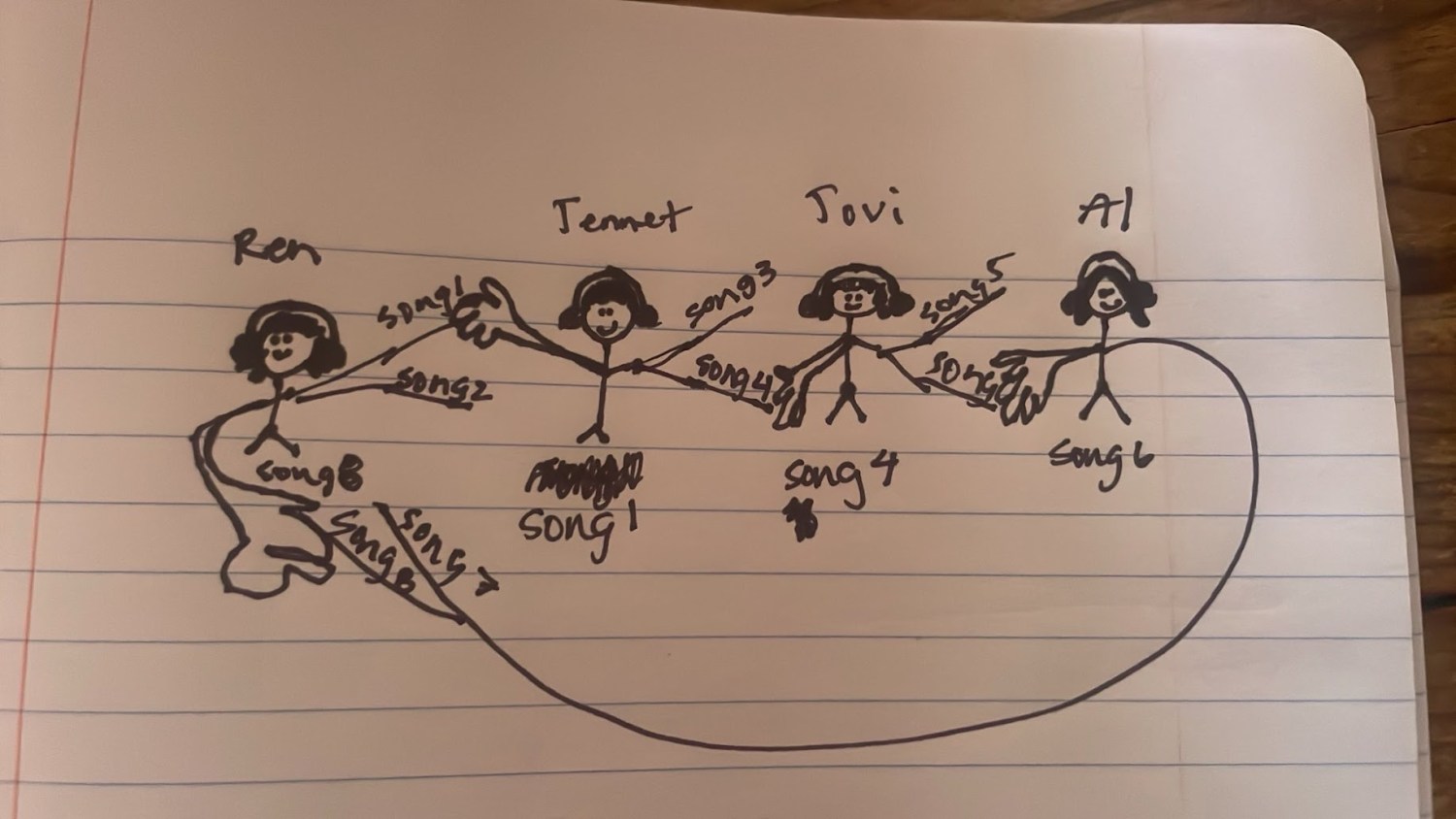
We did an exquisite corpse of sorts – starting with one of us sharing a song to the next and then that person picking a song that came to mind while listening and then sending that song to the next person and so on. I made a diagram before we started that may make it more or less confusing to understand the process (attached – feel free to include or not!). A random person who was retired from naming things for a living told AL we should change our name to heavy lifting, we aren’t gonna, but we thought it was funny and the idea will live on as a playlist. The songs are partly things we are listening to now and partly things that got pulled from our memory banks after listening to the song that was shared. It’s been a challenging month for a few of us in different ways but sending these songs back and forth and then listening to them all together has been something sweet. Hope it’s sweet for u too.
Every Wednesday, the ugly hug shares a playlist personally curated by an artist/band that we have been enjoying. This week we have a collection of songs put together by Chicago-based artist Carter Ward.
The beings that live in a Carter Ward song are filled with a deliberate sense of belonging, playing with a type of storytelling that feels immediate, scrappy and incredibly sincere as they take shape in their own little worlds. With his rich instrumental voicings, tinkerings that become fixations in his stories, each CW track ripples in the immediate pond that we all wade through; reactionary to the minor moments, the disorder, the celebrations, the heartbreak, the moments we work towards and the pieces of us that have fallen behind all become a reflection point of immunity and community. Although his last official release was 2023’s Try Again, a collection that lingers in our ears with each melodic infatuation, each conscious sound that breaks the facade, brimming with a type of casualty that is both compassionate and committed, Carter is continuously looking ahead at what is next.
Listen to Carter’s playlist here!
You can listen to Carter Ward everywhere you find music! Check out his latest album Try Again or catch him playing lead guitar in Chicago’s own Girly Pants.
Written by Shea Roney | Photo Courtesy of Carter Ward
There is something innately natural about a Lisa/Liza song, the project of Portland, Maine based artist, Liza Victoria, whose self-made path of intimate folk music has been creating a presence where much often goes unnoticed in this fast paced world. In 2023, Victoria released Breaking and Mending, an enduring collection of songs that grew from grief and found a home amongst an extensive and true journey of healing. But last week, Lisa/Liza shared Ocean Path, an EP consisting of some of her earliest recordings she made in her teens and early twenties, now put directly on tape via Chicago’s Orindal Records. Although these songs were pocketed for years, serving as a measure of time for Victoria, in its own way, Ocean Path was always meant to be shared with the world, it just needed to feel like the right moment.
The basis of Victoria’s intuitive storytelling lies within her guitar playing, where thought and feeling almost become a deliberation of a moment – transparent in the motion of feelings and capturing the environment entirely in which it was recorded in. Often tracked in open spaces, such as her kitchen or backyard, these songs fit just right in those places we deem as safe for our own being. “Summer Dust”, the opening track, plays with that same meaning of intimate stillness, the acute pieces of collective thoughts, mental dust, that begin to build when left alone for some time. “Love for two-becoming / Love for yourself / finally running through you”, Victoria sings with such acching care, sometimes almost to a whisper, as if saying it loud enough for only her to hear it. “Gamble”, one of Victoria’s earliest recordings, is a story of nature and nurture, following our inherent need for connection, and the responsibility we feel to offer it to others. “Gamble, my Father’s dog, was born in a mountain fog / Followed me through the dark, Searching for the dawn”, she sings through a striking progression of stunning vocals and vivid imagery.
There are also many ghosts that we haven’t been introduced to yet that align on “Shark Teeth” and “Then You Shall See”, bidding for their piece to be heard before going off to complete their other ghostly tasks. The word ‘haunting’ holds an authentic meaning when writing about Victoria’s work, where it often feels to be tapping into the presence of a soul which lives amongst these delicate and intrinsic soundscapes. But whatever that soul may be, whatever we feel it represents, it’s not there to cause alarm on this earthly plane, but rather to make that connection between what we see and what we feel – being that direct line between a deep longing and a deep understanding of our own place in this world.
Ocean Path is a remarkable sense of self, tracking a linear path of growth that can often be hard to visualize when you are the one laying the groundwork. These songs aren’t immediate, but it’s in the trust that Victoria has always held true to her artistry that is representative of a journey you take on your own time. It’s the dirty fingernails, the layer of dust, and a broom in the corner that becomes such a personalization of storytelling from Lisa/Liza, yet has always been beautifully universal to those who are welcomed in. As the project is now getting the chance to be shared with others, it’s best said in Victoria’s own words, “this cassette leads down paths of memory, reminding me we are always becoming and growing into who we are and what will be.”
You can listen to Ocean Path out everywhere now as well as order a limited edition cassette tape via Orindal Records.
Montana’s latest addition to the summer heat comes from the newly formed group Les Duck, who are sharing their debut single “Head Fell Off” with us all today. Coming from the pop-driven minds of Lukas Phelan (Fantasy Suite) and Sanders Smith (Soft Maybe, Wrinkles), this track is the first bit of taste-testing from Les Duck’s debut album “Love Is The Dirt” set to be released August 29th via Anything Bagel, bringing in a collection of players who embody the likings of “fast cars, loud guitars, family and friendship.”
From the daydreams that take the reins in a moment of stillness, “Head Fell Off” finds sincerity in the off-kiltered melodic fixings that Les Duck take for a joy ride with both pure excitement and full commitment. It’s a riveting collection of thoughts, unhindered by any expectations of structure or rules, where Phelan lays the dots and the sprightly instrumental voices connect em. “When my head falls off, what will they say about me? “what a fool” they will say, “though he was nice,” Phelan sings, while the track begins to unravel with charm-filled possibilities, instinctive foot tapping and a reminder that there is a bit of Timothee Chalamet in all of us.
About the single, Phelan shared, “this is a song I wrote on a walk by the river while my kids were being real wacky and getting into trouble. I guess it’s a song about feeling like a different person than the person I was before I was a parent, or at least a dumber and more scattered person. Also pondering what legacy and artistic expression means for me now that I’m like that. Not complaining though, I love it!”
Listen to “Head Fell Off” here!
You can pre-order “Love Is The Dirt” now as well as on vinyl and/or one of the Bagel’s specialty screen printed tape.
Mila Moon has always been a project that decomposes any sense of formulation, grifting amongst Isabella Feraca’s innate intuition and maturing senses. Beginning as a solo project back in 2021, finding solace in the new sounds that she would create on a whim, Mila Moon has since found new meaning in her life. And as of a few weeks ago, Mila Moon shared “In Transit”, the fourth album from the Pittsburgh-based songwriter, finding the project coming into full harvest as Feraca continues to define the space it occupies as something more reflective of where she is now.
“In Transit” becomes a vehicle in and of itself, trekking through soundscapes of genre-bending fascinations, as Feraca makes thoughts and goals feel like destinations to be met and explored. As a listener, we are taken along for the ride, accompanying the various new routes that Mila Moon travels down; finding the alt-country nods of “why” and “less” play out like familiar landmarks, while the electronic backbone of “Reprise” becomes a scenic route to the more hearty and boisterous guitar work of songs like “Bored” and “Drive Through”. It’s an album that beams with confidence as In Transit also finds Feraca bringing in a few collaborators, including a duet from Chicago’s Henry Tartt of Memory Card on the opening track “The Half”.
We recently got to catch up with Feraca to discuss the heart of In Transit, the practice of writing a ‘song’, and continuing to grow with Mila Moon.
This album has been edited for length and clarity.
So it’s now been a few months with In Transit out there. How are you feeling about it all? How’s it sticking with you?
I feel really good about that album. We’re preparing for a few shows and finally playing some of those songs live. I feel really good about the feedback that people have given me, and I’m excited to keep going in that direction and write more.
This album definitely feels like you’re really coming into this project with a lot of confidence, like exploring different sonic avenues or bringing in a few collaborators. What aspects of making this album are reflective of where you’re at in your life, both personally and as an artist, too?
Well, bringing in collaborators is definitely reflective of my life creatively. Before this record, I was trying to do everything myself. I don’t know why, I guess I had an image of how I wanted things to sound, and I really just wanted to do it myself. But for this record, I wanted to break out of that because I became aware of the limitations that exist in doing it that way. So, at this point in my creative life, I was trying to work on that and bring in other collaborators so I could go outside of those limitations and just make a better project overall. Personally, I just feel like I’ve been moving between different locations and spaces, in transit literally [laughs]. That’s what a lot of the record is about. It’s about literally physically being on trains and planes, and then also feeling that way mentally and emotionally as well.
So you had a clear vision for this project, so when it came to discovering your own limitations creatively, was that something that was easy for you to accept?
I mean, it took a couple of projects, but it’s hard to say. I guess part of why I was not really looking to collaborate that much is because a lot of the records were being recorded in my room whenever I had a chance. I didn’t like sitting on songs that much, so I would just record everything in one take. For this album I sat on songs and showed them to people and got input and recorded demos and then took in other people as well. It did take a little bit to accept, but it was more just looking to approach this project completely differently.
What sort of things did you want to approach differently?
Definitely the songwriting aspect. I feel like on previous records, I wasn’t really writing full songs, just music. But this time I was looking to write songs that could be recorded and reproduced. It was more trying to write the actual song, and maybe just recording a simple demo, and then coming back to it and figuring out how I want the final recording to sound.
It’s a very expansive collection of sounds, exploring bits of alt-country, some electro, methodical interludes, and really just more boisterous guitar work than your previous work. What things did you find yourself wanting to explore more sonically, and what new avenues were you finding comfort in that you explored?
I was definitely wanting to explore the alt-country sound. A lot of Wilco, Frog, Neil Young, and all of that. I’ve gotten to a point where I really like that sound and I like how it suits me. A lot of times my music takes shape in what I’m really into. So that’s probably why I did find comfort in that. And as I’ve started writing other new music, I’ve been exploring different sounds on different projects. But I’ve definitely found comfort in these new things, and it’s something that I want to pursue going forward.
As you said earlier, being more comfortable sitting with these songs longer, did that spark any of the different avenues that you explored, and maybe wouldn’t have originally thought to go down before?
I can remember writing a song, sitting with it, and then later, coming back to it and adding something crazy to it. Like that song “Reprise”, the last bit of it is this really insane electronic stuff that I was just playing with. I was sitting on that song for a while, and I re-recorded it like three times. I just really liked the chord progression. It’s a reprise of the second song on the album, “Scratch”. I was really unsure of how to finish it and make it exciting. But that song is definitely a product of sitting with it longer.
Does it feel finished to you now that it’s got a new life to it?
Honestly, yeah. When I added that part, I was like, ‘this is it’ [laughs]. I thought it was fun, and a lot of this album was just me trying to have fun and to play with it a little bit, just not take it too seriously.
Does it feel like you accomplished that?
Definitely. I feel like it’s a really good mix of playfulness and also seriousness.
I know the instrumentals of a Mila Moon project are very crucial, where the lyrics weren’t necessarily your biggest priority when you were first starting to write. Do you find yourself putting more weight on the lyrics that you write now to accompany these instrumentals?
Definitely. I think that goes with what I was saying about trying to write songs, where a lot of them started out with either just words or me on the guitar, just really simple bare bones stuff. Whereas Prior, when I wasn’t really focusing on the lyrics, it would be a lot more about recording an instrumental that I really liked, and then just adding words that sounded good to it. So this time there’s a lot more weight on the lyrics and just making them cohesive songs.
With the idea of being in transit a lot, what stories did you want to get across when pairing your focus of instrumentals and newfound focus of lyricism on this record?
A lot of the stories are about movement. There’s a lot of songs about me riding the train from my house here in New Jersey to New York. I was just on the train a lot, and it would be this bridge between here and the things happening there that were also in my life. It’s kind of a mosaic of different stories of my life from the past year or so. It’s not a concept album or anything, but more just pieces of things that were happening. But I was really focused on trying to translate things from my life into a song, rather than the more abstract lyrics that I was writing before.
Okay, so you’re in New Jersey now?
I go to school in Pittsburgh, which is usually where I’m based. But I’m home right now in New Jersey and every time I’m in New Jersey I’m going into the city for various things.
Do you feel settled at all? I know you’re still moving around, but with this album out, are you feeling settled as a project, or just where you’re at?
Honestly, yeah. I think before, I wasn’t really sure of what direction to take. I wasn’t even sure if I wanted to keep the Mila Moon project, or just abandon it because it’s so old. I started it when I was 16, and it’s just taken so many different forms that sometimes I don’t even know if I want to keep with this or just start something else. But I think with this record, especially with the love that it’s gotten, I’m going to keep going in this direction and see what happens.
I understand wanting some distance from something you made when you were 16. So how did this album help you get over that hesitation and decide to keep the name?
Mila Moon has sort of become less of my alter ego and more of a project that incorporates other people, which is what this album was about. I think that helped me to grow into it more. And having my friends who are in the band really embrace the name has really helped me feel more attached to it, and just feel better about what it is, and less of my 16-year-old alter ego. It’s become more of a project that’s growing and putting out records that I’m proud of.
You can listen to In Transit and all other Mila Moon projects out everywhere now!
Written by Shea Roney | Photos Courtesy of Mila Moon
Every Wednesday, the ugly hug shares a playlist personally curated by an artist/band that we have been enjoying. This week we have a dj mix put together by San Diego-based project Kan Kan.
Kan Kan revels in the scruffy intermediates; a type of rock n roll that’s not one to weigh the empathetic with the obscure, but to be the one fighting the revolution through community hubs, interior plots and definitive charm as the band has so seamlessly blended the two together. Playing to the lackluster scribes that float through their day-to-days with holy prowess, Kan Kan makes any type of formality a bit sweaty and finds engagement a bit bolder when their altruistic form of guitar rock hits its audience. As a three piece, Kallen, Joe and Cameron, Kan Kan released their last bit of music in 2024, an EP called two thousand and whatever. But as they push on, Kan Kan continues to play show after show, finding space beyond their home of San Diego, and becoming a conversational piece, a connecting thread when this band is brought up, “oh, yeah, Kan Kan? They rip.”
About the mix, Kan Kan shares;
This is a mix of selections by the band. Some to dance to, some of joes hidden YouTube gems, I also tried to pick songs of our friends that have been a constant source of peace in these dark times.
Madrone, Californias oldest friendship over everything band new album “Eponymous Debut Masterpiece” is out now.
Oldstar on tour last summer in Detroit in a dingy old bottle club. These young chaps just might save rock n roll
Crush23, Kellan and Joe also play in this band. a super group live band now of sorts.
threw in an unreleased Outwest song called “Cameron says” produced by Kraus. plus ! a new Kan Kan song “she goes by another name” mixed and mastered by Will and Jack Kraus ! Out soon on a 7inch split with Pocket Full of Crumbs out on Cherub Dream Records!!
Track listing
Monitors – Madrone Blushin (not!) – Charles The Durutti Column on the review show On The Way Home (Neil Young) – covered by David Roback Upstairs (212) – First Day Back The Mixer – The Fall Spring – Edaline How About Hero – Kelley Deal 6000 York Blvd – Acetone Skyskrape – Idaho Vivea – Ariel M Self Ignition – Silver Jews chairs in the backyard with Parke – Kan Kan Wallflower – Bob Dylan Pop Song/She Liked Horses – Oldstar “Broken Hearted At The Bottle Club” Live In Detroit (2024) Silver Shoes – Ampersand She Goes by Another Name – Kan Kan Locket – Crush23 Twins – Calla Ward Any Day – Bizarre Anyones Style – Daisies Slowfire – Sciflyer Can’t be Bothered – Idle County To Be Rich Should Be a Crime – Cola Boyy Cameron Says – Outwest Four – Elm
Listen to Kan Kan’s mix here !
Listen to all things Kan Kan everywhere now!
Written by Shea Roney | Featured Photo Courtesy of Kan Kan
 the ugly hug