Dan Knishkowy, the creative stamina behind the New York project Adeline Hotel, recently announced the project’s return with his new record Watch the Sunflowers out October 24th via Ruination Records. Today, the ugly hug is premiering the second single “Just Like You”, a stunning display of attachment and self-agency in the face of a deeply rooted patterns.
“Dog tooth violence, rare blood run. Where’s my wild rose? Where will I become,” Knishkowy begins, his words linger like footsteps in an empty hallway, each step more and more pronounced as the direction and distance becomes more clear. As the track falls into its groove, ruminating in varying textures of strings and rich colors of instrumental shadows, a defiant guitar solo breaks through, dripping with distortion and unaligned with any classic structure, as “Just Like You” becomes a dynamic exchange, a transfer of self as Knishkowy pulls from this deep need to disengage with what he knows best. It’s a song that grapples with the ghosts that we have yet to become acquainted with, but Knishkowy’s writing has always held an edge to perspective, animating their presence with both curiosity and foretold hindsight when the moment comes to look those ghosts in the eyes. And in classic Adeline Hotel commotion, he shakes out the dust of folkloric expectations as the fluent instrumentation, the crack of the drums and the weightless harmonies begin to pack up their belongings and make their way to the door.
About the single, Knishkowy shares, “We started Sunflowers and left it unfinished for years. On returning, we felt inspired to totally reimagine it, ripping it apart to its bones and rebuilding it into a kaleidoscopic experience. We very much took the Yankee Hotel Foxtrot approach of ‘well, we made it, so we can also destroy it if we want to.’
The song itself mirrors that process, taking a hard look at ingrained patterning and the attempt to grow beyond that. Whether inherited generational trauma (‘in the hallways of my skin’), or the safe appeal of culturally sacred institutions, the narrator decides not to acquiesce any longer to the ease of familiarity (‘I cannot kneel’).
The titular line remains elusive still, even to me. Is it ‘I’m just like you’, a self-aware acknowledgement of how deep that conditioning goes, or ‘I just like you’, the rare feeling of connection you find with a person also committed to breaking these cycles?”
You can listen to “Just Like You” anywhere you find your music as well as preorder Watch the Sunflowers on vinyl.
Generifus is the long-running project of songwriter Spencer Sult, who today is sharing Best Of, a collection encompassing twenty years of songwriting released via Perpetual Doom. Coming up through Olympia, where projects like Generifus have been acclimated to the ever-shifting scenes, Sult still manages to craft his own path through the years, building up a project of fulfillment and joy as he now reflects on his time sharing music.
I first became privy to Generifus after 2023’s release, Rearrangle, when digging through the catalog of Butte’s Anything Bagel and Portland’s Bud Tapeson their split release. This record became a haven of connections, a collection of formative stories that lived full lives within these lighthearted tunes. But with each release over the years, Sult’s words have stuck with both fondness and experience, like snacks for the road and change in your pocket, something to hold on to for when you need it most. With albums like 2012’s Back in Time or 2016’s Peace Sign Rising, his writing became rooted in both placement and perspective, where the minor moments of joy, confusion, heartbreak and clarity become a reflection point that we can all anchor to. With such a deep catalog to explore, Generifus paints a picture much larger than we can initially take in, but Best Of is an album built on gratitude, understanding the role in which sharing music has played in his life, and offering a space to look at how far he has come.
We recently got to ask Sult a few questions regarding the Best Of release, reflecting on his career and sharing music for two decades.
Photo by Sarah Cass
This interview was conducted over email
What does it mean to you to have such a long-term project? Did you foresee the longevity in this curation and creativity when you were starting out back in 2005? What made you keep returning to this little world you have constructed?
Having such a long running project makes me proud and also gives my life meaning, as the project and my life are pretty completely intertwined after 20 years. When I was starting out, I did not foresee anything in particular. The project began as mostly instrumental and ambient, I had no idea I would even learn to write songs or sing at that point. Once I started playing shows, things progressed gradually and everything I did from then on made sense under this project name. I sought advice about potentially moving to performing under my own name around 2019, but it didn’t seem to be a smart move based on the body of work I had already created as Generifus.
Looking back now at your catalog, are there any risks or shifts that you tried out and can look back on with fondness as a memorable moment in the project’s history? And vice versa, anything you can look back at and maybe laugh at and be okay leaving in the past?
Both in recording and live performance, starting to collaborate with other people on my music has been the biggest and most rewarding shift. I believe that listeners can recognize my music regardless of who’s playing with me, based on the mood and my presence, but many of my favorite moments on records are those played by others. My song “Wouldn’t I” where I rap a bridge is a bit silly and caught in a certain moment where I was trying to interpret Young Thug and Gunna in the way that Kyle Field had with Lil’ Wayne. It is slightly embarrassing now.
What sort of things were you discovering about yourself and the stories you were writing from as you were starting out? Has that lens shifted as you got older? Are you able to make sense of a path or linear growth through your catalog as you look back on it now?
When I was starting out, I relied heavily on imagery and metaphor for my songwriting content. Over time I felt more comfortable including personal references, while never being fully confessional or self-referential. The sweet spot that I have found success with has been to create vague but recognizable imagery coupled with specific relatable details. I think that the variety of songs has grown and changed along with me, not necessarily linear but definitely always shifting.
What were the conversations around creating a ‘Best Of’ album for Generifus? That practice feels rare these days, more of something you would pick up in an old CD collection. Does that nostalgia factor play into this release at all for you?
I had some great Best Of and Greatest Hits CDs such as Tom Petty and Fleetwood Mac and they are always a good entry point for any artist. Especially those who may not have physical music in constant print. Nostalgia was not a huge factor in deciding to work on this release, but I did want to create a good starting point for my large back catalog.
How did you go about choosing which tracks best fit this momentous project?
To choose the tracks for this album, I started with my Olympia-era releases as the earlier material was somewhat rough and not as memorable. I picked songs that were performed often, ones that I’ve received lots of good feedback on, some that have amassed relatively higher streams on Bandcamp and other streaming services, and some that were favorites of the band to play live. I tried to spread the tracklist pretty evenly from those albums from 2009-2023.
Beginning the project back in 2005 with a handful of self-releases, and then continuing on, working with new people, friends and labels more frequently, how did this project shape the way you approach collaboration and relationships, both in and out of music?
Relationships formed from musical collaboration are so important to me. When I listen back to the Free Ways album, for example, I think about the fun times we had recording it in Anacortes as much as the songs. I’ve toured and hosted shows, and made music with so many people over the years. This is the basis of my social life and most of my relationships. While there hasn’t been a ton of outside recognition or material success from playing music, the moments created and bonds formed have given my life deep meaning and significance.
You can listen to Best Of anywhere you find your music as well as purchase a cassette via Perpetual Doom.
Written by Shea Roney | Featured Photo by Sarah Cass
Today, Motocrossed share “Drown (Country Girl)”, the second single off their upcoming debut self-titled record out October 3rd via the legendary Trash Tape Records. Coming up through Charlotte, North Carolina, this band is nothing new to the surrounding scene, although there have been some notable changes. Originally named sayurblaires, the project was formed by songwriter Blaire Fullagar, leaning into territories of digital soundscapes and emo inspired song structures. But sayurblaires soon became a project embedded with collaboration, as Colin Read (guitar), Caroyln Becht (drums) and AJ George (guitar) joined the live crew, before shortly offering to the writing process for new songs between 2023 and 2024. What came out was this newfound level of alt-country chaos as Motocrossed became the next step for the NC musicians.
In a clash of noise, Fullagar asks, “Do you wanna walk and laugh along the streetlights? We can just talk and pretend everything’s fine,” her voice falling into the motion with both confidence and an underlying layer of trust that there is something below to catch her in case she gets ahead of herself. And with that, “Drown” becomes a team effort, a culmination of distinct voicings that each bring something unique to the track, and cultivating this scenic dispute of love, curiosity, heartbreak and comradery. In the same way that we all know that Walmart parking lots have the best sunsets, the amount of noise put into the environment brings out the best of each color; loose harmonies shooting the shit amongst distorted guitars, a fiddle doing what it does best, and the rich tones from a few sax runs pull us closer into the ruckus. “Country Girl, you’re my world. But I’m not sure you should be just yet,” feels messy, but pure, and you can’t help but admire that feeling.
We recently got to talk to Blaire and Carolyn about “Drown (Country Girl)”, shifting genres, and what this project means to them.
This interview has been edited for length and clarity
You made music under the name sayurblaires for a while, but now shifting genres completely and now writing and performing under the name Motocrossed, what sparked you to want to reset everything?
Blaire: So, in 2023, we started the sayurblaires band, and we would play renditions of songs on the sayurblaires album as a full band. They were fun to play, but I feel like we kind of got detached from them and we started to write new songs. They were all just way different, because I switched to writing on guitar instead of just on my computer. They turned out a lot different, of course. And so, sayurblaires just didn’t feel right, especially because we formed the band, and then it felt like we all wrote these songs together by the time that they were actually written as a full band.
Carolyn: And it was so sonically different from what we were doing as sayurblaires, which was like, a digital, emo, screamo project, and this is, way different conceptually, unrelated almost. Not unrelated, but… we’re calling ourselves alt-country now.
Blaire: The songs that we would play, the songs that eventually became Motocrossed songs, we’d play them in the middle of the sayurblaires set, and it would feel really bizarre, honestly. So, it just felt right to switch to Motocrossed, and we’ve just played shows under Motocrossed, and we’ve only played Motocross songs since then.
Did you find that there was a shift in the shows you were playing and the crowds that were coming out?
Blaire: Yeah, when we were sayurblaires we played with bands like Your Arms Are My Cocoons and Awake But Still in Bed, which I don’t think we would have gotten those shows now. They probably wouldn’t have reached out to us. It was cool, I like those bands, and I do like emo, but ultimately, now, bands that I like a lot more are reaching out, and I feel like I’m just more in the scene that I’ve always listened to.
As that original four-piece, was it natural for everyone else to adjust to this all-country route?
Blaire: Yeah, I mean, I think everybody was super down for it, especially having the ability to write their own parts instead of the ones that I wrote for them. I think it naturally played out well. Like AJ [George], our guitarist, listens to a little bit of alt-country, but mainly they listen to a lot of really, really heavy shoegaze, so what they provide for the band is all the heavy parts. And then I feel like Colin [Read], our other guitarist and lap steel player, listens to a lot of everything, so Colin’s playing just kind of goes off of whatever the thing calls for. I think that it just naturally worked out perfectly.
With these singles, it sounds like there’s so many different voicings that you’re trying out, that it feels like it should be chaotic, but it works really well. Especially going from a 4-piece to 6 members and counting, how does this inclusion of new players represent what you wanted this project to be as you were continuing to shift and evolve and try something new?
Blaire: When we started recording these songs, I already had in mind that I wanted it to be a big band. I mean, I still want to keep adding people, I’m not against going up further. I just started reaching out to people to record on these songs that I had written. Like, the 8 songs that we have right now have probably gone through 6 or 7 versions each, just sounding different from having different people record on them.
With your new single “Drown”, you’re writing about a relationship of love and worry and complexity. What did this song mean to you as you were choosing singles and how did it come together?
Blaire: I write songs in a way where I will write one part, and then that part kind of sticks with me for a while. And then eventually, I’ll find another part that goes with it. So, this song existed as three separate parts. There was the beginning, and then the middle part, the country girl part, and then there was the end. And it came together nicely once I sat down and really wrote it. But, I’d say, more than anything, it’s just a love song. I’ve had a long on-and-off relationship for 10 years that’s messy and complicated, and that’s ultimately what it’s about. The album in general is a lot of love songs, but more than anything, it’s an album about being in love with music and the people around you. “Drown” doesn’t really feel like it’s specifically about one person in any real way, but I think it’s a good representation of the album.
You can listen to “Drown (Country Girl)” anywhere you find your music. Motocrossed is set to be released Oct 3rd via Trash Tape Records which you can preorder now!
Written by Shea Roney | Photos by Valentina Calderon
Every Wednesday, the ugly hug shares a playlist personally curated by an artist/band that we have been enjoying. This week we have a collection of songs put together by Toronto-based artist Eva Link of the project Triples.
Originally formed as a duo with her younger sister Madeline Link (PACKS) on drums, Triples was a force, glimmering and carefree, singing rock songs that beamed with playful melodies and distortion that tangled up loose harmonies like a knot of twinkle lights. Their last full length was 2019’s Big Time, where songs of growing pains became something like a pillow fort with a sturdy foundation; a commemoration of what it meant to be disheveled, curious and imaginative in hindsight of everything you now know. Last year, Eva released “So Soon”, the first new Triples track in a a handful of years, offering a blast of both energy and sincerity; returning to the ruckus, where dance parties are scheduled because you know they’re good for you and where laughing so hard you snort through your nose is the most genuine sign of endearment.
About the playlist Eva shares;
I like to take my dog on walks in this big forested park near my house and it’s so sublime in the fall when all the leaves start to turn, the sidewalks are wet, there’s a little chill in the air. When Autumn comes around I always feel more introspective and moody and love to indulge in those feelings by listening to a playlist like this while wandering around Toronto. This playlist is a combination of 90s shoegaze-y songs, melancholy folk, and experimental indie rock that I thought all had a similarly wistful tone that would pair well with a misty fall time moment.
It’s the end of the summer. The moon is uncomfortably warm, the air is stale and still, and it’s so thick you could cut right through it. The late August nights bleed together with machine-like efficiency, and in the atonal drone of the remaining cicadas’ final chirps, an intangible feeling of intense dread swarms all daring enough to step out into this unforgiving night. The drive home is white-knuckled. The hypnotic glare of oncoming traffic engulfs the reddened retinas of the late-night travelers. The machine whirs. It feels as though everything might come crashing in at any given moment.
PORTRAiTS, the debut full-length from Kentucky-based art-rockers PARKiNG, captures this unforgiving sense of dread, unease, and mania with haunting accuracy. Its sprawling and oftentimes politically charged sound is a perfect fit for the ledge, for the cusp of collapse, and for the dreadful isolation of twenty-first-century America. Spanning ten tracks and clocking in at nearly forty-five minutes, ‘PORTRAiTS’ features pulsating post-punk explosions, haunting orchestral abstractions, and fresh takes on the last half century of art and noise rock.
‘Siren’ starts the record with Frankie T. Moore and Lizzie Cooper’s hypnotic, driving rhythm section. They’re accompanied shortly thereafter by Boss Benson’s guitar, which dances in the nostalgia of late 70s UK post-punk. Moore exhales over the sprinting track as he shouts one of the album’s defining decrees, “Feed into the sirens/Everyone knows the silence.” As the song chugs, it grows more manic, more disjointed. Benson’s guitar growls and shrieks in feedback, Moore’s wails grow more pressing, and Cooper’s bass never relents. The song crescendos into a swirling wall of sound around Moore’s non-lexical vocables.
Immediately following is ‘Thirds,’ a quasi-sung-spoken art-rock track that features the first of Moore’s manic, drowned-out narrators. Moore rambles his dissatisfactions and disillusions over Cooper’s stabs and Benson’s beautifully shambolic guitar. The monologue wanders and backtracks through conversations about the plausibility of a higher power, distressed linens piling up, poor reading material, and frustrations with socially constructed hierarchies. Its verses read like a dejected manifesto on disillusionment with the general state of well—just about everything. The singular glimmer of hope amidst the disillusionment is shouted in the chorus; Moore empathizes with our collective frustrations and isolation as he shouts, “It’s not your fault you’re out of place.”
These frustrations are further explored in ‘Lantern’ and ‘Mike Johnson is a Mechanic,’ two of the album’s most politically driven songs. ‘Lantern’ drives and bounces like a lost Joy Division track. Moore’s frantic drums are reminiscent of Stephen Morris, and Benson’s jagged guitar reads like an amped-up Bernard Sumner riff. ‘Mike Johnson is a Mechanic’ is one of two songs with leading vocals by Cooper (the other being ‘Statements’). Her blasé delivery paired with the
dancey instrumentation creates the record’s catchiest song and one of its best. She encapsulates the recurring thesis of frustration, taking political aim at our inherited issues and apathetic leaders, saying, ‘Once more/I’ve grown so tired.’ Moore maniacally shouts beneath her, and Benson shreds the record’s catchiest riff.
‘DSGN’ and ‘Observation’ are two more extremely well-crafted songs. The band proves that not only does it have something to say, but it can also produce extremely catchy and well-engineered tracks. ‘People Running Madly to Some Kind of Monolith’ is the first of two orchestral tracks. The ghastly whines of Moore’s violin, cello, and bass haunt the three-minute runtime until it dies out into swirling static and feedback. The white noise bleeds crimson into ‘Monolith,’ a seven-minute post-rock exploration of mania, dread, and delusion. This is the record’s defining piece.
Chains rattle, Cooper’s bass stalks, Benson’s bowed guitar screeches, and Moore begins his sleep-deprived, haunted narration. Moore begins speaking of his premonitions, ones so vile and so filled with dread and hatred that he “can’t bear to watch.” Benson’s guitar moans in eerie notes, and Moore pounds his drums as his narrator grows evermore paranoid: “The lies brought to attention by no one of importance. Lies that I have brought to my own attention.” He stands beneath a nauseating night facing an unknown crowd, putting us face-to-face with one of his delusions, “The wind is dark/Their eyes all glistening in the rather unpleasant but warm moonlight.” He reads this exhausted and indifferently as if trying to justify and cling to his remaining sanity.
Moore’s mania grows, and the instrumentation follows; it feels as if everything might collapse in on itself. With one final attempt to retain his sanity, he shouts the thesis for the album’s mania, “I fear/I fear what I fear might not be real.” It’s not enough clarity, and the hysteric instrumentation—the mania—overtakes Moore. Benson’s guitar screams as he bludgeons it, the drums frantically sprint in every direction, and Cooper’s bass and backing vocals loom over the volatility like the “dark wind.” Moore shouts nondescriptly, but he’s silenced by his own mania.
It plays like the score to a lost Edgar Allen Poe text. Perhaps much of the record does. ‘PORTRAiTS’ deals in mania, but the issues its narrators face are very real and very pressing. In a culture and country where isolation and extremism have spread like a common virus, ‘PARKiNG’ offers a complex take on 21st-century America that is uncompromising and blunt in its horrors yet hopeful in its anthemic refrains. Maybe amidst all this dread and unease there is comfort; maybe that comfort is simply that it isn’t all our own faults. ‘PORTRAiTS’ is the announcement of a band that can craft intelligent, ornate, and catchy songs. Their voice is distinct, urgent, and sincere.
PORTRAITS is now available anywhere you find your music. Tapes are available on the band’s Bandcamp.
Edging is a Chicago based four piece comprised of self proclaimed “Landscaper Punks”, who make (Ugly Hug proclaimed), really fucking awesome music. Yesterday, they shared “Scam Likely”, the single the latest addition to a discography packed with overripe frustrations, charged vocals, animated riffs, and plenty of innuendos. The unapologetically explosive “Scam Likely” is a vibrant punk track that confronts late stage capitalism and the piggish mercenaries upholding unjust systems that are, well, a scam. Lines of “You take what you want”, and “you wish I wasn’t born”, and “suck up all the money”, are whacked with charged repetitions “scam likely” that beg to be sung along to. Luckily, there are plenty of opportunities for this, as Edging leaves for tour this week supporting Lambrini Girls.
Recently, our photographer David Williams took photos of Edging in Chicago. Listen to “Scam Likely” and check out the photoshoot below!
“Darla is sort of like your alter ego… the person you thought you were going to be, but maybe you’re not.” Is it a love letter? A letter from a former enemy? Or maybe a reflection of who we want to be? Love, Darla, the newest release from NY-based duo Laveda, perhaps comes from a place of wanting. We reflect on choices we don’t make, wondering how our life trajectory would’ve changed. Filled with noise and the hustle of city life, this latest project aches to be in our headphones as we walk across streets and alleyways.
The ugly hug recently had the pleasure to sit down with Ali Genevich and Jake Brooks of Laveda, to talk about Love, Darla and more.
Photo by Julia Tarantino
This interview has been edited for length and clarity.
Who’s Darla?
Ali: Darla is sort of like your alter ego or maybe that person that you thought you were going to be, but maybe you’re not. It’s the person that you wish you were.
Jake: If you made other decisions in your life in an alternate reality. She’s definitely a badass.
Is she the narrator of this album?
Ali: I would say so! It’s not always in a first person or omniscient sense, but I would say so. I think every song has a different version of her.
I wanted to talk about “Strawberry,” your latest single. You guys talked about how it is very formative in the evolution of your creative processes, where it gave to a fully realized sound after being tested live. When did you know that the track had crossed from being a live track to being a fully finalized version?
Ali: I feel like it was on tour. At some point, we took it out in March of 2024, and we had it and “Heaven” sort of demoed out. And we had an idea of what we wanted to do for the next record, but most of it wasn’t written. And we were like, “Oh, we should take these two songs out on tour and see how they feel in a live setting and make some adjustments and put our own little flair on things.” And I think that “Strawberry” had a very natural evolution, where we would play it, and vocally I remember trying some new things and straying really far from the original vocal performance that I did in the demo. So by the end of the tour, we had a version that felt very different. And just the energy that it was evoking, I was like, “Okay, I think I want the rest of the record to sort of feel like this.”
Jake: I think we knew maybe after our tenth show in Austin.
Ali: We were playing a lot of shows in one week and doing the songs three times a day almost. So, you have a lot of time to think about the set and think about what you’re doing, and you have a lot of creative freedom when you’re playing that much. I don’t know if I would recommend it necessarily, but it was fun in some ways. It was cool to spend that much time with one set too. I think that was about the time we figured it out and then the rest of the record came later, but that definitely inspired everything else that came later.
You talk about a feeling – with the context of New York, it kind of feels like walking around at 4 a.m. maybe with some dark alleyways. What imagery do you invoke from it? Is it intentional at all?
Ali: Definitely walking, movement in some way, I think just goes hand in hand with the record. Whenever I’ve been listening to some of my favorite records since moving here, it’s been in transit. It’s just sort of that chaotic movement feeling and headphones specifically. I think it’s like a very headphones listening sort of record, so you can just be in your own world, while everything else is moving past you.
I love that. You also mentioned playing unfinished songs during your sets – did audience reactions ever shape how the songs ultimately developed?
Ali: Definitely. With “Strawberry” specifically, I think my vocal performance had a lot to do with what feedback we were getting at the end of shows. I would have people say, “By the way, I really like when you would scream during that one song.” And it would be something that I was trying out, and so I definitely think I took that to my heart for sure. And I was like, “Well, I like doing that too.”
You guys also mentioned digital burnout before. How does it feel to navigate the tension of needing to promote yourselves while also being drained by this personal burnout that you guys experience?
Jake: I think it’s a never ending struggle. We’re on our phones a lot promoting. And I think that goes for everybody that does something that they like doing, I feel like American commercialism and capitalism bleeds into everything that we do. It sucks and it’s annoying. I think that digital burnout definitely is like the most modern way of experiencing being sick of capitalism. Music is supposed to be about hanging out with your friends and meeting people. That’s one of the things I really like about music, is that you go to all these small cities and towns and they welcome you into them, you know? And you meet so many cool people out of it. It’s such a local thing, playing music and going to different cities, you just meet all these people that are so present in their own reality. And so it feels weird and superficial to be doing stuff like that, and also having to be promoting yourself and selling a product. It’s a tough thing to navigate.
Ali: I’m excited that the label that we’re working with for this record were like, “Sure, selling records is good, but at the end of the day you should be focusing on the music.” It’s cool that they recognize it, whether or not we can do it. We all work day jobs, but I feel lucky to even be able to put out a record, and that people care about it.
I wanted to talk about one of your songs, “Cellphone.” I think that’s one of my favorites off your record. I got to look at the lyrics and I particularly like the repetition of, “I don’t need to know that my hair looks like a boy.” To me, it captures unsolicited critiques, projecting insecurity, narcissistic tendencies, and such. I was just wondering more about the story behind it.
Ali: Totally, I feel like you hit the nail on the head. It’s funny because when we first wrote that song, it was really just total gibberish that I was singing into the mic for the demo. And I just had this melody of “I don’t want to be your girlfriend anymore, I don’t want to be your boyfriend anymore.” And then I had the hair lyric, and was like “God, I should probably change that, it doesn’t make a whole lot of sense.” And then I remember for days, once the song was totally done, thinking I gotta come up with other lyrics. Then so much time passed and I was like, “I just can’t sing anything else there,” like it made sense to me and that’s what I was feeling behind it. It doesn’t matter what people say, but it’s just, like, why do we even need to think about it? It’s like, you’re upset about it, but you also don’t give a fuck at the same time.
You’re celebrating the record with a release show at Baby’s All Right – what does playing that stage mean to you?
Ali: We’re super excited, it means a lot!
Jake: We grew up as a band hearing the mysterious tales of Baby’s All Right and how amazing the place is. It’s kind of a milestone thing to play there. We played there once, opening for our friend’s band and now we’re excited to headline it.
Ali: The sound is so good there and the staff is so awesome. It’s gonna be the craziest Tuesday ever.
What do you hope people will carry with them about Love, Darla, especially after the show?
Ali: I hope they have fun! I hope they can release some sort of energy at the show, because the record is very fiery and a big release of energy. I hope they can let go of something and just enjoy themselves.
You can listen to Love, Darla anywhere you find your music as well as on vinyl and CD via Bar/None Records.
Written by Chloe Gonzales | Featured Photo by Mars Alba
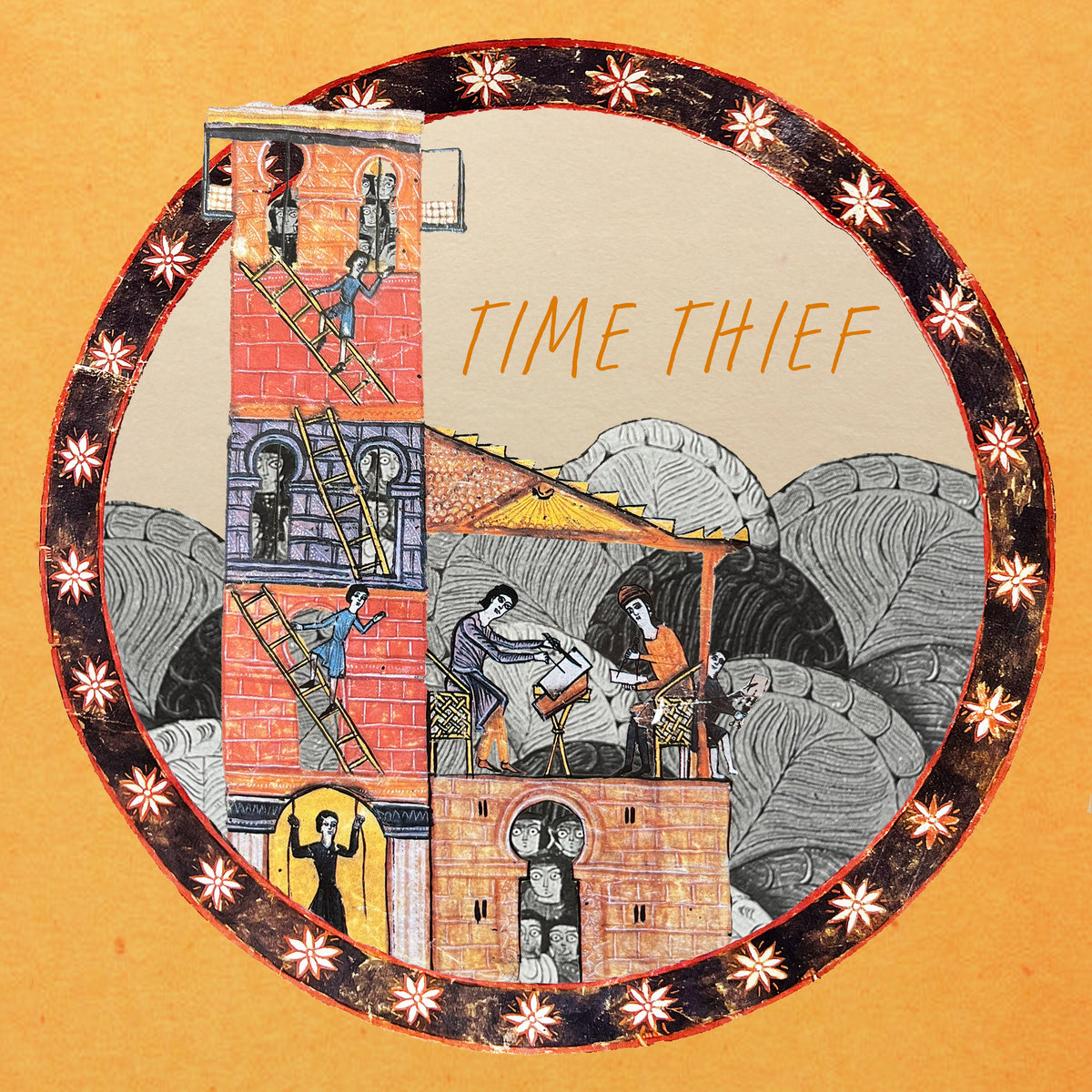
“So hold on tight and see how they fly!” Time Thief is Providence’s new duo of Zoë Wyner (halfsour, zowy) and James Walsh (Dump Him, Musical Fanzine Records), who today share their debut self-titled mini LP via Lost Sound Tapes and Musical Fanzine Records. Wyner and Walsh last collaborated on dump him’s 2017 release Venus In Gemini, and soon after had a falling out and went their separate ways. But now starting fresh, bringing what they each know best to the table, Time Thief is a testament to both collaboration, friendship and the craft.
Reshaping their approach to song writing, Wyner and Walsh decided to switch off on vocal and instrumental duties for each track. What came out of that practice were six songs that flow like little doodles in a sketchbook, where people and places interact amongst the most nuanced depictions of the world and are never deterred to lead with a bit of whimsy. As the jangly instrumentation takes you for a light jog, keeping pace with the energy brought out from a beloved punk rock antiquity, Walsh and Wyner shine amongst their sweet melodies and intuitive harmonies. Although written with such care and experience, Time Thief bubbles like teenage daydreams, where moments of absurdity and humor weigh just as heavy as love, heartbreak and promises. And it isn’t long before Time Thief’s tunes stick to you like bubblegum in your hair and a skip in your step.
We recently got to catch up with Walsh and Wyner to talk about the new project, what collaboration means to them, and the album’s accompanying zine.
Having worked together in previous projects, but also coming from being friends to enemies back to friends, how does this project represent the spirit of collaboration in both of your lives? Do you find that collaboration in general has shaped the way you approach your relationships in and outside of music?
James: So, for context, Zoë and I played together in my old band, DUMP HIM, from 2016-2017 and made a record together then. For a bunch of reasons that we have since worked out and don’t even feel like my business anymore in the year 2025, that friendship ended really poorly and we didn’t speak at all for about 6 years.
In terms of your question, there are a few things that come to mind. I think the way I have conceptualized collaboration has changed drastically since then, both artistically and interpersonally. In 2016/17, I was 20 and doing what I thought of as a “solo project that other folks played in” and wasn’t really recognizing how much time, effort, and energy others put into the project. Maybe I wrote the foundation of the songs, but none of those songs would be anything but me and a guitar without the parts that others wrote. It’s really important to me that I properly understand and acknowledge the contributions of others in everything I do from here on out.
When we started to write songs for time thief, Zoë and I had already talked a lot about what worked for us in the past (and what didn’t). It became clear that with this project, it was really important to both of us that neither of us would be the main songwriter, and we thought it might be fun if neither of us had a set instrument that we played – one of us brings a song in, and the other adds an idea on whatever instrument we feel like. We recorded all these songs for three instruments, and play as a three-piece live with one friend or another joining us on whatever instruments they feel like playing, which means we end up in different configurations from one show to the next.
Zoë: I’m someone who has really strong aesthetic sensibilities / a LOT of strong opinions and it has been a really big but good challenge to put some of that aside for this project. It has definitely resulted in some fun outcomes that are not what I would inherently reach for myself; I’m really proud of the music we’re creating together.
James: And naturally, the way we all approach our bands is going to reflect the way we navigate our interpersonal relationships, too. I definitely had a lot to learn about collaboration in a lot of different ways when we first knew each other. I certainly would have said back then that community and relationships were important to me, and I had read a lot of like, anarchist theory and DIY punk manifestos that talked about how to relate to others, but I don’t think I quite figured out how to live by my own principles to the degree I thought I had back then. I think the key to a lot of it was really just learning to listen to others without projecting, and coming to my relationships as honestly as possible. I’m still learning!
Zoë: I relate to this last piece in a big way and am definitely still learning too!
What aspects of your respective styles, processes and backgrounds did you want to bring out on this EP?
Zoë: I don’t think that we had a ton of clear goals coming into this project around what we hoped to reflect sonically. We did talk a lot about the music that we liked (we do this constantly), and things that we were most proud of that we had written/recorded before, but past that we let things happen pretty organically. I’m someone who often will say “I want to be in a band that sounds like x, y, or z” and it never quite works out that way. I was a big sing-in-the-car kid (like, would constantly write 20 minute long rambling songs while on road trips that had no clear destination), and I still feel like a lot of my writing starts the same way it did then. I have certain melodic sensibilities that make sense in my head and it’s really hard for me to get past those/emulate other things I love and would like to be associated with. This does sometimes leave me wondering where my music fits/who my audience is, but I’m not totally sure how to go about this any other way.
James: For the most part, I wasn’t thinking about what I wanted this EP to sound like while we were writing the songs. I know we both wanted to feel able to let ourselves make music that felt true to ourselves, and I knew I didn’t want to limit myself in ways I had in the past. We love a lot of the same bands, and there are also a lot of bands that I absolutely love that Zoë doesn’t get (and some that she likes and I don’t care about). I tend to vibe with stuff that Zoë might find too sing-songy on one end of the spectrum, or too aggressive on the other. She tends to gravitate towards stuff that is a little more musically complicated (one of her first favorite songs was Mother Whale Eyeless by Brian Eno and mine was Baby One More Time by Britney Spears, she was raised by an audio engineer/musician and I was raised by a Bon Jovi superfan, etc). We share a love of C86/Flying Nun/indie pop, ‘00s Australian indie rock, early music (except she’s more Monteverdi and I’m more chant), and Grass Widow. I don’t think that all came through here, but I don’t want to sound exactly the same as all the bands we like, y’know?
Otherwise, I think the most notable conscious change I made was my approach to writing lyrics. I got deep into music via hip hop, mostly a lot of conscious stuff, and then feminist punk. Lyrics were what really won me over, and I used to think really hard when writing them. Zoë is someone who can sing along to a song without even realizing what the words mean until it’s pointed out to her. And when she writes lyrics, it’s all really natural, but still can be really poignant. I took some inspiration from her there and let myself go with the flow when writing this time around.
One of the singles you released called “A Brief History of Ordinary Letdowns”, you said, showed a different side of your collaboration. What did this sentiment mean to this song and the rest of the EP? Where did your differences as creatives bring out these songs, and did it take this EP to places that you didn’t expect to venture?
James: Zoë said that about the song, so she’ll have to clarify, but I think “A Brief History” is a bit softer than the other songs. That was the song on the record that was most inspired by Sarah Records bands like The Field Mice. I always think of Sarah bands (and the label) as being super vulnerable while simultaneously operating in a way that is punk as hell, which is really inspiring. I think a lot of people conceptualize punk as stuff with raw energy or a certain sound or look, and I don’t – for me it’s more about the principles involved. That said, I still used to be really self-conscious about writing softer songs. Like someone was going to judge me for not being punk or whatever. Which has happened, and I really don’t care anymore. I have a Sarah tattoo now, fuck ‘em (i’m joking, kind of). Anyway, writing this song felt like I finally figured out how to access that mentality creatively. Like, I asked Zoë to play mellotron! There are no live drums!
Zoë: Yeah “A Brief History” is the one time thief song where I feel like some of the sensibilities from my other current project, zowy (pronounced the same as my name in case you were wondering), came into play in a way that I really like. I have played in other indie pop/rock bands that usually consist of more standard rock instrumentation (guitar, bass, drums) – zowy is the first time where I’ve branched out and allowed myself to explore the world of synths, vocal processing, and drum machines. It was really nice to be able to bring some elements of that into this project, if just for a moment. I also love this softer energy coming from James. It really feels like they are being true to a different side of their songwriting tendencies that is so special to see!
You also made a zine to accompany the physical releases of this record, going into some background of the band as well as how the recordings came to be. Why did you two choose to preserve and document this moment of collaboration and creative process? Especially considering it gets pretty specific into your recording setup and equipment.
James: This record came out on a label I do called Musical Fanzine. The whole idea of the label is to get bands to create more joint audio + zine releases. I got into collecting physical media in the first place because I wanted to learn absolutely everything about what I was listening to. I would buy a pile of CDs of albums I had already downloaded, hoping that they’d all have robust booklets – or at least lyrics inside, and I’d always be disappointed if they didn’t. Booklets are kind of like zines in a way – I mean, I’m thinking about the booklet for something like Bikini Kill’s C.D. Version of the First Two Records. It totally blew my mind with how thoughtful it was. In encouraging bands to make zines, I’m trying to do my part to keep physical media sacred in a really online world.
Zoë was pretty against having any lyrics anywhere in the zine (we are polar opposites in that way), and tasked me with all the writing (she did the layout), so I just wrote about what I knew – since I recorded the EP, I focused on that. As someone who has been teaching myself about sound engineering a lot over the past 5 or so years (after discouraging myself for about a decade before that), I do a lot of reading about the making of records. I always wished that info was more accessible. Sound engineering is something that can be gatekept, and really expensive to get into. I’ve experienced that a lot. It can be especially hard to work up the confidence to try or figure out how to learn that shit if you don’t come from money or aren’t a dude. I guess I just wanted to show that if my dumb ass can figure this stuff out, so can some other random queer kid, and here’s how.
You go beyond the band in your zine, mentioning both influences and recommendations in your local Rhode Island setting. What do these spaces mean to you as members of the community?
James: I moved to Rhode Island in a bit of a whirlwind time of my life; it almost felt like I ended up here by accident. That said, I’m so grateful I did. I grew up in Eastern MA, which is prohibitively expensive now, and Providence really feels like the closest I can get to it in a lot of ways. The music community here is so welcoming and creative and there are truly so many freaky geniuses that really think outside of the box – I’m really grateful to share space with everyone here, and I think we just wanted to shout them out.
Zoë: I agree with so much of what James said. I’m a visual artist as well, and this is the first place I’ve lived where I don’t really feel as though there’s a ton of competition within the various creative communities that I’m a part of. Folks are really supportive and encouraging, which has opened a lot of doors for me as far as pushing myself creatively goes. It is hard seeing the city shift and change, with more echoes of Boston apparent pretty much every day. As someone who used to live in Boston and moved to RI about five years ago, I’m very aware of my part in this. I just hope that this sweet city can retain its weird, unique charm and not just become another tech bro destination.
James: That too. We also spend a lot of time hanging out at record stores around here (and I spend a lot of time at the local vegan deli/ice cream shop) and we’ve gotten to know the folks who run all of those places a bit. When we decided to put together a playlist of our inspirations, it felt incomplete without including influences within our own community. Besides, so many bands skip Providence on tour and I think I just want to encourage everyone to come hang.
You can listen to Time Thief anywhere you find your music as well as order a limited-edition tape or vinyl which comes with a zine about the album.
Deja Vu can be quite the restless feeling. When moments of wracking the brain for memories becomes a dialogue; longing for answers and building mistrust in any bit of reason as to why this feeling is so intense. But what herbal tea does on this debut album Hear as the Mirror Echoes is build upon this space; one that feels achingly familiar, but you can’t seem to pin down why. herbal tea is the project of British artist Helena Walker, who has spent the last several years crafting songs in solitude and playing with artists such as Gia Margaret and Advance Base on their UK tours. Now she shares her long-awaited debut album via Orindal Records and Gold Day. Recorded entirely DIY with her long-time collaborator and childhood friend Henry C. Sharpe, the two brought these songs to life out of various rented living rooms and bedrooms, filling each corner of the space with their intuitive folk-laden dream pop.
Like watching a line of geese cross the road, the stories that Walker entrusts in us take time, but there is comfort in the practice. One by one, each song disrupts the bustle of the outside world and marks her path through these intimate landscapes. The opening track “seventeen” toys with time as a coping tool, as Walker sings, “I’m inventing life again at seventeen / Dancing in a drawing room / like in a dream”, opening up to the struggles of trauma through shifting layers of cinematic synths and cutting distortion. This sentiment is carried through on tracks like “Grounded” and “Kitchen Floor (4A.M.)” as they become sobering moments of stillness, balancing how to effectively ground yourself while also longing for someone else to rely on in times when you can’t rely on yourself. “I don’t know what I’m worth, but I want someone like an old friend,” Walker sings on the latter track, allowing the melodies to wash over with such gentle motion.
Although these songs feel heavy, what Walker creates is a place to lean into this undeniable familiarity with both validity and inquiry; a piece of work that is just as much about discovery as it is about understanding why these feelings are here in the first place. “Submarine” creates depth amongst the many voicings that Walker and Sharpe explore, threatening to strain each choice as she becomes buried by intense longing. The standout track “Garden” revels in the delicate harmonies that seem to flow whichever way the breeze blows. Soon Walker’s singular voice becomes the benchmark for retainment and release. Growing out from planted guitars and light piano chords, the dream stops in its tracks as Walker sings, “I was born in a garden, when I liked being me, before the burden of my body.” The song speaks to the difference between growing wild and getting clipped from the stem to fit into a handpicked vase, but herbal tea refuses to be restricted as the instrumentation blooms in full color and variety.
Hear as the Mirror Echoes becomes a space in which themes of dissociation, longing and emotional anxiety are written about with such care. Where stories are rooted by intuitive soundscapes and ethereal vocal performances that each become empathetic to the other’s expressional deliverance. It’s easy to get lost in the malaise of self-doubt, but herbal tea gives voice to thought and comfort to dissonance. It’s a collection that moves at its own pace, and to its credit, the album’s greatest strengths come from those little individual blossoms of patient voicings and unconventional instrumentals that make this record feel so deeply human.
You can listen to Hear as the Mirror Echoes anywhere you find your music as well as order cassette and vinyl put together by Orindal Records and Gold Day.
Every Wednesday, the ugly hug shares a playlist personally curated by an artist/band that we have been enjoying. This week we have a collection of songs put together by Providence / Brooklyn-based band Dogs on Shady Lane.
Today, I found out I can fit three listens of Dogs on Shady Lane’s latest EP into my commute from Brooklyn to Midtown. It was not a calculated experiment, rather a product of the EP’s cunning structure and how its wistful textures pair so perfectly against a rainy New York morning. I was lost in it from the second I twisted the lock on my apartment door to the broody intro chords of “Knife (Lady)”, until the inflamed final moments of “Basement” accompanied my departure from frenzied train stop to umbrella-clad Manhattan streets. Fronted by Tori Hall, who started the project in 2018, Dogs on Shady Lane is a Providence / Brooklyn based four piece that now includes Evan Weinstein (guitar/synth/vocals), Calder Mansfield (bass/vocals), and Grace Gross (drums). It is impressive how deep cut their 2024 release, appropriately titled The Knife, manages to cut within a timeline just shy of 14 minutes (or 42 minutes depending on your self-control). As withering introspections surrounding a brittle heart tread in fuzzy alt-folk sea, Hall’s honeyed vocals are at times complemented by the twinkly instrumentals they coincide with and at times engulfed by fervent and frothy riffs. It is a stunning and cathartic listen, one certainly representative of the dynamic quality of Dogs on Shady Lane’s discography, the captivating nature of their live sets, and surely any future projects they may have in store.



 the ugly hug