Written by Shea Roney | Photo Courtesy of The Fruit Trees
Every Wednesday, the ugly hug shares a playlist personally curated by an artist/band that we have been enjoying. This week we have a collection of songs put together by LA-based songwriter Johnny Rafter of the project The Fruit Trees.
At the start of this week, The Fruit Trees shared their latest album titled Teeth. Although these tunes feel heavily worn in, The Fruit Trees, and Johnny’s writing as a whole, consistently builds upon the nature of both exposure and accessibility – a place to step in, step out and come back around much wiser in the end. Last Year, The Fruit Trees released An Opening, an album that captured a one-off “lightning in a bottle” session with friend and visual artist Hannah Ford-Monroe taking over the role as lead vocalist and lyricist for the first time ever. At their heart, The Fruit Trees grasp a type of curiosity that opens up the most minute details that make our day-to-days so magical – like a growing collection of bugs, gently caught and kept in a rinsed-out pickle jar, recentering our surroundings into a one-of-a-kind little world.
About the playlist, Johnny shared;
A mix of songs I’ve heard on the radio over the past few months. I’ve been enjoying putting my faith in DJs and the experience of songs taking me by surprise after years of streaming abuse. So buckle up, open your mind and join me on a trip through the airwaves! Thank you to the good people at KXLU, KALX, KCSB, KCHUNG, WNYU and WFMU to name a few!
The Fruit Trees has been the recording project of LA-based artist Johnny Rafter for a few years now, just releasing We Could Lie Down in the Grass at the tail end of 2024, and a handful of one-off bandcamp-only recordings since. The most recent Fruit Trees album, titled An Opening, stands out in more ways than one. First and foremost, Johnny brought in friend and visual artist Hannah Ford-Monroe as lead vocalist and lyricist for the project. But An Opening finds its footing not solely within a new collaborative set up, but one that embraces the most instinctive feelings that came from the pair in a single sitting.
Described as “lightning in a bottle”, a night after the Dodgers opening night in LA, An Opening was written and recorded within a 3-hour sitting after a long day of work for both Johnny and Hannah. When no one else showed up for Fruit Trees practice, the pair set out to work on some harmony parts, as this was the first time Hannah had ever taken a stab at singing outside of the privacy of her car. Frustrated and tired, what came after was an unconscious flow of sweet, delicate melodies and open lyricism from Hannah, riffing on the warm, flourishing guitar voicings that Johnny plays with ease.
These songs flow out like an old fan; methodical, but slow in its rotation, bringing weight to the moments of pleasure and relief when that breeze finally hits your direction. Lines like, “I’ve got band-aids on my knees, I got them climbing trees, they have a face that looks up at me from a cartoon I haven’t seen”, are beautiful simply in their deliverance, especially considering being Hannah’s vocal debut. But beyond that, just the sheer coincidence that these images, these stories and these melodies managed to squeak out of her brain at that time, following Johnny’s worn-in directional paths, is worth a patch of momentary reflection at the very least. But rather than ask under what circumstances brought it out of them, circling the ever-shifting drain that is the subconscious, it’s easier to point at the amount of trust that blooms between both Johnny and Hannah, and the lengths at which their creativity will allow them to travel. These songs are rough, and rather imperfect (as the duo would say themselves), but that’s what makes An Opening such a beautiful anomaly. It’s an unintentional collection, placing Johnny and Hannah only with each other and what was around them, and deep down, trusting that that simple breeze will always turn back their way.
We recently got to talk to The Fruit Trees about trusting each other, leaning into imperfection and how An Opening came to be.
This interview has been edited for length and clarity. We could have talked about baseball and sandwiches from Larchmont Wine and Cheese for hours.
SR: So really you two had no intention of making an album together?
Hannah Ford-Monroe: Absolutely not! [laughs]
SR: But here you are. I know this was all recorded one night after a shift at opening night at Dodger Stadium, but how did this idea come to be?
HFM: It was the opening day, so it was really busy, but you know, it’s the best job ever and I love it. But there was Fruit Trees practice that day, and I was getting off by 9ish, and Johnny lives right down the street from Dodger stadium.
Johnny Rafter: I had recently asked Hannah to sing harmonies in The Fruit Trees, so we were practicing older songs, working out the singing parts. That was really the only intention we had at the time.
HFM: Singing is still very new to me, so it’s not super natural for me to just sing a harmony part.
JR: We’re not trained musicians, so with harmonies, it either clicks or we could sit around forever trying to figure out.
HFM: I just wasn’t getting it right. I was just tired and it wasn’t hitting. And then Johnny was like, ‘do you want to just try writing a song?’
JR: Something like, ‘I’ll just make up guitar stuff, and you can freestyle over it for fun’. We had the mics set up because we had been singing through them, so I recorded it having no idea how it was gonna sound.
HFM: So Johnny would work out the guitar for like a minute or so, and noodle to find some chords or a riff, and I would listen as he was doing it, and then he would just hit record and start playing and I would just start singing. And that’s what you’re hearing on the album. Afterwards I had no recollection of what any of it sounded like.
SR: That’s insane! At any time during this session did you think to yourself that this may be something? Or did the realization come afterwards while listening back?
JR: At first I thought maybe we’ll come up with some ideas to revisit later and work into songs. But then midway through the initial recording session, I realized something special was happening— To me her voice is so beautiful and timeless and I’ve heard her sing in the car, and that’s why I asked her to join the band…
HFM: [laughs]
JR: And she’s my best friend, so it’s easier than finding some random person on Craigslist to sing with— but yeah halfway through, I realized what was happening was really beautiful.I was holding my breath for each song just thinking… ‘don’t mess up the chords’! [laughs]. Just keep going, let her do her thing. Then we’d get through the song and I would exhale. We wrapped it up at like one or two in the morning and I stayed up for three more hours listening through everything. I sent it to her that next morning like, ‘Hannah!!!’
HFM: It’s funny, because in my head I was like, ‘I don’t know’. You know? You know, I don’t know [laughs]. We were both so tired and worked all day, so it was this really special thoughtless, go-with-the-flow kinda state. And when you’re in a go-with-the-flow state it’s hard to gauge whether or not it’s actually good. When he first texted me the next day, I was afraid to listen to it. I haven’t really done music stuff. I don’t really know what my voice is yet. It’s kind of mysterious to me. But it really just simply appeared. One day we didn’t have an album, and then the next day we did.
SR: Johnny, when you were listening back, thinking of adding more parts to the recordings, how much did you try to honor what you recorded in that sitting?
JR: Luckily I had a few days off of work, so I spent them doing all the overdubs– mostly drums and harmony stuff. I tried to carry the same spirit– first idea, one or two takes. I tried to not overthink and trust that energy. I didn’t want to overdo the production because it felt like a special, small thing, like you’re there in the room with us as it was happening. It sounded sort of mysterious, and I didn’t want the production to take away from Hannah’s voice. I wanted that to be the focal point.
HFM: But with the whole timeline, we were both really exhausted after work, putting us into a state with my voice sounding like that after a day of talking and yelling, and then just the coincidence of our work schedules…
JR: If one little thing was different, like if one person showed up to practice, we probably wouldn’t have done this. It was so beyond our own intentions. I felt like we should just put it out in this form. It just feels special, even if there’s a lot of imperfection to it, maybe because of that.
SR: What’s your relationship with imperfection?
HFM: I like to draw, and taking it seriously is not the right approach for me. I feel like everything I’ve ever made that I’ve liked, for the most part, has been thoughtless, and just moving my hand without thinking about it. So for singing, I feel like doing it this way was the only way for me to start doing it. I’m not really the type of person who can sit down and really plan something out, and if I had tried to sit down and write a bunch of lyrics and melodies, it wouldn’t have turned out like this. I enjoy doing something just because, you know? Of course art’s not perfect. Nothing’s perfect. You can find an imperfection in everything. So why not just not care at all, and just be like, ‘yeah, that’s what I did. And?’ What does perfect even mean?
JR: Accepting the imperfection is the only way I can do it. I’ve always tried to embrace whatever happens, not trying to get a certain sound, and just sort of working with what is in front of me and what I can do with limited abilities versus trying to make something that’s technically perfect or something. A lot of the art and music I like looks and sounds kind of messed up. Homemade stuff especially, it feels so personal.
SR: Taking away from the noodling on guitar and riffing lyrically, what sort of things were you trusting in the moment? What was coming out that you wanted to follow?
JR: I think we both had a lot of pent up emotions, and it was just this emotional outpouring. It seems you weren’t like, ‘I want to write about this or that’. You were just kind of going wherever your intuition led. And for me, with the music in that moment, I tried to vary the structures and the tone of the songs. I feel like I would set the tone and then Hannah would build off of it.
HFM: Yeah, as Johnny was playing, I would be thinking about something, in general, to start off in a direction. And then it would just kind of… honestly, who knows where it came from? I was just kind of riffing off of Johnny. Maybe my brain would be like, ‘Okay, what rhymes with that?’ And then sometimes I was thinking about things that had happened recently or I would look at stuff that’s in Johnny’s practice space. I was thinking a lot about strings because there’s a lot of cables. As we kept recording, themes just naturally reoccurred. Like, now that word is in my brain, so when I can’t think of anything else, that’ll be the word that fills the space. It’s funny because when I was listening back, I talk about dreams a lot, but I don’t even really have very many dreams. I’m not a frequent dreamer.
JR: But life is a dream!
HFM: [Laughs] I don’t know, it’s like, how the heck did that all happen?
SR: As you’re parsing through these recordings, touching upon these feelings of silly or sad, were there thematic through lines that began to pop up?
JR: It’s almost in the exact order that we recorded it in. I think, kind of unconsciously, that I was trying to make an album. I was thinking, ‘well, if this was an album, what would be cool after that last song?’. That’s why it ended up flowing, I was trying to direct it in a certain way, and it all kind of fell into place. I can’t really speak for the lyrics.
HFM: I mean, I can’t either! [laughs].
JR: When I listened back, it felt cohesive. Like the songs sort of speak to each other in a way. There’s a lot of nice imagery and threads running through.
SR: The subconscious had a field day that night.
HFM: I think the last nine songs we recorded are all on the record. We just got into this flow state. And you really can’t think about it because you don’t want to lose it. It’s thinking about stuff that kind of gets in the way, you know? I can’t speak that much about music, besides this. What do I know?
JR: Instead of first thought, best thought, this felt like no thought, best thought.
HFM: Woah!
JR: The only thing in my life it reminded me of was last spring when I found a butterfly on the sidewalk on a super windy day. It was gonna get stepped on because it was hurt, and I picked it up and I walked like four blocks to my house, cradling it in my hands, trying to shelter it from the wind. That’s how it felt when we were playing. I was like, ‘Oh, my God! It’s such a delicate, beautiful thing. Don’t crush it!’
HFM: Dang!
JR: It was super emotional for me, listening to her sing and hear these melodies and words. It was just so moving. And then the whole weekend when I was recording, I would be alone recording the drums or something, and I would just start sobbing!
HFM: Johnny really hypes me up. I’ve always really liked to sing in the privacy of my car, but I’ve always wanted to write songs. I don’t play any instruments or anything and I don’t know how to make music at all. So Johnny inviting me into something that he does has meant a lot to me, because I couldn’t on my own. I needed someone else to invite me into their world. I’m grateful to Johnny for that. Honestly, I was really afraid when I went back to listen to some of the songs after. I didn’t want to listen to my voice, but I was surprised by how it came out. Even Alex [Favorite Haunts] asked me if Johnny pitched it up. I was like, I don’t think so [laughs]! I feel like I still don’t really know what my voice is, because I haven’t made anything before, so it’s been a fun surprise.
SR: How are you sitting with them now? Have you gotten over that fear of hearing your voice?
HFM: After listening to it a couple times, I feel more comfortable with it, for sure. I think it’s probably something that a lot of people feel when they first sing on something. I’d say there’s some nerves of like, ‘Oh, yeah, anyone could just listen to this’, but it’s fine. I feel more comfortable with it. I wouldn’t say I’m confident. But we made this album and we’re gonna put it out and just try not to think about it too much. Because, like I said before, that’s never really gotten me anywhere.
JR: I think sharing your voice is maybe one of the hardest things to do creatively, because it’s your physical body. There’s nothing you can do to change it, so it definitely takes some courage. I’ve felt similar things when sharing songs, but it goes back to the imperfection thing, it’s really just like, ‘this is what I can do’. I could either never share it with anyone or just put it out and move on with my life.
You can listen to An Opening out everywhere now!
Written by Shea Roney | Featured Photos Courtesy of The Fruit Trees
The Fruit Trees is the moniker of California songwriter and multi-instrumentalist Johnny Rafter, who upon releasing his debut record Weather in 2023, quickly followed it with We Could Lie Down in the Grass, the hour-long, 24 track sophomore record that rang in the end of summer this year.
Although these tunes feel worn in, The Fruit Trees, and Johnny’s writing in that case, is still a rather fresh journey, but also one of exposure and accessibility – a place to step in and step out and come back around much wiser. Like a small collection of bugs, gently caught and kept in a rinsed out pickle jar, We Could Lie Down in the Grass captures and culminates curiosity towards the most minute details that surround Johnny’s day-to-day. As the glass tinkers and buzzes with life, experimental folk voicings playing amongst warm melodies and memorable structures, this little ecosystem grows with each additional moth or pill bug – each witty one-liner or field recording – as these songs become part of a much larger story.
Through email correspondence, Johnny took the time to answer a few of our questions about We Could Lie Down in the Grass, finding placement in his changing world and embracing all bits of creativity.
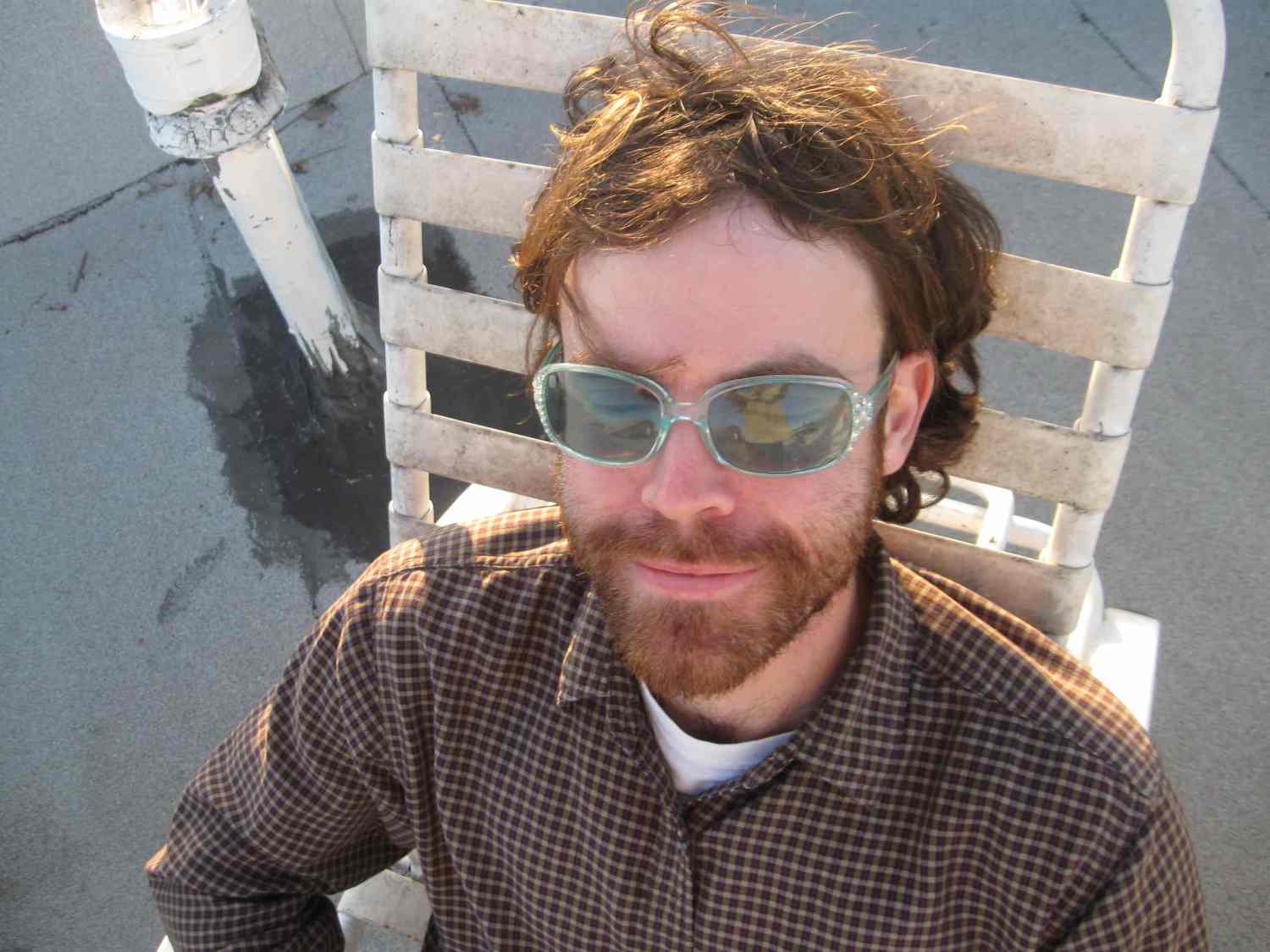
Photo by Hannah Ford-Monroe
Shea Roney: We Could Lie Down in the Grass is your second album in just a little over a year. In what ways do you find comfort in your writing process that you can still rely on, as well as where did you find yourself changing course and trying something new when compared to your process on Weather?
Johnny Rafter: My writing and recording practices sort of feed into each other. Usually I find some chords and see what feelings or images they unearth. That leads to maybe a word or two, and then the lyrics spiral out from there. I find it awkward to write words separately and just sing them over chords. It’s nice to feel like the words sort of blossomed out of the music and it feels better to sing words like that for some reason…
My writing seems to naturally go towards simple language, the passing seasons and my own blurry sense of the inner and outer world. Working alone, it can be challenging to record songs in ways that feel organic and have a sense of performance, but I tried to strive for that this time. My lack of musical understanding and skill makes mistakes and messiness inevitable, so I try to embrace it and allow things to be loose.
This time I was a little more competent at recording, so I spent less time digging through the internet trying to figure out what compressors do. There was more of a leisurely flow to the work… I think that helped me access more resonant ideas without getting tripped up on technical stuff… It might be worth saying that my first album Weather was my first time writing songs and recording, so it’s kind of a messy testament of my own learning and curiosity about songs and recording. This new album was a continuation of that but with a little more confidence and momentum. I think the songwriting on this second album is more potent and direct.
SR: We Could Lie Down in the Grass is a rather extensive project, 24 songs and running over an hour long, yet still flows naturally amongst themes and sounds that create a welcoming and unique environment. What do you think this album was able to accomplish in part due to its length?
JR: I’m glad that it comes off as cohesive! And has a flow to it… I didn’t really think about the length… It was just— “Well these are all the songs that came to me over the past year”. It would’ve felt strange to release them separately or never at all. I think it’s good to just release stuff so you can move on and not overthink it. I’ve been trying to embrace “good enough” and “might as well”.
I’ve tried to make writing and recording a casual part of my daily life. Something lightweight I can work on at home after work and on days off (I was inspired by Kieran Hebden’s approach “good music is about ideas not gear”; also I heard the poet CA Conrad suggest trying to write poems at your job— fitting it into the reality of your life and not waiting for some ideal situation). The advantage of that is you can make a lot of work, even if the production value might never compare to studio recordings. I think of the songs more like drawings in a sketchbook or collages — something handmade and imperfect. So this was just a longer sketchbook.
I tried to interweave the lyrics with images, ideas and words across the different songs. At some point I started to see the whole album as one long text, so it made sense to have the songs speak to each other. With the length, I was able to explore lots of approaches to making songs and just try lots of fun stuff. The process is the good part for me, though it’s cool when the fog burns off and you get to look back at everything you made as a whole. Some people told me to cut songs, but honestly it didn’t feel like it mattered. For my own emotional wellbeing, I need to stay in a 100% hobby mindset and put zero pressure on myself. So there’s no right way to go about things. I’d just like to keep writing songs as a lifelong practice/process and be unfettered about it and see where it goes.
SR: The Fruit Trees is taken on as a mostly solo endeavor, although you worked with a handful of others to complete this record. Where did you find your vision for this album enhanced by the people who helped work on some of the parts? How is that different from going fully solo to you and your creative vision?
JR: When I started a few years ago, I didn’t know anyone making music, and I’d never been part of a music scene or anything like that. So just out of necessity I recorded and mixed myself. Naming it “The Fruit Trees” was in hopes that it would turn into more of a collective situation. The hope with the first album was that maybe if I made something interesting enough it would help me find people to make music with.
Luckily that’s been my experience— The songs sort of feel like magic spells or beacons that have brought me closer to people after a pretty lonely chapter of my life. Over the past year new friends and bandmates have sort of come into my life in a beautiful way. I think that’s an awesome thing about sharing your art even if it’s on a casual local level, it opens up life a lot.
But yeah, the collaborations so far have been kind of light, and my intention is that future albums will have deeper collaborations. My awesome friend Ben (who plays bass in our band) and I have a really close friendship that’s slowly turning into a deeper musical collaboration. I’ve realized you can’t rush these things. I think it has to be based in friendship and trust, and also you gotta work with people who make you laugh!
SR: There are a lot of instances where you piece together field recordings, almost making this album sound like a found footage video of the world around you. What did setting mean to you when piecing this album together? Were there any throughlines that you tried to build through themes and environment?
JR: I definitely hope to create some sense of an environment or a space— like an album as a place you can go for a while. For this album I imagined an old house and the songs were in different parts of the house like the kitchen and the yard and the porch and the attic. Some of the songs are down the street.
One way I felt like I could have the world permeate the songs was to include some field recordings from my life. Like opening the windows and letting the wind blow in. I love sounds… Like just sitting in the park and hearing the different sounds— the wind, the birds, the engines, the voices and the ways those are perpetually changing and interacting in new ways. The surrounding environment is sort of always bleeding into my inner experience (or maybe it’s the other way around?) and so I think I try to create a similar sense in my recordings.
SR: Each song feels like its own moment that can be expressed in a million different fleeting feelings, yet your writing is so concise in its expression. Were there any stories or feelings that you found difficult to articulate when writing, and did fleshing them out through the process help define their meaning further in any way? What were some of your favorite stories to tell?
JR: It feels risky to write sincerely and simply. That feels scarier to me than ironic distance and wit, but possibly more important nowadays… That being said, I hope to find a sense of whimsy in the songs, so there’s heaviness and levity happening at the same time.
Honestly writing songs is also just so cathartic and fun, and it does help me make some meaning of my confusing little life. I hope to not only write from that therapeutic place but also imagination and humor and things like that. Not just about me and my turbulent inner life but also about how wonder and pain-filled the world is.
The song Collar was a favorite— it was based on a neighborhood dog I saw that wasn’t looking so good. I was really worried about it, and this little story from the dog’s perspective appeared in my mind. To me it feels like a fairytale or a fable or like a tarot card which I like. I hope that dog’s okay.
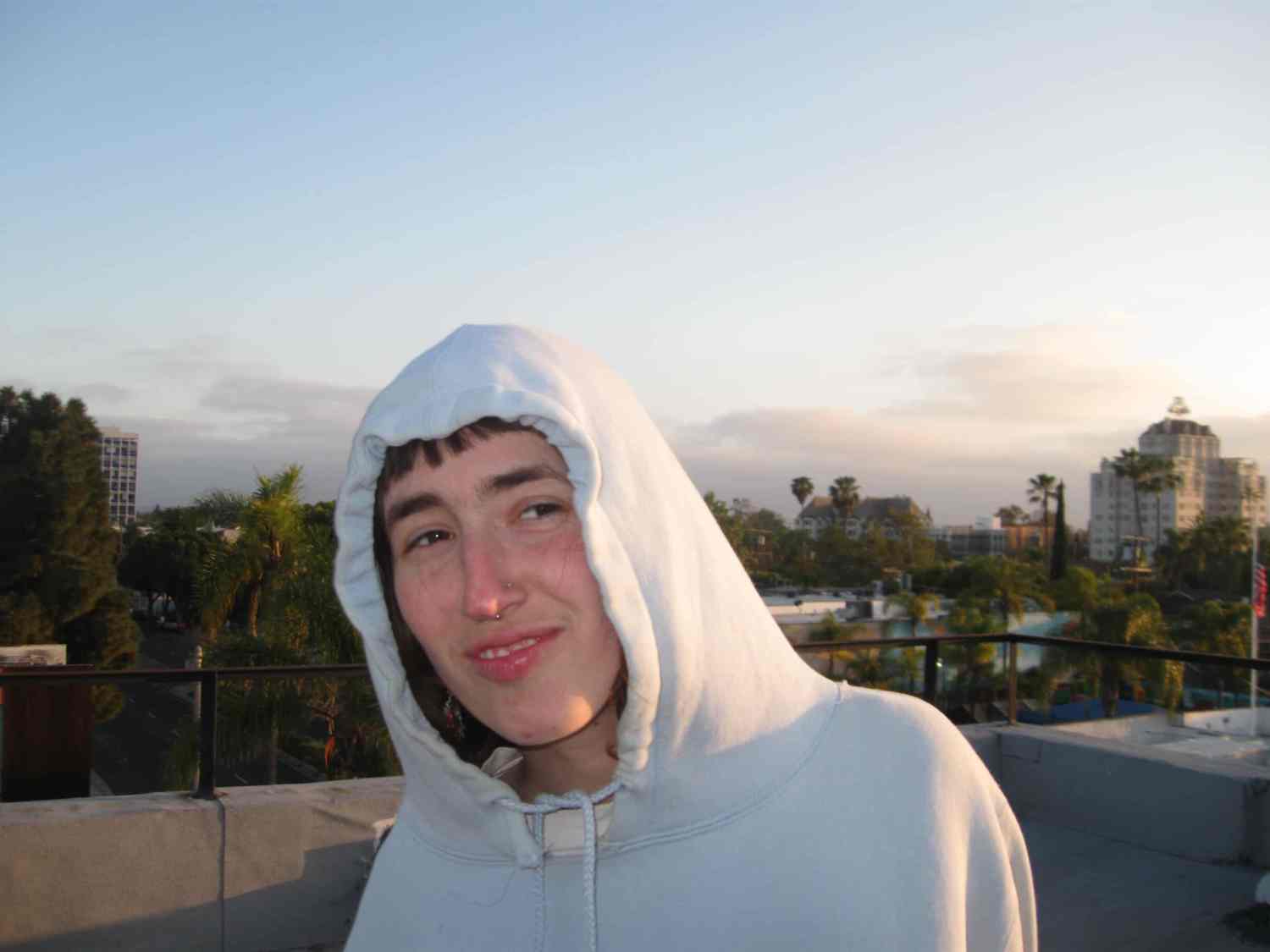
Photo by Hannah Ford-Monroe
SR: Continuing, the articulation of singular moments, the feelings and images that you bring a focus to, are often moments overlooked that hold a sense of beauty and an edge to what it means to simply be alive. Do you find that there is a consciousness in your creative worldview that embraces this simple beauty, or does it come from some sort of disconnect that needs to be tied together again to build that clearer picture?
JR: That’s cool it comes across that way. I think perhaps it is branching out from whatever my worldview is and from the way I try to live— appreciating smallness and the mundane everyday life stuff, paying attention to my senses and how we don’t really need that much to be content. How the best things are simple like sharing time with people and eating food, or playing frisbee. Joy is always there underneath. But I also go through waves of horrible feelings of loneliness and disconnection, dissatisfaction, fragmentation, grief, separation, shame… I guess the interplay of those different states creates a lot to explore. There’s a lot of paradoxical things to hold all at once, and I think songs are good for exploring that.
SR: There is an element of timelessness that floats through this record, both in style and writing, that a lot of people gravitate towards when they listen to your music. Do you find any sense of preservation in your work, whether that be of memory, stories, people or places? And if so, do you personally feel a need, or an obligation, to make something that will be long lasting?
JR: Honestly I don’t think about making things long lasting. I guess some people want to make art or achieve greatness or whatever so after they die there’s something left of them? I don’t really care about that, and it seems like a sick pressure to put on yourself. I remember a line from the Tao Te Ching that was like “To live as long as you live and then die is enough”. Plus things I make don’t really feel like “me” anyways.
But on some level I guess I do see it as sort of residual evidence of who I was, what I felt, what I saw, where I was, etc. I think I fear wasting my time, not in a productivity sense, but not living fully enough— dissociating and missing the actual details and reality of my life. Maybe making songs is a way to help me pay attention and ask questions, and a way to stay a little weird. It sort of feels like gathering a bunch of small beautiful things into a basket and then leaving it on a friend’s doorstep. I just enjoy the gathering and the giving… It does seem like an interesting experiment to sustain this as a lifelong practice and then get to look back at all these words and sounds. A lifetime of music and poetry!!
SR: What’s next for The Fruit Trees?
JR: Waking up before dawn; time in and around bodies of water; playing more shows; I’m gonna go see Simon Joyner next week; also Agriculture; an ambient/instrumental album is almost done (a collaboration between me and Ben); two more albums in conceptland— one is a full band sort of indie rock album and the other is a classical guitar based album in a tuning I made up that I’d like to record somewhere with snow; lots of biking around, soaking up the sun and getting as silly as possible; making lots of soup; a small Pacific Northwest tour with our friend Ash’s band Swinging next January; doing chores; baking bread.
You can now purchase cassettes of We Could Lie Down in the Grass via Jon Shina’s label, Flower Sounds out of Greenfield, MA. Find more of their releases and curations here.
Written by Shea Roney | Photos by Hannah Ford-Monroe
 the ugly hug