“I almost forgot,” Olivia Wallace blurts out towards the end of our conversation. “I made a list of a couple local bands to shout out.” Reading from a prewritten list of local Chicago bands that have sparked some excitement for her – a moment of true music fandom;
“Well, Precocious Neophyte, they’re a shoegaze band from South Korea that lived in Chicago for awhile, but I think they’re moving away to Denver soon. They’re so good, they’re my favorite. Julia Morrison is a singer-songwriter I saw the other day. She’s so unique and unexpected in her vocals and lyrics. And then another local person I really like is Girl K, especially their foray into more pop oriented music. Super good.”
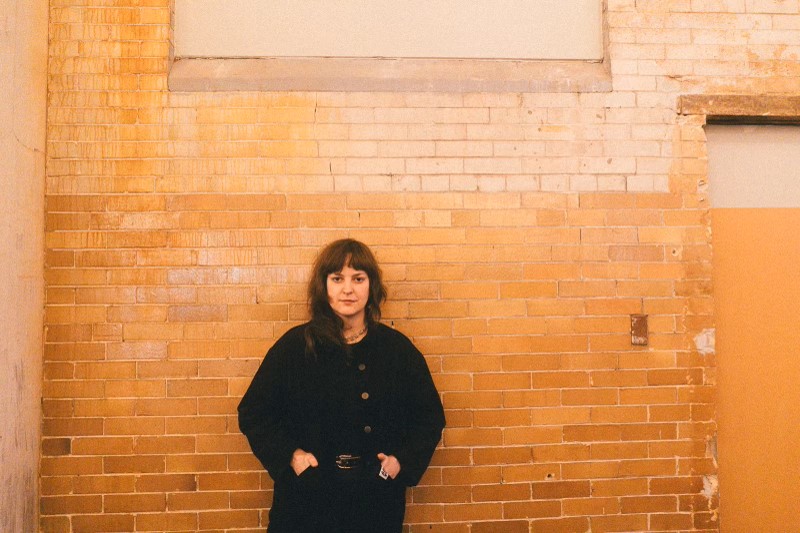
Olivia Wallace is the backbone behind the Chicago-based pop-rock project Sick Day. Earlier this year, Wallace and co. released their latest EP, Overexposure, under their new label home, Substitute Scene Records. As the follow up to 2022’s debut full length Love is a State of Mind, Overexposure rattles to the brim with soaring guitars and distorted anxiety. But cutting through the noise is an institution of pop melodies, as Sick Day turns moments of doubt and anguish into catchy one liners, relatable anecdotes and a pure enjoyment for loud music.
Whether putting together stacked local bills, hosting songwriting groups or photographing events, Wallace has a deep love and respect for the Chicago scene and the people who build it up. The conviction to relatability is crucial in her work – personifying, articulating and inviting shared experiences is not only a marking for mindful involvement, but a gesture to the community that Wallace wholeheartedly promotes. Made up of other Chicago musicians, Sick Day has become a local hub of heavy hitters and rock n roll softies alike, collaborating with artists like Ryan Donlin (Red Scarves, Chaepter), Jen Ashley (Cruel) and Robby Kuntz (Red Scarves, Old Joy) on drums, as well as a rotating cast of live players including Chaepter Negro (Chaepter) on cello and Kaity Szymborski as the groups new bass player.
Wallace and I recently got to catch up over coffee and a banana cream Danish to discuss the community that holds up the Chicago scene, the evolution of the Sick Day project and the importance of exposure in her songwriting.
This conversation has been edited for length and clarity
Shea Roney: You’ve become a staple in the Chicago scene over the years, playing shows, collaborating with other artists and just being a big proponent for the community. What was your first exposure to local Chicago music and what stood out to you?
Sick Day: I didn’t start doing music for a few years after I moved to Chicago, but I feel like I didn’t really start to build that community until after COVID. It took me a while to, well, network is not the right word because it doesn’t feel like networking, but just becoming friends with people in the scene. Places like the golden dagger (RIP), friends’ house shows, and songwriting meetups that I had going a while back really helped.
SR: As someone so involved within it, where have you seen smaller bands struggle in this expanding and profit-driven industry? Are you still able to find hope in it all?
SD: As more and more of our public life takes place in online spaces mediated by tech corporations, it’s more important than ever to create real, personal community around the arts. Music is much more than a metric used for advertising and I’m somewhat afraid that musicians have internalized the backwards messages that apps like Spotify and Instagram have pushed upon us. The races for likes and streams and manufactured scarcity of popularity that leave people feeling atomized & undervalued. It’s so important for musicians to forge real-life connections because music isn’t about ego. It’s an extremely powerful spiritual force that makes the online narcissism factories look laughable. I do think the diversity of the music ecosystem is endangered, but I’m seeing more and more people craving real community in the arts, and that gives me hope!
SR: You have described yourself as a more solitary writer, but since the formation of the project, Sick Day has seen additions to your recording and live roster. How did this culmination of artists come to be?
SD: It takes a certain headspace of focus and like vortex of thought for me to really get into the songwriting space. So I write alone. The people on the EP are Ryan on lead guitar, who I’ve collaborated with a ton before, Robby on drums, and Jen on bass. I’ve played with them a lot in the past, and they’re amazing instrumentalists in that they pick up on songs so quickly. The final version of the song “It Hurts to Try” was probably Robby’s first time playing that song right before we went to the studio that day.
SR: There was a two year gap between the release of your debut LP Love is a state of Mind and Overexposure, marking a clear difference between the sonic build ups and performances in each. Did you find your writing or influences change between projects? Did your writing and recording process shift at all with more voices involved?
SD: Love Is a State of Mind was released in September of 2022 and we recorded Overexposure maybe six months later. It just took a while for the label to gather all the materials and set a release date, but I was recording pretty continuously in that time. Love is a State of Mind was all home recorded, and then we recorded some with Danny from CalicoLoco – it was all very homespun. Some of the songs were just demos that I recorded during the pandemic and it was just going to be raw, compared to my previous EPs, Deja Vu and Sleeping in the Dark, where I strove for a more professional sound. Overexposure was a bit of melding the two together. And I think Henry [Stoher] (Slow Pulp) and Keith [Douglas] were really good at capturing that idea amazingly. Keith was so professional when we were recording and then I worked with Henry via email, and he just has a gift for mixing things that sound both raw and so professional at the same time. I don’t know if it was a shift so much as a shift in how we recorded it. We recorded it all at once and I didn’t consciously think, like, ‘oh, I want to make a shoegaze record, or I want it to be grunge’. It’s just kind of how it turned out and evolved.
SR: Was there significance in revisiting the song, “Meet Me At The Park” a year or two after it was originally written? Does it sit differently with you now having worked on it twice?
SD: My friend Danny convinced me that this song has to be recorded with a full band. That first recording on Love is a State of Mind is something I just did real quick in my room. I appreciate both of the versions, but the full band version has so much life to it. The guy from Amplified Magazine said the demo version of “Meet Me At The Park” sounds like maybe I didn’t meet them at the park – then the full band version sounds like I met the person at the park [laughs]. That was definitely the simplest song I’ve ever written. It’s basically just a few chords, trying to be more hooky. I sometimes think about cognitive biases and psychology – there’s a thing called the mere exposure effect, which means the more you’re exposed to a certain stimulus, the more you just generally like it. And so applying that to songwriting, if you just repeat the same thing a lot, it’ll get more stuck in people’s heads. I’m not trying to like wield psychology [laughs], but it’s good to keep in mind.
SR: I find that psychological interpretation very interesting, it makes sense when it comes to melodies, but I can find it in your lyrics as well when you write about common struggles and the stimuli we get from them. In a way, that is another mere exposure effect, as you kind of highlight things that people experience day to day, building a personal attraction to your songs. This is brought out very well in the “Overexposure” music video. What were the ideas behind that video?
SD: I outsourced the music video to Kaity [Szymborski] who was super enthusiastic about making a video and she put her own spin on the meaning of overexposure. I love how she kind of parsed it down to a really mundane seeming detail, but it’s so relatable. If I was making the video, I might’ve gone for grander ideas or something, but it probably wouldn’t have hit as much as Kaity’s idea. And shout out to Lola’s Coney Island for letting us film there and being super nice and enthusiastic about wanting to be in the video.
SR: Does your own interpretation of the word ‘overexposure’ differ from Katie’s interpretation that is highlighted in the music video?
SD: I think it’s been hard to answer questions about the meaning of overexposure because I kind of channeled the song and wrote it in like 15 minutes. It felt really real and right and meaningful to write the lyrics and melody, but it’s strangely hard for me to put the meaning into prose. I wrote it more as a poem that is, in a way, rich with meaning but also it’s a song that I want the listener to feel, and interpret, on their own. It’s a different mindset and I try to make something really deeply relatable and also a little bit of amalgamation of experience, not just one detail of my life, but something that both resonates with me, but also with a potential audience.
SR: Since it’s been a few months since its release, what has it been like to play these songs live? I know you have a show coming up in Madison where you are only taking two cello players as opposed to your full band. Is there a formation that you feel brings out the songs better?
SD: They’re just totally different experiences. I played a strip down set with just me and Ryan the other day at a bar called Bernice’s and I was not expecting anything. I was thinking, ‘okay, we’re going to play and the people are just going to talk at the bar,’ but when we started playing, it was like a vortex that sucked the attention to the music. It was such a cool experience. But I think the main difference between full band and playing a stripped down set is that when with the full band, the lyrics sometimes get a little buried, but the spirit of the song really comes alive. Whereas when I’m playing stripped down, the lyrics really shine through and people can really hear each word and that’s really nice.
SR: Anything you have coming up that you are excited about?
SD: I’ve been recording an EP with an artist named Snow Ellet, which is a totally different process, just me and Snow Ellet to a click track. And then I’m trying to record an album of my earliest songs from when I was in my early twenties.
SR: Are you going to keep them as they are?
SD: I’m going to keep them as they are, but plan to just make the most of them. But yeah, my music from back then is not at all the same. It’s not worse, maybe, I don’t know [laughs], it’s got its own charm that’s just a little different.

Sick Day will be playing a full band set on August 10th at the Beat Kitchen along with All Weather Sports, dmb the etymology and Oyeme. Sick Day will also be headed to Madison, WI on September 13 to play the Snake on the Lake Festival (free of charge).
Written by Shea Roney | Featured Photo by Tracey Conoboy

 the ugly hug