You can observe a discernible tightening within Trembler’s music over the years. Their 2019 debut was a biting display of heaviness and scorching lyricism, one that bends from post-hardcore and contemporary shoegaze to early 2000’s screamo and ambitious prog rock-esque compositions. It is potent and abrasive and beautiful and reckless and heartbreaking, and it might be my favorite record of the last decade. And yet, as they move further from the loud discordance of Trembler, the intensity they managed to cultivate in that record has only heightened. Before I wrote this, I spent about a week attempting to pin point what it is about Trembler that I find myself so incredibly drawn to. A way to articulate the feelings elicited by everything they have done; whether it be coarse contributions on a split EP with Austin-based screamo band Palefade, or the somber, wispy new single they released today. I realized what generally draws me to abrasive music is not some masochistic urge to cauterize my ear drums, but a craving for the vulnerability found in less polished art. What makes Trembler so moving is less about volume or distortion or any one sonic technicality than it is the inimitable fragility that binds their music. It is equally present in their corrosive tracks as it is in their softer work, layering a complexity to Trembler that continues to expand with each new release. Today, they shared “Wilt”; the single further proving Trembler’s ability to yield raw and poignant music regardless of what route they take.
“Wilt” is a first taste of Trembler’s forthcoming EP, Total Sorry, set to come out January 29th via Rite Field Records. The line “we wilt away” hypnotically surfaces fourteen times throughout the track, layered between a lyrical unfolding of loss, remorse and doubt. “Wilt” is subdued and unresolved; yet like most of what Trembler carves out, it is rich in its dimension, guided by authenticity rather than logic or precision. Cushioned by pale guitars that lie somewhere neutral on the spectrum of bleak to cheerful, the track’s moments of lyrical devastation are sweetened with threads of optimism and pivotal acceptance. In spite of its name, “Wilt” grows stronger with each listen, rendering a familiar story of closure you have to forge for yourself, and the consolation that comes when you do.
About the song, Luke Gonzales shares, “‘Wilt’ deals with what it sounds like–watching something beautiful in my life die. Losing my closest friends, having my view of something that consumed so much of my life splinter and leave, and wondering whether it was hollow all along. Generally, a good representation of the central feeling I was trying to capture on this EP. It’s sad, but in my opinion, sober in its acceptance that how things were over now, in an attempt to move on.”
I have never gravitated towards astrology as a tactic for measuring compatibility. Perhaps it’s because I have never done ample zodiac research – instead I turn to slightly more specific litmus tests , like do you insist on using a Brita? Or, what lo-fi bedroom project resonates the deepest with you? Sometimes, the latter is merely a matter of surveying one’s thoughts on the Brooklyn based project, People I Love. It is a somewhat self-serving probe, with lines like “my relationship with words has a gold key” and reoccurring grievances pertaining to attending parties – People I Love’s discography is chock-full of anthems for the socially reserved. But, even if your Myers Briggs begins with an “E”, I think there is a grandeur weaved carefully into People of Love that requires a certain level of intentional and emotionally aware listening to fully appreciate (therefor setting it up as personality assessment gold). Within tracks that rarely surpass three minutes and structures that aren’t trying to prove themselves, there are parcels of complex emotions tucked in the intimate and lived in corners of each song, and an opulence that grows with each listen.
Today, People I Love shared new track, “Perfect.” Featuring Avery Kaplan on drums, as well as and guitar, piano, and slide contributions from Boone Patrello (Dead Sullivan), it’s a song about longing to be perfect…maybe. It strays from commercialized notions of perfection, dodging 9pm bed times, self-improvement books, and $16 green juices (although if I were a hypothetical gym rat, I could see the bridge pushing me to an arm day PR) and instead prods at something darker. “Perfect” opens with going about felt the bloody air / spying around find a violent stare wanna explode – but even without this lyrical agony, the track in its entirety flirts with detonation. Leading with a fleeting warmth that quickly transcends to an intense, pressure cooker kind of heat, “Perfect” conveys a dysregulated mood threatening to burst. The general soundscape is a moving target, springing from cascades of dejected guitar, quirky pitch bending, angular percussion, and Dan Poppa’s signature frothy vocals. It’s also rather catchy, sure to have you seething “wish I was perfect, my blood they’ll inject it” throughout this (appropriately timed) week.
I have a tendency to fall into anecdotal rambling when I try to write about a project I find especially moving. This achilles heal is most inflamed when a song makes me cry – which does not happen super often – but when it does, I have to fight the urge to cite my own tears. It’s usually a desperate attempt to articulate the gravity of a track without turning to some dry technical dissection, but it doesn’t matter. No one gives a shit about the time I cried at my roommate’s roller blading competition, seated in a patch of grass above the park with Shallowater’s There is a Well in my ratty noise-cancelling headphones. So I will not tell you about it.
What I will say is that Houston based Shallowater is not doing anything new. At least not in a way I can cite on paper. Their soundscapes are familiar and rather organic, and I could write a laundry list of band comparisons ranging from emo and posthardcore to alt-country and slowcore, and they would all be valid. I suppose that is the real root of this apprehensive music journalism crisis I have so generously decided to include in this single review – the chasm between the abstractly unprecedented feel of a band and a reality that they are not technically doing anything unheard of. But perhaps that is the foundation for the most touching projects; an ability to pull from motifs seen countless times before and churn it into something that stops you in your tracks.
Today, Shallowater shared “Sadie”, the second single off their forthcoming record, God is Going to Give You a Million Dollars. The track starts on a gentle note, finding its footing in drawn out enunciations and a cautious rhythm section. As vocals grow in urgency, the soundscapes inflate into an eventual riff –lathered with mucky distortion, indulgent percussion, and a suffocating amount of poignancy. In the span of seven and a half minutes, Shallowater pursues this sort of escalation more than once, leaving you unsure of which buildup is the buildup. Perhaps the answer is neither? Perhaps the mud-slides of twangy sludge are less a destination than they are a means of amplifying slivers of delicacy and desperation between them. In the case of “Sadie”, soft vocals tend to cut deepest when they follow moments of sweeping cacophony. It’s enough to subdue even the sturdiest of poker faces.
You can listen to “Sadie” everywhere now, and pre-order God’s Gonna Give You A Million Dollars on Bandcamp.
“They also have seasonal shake thingies, and they’re just… I mean it’s melted ice cream. It’s ‘mint milk’. I think they also have a creamsicle one. They make you feel so sick. Just 900 calories of milk based drink.”
Peter Lukach of mall goth is discussing the delicacies available at Stewart’s – a gas station dispersed throughout Upstate New York. It was the first I had ever heard of this institution, despite the fact that I also grew up in “New York but not New York”.
What constitutes “Upstate” is a tired debate. Some deem it anything between the final stop on the Wakefield-241st St. bound 2 train and the Canadian border. Others believe in more complex distinctions for non-metropolitan New York, arguing that it consists of Western and Central New York, Upstate, and my home territory of ‘Downstate’. Some give the debate – and the idea of New York beyond the five boroughs – little to no thought at all.
If you have read any features I have done in the past, you might notice a pattern of questions about a band’s respective home. It usually stems from a place of my own curiosity; sometimes I find myself more intrigued by the idea of a scene than the actual music the scene in itself nurtures. The ways an environment can be reflected in the contours of a band’s melodies, or how influences of other artists in the vicinity can pull an unexpected sound out of a project. I also ask from an idyllic place – hoping to hear the ways in which a band’s surroundings have marinated into their art, optimistically seeking some confirmation that the internet has yet to push this notion into extinction.
My conversation with mall goth was seasoned with Upstate trivia. I learned the apple cider donut was invented in Albany. They sometimes serve a raspberry sauce with their mozzarella sticks. Binghamton has an exciting music scene, though it often feels fleeting given the rapid member turnover that is inherent to a college town. Albany is more robust in that regard, home to projects that have cultivated beyond a four year term and a community with a good heart.
From my intel on local scenes, I have also become familiar with certain rites of passages that triumph variables like whether you took a subway or yellow bus to middle school. Falling in love with an album and building relationships from the seed of shared music interest is one of the most prominent. In the case of mall goth, this was initially Plumtree, though as their inner band relationships have grown and expanded, so have their auditory pallets. They told me about their intrinsic love for “loud-quiet” dynamics in guitar-forward bands, citing Weezer and the Pixies as mutual staples. They also enthused about short term phases, which helped to paint a picture of their curious natures as individuals, as well as the influence of their enthusiasms have on each other.
Their latest EP is the band’s fullest release yet – both sonically and in a more abstract sense. It ventures down an experimental and emotional path, clearing space for individual inspirations and perspectives while ultimately remaining grounded to the project’s sturdy spine. Out last week, Heather’s Exit is a vulnerable reflection on how even the simplest lived experiences shape us, as mall goth molds imagery of old Tupperware, rainbow sprinkles and white mildew into a cathartic listen, bleeding with honesty and nuance.
We recently sat down with mall goth to discuss the project’s roots, inspirations and Heather’s Exit.
This interview has been edited for length and clarity.
Manon: I’m so excited to talk about this EP, it is so fun and such a confident and full version of this sound that you have been cultivating, but first I would love to hear about the background of mall goth. How did you all start playing music together?
Ella: Peter and I met in a music theory class in college. He posted a song by Plumtree on his Instagram Story.
Peter: I swiped up and was like “I love Plumtree!” And [Ella] was looking to make a new band. I was in a band but it wasn’t very serious and I was not super involved in the creative process, so I was looking for something different.
Ella: Yeah I stole him. I was also living next to a friend named Sam so the three of us started playing and then I met Kensho and stole him from a friend’s band too, as our drummer. The four of us started playing, and as the years have unfolded, we’ve just gone through a few lineup changes. Katie has been drumming with us for about a week and a half – she’s really fucking good. Justin has been playing with us since the fall.
Manon: How long have you been in Albany?
Ella: I have lived in Albany my whole life, but we officially relocated in June.
Manon: So is Heather’s Exit your first release since you moved?
Ella: Yeah. It’s funny because we mentioned our lineup has changed so much, so the EP process took a lot longer than we anticipated. But we’re excited for this chapter and to just put this music out there, we have been sitting on these songs for about a year. So we are excited, and having Katie join us has brought a different vibe to the songs – it made them feel fresh again in some ways.
Manon: Heather’s Exit has such a great coming of age feel – there is so much change, growth and nostalgia all wrapped up in a jangly, dream-pop sound. I know you mentioned you have been sitting on these songs for a while,
Ella: In terms of writing lyrics, it’s probably the most honest and raw I have ever been. It felt good to just talk about things that make you the way you are. I was really inspired by Wednesday’s Rat Saw God when I was writing. I just love how Karly Hartzman is so honest, and every song unfolds a story. That was the biggest inspiration for “Crawl Space”, also “Ribs” by Lorde. When we were working on Heather’s Exit, I really wanted to make sure the synths were building large soundscapes.
Manon: All of that certainly comes through on the EP. Your imagery is so intense and I also like the way it tends to parallel the soundscapes – I like the rainbow sprinkles and flowers against the melodically upbeat nature of “Your Garden”, versus the mentions of spoiled food on the darker and more experimental “Heather’s Exit”. I did want to ask about that one specifically, and why you chose to end the EP on that track?
Ella: That’s a great question. I feel like the EP descends from happy into, almost scary.
Peter: I think the lyrics helped propel it to that point too.
Ella: Yeah, we felt like although “Your Garden” has some gloomy undertones, it mostly feels like a sugarcoated, candy song. “Crawspace” is then a good bridge into “Marionette”, which is just loud, quiet, loud, quiet. I wanted that one to have imagery of a puppet getting ready in a dressing room – just this idea of being guided by what others think of you. As for “Heather’s Exit”, that one is kind of hard to put into words. There is a lot of nuance, and I ultimately want the music to speak for itself, and for people to have their own experience when they listen.
Manon: The EP has such gorgeous cover art too, who did it?
Ella: My friend, Eliza Waylon. I know her from high school, she is a fantastic painter and I thought that piece really fit our aesthetic perfectly. I’m so grateful she let us use it.
Manon: I know you mentioned some lineup switches. Would you consider your songwriting dynamic collaborative, and if so how have those changes affected it?
Ella: When we started the band I had some songs under my belt, so initially I was like “hey, do you guys want to play these songs I wrote?” Since then we have definitely built upon it, and in terms of what things ultimately sound like, everyone adds their parts. I am really excited to see what happens going forward, and we definitely want it to become more collaborative. We were really chasing a dreamy sound, and have since been returning to our roots which has been very inspiring.
“We were really heavy for a minute there. For Dizzy Spell and that era we were so hyper-focused on what we can get out of our amps and our pedals, just the sonic width we wanted live and the thickness we wanted”, Isaac Kauffman explains of Abel’s 2024 record, Dizzy Spell.
The Columbus based band released Dizzy Spell just shy of a year ago, a record armed with an arsenal anxious intensity carved with heavy guitar and hazy feedback. There is an immediacy to the listen, as Abel wastes no time reaching a heightened emotional state as they shred through ridiculously catchy pop structures and pedal suffocation. It is an intense album in an all consuming way, thought drowning sort of way. The lyrics are poignant and often heart wrenching, but they are approached in a manner that feels distant, as the album succumbs to a sea of shoegaze-fueled dissocoation. On Dizzy Spell, noise is a lifevest. On How to Get Away with Nothing, Abel leaves this cushion behind, exploring new ways to manipulate their soundscapes as they prod at what can be found, and more importantly, felt, when they slow down.
Released last week via Pleasure Tapes, Julia’s War and Candlepin, How to Get Away with Nothing marks Abels shift towards a slowcore leaning sound. The stylistic decision stemmed organically, pulling from a chapter the band was in whilst they made it. “My bandmates go through phases, and I think it makes the most sense to take those moments and run with them”, Isaac tells me. “It really lends itself to emotional music when you take things as just a section of your life”.
The authenticity that comes with this philosophy can be felt through Abel’s discography. While How to Get Away with Nothing leans away from the density and shoegaze feel of Dizzy Spell, it also attests to the strength of the project’s identity, and their ability to experiment with genre without alienating the feel of Abel. Their “phases” do not come at a cost to the band’s ability to extract beauty from a raw and gritty sound, a consistent pillar in their releases.
How to Get Away with Nothing boasts a sound that is expansive, challenging and profoundly textured. It leaves space for near silence. It toys with manipulations of pitch and speed. It flirts with the thickness of Dizzy Spell. It experiments with a hyperpop feel. All of this could be a recipe for auditory whiplash, but How to Get Away with Nothing is grounded by the deliberate and balanced nature of its structure. Abel maintains an equilibrium while exploring various means to express melancholy, as well as a range of vocal approaches. Volatile deliveries scrape away at minimal guitar arrangements on “Dusk”, while on “Parasympathetic” earnest and gentle vocals exist in the shadows of a track guided by imposing percussion.
The record commences with warm and earthy lo-fi track “Grass”, which features twangy contributions from fellow Ohio-based project Cornfed. As implied by the title, it’s a song about grass, though the abundant plant is viewed as a concept rather than a reality, as Abel admits to a laundry list of fear that comes with walking barefoot in the grass. Fear as a barrier is carefully weaved into both Dizzy Spell and How to Get Away with Nothing, though the notion finds itself more crushing on the latter release. As they adhere to a slowcore style, drawn out moments of instrumental minimalism carve space for ideas to be questioned, and for emotional paralysis to be expressed through achy chord progressions.
“I think taking that into slowcore and slower songs lended itself to offer more of a minor space for lyrics”, Isaac reflects. “Although the lyrics still take up emotional width, I think we wanted to focus on keeping those tones and atmospheres that we created in a slower sense, and that lended to the emotional guitar parts having to be pushed. I feel like we’ve always had this kind of disconnected vibe to our songs, and I think that leaves our own playing styles and emotions on the table while also keeping the atmosphere thick”
The most devastating tracks on the record are followed by songs that toy with elements of hyperpop, and although they still tackle heart-break and dwindling self assurance, the blow is softened by their twinkly, bedroom-dance-party shape. Isaac tells me though he usually does all of the production and engineering for Abel, for How to Get Away with Nothing, the band collaborated with Quinn Mulvihill from Glaring Orchid, offering him extra time and capacity to experiment.
“I think that with the extra mixing help, I felt like I had more space and time to put some weird mixing energy into a few songs, and I wanted to do that just to break up the album in a way that felt different than using interludes or something like that”, he explains. “I think my melodies always come out in a pop way, and I think putting that over slowcore stuff is really good a lot of the time, but there are certain melodies where you’re like, how will this work over an emotional, drawn out guitar riff? It was almost just the easy way out to make something more poppy and more straightforward.”
The humbly deemed “easy way out” elevates Abel’s already textured sound, as well as the How to Get Away With Nothing’s intricacy as a whole. The hyperpop motifs and eccentric sonic manipulations contort themselves into moments that feels mechanical or almost alien-like, offering a complex juxtaposition to the album’s organic bones and painfully human lyricism. “I think there’s always been this production heavy side of Abel simply because I’m still teaching myself how to do certain things and I need to try it before I feel comfortable. So I think those hyperpop songs are just a testament to handling my growth,” Isaac says.
While it stands as proof to their skills as songwriters and range as musicians, above all How to Get Away with Nothing attests to Abel’s exceptional ability to harvest a poignancy in all that they create. You can listen to it everywhere now.
Today, New York based noise outfit Docents released their latest EP Shadowboxing via Ten Tremors. A turbulent and tightly packed five track listen, Shadowboxing is a fervent push and pull, eliciting a ragged fun house of eerie post-punk experimentation as Docents obscures the line between controlled and erratic.
The earliest rendition of Docents traces back to Noah Sider (guitar / vocals) and Matthew Heaton (drums) playing together in college upstate, adding Will Scott (guitar / vocals) in 2018 and Kumar-Hardy (bass) in 2021. The project is driven by an emphasis on noise that feels almost sentient, toeing drastically between minimalist and maximalism without being haphazard. “There’s a pendulum that swings between writing straight-ahead-ish punkier “rippers” and, at the other end, maybe some “thinkers,” and a lot of our songwriting sessions constitute where we’re trying to place ourselves now”, Heaton explains. “There’s no principal Docents songwriter – these are very much struggle sessions, and there’s a lot of material in the discard pile. Our favorite tracks tend to either take six months to finalize or half an hour.”
The EP starts with the melodically winding “Garden”, where jerky sonic elements find grounding in assertive omens and warnings of “the land will pass judgement, it’s body keeps the score”. It’s unclear if the track “Shouldn’t We” is posed as a question or a proclamation, as Docents fervently chants the statement over a swelling of pulse-raising noise. The EP ends with “Workout”, where Docents offers both a resolution to the disorientation and a new dose of unease. An abrasive clutter of “what ifs” are countered by tranquil utterances of “then what, what now”, the dialogue unraveling against pounding walls of foreboding and flammable sound.
“Shadowboxing is our first release that feels like a cohesive unit since our first full-length from 2023, Figure Study. We recorded Figure Study to sound like a really clean version of a Docents live set – our incredible engineer Sasha Stroud ran a tight ship – Dan plays more of a producer role in our sessions. This led to more experimentation and iteration in-studio, especially on Shadowboxing”, Heaton says of the release.
Shadowboxing is out everywhere today, and can be purchased on CD via Ten Tremors.
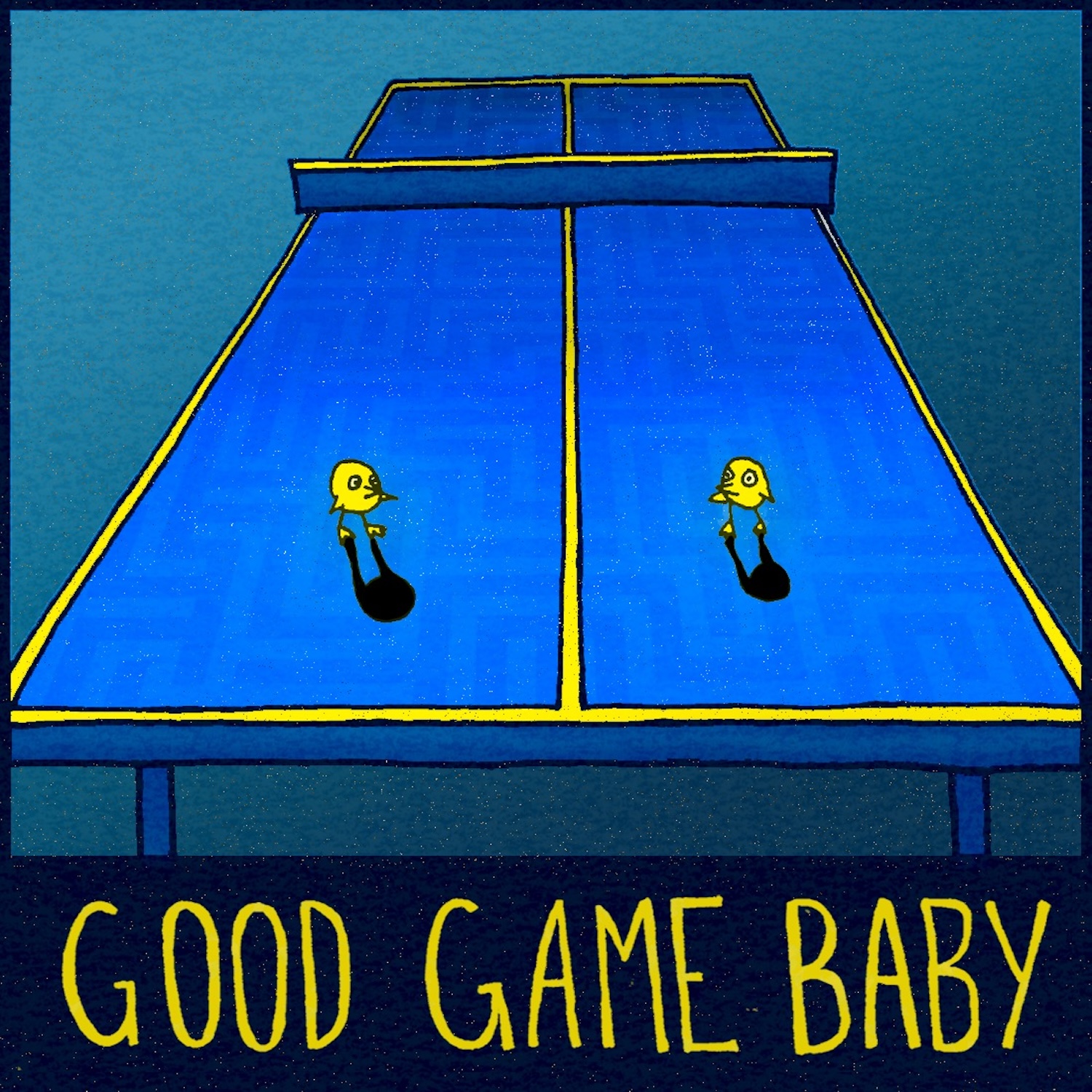
“Got home safe / Puttin on tea / Thanks for working on this with me,” Awh sings, almost instinctively; a clear marking – an endcap – no matter how fleeting this moment of calm may seem, there is a sort of closure at hand. This line, as simple as it is, opens the song, “Heart Container”, provoking a story to be told, while simultaneously closing out the album Good Game Baby. The song is an emotionally fostered and well rounded meander through a precarious heart; not necessarily in the right – nor the wrong for that matter. But as the song is escorted to its end, it becomes embedded within a collage of handpicked sounds and field recordings, some familiar, some unknown to us listeners. But the familiarity, although derived from the ethos of nostalgia, adds depth to where we stand; revisiting with a new perspective matured through time and experience to understand the full story.
Jess Awh is the gentle and vivid voice behind the band Bats, who, as of today, has just self-released her third LP, Good Game Baby. Following 2022’s Blue Cabinet, Bats has built a reliable reputation as a sincere lens into Awh’s own growing pains and intimate reflections. Good Game Baby is no different, with her tongue and cheek lyricism, hyper specific anecdotes and country music roots, the album weaves through pop facets and responsive traditions of storytelling to piece together a cohesive and sincere profile of the writer at hand. But as Awh reflects on the past, taking stock of genealogical traits, destructive patterns and influential circumstances, there is deliverance in her fractured timeline, blending nostalgia with confessionals as she looks back on how far she has come.
Album Art by Jess Awh
When it comes to recording, skills she has been sprouting since high school, Awh admits, “when I am outside of my own space I feel pressure to act a different way, and then it just never ends up coming out right.” So instead, with help from some friends, Awh turned her Nashville home into a live-in studio, taking advantage of the whole space being of her own. Weaving mics through the entire house – each room dedicated to a specific function; “the drums were in the living room. We had guitar amps in closets and in the bathroom, and we even recorded some of the record outside on the front porch.” As the time came to capture the valuable structure of Good Game Baby, “the whole band took a week off of work to have a little staycation and coop up in my house,” Awh recalls with giddy likeness – familiar with the importance of slumber parties as a kid. “We made breakfast together every morning, and then we would just get to work. It was very non-traditional and very relaxed and communal. That’s how I like to run the band.”
In turn to the accessible environment, Good Game Baby is a collection of songs that don’t sacrifice development due to comfortability, but rather find Bats taking on new sonic risks, while still propping up what makes Awh’s writing so special to begin with. Songs like “Going For Oysters”, “Are you like me?” and “Finger on the Tear” are dedicated to slinging guitar solos and more brash compositions than before, adding a dynamic intensity to Awh’s cunning melodies and cutthroat lyrics. Songs like “Sand Time Machine” and “Oh My God”, melodically fragile and willfully poignant, blend steel guitar, synthesizers and lo-fi drum tracks – a smooth blend of nostalgic rust and indie charm that has become the beating heart of the Bats sound. In all, Good Game Baby finds Awh taking the project from the early bedroom bandcamp days to a full band operation. “I’ve always wanted to make rock music ever since I started writing songs,” she recalls. “I could always hear full arrangements for them, but I just didn’t really have the resources, so this record really feels like a full realization of what I have always wanted Bats to sound like.”
Most of what Good Game Baby is based around thematically is Awh’s experience of growing up in the fast paced and self destructive city of Nashville, Tennessee. Besides leaving for school in New York, Awh has spent her whole life calling the “Athens of the South” her home. As a kid, “I grew up listening to 90s and 2000s mainstream country radio,” she shares; a notion that comes with the territory. “Being surrounded by that really potent pop and melody forward music taught me how to write the stuff that I like to write.” Too big for its own good, though, Nashville has become one of the fastest growing cities in the US. In search of sharing the authentic country music experience, it has fallen into years of demolition and rebuilding, as Awh watched the place that she grew to love become unrecognizable in virtue. Favorite businesses boarded up, parks left to their own efforts, restaurants’ Proust effect too overbooked to even experience; “Bats songs often have an undertone of being about the gentrification that I observe in Nashville,” she says with notable discomfort. “I feel that it runs parallel to my own experience of getting older and changing and grieving what used to be.”
Photo by Abby Johnson
“I think a lot of the turmoil of my early and mid twenties is represented by this desire to be able to identify myself,” she adds, “which is something that becomes harder when you don’t feel like you’re really situated in a place that is constant.” Touching upon stories of death, ambiguous love, losing friends, starting drugs, stopping drugs and terms of sincere guilt and ego, as a narrator, Awh’s defiance in change becomes crucial in experiencing Good Game Baby as a whole. “For some reason I’ve always tried to invite situations that are a little bit on the fringes of society,” she suggests – “a little bit unsafe.” Whether to do with dating an older man, cyclical substance abuse, breaking clarified distance or just simply profiteering self destruction, there is weight in reference that Awh releases in every song. Although it’s not easy to do, when done sincerely, “writing helps me confirm that I’m still me,” she expresses with an appreciative smile. “I’m still here trying my own experiences, putting them on paper and recording them. It helps me to contextualize myself.”
The track “Queen song we will rock you”, a cheeky name Awh will admit, begins to initiate an end to the record – bringing the heart of reflection into the forefront. “Grandpa died standing upright on two feet / Listening to Queen’s song we will rock you on repeat,” she sings with a soft yet forward delivery. “I would say it’s the most important song to me on the record, just because it provides a framework for understanding the rest of the lyrics on the album.” As is used, “We Will Rock You”, the bold and anthemic battle song, becomes self protruded when facing death, as Awh admits, “my family as a whole has this quality of taking the hard way through life and never really being able to give up or compromise their efforts,” leading to, “this realization that it’s in my blood to get up and try again no matter how many times I get fucked.”
Going back to the final track on the album, “Heart Container”, although it is not the beginning of Awh’s story per se, in the process she shares, “I have a desire to contextualize my life narrative as a thread that I can follow from beginning to end, even though in reality it’s not always so linear.” It can be found when blending together a story of a momentary relationship with the wistful sound effects from the cherished game, Legend of Zelda; as parting as a song about death introduced with voice memos from inside a favorite childhood restaurant; as defining as crippling self agency in a fleeting home like Nashville, Tennessee. Starting at the end of a story can give an artist some leverage; with expectations set, the rest of the time is spent filling in the holes that piece together a cohesive and resonating character. “I think juxtaposing my own history with my own present to tell a story of myself is a way to make it all make sense,” she says with a matured confidence. When dealing with a fractured timeline, jumping back and forth in its construction, there is an emotional emphasis brought on by hindsight and inevitable growth that resonates in this depth. But through her deliverance, blending these two narrative paths, there is closure that Awh demonstrates so affably of how things have been and an understanding of where they may go from here.
“Good game”, a form of etiquette passed around at the end of competitions, is meant to acknowledge the effort put in by an opponent. “Good game, baby”, a more personalized message, has a similar effect, yet less diluted by expectational manners. As the album enters the world, a physical project to face, Awh admits, “I think I’m actually a really well adjusted person in real life. Pretty happy and pretty peaceful in the day to day now,” before letting out a laugh, “I know this isn’t really what you’re supposed to say as an artist, so it sounds a little funny.” Through the turmoil and change, familiarity and rooted pleasures, Awh’s demeanor not only rounds out such an intimate and stylistically absorbing record, but marks impressive personal strides and victories as well; deserving of a pat on the back; a rewarding cup of tea; a good game well played.
Bats will be playing an Album Release show at Third Mans Record’s Blue Room March 1st, 2024. They will also be joining Bendigo Fletcher for a few supportive shows April 12 – 18. Listen to Good Game Baby now on all streaming platforms.





 the ugly hug