Every week the ugly hug shares a playlist personally curated by an artist/band that we have been enjoying. Kicking off the new year, we have a collection of songs put together by New York-based singer-songwriter, Allegra Krieger.
Allegra’s songwriting unfolds with a unique fluidity – slick phrasings flow with both a furrowed brow and an evocative smirk that bring love, sex and rock n’ roll into fruition with a type of storytelling that is unshaken by truth, intentionality and the beauty that often falls behind. Allegra released one of the ugly hug’s favorite records of 2024, titled Art of the Unseen Infinity Machine, an album of melodic stamina where vivid tales are primped and fitted, and fleeting dreams hiss like an inflicted tire trying to hold its breath, yet these thirteen songs still lead with purpose and unlevied gratitude, filling out with the kind of compassion and introspection that has made her work so collective and meaningful to so many.
Listen to Allegra’s playlist here;
Listen to Art of the Unseen Infinity Machine out on all platforms now.
Every Wednesday, the ugly hug shares a playlist personally curated by an artist/band that we have been enjoying. This week, we have a collection of songs put together by Dominique Durand of the New York-based group, Ivy.
Composed of Andy Chase, Dominique Durand and Adam Schlesinger, Ivy’s musical contributions have shown to be a testament to how definitive and essential the group has been to underground music since their debut release in 1995. Rooted within their breathy and expansive art-pop sound, DIY determination and approach to the commercial industry, Ivy’s songs are just as important and beloved as ever. This year, Ivy is celebrating the 25th anniversary of their highly acclaimed third studio album Long Distance with a first ever vinyl pressing via Bar/None Records.
Along with the playlist, Durand shared;
I started making playlists when I was around 12 years old, living in Paris. Nothing made me happier than sharing the music I loved with my family and friends, or anyone who would listen. Even though I live in NYC today, I try to spend as much time as I can in France during the summers. When I leave, I like to keep the French vibe going for a while…to remain connected to my roots. The truth is, French pop music was never really perceived as being very cool in the USA. I’m hoping – perhaps naively – this playlist might change people’s opinion! I purposely chose both old and new artists, and some of them are even close friends of mine. I guess I’m just in an eclectic French mood these days… J’espere que vous aimerez!
You can now purchase the 25th anniversary vinyl of Long Distance, a double album that includes a side of bonus tracks: “Digging Your Scene”, “All I Ever Wanted”, “Edge Of The Ocean” (Duotone Remix) as well as an insert with track notes by Andy Chase.
Everyday for the last three-ish years my daily routine has been pretty simple. I wake up, make a fried egg, deliberate between sourdough bread and multigrain bread while my egg cooks, scroll through mind-numbing Instagram reels hoping to see some content that depresses me enough to put my phone down and spark a change in my daily routine, listen to music and mope around town until I have to go to work or school. And now that I’ve just graduated I thought I’d have more time in my post college life to create, or write, or at least listen to some new albums but playing drunksketball with friends and waiting for the pool table to open up at the local dive bar takes up a lot of my time.
Really the only thing that keeps me going sometimes is knowing I’m going to make a good breakfast in the morning that lasts me all of five minutes while I listen to Kitchen as the sun shines through my windows and I take my first sips of hot black coffee. Wearing the tape thin on my Breath Too Long cassette is maybe all the structure I need. Kitchen’s music is such a constant in my life that it almost feels impossible to take a step back and reassess why I love his music so much. It’s hard to break down the barriers surrounding his music and him because I hold him on such a pedestal, one that my friends kind of make fun of, and have thought that he was Phoebe Bridgers-level famous based on the way I talk about his music.
For those who aren’t my friend, and haven’t got the “who is Kitchen” spiel in my bedroom as I pick out a record to throw on to alleviate the stress of an awkward silence, Kitchen is the recording project of Rochester based artist, James Keegan. Before Kitchen, Keegan released dreamy bedroom-pop music under the moniker Loner(s) while he was in high school, and the first Kitchen release, the eclectic set of lo-fi pop tunes, Town came out his senior year. He went to SUNY Purchase where he studied Audio and Music engineering and has released a slew of full albums, EPs, and instrumentals consistently since 2017. I often describe him as the songwriter of our generation, adding a tired “he just gets it” at the end when it becomes too vulnerable for me to try and describe how magical his music is. Much like his music, Kitchen feels like a distant memory, and if you’re not there to hold on to the moment, you’ll miss it all.
I started re-reading some features on artists I love to determine how other writers painted them. I’ve read numerous MJ Lenderman articles recently that described whatever basketball jersey or 90s alt-country band-T he was repping to show how “he’s just some dude.” So I tried to describe James Keegan the same way. I pictured him in front of The Burlington Bar in Logan Square, where the rest of his bandmates and touring partners in the Conor Lynch band were grabbing post-show beers, as he stood outside with my brother and I in an oversized Attic Abasement-shirt answering our jumbled questions in a hushed murmur with his hands constantly moving between his pockets and the side of his face. “Intergalactic” by the Beastie Boys played from speakers inside the bar and flooded into the street where we all shared a distracted laugh and a sigh of relief breaking down the awkwardness that separated us a second earlier. I wondered if we were all thinking of that Diary of a Wimpy Kid scene or if we all just needed a minute to acknowledge our surroundings again. I can’t think of James as just some dude, I couldn’t paint him in that light even if I forced myself to. As the three of us shared a “see ya later and get home safe” yell to our friend Nathan as he ran to catch his bus home a few minutes into our interview, I realized that Keegan was so ingrained in my daily routine and life that, standing there, he didn’t even feel real. Minutes before I was thinking about how strange it was to be talking to somebody whose voice follows me everyday in a trail through my earbuds, my tape deck, my car, and then next I was thinking about how oddly in sync we all were.
There’s so much trust, comfort, and nostalgia embedded in his music. Sometimes it almost feels too vulnerable to me, sharing his latest album, Breath Too Long with somebody might be the most intimate thing one could do, and to write that is even more daring. The title track, a song for when you’re lovesick, or sick in bed with COVID as Keegan was when he wrote it, watching the world pass you by from your back flat on your bed staring up at the ceiling, unable to do anything but toss and turn and replay pathetic conversations and moments where you wish you had more to say. It’s in those restless nights where you finally have the time to confront your feelings and actions and recognize that you’re not as poignant or forward as you want to be. Keegan sings on the track, “you always take the leap of faith, I stay where I know it’s safe, a dream, a distant dream.”
Kitchen’s music is simultaneously so bare yet so cloaked in fuzziness that it gives this feeling of a distant daydream. His music quite literally feels like “snow on the dead brown leaves” as he sings on one of his earliest songs “November Prayer.” It’s the moment you hear wind gushing outside your window as you grab your comforter tighter and curl it around your toes. It’s the four step distance you walk behind your friends when you think you sense sparks between them and don’t want to be overbearing. It’s hesitant and it’s bold. It’s pathetic and abashed, yet confident and unashamed. Everytime I felt like I didn’t have the words, I wished I could send somebody a Kitchen song that matched my emotions. Keegan expresses your feelings and takes away the fear of sounding pathetic so you hold it in until the moment has passed and there’s nothing you can do about it now.
In our digital age, we share everything online; even our dumbest thoughts that consist of a new iteration of hawk tuah recalling a Silver Jews or Sparklehorse lyric find a home on Twitter and our most revealing selfies that also show off a new band poster freshly picked out from the local record store to make sure the person you like knows how indie you are can live on Instagram for 24 hours. It almost feels like nobody has a sense of shame anymore, yet we all do. We’re just looking for somebody who will relate to us and make us feel like our words and feelings hold some weight. Everything moves so quickly that we start to lose a sense of ourselves. We live in an age where a like on an Instagram story means more than a wave at a show or a nod at the bar, so we’re always thinking about our next tweet, or what song to post on our story and the most relatable Letterboxd review. I have less and less of an actual person to hold onto and more of a figure of a person, shapeless and malleable, nothing on the inside but a projection of what I think I want to be.
Kitchen’s music is so magical to me because it reminds me of moments and pieces of myself that I forgot existed. While losing yourself in the world he creates within his albums, you somehow become more aware of yourself and your environment. I fear sometimes that if I don’t listen to his music I’ll forget the streets I’ve walked down 100 times because I was always listening to his music while doing so. I’ll forget how the dying streetlight blinks in time with “I Want You” and I’ll miss the people having a fight outside of the bar while Keegan sings “when I was a kid so obsessed with love, a word with permanence, you fall and don’t get up.” Rain doesn’t fall as peacefully when it’s not being soundtracked by “World is Big” and smiles from strangers as I pass the gas station don’t seem as genuine when I don’t have the reassurance of “Already Going Home” in my headphones.
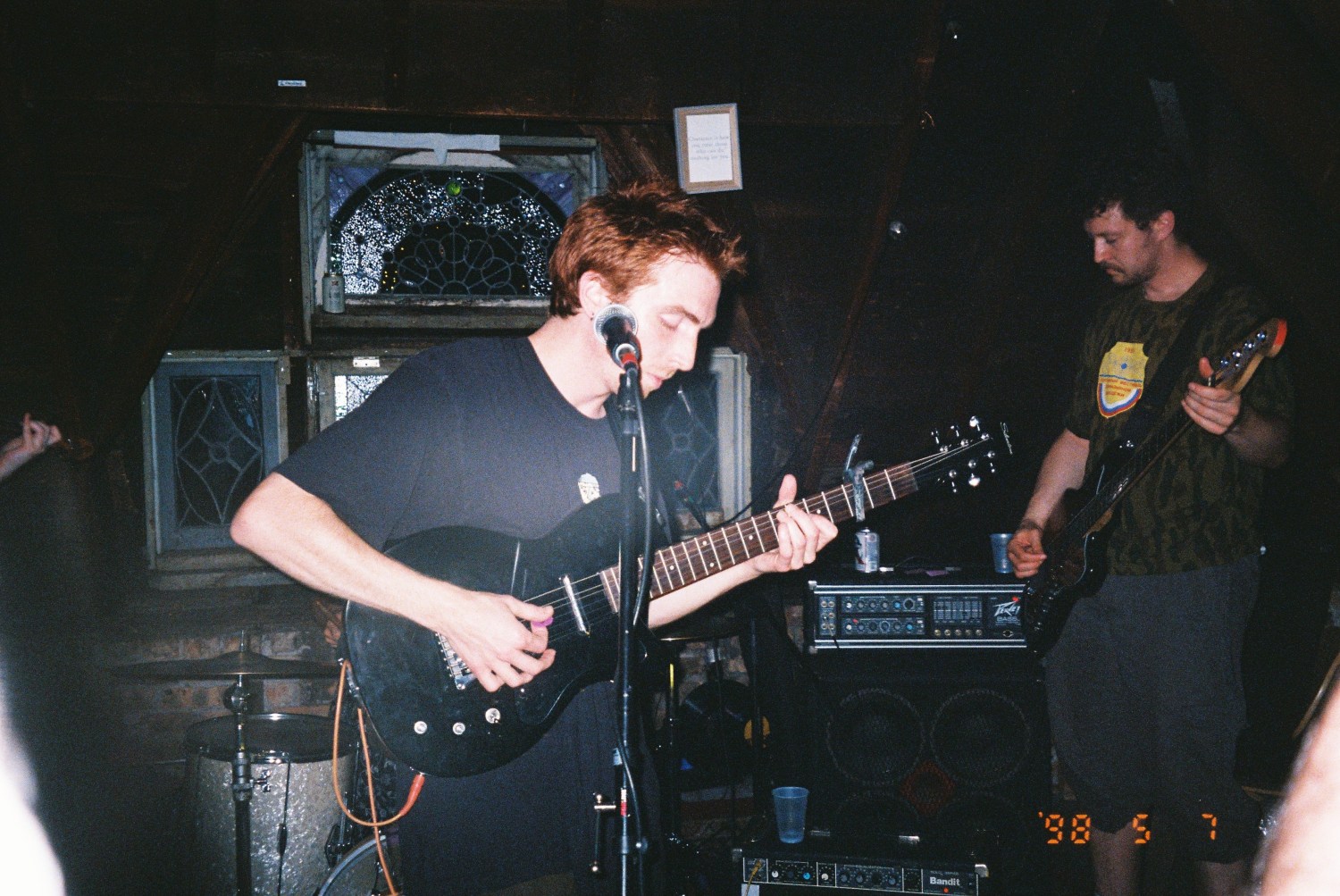
Photo by Eilee Centeno at The Attic in Chicago
During his performance at The Attic, a house venue in Logan Square, Chicago just a few hours before the interview, I felt myself slipping in and out of consciousness. Huddled around the five-piece ensemble framed by beautiful wooden ceilings and stained glass windows overlooking the neighborhood park, dripping sweat from the back of my neck, I wrapped my arm around my brother as tears swelled in my eyes, feeling a sense of belonging and comfort I had thought I’d lost. One moment I was zeroed in on every movement on stage, the next I was completely blacked out singing along to “Domino” and imagining every step I’ve taken mumbling along to that song in my hometown in North Carolina, being reminded of every time I looked up at a stop light and felt my heart sink and long to slip into one of the strangers passing me on the street.
I started thinking about how Hanif Abdurraqib profiled artists, usually making them seem larger than life. It feels like an innate human reaction to obsess over people and hold them up to standards that are above themselves. Maybe it was because I had just read a chapter in his book, They Can’t Kill Us Until They Kill Us, about the Weekend and his superhero-like ability to turn a crowd of thousands of people into sex-crazed animals, and it made me think about the humor in how most people obsess over huge pop stars, people like Taylor Swift or Drake who have big personalities and heaps of charm and charisma, but the person I obsess over is an artist with the posture of Bart Simpson who works at a fast food restaurant, and maybe everyone should make that pivot, too.
Maybe looking up to figures that are larger than life is what’s stopping us from making the changes in our daily routine that will push us towards a realization that we can take small actions to get us out of this mind numbing repetition. If our inspirations are more grounded in everyday life and our peers, then the disconnect between our motivations and our willingness to delve into our passions will disappear.
Even Keegan’s recording process when making a Kitchen album is reflective and representative of how it seems our generation is feeling. There’s tons of kids who are getting into analog recording with the hunger to connect to a creative process that grows with you and naturally takes the shape of your environment. It’s harder to delete or record over a mistake on a tape recording, but it becomes easier to accept and work with it, forming the rest of your recording process around that moment.
“I was really inspired by Spirit of the Beehive for a while and I moved away from tape recordings, but then I stopped doing the computer stuff so much because it’s all MIDI and you can get any sound you want. You can make an instrument play any sound you want. Most of what I like about a lot of the music I listen to is that it feels very natural and feels like things happen almost by accident,” Keegan said when talking about the evolution of his recording process.
There’s a sense of satisfaction that you get when committing to things, whether it’s finally finishing that Cormac McCarthy book that’s been sitting on your shelf for a year, or completing a week of journal entries, or following through on plans to hangout with your friends, sticking to your word is one of the hardest things to do especially when we are constantly distracted by the endless cycle of Instagram reels from friends we have to watch or new Pitchfork articles we have to read and argue about on Twitter. We’ve become so scared to share any imperfection of ourselves or our work that we often lose all strength to do anything at all, but Keegan has learned to embrace imperfections during his recording and writing process and even finds stability in them.
“When I was recording ‘Pike’ years ago I accidentally recorded one second over every track so there was a gap in the song that I couldn’t fix and I ended up having to re-record the whole thing. This was one of the worst mistakes I ever made while recording and the track was shaping up to be exactly how I wanted it, but it ended up being even better when I re-recorded it.”
After years of recording, Keegan has found a method that works well for him, bridging all of his influences into a succinct and memorable writing and recording style. In a short period of time Keegan has been able to create a distinct sound for himself that goes past his abilities to write catchy and relatable pop tunes. From the minute you hear the tape hiss, to the first down stroke of his guitar, to his shaky voice breaking over the track, you immediately settle into the comfortability of his work, allowing yourself to let your walls down as he does in the same breath. The combination of digital and analog recording styles is a reflection of the world he wants to create, full of imperfections, insecurities, and timidness, as well as patience, desire, and care.
Keegan described how his most recent record was made through this process, “You can hear when it’s tape stuff. ‘Fall’ is all digital, but ‘Halloween in August’ is a blend. The first half was recorded on a boombox and the second half was recorded into logic. The vocals were all recorded into the boom box, and then I cut them up and put them on top of the track.”
There’s so much care that goes into Kitchen’s recordings. His music builds upon intense swells, yet they’re never emphasized by crashing symbols or heightened vocals. They’re intensified by the realization of seeing yourself in Keegan’s music more and more. The lyrics become more weighted and backed by the world he creates throughout his albums. While his records may not be conceptually planned, there’s lots of nuance that leads you from song to song. “I Want You” wouldn’t make you cry as hard if it didn’t follow “Halloween in August,” continuing in Keegan’s story pining over someone. He has such a unique way of making you see the beauty in the mundane, and genuinely walk away feeling it. Weaving instrumental interludes between songs carries the feelings over from one place to another, transporting emotional spells from one song to another.
The other night I watched the movie The Lunchbox by Ritesh Batra, and in it the main character passed a street artist who painted the same place every day, but in each painting there were small differences. A kid riding a bike, a guy walking a dog, a couple holding hands would appear somewhere in the painting. The main character thought he saw himself in one of the paintings so he bought it and held the painting to his chest the whole train ride home. Keegan’s music feels like bits and pieces of a larger feeling. Each time I listen to a Kitchen song I see myself in a different world. His music is instantly so familiar that you sink into his world so instantaneously, holding on to your own memories and creating more within his albums. In a time where feelings are so quickly passed through, especially in the way that we’ve become accustomed to consuming and processing feelings, Kitchen’s music is so permanent and tender. His music instills a sort of stillness that feels very important and impactful right now. “Everything I do is cautious, can’t make my arms do what I want.”
“I think I process stuff very slowly. It takes me a really long time to figure out how I feel about something a lot of the time. By the time I figure it out, it’s a little bit too late to do anything about it but write a song. Maybe that sounds fucked up.”
Unknowingly, Kitchen connects rooms full of kids acting like adults based around a sense of hope that while we outwardly try and project how unique we are, we all feel the same sense of desperation, hopelessness, and passion. At his show he closed with one of my favorite songs, “Demon (Yellow)” and it only feels right to me to end this piece by quoting my favorite lines from it because Keegan always has the words for when I don’t, “crossing oceans, desperate phrasing I can’t talk cause I’m too lazy.”
Keegan just announced that you can now pre-order the first Kitchen album, town, on both vinyl and cassette. You can purchase a copy here. Kitchen will also be playing a few upcoming shows with Hello Shark in Troy, NY on November 15th and in Buffalo, NY on the 16th, then in Rochester on the 17th with Spencer Radcliffe, Hello Shark, Attic Abasement and A Wonderful.
“I can be sweet as candy” is the opening line on Joyer’s latest EP, I See Forward and Back. The delivery is timid but sincere, like most of the gentle vocals on the project, maintaining a warmth throughout the three track stringing of hazy, slowcore melodies and contorted soundscapes. I See Forward and Back is both an extension of Nick and Shane Sullivan’s fifth album, Night Songs, and an entity entirely its own. Though unified as a collection of songs conceived in late hours, where Night Songs toys with catchy pop hooks and vocal-centered tracks, I See Forward and Back strips down to the themes of Joyer’s earlier work, with gentle vocals drowning in and out of an abraded, DIY production.
Along with offering a more home cooked annex to Night Songs, I See Forward and Back highlighted Joyer’s range as multidisciplinary artists. The brother duo strung all three songs into one video, a collaging of black and white clips. Akin to the EP’s sound, the visuals are texture heavy, ranging from the soft print of a thumb to brutalist scenes of a scrapyard.
Recently, the ugly hug caught up with Joyer to discuss their tour, the power of shelving projects, and I See Forward and Back.
This interview has been edited for length and clarity
Manon Bushong: Your EP, I See Forward and Back contains songs that were written in the early stages of your album Night Songs. Do you often revisit music once you’ve fleshed out a project, and how does that distance affect how you feel about your work, and what you want to do with it?
Nick Sullivan: I guess it’s kind of new for us. I feel like we let songs hang for a while, a lot of times we won’t really go back to them. A lot of these songs started with Shane, so I feel like he could speak to the distance.
Shane Sullivan: I started writing them a while ago and shelved them because I never really expected them to go anywhere, but I always really liked them. It was unique to revisit them, and it was cool to have Nick jump in and add new ideas, like a bunch of cool percussion that I hadn’t thought about when I was initially writing them. It definitely was a new process for us, but I’m glad we did it and might be something that we continue to try to do just because I tend to write something, but then my attention span is kind of short and I move on to the next thing. It was a cool exercise, forcing myself to revisit and put out older stuff.
MB: There’s also a visual element to this project, you put all of the songs all together for one video. What was the process for that and what made you want to pick those three songs specifically?
SS: Honestly, I started working on these as a part of a class project back when I was in college. I was always interested in doing a visual EP, or a visual component to a collection of songs. I was in a class where I had to make a video, and at that point I was realizing how much I liked making music, so I would come up with any excuse to write music and songs for other projects I had to. So it started as a class project, but I ended up really liking the songs and the video work and I felt it was really interesting having them inform each other. I hadn’t done anything like that before, so it was a really fun way of making something – sitting on it and releasing it all these years later gives me a new appreciation for them.
Further on the topic of visuals, the EP’s cover art has a bull/cow, similar to Night Songs, but the image is also a bit simpler and in black and white. What was the story behind the cover art for I See Forward and Back, and how it ties to Night Songs?
SS: I think we definitely wanted to highlight the link between this EP and Night Songs since it’s an extension of it. So similar imagery, it’s a still from the video – our grandma had a painting that I shot little fragments of. I remembered that being a frame that I really liked, and felt suited the songs, and also matched the album art of Night Songs. So we just wanted to highlight that link, since this was all birthed out of the Night Songs songwriting process.
MB: So these were all collectively part of the writing process for Night Songs, but while it is an extension, it also feels like its own body of work, and I think that a lot of that comes from different production styles. How did you go about production differently, and how do you think that it affected the overall feel?
SS: I feel like it’s a fun glimpse into how we approach the songwriting process because we usually demo a bunch at home, and the songs change a lot in the studio. Usually we’ll write a ton of songs and then pick a solid 15-ish to bring to the studio, and then from there cut it down to 10 to 12. These were ones we liked the way they sounded lo-fi, but in the past when we’ve tried to bring songs that we like lo fi into the studio, it doesn’t really capture what we were going for originally. It made me kind of nervous because it is a little bit more vulnerable, but I thought it would be something cool to highlight the home-recorded and stripped down nature of where our songs usually begin. Another thing about Night Songs is we recorded close to 20 songs, even though it ended up being 12, and there were a lot of different styles of songwriting within those 20. I think we ended up picking the track list that we have now because that was what fit, so it’s interesting to me because the whole album could have sounded more like this EP, and it’s cool to see what it could have been if we went forward with that.
MB: I know you explored some new sounds on Night Song, how has it been playing that album live? Do you think you’re going to incorporate some of these off the EP in your touring as well?
NS: Yeah, it’s been a lot of fun. I feel like Night Songs is way more fun to play live than some of our older stuff, so we’ve been really enjoying it. It’s louder and faster but also has some quieter moments. We will hopefully include the songs off the EP into our live set eventually – we never really thought about it, so a day or two ago, before we left for a tour, we were like ‘damn I guess we should have gotten those ready’. They’re a bit trickier because they’re so stripped down, and have a lot of ambient noises interlaced within them. It’s like a fun puzzle for us to figure out how to make live versions. We’re just excited to get on the road again, we’re touring with some of our favorite bands, so, I think it’ll be a blast.
You can now stream I See Forward and Back and Night Songs on all platforms as well as purchase a cassette of Night Songshere via Hit the North Records
Written by Manon Bushong | Featured Photo by Juliette Boulay
Today, New York’s Toadstool Records has shared Let’s Be Friends: A Tribute to the Beach Boys, a 28-song compilation album of beloved Beach Boys songs benefiting the Billion Oyster Project and Mutual Aid Disaster Relief.
In a statement, Toadstool’s founder, Caroline Gay, shared, “In the lead up to the United States presidential election, climate change has become a hard reality. The United States’ support of Israel’s military assault on Palestine is not only a humanitarian disaster, but has had an immense effect on the climate. Combined with Donald Trump’s outright denial of climate change and rollback of over 100 environmental regulations during his presidency, the United States’ hand in the global climate catastrophe cannot be ignored.”
The comp includes contributions from artists like Joe Fox, The Fruit Trees, ghost crab, ebb, orbiting, djdj, Billy Plastered, Gavin Serafini, Luca Vincent, Bill Hagan and Friends, Luke Lowrance, Cephalid Breakfast, Daniel Um and many more.
All profits will be split between Mutual Aid Disaster Relief, a grassroots mutual aid network whose mission is to provide crisis relief based on the principles of solidarity, mutual aid, and autonomous direct action, and Billion Oyster Project who works with local communities to restore oyster reefs in New York City. Oyster reefs provide habitat for many species, and can protect New York from storm damage — lessening the impact of large waves, while aiding with flood and erosion control.
About the comp’s album cover, Caroline also shares, “Beach Boys fans will appreciate the artwork for this compilation, a custom piece by Matthew Durkin. It contains references to Smiley Smile (the house, plant on the backside of the album) and Friends (using a very similar typeface as seen on the album cover) all combined to make an original piece for this compilation.”
You can purchase Let’s Be Friends: A Tribute to the Beach Boys exclusively on bandcamp.
On a rainy Wednesday evening, Grumpy’s starvation for attention and a protein bar is satisfied by a chocolate croissant and a friend passing by with their dog. “Grumpy is famous now, spread the word” front person Heaven Schmitt explains of the open voice-memo app between us mid-interview, before leaning in to generously pet the small terrier. The interaction was the closest I got to meeting Grumpy that evening, a charming big-hearted character parading around in an armor of extreme ego. Schmitt describes Grumpy’s identity as “me, plus a very cocky bravado. There’s a huge layer of cockiness to it, but it’s also just very earnest about wanting attention.”
Following a transformative four year stretch since Loser came out, Grumpy released singles “Saltlick” and “Protein”, both glimpses of EP Wolfed, out via Bayonet on October 25th. These vibrant songs confirmed the band’s charming sense humor remains unscathed, while also teasing a new voice to Grumpy. It’s a nightmare for the genre labeling fanatics on the depths of the internet, but for the rest of us, Wolfed is unpredictable and addicting, a sonically innovative feast guided only by itself.
The third single off of Wolfed offered a glimpse at the soft core nestled deep beneath Grumpy’s cocky bravado. “Relationships are not always forever, but I think that love can be”, Schmitt says of the ideologies behind “Flower”, a tender twee ‘syrup song’ immortalizing a connection after the romance has expired. The EP’s wittiness proves to be an easy hook, but it’s ultimately this dispersing of vulnerability, weaving in and out of comedic one liners and self-deprecating jests, that uphold Wolfed as Grumpy’s most captivating project yet.
When I sat down with Schmitt last week, their signature mischievous Sweeney Todd-esque hat had been replaced by an adorable knit striped hood they finished making the day prior. Along with knitting, we discussed the other ways Schmitt has kept busy, such as planning an epic release show, pioneering the niche internet aesthetic of “dirtybag twee”, and taking a hands-on role in the creation of Grumpy’s new sound.
This interview has been edited for length and clarity:
Manon Bushong: Before we dive into music, I did want to ask about your outfits and awesome hat collection. How you would describe your style, and what do you look for when you’re picking the outfits you play in, or just wear in general.
HS: Well, I love a funky hat, obviously. I’m super inspired right now by Sweeney Todd / Beetlejuice vibes…crusty insane man in a suit. It’s largely inspired by my hair, it recently came out a more cool-toned gray than I thought, but then I just leaned into it. I have a Sunday night ritual of making a little picnic dinner on the beach and the only time I wet my hair is in the ocean. So it’s super gross and sandy and wavy, and that inspired the whole Beetlejuice, Sweeney Todd era for me.
Right now, I’m trying not to buy anything. When I’m picking stuff out, I’m just trying to entertain myself with what I have. I’ve just started posting outfit TikToks…lord help me…but someone on TikTok described it as “Victorian Truck Stop, and I love that. Challenging myself to post TikToks about it really pushes me to make an outfit that much more bizarre, or just to add one extra layer of intrigue. I just love clothes and expressing myself with my style.
I’ve landed on, what do they call it? Oh yeah, therian TikTok. It’s these young kids who are ‘therians’, from what I understand, it’s a furry thing. So I need to figure out what animal I am. I don’t know…I’m getting wolf a lot, but I don’t know if that’s true. I think I’m a little cuddlier. Maybe there’s puppy elements to it? I’m never gonna beat the furry allegations.
MB: Wolfed is also the title of your upcoming EP.
HS: Ohhhh, yeah. Okay, I’m Wolf. I am Wolf.
MB: What does that verb mean to you for this collection of songs?
HS: Wolfed came from Anya, my bandmate and deepest collaborator. She’s the bassist in the band. I kind of just call her the art director of the project because she and I make all of the PR photos and cover art together. She has a really crazy editing style that I love and she also really gets me. She sees the fantasy realm that exists in my head. She sees it in me and understands me and is so good at translating these things into words and images. Anyways, I’m always saying, ‘oh, like you ate’, ‘you tore’, like ‘you, you ate that’ and Anya just conjured a lot of Big Bad Wolf energy. The art direction for this EP has a lot of dark fantasy inspiration. So we were thinking a lot about Big Bad Wolf, and she came up with the phrase wolfed as another way of saying “you ate”, like, you just devoured something.
For me, this EP and what’s coming is a real response to our first album, Loser. This is kind of my winner. These few years when I haven’t released anything have been a huge transformative time. I mean I called the band Grumpy, and I called the first album Loser, and it was tongue in cheek, but there was some truth to that. That’s how I felt at the time. Now, I still love the band name, but I want to put out stuff that I produced and made, cause I think I was hands off on the first album in a way that it ended up not sounding like it could have if I really tried to learn. Anyways, I connect with the big bad wolf because it’s this person whose bravado and cockiness gets him into trouble ultimately is his demise. So I think this is before the big bad wolf knows about his downfall. We’ll see where I go from here, but for now I’m just feeling like I could huff and puff and blow the house down.
MB: When it comes to lyrics, Grumpy does a great job of meshing humor and some very clever lines with a lot of pretty solid introspection that can be very poignant at times as well. How do you feel like humor is something that you incorporate into your writing and is it something that you really feel is necessary?
HS: What I really value in music are comedy and melody. Those are the things that can get me really hooked, or just think, ‘Oh, I wish I wrote that’. I’m glad that that’s what you take away, the self reflection and the humor, because that’s what Grumpy stories are. It’s just a lot of me being like ‘how much can I embarrass myself with what I can admit in a song’, there’s a huge amount of vulnerability in it. I’m trying to be very raw and write how I speak and exactly what I was thinking. I bring in discomfort from honesty and then invite people to laugh at me, like isn’t it ridiculous that this is how I saw it?
Humor is such a way for me to access the uglier sides of who I am and to confront them. My history with music and pursuing music, was so ‘tortured artist student’. I really wanted to pursue music as a career so in college I was trying so hard to make songs that were relatable and not too weird. It just destroyed me, it was zero fun and the songs were terrible. I got to this point, right as I was graduating college where I was like, ‘you know what? Let’s just get real, I don’t have what it takes to do this’. So I went and worked at an ad agency for a year, it was just this dramatic exit and I didn’t make any music during that time. It relieved so much pressure that after maybe eight or nine months, I was like, ‘well I’ll pick up the guitar’, I can just do this for fun. Then there were no constraints, it wasn’t for anyone but me. From that total lack of pressure, all these goofy dorky songs that were so me came out. So that’s the whole genesis of what Grumpy is, how I figured out how to make music fun for me.
MB: What shape is the fun of Grumpy taking now, four years later?
HS: We’ve got a really exciting tour planned and a bunch of music sitting in the cannon. These past four years in between releasing anything have been so important and I’m glad I waited because I knew I wanted help. I talked to a bunch of labels, but nothing ever felt right until Bayonet. I totally cried in our lunch meeting, because I was just like “Oh my God, they get it. They get me”. They shared what they believed was possible for me and the spaces they saw us in, like the bills they saw us on, stuff that I only privately thought ‘does anybody else but me think that we belong in this space?’ I love them and I’m grateful and I think they’re crushing.
Everything that’s coming for Grumpy is the result of my roots in folk and indie music, those are just my biggest influences. I’m also hugely inspired by hyperpop and electronic music. Hyperpop artists have this brilliant sense of humor and sense of fun that doesn’t take itself too seriously, and I’m so inspired by what they can achieve. I think Frost Children is so much bigger than any one genre you could put them in, they’re just absolute savants. I think they’re the best performers I’ve ever known, they have so much fun on stage.
For me, Grumpy is this combo, a product of these two influences. During our first meeting, Bayonet was describing it as “hyperfolk”. Genre-izing things is hard for me, everybody wants to come up with the next Indie Sleaze category, but damn, they kind of nailed it with hyper-folk. Electronic vocals, indie sensibilities.
MB: Do you think that there could be more of a hyper pop future for Grumpy?
HS: I’m never concerned about cohesiveness. I think I’m the through line, so I can make whatever I want and it is Grumpy. I don’t see myself doing side projects, I just see Grumpy having a wide stroke. I have a lot of heavier rock stuff coming, some more electronic stuff, some classic indie, jangly pop stuff, and then it’s just some weird, weird folk that I’ve been sitting on for a long time. That’s another reason Frost Children are such a big inspiration to me, they could really crush such a huge variety of genres and it still sounds like them because they have a strong voice.
I love it so much, these people are my family, they understand me and have seen me so fully and still love me. It’s very healing to have them close, that we’ve remained valuable to each other in and outside of a romantic context.
MB: You play with a few of your exes. I saw you live last week, and there was something very special about the energy of your band, which I assume that contributes to. Do you have a favorite part about playing with people you share that intimate relationship with?
HS: I like to joke that dumping me results in a life sentence of commitment to the band Grumpy, but they have all honored that. It is funny to joke about but it really is this beautiful thing for me, and I think it adds to the rawness. There’s a level of realism that can only be achieved by songs being performed by the people they’re about, like I’ve written the songs, but the people in the band have had a hand in living the story. In a way, they’ve written the reality, I just put it into words and melody.
“Flower”, is a very twee, sweet love song about a romance that has ended and it’s a reflection on the love. Relationships are not always forever, but I think that love can be. The way that I approach dating is knowing that that love can and will change shape. I’m not building some commitment to you so much as I’m nurturing a bond that I hope to hold forever. So, having these exes near and dear is just living that. I’m so glad I dated each of them, they’re such a huge part of me and I still feel very loved by each of them. My bonds with them feel eternal. In and outside of a relationship, we nurture that with each other, and that’s what “Flower” is about. I think it speaks highly of all of us, and the community that we hold for each other. It’s a rare relationship that I’ve come to really appreciate.
To specifically highlight Anya, we ultimately realized that we were not lifelong romantic partners, but we do have this really incredible artistic connection. I always get this image in my head of two little rodents digging, like a skunk and raccoon with little archaeology brushes, uncovering and discovering things that we can make in the world. She’s just a music veteran, absolute powerhouse, freak of nature, not from this planet. Then Austin, my ex husband on drums, he’s the voice of reason in the band. We often don’t follow his apprehension, but it is good to have. He’s also just like our AV guy, he can really be so organized.
MB: What’s next for Grumpy
HS: Our EP release show is happening October 27th. I held off on playing a Grumpy headline show, this band has been around like four or five years and we just played our first one in July at Cassette. I like to be very specific with headline shows because I personally don’t love to go to shows. If the band is good, I’m like, ‘Damn, these guys are great. I want to get home and write a song.’ If they’re not, I’m like, ‘how come I’m not up there? I want to go home and write a song.’ Either way, it makes me want to leave and write a song, except for Blaketheman shows and Frost Children shows, then I’m locked in, that is pure entertainment. Blaketheman1000 has humor like no other, I actually think he’s a genius if you read his lyrics. He and I’ve been friends for 10 years, he was my first friend in college. I just think he’s an underrated genius and comedic hero. He really understands putting humor in music, he just nails that confidence.
Anyways, EP release show. It’s Halloween weekend and I basically want to throw a party where bands are playing. For our first headline show, we had free hot dogs and a hot dog eating contest with a bunch of my beautiful friends. So for this Halloween weekend show, we’re doing a huge costume contest and I want to gather a whole bunch of prizes and merch related stuff. I want an apple cider donut contest, probably some candy too. I like a snack element, there’s not enough food at shows. It’s going to be at Trans Pecos and the lineup is Estelle Allen and Thanks For Coming, and Grumpy. We’ll be dropping some merch and the EP will be on cassette. I’m gonna go hard, but Halloween is such an impossible question. I think for a Halloween costume to work for me, it has to have a wig, cause wigs are the thing I’m not wearing. Although, I really cannot deny that I am thinking about powdered wigs. Who’s pulling up to the function in a powdered wig?
Wolfed will be out October 25 via Bayonet Records. You can preorder the EP as well as a cassette tape here. Grumpy will be playing an EP release show at Trans Pecos in New York on October 27 along with Thanks for Coming and Estelle Allen. Buy ticketshere.
“I was so nervous it was just going to sound like a collection of songs? In hindsight…what the hell does that even mean?” Victoria Winter reflects in between sips of chai tea.
We are having the age-old ‘what makes a record’ conversation. It’s a topic that leaves room for hours of discourse, but for New York based Shower Curtain’s debut album, the answer is relatively straightforward. Titled as an ode to the band’s journey, governed equal parts by fate and Winter’s deep sense of intuition, words from a wishing well marks the promising start for Shower Curtain’s synergetic future as a four-piece rock band. “I also don’t want a record with songs that all kind of sound the same. I had forgotten that, no matter what, it still has this unspoken identity that is ours”, Winter declares, putting the subject to rest.
The unspoken identity she speaks of is a strong one, one you trust and one that leaves you wanting more. A certain tenderness in Winter’s vocals paired with vulnerable slices of internal dialogue salute her bedroom pop roots, while a new presence of heavily layered instrumentals eulogize Shower Curtain’s days as a solo project. Now joined by Ethan Williams (guitar / vocals), Sean Terrell (drums), and Cody Hudgins (bass), words from a wishing well is a stunning journal of internal roadblocks, some easy to articulate and others leaning more into the abstract.
Wilting thoughts of “I can’t be on my own” and “I’m always falling apart” are intensified by fervent guitar riffs on “take me home”. On “benadryl man” the suffocations of nocturnal anxieties manifest as a figure on Winter’s ‘velvet purple couch’, blanketed in eerie, staticky distortions. The album wraps with “edgar”, where the stinging in Winter’s vocals compete with heavy chord progressions to deliver a story of grief you feel in the depths in your chest.
At times honoring the noise-driven, sludgy guitar tropes of 90s shoegaze, at times experimenting with electronic production styles, there is an essence of Shower Curtain’s newly formed collaborative personality seeping into every track.
I sat down with Winter and Williams last week to discuss Shower Curtain’s compelling visuals, their upcoming tour, and words from a wishing well, out everywhere today via Angel Tapes / Fire Talk Records.
This Interview has been edited for length and clarity
Manon Bushong: You’ve been making music since 2018, but words from a wishing well is Shower Curtain’s debut album. Did you always intend for these songs to exist as an album, and how did the process of creating them vary from Shower Curtain’s prior singles and EPs?
Winter: This is the first time that Shower Curtain is really doing things as a band, before it was more just me alone for fun. I would say this album definitely marks being in New York, being collaborative, and just having a more solid group of individuals and contributions. I always did want to make a record, but it’s kind of hard to navigate the music landscape. One hand, people tell you, “fuck albums, you need to be doing singles and EPs until you’re big enough”, but then, no label is gonna wanna work with you if you don’t have a record. So as a small indie band, you’re kind of like, ‘okay, what should I do?’ So we kind of went back and forth and then kind of just kept as we wrote, which I don’t feel like we’ll ever do again.
Williams: We’re not going to do that again. There were like, maybe four or five songs when we started recording it. So we were like, well, let’s start making an EP and see what happens. And then it just took so long that then there were like four or five more songs that we had and we were like, just re-recording them as we wrote. So it wasn’t necessarily the plan, but it wasn’t not the plan, you know?
Winter: I definitely felt in my heart, even though we went back and forth, that I always wanted to prove myself and make a record. I work as a designer in the music industry too, so I see a lot of vinyls and really wanted to have that for us as well. I’m like an album person in general.
Williams: I’m an album person too. It’s easier to create more of a cohesive artistic vision that way.
I really enjoy the album’s structure, and I noticed you included a more electronic track, “tell u (interlude)”, in between two heavier songs. When it came to producing, which I know you both do as well, did you feel like creating an album pushed you to think a bit more alternatively there?
Williams: I mean, we made it in my basement. So once we had recorded everything, or towards the end of having recorded everything, we thought about how to make it sound more like an album and not just a bunch of songs that we wrote over the course of two years. So we added some stuff in between and tried to create some motifs, it wasn’t planned from the get go, but it made it feel like more of a finished thing to us.
Winter: I had been really nervous, I used to say to Ethan “ugh, it’s just gonna sound like a collection of songs”, this is not gonna sound like a record. Now in hindsight, I’m like, what the hell does that even mean? Why was I so stressed about that? “tell u (interlude)” was the last thing we made, and by that point I had kind of gotten over myself because at the end of the day, I also don’t want a record with songs that all kind of sound the same. I had forgotten that, no matter what, it still has this unspoken identity that is ours.
All of the visuals for this project have been super sweet. I really like the cover art, the semi distorted pink photo of you all in the woods really matches the album’s sound. Could you discuss that a bit?
Winter: All the visuals are kind of my brainchild, whereas, the music has been way more collaborative. The actual album cover, I wanted to put a lot of thought into because that is something that matters a lot to me, I remember album covers more than their names. I was graduating from Parsons for Graphic Design, and I had the record be my final thesis, and so a lot of consideration went into it, and brainstorming if we were a color, what would it be? I wouldn’t say we are pink, but we definitely aren’t blue, or purple, or green. I went on this journey, I thought about certain descriptors for the songs, like ‘textured’ and ‘heavy’, but also ‘emotional’ and ‘sensitive’. Just really considering how close an album cover can get to what you’re about to listen to, I put a lot of thought into that and the name.
For the name you chose words from a wishing well, what was the meaning there?
Winter: So much of how I move through life and with the band is with these very intuitive and esoteric beliefs, so being in tune with ourselves is extremely important. That’s the main motif behind the title, this idea that when you really want something, the wishing well talks to you.
Sometimes it’s just not the right moment, and not everything that you wish is going to come true. But I do believe that if it doesn’t happen in a moment, later on you’ll think, ‘I’m so happy that it didn’t’. I feel like a lot of the lyrics are about how I am as a person. Whereas the title, I wanted it to be about the story of how the band came together.
When you mentioned that balance of cute and creepy, I immediately thought of the music video you put out for “benadryl man”, which features some very sweet bunnies, but also edited at a pace that feels a bit eerie. How did that project come to be, and what do you prioritize when creating music videos ?
Winter: Sean the drummer, made those bunnies with his girlfriend, Kati, for an exhibition. When I saw the bunny with the painted flames, I thought ‘oh my god, this would be such a sick album cover’. I knew I wanted to use that bunny for something, and Kati likes a lot of similar stuff, like small objects, tinted glass, and metals – she’s a visual artist. So I asked her to set up a stage for the bunnies and then I went to Mother of Junk and got a bunch of miniature random items. Then Cody showed me this guy, Matt, who makes animations, which was also a crazy coincidence because a bunch of people from my city in Brazil followed him. Turns out he is Brazilian and knows a lot of people that I know from my hometown. So, he actually edited all the spooky, crazy shit his own way, and added his own spin on it.Then, the music video for bedbugs is a horror film-noir. When I work with people for a video, I’m just like, ‘I really don’t want it to be too cute and twee’, but I want it so you can tell it’s a girl making it. Kind of a female gaze, not necessarily cute and with this aspect of moodiness to it.
Do either of you have a favorite song off the album to perform, or just in general?
Winter: Personally, I think “bedbugs” is my favorite and “you’re like me”. And then for performing live, Edgar is my favorite.
Williams: I think my favorite ones to play are “you’re like me” and “star power”.
Winter: Ooh, yeah. And from the record?
Williams: Maybe also those. Yeah, I don’t know, I like the parts that I play, which is kind of egotistical to say, but they’re just fun
Apart from the release of words from a wishing well, is there anything else exciting on Shower Curtain’s horizon that you would like to shout out?
Winter: We’re having our New York City record release show on November 13th. It’s going to be a ‘Stereogum Presents’ and it’ll be with Many Shiny Windows, My Transparent Eye, and a Special Guest we can’t announce yet. Then we’re going on tour in two weeks, which I’m really excited about. Then I want to come back from tour and record new stuff.
Williams: I’m excited to go to New Orleans and Chicago. Those are two of my favorite cities in general. I just love going on tour, it’s like a little rock and roll circus. You know, driving around Oklahoma and Kansas feeling like a cowboy. I’m just excited to do that.
words from a wishing well can now be streamed on all platforms. You can purchase a vinyl or cassette of the album via Angel Tapes / Fire Talk Records here. You can purchase tickets to Shower Curtain’s upcoming album release show at TV Eye in New York here.
Fronted by Diego Clare, a local spearhead to the New York community and a project of influence and vision, their penname D.A. Crimson has shared a new single called “Barrel to Heaven” this week, along with an accompanying music video. Within a controlled burn of sonic dismemberment, Clare’s performance withers and writhes in the face of loss and the complexity of familial altercations when emotions and memories begin to conflict.
Leaping in strides like a choreographed dance, “Barrel to Heaven” begins with a guitar that quickly establishes the thematic weight, further brought to life by an array of sonic voicings and deliberate timbres – dilapidated yet concise; harsh yet sobering when face-to-face with its grand scheme. “When I wrote it, my grandmother had just passed away after I’d spent a month staying with her and my dad at her house in Costa Rica. There was a lot of familial drama between her kids throughout this process, which I just found really upsetting,” Clare shares about the song. As the chorus follows the movement below, singular harmonics flash out at the end of each repeated stanza, “There’s a way out” – reverberating before screeching in exasperation – “Looking down the barrel to heaven”. “I felt especially attached to her home, my memory of which now feels sort of embedded in this song. In any case, those are the things that came through, or morphed into this kind of Hamlet-ass soliloquy about loss and what remains in the wake of it,” Clare finishes.
Along with the release of “Barrel to Heaven”, D.A. Crimson has shared an accompanying music video made by the creative duo known professionally as “The Valdez”, which features both Clare and movement by choreographer, J Gash. You can listen to “Barrel to Heaven” out everywhere now.
“And my idea of me / Is a place where we fill every corner / With Trinkets and Horses” sings like an open letter, where the past, present and future speak to each other in tones of grace and understanding as things are always uncertain, but each step forward is fulfilled by who you choose to bring along the way. One year ago, Mariah Houston and Alan Howard (Sleep Habits) released Trinkets and Horses, a split EP that has become a point of celebration for the two artists, both in what it has come to represent on its own, as well as what they have accomplished since.
Having met in college, the duo began to collaborate on anything they could, working out the early iterations of what would be their respected solo projects. After college, Mariah moved to New York, where she has since joined the noise-rock project, Plastic, and Alan continues to make music under the name Sleep Habits in New Orleans, where he also plays and tours with artists such as Wesley Wolffe, Noa Jamir, Thomas Dollbaum and hemlock.
As these songs continue to build out their lives, the stories scratch those marks that were left behind; imprinted – irritated and molded to shape, like the markings a harsh wood fence will leave on your skin when you get up from a momentary break. With a blend of twangy daydreams, rooted folk voicings and DIY lo-fi admiration spackling in the cracks, Trinkets and Horses does not just represent a single moment in a creative project, but rather the detailed rhythm and dedicated trust that comes with a friendship.
Recently, Mariah and Alan teamed up with New Orleans-based tape label, Kiln Recordings, to release a special edition CD, marking the first time that Trinkets and Horses can be found in a physical form. Revisiting those beloved songs, the ugly hug got to catch up with the duo, Mariah in New York and Alan driving through Utah on tour, as we discussed how the album came to be, strengthening their creative collaborations, and looking back at the experience one year later.
This interview has been edited for length and clarity
SR: I know that you two have been friends for a long time, but how did this creative relationship start?
MH: Alan and I met at Loyola in New Orleans where we lived across the hall from each other. What are the odds, right? We played in a few bands together, including a wind ensemble, I played French horn and Alan played trombone. And then on the first iteration of Sleep Habits I was singing..
AH: …because I was too scared [laughs].
MH: Yes, Alan was scared [laughs], so I was singing in Sleep Habits and Alan was playing a bit of guitar with me and helping me record some songs. It was very entry level stuff, we were just in college hanging out and making silly songs. Then it just kind of progressed from there to more serious songwriting and more serious collaborations. As we began to release stuff for our own projects, we thought, ‘damn, wouldn’t it be fun to go on tour? Why haven’t we done that yet? Let’s just make it happen!’ But we knew we needed something to tour behind, so we decided to record an EP together.
AH: In the grand scheme of things, it was all kind of very last minute, too. We really just said ‘fuck it’ and just immediately jumped into doing it. I think we uploaded the tracks a week before we left for the tour.
SR: As you were putting together the track list, you two were pulling out a few songs that you wrote individually that had been demoed and back-pocketed for awhile. What was the timeline in which you wrote these songs?
AH: It was pretty different for all three of my songs. “Little Smile” is pretty old and then “Pavement” was already on a Julia’s War comp in 2022. “Trinkets and Horses” was a pretty fresh song that I was messing around with at the time and just really came together.
MH: I had written “Promise” while I was living in Portland and the other two more recently. I actually wrote “Backseat” right when I moved to New York and then I wrote “Different Now” on New Year’s Day of 2023.
SR: A fresh start?
MH: Trying to [laughs]. I had done that this year again too. Maybe this could be my tradition. It feels really good.
SR: Throughout the EP, there feels to be this thematic throughline of redefining placement and growing up that really sticks out. Were there any overarching themes that you were looking to build upon or connect when choosing which songs to include?
MH: We didn’t really have a concept for this EP, so I do think a lot of the themes were accidental. It is funny to reflect on each song now and see how they overlap, because intrinsically, Alan and I have a lot of similar influences and we’ve known each other for almost seven years and have been collaborating since we met. So there is a lot of crossover in the kind of emotion and themes that come out in our songwriting. We also had a similar pace of upbringing, me being from the Midwest and Alan from Baton Rouge, we both had an itch to experience more about life, so there’s a lot that we both reflect on that feels similar.
AH: There were also a couple of songs that we were thinking about finishing that didn’t make the cut and may be too far gone to return to. But all of the decision making was very mutual.
MH: I decided to include “Backseat” at the last minute and Alan decided to include “Pavement”, which would both be considered more of the commercial songs, so we had a lot of discussion about the vision and style. But ultimately I think we just had some demos that came together naturally.
SR: Having both worked so closely together in college, and now covering a lot of physical distance in your collaboration, were there any takeaways about your own creative process that this EP brought out?
MH: Collaborating makes two things easier for me, which is holding myself accountable and executive functioning. We set deadlines for each other, so there was an element that reminded me not to put this off because there’s another person involved. Usually with my own music, I’ll just put a pin in it, but because we both have the tendency to sit on music for a long time, by the time we release it, we’re kind of dissatisfied with it. It’s not an accurate reflection of our taste and our style that we hold presently. But because this was such a quick turnaround, and because we’re working with each other and admire each other a lot, we actually released a project that we felt really confident about and really proud of.
SR: As it was your main goal to go on tour, which inspired you to make this EP in the first place, did these songs find different lives as you traveled and played them night after night? How does it feel looking back on it all now one year later?
AH: It was amazing! It was so fun to play the songs stripped down like they were written, but with single elements that came out in the recording process (Mariah singing with me/me playing slide with her). It felt really good to make new friends and see how people reacted to the music. It really solidified why I love playing music and doing stuff DIY. Especially it being the first tour I ever went on.
SR: Now you are celebrating the one year anniversary of Trinkets and Horses with a limited CD release from Kiln Recordings? What made you want to mark this anniversary by re-releasing the album?
AH: We had always thought about releasing this EP with some extra tracks, like we had these backyard recordings that we did at Carolina’s (hemlock) house in Chicago while we were on tour, so those are on the re-release. And we’ve always just really wanted a physical of the album.
MH: But also, Kiln is based in New Orleans and has supported our friends and our community there, like some of Alan’s other projects and Wesley Wolffe, so it’s exciting to work with them regardless. They are very deliberate, make really great art and on top of it all, they’re people we know personally, so it feels good to collaborate like that with them.
SR: Do you two have any plans to collaborate again in the future?
AH: Yeah, we’ve already been working on stuff together! I’ve been playing bass on Mariah’s new record and she’s going to be singing on my new record. But I mean, if we’re talking about collaboration, to me it feels like Mariah is just part of Sleep Habits at this point. So yeah, definitely gonna have her on the record.
MH: In any formal or full band iteration of my music, Alan will have a place. And if by chance we live in the same place again one day, I know that that will come into fruition. Whether I’m singing or playing guitar I know I’ll have a place in Sleep Habits, and when we record it doesn’t matter where we are, we can always send each other tracks. And I did record some of my album that I’m working on now in New Orleans, so Alan was there with me.
You can now order the special edition of Trinkets and Horses from Kiln Recordings, which includes two never before released backyard recordings of “Pavement” and “Trinkets and Horses” ft. hemlock, completed with a 14 page booklet including the artists’ handwritten lyrics.
While history has proven that amity amongst band members is not necessary to create good music, it’s always special when the depths of a bands’ friendship is palpable in their work. Years of experience playing in bands like Sloppy Jane and Water From Your Eyes speaks to the technical talent of Al Nardo and Bailey Wollowitz, but it’s ultimately this sense of camaraderie that makes their prog-rock band, fantasy of a broken heart, so compelling. The duo’s collaborative friendship dates back to 2017, though up until now, fantasy of a broken heart was confined to a relatively low profile of house shows and occasional single releases. The time spent cultivating fantasy’s identity, or perhaps lack thereof, is discernible in their debut album, Feats of Engineering, a captivating experience doused in honest introspection and eccentric charm.
While fantasy of a broken heart claims that “only isolated artists make original material”, Feats of Engineering is a harmonious dialogue sung in a language that feels completely their own. Lyrically, Nardo and Wollowitz are masters at fusing vulnerable with whimsy. It would be easy to assume an album with imagery of Tony Danza preparing buttermilk pancakes and a possessed Evil Kenevil wielding an “as seen on TV magicians novelty arrow” would amount to a goofy but hollow listen, perhaps engaging in a bit of post-irony ridden social commentary at best. Instead, fantasy’s amusing tangents and bizzare imagery work to enhance the project’s emotional depth. In its entirety, Feats of Engineering is somewhat of an auditory hallucinogen, inviting us deep into an unrefined subconscious reality where the strangest of thoughts are met with rather hard to swallow existential notions. Instead of coming across as a joke you aren’t in on, the album’s vulnerability factor feels somehow amplified by each lyrical peculiarity.
In an auditory sense, fantasy is a maximalist quilt of 70’s prog-rock, 90’s dream-pop, and modern indie-pop, though if you tried to create a list of every subgenre their sound touches it would rival a CVS receipt. Each song on the album has a distinct identity, with its own unique formula of layered instrumentals and varied time signatures. However, amidst their most enigmatic structures, Feats of Engineering successfully stands as a holistic body of work, unified by a discernible sonic ethos and enriched by the soothing harmonies of two voices with an undeniable musical rapport.
The album commences with the trance-inducing “Fresh”, a minute long track that starts off with a steady high pitch car beep, the one reminding you to buckle up or perhaps shut your door. Though the beep is initially attention-seizing, it is soon lost in a mesmerizing synthetic organ melody, and in a brief, word-less 60 seconds, the magnetizing pull of Feats of Engineering has begun. The vibrant “AFV” follows, providing an auditory finger snap to the meditative state induced by the intro song. At its core, “AFV” is a humorous tale of a romantic interaction gone wrong, a palm to the face detailing of a flirting effort mistaken as an attempt to buy weed. The earnest anecdote is paired with an uneasy chorus, as the two harmonize on the repeating lines of “All I wanted was a little sensation”, and “I thought a devil called my name”. Through satisfying hooks and a lavish layering of instrumentals, fantasy of a broken heart harvests structures of an addicting pop track, while balancing a lighthearted story with a desperate longing to feel.
It doesn’t take long to establish that fantasy of a broken heart has perfected the art of writing tearjerkers that pass as chic remixes of vintage television jingles. Loss is the archetype for this, offering a vulnerable testimony to the umbrella concept of “loss”, supplemented by buoyant guitar riffs and animated vocals. The track is burdened by the weighing question of “have you lost it”, but not without the comedic relief of “Where did you put the sword”. “Loss” is not the only song on Feats of Engineering where fantasy sugar coats dreary ideas in bubbly melodies adorned with quirky references. At a recent Brooklyn show, Wollowitz led with “this song is about Pizza”, before diving into “Doughland”, where the duo’s craving for inner peace becomes increasingly harrowing with every “I can’t stand this” they chant. In “Mega”, the toll of an ambiguous relationship dynamic takes the shape of a catchy tune about an extinct giant shark. The title track might hold the most intense juxtaposition of heavy and eccentric, with imagery of tiny men and their adorable miniature safety gear following shortly after a painful reflection of “thoughts of jumping off a broken bridge in Middletown”.
The compelling effect of Nardo and Wollowitz’s harmonies excels in “Ur Heart Stops”, a sonically melodramatic track about the tethers of depression and stagnation. When Wollowitz’s droning is met with Nardo’s shimmery vocals over a series of jolty instrumentals, the repetitive chorus of “Ur Heart Stops” becomes hypnotic, transforming a devastating existential dialogue into a catchy prog-pop masterpiece.
“Tapdance 1” and “Tapdance 2” are back to back tracks that take contrary approaches to exploring the crushings of doubt. In “Tapdance 1”, the lyrics rarely stray from “Nobody knows what you’re talking about”. In “Tapdance 2”, Wollowitz embarks on a tangent of reflective commentary and what ifs, confessing to a habit of overindulging in Pitchfork reviews and dwelling on a “surplus of vision”. In the midst of an excess of thoughts and questions, fantasy of a broken heart gets honest about the blurring between art and interpersonal, while once again toying with the idea that “nobody knows what you’re talking about”.
The album wraps up with “Catharsis”, an appropriately titled delicate ballad that matures into an impassioned crescendo of realization. Around four and a half minutes in, Wollowitz’ soothing vocals erupt into an emotionally charged shout, and the lyrics shift from guarded thoughts of “it means so much to me that it happened at all”, to fervent revelations of “Love is collision, destroying your soul for another”. The two offer one final harmony, repeating “catharsis of the heart is the narcissist’s nightmare” over a pulse-raising arrangement of drums and fierce orchestration. While the album hurdles through a docket of unresolved questions and heavy notions, the intensity of “Catharsis” offers closure to a lyrically and sonically consuming experience, solidifying that Feats of Engineering is not only a collection of quality songs, but an extremely well structured album.
Like many of their fellow Brooklyn-based genre-bending contemporaries, fantasy of a broken heart isn’t here to resuscitate a subculture from decades prior. At the same time, it is abundantly clear the duo has spent ample time listening and deconstructing the most successful structures and sounds, creating arrangements that are equal parts pragmatic and avant garde. Through every nonsensical twist and earnest turn, Feats of Engineering engages in sonic nostalgia while paving a completely original identity, verifying that fantasy of a broken heart is a major band to watch.
You can listen to Feats of Engineering out everywhere now.

 the ugly hug