“So hold on tight and see how they fly!” Time Thief is Providence’s new duo of Zoë Wyner (halfsour, zowy) and James Walsh (Dump Him, Musical Fanzine Records), who today share their debut self-titled mini LP via Lost Sound Tapes and Musical Fanzine Records. Wyner and Walsh last collaborated on dump him’s 2017 release Venus In Gemini, and soon after had a falling out and went their separate ways. But now starting fresh, bringing what they each know best to the table, Time Thief is a testament to both collaboration, friendship and the craft.
Reshaping their approach to song writing, Wyner and Walsh decided to switch off on vocal and instrumental duties for each track. What came out of that practice were six songs that flow like little doodles in a sketchbook, where people and places interact amongst the most nuanced depictions of the world and are never deterred to lead with a bit of whimsy. As the jangly instrumentation takes you for a light jog, keeping pace with the energy brought out from a beloved punk rock antiquity, Walsh and Wyner shine amongst their sweet melodies and intuitive harmonies. Although written with such care and experience, Time Thief bubbles like teenage daydreams, where moments of absurdity and humor weigh just as heavy as love, heartbreak and promises. And it isn’t long before Time Thief’s tunes stick to you like bubblegum in your hair and a skip in your step.
We recently got to catch up with Walsh and Wyner to talk about the new project, what collaboration means to them, and the album’s accompanying zine.
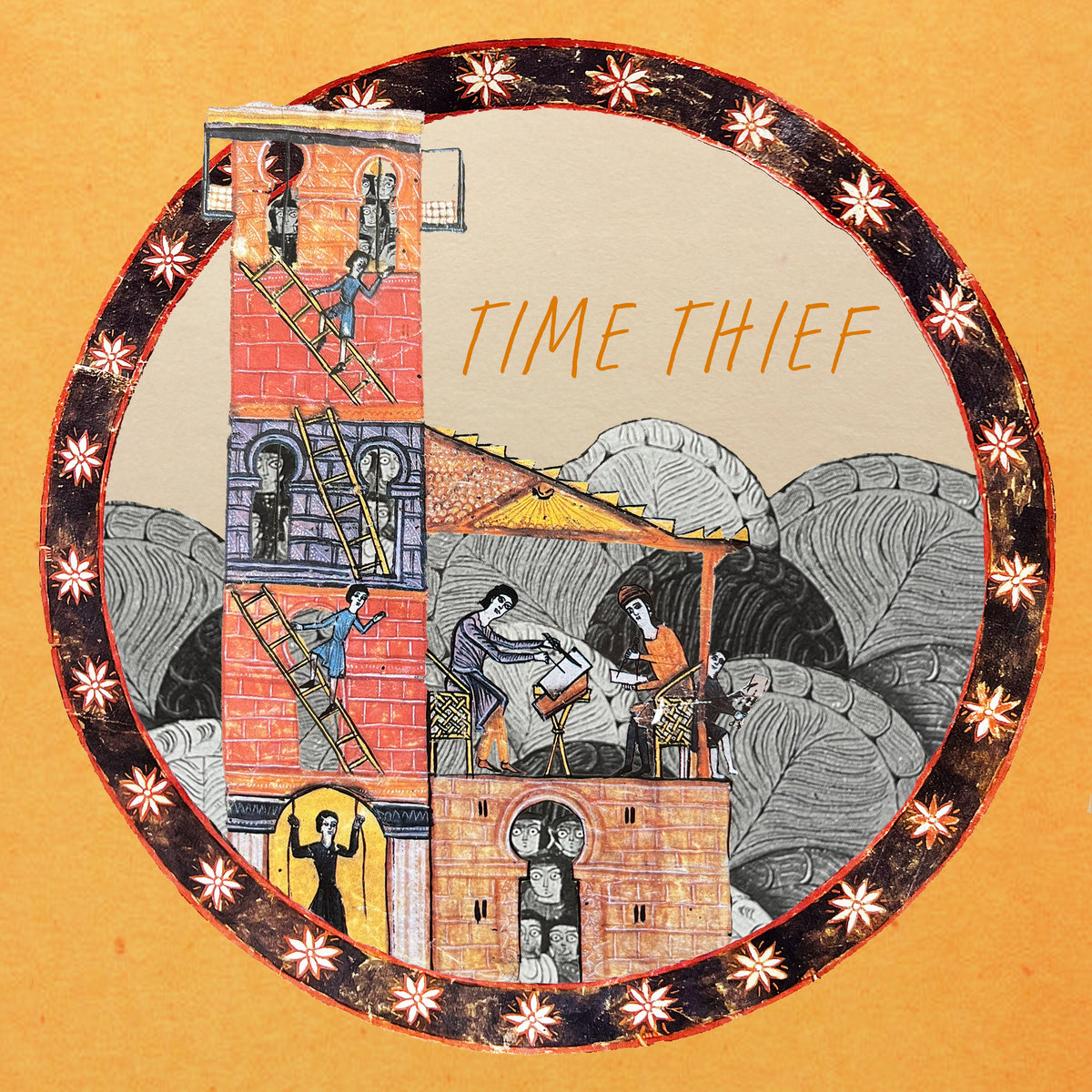
Having worked together in previous projects, but also coming from being friends to enemies back to friends, how does this project represent the spirit of collaboration in both of your lives? Do you find that collaboration in general has shaped the way you approach your relationships in and outside of music?
James: So, for context, Zoë and I played together in my old band, DUMP HIM, from 2016-2017 and made a record together then. For a bunch of reasons that we have since worked out and don’t even feel like my business anymore in the year 2025, that friendship ended really poorly and we didn’t speak at all for about 6 years.
In terms of your question, there are a few things that come to mind. I think the way I have conceptualized collaboration has changed drastically since then, both artistically and interpersonally. In 2016/17, I was 20 and doing what I thought of as a “solo project that other folks played in” and wasn’t really recognizing how much time, effort, and energy others put into the project. Maybe I wrote the foundation of the songs, but none of those songs would be anything but me and a guitar without the parts that others wrote. It’s really important to me that I properly understand and acknowledge the contributions of others in everything I do from here on out.
When we started to write songs for time thief, Zoë and I had already talked a lot about what worked for us in the past (and what didn’t). It became clear that with this project, it was really important to both of us that neither of us would be the main songwriter, and we thought it might be fun if neither of us had a set instrument that we played – one of us brings a song in, and the other adds an idea on whatever instrument we feel like. We recorded all these songs for three instruments, and play as a three-piece live with one friend or another joining us on whatever instruments they feel like playing, which means we end up in different configurations from one show to the next.
Zoë: I’m someone who has really strong aesthetic sensibilities / a LOT of strong opinions and it has been a really big but good challenge to put some of that aside for this project. It has definitely resulted in some fun outcomes that are not what I would inherently reach for myself; I’m really proud of the music we’re creating together.
James: And naturally, the way we all approach our bands is going to reflect the way we navigate our interpersonal relationships, too. I definitely had a lot to learn about collaboration in a lot of different ways when we first knew each other. I certainly would have said back then that community and relationships were important to me, and I had read a lot of like, anarchist theory and DIY punk manifestos that talked about how to relate to others, but I don’t think I quite figured out how to live by my own principles to the degree I thought I had back then. I think the key to a lot of it was really just learning to listen to others without projecting, and coming to my relationships as honestly as possible. I’m still learning!
Zoë: I relate to this last piece in a big way and am definitely still learning too!
What aspects of your respective styles, processes and backgrounds did you want to bring out on this EP?
Zoë: I don’t think that we had a ton of clear goals coming into this project around what we hoped to reflect sonically. We did talk a lot about the music that we liked (we do this constantly), and things that we were most proud of that we had written/recorded before, but past that we let things happen pretty organically. I’m someone who often will say “I want to be in a band that sounds like x, y, or z” and it never quite works out that way. I was a big sing-in-the-car kid (like, would constantly write 20 minute long rambling songs while on road trips that had no clear destination), and I still feel like a lot of my writing starts the same way it did then. I have certain melodic sensibilities that make sense in my head and it’s really hard for me to get past those/emulate other things I love and would like to be associated with. This does sometimes leave me wondering where my music fits/who my audience is, but I’m not totally sure how to go about this any other way.
James: For the most part, I wasn’t thinking about what I wanted this EP to sound like while we were writing the songs. I know we both wanted to feel able to let ourselves make music that felt true to ourselves, and I knew I didn’t want to limit myself in ways I had in the past. We love a lot of the same bands, and there are also a lot of bands that I absolutely love that Zoë doesn’t get (and some that she likes and I don’t care about). I tend to vibe with stuff that Zoë might find too sing-songy on one end of the spectrum, or too aggressive on the other. She tends to gravitate towards stuff that is a little more musically complicated (one of her first favorite songs was Mother Whale Eyeless by Brian Eno and mine was Baby One More Time by Britney Spears, she was raised by an audio engineer/musician and I was raised by a Bon Jovi superfan, etc). We share a love of C86/Flying Nun/indie pop, ‘00s Australian indie rock, early music (except she’s more Monteverdi and I’m more chant), and Grass Widow. I don’t think that all came through here, but I don’t want to sound exactly the same as all the bands we like, y’know?
Otherwise, I think the most notable conscious change I made was my approach to writing lyrics. I got deep into music via hip hop, mostly a lot of conscious stuff, and then feminist punk. Lyrics were what really won me over, and I used to think really hard when writing them. Zoë is someone who can sing along to a song without even realizing what the words mean until it’s pointed out to her. And when she writes lyrics, it’s all really natural, but still can be really poignant. I took some inspiration from her there and let myself go with the flow when writing this time around.
One of the singles you released called “A Brief History of Ordinary Letdowns”, you said, showed a different side of your collaboration. What did this sentiment mean to this song and the rest of the EP? Where did your differences as creatives bring out these songs, and did it take this EP to places that you didn’t expect to venture?
James: Zoë said that about the song, so she’ll have to clarify, but I think “A Brief History” is a bit softer than the other songs. That was the song on the record that was most inspired by Sarah Records bands like The Field Mice. I always think of Sarah bands (and the label) as being super vulnerable while simultaneously operating in a way that is punk as hell, which is really inspiring. I think a lot of people conceptualize punk as stuff with raw energy or a certain sound or look, and I don’t – for me it’s more about the principles involved. That said, I still used to be really self-conscious about writing softer songs. Like someone was going to judge me for not being punk or whatever. Which has happened, and I really don’t care anymore. I have a Sarah tattoo now, fuck ‘em (i’m joking, kind of). Anyway, writing this song felt like I finally figured out how to access that mentality creatively. Like, I asked Zoë to play mellotron! There are no live drums!
Zoë: Yeah “A Brief History” is the one time thief song where I feel like some of the sensibilities from my other current project, zowy (pronounced the same as my name in case you were wondering), came into play in a way that I really like. I have played in other indie pop/rock bands that usually consist of more standard rock instrumentation (guitar, bass, drums) – zowy is the first time where I’ve branched out and allowed myself to explore the world of synths, vocal processing, and drum machines. It was really nice to be able to bring some elements of that into this project, if just for a moment. I also love this softer energy coming from James. It really feels like they are being true to a different side of their songwriting tendencies that is so special to see!
You also made a zine to accompany the physical releases of this record, going into some background of the band as well as how the recordings came to be. Why did you two choose to preserve and document this moment of collaboration and creative process? Especially considering it gets pretty specific into your recording setup and equipment.
James: This record came out on a label I do called Musical Fanzine. The whole idea of the label is to get bands to create more joint audio + zine releases. I got into collecting physical media in the first place because I wanted to learn absolutely everything about what I was listening to. I would buy a pile of CDs of albums I had already downloaded, hoping that they’d all have robust booklets – or at least lyrics inside, and I’d always be disappointed if they didn’t. Booklets are kind of like zines in a way – I mean, I’m thinking about the booklet for something like Bikini Kill’s C.D. Version of the First Two Records. It totally blew my mind with how thoughtful it was. In encouraging bands to make zines, I’m trying to do my part to keep physical media sacred in a really online world.
Zoë was pretty against having any lyrics anywhere in the zine (we are polar opposites in that way), and tasked me with all the writing (she did the layout), so I just wrote about what I knew – since I recorded the EP, I focused on that. As someone who has been teaching myself about sound engineering a lot over the past 5 or so years (after discouraging myself for about a decade before that), I do a lot of reading about the making of records. I always wished that info was more accessible. Sound engineering is something that can be gatekept, and really expensive to get into. I’ve experienced that a lot. It can be especially hard to work up the confidence to try or figure out how to learn that shit if you don’t come from money or aren’t a dude. I guess I just wanted to show that if my dumb ass can figure this stuff out, so can some other random queer kid, and here’s how.
You go beyond the band in your zine, mentioning both influences and recommendations in your local Rhode Island setting. What do these spaces mean to you as members of the community?
James: I moved to Rhode Island in a bit of a whirlwind time of my life; it almost felt like I ended up here by accident. That said, I’m so grateful I did. I grew up in Eastern MA, which is prohibitively expensive now, and Providence really feels like the closest I can get to it in a lot of ways. The music community here is so welcoming and creative and there are truly so many freaky geniuses that really think outside of the box – I’m really grateful to share space with everyone here, and I think we just wanted to shout them out.
Zoë: I agree with so much of what James said. I’m a visual artist as well, and this is the first place I’ve lived where I don’t really feel as though there’s a ton of competition within the various creative communities that I’m a part of. Folks are really supportive and encouraging, which has opened a lot of doors for me as far as pushing myself creatively goes. It is hard seeing the city shift and change, with more echoes of Boston apparent pretty much every day. As someone who used to live in Boston and moved to RI about five years ago, I’m very aware of my part in this. I just hope that this sweet city can retain its weird, unique charm and not just become another tech bro destination.
James: That too. We also spend a lot of time hanging out at record stores around here (and I spend a lot of time at the local vegan deli/ice cream shop) and we’ve gotten to know the folks who run all of those places a bit. When we decided to put together a playlist of our inspirations, it felt incomplete without including influences within our own community. Besides, so many bands skip Providence on tour and I think I just want to encourage everyone to come hang.
You can listen to Time Thief anywhere you find your music as well as order a limited-edition tape or vinyl which comes with a zine about the album.
Written by Shea Roney
 the ugly hug