“We were really heavy for a minute there. For Dizzy Spell and that era we were so hyper-focused on what we can get out of our amps and our pedals, just the sonic width we wanted live and the thickness we wanted”, Isaac Kauffman explains of Abel’s 2024 record, Dizzy Spell.
The Columbus based band released Dizzy Spell just shy of a year ago, a record armed with an arsenal anxious intensity carved with heavy guitar and hazy feedback. There is an immediacy to the listen, as Abel wastes no time reaching a heightened emotional state as they shred through ridiculously catchy pop structures and pedal suffocation. It is an intense album in an all consuming way, thought drowning sort of way. The lyrics are poignant and often heart wrenching, but they are approached in a manner that feels distant, as the album succumbs to a sea of shoegaze-fueled dissocoation. On Dizzy Spell, noise is a lifevest. On How to Get Away with Nothing, Abel leaves this cushion behind, exploring new ways to manipulate their soundscapes as they prod at what can be found, and more importantly, felt, when they slow down.
Released last week via Pleasure Tapes, Julia’s War and Candlepin, How to Get Away with Nothing marks Abels shift towards a slowcore leaning sound. The stylistic decision stemmed organically, pulling from a chapter the band was in whilst they made it. “My bandmates go through phases, and I think it makes the most sense to take those moments and run with them”, Isaac tells me. “It really lends itself to emotional music when you take things as just a section of your life”.
The authenticity that comes with this philosophy can be felt through Abel’s discography. While How to Get Away with Nothing leans away from the density and shoegaze feel of Dizzy Spell, it also attests to the strength of the project’s identity, and their ability to experiment with genre without alienating the feel of Abel. Their “phases” do not come at a cost to the band’s ability to extract beauty from a raw and gritty sound, a consistent pillar in their releases.
How to Get Away with Nothing boasts a sound that is expansive, challenging and profoundly textured. It leaves space for near silence. It toys with manipulations of pitch and speed. It flirts with the thickness of Dizzy Spell. It experiments with a hyperpop feel. All of this could be a recipe for auditory whiplash, but How to Get Away with Nothing is grounded by the deliberate and balanced nature of its structure. Abel maintains an equilibrium while exploring various means to express melancholy, as well as a range of vocal approaches. Volatile deliveries scrape away at minimal guitar arrangements on “Dusk”, while on “Parasympathetic” earnest and gentle vocals exist in the shadows of a track guided by imposing percussion.
The record commences with warm and earthy lo-fi track “Grass”, which features twangy contributions from fellow Ohio-based project Cornfed. As implied by the title, it’s a song about grass, though the abundant plant is viewed as a concept rather than a reality, as Abel admits to a laundry list of fear that comes with walking barefoot in the grass. Fear as a barrier is carefully weaved into both Dizzy Spell and How to Get Away with Nothing, though the notion finds itself more crushing on the latter release. As they adhere to a slowcore style, drawn out moments of instrumental minimalism carve space for ideas to be questioned, and for emotional paralysis to be expressed through achy chord progressions.
“I think taking that into slowcore and slower songs lended itself to offer more of a minor space for lyrics”, Isaac reflects. “Although the lyrics still take up emotional width, I think we wanted to focus on keeping those tones and atmospheres that we created in a slower sense, and that lended to the emotional guitar parts having to be pushed. I feel like we’ve always had this kind of disconnected vibe to our songs, and I think that leaves our own playing styles and emotions on the table while also keeping the atmosphere thick”
The most devastating tracks on the record are followed by songs that toy with elements of hyperpop, and although they still tackle heart-break and dwindling self assurance, the blow is softened by their twinkly, bedroom-dance-party shape. Isaac tells me though he usually does all of the production and engineering for Abel, for How to Get Away with Nothing, the band collaborated with Quinn Mulvihill from Glaring Orchid, offering him extra time and capacity to experiment.
“I think that with the extra mixing help, I felt like I had more space and time to put some weird mixing energy into a few songs, and I wanted to do that just to break up the album in a way that felt different than using interludes or something like that”, he explains. “I think my melodies always come out in a pop way, and I think putting that over slowcore stuff is really good a lot of the time, but there are certain melodies where you’re like, how will this work over an emotional, drawn out guitar riff? It was almost just the easy way out to make something more poppy and more straightforward.”
The humbly deemed “easy way out” elevates Abel’s already textured sound, as well as the How to Get Away With Nothing’s intricacy as a whole. The hyperpop motifs and eccentric sonic manipulations contort themselves into moments that feels mechanical or almost alien-like, offering a complex juxtaposition to the album’s organic bones and painfully human lyricism. “I think there’s always been this production heavy side of Abel simply because I’m still teaching myself how to do certain things and I need to try it before I feel comfortable. So I think those hyperpop songs are just a testament to handling my growth,” Isaac says.
While it stands as proof to their skills as songwriters and range as musicians, above all How to Get Away with Nothing attests to Abel’s exceptional ability to harvest a poignancy in all that they create. You can listen to it everywhere now.
“Climb the ladder in the cage,” Simeon Beardsley leads in the opening track of Pry’s debut record, Wrapped in Plastic. Gently packaged in a soft wall of synthy sound, the line is the first of several zoo innuendos the record maneuvers in its exploration of self-sanctioned confinements and external surveillance. These metaphors exist alongside other forms of stifling visual imagery, ranging from intrusive ghosts to grotesque feelings of frozen, refrigerated meat. Conceptually, it’s a suffocating story; though I write that under the assumption you are reading the lyrics to Wrapped in Plastic in silence. If you have caught any of the singles Pry has trickled out thus far, then you would know there is nothing suffocating about the soundscapes they pave. Or maybe there is, but it’s a different kind of suffocation. A pop-driven spattering of sound. Fervent spats of drumming and potent guitar riffs. A hotboxing of synthesizer. Moments of almost silence that exist just as loudly as their maximalist counterparts. Out tomorrow, Wrapped in Plastic finds power in its nuance, shying from insulated timelines and distinct personal details as Pry yields a malleable listen of juxtaposition, sonic dexterity and disruptive wit.
When I met Pry members Amara Bush and Simeon Beardsley – at a coffee shop that happened to share a name with a track off Wrapped in Plastic – they were both a bit tired. Amara from a night at Knockdown Center and Simeon from a day spent estate sale shopping, which concluded with the hauling of a pull-out couch up into a fourth floor walk up apartment. In the face of depleted energy and minimal sleep, the duo’s ability to elaborate on the history of Pry and their trust-driven creative relationship remained unscathed. Between sips of iced coffee, they told me about past variations of the project, sonic shifts and being briefly pigeonholed as a “New York Shoegaze Band” (they are not opposed to this label…it just does not align with their own perceptions of Pry).
“This was my first time ever playing music with anyone. Simeon was just so open and welcoming, and we decided that in whatever context, we should continue creating stuff together”, Amara reflects on the start of their friendship; which began a typical New York tale of haphazard mutual friend introduction, catalyzed through the act of an Instagram story slide up. Shortly after, the two began meeting in the back room of a coffee shop Simeon managed at the time, writing songs, programming drum tracks and dissolving Amara’s apprehensions to creating music collaboratively.
The record is composed of nine tracks, some predating Pry, some written early on in the project, and some that came together towards the end of the album’s recording process. On Wrapped in Plastic, these songs find their most confident and full iterations yet. “It was a very unique recording process for me, I feel like it was the most I have collaborated with the producer”, Simeon notes of working with Ian Rose. “I was so nervous before, I was like ‘I’m going to have to sing these takes over and over again, this is going to be so embarrassing.’ Ian was so encouraging and really helped me break out of my shell,” Amara adds.
Though I noted that the record represents these song’s strongest iterations yet, like many aspects of Pry this verdict is hardly crystallized. In fact, it’s likely subject to change later this week, when the band occupies the late slot at Nightclub 101 on May 31st for their album release show. “I think I will be screaming more. I think before when we were playing shows I wanted to sound like the recording, but now I just want to have fun up there. It’s been really sweet to have Simeon and our drummer, Dave, really encouraging me to push myself. I would only do that in a space where I feel really safe,” Amara tells me. “If something feels boring, we can just change it,” Simeon adds. “That has been really exciting because we want the live performance to feel fun, and maybe we do something we haven’t done in rehearsal. It’s nice to have total freedom and be in the moment and just trust that we have each other’s backs.”
The malleability of their live sets, and the perpetual growth of these tracks represents the ways in which Pry is a space where Amara and Simeon can nudge at previously defined ‘comfort zones’, paralleling ideas of self-inflicted cages that Wrapped in Plastic works to contend. As swelling sonic atmospheres and charged vocals dig the duo’s own personal ruminations into sugary pop hooks, Pry patches gaps between their own multiplicities, or at least creates a space where various sides of themselves can coexist. For Amara, who tells me she never considered herself a singer in the past, this has also meant experimenting with a range of vocal approaches. Her deliveries stretch from tender in tracks like “Greener”, to the hostile feel the duo embraces in “Tether You”.
“I played ‘Tether You’ for the girl I nanny for, and she was like, ‘That’s not you! You sound weird,” Amara says.
Pry probes heavily into this idea of multiplicity on “World Stopped Spinning”, a track where the duo follow an intense guitar solo with a heated dialogue relying only on the word golden. “I don’t know how it’s perceived by people who don’t know me, but I’m a pretty sarcastic person, and I think we want the way we’re singing ‘golden’ to feel sarcastic,” Simeon explains. “I think the repetition makes you start questioning like, is it golden? That’s the hopeful intent. When you say something so much, does it start losing its meaning? I think that song is a hundred percent about that, and having a frame of reference for yourself that with time, you hear the same thing over and over to the point it may not have the same hook into you it once did. I feel like using repetition really makes you curious about what’s being said versus the substance of what’s being said.”
The skewing of a word through delivery is just one of the many ways Pry cleverly dismantles their own cages. It is not necessarily your sanity that they beg you to question, but perhaps the rigid outline of what you deem sanity to be. Or maybe they just want you to get out of your own head and have some synth-filled fun. You can find out tomorrow.
Today, New York based noise outfit Docents released their latest EP Shadowboxing via Ten Tremors. A turbulent and tightly packed five track listen, Shadowboxing is a fervent push and pull, eliciting a ragged fun house of eerie post-punk experimentation as Docents obscures the line between controlled and erratic.
The earliest rendition of Docents traces back to Noah Sider (guitar / vocals) and Matthew Heaton (drums) playing together in college upstate, adding Will Scott (guitar / vocals) in 2018 and Kumar-Hardy (bass) in 2021. The project is driven by an emphasis on noise that feels almost sentient, toeing drastically between minimalist and maximalism without being haphazard. “There’s a pendulum that swings between writing straight-ahead-ish punkier “rippers” and, at the other end, maybe some “thinkers,” and a lot of our songwriting sessions constitute where we’re trying to place ourselves now”, Heaton explains. “There’s no principal Docents songwriter – these are very much struggle sessions, and there’s a lot of material in the discard pile. Our favorite tracks tend to either take six months to finalize or half an hour.”
The EP starts with the melodically winding “Garden”, where jerky sonic elements find grounding in assertive omens and warnings of “the land will pass judgement, it’s body keeps the score”. It’s unclear if the track “Shouldn’t We” is posed as a question or a proclamation, as Docents fervently chants the statement over a swelling of pulse-raising noise. The EP ends with “Workout”, where Docents offers both a resolution to the disorientation and a new dose of unease. An abrasive clutter of “what ifs” are countered by tranquil utterances of “then what, what now”, the dialogue unraveling against pounding walls of foreboding and flammable sound.
“Shadowboxing is our first release that feels like a cohesive unit since our first full-length from 2023, Figure Study. We recorded Figure Study to sound like a really clean version of a Docents live set – our incredible engineer Sasha Stroud ran a tight ship – Dan plays more of a producer role in our sessions. This led to more experimentation and iteration in-studio, especially on Shadowboxing”, Heaton says of the release.
Shadowboxing is out everywhere today, and can be purchased on CD via Ten Tremors.
As a small music journal, we rely heavily on the work of independent tape labels to discover and share the incredible artists that we have dedicated this site to. Whether through press lists, recommendations, artist connections, social media support or supplying physicals, these homemade labels are the often unsung heros of the industry. Today, the ugly hug is rolling out a new series called the tape label takeover, highlighting individual tape labels that we have grown to love, with our friends over at Anything Bagel kicking us off.
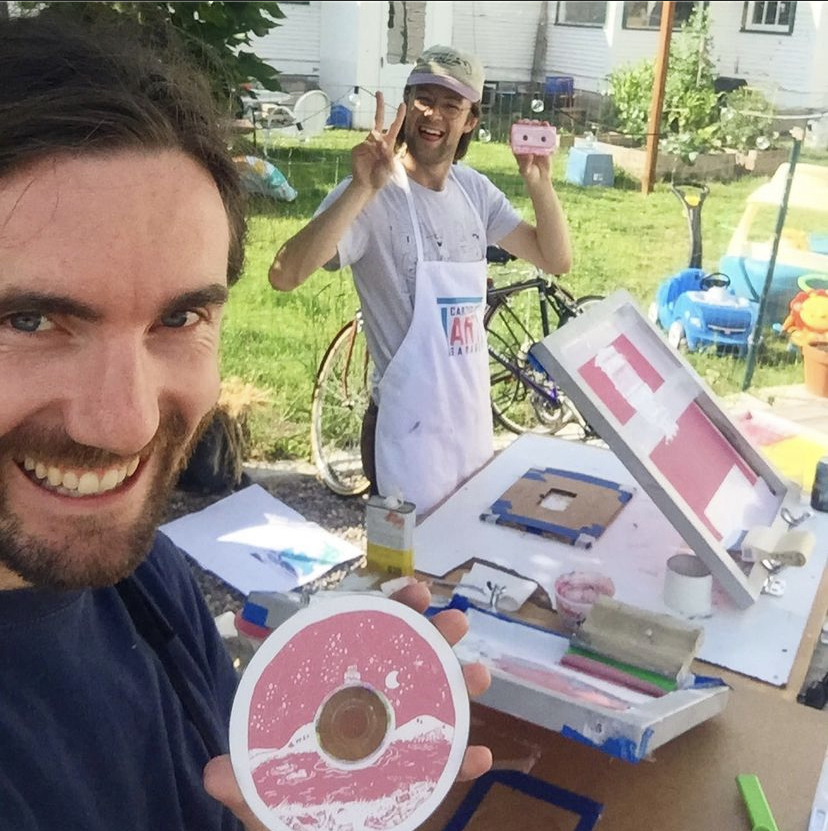
Anything Bagel, a vibrant tape label run by Jon Cardiello and Sandy Smith out of Butte, Montana, is driven by a deep passion for DIY music and community. This duo produces limited-edition, screen-printed tapes that capture the spirit of DIY craftsmanship. With a focus on small-batch releases, Anything Bagel has cultivated a distinct identity that resonates with music enthusiasts, offering something truly special in every release. In this interview, we explore their journey, creative process, and the inspiration behind their one-of-a-kind label.
Jon Cardiello and Sandy Smith
This interview has been edited for clarity and length
Kat Curey: What sparked the idea to start a tape label?
Jon Cardiello: I think it was 2015-2016 when we were getting into the DIY music world, and I had lived in New York for a little bit and we were kind of following a couple cool little tape labels. MT. Home Arts was one that we really liked that was making these screen printed tapes out of New York. We were also into Sleeper Records out of Philly and there were some in the Northwest that we were into, but it didn’t really feel like there was anybody we knew doing it in Montana that our bands could put projects out on. I felt like kind of being voyeurs into other people’s scenes but there wasn’t really anything in our scene that was doing this and so you know I think it was with my first solo album, Placid Lake, that we were finally like, well maybe we should just take the jump and just do it so that we’d have something to release our bands projects on, and also our friends’ bands.
Sandy Smith: We also wanted to get into screen printing as a practice, and it was kind of an excuse to learn more in that world. Jon had done some printing stuff before but we had a couple of friends in Missoula who were incredibly talented screen printers, Max Mahn of Twin Home Prints, and then Foster Caffrey. Foster especially helped us with specifically printing on tapes, and how to translate some of the stuff to record label-specific printing, and Max is just an all-around whiz and so invaluable, keeps teaching us stuff; he is incredible because he’s really, really good at it, isn’t annoyed when we have beyond beginner questions like, okay, “I understand that’s how you’re supposed to do it, but what if we wanted to do it like really cheap and shitty in a basement, how would we do it then,” and he was even willing to help us figure that out too.
KC: Can you share the story behind the name of the label?
JC: I feel like we were trying to think of something that felt representative of our friendship, and at that point in time, I wasn’t living in Montana, I was either in Seattle or New York and I would always come and crash for extended periods of time in Sandy’s basement to do music stuff and I think we just ate a lot of bagels is why that came up.
SS: Like one a day, 1.5 a day average; there were a lot of days with more than one bagel.
JC: We both really like bagels so something bagel-related was one of the many brainstorm ideas. And then I think we also just liked the idea of a label name that doesn’t necessarily sound like a label.
KC: As a duo, how do you divide the roles between each other, and how does that shape the way the label runs?
JC: The screen printing we always do together aside from a few exceptions when one of us was too busy or something, but I feel like it’s incredibly time consuming to do it that way. That keeps us kind of going at a slow enough pace where we can’t take on too much, which I think that’s been good for making it sustainable. We just always end up getting together to hang out and screenprint, which is fun. And it just reinforces the parts of it that we like most, which is the art, the music and the community, even when it’s just us two hanging out getting excited about music.
SS: It’s fun. We listen to cassette tapes and print together. I think we get a lot out of it.
JC: It’s always good for filling the tank of why it’s all worth putting in so much time into this passion project. Generally I do all the design stuff because I have a background in that. Sandy duplicates all the tapes and generally folds and glues the packets after we print on them. Sandy has kind of taken over the press department. We used to do that together.
SS: We still mostly do it together [laughing].
JC: Yeah we do a lot together.
SS: Jon has been dealing with most of the uploading and digital distribution stuff. And it’s a whole thing. There was a time when Jon’s job was really chill and it was a fun thing to do in the day. Now Jon’s job is less chill so we might be reconfiguring slightly.
KC: What motivates you to keep the label alive, especially with how digital music dominates today’s scene?
JC: Yeah it’s kind of amazing that now we’re at release 28, but we’re still sticking to the exact same cassette tape runs that we started with. I feel like we really like the art aspect of making physical merch, we know how helpful it is as a band to be able to sell merch on tour. I feel like if there wasn’t a physical element of it, we just wouldn’t do it. And for me in terms of buying tapes and stuff these days, I feel like my main reason is in direct opposition to the streaming world where I think I just literally would forget about albums, or I do all the time if I don’t have a physical copy of it. Where it’s like ‘oh, that was one of my top 20 albums of that year but I totally forgot about it because I didn’t buy it.’
SS: I think that some of the art object thing is also just a physical object that someone had to put an inordinate amount of time to make the thing exist and it feels precious. But also it’s not like fully giving it away, but it’s close. The tapes don’t really make much money. They’re more there as a representation of the music and the object as a playable thing that actually produces a cool sound. It’s as much the thought of the thing for me that does it.
KC: How do you find the artists you work with? Is there a special connection or vibe you look for?
SS: Well, I’m A&R on the team and let me tell you, it is difficult [laughing]. It’s nice now we’re going to be putting out some recurring artists. We’re going to put out a Zinnia album. We’re going to put out Jon’s album, and we’re putting out the next Vista House, which is really exciting.
JC: It’s nice that right now there’s a little bit of a roster and not necessarily room, we’re already penciled out well into the middle of next year with releases. But fortunately it’s mostly been in the past year or two, people reaching out to us to see if we would put stuff out. It definitely makes life a little bit easier, but we tend to listen to the project and usually do not have any room or time to do it, but then if it is something that we just like so much we try to figure out a way to make it happen.
SS: Like with Levi Minson who we just put out, is someone who actually just reached out to us via Instagram. They had submitted their last album and we were psyched about it, thought it was great, but we didn’t have the bandwidth to do it at the time. And then they sent us this most recent album, Violet Speedway and we both loved it. They were flexible enough that we could go far enough out into the year that worked out for us and for him. So to answer your question, it’s that right now, mostly people are submitting stuff to us.
JC: It very much started out super close to home with our bands, our partner’s bands, our sibling’s bands and Missoula bands. And then it kind of chugged along and took a couple jumps into different scenes which has been neat. An original goal of ours was always to tie the Montana scene into a greater network of bands.
SS: DIY bands, especially.
JC: Yeah. So it’s cool that it’s spread out quite a bit since the beginning.
SS: Now there are little pockets. There’s some bands from the Northwest, there’s a little pocket in Montreal and Toronto and some Philly bands too. And then we’re going to help release a split seven inch record with a bunch of labels around the world for a French band, which will be the first European band.
JC: There’s a Tokyo label, a German label, some French labels and us [giggles].
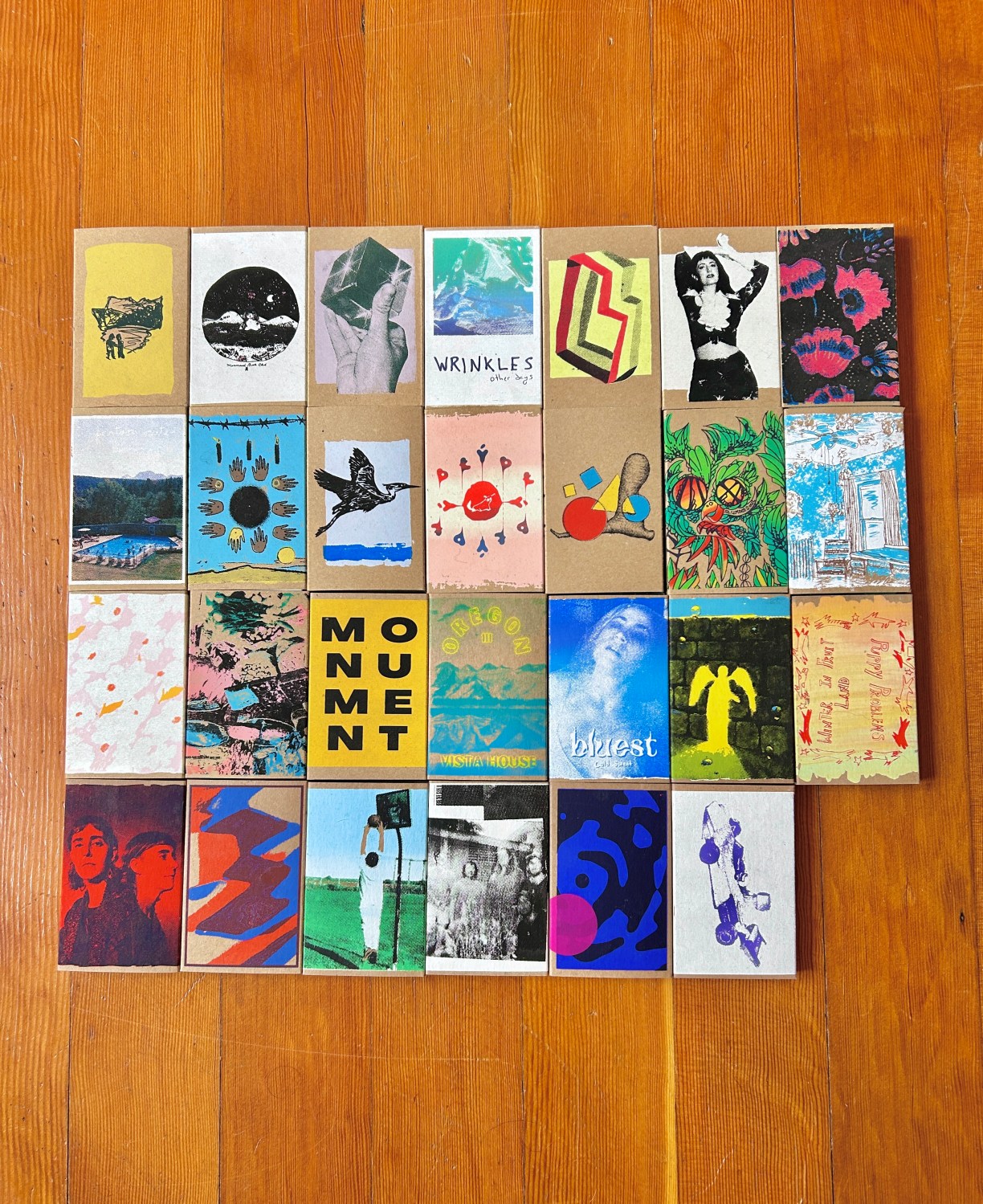
Anything Bagel Label Sampler
KC: What’s it like bringing a tape from concept to reality? Are there any parts of the process you particularly love—or find challenging?
JC: That part is a pretty fun part of the process. I guess in the most literal sense, we order blank tapes with no music on them and then we make a master tape at home. I upload all the music onto Logic and then burn it on to a master tape that we used to duplicate. We used to have this super sketchy duplicator and it would do one tape at a time.
SS: Our new duplicator is still one at a time and it still ate some tapes on the last run [laughs].
JC: Yeah it usually eats some tapes. We order a few extra [laughs]. And then we order blank card stock so it’s like an unfolded jacket that we screen print onto them. And that process is pretty fun where I’ll work with the artists with whatever the digital art is for the album and we’ll kind of come up with a screen printable version that somewhat references the album art, but it doesn’t have to be exact. Then we print them, fold up the jackets, glue them, and ship them out.
KC: How many do you produce per album? Is it different depending on the album?
SS: Usually 50. We’ve done some that are a little smaller. But usually 50. We like to do limited runs, where 50 feels like a good number. We usually just keep 10 to sell and ship the rest to the artist. Just because we know how nice it is to have merch to sell. But sometimes it’s a different model per release.
KC: The screenprinting aspect of your label is really impressive. Could you tell us more about how that process works?
JC: Well, it did start in extremely sketchy circumstances where we didn’t know what we were doing or have any of the equipment. And so it started when I lived at the farm and we would do it in the basement and we tried to expose screens with just a single light bulb.
SS: With a single UV light bulb. Like a small regular lightbulb.
JC: There was always just so much trial and error in that process where it’d be like we were both working and would get together after work to try to do this thing and it would just fail and we’d have to re-wash out the screens to try again the next week or whatever. And there was a lot of time spent without a washout sink where I’d be in my alleyway in the freezing cold washing out screens. There were definitely times where it felt incredibly ridiculous to do that as part of it. Most tape labels just print out J cards off of a printer which makes a lot more sense.
SS: Which makes so much more sense than the way we do it. The way we do it is so much work.
JC: I think we stand by that. I think that actually it turned out to be an art practice for us too, which is really fun. We fully learned how to screen print and now finally I have a washout sink in my basement that we don’t have to go out into the alley. This’ll be the first winter where we don’t have to go out into the alley.
SS: Seven years in and now we don’t have to go out and do an alley wash. That took a long time [laughs].
JC: We used to just not be able to print tapes for a couple of months, weather dependent.
SS: Yeah, we used to just not do releases from like December until March, mostly.
KC: Anything Bagel seems really community driven. How do you go about building those relationships, and why does that mean so much to you?
JC: I think that that’s the coolest part of it all, I think we felt really fortunate to have been around Missoula when we were getting introduced to this DIY community of bands coming through town to play shows. Then you’d make a friend on the East Coast, and then maybe eventually tour to where they live and get to play and see them again, and I feel that is the neatest part of music really. It’s finding all these people around the country that share this incredibly niche excitement over the same kind of music. And that happens on the internet too, but it’s really cool with music, getting to meet people and those friendships in person have been really cool.
SS: The community aspect started out literally where the first bands we were putting out were our friends’ bands and bands in the Missoula scene that we were really excited about. It’s not so much literal as physical, where it was all about proximity. It wasn’t the only driving factor, but there were a bunch of things we were really excited about that were really close to us. And there’s still a bunch of really exciting things that are happening close to us. But some of them have different homes and different people already doing the things. And it’s been really fun establishing a community that’s more based around the idea of the thing, that isn’t just physical. For example, even this Levi Minson release, he was excited about some of the other music we had put out and knew about it from that. Some are people that we have met physically, in real life, but live halfway across the country. But I do think that the community part of it is an incredibly important driving part of the whole reason we want to do it. And it is mostly just these people who are excited about making music, making art that they care deeply about and that they’re willing to put their time and an insane amount of effort into something that enriches their community and the lives of other people who happen to listen to it.
JC: I feel like when we were in Wrinkles and it was a relatively active band for a while we loved meeting people through touring and making those connections. But since then we haven’t been in bands that are really sending it with touring all the time, I feel like it’s really neat where this project has kept us connected in that way. Getting to meet really awesome, like-minded people around the country doing the same thing as us in different places. But since we don’t really get the chance to tour all that often, it’s cool that this is another avenue to make those kinds of friends.
KC: How does the DIY spirit influence what you do? Is there a part of that ethos that really resonates with you?
JC: I feel like it’s been something that we’re always talking about, because it’s really tempting to always try to level up as a label, to maybe take the next jump with distribution and different label things that feel very businessy. I think coming from DIY music communities, where it’s kept us rooted in the things that we really care about, which is the music, the art, and the people, that’s kind of kept us grounded in making sure it’s always still a really good deal for the bands and not trying to get too crazy with it. Which I think has made it more sustainable at least for us to keep doing it.
SS: Yeah, it’s probably actively making what would be bad business decisions, but just for the sake of having it be something we like to do and that makes sense for us and the bands to still do it. Like economically, it doesn’t make sense, we’re not paying ourselves as labor at all. We’re not doing anything for money, and yet understand that the things we’re making, hopefully are able to make the band’s money. And then it’s a matter of putting in all that time and effort and still balancing it with having a life and needing to work jobs that do make money and figuring out how to have that all balance out. And most of the time that works out alright. Every now and then it’s a little much, but I don’t think that’s anything we want to stop doing anytime soon.
KC: What keeps you going and excited about what you do, especially on the challenging days?
SS: I think it’s loving the thing and just caring about it. We really do treasure this stuff and it’s always exciting to be a part of a release and the whole thing is ultimately such a rewarding and positive thing. Someone put in all this time to make this music and put it out into the world, and you get to help them realize that and I think that’s at least a big part of what keeps it going for us.
KC: Difficult questions but can you share a few personal favorite releases that you’ve worked on?
SS: We kind of love them all, it’s like picking a favorite child. Every parent does have favorite children [laughs]. I’ll start with the New Issue record. The last one that we put out, it’s so good. Absolutely love it. Adore that band. They’re also our friends in Anacortes. We’ve been out there a couple of times to record and have genuinely become friends with them and really like them as people.And they kind of told us that they had this album they’d been sitting on for a long time and we insisted they let us hear it and then insisted on helping put it out into the world and they’ve been great to work with and we really love that music.
JC: I feel like another cool one was Puppy Problems last year. That was another one where we were fans of Sammy’s previous 2018 album, when it was on Sleeper Records. That was truly one of our favorite labels that we were inspired by and so it’s really cool to put out bands that were Sleeper bands at one point. Sammy is just such a talented artist and person.
KC: For those who are looking to start their own tape label, what advice do you have for them and what do you wish you knew when you were starting out?
SS: Do it.
JC: Do it.
SS: Just do it. I think to do it and to try to take steps to make it something you can do for a while. It’s just a matter of fitting it into your life in a way that makes sense and putting out stuff you love.
JC: It is a lot of work, but it’s been incredibly rewarding and worthwhile. I feel like we did a lot of legwork in the beginning, years of ironing out the parts that we really wanted to put our energy into. It kind of took a few years for it to feel like that was working, even with the screen printing and trying to do little bits of press outreach here and there. But I guess, just stick with it. The first couple years might be slow going until it creates a thing, but we just need more and more little labels, because there’s so many good albums coming out all the time. And I feel like, if there are parts that you don’t wanna do, just don’t do ’em.
SS: Yeah whether it’s like making a certain type of physical media press, if you don’t wanna screen print your tapes, lazy [laughs], but understandable. No, but set it up the way you wanna do it, and then do it.
KC: Last but not least, if you could hand select a variety pack of bagels, what would be in it?
SS: Okay, start out with the classic, you know, like there’s an everything bagel in there.
JC: There’s got to be a Helena Bagel Company jalapeno cheddar bagel with plain cream cheese.
KC: Yeah, like an inordinate amount of cream cheese.
JC: I still stand by Helena Bagel Co., it is like one of the best bagels I’ve found west of New York.
KC: Yeah, I know. It kind of goes hard.
JC: At least best in Montana, I’m saying.
SS: Definitely. The tough thing would be, do we actually put in any sweet bagels? I’m not opposed. But next on the list you gotta get an Asiago bagel. They smell a little bit like farts when you toast them, but they’re so good.
JC: I don’t know if we were going to go sweet, though, I would say a cinnamon raisin.
SS: Yeah, cinnamon raisin is good. I like a blueberry bagel. I don’t know, maybe it’s not everyone’s thing but I like that.
JC: That was in my head, too. Toasted with strawberry cream cheese.
SS: Yum. That’s good.
KC: Get your fruit serving of the day.
SS: Ooh I think a poppy bagel is maybe a little bit underrated. I think I would almost always rather have an everything bagel than a poppy bagel, but they’re good. What I’m picturing would actually play well on both of them, but a poppy or an everything bagel with sun-dried tomato cream cheese.
JC: Yeah. Pretty good. Can we say six bagels with their toppings? Because I feel like that’s important.
SS: What’s on the everything bagel? The beauty is it works with so much because it is everything. Anything and everything.
JC: I think lox.
SS: That’s an option?! I thought we were just doing cream cheese! Oh yeah, definitely lox.
JC: Lox and capers.
SS: I mean, that one is the one I’m choosing every day for eternity.
KC: But what about the cinnamon raisin bagel? Did we discuss that?
JC: You know what? It’s really sweet, but toasted with frosting.
SS. Okay. I’ll go with it. I was going to go with just butter on that.
SS: I’ll admit that the frosting is actually very good. It’s just pretty indulgent. But sometimes you need to be.
Final verdict after much deliberation: Everything bagel with lox and capers, Jalapeno Cheddar with plain cream cheese, Asiago with Pesto, Cinnamon Raisin toasted with butter or frosting, Sesame with sundried tomato cream cheese, Blueberry with strawberry cream cheese.
Interview conducted and written by Kat Curey
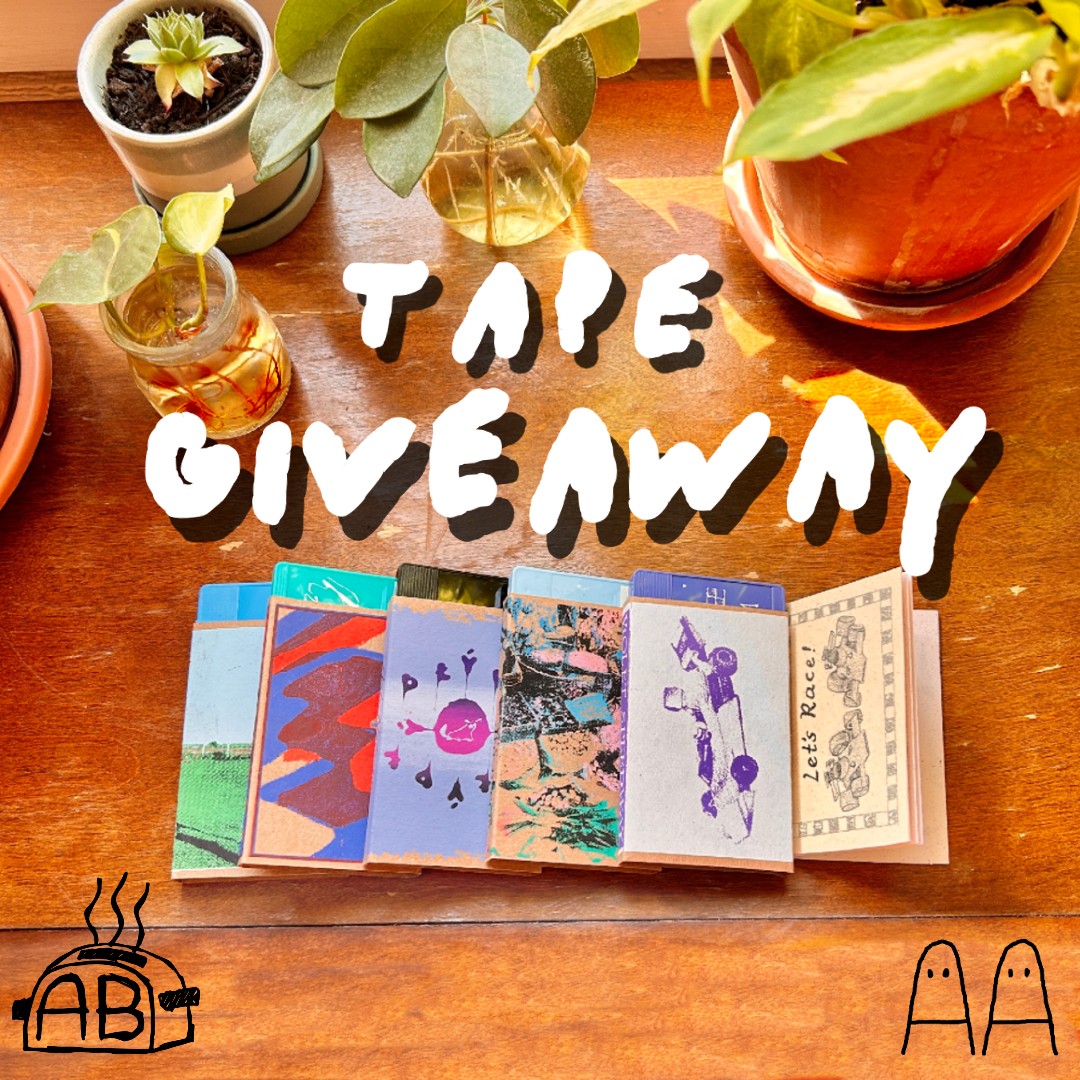
Along with this series, our friends at Anything Bagel are offering a five tape bundle giveaway in celebration of independent music and journalism! The bundle includes the albums Violet Speedway (2024) by Levi Minson, Sun Into Flies (2022) by Joyer, Exit Music for Exit Wounds (2021) by Ash Nataanii, Lagrange (2023) by Panther Car and ionlyfitinyourarms (2023) by Pompey.
To enter the giveaway, follow these easy steps below!
When Baltimore/Philadelphia-based duo @ (pronounced “At”) released their debut album “Mind Palace Music” in 2023, they launched with a unique “hyperfolk” sound. Taking inspiration from modern folk-pop and 70s outsider folk songwriters, @ created a sound all their own — melding intricate studio production with lush vocal harmonies, acoustic instruments, and a penchant for the unexpected.
Earlier this year, @ released their sophomore effort — a five-song EP titled Are You There God? It’s Me, @. It’s a dramatic shift in their overall sound that serves as their breakout into electronic music production.
@ is the music project of Philadelphia, PA musician Victoria Rose and producer/ musician Stone Filipczak of Baltimore, MD. They formed during lockdown, sharing musical ideas and sketches back and forth via email and iMessage. This is their second release on D.C./ NY-based indie label Carpark Records.
Are You There God? It’s Me, @ is a record with a science-fiction aesthetic written into the code of @’s songs, taking listeners through a mirror darkly to an alternate reality that reflects our own.
The EP opens with “Processional,” a song that’s part psychedelic trance and part synth-pop jig. With its ethereal vocals and harp-like synth lines, it ascends to an apex that feels like it’s taking listeners up and out of the atmosphere.
The lyrics are cryptic and impressionistic — like subconscious thoughts taking shape in the form of dream dialog. “Inside the old mind, it’s hard to be kind/ I’m swimming/ I’m singing/ Go to, where you want to/ But don’t stray too far (to the ends of the Earth.”
On “Webcrawler,” @ makes full use of its intricate production process — blending electric guitar with a heavy industrial-sounding bass synth, shimmering keys, layered vocals, and even a guitar solo that sounds like it’s from a Van Halen record.
With all its many parts moving together like clockwork, it digs into a melodic groove that serves to underpin a cyberpunk theme that @ weaves into its song’s poignant lyrics about Internet culture and isolation.
“Database my remains/ Open up for a phase/ I’ve been dying to see you/ When you go you should stay/ I’ll be on your domain one day/ I’ve been dying to see you/ When you go you should stay/ But you’re going away.”
There’s existential musings at play on this EP. That’s self-evident with its title — a tongue in cheek reference to Judy Blume’s 1970 coming-of-age story “Are You There God? It’s Me, Margaret?” @ uses that pop culture touchstone as a launchpad for songs that search for purpose and meaning beyond the daily humdrum.
No song better encapsulates that idea than the title track. It starts off with @ slowly building a choir made from their two voices repeating the mantra: “I can’t feel you anymore/ As long as you hide away, I can’t see you in my dreams anymore.” The vocal harmonies are angelic and tender, evoking The Beach Boys’ Pet Sounds era.
But then the song is disrupted by electronic glitches, which cuts the mics on this studio choir. The track shifts into a sunshine twee pop section reminiscent of bands like Belle & Sebastian or The Vaselines.
“Odor in the Court” leans into a spellbinding electro-pop groove, while natural human voices meld with robotic auto-tuned vocals. The lyrics reinforce themes of digital age isolation, adding to that foundation by asking existential questions about the nature of reality.
From there, “Soul Hole” closes out the EP with a hyperpop song that cements its cyberpunk narrative. @ merges with the ghost in the machine for a bop that shifts back and forth between EDM rhythms and folk-pop melodies; a parallel to @’s own musical evolution.
Taking elements of hyper-pop and pairing it with experimental indie rock has resulted in a record that’s wildly inventive. With avant-pop hooks, left of field engineering, and earworm melodies, Are You There God? It’s Me, @ is made for repeated listens.
Late last year, the ugly hug had the honor of featuring a new single called “Crown of Tin” by the Asheville/Brooklyn group Hiding Places. The first time I listened to that song, linked to its protected SoundCloud file, I was pressed up to the window of the express train from Chicago headed to my hometown of Aurora, IL. As the train pulled in, exhausted from its own journey, I immediately called my best friend of seventeen years – not necessarily to discuss the song, but to shoot the shit as we haven’t done for a while. He brought up this game that we made up when we were ten called “Bob” – a tag style game that included a museum and a tour guide who was in cahoots with a monster named, predictably, Bob. The tour guide, creating a cohesive exhibition of our woody backyards, would give us a tour that inevitably led the unsuspecting gallery goers to Bob’s hiding spot. Then all hell would break loose. Caught up in the movement, a combination of the loose direction my life was headed, the staunch unpredictability of the locomotive’s lurches and the eerie familiarity I absorbed from “Crown of Tin”, hearing my friend’s voice again was the liable push towards contentment that I didn’t know I needed.
Today, Hiding Places have released their third EP, titled Lesson, off of the independent Brooklyn-based label HATE TO QUIT. Since forming, the band has cultivated and perfected a unique blend of hushed folk melodies along with the crushing subtlety of Elephant 6 style production across two EPs and a handful of one off singles; taking a cult classic poise amongst the most taught folk knots and rock n’ roll softies alike. As they have come to release these new songs, most of which were recorded in London at Angel Studios, Lesson reflects on the teetering compromises of adulthood, showing a young band embracing their imaginative and collaborative spirit to confront the duality of getting older, both through immense individuality and as a excitingly new and creative group.
Cover art: Matthew Reed (TV Beaches) and Kristen Kershaw
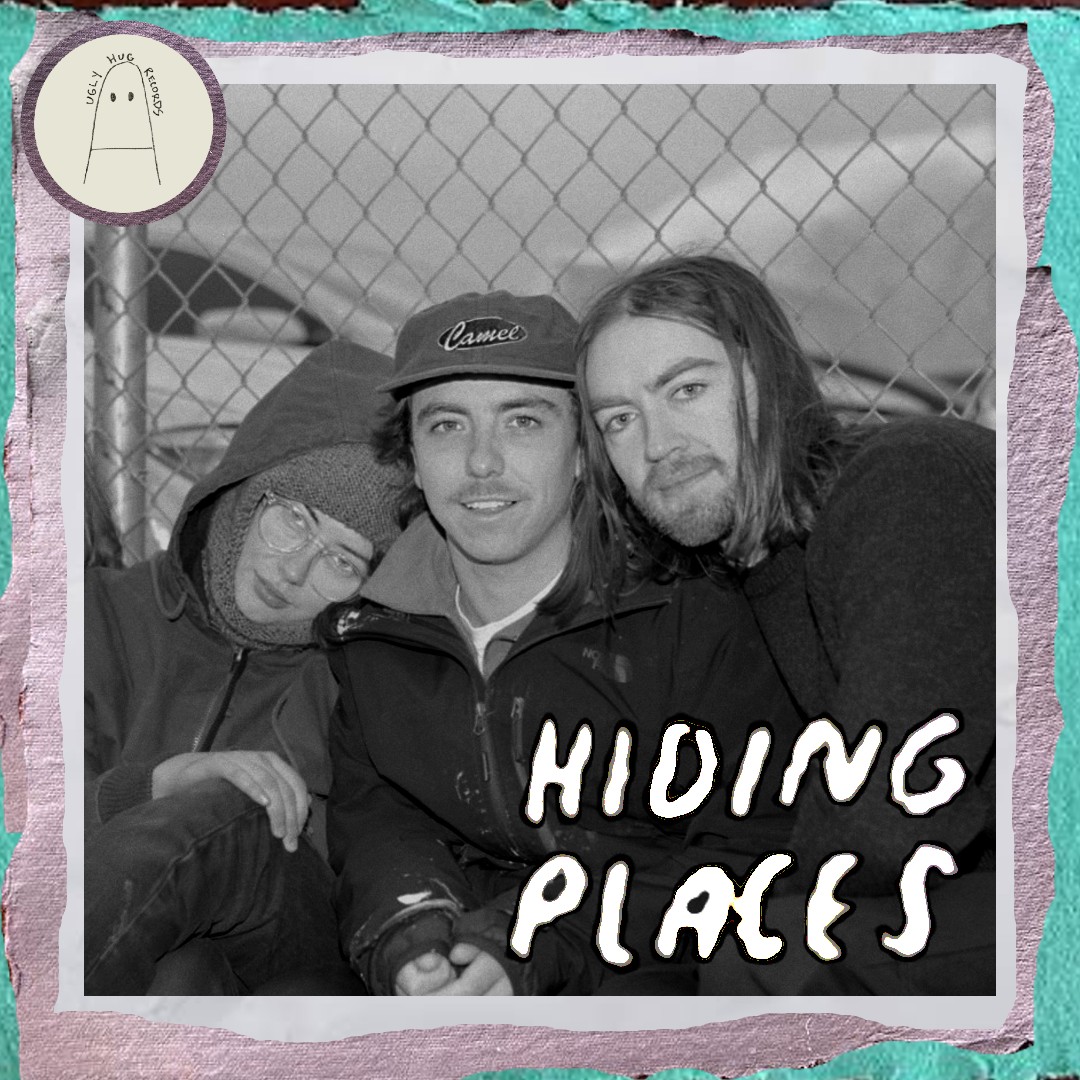
As a three piece, made of Audrey Keelin Walsh (guitar/vox), Henry Cutting (drums) and Nicholas Byrne (guitar/vox/synths), Hiding Places’ initial lore comes from UNC Chapel Hill’s student-run radio, WXYC. Their story, to be told through the style of on-air lingo; DJ Arts + Crafts (Byrne) and DJ Silicon Based Life Form (Cutting) needed a photographer for a party they were throwing, to which they found DJ Tidy (Walsh) in the radio listserv. Quickly building a professional relationship – strict artistic business – they inevitably became good friends, and, soon enough, Byrne was offering to record some of the demos that Walsh had been piecing together. With the addition of Cutting on drums, the three recorded and eventually released Homework and Heartbreak Skatepark as the first Hiding Places singles in 2021.
Since leaving Chapel Hill in recent years, the members of Hiding Places have never lived in the same place at one time. While Byrne and Cutting moved to Brooklyn, Walsh stayed in North Carolina before heading to London to study abroad. “It definitely is an adjustment,” Cutting was the first to admit. “You get used to a lifestyle where you’re hanging with these people all the time and then they leave.” Going long distance, a struggle enough for young lovers migrating to different colleges, it is a profound geographic feat of sorts for a young band honor-bound to create something genuine and collaborative. Though they make the most of it; planning to write and record in quick trips to predetermined destinations, something in which Walsh considers to have only enhanced their creative relation; “there’s the intentionality, and the comfort, and this element of trust that happens that is just so rare,” they articulate sincerely. Managing that kind of creative relationship, though any relationship for that matter, distance – as Walsh continues, “just reflects a commitment to each other. A commitment to knowing what we are hearing, what we have to say, and being curious about what we each have to say.”
Photo by Alec Peyton
That sentiment rings true as Hiding Places has only ever functioned as a fully collaborative group, dividing amongst them royalties, recording say and especially writing responsibilities – utilizing three different perspectives for each and every project. While living separately offers a unique and sequential opportunity for individuality, the band has come to embrace the perspectives of localization into a cohesive synthesis of style and story. “I feel like for the entire existence of Hiding Places we’ve had geographical influences from multiple places at the same time,” Byrne says, continuing, “I think that has allowed us to really explore different kinds of sounds as far as how they relate to our daily lives.” While Wash was in London, recalling, “I got to see a lot of local artists who made music that sounded much more grim than the local music of the South that I had grown up going to see,” at the same time, Byrne and Cutting were experiencing their first harsh New York winter – northern environmental standards when vitamin D deficiency feels like seasonal betrayal; “I just wasn’t used to feeling sad in that way;” Byrne admits.
Lesson, as a whole, does have a much darker, much more contemplative deliverance than past projects, leaning into more serious topics of fate, grief and the the new responsibilities that come with aging. Though, the band’s approach has not changed. What sticks out in a Hiding Places song is the ability to comprehensively build upon a perception, pinpointing the exact feelings that sprout in our gut rather than force it’s hand to be present. For instance, “after image” was written by Byrne during that first winter in New York. In its nature, the track plays with the idea of stillness as the guitars flurry down in uncoordinated patterns like snowfall on a windless night whilst Byrne and Walsh’s harmonies grow and deplete like a series of deep breaths – a clear play of dynamism built with trust and accents built from pure addiction. The title track “Lesson” blooms from an outburst of love and genuine benevolence, as an overt sense of warmth ebbs and flows where it sees fit (reminiscent of songs like “Sun Was” and “Skatepark Heartbreak”). The track soon revolts into a second act; grim, dynamic and hopeless as Walsh witnesses joy, so distant through the lens of grief and vice versa. The band doesn’t see it as a depressing matter, but rather an opening to new opportunities of expression, as Walsh responds, “feeling allowed to make sad music, or to make music that is honest and runs the whole landscape of emotions is very cool,” they say, before finishing, “I feel like we are kind of low key going in an Evanescence direction in some sort of way;” said only half jokingly.
At the time of our call, Walsh was currently diving into the novel, Lapvona, the most recent work of author Ottessa Moshfegh – notorious for the light reading material of My Year of Rest and Relaxation. Taking place in a corrupt medieval fiefdom, Walsh explains, “in the book, humans use imagination to lie, steal, murder and do really hurtful things.” But to their point, they share, “imagination is a gift that as a human I have the privilege to access, one that my dog does not have in the same way, so I might as well use it for something good.” With everything that Walsh finds creatively moldable, whether that be songs, stories, photographs, the arts and the crafts, even their doodled car has become synonymous with the band’s image. With this rich and lovely DIY aesthetic blended with hints of fantasy and natural exploration, there is a pure wonderment that the band omits. On the track “Elephant Key”, the story explores the capacities of different animals’ self agency while also referring to Walsh’s own accountability as a human. There is no thought of what is realistic or probable, playing with references to a “fish king” and a clairvoyant elephant, but Walsh’s approach to songwriting isn’t based in the grips of reality, but how far can we utilize imagination to push the novel feelings and experiences, those singular to being human, into a more comfortable place of understanding?
“Crown of Tin” was written in 2019 during Walsh’s first year at Chapel Hill. The song spent years being recorded and scrapped, just never feeling to have been done justice. Until Cutting suggested using the original vocal and guitar demos that Walsh had made underneath their lofted dorm bed, it may still have never been completed. But in its finalized form, it’s a simple track, a meandering verse to verse style, as Walsh narrates their experience with homesickness. It’s not a song that grapples with being physically alone, but more of drifting through a changed environment; new people, places, and things that haven’t been defined yet. But that simplicity of production allows the demo tracks to excel in their significance, as Walsh expresses, “I think that the sentimentality behind it is very much rooted in honoring the exploration and the wonder that comes from just realizing that you can make something.”
On its own, “Crown of Tin” is a lullaby of Walsh’s own vocation; setting boundaries between real expectations unmet and those that we create – made to be resourceful to our wellbeing. “I have been thinking a lot recently about how most of my emotions either fall under joy or grief in some form, and usually at the same time,” Walsh explains. “Often if I am angry, I am grieving an expectation I imagined.” It’s not out of convenience or habit that these feelings arise, but an effort to revert back to a sense of self that feels in control. The opening verse of the song sets the scene; “Counting down the seasons till I see you again/Winter is me singing in my room it never ends/Taking a short dance under the sun when I can/Going on some picnics with all of my new friends”, a relic of a blushed and lonely reality of a first year student. As the song comes to an end though, the last verse takes a turn; “I wanna live inside a cabin or a tent/Animals will smile at me, will make conversation/I’ll climb trees and look around and wear my crown of tin”.
As I sat with this song for a few days, overwhelmed with this stunning sense of nostalgia it left me with, I was reminded of my childhood bedroom that I shared with my two younger brothers; three parallel twin beds – every night in the fashion of a structured summer camp (or juvie) – as my mom read us the book, Where the Wild Things; not intimidated to use the grumbly voices, but rather encouraged by her three baby boys. Maurice Sendak, the author and illustrator of that book once described, “children do live in fantasy and reality; they move back and forth very easily in a way we no longer remember how to do.” To get older, when imagination isn’t just for kids, but extended to those who have to live by the rules of capitalism, heartbreak, apartment leases, catalytic converters, sell-by dates and homesickness, why not make the reality of it all just a little bit easier? “[Crown of Tin] was a very momentous song for me,” Walsh conveys with sincere recognition. “It was the first song that I recorded on my own and it’s a reminder to myself that the reason I like to make music is because I like to explode my imagination everywhere.” As simple as that.
At the time that this piece is published and Lesson is pushed out into the wild, Walsh will have moved and settled down in Brooklyn, joining Byrne and Cutting; all together for the first time in a handful of years. “We’re excited about increasing the pace in which we’re writing and recording and releasing songs,” Byrne says. “I think we’re in a really good position to do that because we’ve already figured out how to collaborate when it was much more difficult.” With more songs already recorded, full band shows in the works and the excitement of just being together again, it could be safe to assume that Hiding Places is just getting started, yet it feels like they are already so timeless.
Lesson also features Anthony Cozzarelli (bass/guitar/vox), Malik Jabati (saxophone on “Lesson”), Lucas F Jordan (flute on “Elephant Key”) and Frankie Distani (clarinet on “Elephant Key”).
hemlock is the swamp-raised and untethered (Chicago / LA / Texas) project of Carolina Chauffe who, as of today, is celebrating the two year anniversary of their album, talk soon. To commemorate the anniversary, hemlock, alongside Ghost Mountain Records, is announcing the release of a limited pressing of talk soon for the first time ever on vinyl as well as a new music video for the song “garbage truck”.
With a brush of gradual guitar, Chauffe begins, “I’ve always been so afraid of the things I can’t control / Like accepting that you couldn’t stay, and the sound of the garbage truck.” This line, opening the song “garbage truck” with a gentle admission, sets both tone and desire in the wake of a relationship while also putting weight on the things that feel inevitable. As the track goes on, with a steady heartbeat behind flourishing instrumentation, the music begins to drive with purpose – Chauffe admitting with sincerity, “I wanna be a better person to you.”
Two years after its original release, “garbage truck” only feels stronger in its deliverance, both towards its confessional imperfections and the confident strides of growth that hemlock has so genuinely crafted in their career. “I’ve always been so afraid of the things I can’t control,” Chauffe repeats one last time, before affirming, “But I am not bound to make the mistakes I did before.” With accountability, reassigning the things that we can control, soon, the conditioned racket of the garbage truck outside begins to feel less harsh in its composition – our unfavorable habits are no more foundational to who we are as is the stuff that is hauled away every week by that same darn truck.
To celebrate the two year anniversary today, hemlock has shared a DIY made music video for “garbage truck” compiled of footage shot back in 2021. With a bike basket full of flowers, Chauffe rides around the city of Chicago in hopes to hand out the beautiful bundles to the people at the helm of these dynamic machines. You can watch the full video for “garbage truck” premiering here on the ugly hug today.
The limited double LP pressing of talk soon is pressed on coke bottle clear vinyl. It also contains the bonus track, “Monarch” added in its original intended position on the track list. Side D has an etch designed by Carolina Chauffe. You can preorder the vinyl on hemlock’s bandcamp or at Ghost Mountain Records.
“Got home safe / Puttin on tea / Thanks for working on this with me,” Awh sings, almost instinctively; a clear marking – an endcap – no matter how fleeting this moment of calm may seem, there is a sort of closure at hand. This line, as simple as it is, opens the song, “Heart Container”, provoking a story to be told, while simultaneously closing out the album Good Game Baby. The song is an emotionally fostered and well rounded meander through a precarious heart; not necessarily in the right – nor the wrong for that matter. But as the song is escorted to its end, it becomes embedded within a collage of handpicked sounds and field recordings, some familiar, some unknown to us listeners. But the familiarity, although derived from the ethos of nostalgia, adds depth to where we stand; revisiting with a new perspective matured through time and experience to understand the full story.
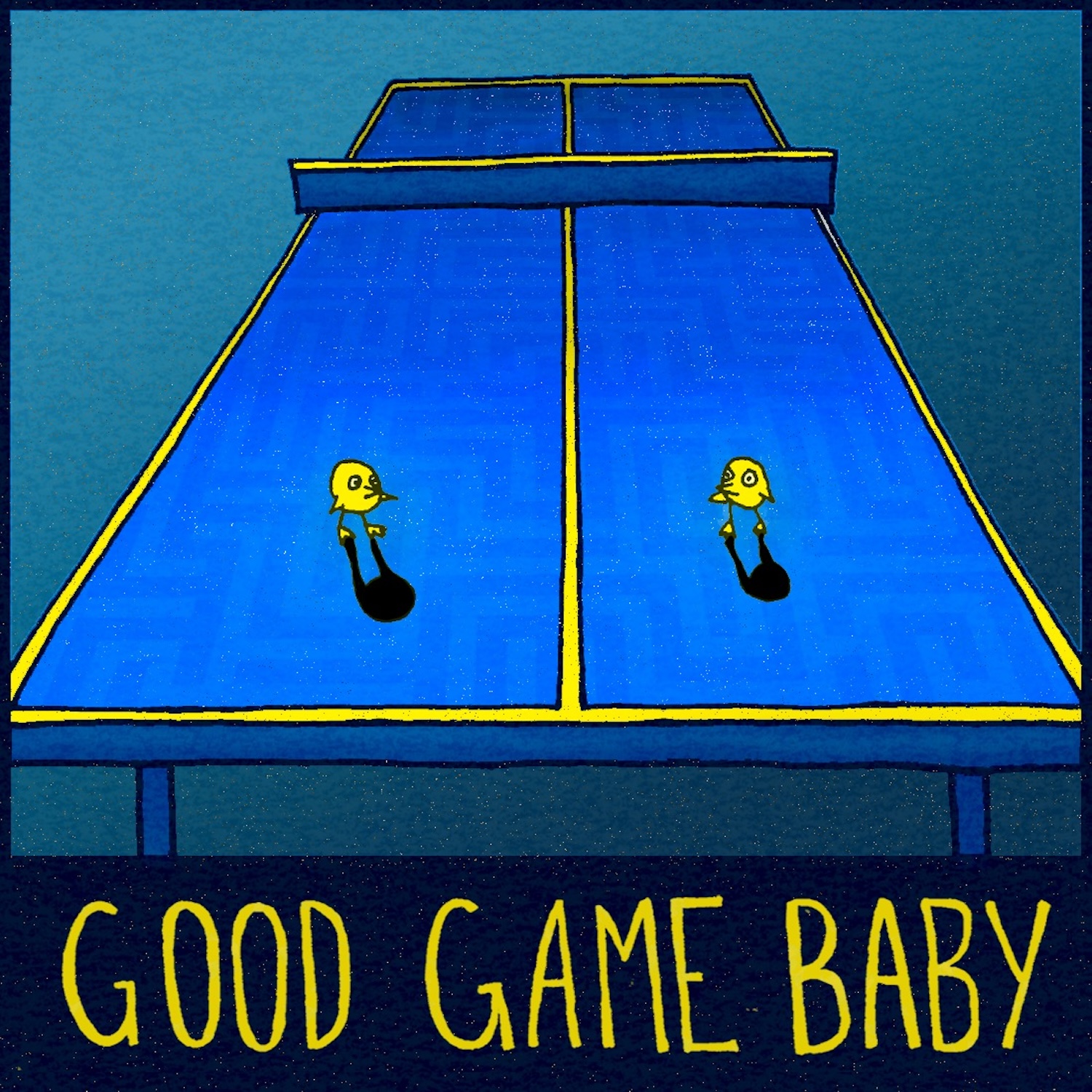
Jess Awh is the gentle and vivid voice behind the band Bats, who, as of today, has just self-released her third LP, Good Game Baby. Following 2022’s Blue Cabinet, Bats has built a reliable reputation as a sincere lens into Awh’s own growing pains and intimate reflections. Good Game Baby is no different, with her tongue and cheek lyricism, hyper specific anecdotes and country music roots, the album weaves through pop facets and responsive traditions of storytelling to piece together a cohesive and sincere profile of the writer at hand. But as Awh reflects on the past, taking stock of genealogical traits, destructive patterns and influential circumstances, there is deliverance in her fractured timeline, blending nostalgia with confessionals as she looks back on how far she has come.
Album Art by Jess Awh
When it comes to recording, skills she has been sprouting since high school, Awh admits, “when I am outside of my own space I feel pressure to act a different way, and then it just never ends up coming out right.” So instead, with help from some friends, Awh turned her Nashville home into a live-in studio, taking advantage of the whole space being of her own. Weaving mics through the entire house – each room dedicated to a specific function; “the drums were in the living room. We had guitar amps in closets and in the bathroom, and we even recorded some of the record outside on the front porch.” As the time came to capture the valuable structure of Good Game Baby, “the whole band took a week off of work to have a little staycation and coop up in my house,” Awh recalls with giddy likeness – familiar with the importance of slumber parties as a kid. “We made breakfast together every morning, and then we would just get to work. It was very non-traditional and very relaxed and communal. That’s how I like to run the band.”
In turn to the accessible environment, Good Game Baby is a collection of songs that don’t sacrifice development due to comfortability, but rather find Bats taking on new sonic risks, while still propping up what makes Awh’s writing so special to begin with. Songs like “Going For Oysters”, “Are you like me?” and “Finger on the Tear” are dedicated to slinging guitar solos and more brash compositions than before, adding a dynamic intensity to Awh’s cunning melodies and cutthroat lyrics. Songs like “Sand Time Machine” and “Oh My God”, melodically fragile and willfully poignant, blend steel guitar, synthesizers and lo-fi drum tracks – a smooth blend of nostalgic rust and indie charm that has become the beating heart of the Bats sound. In all, Good Game Baby finds Awh taking the project from the early bedroom bandcamp days to a full band operation. “I’ve always wanted to make rock music ever since I started writing songs,” she recalls. “I could always hear full arrangements for them, but I just didn’t really have the resources, so this record really feels like a full realization of what I have always wanted Bats to sound like.”
Most of what Good Game Baby is based around thematically is Awh’s experience of growing up in the fast paced and self destructive city of Nashville, Tennessee. Besides leaving for school in New York, Awh has spent her whole life calling the “Athens of the South” her home. As a kid, “I grew up listening to 90s and 2000s mainstream country radio,” she shares; a notion that comes with the territory. “Being surrounded by that really potent pop and melody forward music taught me how to write the stuff that I like to write.” Too big for its own good, though, Nashville has become one of the fastest growing cities in the US. In search of sharing the authentic country music experience, it has fallen into years of demolition and rebuilding, as Awh watched the place that she grew to love become unrecognizable in virtue. Favorite businesses boarded up, parks left to their own efforts, restaurants’ Proust effect too overbooked to even experience; “Bats songs often have an undertone of being about the gentrification that I observe in Nashville,” she says with notable discomfort. “I feel that it runs parallel to my own experience of getting older and changing and grieving what used to be.”
Photo by Abby Johnson
“I think a lot of the turmoil of my early and mid twenties is represented by this desire to be able to identify myself,” she adds, “which is something that becomes harder when you don’t feel like you’re really situated in a place that is constant.” Touching upon stories of death, ambiguous love, losing friends, starting drugs, stopping drugs and terms of sincere guilt and ego, as a narrator, Awh’s defiance in change becomes crucial in experiencing Good Game Baby as a whole. “For some reason I’ve always tried to invite situations that are a little bit on the fringes of society,” she suggests – “a little bit unsafe.” Whether to do with dating an older man, cyclical substance abuse, breaking clarified distance or just simply profiteering self destruction, there is weight in reference that Awh releases in every song. Although it’s not easy to do, when done sincerely, “writing helps me confirm that I’m still me,” she expresses with an appreciative smile. “I’m still here trying my own experiences, putting them on paper and recording them. It helps me to contextualize myself.”
The track “Queen song we will rock you”, a cheeky name Awh will admit, begins to initiate an end to the record – bringing the heart of reflection into the forefront. “Grandpa died standing upright on two feet / Listening to Queen’s song we will rock you on repeat,” she sings with a soft yet forward delivery. “I would say it’s the most important song to me on the record, just because it provides a framework for understanding the rest of the lyrics on the album.” As is used, “We Will Rock You”, the bold and anthemic battle song, becomes self protruded when facing death, as Awh admits, “my family as a whole has this quality of taking the hard way through life and never really being able to give up or compromise their efforts,” leading to, “this realization that it’s in my blood to get up and try again no matter how many times I get fucked.”
Going back to the final track on the album, “Heart Container”, although it is not the beginning of Awh’s story per se, in the process she shares, “I have a desire to contextualize my life narrative as a thread that I can follow from beginning to end, even though in reality it’s not always so linear.” It can be found when blending together a story of a momentary relationship with the wistful sound effects from the cherished game, Legend of Zelda; as parting as a song about death introduced with voice memos from inside a favorite childhood restaurant; as defining as crippling self agency in a fleeting home like Nashville, Tennessee. Starting at the end of a story can give an artist some leverage; with expectations set, the rest of the time is spent filling in the holes that piece together a cohesive and resonating character. “I think juxtaposing my own history with my own present to tell a story of myself is a way to make it all make sense,” she says with a matured confidence. When dealing with a fractured timeline, jumping back and forth in its construction, there is an emotional emphasis brought on by hindsight and inevitable growth that resonates in this depth. But through her deliverance, blending these two narrative paths, there is closure that Awh demonstrates so affably of how things have been and an understanding of where they may go from here.
“Good game”, a form of etiquette passed around at the end of competitions, is meant to acknowledge the effort put in by an opponent. “Good game, baby”, a more personalized message, has a similar effect, yet less diluted by expectational manners. As the album enters the world, a physical project to face, Awh admits, “I think I’m actually a really well adjusted person in real life. Pretty happy and pretty peaceful in the day to day now,” before letting out a laugh, “I know this isn’t really what you’re supposed to say as an artist, so it sounds a little funny.” Through the turmoil and change, familiarity and rooted pleasures, Awh’s demeanor not only rounds out such an intimate and stylistically absorbing record, but marks impressive personal strides and victories as well; deserving of a pat on the back; a rewarding cup of tea; a good game well played.
Bats will be playing an Album Release show at Third Mans Record’s Blue Room March 1st, 2024. They will also be joining Bendigo Fletcher for a few supportive shows April 12 – 18. Listen to Good Game Baby now on all streaming platforms.
Calling from separate locations for our Zoom call, Kevin Krauter, braving the November cold on the front porch of his friend Stephen’s house and Nina Pitchkites from her cozily lit room, were discussing a carpool possibility to pick up Ben Lumsdaine, friend and producer, from the airport at midnight. The next day they would be traveling down to Bloomington, Indiana to record what would be the debut full length album from Wishy. But obviously, before we can talk about a full length album that hasn’t been recorded yet, Wishy is riding the release of their debut EP, Paradise, out today.
Making noise from Indianapolis, Wishy is racketeering force of Midwestern exceptionalism; a blanket of whirling guitar music and breezy pop hooks in return for a melancholy heartbeat by leaders Kevin Krauter and Nina Pitchkites. Having met in high school, Krauter and Pitchkites already had a built in friendship, though Wishy wasn’t formed until 2021 when Pitchkites moved back from Philadelphia. Both being established songwriters before collaborating, Krauter being a former member of the band Hoops as well as a solo career, and Pitchkites’ electro-indie pop group, Push Pop, the two had to put their respective projects on the backburner due to the pandemic. But coming out of this break was the formation of Wishy; a purposefully emulated and collaborative force to be reckoned with. Spending two trips in LA with Lumsdaine to record the new songs, Wishy came back with one of the most critically acclaimed EP’s released this year. Coming upon this release, Krauter and Pitchkites called me up to discuss the project, commemorating the homegrown spirit, and the pleasure of where they are currently at.
As the band began to catch steam in the media for the three singles released ahead of the EP, Wishy became a cluster of descriptors and antiquated jargon to try to lock down a clear understanding of their sound. With loud and boisterous instrumentation, layered atmospheric calms and jangly pop hooks, Wishy is a consistent, impressive and nostalgic blend of noise. When asking the two of them to sum up their own interpretation of their sound, Krauter expresses, “I think that it’s a reflection of our personalities and our tastes, you know.” To which he continues, “in general, we both have an emo side and we both really love cutsie happy sounding shit. I love when bands are able to capture a synthesis of both.” Building upon, Pitchkites adds, “it’s edgy and sweet. I’ve always had a taste for both and I’ve always wanted to communicate it,” continuing with, “I feel like I just never hear much of that anymore, but I found that through Kevin.” With tracks like “Paradise”, “Spinning”, and “Too True”, Wishy breaks down and expands on generic genre terms, creating something that they feel most comfortable in. “I think at the end of the day, we both just really love writing pop songs,” Krauter reiterates, saying “this EP in particular, is a presentation of the softer side, for the most part, the sweeter side of things.”
Before Wishy was even an initial idea, Pitchkites became indifferent on whether to pursue a career in music at all. Once moving back to Indianapolis, where Krauter asked her into the band, Pitchkites was hesitant, saying, “I just got jaded and cynical about the world. But, I went with it and it’s been over 2 and a half years since we started this band.” She finishes, “it’s just motivated me to actually write more and to practice more and challenge myself.” That feeling doesn’t go unreciprocated, as Krauter shares, “I think I personally feel more confident in my songwriting than I ever have,” he says, sustaining on that thought. “Having this outlet where Nina and I can collaborate, the atmosphere we both like to inhabit feels really good together”.
With the release of Paradise as well as a foretold debut full length in their future, Wishy shows no signs of slowing this momentum, as well as a clear understanding of the camaraderie that they surround themselves with. Bringing back Lumsdaine to record again as well as the inclusion of Steve Marino, who you can also find playing guitar on the EP, finds two Hoosiers returning home to contribute to the project. When asked if this homegrown mentality was something that they try to preserve, Krauter responds, “Yeah, it feels really good, it’s just fun to do shit with your friends,” with Pitchkites adding, “everyone gets a little exposure to their own craft, you know. So like, we’re all winning”.
Where Wishy stands as a new band that is catching the wave of popularity was in no way their definitive goal when starting this project. Beyond the stereotypical formalities found in Midwest caricatures, being a part of a music scene in the middle of the country has a very approachable, dare we say wholesome, feeling to it. The Indianapolis indie scene is a comfortable home to many underground groups, and like other bands in Midwest scenes, that grow up on a specific tenacity that comes through the rickety house shows, backyard parties, and the occasional farm show, Wishy truly capitalizes on the humble midwestern roots. “Starting out, this whole project has just been about having fun with our homies and impressing my friends,” Krauter shares, as simple as that. “That’s really been my main goal.”
That kind of sums up where Wishy is at the moment; just happy to do what they love. As we finished up our call, and the conversation wandered to ridiculous FedEx fees and favorite music publications, Krauter and Pitchkites were looking ahead into a busy next couple weeks, but they didn’t seem phased. With one last single to be released and a full album to record, the two of them are extremely proud of the work that they have done, but truly humbled by the attention it has received. Still in slight disbelief, Krauter voices one more time, “when I first started writing this shit, the vision in my head was always like ‘I can’t wait to play this at State Street Club with my homies’, and not exactly like, ‘I can’t wait to get on Pitchforks singles of the week’. That’s just been a really happy surprise”.
You can find Paradise, off of Winspear, out everywhere now. In addition to this interview, you can read my review of the EP at Post Trash.














 the ugly hug