Every Wednesday, the ugly hug shares a playlist personally curated by an artist/band that we have been enjoying. This week we have a collection of songs put together by Maine-based artist Jesse Guerin of the project jes.
With sincere delivery and eager expression, the music put out under jes is intuitive to the environment in which it was derived from. Playing to the limitless opportunities given by open spaces, Guerin leads with faith towards whatever may lie ahead, allowing guitars to interact, building layers of individual voicings until that open space holds a brand-new meaning.
About the playlist, Jesse shared;
“songs that feel like a sunset, maybe a sunrise too. songs that feel like my hands are in the soil. a playlist for gardening. a playlist for the dusky dewy evenings in the field.”
Every Wednesday, the ugly hug shares a playlist personally curated by an artist/band that we have been enjoying. This week we have a collection of songs put together by Maine-based artist Genevieve Beaudoin of the project Dead Gowns.
Earlier this week, Dead Gowns shared “Maladie”, the final single before the release of their long-awaited debut album, It’s Summer, I Love You, and I’m Surrounded by Snow, out February 14 via Mtn Laurel Recording Co. As a writer, isolating rather complex and dynamic feelings with a vivid prose of both mindful delicacy and emotional intensity, GV works towards the terms of desire, an ever-shifting goalpost in a sometimes-unwinnable game. But it is in this delivery and stature that GV so easily articulates though her music that gives us an open space to find our own answers no matter how daunting these feelings may be.
“You could call ‘Maladie’ a bilingual song,” Beaudoin says of the single. “But for me, it’s more about how gaps in one language can be filled by another and the entire process gets me to the real feeling. Growing up around two languages, I don’t think I ever felt like I ‘got it’ either way and this song just leans into the idiosyncrasies of how French and English exist in my brain.”
About the playlist, in which she titled, “time is all together, without separation”, GV shares;
I have a record coming out on a ‘holiday’ around love but I wanted to look at love differently here. in its most enveloping shaping.
the playlist has a name, “time is all together, without separation” and it’s a [translated] line by Tim Bernardes.
sometimes when I feel unsteady, I try to call in love like two hands, one holding my heart from the front, the other from the back. so these are just a few songs for loving harder. no erasure.
Listen to the playlist here.
Listen to ‘Maladie’ below.
It’s Summer, I Love You, and I’m Surrounded by Snow will be out February 14th and you can preorder the vinyl now!
Written by Shea Roney | Featured Photo by POND Creative
From the sincere and expansive community in Maine, Dead Gowns is the project of Portland artist, Genevieve Beaudoin, who has shared her new single, “How Can I”, today as the first release off of her upcoming debut LP, It’s Summer, I Love You, and I’m Surrounded By Snow, due February 14 via Mtn. Laurel Recording Co. Produced by Beaudoin and Luke Kalloch, “How Can I” is a stirring passage, brought out by the textured array of instrumentation and emotional dynamics, giving a glimpse to the power within the details that Dead Gowns has learned to hold dear over time.
Simple and steady, “How Can I” begins like a melodic conversation – a sparing guitar, full yet aware, animating the internalized dialogue that Beaudoin sings about with such carefulness. But it’s with Beaudoin’s understanding of deliverance, where the complexity of feelings can rummage through different sonic interpretations, that really hits home this expressive and enduring motive – something that has made Dead Gowns such an absorbing and poignant project to watch over the years. “But it’s just what I have to do / On these nights / When I’m in love with you cuz,” becomes a precursor to the heavy distortion and rolling drum progression that soon fills the space when she asks, “How can I?” – with time and repetition, becomes less of a question, and rather a statement of self agency in the often defeating presence of desire.
About the song, Beaudoin shares, “I think as a first single, “How Can I” sets this scene for the entire album – it’s dark, romantic, and disorienting. I wrote this song when I was in love with someone and couldn’t tell them. I swallowed so many of my feelings down –– and pushed this person and that desire away. I think that dishonesty led to a rot in our connection that was unrevivable.”
“How Can I” is accompanied by a music video filmed by Beaudoin and Hilary Eyestone on a Super8 camera. Listen to the song here.
Dead Gowns is set to release their debut album It’s Summer, I Love You, and I’m Surrounded By Snow on February 14th via Mtn. Laurel Recording Co. You can preorder the vinyl here.
Written by Shea Roney | Featured Photo by POND Creative
“What’s that little snapping sound off and down the hall? It’s someone snapping gems off the cavern wall.”
Windier is a bell that rings early in the morning. The bell stands on its side, somewhere near the coasts of Maine, and several people live inside. They crawl in and out to get to their shows on time. They work in the weather, tying and untying knots with only a slight toil. Windier, of course, is a band. Their latest album Doesn’t the Baby captures songwriter Asa Shadis as he writes of the world and its warm ashes, remembering and trying to remember how to stay present for the things we’re not ready for. “When things get real,” he sings on another track, “doesn’t the baby arrive?”
“Gems” is the final track on Doesn’t the Baby. Asa sings with Zoe Holland, whose drumming on other tracks is at least one of Windier’s crucial heartbeats. A third voice belonging to Kenzie Reilly also appears on occasion, completing a brief and elegant trio. They all mirror each other with a delicate attunement, wondering as clearly as one can about a planet so blurry it obstructs your vision. How long have we lived here? What are we holding onto? Where do we put it down? And who is taking the gems from the cavern? They may not be asking these questions outright, but their search is felt. Though “Gems” doesn’t talk about “the baby,” we do hear Asa, Zoe, and Kenzie reflect on the long-awaited collapse of the thing they held up high. It is a pregnant moment, the one that happens right before things change.
“Until the thing we held up high was collapsing finally / so out into the street, planet blurring / I saw real life in the morning / a whispered little warning.”
Throughout the recording, a cello (played by Annie Dodson) flows beneath the poetry. Sometimes it creeps up to dance with Asa’s rich acoustic guitar, expanding the song’s center with a dusty decadence. The environment of the song seems to stretch out horizontally and vertically, as if they are all huddled together, performing inside of a tall, endless cave. Perhaps thanks to Mike Bullister’s mixing and mastering. But it’s also not hard to imagine them playing this song next to a stalactite or two. Once, they actually sort of did:
In February 2024 Windier played a show at The Space in Portland, ME in February 2024. Part of their performance featured a handmade cave structure, within which a couple members sat and performed. Seen above. Sadurn and Night Hawk also played the show.
“Gems” is minimalist songwriting at its best. Like an enchantment, it doesn’t reveal too much. You may want to sit yourself somewhere dark and find yourself a flashlight before listening. Maybe you will find one of those missing gems.
You can learn more about the band at windier.net. Or you can find the nearest bell that looks shorn by the sea and peer inside.
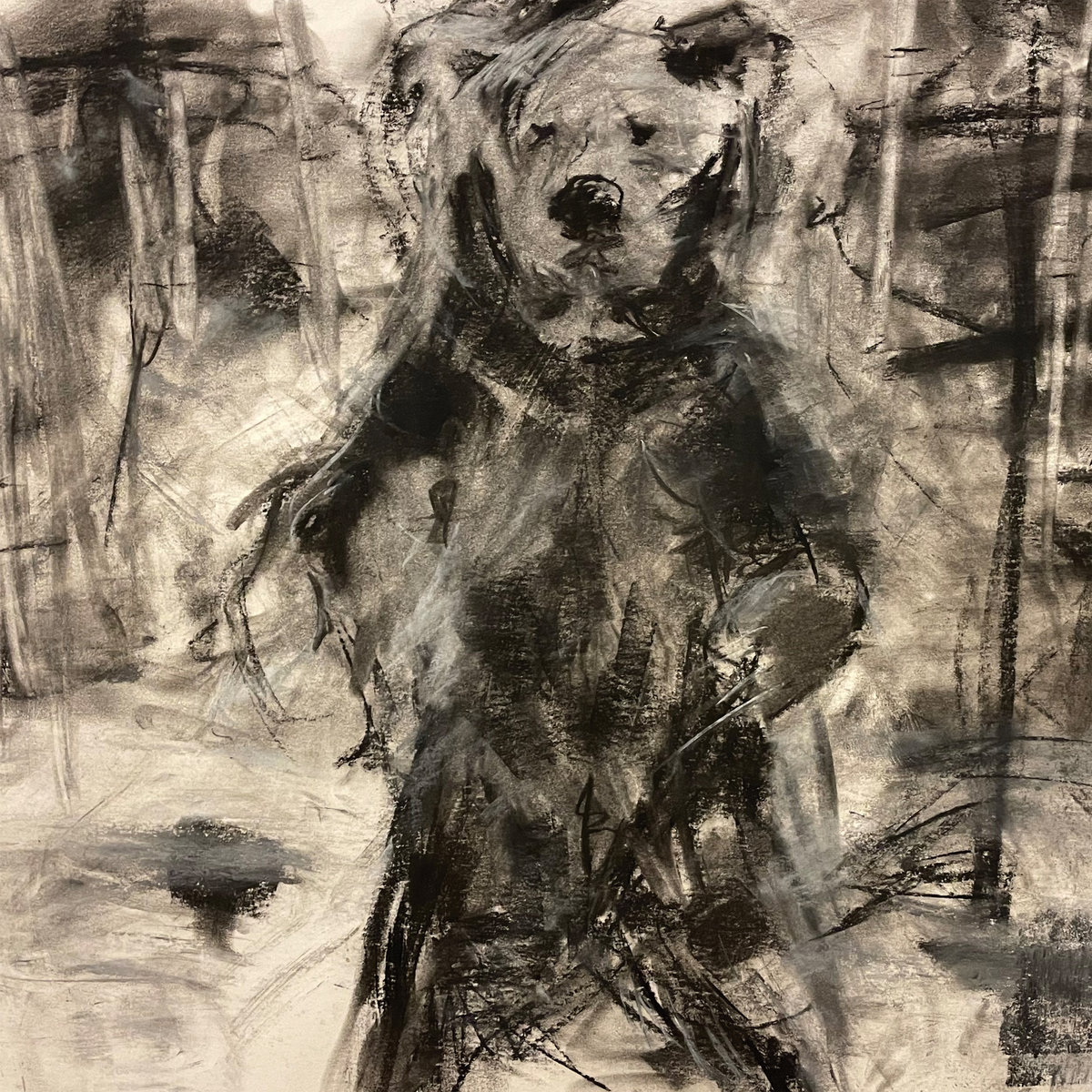
“It was the morning after I had done a release show for the first record I ever did called Black Hole. I remember all my friends were just so supportive about it. But, I was basically living in a closet and I was pretty much on my way out of Brooklyn to go and study music therapy, so I just needed a change for a lot of reasons. But it was hard to leave”. Goldberg continues, “I had a dream that I was with some of those friends at this cabin in the snow. As I set off away from those friends at the cabin, a bear appeared in front of me. We had a standoff. The bear whacked me with its paw, and I was dying in the snow, but I remember thinking to myself, ‘I don’t regret this’”.
The Spookfish, the project of Maine-based musician Dan Goldberg, recently released his latest project, Bear in the Snow, off of We Be Friends Records. As a songwriter, Goldberg is a collage artist of sorts, encountering sparse folk music and lo-fi electronic fixings in a layered and textured sonic world. As a project, Bear in the Snow finds Goldberg in an extension of his natural self; the part of him that no longer has a place on this earth, but with full acknowledgement to his physical journey in the natural world. The album is also accompanied by its own video game created by Goldberg that follows that path of self discovery. Calling from his home in Maine, Goldberg opened up about his recovery process after a tragedy that led to this alluring and earnest project.
To fully grasp the personal aptitude and eternal understanding that went into the writing and producing of Bear in the Snow, it is crucial to know about Dan Goldberg’s last few years. With life turning events facing a family tragedy, on top of a heartbreak and moving to a new state, Goldberg was pushed into the externality of our human fragility. Referring to a lyric he wrote for the track “Misanthropy”, Goldberg kept coming back to the phrase, “the world’s not going to miss us when we’re gone”. In a bleak state, Goldberg explains his “frustration at the way that western values and capitalism can get in the way of human life,” while he adds, “if it killed us, the animals would not miss us. They won’t be like, ‘oh, I wish they did more economic development in their time,’” he laughs, but it is clear there is some weight behind it.
Having studied and practiced to be a music therapist, Goldberg made an effort to find effective ways of recovery through his own creative outlets. In textures, Bear in the Snow is a deeply expansive listen, embodying layers of familiarity and subtle sonic tensions. “I would go to this cabin and it would be these moments where I wasn’t gonna get an emergency call for an hour. I was just completely hidden in these scary woods,” he says. “I would really enjoy making sounds that soothe my brain and then playing them back,” Goldberg shares. Breaking away from structural soundness, “I think I was able to find a little bit of freedom to move the music away from my normal patterns”.
Beyond the primitive and experimental instrumentation that Goldberg creates, Bear in the Snow serves as a kind of natural field recording, following the sounds that make up his world. “Coyotes”, as simple as it sounds, is a recording of a pack of coyotes as they howl and laugh to the open sky. To some, this is an external noise that doesn’t grasp at any deeper meaning, but to Goldberg, this inclusion stands as an expansion of personal sense and growth. “As a small child I was horrified by everything. I was horrified by the woods, and I felt like everything was haunted. I’m sure that’s just being a vulnerable little being that could easily be eaten by anything,” Goldberg laughs, but with slight sincerity to his younger self. The inclusion of “Coyotes” was a thoughtful addition into an already deeply personal record. “I guess I wanted to revisit that childhood feeling” of vulnerability to the world. “That particular recording, I was walking back from a hike, and it had gotten dark. I was just immersed in that feeling and I recorded it as a journal entry”.
Recalling the time he went on a solo hike on Devil’s Path, one of New York’s most difficult trails to hike in the Catskills, Goldberg brings up a fractured process where he admits, “I would try to exhaust myself into feeling better”. As the sun set on the treacherous trail, Goldberg found himself lost and with no cell service. As the old tale goes though, follow running water and you will find a way out (which Goldberg says that this is an irresponsible action and that it is safer to stay put). Soon coming upon water supply land and flag markers, Goldberg ended up on a highway, where he came face to face with a mama bear and her cubs. “She scowled in my face before shooing her cubs in the woods and leaving,” Goldberg says. Eerily similar to the dream he explained earlier, Goldberg admits, “I feel like that was when I was like, ‘Okay, I need to focus’”.
The video game, a visual extension to the album in which Goldberg also titled “Bear in the Snow”, is a personally rooted piece of art representing Goldberg’s understanding of his path to recovery. “Well, I was working at a soap factory while I was in school. I was just drinking coffee, putting soap into boxes, and the idea just popped in my head,” he says in suit of mindless busy work. Goldberg describes the game’s concept, in which “you’re this little ghost character. I came to see that as my own ghost,” referring back to the dream, “because the bear killed my sense of self”. Enriched with these beautiful and introspective beings, the game is a haunting exposé of Goldberg’s eternal conflicts. As he continues, “my ghost is floating around, and each of those places in the game and each of those song titles is a place where some really significant things happened”.
These significant places are highlighted with a storybook instruction manual that refers to Goldberg’s travels. Put together by his partner, Saffronia Downing, the manual explains specific paths, locations, creatures, and myths that expanded Goldberg’s perception of self. As the ghostly character, you encounter this cathartic journey, redefining your own place in the world.
As a world traveler, Goldberg has been on the move for years. But he finds himself comfortable with where he is at now. “I think that I feel like I’m set,” he tells me with confidence. Having graduated and spent years in practice as a musical therapist, he has found a love for helping others in their own recovery process. “I’m really interested in combining outdoor therapy with music therapy. I would like to have a place that I could build relationships with the people that I work with,” he says.
When living in Brooklyn, Goldberg would host events that he called the ‘Mountain Shows’. Taking a group of musician friends as well as a group of listeners up Mount Taurus, the mountain became a sanctuary of redefining personal roots, not only in the natural world, but internally as well. “I think a big reason for the mountain shows was to give people different ways of looking at being in the woods, especially in New York City where a lot of people hate hiking,” he says. Goldberg developed a remarkable way in which people can experience both kinds of therapies. “I would say that the interesting thing about both fields is that they let people have moments of not speaking”. He insists, “I don’t necessarily or rationally believe in ghosts, but, some part of me feels the ghosts. Some part of us is feeling things that we aren’t thinking”. In the search for understanding, those inner ghosts can come out when least expected when given a moment to breathe and “it can share really valuable information about [people’s] lives,” Goldberg finishes.
Returning to his dream, as Goldberg laid dying in the snow, the bear stood defiant and remorseless in its actions. A nightmare of sorts, but in the end, the bear is the least important facet of this dream. A narrative, told through the simplicity of closing his eyes and the complications of REM sleep, broke down an impossibly difficult decision into a clear answer. Goldberg recalls a moment where, “it felt worth it to try and do what I needed to do, even if I got killed by a bear within five minutes”. Bear in the Snow stands as a complementary parallel to the valuable information given by the ghosts that find home in our physical bodies, as Goldberg tells me he decided right then and there, “I’m gonna do this change, even if it fails”.





 the ugly hug