Every Wednesday, the ugly hug shares a playlist personally curated by an artist/community member that has inspired us in some way. This week, we have a collection of songs put together by singer-songwriter, founder of new power-pop band Culture Tax, and Label Director of Brooklyn’s Double Double Whammy, Mallory Hawk.
Earlier this year, Hawk shared two singles, “All Your Troubles / Run Until They Catch You,” finding her embracing a new and vulnerable creative outlet as a songwriter. She is also a leading member of the new group, Culture Tax, a scrappy power-pop band with more music and shows on the way.
Beyond her own music, Hawk is a major advocate for the indie music community, bringing attention and solutions to the gender disparity in producing/engineering, sharing new ways to approach the music market and promotional campaigns, as well as helping artists navigate the unsavory terrain of the industry on her Substack, Senses Working Overtime.
In every aspect, Hawk reminds us that a shared love of music is what builds up communities. In the spirit of discovery and relationships, she shares this write up about the playlist:
“I considered a few themes for this playlist before catching myself shazamming a song at Honey Moon Cafe in Ridgewood, Queens this week. This is a common occurrence, I dwell there at least twice a week and a few of the baristas have impeccable taste. I thought it would be fun to just make this playlist the last 12 songs I shazammed, which could have been embarrassing or revealing, but all it revealed is I’m clearly going through a jangle pop phase. Some of these bands are largely forgotten, others a bit culty. All of it rocks and I totally see why I shazammed these songs. Shout out to Alex who works there, he unknowingly made at least 1/3 of this playlist. Enjoy!”
Cutlure Tax will be having their first show 6/22, at the knitting factory with ducks ltd. and kiwi jr.
Earlier this week, the Brooklyn-based trio, Sister., released a new single, “Colorado” off of Mtn. Laurel Recording Co. If you live in New York and have seen the band perform in the past few months, whether that be stripped back for a house show or a full band endeavor, you most likely have heard a variation of this song. Regardless of which version, “Colorado” finds Sister. exuding a level of patient handling; a relic that romanticizes the enduring process of their collaboration, all while further defining their style and sound at their own pace.
This interview was conducted in January of this year. The band took the time to call me as they sat between projects and recording sessions of “Colorado”. We decided to hold off on publishing this piece until the song was released, and in the sense of music PR, that was the move – and for the sake of the piece, it allowed me to watch the contents of our past conversation live its life in real time.
Photo by Avery Davis
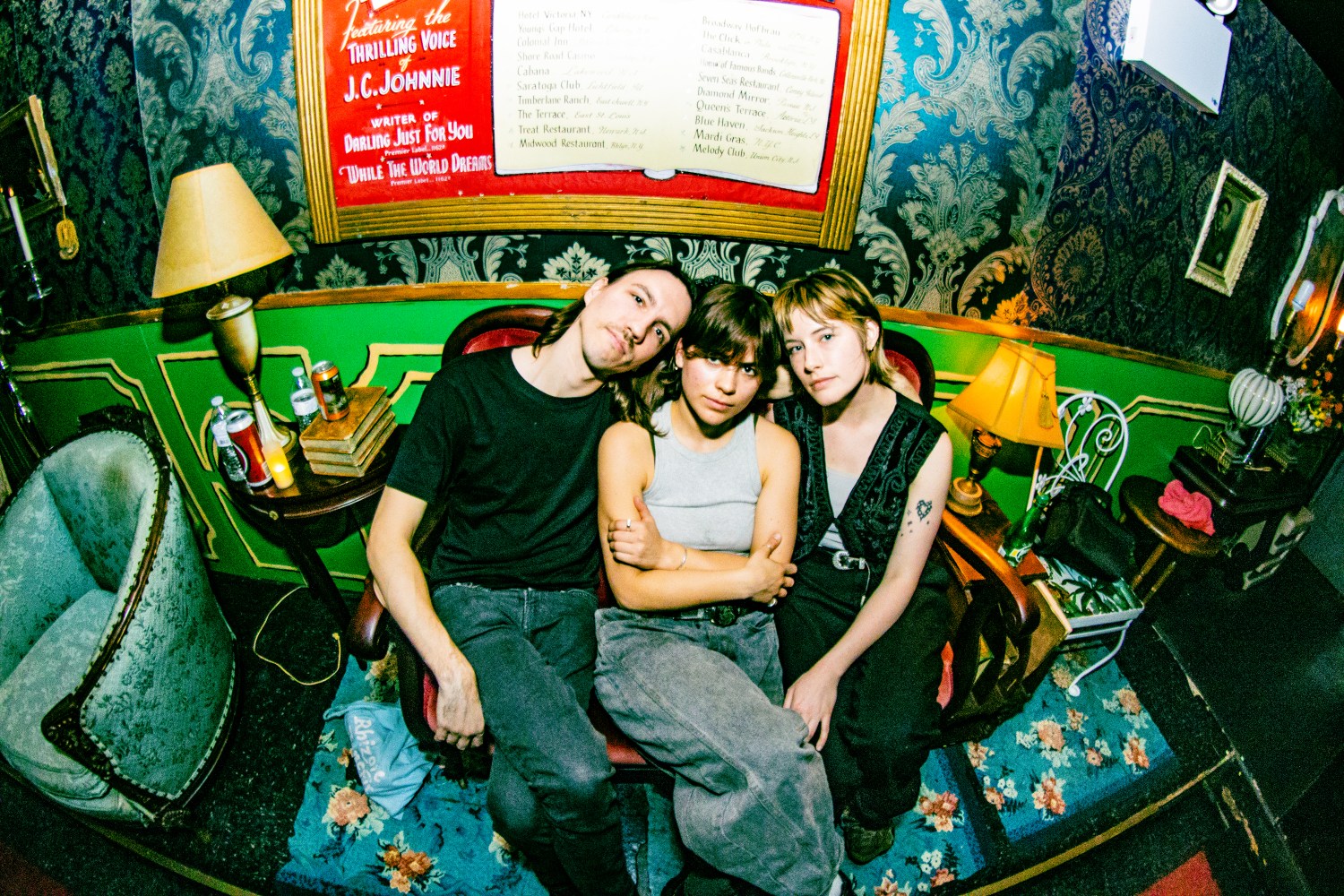
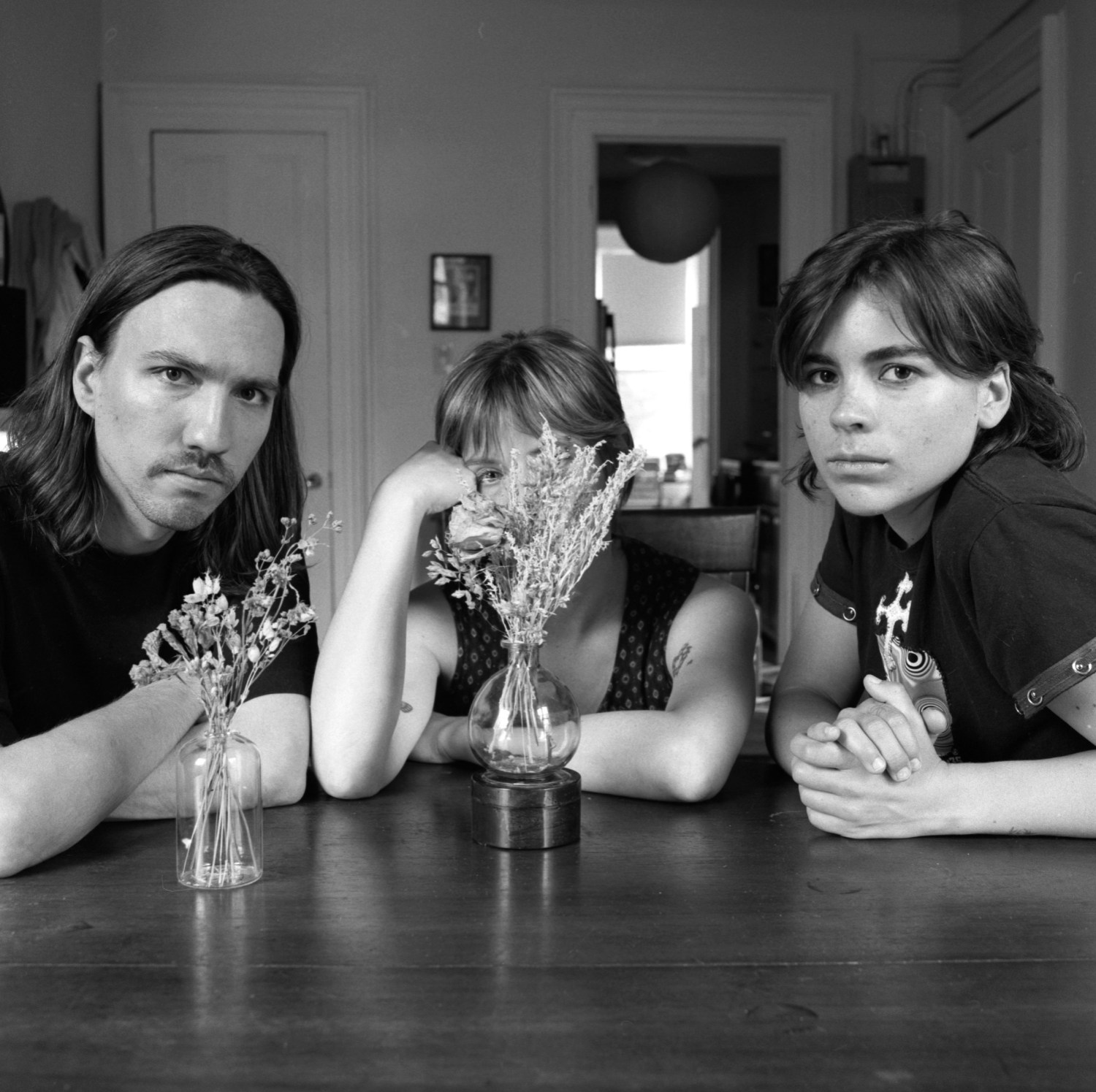
Sister. is composed of songwriters and multi-instrumentalists Hannah Pruzinsky, Ceci Sturman and James Chrisman. Last October, the band released their debut full-length album, Abundance, which found the band in a comfortable spot. Pruzinsky and Sturman started the project as a duo when they met in college, and since then, their songwriting found a similar path of sincerity and inventiveness in Chrisman’s warm and unique production and textured instrumentation.
At its core, Abundance is a bedroom record, hopping between locations in the process of writing and recording. Most of the album was tracked in a small cabin in Woodstock, NY – a little run down unit making a comfortable home for the trio to set up shop and flesh out the new songs. Unlike recording in a professional studio, the band was able to take their time, as Pruzinsky shares, “I think it was fun to be able to stretch it out so long. Even more so than recording in the cabin, I feel like I always think of us recording all the overdubs in my room with James at the computer and Ceci laying on my bed re-listening to the songs a million times.”
Whether at the cabin or in Pruzinsky’s bedroom in Brooklyn, the band recognized the outside elements that allowed the recordings to breathe; a symbiotic relationship between the noises captured and the environment in which the band occupied – “when we had the mics gained up you could hear the creek that was under the cabin,” Chrisman recalls, sharing an example form their time in the woods. These moments throughout Abundance latch on to our senses; a blend of birds in conversation, the clicks of guitar pedals and keyboards, pouring rain and the creaking of old wooden floors all stand out in their own way, yet add a collective beauty to the overall experience of the record. “That’s actually a personal preference of ours,” Sturman says, “using whatever happens to be captured, instead of going back and trying for a better sound or recording.” Something she further explains, “I think we’re just really good at embracing that sort of thing – this is what we did, we’re gonna honor it and that’s gonna become the song.”
There is no more striking example than the album’s opener “Ghost” – a song attributed to Sturman’s time learning the piano and recorded on a trip with her mom to a ranch in New Mexico. The final version grows from that original voice memo, capturing a performance of Sturman playing the song for her mother. “Ghost’ was really uncomfortable for me to accept,” Sturman shares as the others recall having to convince her to use it on the album. This song was my introduction to Sister., first listening to Abundance on the train when it was released. Its spacing felt like a familiar form of tenderness, one that knows that healing is an option, as Sturman sounded so distant in her presence, but so vulnerable and compelling in her performance.
The choice to place it as the opener wasn’t much of a topic of discussion for the band; “we started sending the album around a lot, and people said “Abundance” has to go first – you need a big entrance, and we all were like, no,” Pruzinsky laughs. It was a gut feeling, trusting their creative intuitions that kept it in its tracking spot. “I think there were definitely nerves about it, but it does welcome you into the expansiveness of the album,” Pruzinsky continues, with Sturman adding, “well, it felt like a risky move for me because it feels vulnerable, but I think it’s cool. We have to put trust in the listener that they will keep listening, and then they can understand why that might have been the first song.”
And to the band’s credit, having “Ghost” open the album perfectly sets the tone for a project that doesn’t stay in one lane for long, but rather focuses on their craft as a culmination of moments. “It’s like a record of so many things,” Chrisman says about the song. “It’s a record of Ceci and her mom and one particular performance, but it’s also because Ceci is learning the piano, it’s a document of a moment in her relationship to piano, too.” And once again, inviting in their settings, “even a document of that acoustic space with a weird bird in the background,” he laughs.
As a project, Abundance savors maximalism at no expense to intimacy, and originality through vision and feel of its players. Songs like “Notes App Apology” and “Guts” flow with melodic folk voicings through a classic and tempered alt-rock drive. “Gorilla vs. Cold Water” is a patient build, standing strong through synth drones and heavy guitar strums. The drum machine track plays second hand antagonist in the dark turns of “Classon”, and “Kinder” reaches similar emotional heights until decomposing into dust as the instrumentation burns from the inside out. “There are so many different narratives that take place on this album,” Pruzinsky shares, “I think what came through were these momentary glances in time.”
Abundance became a document of the trio’s growth, experimentation and ultimately, their form, but it is also helped capture the way that they learned to communicate creatively with such intention and ease. “It was more like a phase or a chapter for us, as songwriters and collaborators,” Sturman begins. “I think we have just been growing a lot as people and as musicians, so we got to just use this as an opportunity to co-write and just really try to see how we could make a bunch of different songs really work together and have cohesion.”
That cohesion comes through in the varied feels of comfort that arise from the individual songs, regardless of their build, emotional pull or stylistic choices. “For so long, Ceci and I had no idea how to articulate our ideas to each other and how to find someone that also just knew what we wanted,” Pruzinsky shares. “When we were able to finally get there, it was like, ‘okay, now we can do everything we want!’ It’s like we can be doing the most minimal thing, which is just the three of us playing acoustic instruments in a room, and it feels so good and so comfortable.”
Photo by Felix Walworth
“We wrote Colorado together,” says the band in their press release. “Hannah started with the chords and the line ‘You drive to Colorado and I get emotional,’ and we built it all from there.” The song builds off of those same elements of loose textures, shared ideas and honored performances that live within the heightened emotional release of the song. Within their composure, the band thrives in pushing the vast soundscape further, but in no way at the expense of losing that intimacy that makes their performances so full and memorable.
While recording “Colorado”, Sturman recalls a time when their friend and label manager, Elijah Wolf, said, “this is such a classic Sister. sound,” in the middle of their session. “That’s so cool that we might have something like that,” she says. And as “Colorado” now sees the daylight, and it was time to resurface this old conversation, I was instantly enveloped in that first experience I had with the Sister. sound, a moment of true Proust Effect on public transportation; my own momentary glance in time that felt so present. And to its effects, that classic sound doesn’t feel to necessarily label their form, but rather a chance for the band to define themselves with where they are now in the moment, knowing they have so much more to show us.
“Colorado” is accompanied by a music video made by V. Haddad with the help from Nara Avakian. You can stream “Colorado” on all platforms now. Pruzinsky and Sturman also run New York-based show zine, GUNK, which is shared at the beginning of every month.
Bloomsday, the project of Brooklyn-based artist Iris James Garrison, has released their sophomore LP, Heart of the Artichoke off of Bayonet Records today. Following 2022’s Place to Land, this new project thrives in its deliverance – the lush instrumentations giving Garrison’s poetic phrasings room to breathe, and vice versa, showcases the personal growth and vision that made these performances so fresh and enduring. Heart of the Artichoke is an album that lives in its connections, creating an honest and clear silhouette of Garrison’s presence while also documenting a keepsake; the community that Garrison has surrounded themselves with to bring it to its truest from.
Last month, I grabbed a coffee with Garrison to discuss the importance of community, the significance of revisiting old songs and the momentary inspirations that stuck out when writing Heart of the Artichoke.
This interview has been edited for length and clarity.
Photo by Desdemona Dallas
Shea Roney: You recorded a lot of Heart of the Artichoke with Ryan Albert at his home studio in upstate New York, which turned into a very community driven and collaborative project over all. Can you tell me about that experience and the people you chose to work with?
Iris James Garrison: I do so much of the writing part alone, and then to find the realized state of the song, I love to hear what my friends and people I admire think would work. So in that process I think the more the merrier. Maya [Bon] and Ryan [of Babehoven], Andrew Stevens (Lomelda, Hovvdy), Hannah Pruzinksky (h. pruz, Sister.), Richard Orofino, Alex Harwood, Chris Daley – they’re all awesome people and I just wanted to feel like we were all able to be really open. I can’t really focus when I’m in New York City, so when Ryan approached me about that, I thought that actually sounded so much better than doing it in a proper studio in New York. As awesome as that is, the pressure is really on to know what we are doing, whereas, exploring the songs and being in a house – going to grab a sandwich, going on the porch for a second, walking in the woods, going in the pond whenever I want. It sounds as dreamy as it actually was. There are very few times in my life where I had no stress. Even my friend Dallas visited us while we were there and halfway through the week, we had a bonfire and they were said, ‘you laughed more that night than I’ve ever seen you laugh.’ I was just very open and it was very special to have so many people I love to be working on my music.
SR: Did you get to work on your own time frame with these songs?
IJG: I gave myself ten days. Ten songs in ten days. We didn’t do the entire thing in that house, we also did three days at the Chicken Shack, which is a really sick studio in upstate New York, with Nick Kinsey to get a lot of the drum sounds and some live band feel. We played a couple of the songs live just to capture what they were like in that environment because some of them I feel like it’s really essential for their sound. So we just did a weekend there and then the rest of it was at Ryan’s house.
SR: Being so comfortable in a collaborative environment and taking in other people’s perspectives on your songs, would there be moments and ideas that would change your own perception of what the song means to you?
IJG: There were some that I was less open than others. The song “Artichoke” is a great example of having an idea, but not a fully fleshed song. I wrote all the melodies, but actually arranging it was a very collaborative process of just figuring out how to make it feel like an arc without there really being many lyrics to work with. That is different for me, because usually I’m really into song structure being pretty classic – verse, chorus, verse. But the instrumentation ended up telling the story a lot more than the lyrics.
SR: “Night Swimming” is fully instrumental. As you talk about perception in instrumentation, was this something that you wanted to focus more on putting meaning into than you have on prior works?
IJG: I think even just the fact that I brought more people in was so starkly different from Place to Land where it was just me and Alex alone in 2020. He was one of the only people I saw that whole year, and that process of working with just two people for a six-month period can be hard. You don’t really get any perspective. It’s hard to get perspective on things that you’ve listened to like a thousand million times. So I guess, yes, I wanted to focus on instrumentation. Ryan, Alex and I were very zeroed in on parts. Now I just write something and think, ‘wow, I can’t wait to work on that with the people that I really love to work with and see what happens.’ Especially with something like “Artichoke” and “Object Permanence”, I was not sure what their form would be. Obviously it’s not like I just hand it over, but it was really fun to be a part of the process and work with everybody.
SR: So obviously you had this great sense of community on this record. When listening to Heart of the Artichoke, it very much focuses on human connection and the many different forms you encounter. Why was this such a natural place to let your songs go?
IJG: I’m not a super conceptual first writer. I’ll have a melody that I like and I’ll just kind of let that ruminate for a long time. I think with human connection I feel I write a lot in second person – a ‘you’ and ‘me’. So I think if I find a pocket of a hook, it’s almost always addressing someone else. I learn everything through my relationships. I need to bounce things off of other people, I think because my unconscious understanding of myself comes through talking to whoever the ‘you’ is. So as the songs come out, I’m learning through ‘you’ and here is a picture of what that feeling is like.
SR: Using that habit to learn from others, what does that say about where you’re at in your life where you’re touching upon all these different connections with such ease and comfort in your writing?
IJG: You know, as we go on in life we get to different spots. I’m much more healed. I feel like my songs when I was younger were so tormented and I had a hard time having perspective on what was going on for me – it just regulates my system and it’s helpful in uncovering the stuff that’s underneath. Some of these songs are my favorite songs I’ve ever written because they take those little moments that I don’t think I would have cared to notice and romanticize when I was younger, instead of thinking I’m tormented and heartbroken and that’s the only way to experience artful romanticism.
SR: I like how you said little moments, because a lot of what your lyrics revolve around are little mundane moments that hold more weight than what we may initially perceive. The song, “Where I Am And You Begin” has some remnants of the first song you ever wrote, bringing us back to those earlier days you mentioned. What was the significance of resurfacing a song that pushes for reliving the sensations of a moment?
IJG: That song is about a person that is from my past and was my super heartbreak. It’s really a song written in hindsight, looking back and sort of being overtaken by that feeling again. I like that song because I’m aware while singing it that the where I end and you begin is actually, in a way, talking about just codependency and not knowing where we are separated. Being aware of that now and then having sort of a flashback to a moment, letting it overcome and then letting it go, that sort of intensity feels so amazing when you’re younger, but it’s also super destructive and can be really addictive and toxic. I think in a way, writing it gives me a place to feel those things instead of actually living in those feelings now.
SR: Because it feels like you’re trying to recreate thesensations of particular memories, using hindsight to kind of resurrect those sensations, what did it feel like to reuse these parts that you wrote such a long time ago?
IJG: I mean the chords I wrote when I was 15 or something. It’s an old song, and when I was sort of going through it again, it almost felt like a ghost coming back into the room. Having a beautiful song that holds space for those feelings, I think there’s less shame involved in desiring them. Desiring them even though you’re older and have grown past certain things. It’s hard to let go sometimes of the teenage angst and the teenage first love – those feelings are a once-in-a-lifetime feeling. You don’t really get to have them again, so I think that yearn was a big part of why that song came through.
SR: This idea of writing about your younger self within the lens of hindsight, especially in songs like “Carefully”, how do you approach working with that reflective voice from who you are right now?
IJG: So “Carefully” came to me while I was on a bus. That was a one-sitting song, but it has a lot to do with sort of the inner voices in my head that are sort of coming back to doubt, feeling worthless or nothing I say will be good enough for the expectations. “Carefully”, the word itself, I think I hadn’t ever touched on that sort of a vulnerable position I often take. I think the way I navigate my art, or life in general, is being extra careful. It’s sort of from an anxious place of not wanting to ruin something. In a way it’s that hesitance where the song is really gripping at that inner tension. It’s a super vulnerable song because this is really a part of my internal self that I have not really shown before.
SR: Do you feel like releasing this song was, in fact, a step to kind of counteract those internal tensions?
IJG: Yeah, and having certain people really connect with it I think also made me feel less alone in those feelings. Also, I think even if people don’t connect with it is fine because I really think I needed the song either way. It’s definitely different from other songs that I’ve written, but I hope to write more like it because I think it was sort of uninhibited, and I didn’t judge it. I really didn’t judge it.
SR: I think the imagery of God buying a dollar slice is perfect. It’s so funny and it just makes sense, almost humanizing the highest being, or like the highest expectations. I know you’re not a religious person, but you’ve brought up this other idea of a higher being – is this something that opens your understanding of yourself or the world around you a little bit more?
IJG: I actually had COVID when I wrote that song and I was very feverish. That was one of those moments where I listened back to a voice memo and I heard myself say, “I saw God buying a dollar slice.” I thought that was so funny and such a weird thing to say. So I could not answer how I got that imagery but maybe that’s part of it, right? Maybe that’s just the higher being delivering me this line from the fucking ether. But the minute I had that image, almost like what if God was one of us? kind of vibe, it really struck me. I think songs sort of live somewhere in that higher-being space. I think there’s a lot of unexplainable kinds of divine experiences, and I feel like they’re most tangible with other people, like that same human connection.
Heart of the Artichoke is out now on all streaming platforms. You can purchase all physical formats here. Bloomsday will be playing a release show for the album on June 10th at TV Eye in New York.
Written by Shea Roney | Feature Photo by Desdemona Dallas
Building upon the gratuity of contrast and the wiggle room of a DIY world, Georgette Pullover is the latest mini-album from New Orleans-based creative project, Make Your Maze. Beginning in 2019 as a Bandcamp-only outlet for multi-instrumentalist and producer Andreas Jahn (Sympathy Wizard) for his more off-kilter sonic explorations, Georgette Pullover sees a definitive expansion of the project into something that is both sweet by nature and confident at heart.
The album opens with “Dov”, where electronic tinkerings push back tides of static waves in a competition of the harshest. It’s an abrasive opening, but it stands out as an incredible differentiator to what follows in suit. While experiencing intense OCD lows, Jahn spent the time fleshing out these tracks as a writing exercise to contrast anxiety-relieving and anxiety-inducing sounds – building fixations to live inside the listener as well. Songs like the delayed mania of “Bronwyn Avery” or the dilapidated folk diddy “6AM Flower Carton” thrive upon their own relapse, creating soundscapes of brash electronic layers and vocal manipulations that graze the edge of anguish.
But in the in-betweens of frustration from unresolved mediums, Jahn compartmentalizes relief in the midst of admirable twee-pop instrumentations and beautifully catchy melodies that are all tied neatly together with a bow of lo-fi rock n’ roll whimsy. Songs like “Pastry” and “Friend Foundation” live amongst Jahn’s warm production style – allowing the repetition of sounds to lift up the catchy and oftentimes complex melodic structures. One of the standout tracks, “baseball” is a patient breeze, making sure to capture the entirety of a blissful feeling, “in the same hi-resolution render” Jahn sings, reaching the high notes of the chorus. But throughout, Jahn romanticizes the sound of nostalgia, whether that be through revitalizing song snippets written in his teenage days or embodying the works that have inspired his own projects (“Awful Mess” by the Softies), there is an undeniable layer of joy tucked into the songs.
Georgette Pullover offers a remarkable escape when taken in as a whole – where Jahn plays with both our sour familiarity and active wonderment for the world around us. It’s a very sweet album, one that is memorable upon introduction, as it allows the listener a view into our own characterizations of what we personally find comfort in – an attribute that Make Your Maze humanizes so well.
You can stream Georgette Pullover on all platforms as well as purchase a limited edition cassette made by Kiln Recordings in New Orleans.
Every Wednesday, the ugly hug shares a playlist personally curated by an artist/band that we have been enjoying. This week, we have a collection of songs put together by songwriter and guitarist, Jason Evans Groth of Magnolia Electric Co., Haunted Library, the Coke Dares and others.
As a librarian, Groth is a natural archivist and this collection of songs connects the web of friendships, networks and inspirations that he has encountered within his long running time in the indie music world. Touching upon the impact that individuals like Jason Molina and Steve Albini had on his life, this playlist is a personal love letter to the passion that comes from music and the people who make it something worth holding on to.
To accompany this curation, Groth has shared a write up to account each song to a specific memory, person or purpose that has moved him.
I moved to Raleigh eleven years ago, for a job that I was offered two days after my friend and bandmate from Magnolia Electric Co, Jason Molina, died. I left Bloomington, IN, my home through college and twelve years beyond; the place I moved to to keep my high school band going and where I joined, subsequently, all of my touring bands; the place where I watched my friends start Secretly Canadian Records; where I hosted, attended, and played dozens (if not hundreds) of house shows and bar shows and festival shows and college shows; and I started life as a full time librarian at a big state school a few states South. I didn’t fully stop touring but I did fully start a different career. Music has shaped my identity for as long as I could turn up the volume on the radio, and I think about everything in terms of it.
I’m now on the brink of another big move to a different college town for a different academic librarian job. Two days before I was offered the job, Steve Albini, who I got to work with on three records and who I consider a huge influence and a friend, died. The timing is not lost on me, and I’ve been thinking a lot about my friends. Not just Jason and Steve, who both died too young, but all of my friends. The ones who are or soon will be in towns I used to live in; the ones who I still keep in touch with no matter how far or close; the ones who I will meet and who I will remember to call and who I can’t wait to see again; all of my friends.
Photo Courtesy of Jason Evans Groth
This list is made entirely of songs that I have, over the last year or so, added to or heard on collaborative playlists with friends. Friends who share music are and always will be my best friends, and sharing music like this – music that I think of when I wake up, music that means something to me for a moment and I capture into a list, music that is brought up in conversations, or music heard in a movie, or music that is evoked because someone says something that makes me think of lyrics – is one of my favorite ways to communicate. Looking back at these lists I see a snapshot of me not just over the year but as a whole, as a person who has been fully taken with music for as long as I can remember. And all of the songs are songs that are both shared, specifically, with friends on lists, but were all shared with me by other friends, too.
Tim and Andy from Silkworm are friends (their band Bottomless Pit toured with Magnolia), and “Couldn’t You Wait?” is often the first song I think of when someone I love passes away. Steve Albini recorded that song, and Tim’s new band – Mint Mile – was the second to last band Steve ever recorded. The first time I heard “Farewell, Farewell” was in Utrecht on the last day of my first European tour with Songs: Ohia, played by our friend Burd Early as a wish for us to travel safely. Mark, the drummer from Magnolia Electric, shared The Goon Sax song with me because it reminded him of some demos I had made and shared with him.
The Gizmos – classic punk rockers from Bloomington – wrote a song about friends in the Midwest that just feels like home to me, and had my band The Coke Dares play some shows with them at a reunion a few years back. Jason Molina invited me into Songs: Ohia partly because he saw my Neil Young album cover band, The Cinnamon Girls, play Tonight’s the Night and told the head of Secretly Canadian “that’s my band.” Zeb, who plays in the Cinnamon Girls, showed me “Don’t Be Denied.” Amy O. is a friend from Bloomington and I can’t get this song out of my head. I heard this Heaven 17 song for the first time with my friend Sarah from Bloomington at a little reunion this past November in the mountains of Asheville. Rosali is a friend from the Triangle and “Rewind” is one of the best songs of 2024.
Here’s Steve with Shellac, being as provocative as ever, but also melodic, and sad, and cathartic, and darkly funny. All of that was Steve, and it sounds so good, as always. The Beths sing perfect harmonies and make great melodies, and my friend Kyle who works with me at the library casually introduced me one day when we were wiring music studios and I was hooked. My friend Scout writes great music, including this, which she recorded with Steve; Sal, who played on the last Magnolia tour, plays bass on this, and Will Oldham, who I admire and who I’ve gotten to play a few weird and memorable shows with, sings beautifully.
One time, at a Robbie Fulks show, Jason Molina told me that I was “as good as he is” at guitar; I don’t believe it, but I am grateful to Jason for showing me Robbie (and Steve recorded this, too). Nobody really showed me the Ariana Grande song but it’s been following me around, and it is so much like “Dancing on My Own” how could I not like it? It also has the word “friends” in it, so it works. Butterglory was one of those bands that only your friends knew about in the 90s, and I ended up meeting one of them at another indie rock person’s wedding in like 2011. Sardina was an amazing Bloomington band made up of people who were both inspirations and friends – the singer, Michelle, used to host my bands in Austin, and the drummer, Lon Paul, recorded my band the Impossible Shapes and played in the Indy band Marmoset. He also died way too soon.
Photo Courtesy of Jason Evans Groth
Steve recorded this Superchunk song, my favorite Superchunk song, and I thought it was appropriate to nod to the region I’m about to leave. My friend Matt does sound for them, too, so it all comes together. My friend David Vandervelde played “Looking for the Magic” for The coke dares when we stayed with him one night, and it’s never not been the first song I think of when I think of songs everyone should hear. My friends in the band Pavement introduced me to “Witchi Tai To” over the last two years of them playing. Ok, we’re not actually friends, but they changed my life and I feel like we’re close. And “Red Barchetta” was the secret fantasy song that Jason Molina wanted Magnolia to cover, shown to me first by my friend Greg in high school, but made legend by Molina at sound checks when we couldn’t quite figure it out. And “Thank You Friends” – the full version of which was shared with me first by my friend Jim, singer of my band Cadmium Orange, and the demo version which was shared with me by my friend Elizabeth, a DJ on one of the best radio shows I ever heard (Girls’ Guide to the Outlaw Spirit on WKNC in Raleigh) – is obvious.
Just writing this all down and looking at this list that is also a story, makes me feel so incredibly grateful for my friends, friends for whom music has been an identity definer and shifter, friends for whom friendship is often founded on the platform of passion for music. Thank you, friends.
Meredith Lampe: I think there’s a 20% chance that Isaac [Stalling] pulls up in the van as we’re sitting here. He borrowed the van because he’s on tour with Greg Freeman.
We were all curious as to if the universe would allow such a coincidence to occur – to see the Hot Wheel emblemed Work Wife van pull into town on this dreary New York afternoon.
A few weeks ago, Brooklyn-based band, Work Wife released their latest EP, Waste Management off of Born Losers Records. Started by Lampe as a creative bedroom project back in 2021, Work Wife has found its fullest, most collaborative form yet. With the edition of Kenny Monroe (bass) and Cody Edgerly (drums) for 2022’s Quitting Season, Isaac Stalling (guitar/banjo) is the most recent addition to the Work Wife business.
I met up with Lampe and Monroe recently at a café in Brooklyn, New York, to catch up and discuss the new EP, writing love songs and indie-rock basketball.
Photo Courtesy of Work Wife
SR: So you guys just released your second EP, Waste Management, a few weeks ago. This is also your first release as a fully formed group. Can you tell me about the recording process a bit?
ML: This time Cody and Kenny were much more involved, because I always forget to show them the songs before we record them. The way that the Toledo guys operate is they don’t want to hear anything beforehand – they work more like, ‘let’s just get in the room and then we’ll do whatever we feel like’. This time they had actually rented a studio space in the Navy Yard in central Brooklyn and Kenny, Cody and I went there together for a full weekend before we recorded and we worked the songs out and learned them.
KM: Yeah, a little bit. Not too much though.
ML: No, not too much. But yeah, this time there’s a couple more collaboratively written songs. I feel like Kenny wrote a lot more of the guitar licks. This thing will happen where Kenny will come up with a bass part that’s super sick and then Dan and Jordan, our producers, will be like, ‘oh we’re gonna actually play that on the guitar,’ and I feel like your bass part gets stolen. It’s the melodic stuff, he can hear it – that’s your superpower, Kenny. But I wrote most of the lyrics and structure for all the songs, and then they wrote the parts.
KM: Arranging the songs is a very fun process after Meredith writes them.
ML: I think that writing is more fun than arranging. Arranging feels like work to me.
KM: Then it all works out in the end. I think Dan, Jordan and Cody like arranging equally. They seem like they’re really in their bag when they’re arranging.
ML: The way they record is we’ll be working on a song and everyone will kind of have something that they’re messing around with, and then when Dan hears something that he likes and he’ll yell, ‘TRACK IT’. So, Jordan will be playing the guitar and I’ll be turning all his guitar pedals and Cody will be shaking something weird and then Dan will yell, ‘TRACK IT’, and then we run to put the mic over there and then we track it. It’s kind of stressful.
KM: It’s loose, you know, kind of chaotic. But there’s definitely a method to the madness. We have great chemistry, though. Especially when young Isaac joined us – we became a full unit.
SR: Yeah that’s one thing that I wanted to ask about, because your performances, and the song structures themselves on Waste Management feel looser, like you are all just having fun with it. Are you feeling more connected as a collaborative and creative project?
ML: Actually, Cody and I were just talking about this recently, because we’re at the stage where some opportunities we’re saying yes to and some we are saying no to, versus the beginning where we would do anything. But with the previous bands I played in it felt like we were very goal oriented, always pushing to get the record deal and having to grind until we get there. And in my math brain, I always thought the probability of us doing this is so low. So if we are not having a good time, then that is the worst bet we’ve ever made. So when I started this band, I thought, number one, we just have to have a good time and not do things that make us feel bad, and then everything else can come after.
SR: Has that made having to make creative choices easier?
KM: Well, for “Downtime”, Meredith had a demo that was really cool. It was in a weird time signature and it was really disjointed and had a very strange melody and we really wanted to make it a full song. So what happened was we took that demo, which was like one verse and like half a chorus, and then we recorded an entire instrumental that had a bunch of new parts. And then we gave it back…
ML: Well, then I thought you wanted me to rewrite the entire song! So I rewrote the entire song with completely different melodies and lyrics. Then they were like, “no, that’s too much, go back to the beginning!” And I had this whole other song with the “Downtime” instrumental that actually says waste management, and there’s this whole thing around taking your trash out and emptying your brain and I was like ‘oh, it’s so cohesive!’ Then they were like, ‘no no the other one was better.’ Someday I’ll take that melody and slap it on a different piece of toast I guess.
KM: That was a funny multi-step process.
ML: It felt more like what it’s like to write with a band, as opposed to me just being like, ‘this is what the song is.’
KM: Yeah, it felt like an experiment. It sounds like an experiment too.
ML: That song is so polarizing. People either love it or they never address it. They just don’t bring it up.
SR: And you were okay when they approached you, when you thought they wanted you to rewrite the whole song?
ML: Yeah, well, the song wasn’t done in the first place, but, yeah, it’s way more fun that way. It’s way better to have the input. Writing by yourself is boring. It’s lame.
SR: Waste Management deals a lot with, not necessarily loneliness, but solitude with yourself, which is an interesting juxtaposition when compared to the harsh magnitude of the city that you use as a backdrop. What were some ways you worked through this theme and were there any feelings that came out in the process?
ML: When I was writing these songs, I think it was shortly after I had moved back to New York. I think I was just, at that point, having to rebuild my whole social circle. I wasn’t playing in Coltura anymore, and I kind of got tired of the scene I was in. But I think what I was trying to figure out was when growing up I was surrounded by people a lot and have never established an independent routine that felt good. I think it’s because when I was younger my parents put me in a lot of stuff – playing sports, piano lessons, and doing homework – I was just a highly productive child. So I never really learned how to have a fulfilling home life. It’s like the curse of the American productivity complex, but we’re all just trying to figure out how to relax a little bit – and I’m still dealing with that. So, “Downtime” and “Control” are about that, and “Strangers” a little bit, too. The thing that I’ve found that’s been really grounding is just creating lots of routine. You get so much decision fatigue, especially here in New York, about what to do with your time.
SR: One thematic step that I really resonated with on Waste Management is the focus on other relationships beyond just the romantic kind. Can you tell me a bit about that choice?
ML: Yeah, I mean, they’re more important than romantic relationships. I go back and forth about this a lot with all the songwriters here, about love songs and like, should we keep writing love songs or not? Fenne Lily, who’s one of my closest friends, will always say, ‘there’s a reason that the best songs are love songs. You have to continue writing love songs because that’s when you have the strongest feelings.’ But I get really tired of it after a while, you know? I think that writing about other relationships has a lot of nuance, and oftentimes, the relationships are much longer. I’ve been trying to write a song about my best friend Natalie for years. And I can’t figure out how to even begin to describe all the different facets of it. But I think it will be a much more interesting song, perhaps, than a love song about someone who I just met and feel interested in or something. Or like with “Something’s Up”, which is about my best friend’s mom, it’s like that is someone who’s known you for your entire childhood, so I think it makes for a more interesting song. Maybe not quite one that has so much depth of feeling, like extreme sadness or extreme happiness, but there’s more to say.
SR: Yeah of course, can you tell me more about “Something’s Up” and that relationship with your best friend’s mom? It’s such a unique lens to write a song from.
ML: Well, one year I had gone to Dallas for Christmas with my ex, which is where he’s from. One night, we went over to his best friend’s house. I think for him, growing up, he would go to his friend’s house as an oasis. The woman who I ended up hanging out with was his best friend’s mom. They just had this crazy year and were sitting around in the sun room smoking cigarettes as a celebratory thing. I think I wrote that song right when I got back to New York, because it was just a really impressionable conversation I had that night. And when a parental figure gives you a cigarette, something happens in that moment where you’re like SHIT – this is kinda cool. I sort of took that, and then the verses are more about my actual childhood friends and their parents.
SR: Was your friend’s house an oasis for you when you were growing up as well?Was that an environment you resonated with?
ML: I feel like this family that I’m writing about is really fun to be around but has some really intense shit going on. There are always fights because there’s a lot of kids and there are always random people staying over at the house. In my house it was just me, my sister and my parents and everything was very calm. There was never a lot of action, so whenever I went over there it was like, this is life! This is crazy!
SR: Can you tell me a bit about the matching EP artworks and the idea behind those photos?
KM: I can’t remember when I shot the winter one, but it was just in my archive and we needed artwork for Quitting Season. It was taken at my parent’s place up in rural Wisconsin.
ML: You take the best photos, Kenny. Most of the things that Kenny does, he’s very good at and no one ever knows.
KM: Jack of all trades, master of none. But yeah, I have a pretty good archive of cool photos. So I sent like 20 or so photos for single art and cover art and everyone liked the truck. The truck was the winner. And then I thought, ‘I’m going to go take that same truck photo in the summer for the next EP.’
ML: Yeah, you nailed it
KM: It was the same day the truck went to the dump. The truck is gone now.
ML: It went to the dump?
KM: It went to the scrap. It wasn’t really working, and our neighbor came over to maybe buy some of the parts off of it, so he and my dad were there talking about stuff and looking in the hood and that’s what I took the picture. Took a bunch of photos of them doing that and then that dude scrapped it.
Photo by Justin Buschardt
KM: Do you know about Indie Basketball? It’s a podcast from Chicago where your favorite indie rock musicians talk about the NBA. If you ever meet these guys, tell them Work Wife really wants to be on it.
SR: I haven’t, but I definitely will, that sounds incredible! You started your own basketball music fest/fundraiser, didn’t you?
ML: Bandsketball!
KM: I’m working on getting the venue right now! I’m trying to get the parkour gym to do it, because they have this huge parking lot with hoops. But they have their concerns.
ML: Isaac maybe had the worst day of his life at last year’s Bandsketball. Well, first off, we were all hungover for some reason, but it was also really hot and we were not dressed appropriately for it. We got smacked by this band called Monograms who brought their own matching jerseys and had their own plays that they were running.
KM: Yeah, Isaac was playing in boots and overalls.
ML: He actually thought he was going to die, like he thought he was going to have a heart attack. And then we had to play our set after and I knew he was fucked up, but it was hard to tell because he was still shredding. But he was dead in the eyes.
SR: How many bands participated in it?
KM: We had 16, but there were a lot of people who were interested. This band called Henry Flower won. His record came out the same week and he said it was the greatest week of his life.
ML: It was a big deal. He said he and his band had not been having band practice because they were practicing basketball.
SR: Off the record, which band had the worst team?
KM: Probably Work Wife, you can leave that on the record, we were terrible – just awful. But we were only our band. For a while we were going to play with Helenor, but Dave [DiAngelis] fielded his own team, which was probably good for him.
ML: We talked a pretty big game, but we were shockingly bad for how often we play basketball on tour. But I still love the game.
SR: How was this past headlining tour you just finished?
ML: It continues to amaze me that anyone wants to come to these shows. Before we started doing these headlining tours, I was thinking that I really don’t want to do this. You hear so many horror stories of these bands playing headlining tours that are just like empty show after empty show. But the tours have been great! A bunch of people show up to every show. I don’t know who they are but they know who we are and it makes it feel like we can do this. Touring is highly inefficient, though. Hauling around all these humans and equipment to play for like 30 minutes, sometimes to an empty room, you think, is this really the best way to do this? But I think we’re the type of band where the live show is a big part of what we do, so we’ll keep doing it. But we are going to take a touring break and then start playing shows in the summer again.
SR: Does Work Wife have anything coming up that you are excited about?
ML: We’re working on a full-length now which I think will be a little bit different than the old stuff. Now we have Isaac, so the stuff that we’re writing I think has a bigger influence coming from his country rock and blues stuff. He’s just been sending me a ton of music and I feel like my taste is slowly changing for the better.
KM: We recorded demos. There’s like one electro-pop kind of thing which we’re doing as well.
ML: Yeah, the thing I can’t figure out is where to put it. It’s kind of like folk-rock, but there’s some electronic stuff as well. It’s a continual journey of deciding how much to incorporate that, because I always love pushing two things that don’t belong together and trying to make it work. But I don’t know, we will keep trying. Once the summer hits then it’ll be back to the bangers.
Every Wednesday, the ugly hug shares a playlist personally curated by an artist/band. This week we have a collection of songs put together by Asheville-raised, Brooklyn-based artist, and ugly hug contributor, Audrey Keelin, of the band Hiding Places.
Audrey’s songwriting and creativity comes from a place of nostalgia and comfort, carving a unique path of understanding their present surroundings. With this curation, Audrey explains:
Brooklyn-based project Helenor emboldens the sensations of grief on the new music video for “Bad2”, out today. Conceived by visual artist Indie DiMartino, you can watch the video for “Bad2” now premiering on the ugly hug.
Helenor is the creative DIY project of David DiAngelis, who, last month released his sophomore record, A public place, off ofMtn. Laurel Recording Co. After dropping everything and moving to New York as the pandemic let up, A public place is representative of this wandering – a buffer between where he’s been and where he’s going as the world seemingly blows by.
Opening A public place, “Bad2” grows from a mellow haze – an episode of brain fog reluctant to part as DiAngelis feels fated to grief’s plot. Though his life appears to be static, the song presses onward with a blend of grounded acoustic guitars and revitalizing synthesizers.
“This song is a soundtrack for pretending you have the ability to be present, so for the video we wanted it to feel like an erratic playback of memory,” DiAngelis says.
The music video consists of an impressive and sensory fulfilling array of filming techniques and artistic mediums, as DiMartino, the video’s creator, explains:
“The film for Bad2 exists as an erratic playback of a memory. To portray this feeling of messy dissociation, its process pulled from an array of experimental analog compositing practices and mediums. The project’s footage and titles were shot to 8mm film, with some shots relying on in camera mattes and rear projection. Just as well, some of these film scans were manually scrubbed through and reshot on an old LCD the width of a thumb. A quarter of the project’s runtime was physically printed and rescanned frame by frame. A technique was implemented to further distress these selected sequences by “hand-blooming” the highlights with paint and charcoal.”
Although these styles transition and blur, creating a feeling of disconnection between settings and sensations, the one thing that remains consistent through it all is DiAngelis’ presence, no matter how disorienting it may appear.
Helenor will be playing a Palestine Benefit Event along with Katy Kirby and Jules Olsen on May 21. You can stream A public place on all platforms as well as purchase it on vinyl or CD.
Debut album, I’m Green from Nashville based singer/songwriter, Mali Velasquez welcomes you into her inner world of grief, heartache, and shame. You’ll find your own sorrows conjured up alongside Velasquez’s, uncover some of the wisdom that lay beneath suffering, and leave with a sense of solidarity that is rare to find in a world that often feels so disconnected.
I first listened to this album last fall when I had just moved to Portland, Oregon, greeted by skies draped in a perpetual grey. As winter’s chill settled in, the poignant motifs woven through I’m Green became a comforting presence amidst the city’s collective sense of gloom. Now as spring emerges, and the city teems with blossoming trees and flowers, I resonate more with the transformative nature of this album, turning anguish into wisdom, and shame into acceptance.
Opening track “Bobby” invites us into Velasquez’s world of loss and contemplation and ends with instrumentals that bleed seamlessly into the second track, “Shove”, as she delves into interpersonal turmoil driven by fuzzy guitar tones and a droning drumline. Velasquez’s swaying vocals capture the depth of feeling that she offers throughout the entirety of I’m Green.
This album never fails to engage and evoke with palpable pain throughout each song and Velasquez’s knack for creating vivid imagery inviting the listener into a fully fleshed out and deeply aware world. “Medicine”, is one of many stand out tracks that opens with subtle instrumentals, allowing the listener to connect to the demanding emotion expressed in Velasquez’s warbling voice. You’ll feel this depth in lyrical moment’s like “your mom seems so proud of you, well mine’s in the ground” on “Medicine” and “Did I bite a hole in your neck and then drain you dry?” on “Shove”.
I’m Green has a knack for evoking emotions that sometimes lay dormant in a way that fosters productive introspection. I was fortunate to catch her and her band live, opening for A. Savage at Mississippi Studios in Portland, OR earlier this month. They opened with Decider, a moving ode to living in the depths of hopelessness and despair, setting the tone for a particularly impactful live show. The band shared three new songs that surely won’t disappoint when released.
Discovering an artist who courageously invites you into the intricacies of their experience is a privilege – one of many qualities that have left me completely smitten with Velasquez’s work. With finely crafted indie folk compositions seamlessly harmonizing with Velasquez’s narrative, the album offers profound solace found in the shared experience of suffering and creative expression.
For me, I’m Green turned out to be more than just an album; it became an affecting exploration of life’s trials and uncovering one’s capacity for acceptance and compassion – building on reflections that are all at once brutal, tender, and empathic. It’s a rare gift to leave an album with a deeper sense of connection and greater understanding of the human experience and I’m Green gives the gift of deliverance and catharsis you won’t want to miss out on.
Today, New Issue, the three-piece art-rock band from Anacortes, WA have shared a new single “Pottery”, along with an accompanying music video. Directed and shot by the band, you can watch the video for “Pottery” premiering here on the ugly hug.
A super group of sorts, members Nicholas Wilbur, Allyson Foster and Paul Frunzi have had a part in a handful of other PNW groups like Mount Eerie, Ever Ending Kicks, Hoop and the Stephen Steinbrink band over the years. Having released two LP’s and a handful of tapes under various names, (most notably under Hungry Cloud Darkening), the three piece have always been a source for growing creativity, blending their gentle manner with sweet rock n’ roll experiments into their own unique style.
Later this month, the band is returning with Diminished and Transmitting, their first full length album under the name New Issue. The name change is a relic in itself, as the band is constantly shapeshifting, finding method in expanding and collaboration as their tastes mold over time – each project marking a fresh approach to artistry and variety.
“Pottery” is spacious – breathing deeply within its short run time, as both Foster’s soft, hypnotic vocal phrasings and atmospheric synth tones build upon a feeling of loneliness and despondency. But living prominently in the song’s heart is a light bass melody and echoing drum beat that feels relatively conscious of the life within the track, making an effort to make its presence be heard and felt.
With the subtlety of camera work and a Twin Peaks-esque style of strobe lights, rabid use of slow motion and an eerie atmospheric setting, the music video for “Pottery” was shot late one night in the band’s “low-key-haunted” recording studio called the Unknown in Anacortes. As the band shares, “Nich and Allyson spotted the resident ghost between shots. Paul always misses it.”
In its stillness, as the camera pans over tattered paint tarps (borrowed from Anacortes/Whidbey Island artist and painter David Halland) and the harsh flickering blue glow of a TV screen, we finally land on Foster in a distant and brightly lit room, absentmindedly molding clay – unaware of who may be present in the room with her.
The single for “Pottery” will be released on all platforms this Friday, May 10 New Issue’s first full length album, Diminished and Transmitting will be out on Friday, May 17 off of Butte, Montana tape label, Anything Bagel.







 the ugly hug