Emerging from mystical excursions of remote stature and excavated from the depths of cherished indie-rock sounds and a determined DIY spirit, Perth, Australia’s new project, Away, Wretched Beast!, shares their debut single, “Juno The First” along with b-side “Miracle Moon” as the precursor of the artistic lore that follows in its path. Built around the one-man project of JV Krauss, Away, Wretched Beast! is also set to release their debut full length, The Great Telescope and Other Stories, December 13th via Brooklyn’s new tape label, TV-14 Recordings.
Battered but faithful, “Juno The First” finds Krauss grifting amongst the melodramatic folk offerings, famous from Elephant 6 projects of past – fresh and still alive – filling the space with rough and warm guitar layers, ghostly church bells and the weight of a dark mellotron that roots itself into the earth. “These four years have been nothing but trouble,” Krauss sings over a swaying progression. But with the crack of a snare, the signal we were waiting for, “Juno The First” erupts into a dance – a tender devotion of escape – as we are caught between a crushing world and what may lie beyond if we just take that first step.
You can listen to “Juno The First” and “Miracle Moon” here.
Last month, Devils Cross Country announced their first full length album and shared the fiercely catchy single “San Miguel”, titled after the beloved Filipino beer. The Cincinnati based band nails the divine grit of Midwest post-punk so well you’d never believe the project began in the pristine realms of Zoom mid pandemic, with frenzied hours of Google Drive demo exchanges between initial members Patrick Raneses and James Kennedy Lee. In the last few years, Devils Cross Country graduated the confines of virtual meeting rooms and is now a live constituent in the Cincinnati scene, featuring Spencer Morgan on drums, Connor Lowry on bass, and several rotating collaborators on strings, synths, and stretched samples. Today, they’re back with the second single off Possession is Ninetenths, out via Candlepin on December 7th.
“That person takes again, you let them take again — repetition, a musical act, as an offering. Romantic stuff, weirdly,” Patrick Raneses explains of “Second Sin”, a hazy, slacker rock track that bulldozes notions about ownership. The song explores a relationship with a thief, unfolding a narrative where the act of stealing a possession back and forth yields more fulfillment than possessing it in the first place. Perhaps a commentary on materialism, perhaps an unconventional love song, it’s a maverick of a track both lyrically and sonically.
While its initial melodies have softer edges than the jagged, guitar heavy moments of “San Miguel”, “Second Sin” is sneakily energetic, kindled by surging drum sequences and dense bass lines. Layers of creaky synths, swirling guitars, and warped vocals follow a recipe of twinkling distortion that evokes contemporary Pennsylvania shoegaze, but at its core the track is shaped by local influence, with a grisly sense of Cincinnati post-punk rawness welded into each note.
Everyday for the last three-ish years my daily routine has been pretty simple. I wake up, make a fried egg, deliberate between sourdough bread and multigrain bread while my egg cooks, scroll through mind-numbing Instagram reels hoping to see some content that depresses me enough to put my phone down and spark a change in my daily routine, listen to music and mope around town until I have to go to work or school. And now that I’ve just graduated I thought I’d have more time in my post college life to create, or write, or at least listen to some new albums but playing drunksketball with friends and waiting for the pool table to open up at the local dive bar takes up a lot of my time.
Really the only thing that keeps me going sometimes is knowing I’m going to make a good breakfast in the morning that lasts me all of five minutes while I listen to Kitchen as the sun shines through my windows and I take my first sips of hot black coffee. Wearing the tape thin on my Breath Too Long cassette is maybe all the structure I need. Kitchen’s music is such a constant in my life that it almost feels impossible to take a step back and reassess why I love his music so much. It’s hard to break down the barriers surrounding his music and him because I hold him on such a pedestal, one that my friends kind of make fun of, and have thought that he was Phoebe Bridgers-level famous based on the way I talk about his music.
For those who aren’t my friend, and haven’t got the “who is Kitchen” spiel in my bedroom as I pick out a record to throw on to alleviate the stress of an awkward silence, Kitchen is the recording project of Rochester based artist, James Keegan. Before Kitchen, Keegan released dreamy bedroom-pop music under the moniker Loner(s) while he was in high school, and the first Kitchen release, the eclectic set of lo-fi pop tunes, Town came out his senior year. He went to SUNY Purchase where he studied Audio and Music engineering and has released a slew of full albums, EPs, and instrumentals consistently since 2017. I often describe him as the songwriter of our generation, adding a tired “he just gets it” at the end when it becomes too vulnerable for me to try and describe how magical his music is. Much like his music, Kitchen feels like a distant memory, and if you’re not there to hold on to the moment, you’ll miss it all.
I started re-reading some features on artists I love to determine how other writers painted them. I’ve read numerous MJ Lenderman articles recently that described whatever basketball jersey or 90s alt-country band-T he was repping to show how “he’s just some dude.” So I tried to describe James Keegan the same way. I pictured him in front of The Burlington Bar in Logan Square, where the rest of his bandmates and touring partners in the Conor Lynch band were grabbing post-show beers, as he stood outside with my brother and I in an oversized Attic Abasement-shirt answering our jumbled questions in a hushed murmur with his hands constantly moving between his pockets and the side of his face. “Intergalactic” by the Beastie Boys played from speakers inside the bar and flooded into the street where we all shared a distracted laugh and a sigh of relief breaking down the awkwardness that separated us a second earlier. I wondered if we were all thinking of that Diary of a Wimpy Kid scene or if we all just needed a minute to acknowledge our surroundings again. I can’t think of James as just some dude, I couldn’t paint him in that light even if I forced myself to. As the three of us shared a “see ya later and get home safe” yell to our friend Nathan as he ran to catch his bus home a few minutes into our interview, I realized that Keegan was so ingrained in my daily routine and life that, standing there, he didn’t even feel real. Minutes before I was thinking about how strange it was to be talking to somebody whose voice follows me everyday in a trail through my earbuds, my tape deck, my car, and then next I was thinking about how oddly in sync we all were.
There’s so much trust, comfort, and nostalgia embedded in his music. Sometimes it almost feels too vulnerable to me, sharing his latest album, Breath Too Long with somebody might be the most intimate thing one could do, and to write that is even more daring. The title track, a song for when you’re lovesick, or sick in bed with COVID as Keegan was when he wrote it, watching the world pass you by from your back flat on your bed staring up at the ceiling, unable to do anything but toss and turn and replay pathetic conversations and moments where you wish you had more to say. It’s in those restless nights where you finally have the time to confront your feelings and actions and recognize that you’re not as poignant or forward as you want to be. Keegan sings on the track, “you always take the leap of faith, I stay where I know it’s safe, a dream, a distant dream.”
Kitchen’s music is simultaneously so bare yet so cloaked in fuzziness that it gives this feeling of a distant daydream. His music quite literally feels like “snow on the dead brown leaves” as he sings on one of his earliest songs “November Prayer.” It’s the moment you hear wind gushing outside your window as you grab your comforter tighter and curl it around your toes. It’s the four step distance you walk behind your friends when you think you sense sparks between them and don’t want to be overbearing. It’s hesitant and it’s bold. It’s pathetic and abashed, yet confident and unashamed. Everytime I felt like I didn’t have the words, I wished I could send somebody a Kitchen song that matched my emotions. Keegan expresses your feelings and takes away the fear of sounding pathetic so you hold it in until the moment has passed and there’s nothing you can do about it now.
In our digital age, we share everything online; even our dumbest thoughts that consist of a new iteration of hawk tuah recalling a Silver Jews or Sparklehorse lyric find a home on Twitter and our most revealing selfies that also show off a new band poster freshly picked out from the local record store to make sure the person you like knows how indie you are can live on Instagram for 24 hours. It almost feels like nobody has a sense of shame anymore, yet we all do. We’re just looking for somebody who will relate to us and make us feel like our words and feelings hold some weight. Everything moves so quickly that we start to lose a sense of ourselves. We live in an age where a like on an Instagram story means more than a wave at a show or a nod at the bar, so we’re always thinking about our next tweet, or what song to post on our story and the most relatable Letterboxd review. I have less and less of an actual person to hold onto and more of a figure of a person, shapeless and malleable, nothing on the inside but a projection of what I think I want to be.
Kitchen’s music is so magical to me because it reminds me of moments and pieces of myself that I forgot existed. While losing yourself in the world he creates within his albums, you somehow become more aware of yourself and your environment. I fear sometimes that if I don’t listen to his music I’ll forget the streets I’ve walked down 100 times because I was always listening to his music while doing so. I’ll forget how the dying streetlight blinks in time with “I Want You” and I’ll miss the people having a fight outside of the bar while Keegan sings “when I was a kid so obsessed with love, a word with permanence, you fall and don’t get up.” Rain doesn’t fall as peacefully when it’s not being soundtracked by “World is Big” and smiles from strangers as I pass the gas station don’t seem as genuine when I don’t have the reassurance of “Already Going Home” in my headphones.
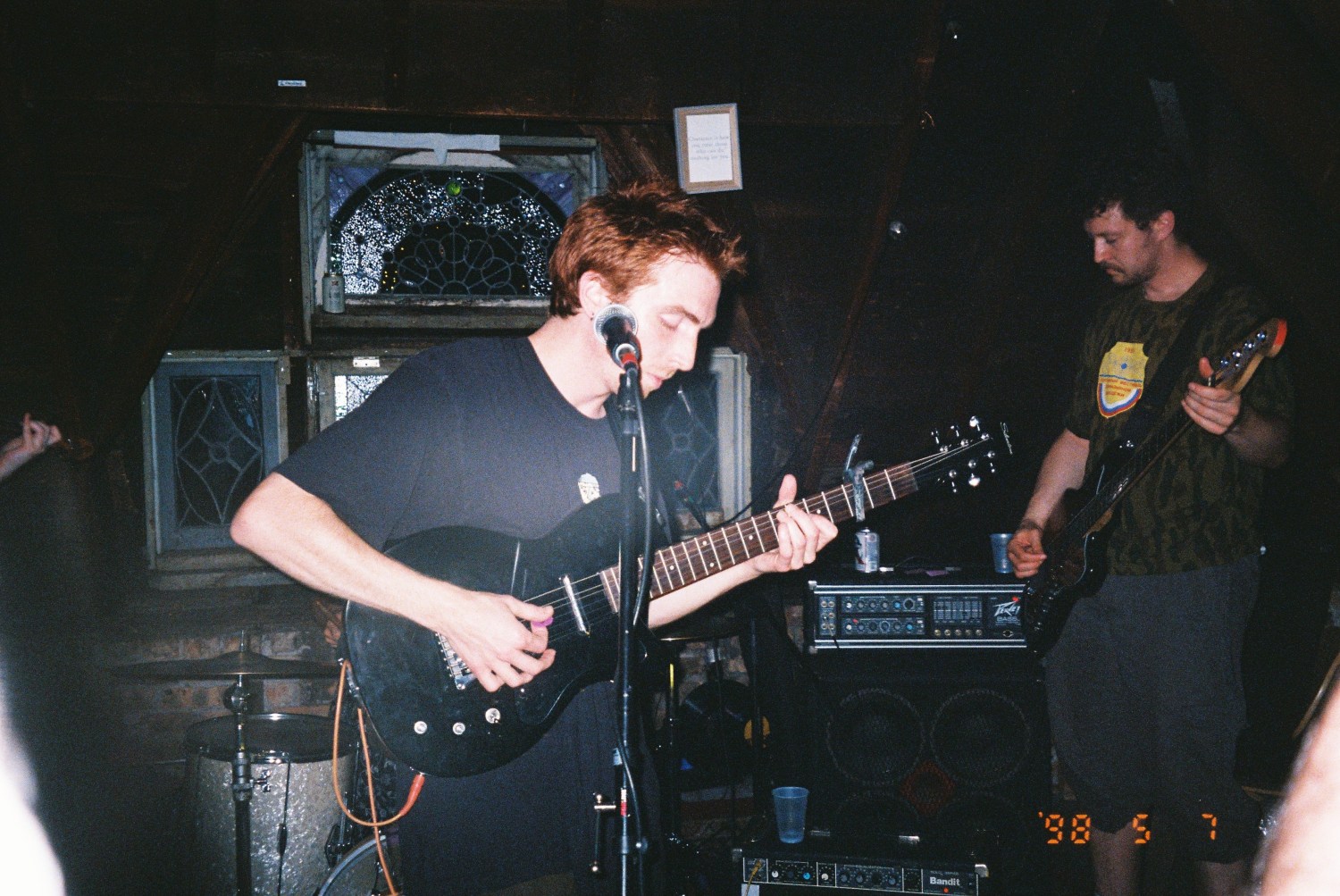
Photo by Eilee Centeno at The Attic in Chicago
During his performance at The Attic, a house venue in Logan Square, Chicago just a few hours before the interview, I felt myself slipping in and out of consciousness. Huddled around the five-piece ensemble framed by beautiful wooden ceilings and stained glass windows overlooking the neighborhood park, dripping sweat from the back of my neck, I wrapped my arm around my brother as tears swelled in my eyes, feeling a sense of belonging and comfort I had thought I’d lost. One moment I was zeroed in on every movement on stage, the next I was completely blacked out singing along to “Domino” and imagining every step I’ve taken mumbling along to that song in my hometown in North Carolina, being reminded of every time I looked up at a stop light and felt my heart sink and long to slip into one of the strangers passing me on the street.
I started thinking about how Hanif Abdurraqib profiled artists, usually making them seem larger than life. It feels like an innate human reaction to obsess over people and hold them up to standards that are above themselves. Maybe it was because I had just read a chapter in his book, They Can’t Kill Us Until They Kill Us, about the Weekend and his superhero-like ability to turn a crowd of thousands of people into sex-crazed animals, and it made me think about the humor in how most people obsess over huge pop stars, people like Taylor Swift or Drake who have big personalities and heaps of charm and charisma, but the person I obsess over is an artist with the posture of Bart Simpson who works at a fast food restaurant, and maybe everyone should make that pivot, too.
Maybe looking up to figures that are larger than life is what’s stopping us from making the changes in our daily routine that will push us towards a realization that we can take small actions to get us out of this mind numbing repetition. If our inspirations are more grounded in everyday life and our peers, then the disconnect between our motivations and our willingness to delve into our passions will disappear.
Even Keegan’s recording process when making a Kitchen album is reflective and representative of how it seems our generation is feeling. There’s tons of kids who are getting into analog recording with the hunger to connect to a creative process that grows with you and naturally takes the shape of your environment. It’s harder to delete or record over a mistake on a tape recording, but it becomes easier to accept and work with it, forming the rest of your recording process around that moment.
“I was really inspired by Spirit of the Beehive for a while and I moved away from tape recordings, but then I stopped doing the computer stuff so much because it’s all MIDI and you can get any sound you want. You can make an instrument play any sound you want. Most of what I like about a lot of the music I listen to is that it feels very natural and feels like things happen almost by accident,” Keegan said when talking about the evolution of his recording process.
There’s a sense of satisfaction that you get when committing to things, whether it’s finally finishing that Cormac McCarthy book that’s been sitting on your shelf for a year, or completing a week of journal entries, or following through on plans to hangout with your friends, sticking to your word is one of the hardest things to do especially when we are constantly distracted by the endless cycle of Instagram reels from friends we have to watch or new Pitchfork articles we have to read and argue about on Twitter. We’ve become so scared to share any imperfection of ourselves or our work that we often lose all strength to do anything at all, but Keegan has learned to embrace imperfections during his recording and writing process and even finds stability in them.
“When I was recording ‘Pike’ years ago I accidentally recorded one second over every track so there was a gap in the song that I couldn’t fix and I ended up having to re-record the whole thing. This was one of the worst mistakes I ever made while recording and the track was shaping up to be exactly how I wanted it, but it ended up being even better when I re-recorded it.”
After years of recording, Keegan has found a method that works well for him, bridging all of his influences into a succinct and memorable writing and recording style. In a short period of time Keegan has been able to create a distinct sound for himself that goes past his abilities to write catchy and relatable pop tunes. From the minute you hear the tape hiss, to the first down stroke of his guitar, to his shaky voice breaking over the track, you immediately settle into the comfortability of his work, allowing yourself to let your walls down as he does in the same breath. The combination of digital and analog recording styles is a reflection of the world he wants to create, full of imperfections, insecurities, and timidness, as well as patience, desire, and care.
Keegan described how his most recent record was made through this process, “You can hear when it’s tape stuff. ‘Fall’ is all digital, but ‘Halloween in August’ is a blend. The first half was recorded on a boombox and the second half was recorded into logic. The vocals were all recorded into the boom box, and then I cut them up and put them on top of the track.”
There’s so much care that goes into Kitchen’s recordings. His music builds upon intense swells, yet they’re never emphasized by crashing symbols or heightened vocals. They’re intensified by the realization of seeing yourself in Keegan’s music more and more. The lyrics become more weighted and backed by the world he creates throughout his albums. While his records may not be conceptually planned, there’s lots of nuance that leads you from song to song. “I Want You” wouldn’t make you cry as hard if it didn’t follow “Halloween in August,” continuing in Keegan’s story pining over someone. He has such a unique way of making you see the beauty in the mundane, and genuinely walk away feeling it. Weaving instrumental interludes between songs carries the feelings over from one place to another, transporting emotional spells from one song to another.
The other night I watched the movie The Lunchbox by Ritesh Batra, and in it the main character passed a street artist who painted the same place every day, but in each painting there were small differences. A kid riding a bike, a guy walking a dog, a couple holding hands would appear somewhere in the painting. The main character thought he saw himself in one of the paintings so he bought it and held the painting to his chest the whole train ride home. Keegan’s music feels like bits and pieces of a larger feeling. Each time I listen to a Kitchen song I see myself in a different world. His music is instantly so familiar that you sink into his world so instantaneously, holding on to your own memories and creating more within his albums. In a time where feelings are so quickly passed through, especially in the way that we’ve become accustomed to consuming and processing feelings, Kitchen’s music is so permanent and tender. His music instills a sort of stillness that feels very important and impactful right now. “Everything I do is cautious, can’t make my arms do what I want.”
“I think I process stuff very slowly. It takes me a really long time to figure out how I feel about something a lot of the time. By the time I figure it out, it’s a little bit too late to do anything about it but write a song. Maybe that sounds fucked up.”
Unknowingly, Kitchen connects rooms full of kids acting like adults based around a sense of hope that while we outwardly try and project how unique we are, we all feel the same sense of desperation, hopelessness, and passion. At his show he closed with one of my favorite songs, “Demon (Yellow)” and it only feels right to me to end this piece by quoting my favorite lines from it because Keegan always has the words for when I don’t, “crossing oceans, desperate phrasing I can’t talk cause I’m too lazy.”
Keegan just announced that you can now pre-order the first Kitchen album, town, on both vinyl and cassette. You can purchase a copy here. Kitchen will also be playing a few upcoming shows with Hello Shark in Troy, NY on November 15th and in Buffalo, NY on the 16th, then in Rochester on the 17th with Spencer Radcliffe, Hello Shark, Attic Abasement and A Wonderful.
“I can be sweet as candy” is the opening line on Joyer’s latest EP, I See Forward and Back. The delivery is timid but sincere, like most of the gentle vocals on the project, maintaining a warmth throughout the three track stringing of hazy, slowcore melodies and contorted soundscapes. I See Forward and Back is both an extension of Nick and Shane Sullivan’s fifth album, Night Songs, and an entity entirely its own. Though unified as a collection of songs conceived in late hours, where Night Songs toys with catchy pop hooks and vocal-centered tracks, I See Forward and Back strips down to the themes of Joyer’s earlier work, with gentle vocals drowning in and out of an abraded, DIY production.
Along with offering a more home cooked annex to Night Songs, I See Forward and Back highlighted Joyer’s range as multidisciplinary artists. The brother duo strung all three songs into one video, a collaging of black and white clips. Akin to the EP’s sound, the visuals are texture heavy, ranging from the soft print of a thumb to brutalist scenes of a scrapyard.
Recently, the ugly hug caught up with Joyer to discuss their tour, the power of shelving projects, and I See Forward and Back.
This interview has been edited for length and clarity
Manon Bushong: Your EP, I See Forward and Back contains songs that were written in the early stages of your album Night Songs. Do you often revisit music once you’ve fleshed out a project, and how does that distance affect how you feel about your work, and what you want to do with it?
Nick Sullivan: I guess it’s kind of new for us. I feel like we let songs hang for a while, a lot of times we won’t really go back to them. A lot of these songs started with Shane, so I feel like he could speak to the distance.
Shane Sullivan: I started writing them a while ago and shelved them because I never really expected them to go anywhere, but I always really liked them. It was unique to revisit them, and it was cool to have Nick jump in and add new ideas, like a bunch of cool percussion that I hadn’t thought about when I was initially writing them. It definitely was a new process for us, but I’m glad we did it and might be something that we continue to try to do just because I tend to write something, but then my attention span is kind of short and I move on to the next thing. It was a cool exercise, forcing myself to revisit and put out older stuff.
MB: There’s also a visual element to this project, you put all of the songs all together for one video. What was the process for that and what made you want to pick those three songs specifically?
SS: Honestly, I started working on these as a part of a class project back when I was in college. I was always interested in doing a visual EP, or a visual component to a collection of songs. I was in a class where I had to make a video, and at that point I was realizing how much I liked making music, so I would come up with any excuse to write music and songs for other projects I had to. So it started as a class project, but I ended up really liking the songs and the video work and I felt it was really interesting having them inform each other. I hadn’t done anything like that before, so it was a really fun way of making something – sitting on it and releasing it all these years later gives me a new appreciation for them.
Further on the topic of visuals, the EP’s cover art has a bull/cow, similar to Night Songs, but the image is also a bit simpler and in black and white. What was the story behind the cover art for I See Forward and Back, and how it ties to Night Songs?
SS: I think we definitely wanted to highlight the link between this EP and Night Songs since it’s an extension of it. So similar imagery, it’s a still from the video – our grandma had a painting that I shot little fragments of. I remembered that being a frame that I really liked, and felt suited the songs, and also matched the album art of Night Songs. So we just wanted to highlight that link, since this was all birthed out of the Night Songs songwriting process.
MB: So these were all collectively part of the writing process for Night Songs, but while it is an extension, it also feels like its own body of work, and I think that a lot of that comes from different production styles. How did you go about production differently, and how do you think that it affected the overall feel?
SS: I feel like it’s a fun glimpse into how we approach the songwriting process because we usually demo a bunch at home, and the songs change a lot in the studio. Usually we’ll write a ton of songs and then pick a solid 15-ish to bring to the studio, and then from there cut it down to 10 to 12. These were ones we liked the way they sounded lo-fi, but in the past when we’ve tried to bring songs that we like lo fi into the studio, it doesn’t really capture what we were going for originally. It made me kind of nervous because it is a little bit more vulnerable, but I thought it would be something cool to highlight the home-recorded and stripped down nature of where our songs usually begin. Another thing about Night Songs is we recorded close to 20 songs, even though it ended up being 12, and there were a lot of different styles of songwriting within those 20. I think we ended up picking the track list that we have now because that was what fit, so it’s interesting to me because the whole album could have sounded more like this EP, and it’s cool to see what it could have been if we went forward with that.
MB: I know you explored some new sounds on Night Song, how has it been playing that album live? Do you think you’re going to incorporate some of these off the EP in your touring as well?
NS: Yeah, it’s been a lot of fun. I feel like Night Songs is way more fun to play live than some of our older stuff, so we’ve been really enjoying it. It’s louder and faster but also has some quieter moments. We will hopefully include the songs off the EP into our live set eventually – we never really thought about it, so a day or two ago, before we left for a tour, we were like ‘damn I guess we should have gotten those ready’. They’re a bit trickier because they’re so stripped down, and have a lot of ambient noises interlaced within them. It’s like a fun puzzle for us to figure out how to make live versions. We’re just excited to get on the road again, we’re touring with some of our favorite bands, so, I think it’ll be a blast.
You can now stream I See Forward and Back and Night Songs on all platforms as well as purchase a cassette of Night Songshere via Hit the North Records
Written by Manon Bushong | Featured Photo by Juliette Boulay
Every Wednesday, the ugly hug shares a playlist personally curated by an artist/band that we have been enjoying. This week, we have a collection of songs put together by artist Ryan Walchonski of the D.C. and Baltimore-based project, Aunt Katrina.
Deliberate, brief and ferocious, Aunt Katrina released their debut record Hot late last year as the first offering from the new solo project of Walchonski, hailing from feeble little horse fame. Favoring both the whimsy and eerie relations that cut deep to its core, Hot leans heavily into the oddities, where the glitchy electro-pop and lo-fi folk fixings link arms to combat the very mundane that we so badly want to resist.
About the playlist, Walchonski shares;
I recently made the relatively short move from Washington DC to Baltimore, which, while being a short distance, still represents a new chapter for me and this band. This playlist represents new beginnings and a fresh start in life, just like my move.
You can stream Hot on all platforms as well as order a cassette tape from Crafted Sounds
From the sincere and expansive community in Maine, Dead Gowns is the project of Portland artist, Genevieve Beaudoin, who has shared her new single, “How Can I”, today as the first release off of her upcoming debut LP, It’s Summer, I Love You, and I’m Surrounded By Snow, due February 14 via Mtn. Laurel Recording Co. Produced by Beaudoin and Luke Kalloch, “How Can I” is a stirring passage, brought out by the textured array of instrumentation and emotional dynamics, giving a glimpse to the power within the details that Dead Gowns has learned to hold dear over time.
Simple and steady, “How Can I” begins like a melodic conversation – a sparing guitar, full yet aware, animating the internalized dialogue that Beaudoin sings about with such carefulness. But it’s with Beaudoin’s understanding of deliverance, where the complexity of feelings can rummage through different sonic interpretations, that really hits home this expressive and enduring motive – something that has made Dead Gowns such an absorbing and poignant project to watch over the years. “But it’s just what I have to do / On these nights / When I’m in love with you cuz,” becomes a precursor to the heavy distortion and rolling drum progression that soon fills the space when she asks, “How can I?” – with time and repetition, becomes less of a question, and rather a statement of self agency in the often defeating presence of desire.
About the song, Beaudoin shares, “I think as a first single, “How Can I” sets this scene for the entire album – it’s dark, romantic, and disorienting. I wrote this song when I was in love with someone and couldn’t tell them. I swallowed so many of my feelings down –– and pushed this person and that desire away. I think that dishonesty led to a rot in our connection that was unrevivable.”
“How Can I” is accompanied by a music video filmed by Beaudoin and Hilary Eyestone on a Super8 camera. Listen to the song here.
Dead Gowns is set to release their debut album It’s Summer, I Love You, and I’m Surrounded By Snow on February 14th via Mtn. Laurel Recording Co. You can preorder the vinyl here.
Written by Shea Roney | Featured Photo by POND Creative
“There is a song on the album where I play saxophone,” McClellan says, falling into a brief pause before letting out a quick laugh, “I’m not a good saxophone player.” When it comes to songwriting, control isn’t always a given, a beneficiary to circumstances in most cases, but can be just as effective an artistic choice as what basic instruments you chose to record. “We could have easily asked someone else to do it,” she continues in regards to her saxophone skills, “but, to me, it’s not about the technique or the form here. It’s about being very committed to the vision.”
Anna McClellan is a singer-songwriter from Omaha, Nebraska whose aptitude for presence has always held an edge to her poetic and faithful ventures. With three previous albums under her name, McClellan’s range of sounds have become, and quite frankly always have been, reactionary to the environments in which her narrations are taken from. The short plights of pounding piano keys take the piano ballad to a more enticing, and oddly eloquent, arena fit for indie-rock slackers and tempted swooners alike. Her melodic phrases croon over deep feelings of devotion and defeat – humorous quips mixed with this unpredictability that resonates just as casual as it is damning to the restless confessionals at play.
Today, McClellan offers her latest work, a sincere and eclectic album called Electric Bouquet. The stories that she writes about, now sitting with accumulated interest as the years pass by, sing of a time when boredom will cost you – the hope for something to happen sits out like soggy cereal in the late-morning. Yet, the details of this foundational mundane begin to blend in amongst personal and societal changes, hitting with such deliberate delivery and personal conviction that is only fitting coming from her singular voice.
I recently caught up with McClellan as she prepared for the release of Electric Bouquet, where we discussed her time growing up in Omaha, becoming an electrician in the TV industry and sticking to the vision she had set out to complete for some time now.
Photo by Madeline Hug
This interview has been edited for length and clarity
SR: You wrote the songs for Electric Bouquet over a range of years. What was the timeline and where were you location wise in the process?
AM: All of it was really written in Omaha, where I grew up. I moved back to Omaha in the fall of 2018 and then recorded my last record in the summer of 2019, and then basically started writing songs for Electric Bouquet right after that.
SR: Growing up in Omaha, which is referenced a few times in your writing, what did the city come to symbolize in this narrative path that the album takes?
AM: Yeah, “Omaha”, the song, is a very love to hate relationship with the city, and then there’s also “Dawson’s Creek”, the last song, which is all about my childhood. It ties up thematically to a lot of the stuff around being a kid and having too much time on your own unsupervised and alone. I wasn’t doing anything bad [laughs], I was mostly just ruminating hardcore, like I was really bored. I just didn’t have enough stimulation. So, Omaha represents a lot of that for me because I have so many rooted memories, restless ones, of wanting something to happen, something exciting or surprising, and I’ve just been looking for stuff like that ever since.
SR: You obviously write from a very personal lens, telling your own story, but there is so much to be said about this larger scope that you utilize, especially on the song “Jam the Phones”, which catches you going through all of these big changes in your life as you also think more critically of how the world changes around you too. Did you find that the identity at which you write from change throughout the album’s process the more you focused on these larger themes?
AM: I’ve been thinking about social justice issues and trying to figure out how to write about them for a long time. Before shit started, like really popping off, at least for our generation, there’s a collective whole that I’ve noticed, where we’re all starting to tap into more and more of what’s going on. So it felt really organic with everyone wanting to talk about this stuff more, but the framework for talking about it is tricky because everyone has such different ideas. I feel like talking about it from the ‘I’ is always the best, because people can’t argue with your feelings. That song specifically [“Jam the Phones”] was written in 2020 around the George Floyd uprisings, when I feel like everyone was, for the first time asking, ‘what do we do?’
SR: There are many songs that reflect on different kinds of relationships throughout the record. Were there any relationships that you struggled with articulating and did you find a way to solidify their meaning on this album?
AM: Of course, most of the ones that I’m thinking of are romantic. When I wrote the first song back in 2019 called “I’m Lyin”, I was with a person, he plays music too, and we played music together. I played the song for him, and he was like, ‘do you not want to be with me anymore?’ I hadn’t thought about it like that, but then after he said that, I was like, ‘wait, maybe that is what this means, shit’ [laughs]. Then we broke up not long after that. Sometimes songs will explain things before my mind catches up to them. I think “Dawson’s Creek” is very much about familial relationships and it was a long time coming. I’ve been trying to figure out how to write about my struggle with my family and our dynamic, because so much of it is about not saying things, and like this sort of repression. So I feel like we’ve had lots of conversations over the past five plus years about this stuff, and through those conversations enabled me to voice these things more and have the courage to do it.
SR: I’ve never actually seen Dawson’s Creek, but I am familiar with the lore. Was there any significance of using that show as the title of the song?
AM: It’s not really about the show at all, but more about watching the show. I used to watch it in the summer, it was on TBS at 9am and 10am every morning. So I’d wake up and watch Dawson’s Creek with my cereal, and that’s sort of how I’d start the day in the summer. It embodies this sort of lost, wistful feeling of just waking up and immediately being swept up in someone else’s narrative, like a fake narrative instead of feeling like I had my own narrative.
SR: Television and film is pretty consistent throughout the record, like on the song “Co-Stars” which plays out like this very Hollywood-esque progression of love and expectations.
AM: Yeah, it’s funny, when I wrote that song I knew I’d wanted to get into TV at that point, but fully was not working in this world at all. It’s funny, a lot of things about this record have grown in their meaning since, not like a manifestation, but there’s been through lines that have carried past the songs. Even the cover is me with a bunch of lamps, and now that is what I do on the show, I get all the lamps to work for the sets. It’s just kind of crazy.
SR: Yeah, I wanted to ask, now working as an electrician on television sets, where did you get the concept of the ‘electric bouquet’ and what does it mean to you?
AM: I was going to electrician school at the time, so I think that the word was just really prevalent. I was also sitting and thinking about live shows and imagining me bringing lamps, like so many lamps to every show and setting them up and that being a part of the load in and out at night – it’s like an electric bouquet. You create the bouquet around you as part of your set design, and that’s what the poem at the end of the album is about. ‘I have lamps – 20 lamps at night, I bring inside, set them up all around me, like an electric bouquet.’ But I think realistically I could only do like three, maybe four lamps a night [laughs]. It’s a small operation.
SR: When I picture a bouquet, obviously it’s like a bouquet of flowers. But thinking further on this word, a bouquet is never naturally occurring. Someone has to put it together.
AM: Totally. Calling an album a bouquet is a cool idea. That’s another way of thinking of it.
SR: Bouquet is a great word for an album. It makes sense.
AM: Yeah, I was really happy when I came up with the title. It’s the first time I’ve ever had the album name before I recorded the album.
SR: That’s gotta feel so good, right? Did that guide the outcome of the writing or recording for you at all?
AM: I just felt very empowered, like I knew what I wanted it to sound like and how I wanted to feel through the whole thing. Through the experience of doing this before, obviously writing the songs, but not necessarily being as assertive production wise, I knew this time that I really wanted that control and to be more uncompromising in my decisions. I was really excited about that because there’s not a lot of places that you get to do that in life, but when it’s your songs and your name, you can just be like, ‘no’ [laughs]. In that case, maybe this thing isn’t going to sound the best or be the most convenient, but I like it when things are impractical. To be honest, I think that it makes for something more interesting.
Photo by Madeline Hug
You can stream Electric Bouquet on all platforms today, as well as order a vinyl or cassette copy of the album via Father/Daughter Records.
On a rainy Wednesday evening, Grumpy’s starvation for attention and a protein bar is satisfied by a chocolate croissant and a friend passing by with their dog. “Grumpy is famous now, spread the word” front person Heaven Schmitt explains of the open voice-memo app between us mid-interview, before leaning in to generously pet the small terrier. The interaction was the closest I got to meeting Grumpy that evening, a charming big-hearted character parading around in an armor of extreme ego. Schmitt describes Grumpy’s identity as “me, plus a very cocky bravado. There’s a huge layer of cockiness to it, but it’s also just very earnest about wanting attention.”
Following a transformative four year stretch since Loser came out, Grumpy released singles “Saltlick” and “Protein”, both glimpses of EP Wolfed, out via Bayonet on October 25th. These vibrant songs confirmed the band’s charming sense humor remains unscathed, while also teasing a new voice to Grumpy. It’s a nightmare for the genre labeling fanatics on the depths of the internet, but for the rest of us, Wolfed is unpredictable and addicting, a sonically innovative feast guided only by itself.
The third single off of Wolfed offered a glimpse at the soft core nestled deep beneath Grumpy’s cocky bravado. “Relationships are not always forever, but I think that love can be”, Schmitt says of the ideologies behind “Flower”, a tender twee ‘syrup song’ immortalizing a connection after the romance has expired. The EP’s wittiness proves to be an easy hook, but it’s ultimately this dispersing of vulnerability, weaving in and out of comedic one liners and self-deprecating jests, that uphold Wolfed as Grumpy’s most captivating project yet.
When I sat down with Schmitt last week, their signature mischievous Sweeney Todd-esque hat had been replaced by an adorable knit striped hood they finished making the day prior. Along with knitting, we discussed the other ways Schmitt has kept busy, such as planning an epic release show, pioneering the niche internet aesthetic of “dirtybag twee”, and taking a hands-on role in the creation of Grumpy’s new sound.
This interview has been edited for length and clarity:
Manon Bushong: Before we dive into music, I did want to ask about your outfits and awesome hat collection. How you would describe your style, and what do you look for when you’re picking the outfits you play in, or just wear in general.
HS: Well, I love a funky hat, obviously. I’m super inspired right now by Sweeney Todd / Beetlejuice vibes…crusty insane man in a suit. It’s largely inspired by my hair, it recently came out a more cool-toned gray than I thought, but then I just leaned into it. I have a Sunday night ritual of making a little picnic dinner on the beach and the only time I wet my hair is in the ocean. So it’s super gross and sandy and wavy, and that inspired the whole Beetlejuice, Sweeney Todd era for me.
Right now, I’m trying not to buy anything. When I’m picking stuff out, I’m just trying to entertain myself with what I have. I’ve just started posting outfit TikToks…lord help me…but someone on TikTok described it as “Victorian Truck Stop, and I love that. Challenging myself to post TikToks about it really pushes me to make an outfit that much more bizarre, or just to add one extra layer of intrigue. I just love clothes and expressing myself with my style.
I’ve landed on, what do they call it? Oh yeah, therian TikTok. It’s these young kids who are ‘therians’, from what I understand, it’s a furry thing. So I need to figure out what animal I am. I don’t know…I’m getting wolf a lot, but I don’t know if that’s true. I think I’m a little cuddlier. Maybe there’s puppy elements to it? I’m never gonna beat the furry allegations.
MB: Wolfed is also the title of your upcoming EP.
HS: Ohhhh, yeah. Okay, I’m Wolf. I am Wolf.
MB: What does that verb mean to you for this collection of songs?
HS: Wolfed came from Anya, my bandmate and deepest collaborator. She’s the bassist in the band. I kind of just call her the art director of the project because she and I make all of the PR photos and cover art together. She has a really crazy editing style that I love and she also really gets me. She sees the fantasy realm that exists in my head. She sees it in me and understands me and is so good at translating these things into words and images. Anyways, I’m always saying, ‘oh, like you ate’, ‘you tore’, like ‘you, you ate that’ and Anya just conjured a lot of Big Bad Wolf energy. The art direction for this EP has a lot of dark fantasy inspiration. So we were thinking a lot about Big Bad Wolf, and she came up with the phrase wolfed as another way of saying “you ate”, like, you just devoured something.
For me, this EP and what’s coming is a real response to our first album, Loser. This is kind of my winner. These few years when I haven’t released anything have been a huge transformative time. I mean I called the band Grumpy, and I called the first album Loser, and it was tongue in cheek, but there was some truth to that. That’s how I felt at the time. Now, I still love the band name, but I want to put out stuff that I produced and made, cause I think I was hands off on the first album in a way that it ended up not sounding like it could have if I really tried to learn. Anyways, I connect with the big bad wolf because it’s this person whose bravado and cockiness gets him into trouble ultimately is his demise. So I think this is before the big bad wolf knows about his downfall. We’ll see where I go from here, but for now I’m just feeling like I could huff and puff and blow the house down.
MB: When it comes to lyrics, Grumpy does a great job of meshing humor and some very clever lines with a lot of pretty solid introspection that can be very poignant at times as well. How do you feel like humor is something that you incorporate into your writing and is it something that you really feel is necessary?
HS: What I really value in music are comedy and melody. Those are the things that can get me really hooked, or just think, ‘Oh, I wish I wrote that’. I’m glad that that’s what you take away, the self reflection and the humor, because that’s what Grumpy stories are. It’s just a lot of me being like ‘how much can I embarrass myself with what I can admit in a song’, there’s a huge amount of vulnerability in it. I’m trying to be very raw and write how I speak and exactly what I was thinking. I bring in discomfort from honesty and then invite people to laugh at me, like isn’t it ridiculous that this is how I saw it?
Humor is such a way for me to access the uglier sides of who I am and to confront them. My history with music and pursuing music, was so ‘tortured artist student’. I really wanted to pursue music as a career so in college I was trying so hard to make songs that were relatable and not too weird. It just destroyed me, it was zero fun and the songs were terrible. I got to this point, right as I was graduating college where I was like, ‘you know what? Let’s just get real, I don’t have what it takes to do this’. So I went and worked at an ad agency for a year, it was just this dramatic exit and I didn’t make any music during that time. It relieved so much pressure that after maybe eight or nine months, I was like, ‘well I’ll pick up the guitar’, I can just do this for fun. Then there were no constraints, it wasn’t for anyone but me. From that total lack of pressure, all these goofy dorky songs that were so me came out. So that’s the whole genesis of what Grumpy is, how I figured out how to make music fun for me.
MB: What shape is the fun of Grumpy taking now, four years later?
HS: We’ve got a really exciting tour planned and a bunch of music sitting in the cannon. These past four years in between releasing anything have been so important and I’m glad I waited because I knew I wanted help. I talked to a bunch of labels, but nothing ever felt right until Bayonet. I totally cried in our lunch meeting, because I was just like “Oh my God, they get it. They get me”. They shared what they believed was possible for me and the spaces they saw us in, like the bills they saw us on, stuff that I only privately thought ‘does anybody else but me think that we belong in this space?’ I love them and I’m grateful and I think they’re crushing.
Everything that’s coming for Grumpy is the result of my roots in folk and indie music, those are just my biggest influences. I’m also hugely inspired by hyperpop and electronic music. Hyperpop artists have this brilliant sense of humor and sense of fun that doesn’t take itself too seriously, and I’m so inspired by what they can achieve. I think Frost Children is so much bigger than any one genre you could put them in, they’re just absolute savants. I think they’re the best performers I’ve ever known, they have so much fun on stage.
For me, Grumpy is this combo, a product of these two influences. During our first meeting, Bayonet was describing it as “hyperfolk”. Genre-izing things is hard for me, everybody wants to come up with the next Indie Sleaze category, but damn, they kind of nailed it with hyper-folk. Electronic vocals, indie sensibilities.
MB: Do you think that there could be more of a hyper pop future for Grumpy?
HS: I’m never concerned about cohesiveness. I think I’m the through line, so I can make whatever I want and it is Grumpy. I don’t see myself doing side projects, I just see Grumpy having a wide stroke. I have a lot of heavier rock stuff coming, some more electronic stuff, some classic indie, jangly pop stuff, and then it’s just some weird, weird folk that I’ve been sitting on for a long time. That’s another reason Frost Children are such a big inspiration to me, they could really crush such a huge variety of genres and it still sounds like them because they have a strong voice.
I love it so much, these people are my family, they understand me and have seen me so fully and still love me. It’s very healing to have them close, that we’ve remained valuable to each other in and outside of a romantic context.
MB: You play with a few of your exes. I saw you live last week, and there was something very special about the energy of your band, which I assume that contributes to. Do you have a favorite part about playing with people you share that intimate relationship with?
HS: I like to joke that dumping me results in a life sentence of commitment to the band Grumpy, but they have all honored that. It is funny to joke about but it really is this beautiful thing for me, and I think it adds to the rawness. There’s a level of realism that can only be achieved by songs being performed by the people they’re about, like I’ve written the songs, but the people in the band have had a hand in living the story. In a way, they’ve written the reality, I just put it into words and melody.
“Flower”, is a very twee, sweet love song about a romance that has ended and it’s a reflection on the love. Relationships are not always forever, but I think that love can be. The way that I approach dating is knowing that that love can and will change shape. I’m not building some commitment to you so much as I’m nurturing a bond that I hope to hold forever. So, having these exes near and dear is just living that. I’m so glad I dated each of them, they’re such a huge part of me and I still feel very loved by each of them. My bonds with them feel eternal. In and outside of a relationship, we nurture that with each other, and that’s what “Flower” is about. I think it speaks highly of all of us, and the community that we hold for each other. It’s a rare relationship that I’ve come to really appreciate.
To specifically highlight Anya, we ultimately realized that we were not lifelong romantic partners, but we do have this really incredible artistic connection. I always get this image in my head of two little rodents digging, like a skunk and raccoon with little archaeology brushes, uncovering and discovering things that we can make in the world. She’s just a music veteran, absolute powerhouse, freak of nature, not from this planet. Then Austin, my ex husband on drums, he’s the voice of reason in the band. We often don’t follow his apprehension, but it is good to have. He’s also just like our AV guy, he can really be so organized.
MB: What’s next for Grumpy
HS: Our EP release show is happening October 27th. I held off on playing a Grumpy headline show, this band has been around like four or five years and we just played our first one in July at Cassette. I like to be very specific with headline shows because I personally don’t love to go to shows. If the band is good, I’m like, ‘Damn, these guys are great. I want to get home and write a song.’ If they’re not, I’m like, ‘how come I’m not up there? I want to go home and write a song.’ Either way, it makes me want to leave and write a song, except for Blaketheman shows and Frost Children shows, then I’m locked in, that is pure entertainment. Blaketheman1000 has humor like no other, I actually think he’s a genius if you read his lyrics. He and I’ve been friends for 10 years, he was my first friend in college. I just think he’s an underrated genius and comedic hero. He really understands putting humor in music, he just nails that confidence.
Anyways, EP release show. It’s Halloween weekend and I basically want to throw a party where bands are playing. For our first headline show, we had free hot dogs and a hot dog eating contest with a bunch of my beautiful friends. So for this Halloween weekend show, we’re doing a huge costume contest and I want to gather a whole bunch of prizes and merch related stuff. I want an apple cider donut contest, probably some candy too. I like a snack element, there’s not enough food at shows. It’s going to be at Trans Pecos and the lineup is Estelle Allen and Thanks For Coming, and Grumpy. We’ll be dropping some merch and the EP will be on cassette. I’m gonna go hard, but Halloween is such an impossible question. I think for a Halloween costume to work for me, it has to have a wig, cause wigs are the thing I’m not wearing. Although, I really cannot deny that I am thinking about powdered wigs. Who’s pulling up to the function in a powdered wig?
Wolfed will be out October 25 via Bayonet Records. You can preorder the EP as well as a cassette tape here. Grumpy will be playing an EP release show at Trans Pecos in New York on October 27 along with Thanks for Coming and Estelle Allen. Buy ticketshere.
“Old Friend” is a love letter to people looking over the edge penned by a person looking over the edge, or who has at least spent a good deal of time looking over it before. The edge of “what,” exactly? There’s the proverbial cliff, or perhaps more applicable to modernity, the roof ledge. But, holistically to the modern world at large, the edge is less a razor-line than an amorphous amalgam of youth, love, doubt, hope, disappointment, fear, exhaustion, beauty, trust, and once again, deep, all-encompassing love. What it means to grow up or at least grow older and see some ideas you thought you had about the world and the people in it fall away, and what that means, and how destabilizing that can be. How to step out of that years-lingering mushroom cloud.
“Old Friend” is the debut album from Hazel City, the brainchild of Clay Frankel, guitarist and vocalist of Chicago-based Twin Peaks. (This album also features some tasty upright bass from fellow Chicagoan Liam Kazar of “Shoes Too Tight” acclaim). Time has only made this capsule sweeter. When the album first dropped in June 2023, I came to it very happily entrenched in this-changes-everything romantic love, and found plenty of tender lines herein to feed my affliction like “Are you looking for a husband or just someone to get drunk with? What you want is never wrong. I could do both or either one. I could see us holding court at night or you holding our son.” Now, I revisit “Old Friend” in the early days of an equally life-changing breakup, and there are plenty more morsels waiting in these lines for me this time around – stuff I missed on the first pass, or more accurately, wasn’t ready or able to hear. Frankel’s record is a lyrical kneecapper, brutal in its simplicity and unflinching in its sincerity.
“Rain” (the opener) is the star track for me, followed closely by “Dirt.” The piano composition on “Rain” is jaunty and impressive, tones that make this gloomy ballad wildly poignant instead of weighing too one-note sad – and this is a sad, sad song. It opens with radio static and rain sounds, immediately evocative of Edward Hopper’s “Nighthawks,” and the singer is telling a similarly domestic story. He’s pacing from the living room to the kitchen to his young daughter’s bedroom waiting for his lover, late, to arrive back home. Our speaker is sadly, patiently, even a little worriedly waiting while, outside, it rains.
This album is unexpectedly orchestral in scrumptious pockets the listener doesn’t see coming – like “Snow,” an interlude that contemplatively heralds the next song (“Gorgeous”), not unlike “Behind the Wall of Sleep” into “N.I.B.” on “Black Sabbath” Black Sabbath. When it arrives, “Gorgeous” is cheerful but not naive. It doesn’t forsake a lively beat to lean self-indulgent or heavy-handed, but it’s still enough to break your heart. (“I knew that you were someone that I wanted to get to know, and now I know you, but I don’t know if you’ve done me any good.”)
No rest for the wicked! Next track “Really” rips in with another kneecapper, “What am I so dumb that I don’t know? Haven’t I been good and beautiful?” backed by dreamy effects keys from strawberry chimes to space bells. One song later, our singer lays the heater “No one remеmbers what we did. No one was еven looking. No one knows we almost made it. No one knows how close we were.” Holy shit! Ow! Not the Face!
“Rain 2” is clearly the answer to “Rain,” the cryptic counterpart of the earlier story-song sung by a piquant chorus of vocalists Emily Neale, Lillie West, Quinn Tsan, and Elizabeth Moen. But, in subtler ways, “Root” is the response to “Dirt.”
“Root” is a vote of encouragement to keep fighting the good fight – an intensely sincere, even desperate plea for loved ones to just try, try again. Its non-naive world weariness prevents this track from being gratingly optimistic. (If there’s one thing people on the edge historically respond well to, it’s a “Hang in there!” cat poster.) Instead, Frankel posits, “I know it’s hard they’ve saddled you up with a heavy heart, well ain’t that a weight we can share.” This is a track that recognizes that the world is fucked, and that at the end of the day the Everyman’s antidote to surviving it is just living the best you can from day to day, loving other people, and letting them know how deep and life-affirming that love really is. Frankel is speaking here about the type of love that is only earned after years of walking the rock beside a person – which might be where the album title “Old Friend” comes in. For the rest of us, “Old Friend” offers an answer to the sempiternal background question that takes on an especially tooth-shaking volume in eras such as ours: “What now?”
On the other side of the property line, only marked by my neighbor’s natural shrubbery – unruly and free – is a decaying birdhouse dangling from a branch that I watch every morning from my kitchen window. Missing half of its roof from many of our repeated Midwest storms, its siding almost timid to be left on its own, the structure’s only sense of hope lies within a singular piece of twine wrapped around its perimeter put there a years ago in hopes to hold, sparingly, what is still together. But lo and behold, with every season comes a new generation of sparrows or chickadees, a race to get there first and fill it with found, soft textures of twigs and the shedding hair of our dog – home sweet home. But from where I stand, as this birdhouse persists through the changing seasons, rotting wood and weathered temptations to finally collapse – I have to wonder, do those birds live in fear, or is it just me?
Grounded in unique homemade foundations of gritty instrumentation and soured conventionals, ylayali is the project of Philly-based artist, Francis Lyons, becoming a safe haven for his artistic visions and rooted stories ever since he was in high school fifteen years ago. Whether as a producer or having played in bands such as free cake for every creature, 2nd Grade and most recently, 22° Halo, Lyons’ work over the years comfortably falls amongst indie cult favorites, rearing the notoriety from tender pop-lovers, lo-fi droolers and calculated gear heads alike. As his tender demeanor and experimental spirit spill out on his latest LP, Birdhouse in Conduit, Lyonsbrings that same appreciation and excitement of what ylayali has been for over a decade, and pulling it towards the possibility of what may come next – brilliant or unusual – both putting a beautiful and enduring edge to the recordings at hand.
Protruded by crude distortion and a grating, hypnotic march of sorts, the album begins with “Francis Funeral Home” locking into nine minutes of controlled chaos – a type of unmatched sanctity of when solitude is met with the fuckery of an electric guitar and a shit-ton of pedals. “Stay and dance until the place close / the Francis Funeral Home”, Lyons sings, guitars circulating as the idea of endings are weighed upon impact. This type of surrealism is nothing new to Lyons’ ability to tell, notably unconventional, stories of identity and self, as he himself becomes interchangeable amongst mundane objects, obtuse scenarios and lackey characters that phase in and out of his line of sight. Songs like “Shadow Play” and “Spacebar” become a pledge of irony when trying to understand his existence, or merely define its intentions. “never saw it comin’ / first lookin’ spider-wise / and the webs all disappear when the dew dries” he sings on the latter, as the delicate vocals of both Lyons and Katie Bennett (Katie Bejsiuk, Free Cake For Every Creature) force us to lean in, introducing a new level of fixation to the sounds he so easily controls.
These sonic textures and attention to detail are almost moldable in your hands, as they condense and build, meander and squirm amongst the conduction of pulpy fuzz and distortion. “Devil Dog”, at its core, is a staggering and sticky rocker, subdued to fit into Lyons’ natural speed and rough façade that feels heavier than the actual sweetness underneath. “Fuzz” plays amongst a culmination of creeks, creeps and patterned fixations, paired together with the light and whimsical string arrangements and the choked clinks of a glockenspiel that push forward; a choreographed movement amongst the differing characters that each sonic voicing represents. The brief instrumental “Security Man” is an acoustic tribulation, a harmony of configured strings that sing for repentance before being overwhelmed by the warm rage of the closing track “God’s Man”. “I saw an angel / An actual angel,” Lyons sings, a continuation of religious motifs brought up throughout the album. But in the end, you can’t help but to think of the due diligence these angels actually perform for him, as absurdity overrides the elegance of salvation – “harbinger, angel of what, solicitation’s tale” – the words holding to whatever they can as the feedback sears its final marks.
“There’s that shiny part / Worn smooth by vinyl twine / birdhouse polypropylene / one spool lasts one life” – amongst the tinkerings on the standout track, “Birdhouse”, comes one of the more tender and grounding expositions on the album as the song hums with a sound that crusts over like hardened sugar. But it is on this song where Lyons feels most grounded into his foundation, where all of those huge questions of fear, death, religion and belonging don’t matter anymore. It’s in these sonic trances that make Birdhouse in Conduit feel so enduring, where meaning fluctuates with a meandering rhythm, and yet, Lyons can still take a pause and look at what’s right in front of him. “But the birdhouse makes me smile with the loop knotted on the side,” he sings, cherishing something so simple; it means the world to both him and those little birds.
Birdhouse in Conduit is now available to stream on all platforms. You can purchase the album on vinyl here, which includes a 22 page booklet, various homemade inserts and found photos. Lyons will soon be playing a few shows with 22° Halo on the east coast. Find dates here.


 the ugly hug