Sometimes the most harrowing heart break tracks are not necessarily the most immediate. Rather, they draw from a wound that is neither fresh nor healed, loitering in a state of emotional limerence and nourished more by romanticized illusion than reality. Think Yo La Tengo’s “My Heart’s Not In It” or “Antenna” by Sonic Youth. What makes these narratives so brutal lies in their inward nature – when dust settles and time dulls at the ration behind a relationship’s dissolution, there is space from a “what if” shaped hole begging to be filled with one’s own yearning. Or, in the case of bloodsports, patched up with a surge of jagged percussion. Out today, “Rosary” nods to the wistful sensitivity that lies beneath an enamel of exasperated song structures and tough sounding band name, as bloodsports paves a robust buildup sure to knock out even the worst case of self-inflicted longing.
“Rosary” comes as the lead single for bloodsports’ debut record, Anything Can Be A Hammer, announced today as well. The track builds on feats found in bloodsports’ existing discography – the melodic tensions that grip their self titled EP, the pensive lyricism bottled in 2024 single “canary”, the potency of their live sets. It also veers into new textures, leaning into a sharper sound and hinting to the dynamism we can anticipate on their debut.
I noted the nature of their sets, but for those who have yet to experience bloodsports live, I will emphasize that the four piece is well versed on the impact of oscillation. They have a knack for suspense through contoured structures, assertive drumming, and compelling buildups. The latter serves as the foundation for “Rosary”, which leads with tender vocal harmonies over bare chord progressions and ends on a blazing riff. The track’s gentle onset is armed with unease, inciting tension as you wait for an impending sonic inflation.
About the single, Sam shares, “This song was written about a relationship that I ended, and reminiscing about the feelings months after the fact. Lyrically, it’s a very bittersweet song. It looks back positively on the time that was spent but there’s also a layer of regret about the things that never quite came to fruition. It’s strange to sing live now because the relationship that it’s referencing has since been rekindled but I can still connect to those feelings from back then.”
Anything Can Be A Hammer is set to come out October 17th via Good English Records. It marks the first release for Good English, a New York and Nashville based label dedicated to creative freedom and a DIY ethos.
You can pre-order Anything Can Be A Hammer on Bandcamp.
In Kim Gordon’s memoir, there is an excerpt from a 1988 tour diary that ends with the sentiment: “I like being in a weak position and making it strong.” It serves as a sort of conclusion to an unraveling reflection on gender and performance, on her relationship to playing bass and her own femininity, on wondering how she’s perceived next to dozens of boys with guitars she deems “ordinary as possible.”
The statement itself is simple, but I think it encapsulates exactly what makes Gordon one of the greatest female musicians in the sphere of experimental noise rock. I don’t mean that in a good-for-a-girl kind of way; rather, she is good because she’s a girl, because of the sharpness within her dissonant sound, the hunger within her seemingly wandering melodies, the harrowing authenticity wound into her abrasion. A perfected scream vocal is nothing without nuance, and the most compelling noise artists wield a caustic sound for subversion, not mere shock value. Among the contemporary artists cultivating dimension within auditory hostility is Flooding, and the Kansas-based project’s latest EP is a testament to their propensity for making weak positions strong. Out last week, object 1 is a sonically full display of satire, blistering yet astute song structures, and cunning juxtaposition.
Rose Brown, Cole Billings, and Zach Cunningham started Flooding in 2020, releasing their self-titled record the following year. While it leaned into a melancholic, slow-core feel, their debut also hinted at a darker and more intense sound – one Flooding would fully sink their teeth into on their 2023 release, Silhouette Machine. The latter revealed how compelling Flooding can be if they refrain from diluting their art for the sake of likability. “The first one was before I really knew how to write music; it was one of the first things I’d ever written, so I approached it in a way of ‘how do I make this what I want to hear,’ but I also still felt kind of pressured to make it palatable for people listening,” Rose tells me of Flooding’s early years.
While it’s true that Flooding’s more recent releases have veered in a creative direction often deemed “challenging,” there’s a slight contradiction in her statement – one that prods at longstanding discourse on music and palatability. The success Flooding has found by embracing a harsher identity speaks to the fact that Rose is not alone in the sounds she craves. Acknowledging the disconnect between that and the music she felt pressured to make for the sake of a general listener begs the question: why do these notions still pervade the industry so aggressively?
What makes art palatable? Is it comfort, something that can appease a wide demographic of perspectives? But what about successful media that isn’t “comfortable”. What about the prominence of violence in the film industry. Is violence palatable? What about sex, is sex palatable? An intro to marketing class will tell you it sells. But can it sell authentically? What happens when it’s not strategically packaged? When it’s honest, when it’s explosive, when it doesn’t prioritize comfort?
My biggest issue with the “palatability” conversation is how little faith it places in the general listener. Perhaps that’s an idyllic stance, but as I listen to Flooding, I have a hard time imagining a reality in which you do not take something from the experience; the hair-raising percussion, the catharsis of Rose’s vocal volatility, the eerie beauty of the chord progressions. Is it challenging? Perhaps. But why is that a bad thing?
When I asked Rose about performing such brash songs live, she explained it had been challenging at first, “I was just so nervous and shy, I wasn’t screaming back then. I was just trying to sing and I could barely do that then. Preforming is my favorite part of music because I like how it can evolve the songs and evolve you as a person too.” Flooding’s appetite for discomfort has been as a catalyst for their own growth, and their latest release encourages you to do the same. You can listen to object 1 anywhere now.
We recently chatted with Rose to discuss music inspirations, shame, and Flooding’s new EP, object 1.
This album has been edited for length and clarity.
Manon: I wanted to ask about the length of object 1—at 17 minutes, it’s a lot shorter than Silhouette Machine. I think something that makes your music so powerful is your contrast between delicate and abrasive. On your last album, you had a lot of time to really manipulate and explore those extremes. Was this project always meant to be an EP, and how did you approach creating a more condensed body of work?
Rose: The process was a lot different from our first two albums. The first one was before I really knew how to write music; it was one of the first things I’d ever written, so I approached it in a way of “how do I make this what I want to hear,” but I also still felt kind of pressured to make it palatable for people listening. For the second album, I really wanted to challenge myself with different ways of approaching writing music. I’ve always been an album person, I really like listening to albums, and that’s what I want to produce. This EP is a lot different. It’s very ironic and sarcastic, and I’m approaching a lot of subjects from different people’s points of view, so it felt right to make it a more condensed work. It felt so different from what we’d been doing that I kind of wanted it to be an endcap or a starting-off point for future things.
Manon: I read that the name Flooding comes from an intense, “face your fears all at once” style of exposure therapy. What sorts of fears or general notions were you hoping to contend with on this EP?
Rose: I’m talking about shame a lot, and I’m talking about shame from other people’s perspectives, because I think it’s pretty hard to explore if you’re just talking about your own shame. I feel like for me, the themes kind of come together and make sense after I’ve recorded everything and it’s ready to go.
Manon: I’m curious about the notion of fragility in “your silence is my favorite song.” I feel like your use of repetition there creates such an interesting skewing of the word fragile, it feels as if “I’m fragile” is a warning, especially in the context of your volatile song structures. What does fragility mean to you, and why did you choose to emphasize it in that song?
Rose: I think it can mean a lot of different things. When people think of femininity, they think of “fragile” in the way a flower is delicate. But there’s also the fragility of a bomb that could explode. The EP has a lot of contradictory elements, and I think that’s a very interesting juxtaposition.
Manon: You mentioned that for the first album, you were still learning how to write songs and were trying to create something more palatable. Since then, you’ve moved toward making what you want to hear. What are some influences that have shaped your recent releases—and yourself as a songwriter in general?
Rose: Thinking about our first album, I hadn’t really delved super deep into slowcore yet. People started referring to us as “slowcore” and I was like, oh shit, yeah, we are. So then I started listening to that. I also got really into screamo and hardcore because Kansas City has a huge hardcore scene, that’s just what’s around us. That definitely influenced our second album a lot. Recently, I’ve been really into pop music and jazz, so I tried to find a way to combine those elements with something that’s still kind of aggressive and noisy.
Manon: Then “object 1,” the track, has no lyrics. Since your vocals are such a powerful instrument in Flooding, how was your experience writing a song without them?
Rose: That’s maybe the only song we have without my vocals on it, besides like one interlude track. It’s also the only song we’ve ever all written together, me, Cole, and Zach. It felt a lot different to me. I approached playing guitar in a different way, where it wasn’t the main structural element. It felt weird to try to put vocals on it, and I couldn’t figure out what to do, nothing felt natural.
Manon: I feel like when you have a more experimental and noise-heavy sound, it often gets clumped into this category of “cathartic music.” Would you consider playing Flooding live to be cathartic?
Rose: For sure. It’s definitely an emotional experience for me.
Manon: Is it always? Or are there times when something you’ve written doesn’t resonate anymore?
Rose: Honestly, we don’t even play the songs we don’t want to, we have enough of a catalog now to just play what we want. It’s definitely different playing the new EP because it’s not as extremely personal as a lot of our past music has been, but it’s still cathartic, just in a different way. You get to act out the perspective of being a pop star, or just some arrogant guy who doesn’t give a shit.
Written by Manon Bushong | Photo by Fabian Rosales
“We were really heavy for a minute there. For Dizzy Spell and that era we were so hyper-focused on what we can get out of our amps and our pedals, just the sonic width we wanted live and the thickness we wanted”, Isaac Kauffman explains of Abel’s 2024 record, Dizzy Spell.
The Columbus based band released Dizzy Spell just shy of a year ago, a record armed with an arsenal anxious intensity carved with heavy guitar and hazy feedback. There is an immediacy to the listen, as Abel wastes no time reaching a heightened emotional state as they shred through ridiculously catchy pop structures and pedal suffocation. It is an intense album in an all consuming way, thought drowning sort of way. The lyrics are poignant and often heart wrenching, but they are approached in a manner that feels distant, as the album succumbs to a sea of shoegaze-fueled dissocoation. On Dizzy Spell, noise is a lifevest. On How to Get Away with Nothing, Abel leaves this cushion behind, exploring new ways to manipulate their soundscapes as they prod at what can be found, and more importantly, felt, when they slow down.
Released last week via Pleasure Tapes, Julia’s War and Candlepin, How to Get Away with Nothing marks Abels shift towards a slowcore leaning sound. The stylistic decision stemmed organically, pulling from a chapter the band was in whilst they made it. “My bandmates go through phases, and I think it makes the most sense to take those moments and run with them”, Isaac tells me. “It really lends itself to emotional music when you take things as just a section of your life”.
The authenticity that comes with this philosophy can be felt through Abel’s discography. While How to Get Away with Nothing leans away from the density and shoegaze feel of Dizzy Spell, it also attests to the strength of the project’s identity, and their ability to experiment with genre without alienating the feel of Abel. Their “phases” do not come at a cost to the band’s ability to extract beauty from a raw and gritty sound, a consistent pillar in their releases.
How to Get Away with Nothing boasts a sound that is expansive, challenging and profoundly textured. It leaves space for near silence. It toys with manipulations of pitch and speed. It flirts with the thickness of Dizzy Spell. It experiments with a hyperpop feel. All of this could be a recipe for auditory whiplash, but How to Get Away with Nothing is grounded by the deliberate and balanced nature of its structure. Abel maintains an equilibrium while exploring various means to express melancholy, as well as a range of vocal approaches. Volatile deliveries scrape away at minimal guitar arrangements on “Dusk”, while on “Parasympathetic” earnest and gentle vocals exist in the shadows of a track guided by imposing percussion.
The record commences with warm and earthy lo-fi track “Grass”, which features twangy contributions from fellow Ohio-based project Cornfed. As implied by the title, it’s a song about grass, though the abundant plant is viewed as a concept rather than a reality, as Abel admits to a laundry list of fear that comes with walking barefoot in the grass. Fear as a barrier is carefully weaved into both Dizzy Spell and How to Get Away with Nothing, though the notion finds itself more crushing on the latter release. As they adhere to a slowcore style, drawn out moments of instrumental minimalism carve space for ideas to be questioned, and for emotional paralysis to be expressed through achy chord progressions.
“I think taking that into slowcore and slower songs lended itself to offer more of a minor space for lyrics”, Isaac reflects. “Although the lyrics still take up emotional width, I think we wanted to focus on keeping those tones and atmospheres that we created in a slower sense, and that lended to the emotional guitar parts having to be pushed. I feel like we’ve always had this kind of disconnected vibe to our songs, and I think that leaves our own playing styles and emotions on the table while also keeping the atmosphere thick”
The most devastating tracks on the record are followed by songs that toy with elements of hyperpop, and although they still tackle heart-break and dwindling self assurance, the blow is softened by their twinkly, bedroom-dance-party shape. Isaac tells me though he usually does all of the production and engineering for Abel, for How to Get Away with Nothing, the band collaborated with Quinn Mulvihill from Glaring Orchid, offering him extra time and capacity to experiment.
“I think that with the extra mixing help, I felt like I had more space and time to put some weird mixing energy into a few songs, and I wanted to do that just to break up the album in a way that felt different than using interludes or something like that”, he explains. “I think my melodies always come out in a pop way, and I think putting that over slowcore stuff is really good a lot of the time, but there are certain melodies where you’re like, how will this work over an emotional, drawn out guitar riff? It was almost just the easy way out to make something more poppy and more straightforward.”
The humbly deemed “easy way out” elevates Abel’s already textured sound, as well as the How to Get Away With Nothing’s intricacy as a whole. The hyperpop motifs and eccentric sonic manipulations contort themselves into moments that feels mechanical or almost alien-like, offering a complex juxtaposition to the album’s organic bones and painfully human lyricism. “I think there’s always been this production heavy side of Abel simply because I’m still teaching myself how to do certain things and I need to try it before I feel comfortable. So I think those hyperpop songs are just a testament to handling my growth,” Isaac says.
While it stands as proof to their skills as songwriters and range as musicians, above all How to Get Away with Nothing attests to Abel’s exceptional ability to harvest a poignancy in all that they create. You can listen to it everywhere now.
“Climb the ladder in the cage,” Simeon Beardsley leads in the opening track of Pry’s debut record, Wrapped in Plastic. Gently packaged in a soft wall of synthy sound, the line is the first of several zoo innuendos the record maneuvers in its exploration of self-sanctioned confinements and external surveillance. These metaphors exist alongside other forms of stifling visual imagery, ranging from intrusive ghosts to grotesque feelings of frozen, refrigerated meat. Conceptually, it’s a suffocating story; though I write that under the assumption you are reading the lyrics to Wrapped in Plastic in silence. If you have caught any of the singles Pry has trickled out thus far, then you would know there is nothing suffocating about the soundscapes they pave. Or maybe there is, but it’s a different kind of suffocation. A pop-driven spattering of sound. Fervent spats of drumming and potent guitar riffs. A hotboxing of synthesizer. Moments of almost silence that exist just as loudly as their maximalist counterparts. Out tomorrow, Wrapped in Plastic finds power in its nuance, shying from insulated timelines and distinct personal details as Pry yields a malleable listen of juxtaposition, sonic dexterity and disruptive wit.
When I met Pry members Amara Bush and Simeon Beardsley – at a coffee shop that happened to share a name with a track off Wrapped in Plastic – they were both a bit tired. Amara from a night at Knockdown Center and Simeon from a day spent estate sale shopping, which concluded with the hauling of a pull-out couch up into a fourth floor walk up apartment. In the face of depleted energy and minimal sleep, the duo’s ability to elaborate on the history of Pry and their trust-driven creative relationship remained unscathed. Between sips of iced coffee, they told me about past variations of the project, sonic shifts and being briefly pigeonholed as a “New York Shoegaze Band” (they are not opposed to this label…it just does not align with their own perceptions of Pry).
“This was my first time ever playing music with anyone. Simeon was just so open and welcoming, and we decided that in whatever context, we should continue creating stuff together”, Amara reflects on the start of their friendship; which began a typical New York tale of haphazard mutual friend introduction, catalyzed through the act of an Instagram story slide up. Shortly after, the two began meeting in the back room of a coffee shop Simeon managed at the time, writing songs, programming drum tracks and dissolving Amara’s apprehensions to creating music collaboratively.
The record is composed of nine tracks, some predating Pry, some written early on in the project, and some that came together towards the end of the album’s recording process. On Wrapped in Plastic, these songs find their most confident and full iterations yet. “It was a very unique recording process for me, I feel like it was the most I have collaborated with the producer”, Simeon notes of working with Ian Rose. “I was so nervous before, I was like ‘I’m going to have to sing these takes over and over again, this is going to be so embarrassing.’ Ian was so encouraging and really helped me break out of my shell,” Amara adds.
Though I noted that the record represents these song’s strongest iterations yet, like many aspects of Pry this verdict is hardly crystallized. In fact, it’s likely subject to change later this week, when the band occupies the late slot at Nightclub 101 on May 31st for their album release show. “I think I will be screaming more. I think before when we were playing shows I wanted to sound like the recording, but now I just want to have fun up there. It’s been really sweet to have Simeon and our drummer, Dave, really encouraging me to push myself. I would only do that in a space where I feel really safe,” Amara tells me. “If something feels boring, we can just change it,” Simeon adds. “That has been really exciting because we want the live performance to feel fun, and maybe we do something we haven’t done in rehearsal. It’s nice to have total freedom and be in the moment and just trust that we have each other’s backs.”
The malleability of their live sets, and the perpetual growth of these tracks represents the ways in which Pry is a space where Amara and Simeon can nudge at previously defined ‘comfort zones’, paralleling ideas of self-inflicted cages that Wrapped in Plastic works to contend. As swelling sonic atmospheres and charged vocals dig the duo’s own personal ruminations into sugary pop hooks, Pry patches gaps between their own multiplicities, or at least creates a space where various sides of themselves can coexist. For Amara, who tells me she never considered herself a singer in the past, this has also meant experimenting with a range of vocal approaches. Her deliveries stretch from tender in tracks like “Greener”, to the hostile feel the duo embraces in “Tether You”.
“I played ‘Tether You’ for the girl I nanny for, and she was like, ‘That’s not you! You sound weird,” Amara says.
Pry probes heavily into this idea of multiplicity on “World Stopped Spinning”, a track where the duo follow an intense guitar solo with a heated dialogue relying only on the word golden. “I don’t know how it’s perceived by people who don’t know me, but I’m a pretty sarcastic person, and I think we want the way we’re singing ‘golden’ to feel sarcastic,” Simeon explains. “I think the repetition makes you start questioning like, is it golden? That’s the hopeful intent. When you say something so much, does it start losing its meaning? I think that song is a hundred percent about that, and having a frame of reference for yourself that with time, you hear the same thing over and over to the point it may not have the same hook into you it once did. I feel like using repetition really makes you curious about what’s being said versus the substance of what’s being said.”
The skewing of a word through delivery is just one of the many ways Pry cleverly dismantles their own cages. It is not necessarily your sanity that they beg you to question, but perhaps the rigid outline of what you deem sanity to be. Or maybe they just want you to get out of your own head and have some synth-filled fun. You can find out tomorrow.
“I guess for me personally, I didn’t have any goals for the album or any distinct visions. I was kind of just doing what came out at the time, and we never planned to have any type of sound,” Angie Wilcutt explains of the latest Artificial Go record.
Without much context, the notion could be perceived anywhere from bashful modesty to a major case of ‘too-cool’ slacker nonchalance. However, if you were to watch a video of a live Artificial Go set, of Angie Wilcutt prancing around in a vintage marching band outfit, you would know this band has little interest in diluting themselves, let alone feigning apathy. Though some bands may find comfort in concrete visions or fitting into the confines of a niche, the members of Artificial Go view this sort of structure as artistically suffocating. Their vibrant sound blooms from a deeply intrinsic place, one that can only be achieved when rigidity is rejected. In a fizzling of ambiguous accents, whimsical pop structures and sheer wit, Musical Chairs is the latest triumph out of Cincinnati’s thriving post punk scene, as Artificial Go shrugs off expectations for the sake of genuine, self-guided experimentation.
Composed of Angie Willcutt, Micah Wu and Cole Gilfilen, Artificial Go is a fairly young project, releasing their debut album just under a year ago. “Artificial Go just started as a recording project between Cole, Micah and I. We recorded the album Hopscotch Fever at Cole’s apartment and then when it was finished, we decided we wanted to perform it live. So we found someone to play guitar and then we decided we wanted to tour and did that, then came back and wrote a second album. It’s just been a pretty natural pace,” Angie tells me of the band’s origins. They nurtured this organic approach on Musical Chairs, prioritizing their maturation as artists over any external expectations of the project. “I think our vision for the second record was just to build off the first, just keep growing our skills as musicians and songwriters,” Micah says. “We don’t wanna latch onto something just because people like it at the time, so we’re trying to stick to that if nothing else.”
Though the members of Artificial Go have minimal interest in cementing the project’s identity, Musical Chairs is anything but haphazard. Nimble social commentaries dance in and out of shimmery pop melodies, and the album’s wit grows more prominent with each listen. An emphasis on domesticated pets parallels the band’s ‘free-spirited’ ethos and aversion to being pigeonholed, as Artificial Go cartwheels around the line (or cage) that separates animal from human. There is also a complex thread of fashion imagery, an idea that presents as both empowering in the buoyant “The World is My Runway”, and a burden in “Playing Puppet”, where Angie somberly notes that “no sense of self is always in fashion.”
“That song is definitely a commentary on growing up as a woman,” Angie tells me. “As a child, I always felt like I had to behave a certain way that my brother didn’t. I think that’s an experience for a lot of women, and that song is just touching on the girlhood experience, and of what is expected from you.”
By outlawing external expectations, whether placed on them from an industry or learned from childhood, Artificial Go carves a space for Angie, Micah and Cole to prioritize their own fulfillment above anything else. The safety net this approach offers them exceeds any comfort found in external validations, and the creativity it encourages extends far beyond the contagiously fun songs they put out. From the playful graphics that Angie creates, to the lucky marching band outfit Micah picked out for her on a prior tour and hid in the car trunk, an air of love and acceptance lingers in every crevice of the project. Artificial Go operates unapologetically, and on Musical Chairs, they encourage you to do the same.
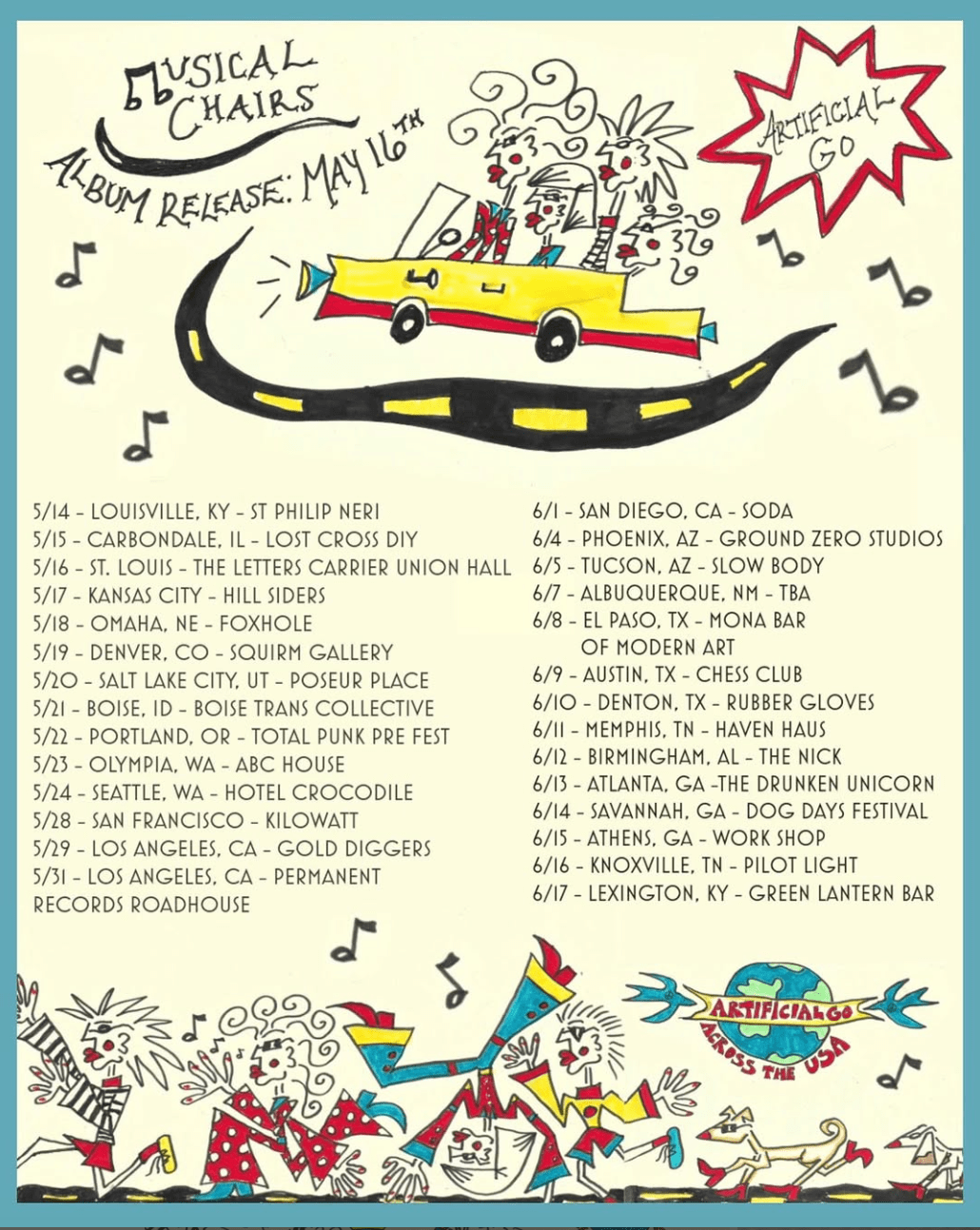
Artificial Go is currently on a five week long tour, fueling themselves with food they cook outside as they share the juices of Musical Chairs at a range of venues and DIY spots across the country. You can catch them on one of the dates above, and purchase a copy of Musical Chairs on their bandcamp.
Written by Manon Bushong / Photo courtesy of Artificial Go
James Keegan, known under the moniker Kitchen, slowly comes to a quiet realization as he sings the haunting outro of his newest single “Real Estate Agent.” “There is no place of perfect connection, no light on the water sweeping the waves.” His voice, embedded with an aching sense of acceptance, reveals his gradual understanding that the pursuit of an idealized, perfect experience is futile. Through each line of the outro his hesitant sense of acceptance starts to wear down as he acknowledges the impermanence of seeking something that doesn’t truly exist.
A song that starts off with the image of a real estate agent’s headshot on a “for sale” sign and a fake ocean breeze blowing back her hair effortlessly turns into a reflection on indifference and apathy in the face of catastrophe as he challenges himself to sit with the uncomfortable feeling and see if it will force him to “stop sleeping.” After paralleling the disconnect between an image of the natural world disrupted by the commodification of space, Keegan cleverly comments on the way we jokingly process the decimation of our world, “calling disaster like sides of a quarter, unlucky enough to never get bored.”
“This isn’t a concept album but one of the main recurring concerns of the lyrics is the destruction of the natural world and climate change. There is a lot of nature imagery but it’s juxtaposed with imagery of the post-industrial human world,” Keegan says.
Over the past two months Keegan has been sporadically releasing singles on Bandcamp and YouTube leading up to the announcement of his newest album, Blue Heeler in Ugly Snowlight Grey on Gray on Gray on White. Keegan cited the simplicity and directness of Neil Young’s After the Gold Rush as an influence while also finding freedom in the loose and unpredictable nature of Pavement’s Wowee Zowee when pacing his longest record yet, a 20-song double record.
“I haven’t made something this long before and I always operated under the assumption that I would be better off cutting a larger project down to a more direct, more easily digestible scale. But most of these songs are not as emotionally direct as the songs on my past albums. There’s not really a simple emotional arc to these songs in the same way as the songs on Breath too Long.”
While Keegan’s newest material might lack a clear, concise storyline, and the themes feel less deliberate than his previous work, as the influences of each song jump from straightforward rock songs, to lengthy layered and droney pieces, each single desperately deals with the struggle of trying to hold onto what is left of our decaying world.
On “Bike Uphill” he sings helplessly, “I wanna be the one to live outside the world” creating an eerie almost apocalyptic feeling while contemplating a world in flux, where cities “melt away” and familiar spaces shift into surreal, dreamlike landscapes. Keegan reflects a sense of waiting, as though he is unsure whether he will be consumed by the unraveling of the world or find a way to belong within it. He imagines a world of isolation and loss, “is there a dream that i have not let pass through my hands” creating a sense of foreboding as the absence of certainty about our world and his place within it creates a dystopian feeling of being adrift in an unknown, shifting reality.
Keegan builds upon feelings he started to uncover and work through on his previous album, like on the lead single “Fall” where he sings “when the bombs go off, will I be with you.” There’s a cryptic sense of inevitability that led to the budding themes on these four new singles. Through very few words on “Ugly Snow in Ugly Moonlight” Keegan poignantly reflects on disillusionment, as if the purity and wonder of snow and moonlight have not only been tarnished by time and growing up but also tarnished by the post-industrial human world. There’s a feeling of longing for something that can’t be recaptured, a quiet surrender to the inevitability of change and the fading of youthful wonder and naivety.
The first single from the album “Sali” calls upon childish imagery by personifying the Finnish liquorice, Salmiakki, which is flavored with a type of salt that’s a byproduct of a chemical reaction according to Keegan. While it remains a spacious song, the use of textural layering and droning parts creates an overwhelming feeling that connects each of the singles.
“Before I could write songs I was even remotely happy with, I was making noise music and doing little recording experiments on audacity on the family computer and on a little digital four track I had, so making more abstract music is just part of what I do. I definitely think carefully about how ambient and drone pieces fit alongside the songs on things I make that are song oriented. In the case of the last album, Breath too Long, the ambient pieces served a structural purpose and helped to elaborate on the emotional content of the songs. The songs approached emotions in a semi-direct way and the ambient sections took them a little further into abstraction. I felt with this album that there was less of a straightforward arc than with past albums, so there wasn’t really a structural justification for ambient sections.”
Salmiakki’s unique taste might evoke a similar bittersweet nostalgia, where something initially foreign or uncomfortable becomes familiar, even a part of us. Something that may seem innocent and natural to us as children can later be revealed to be harmful and unhealthy. Keegan builds upon this feeling of escapability and a looming omnipresent fear of the future. The salty nature of Salmiakki serves as a metaphor for the bitterness that comes with growing up, where the world transforms from the innocent, carefree days of childhood into something more complex, painful, and ultimately decaying. The “salty swell” could symbolize the encroaching weight of reality, coming in waves — first subtle, then overwhelming.
“Writing lyrics that I’m happy with is hard. At the same time I try not to agonize over them. Usually the lyrics that I’m happiest with didn’t have a lot of conscious thought put into them. I’ll realize a couple weeks or months later what I was getting at. That’s sort of rare though. Mostly I try to be honest and to make sure the words sing. If the words technically work or are cool in writing but they don’t sing naturally I rewrite them. Really good lyrics feel like they arrived with the melody as a unified whole.”
Keegan has an unbelievable ability to craft stillness within his songs, a stillness that lingers even amidst the most driving rhythms. In “Real Estate Agent,” this is particularly evident as he delivers the plantitive second-to-last-line, “I learn how to live as my body decays.” Here he suggests that meaning and understanding are gleaned not in some perfect, transcendent moment but through accepting the slow process of decay and imperfection. It’s in this acceptance of time’s passage and the fragility of life that Keegan’s songs come alive in an almost meditative way.
As he repeatedly asks, “Do I know you?” on the outro, Keegan invites listeners into a reflective space, where the urgency of life slows down. Time seems to stop as his vulnerable voice hangs in the air, allowing listeners to pause and consider their own sense of connection and understanding. It’s this rare ability to create a sense of stillness, even amidst movement, that makes Keegan’s work so powerful. His vulnerability, paired with his ceaseless search for meaning and connection, creates an atmosphere where listeners can feel safe to take their time with their own reflection. Keegan’s music becomes a space in which time stops, and introspection takes precedence, offering a quiet sanctuary for those willing to sit with it.
“Overall the album ended up dwelling a lot on the feeling that I don’t know what to do about the horrible things that are happening in the world. I tried to put a few hopeful things in there but unfortunately it ended up kind of a bummer in some ways,” Keegan said. “One song on the album ‘Song for You’ was previously on a compilation by Bee Sides benefiting the Palestinian Children’s Relief Fund. I wrote the words intending for it to be a sort of hopeful song about trying to do good in the world rather than getting stuck in shame and guilt and fear and all that.”
Blue Heeler in Ugly Snowlight Grey on Gray on Gray on White will be self-released on April 4, 2025. Preorders of the album can be found on Kitchen’s bandcamp, including cassette tapes.
Written by Eilee Centeno | Featured Photo by Steven Coleman
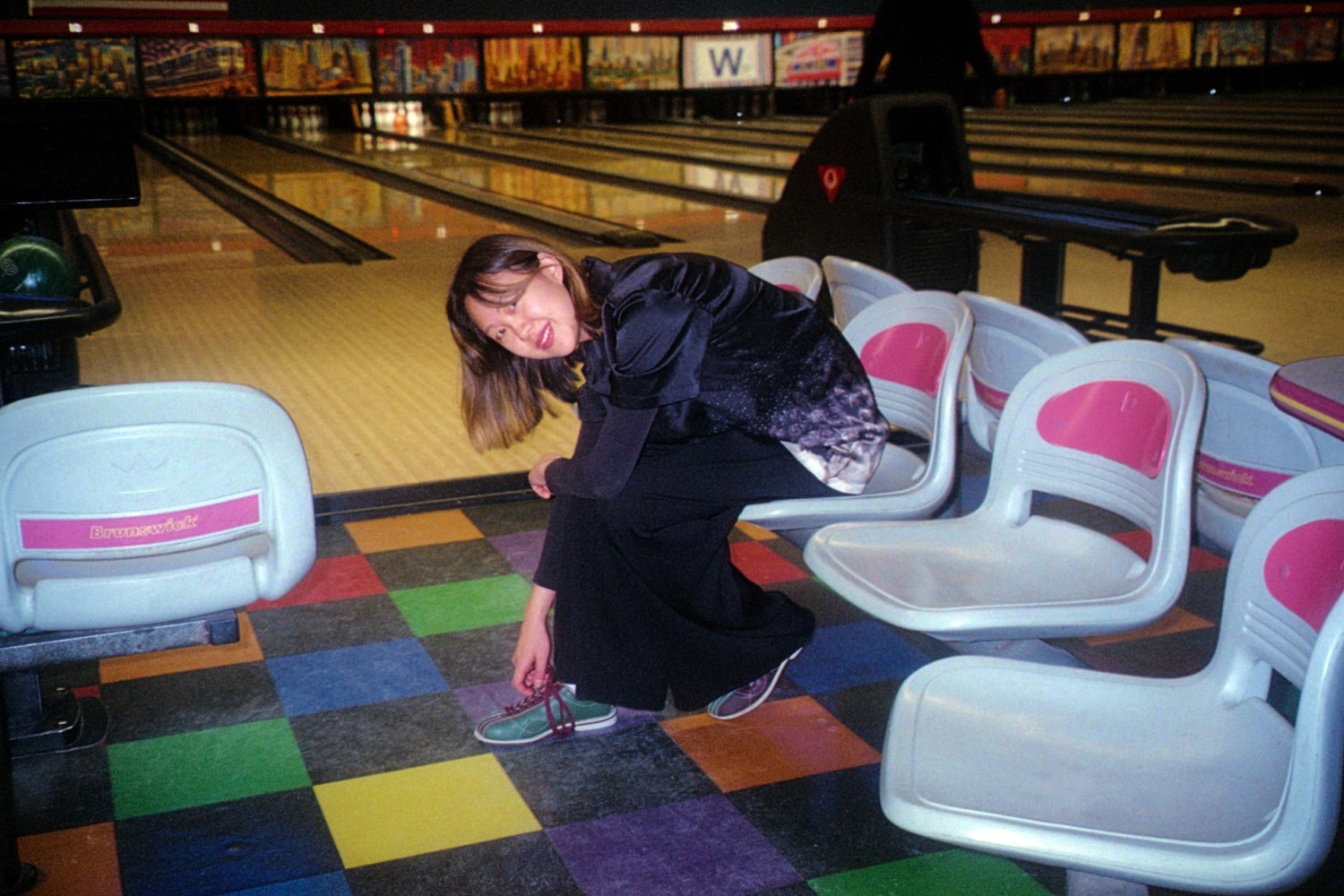
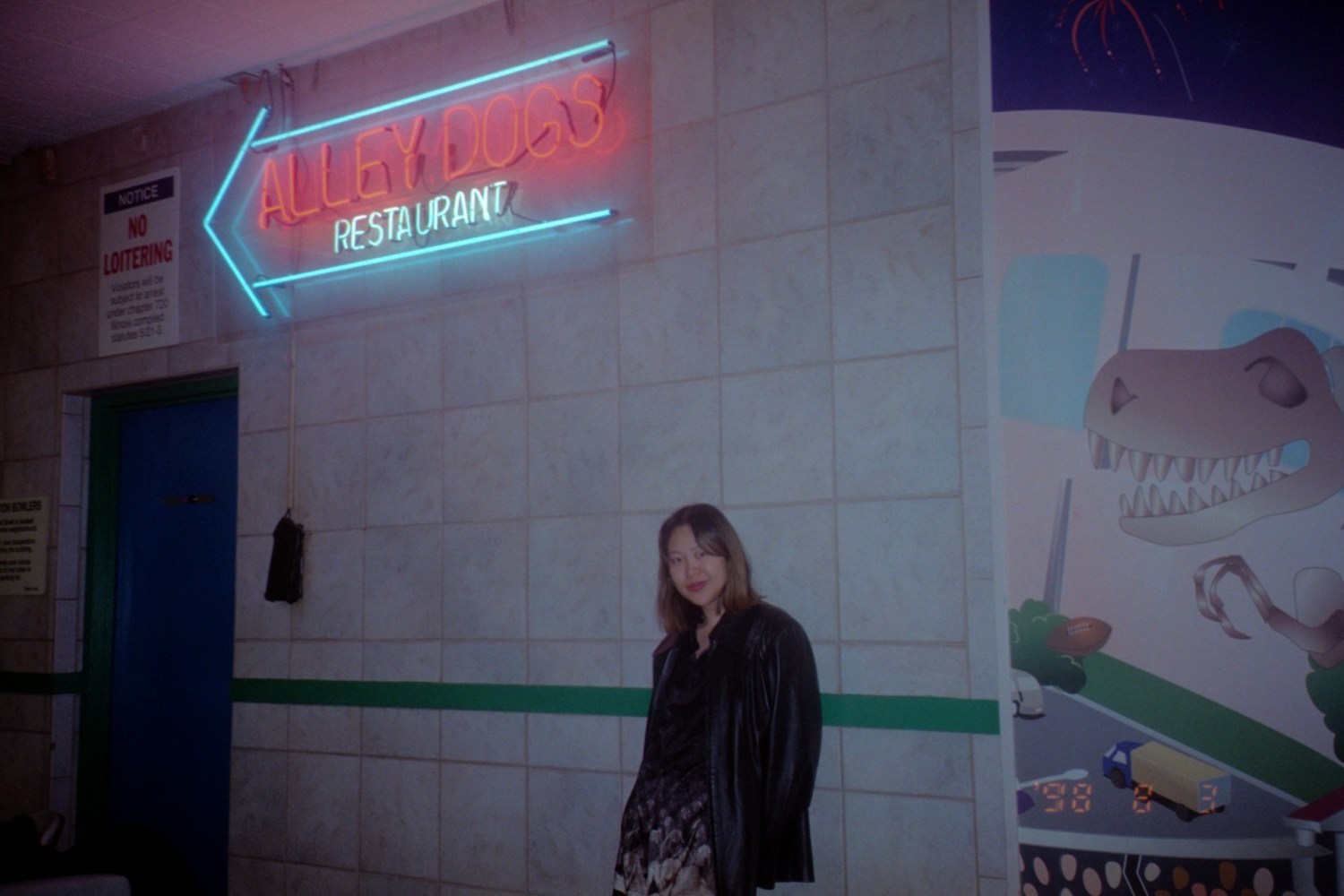
“The thing is, part of the reason why I picked bowling as an activity that I was going to get into is because you look like an absolute fool if you are having a bad day and start crying out on the fucking bowling alley that looks like it is 1994,” Park says, wavering between the need for a joke and a contempt for understanding. “It’s just too goofy to be visibly upset here. Especially alone. You cannot do that. So, it does kind of force a cheeriness into you.”
Victoria Park is a Chicago-based songwriter, who for the past few years has been performing under the moniker Pictoria Vark. With just a slight shift in the nomenclature, there is a differentiation there that even Park herself has set out to understand since the project’s initial founding. Now gearing up for her sophomore record Nothing Sticks via Get Better Records out on March 21st, this album has been a part of a longtime-coming-esque journey. After going through life changes and embarking on a tour that lasted 150 days, Park’s demeanor became ill fitted, relying on the ability to be present when she knew she couldn’t be.
Nothing Sticks is as vivid as it needs to be, rearing an earnest delivery that dares to challenge the fronts that become habit to us all. But where Nothing Sticks becomes most poignant is in Park’s focus in her own sense of self through her experience within the music industry, navigating the relentless expectations and learning how easy it is to lose yourself along the way. But in the end, Park has proven herself to be emboldened by it, embracing a rigorous, empathetic and more in-depth approach to writing these songs. And as they trickle out with each single, rearing with sincere melodies and indie rock bliss that PV and co. have brought to life, there is a sentiment built around momentary lapses of reflection that Park makes so vulnerable and engaging throughout.
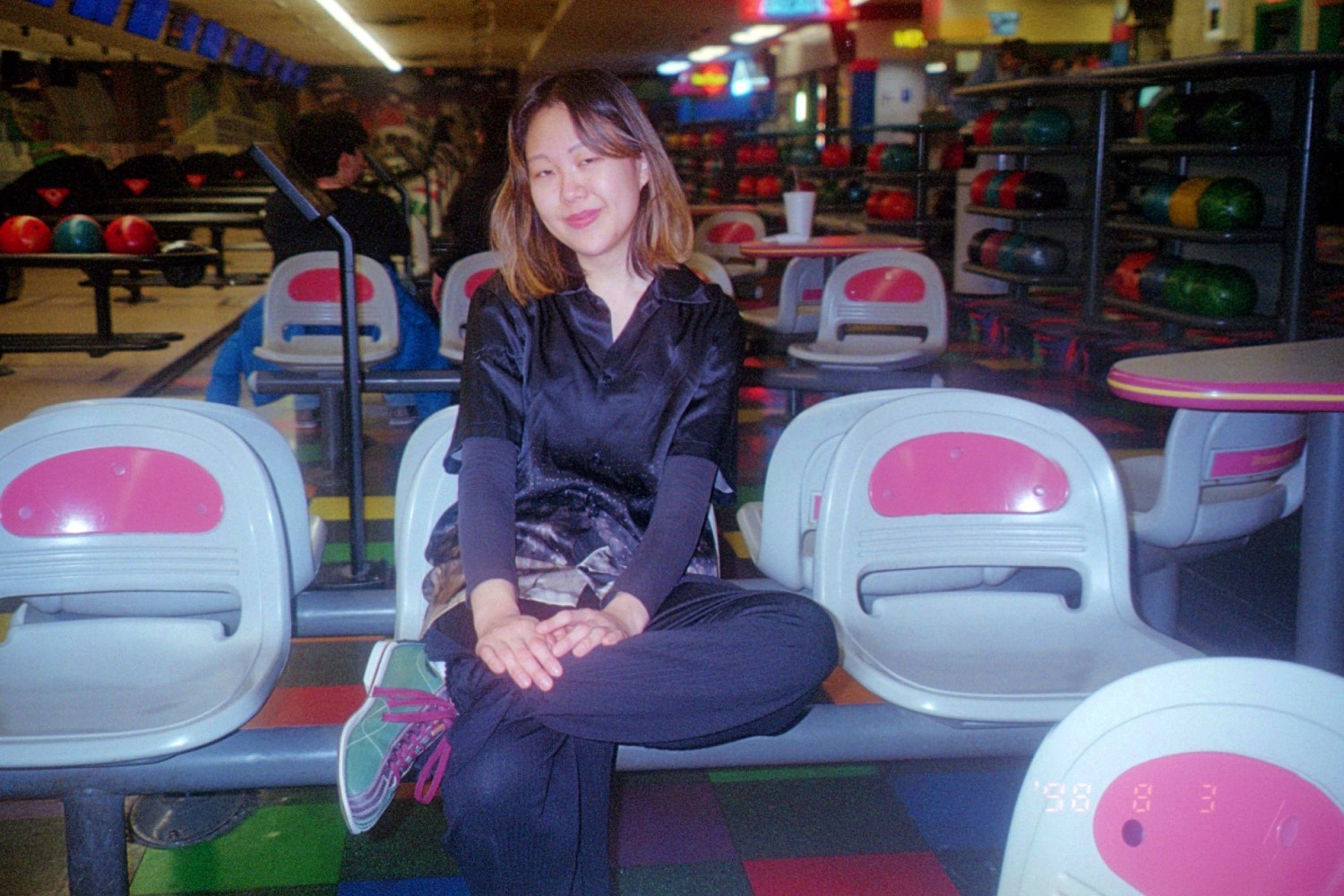
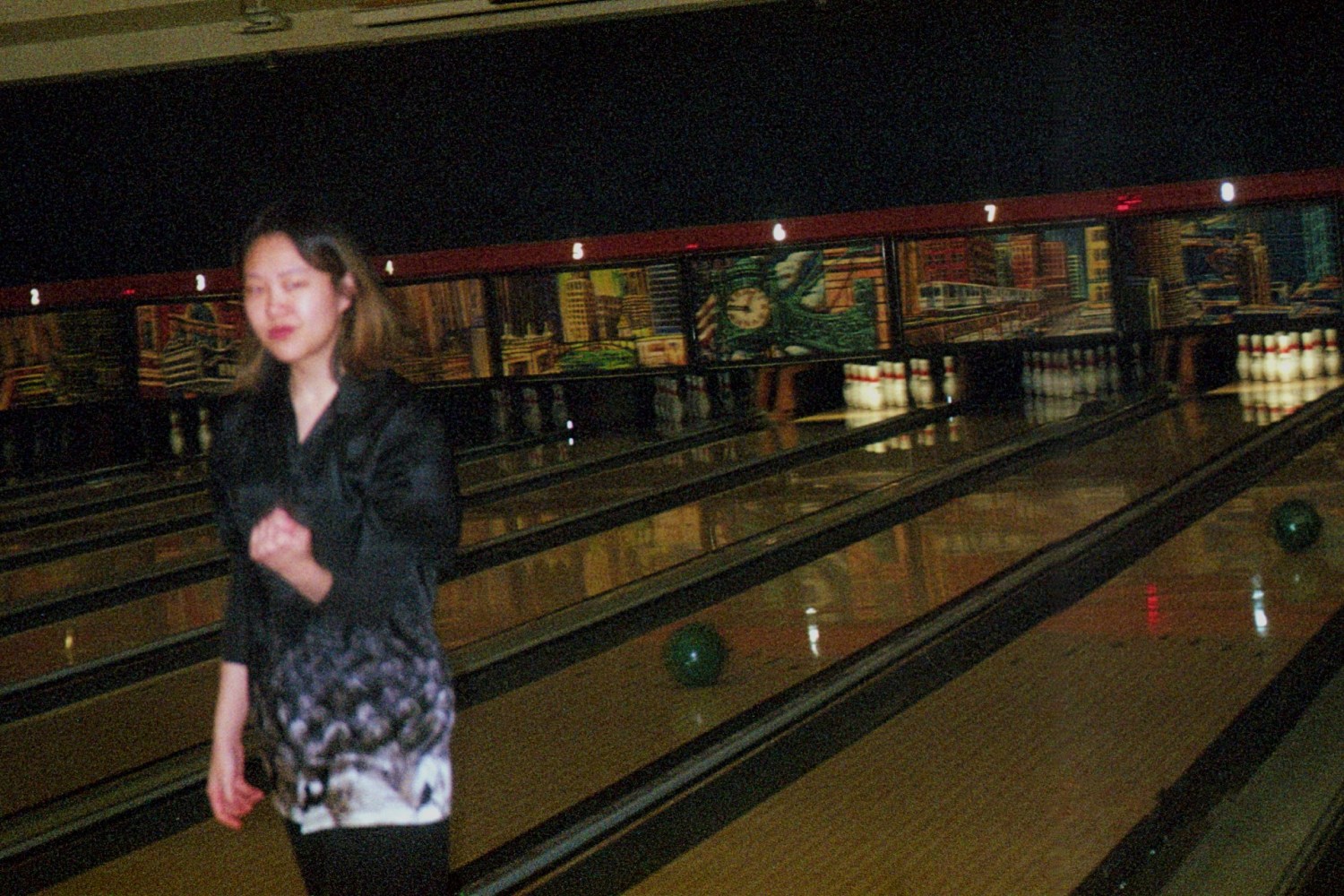
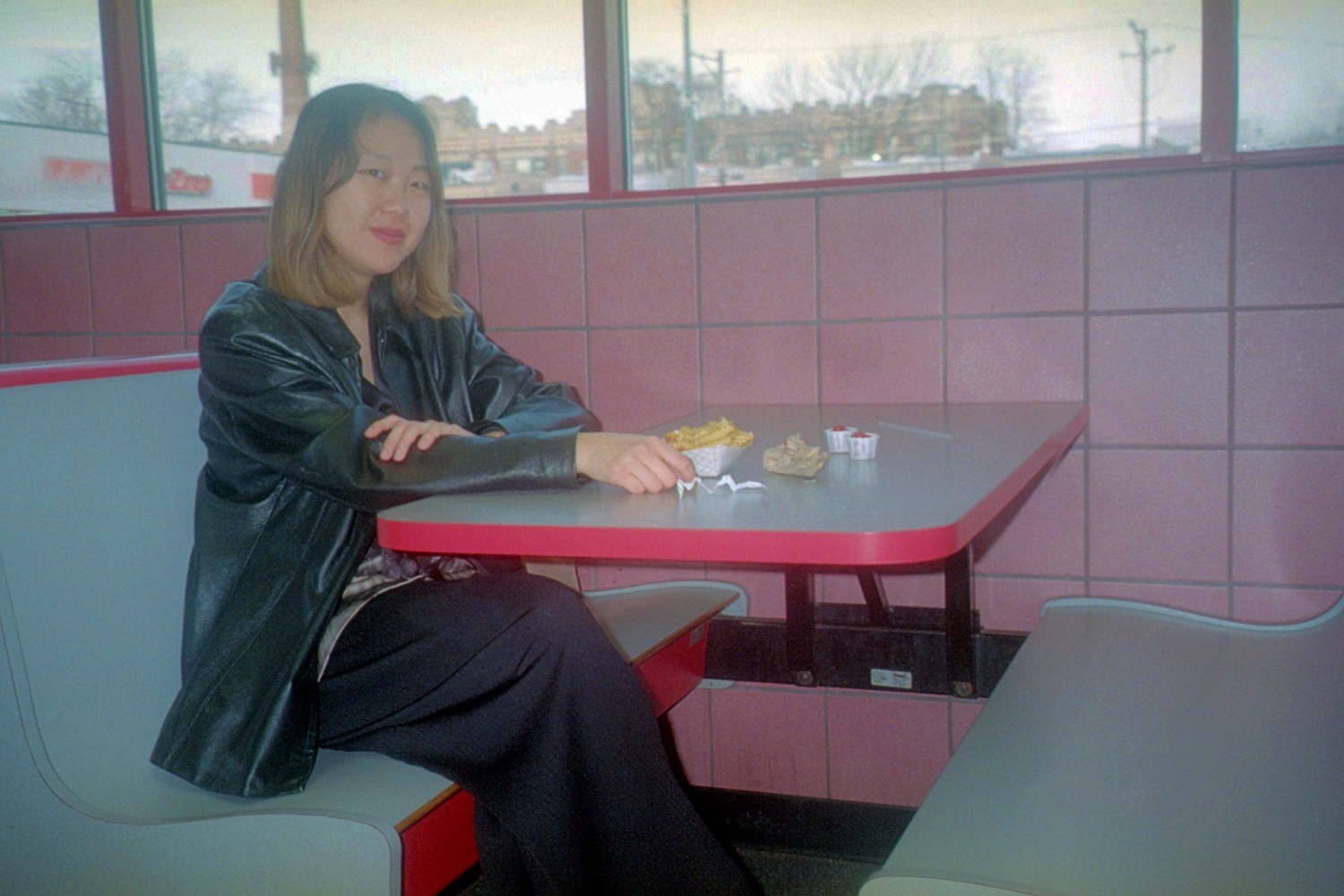
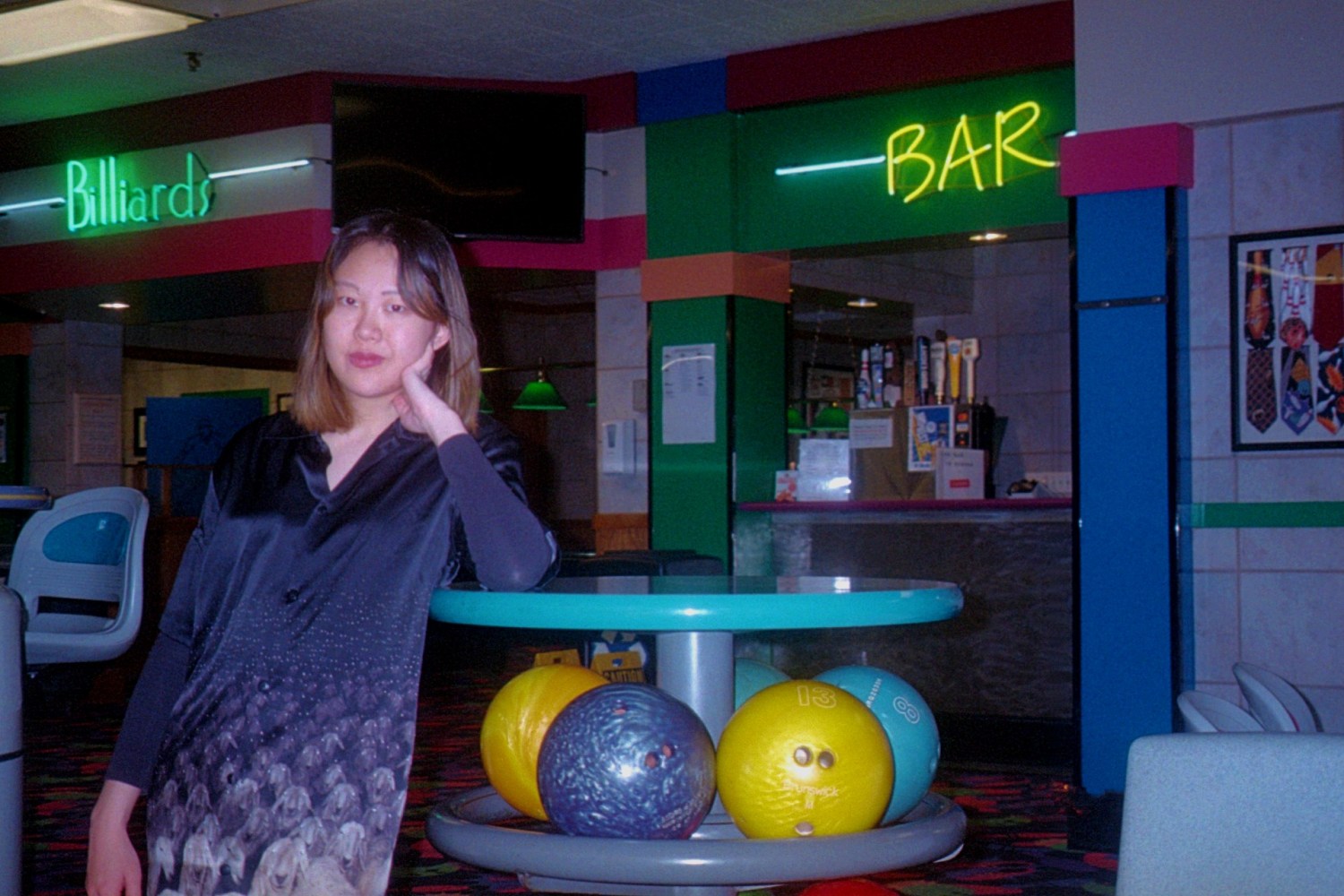
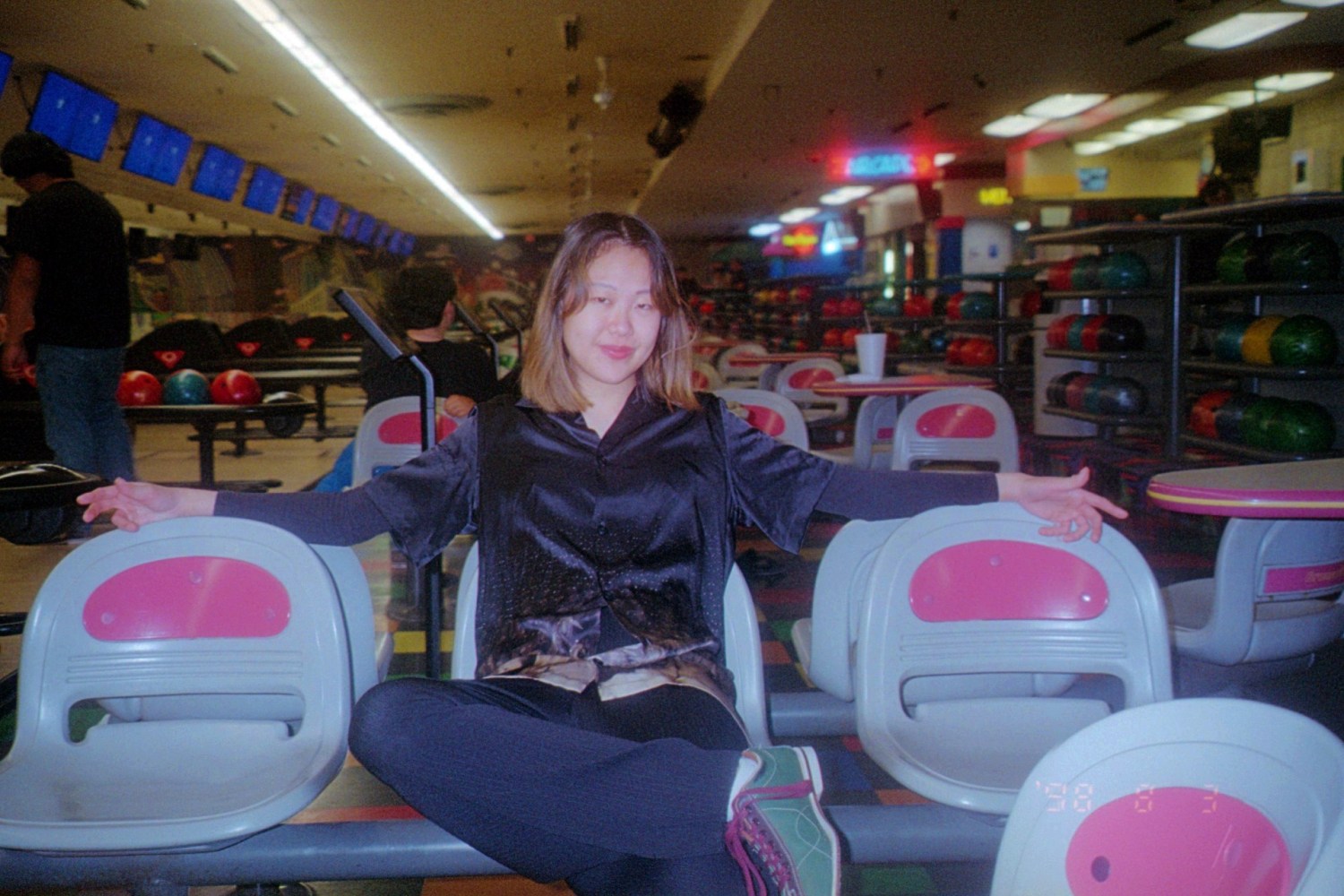
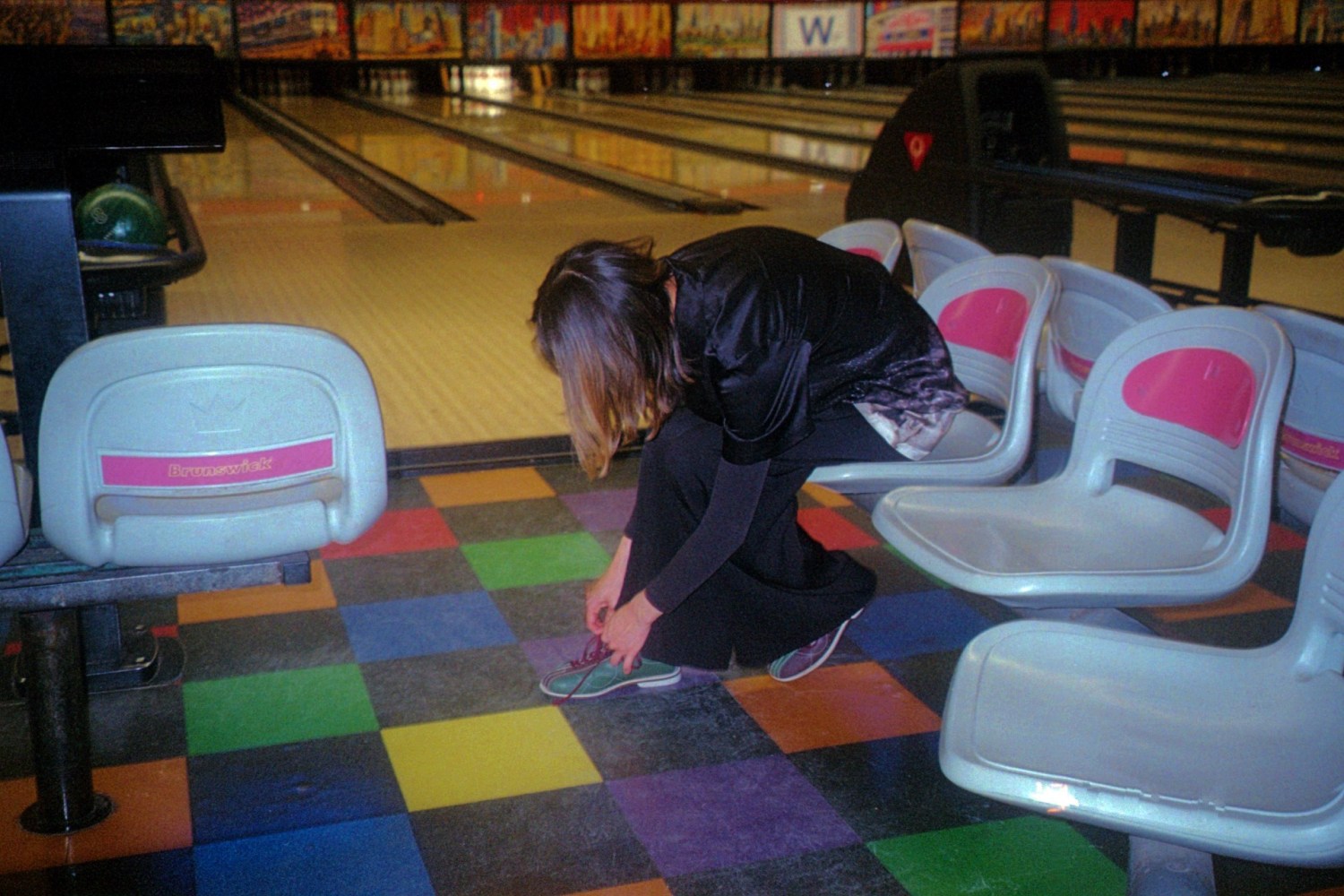
We recently took to the Waveland Bowling Lanes on a below freezing day in Chicago to talk with Park about balancing expectations, breaking habits and the making of Nothing Sticks.
This interview has been edited for length and clarity purposes.
Shea Roney: I am very intrigued about this 150 days of touring, and this is kind of where the generalized theme of the record came from. What was that experience like and what sticks with you now as you have taken time off?
Pictoria Vark: I was enjoying being on tour for that long, but it was also because I was running away from myself and my life. I didn’t want to confront the lack I felt at my home because I didn’t have the time to put energy into making it feel like home, to building friends and making it a real place I wanted to be. And so, instead, I would be like, ‘okay, when am I going back on tour?’ I just kept running away, being like, ‘I want to be here as little as possible.’ I haven’t really toured that much where it felt like I was running towards something. And I think the toughest part of walking away from that, or what the album is about, is when you spend time developing experiences when you spend time and money, the experience comes and goes. It just becomes a memory. So, it was just me kind of building memories and not anything material with it. I’m kind of just taking away the memories, and sometimes I call looking back on that time as “remembering the horrors” [laughs]. Which is partially me being dramatic about it and partially kind of real. Other people have different horrors they remember in their life, just like, ‘oh, that was a fucked up time’, and when you’re looking back on it, that’s remembering the horrors. So, because I have “the horrors” to remember, I’ve been trying to help my friends who are just starting to tour for the first time or want to know more about that to impart that wisdom so that they don’t crash and burn in the same way I did. I also didn’t have a lot of people at that time that I could talk to about these experiences because I didn’t have a lot of peers that were doing that much or were touring to that degree at all. So, it’s nice to be able to be that for other people, or try to be.
SR: You have mentioned in the past that there is a Victoria Park and there is a Pictoria Vark. Where do you draw the line between these two and has one taught the other anything?
PV: I think with the second record, something that I was thinking about is that I have these opportunities to be on stage, to share my music and some people will listen to it. Rather than think about the songs that I’m writing as like, I need this diary, I need to put my demons somewhere on a page and then I share that, but more like, if you were on a microphone in front of an audience of people, what would you want to say? What is the thing that I actually want to share with other people? What is something that I think is a useful message or something? So, it was made kind of intentionally and I think that’s something anybody can do or think about. All those crazy YouTube interviews of just like, ‘we’re just talking to ordinary people’ – that’s kind of like the same thing as that. If you were stopped on the street, what would you say?
With Victoria and Pictoria, I’m trying to do a better job at drawing a line between the two. Online, it’s honestly been really tough because I feel like I am only really using my social media to promote my music. And then it becomes a skewed image of like, ‘wow, you’re really busy’ or like, ‘how’s the music stuff?’ People don’t really know what’s going on in my personal life. One thing I am trying to do for the new record is have a stage costume so that it’s like when I’m on stage, I am in my persona, and then when I take that off, that’s like a different person – to create more of that delineation in a physical realm.
SR: Wow, that’s a great idea! What do you have in mind for the stage costume?
PV: Okay, early drafts, I wore these angel wings at Outset and I kind of want to keep sticking with them for the new record. It’s both a play on the like the halo effect, which is kind of a type of bias that I think happens to a lot of musicians. It’s like you literally put them on a pedestal. So I think that’s funny, angel wings, halo effect, yeah. And also because I love Wings of Desire by Wim Wenders. What if I was just like an angel on earth? That sounds so fun and it’s also, you know, kind of about forever.
SR: You say that these are just better songs in many aspects from writing and recording than your previous release. What did you find yourself focusing on more this time around? Anything out of your comfort zone?
PV: Yeah, I really wanted to push myself as a songwriter to make my craft better, to make stronger choruses or make stuff with more than three chords. When we got to the studio, the biggest challenge was working on a lot of the vocals, because we didn’t do a ton of vocal takes and there was like a whole eight hour day where it’s like Brad and I were just running through vocals and just being like, ‘oh, did we like how I said this word better?’ So by the end of that day, we were so fried. But overall, the studio time went really smoothly I think because we had so much preparation going into it. We were making really complex demos. I felt so bad, I was asking so much of Gavin and Tori because in my head I was like, ‘we don’t have time to like mess up.’ But I think it was like that initial thought and working out that way allowed us to have a smoother experience in the studio. It set a precedent, if I work with these same people for the next record, we can keep things a little bit more relaxed. I don’t really know how much we expected to go wrong, you know, but it was really exciting. It was just so many more people and so fun to watch it happen. There were some times where it’s like Brad and Gavin and Tori were just kind of like cooking and I was like, ‘I’m here’ [laughs]. It was really cool to just let them take the reins a little bit. My main job is assembling the task force.
SR: Do you think next time you will be more comfortable?
PV: Yeah, next time I want to leave it just more open, you know? Like maybe we don’t have to make the demos quite as intense, we can play or leave a little more room in the studio to figure things out. Finding a good balance of preparation and being open to improvising.
SR: And because everything was so tense with time and the demos, do you feel like there’s some parts of the recording process that you really wish you could have focused more on?
PV: Honestly, no, I think the time crunch felt really good, because it made us not overthink things. And we didn’t. We didn’t have time to redo things, we just had to let it live as is. And even if there’s a vocal performance or two that I would like to have done another take, it’s almost nice to think that that’s just room for improvement for next time.
SR: So at the point of this conversation, you only have two singles out. But you just wrote a really nice piece in your substack about balancing expectations, especially about the singles. You crowdsourced friends about which songs should be singles and there were some different ideas. When it comes to songs that are so personal to you, what does that balance of expectations look like as you go forward?
PV: It’s not easy [laughs]. I don’t think I do a great job at it. In all honesty, if you talk to some of my closest friends, I’ve driven them nuts over the last year just by going through the same kind of thought circles I can’t get out of. I think what I struggle with is the uncertainty rather than if something were to perform badly. I just don’t really handle not knowing in a lot of areas of my life, for various different reasons. It’s like more than being in this gray space where anything could happen and only like one thing will. It makes me crazy, makes me unwell – just in terms of like, I don’t know what my life will look like in three months, six months. I think the singles, weirdly, when I polled people on what song should be singles, I was not expecting “I Pushed It Down” to be the number two one that people would pick after “Make Me A Sword”. But to have that reflected by the Spotify algorithm is super weird. This reflects a taste of people, whatever it is. I thought that was really weird and interesting.
SR: One of the major themes of this album is understanding that nothing lasts forever. What did it mean to you, when talking about the fleeting implications of life, to come to this conclusion? Although bleak, did it offer any clarification or justification to you?
PV: I think it was the result of causing myself so much suffering by trying to keep things together in my life. Before this 150 days was started, I was dumped for going on tour for too long. And then four days later, I was on the road for three months. I had centered so much of my life around him unknowingly – it was part of the reason I decided to stay in Iowa an extra year, which became two years and didn’t move to Chicago sooner. And then with different bands or friendships, when there’s those falling outs, it left a really big emotional mark. I think in writing this record, it’s helped me be like, ‘okay, if this person doesn’t want to be friends with me or doesn’t want to repair things, that’s kind of not my problem. That’s not mine to hold.’ I can see that as an opportunity for more space for something else to come in, and I think that reframe has been really, really helpful because of the amount of like, almost a scarcity mindset of, if I want this thing and this thing feels good, it has to stay. I have to be the one to force it to stick in my life.
SR: Has this changed the choices you make when it comes to both your career or personal life?
PV: You know the meme of like, ‘I did X,Y, and Z and all I got was this t-shirt?’ That is kind of what going on tour felt like – I don’t know what happened. It’s like that thing happened, it was a blip in my life, and you know, now I wake up and I go to work and I still make music. I have a hard time not being able to make a clear and straightforward narrative from it. And so I think the ‘nothing sticks’ ethos is to try to enjoy the present as much as possible. Have the memories, but to not expect life to follow in a logical way like X,Y, and Z and be ok with things slowing down or ending because they eventually will. I don’t know if that’s a good answer for that question, but that’s what I got. I think with music, it’s made me change my approach, like, if this thing is going to cost time and money and energy to do, what are the things that I actually want to do in it? Because playing to 20 people, 100 miles away from home is like, I’ve done that, you know, I’ve done that enough now where I don’t feel like that’s an additive experience. So everything that I want to do moving forward, I want to feel really purposeful and really meaningful during the process of doing it, so that the end result doesn’t quite matter.
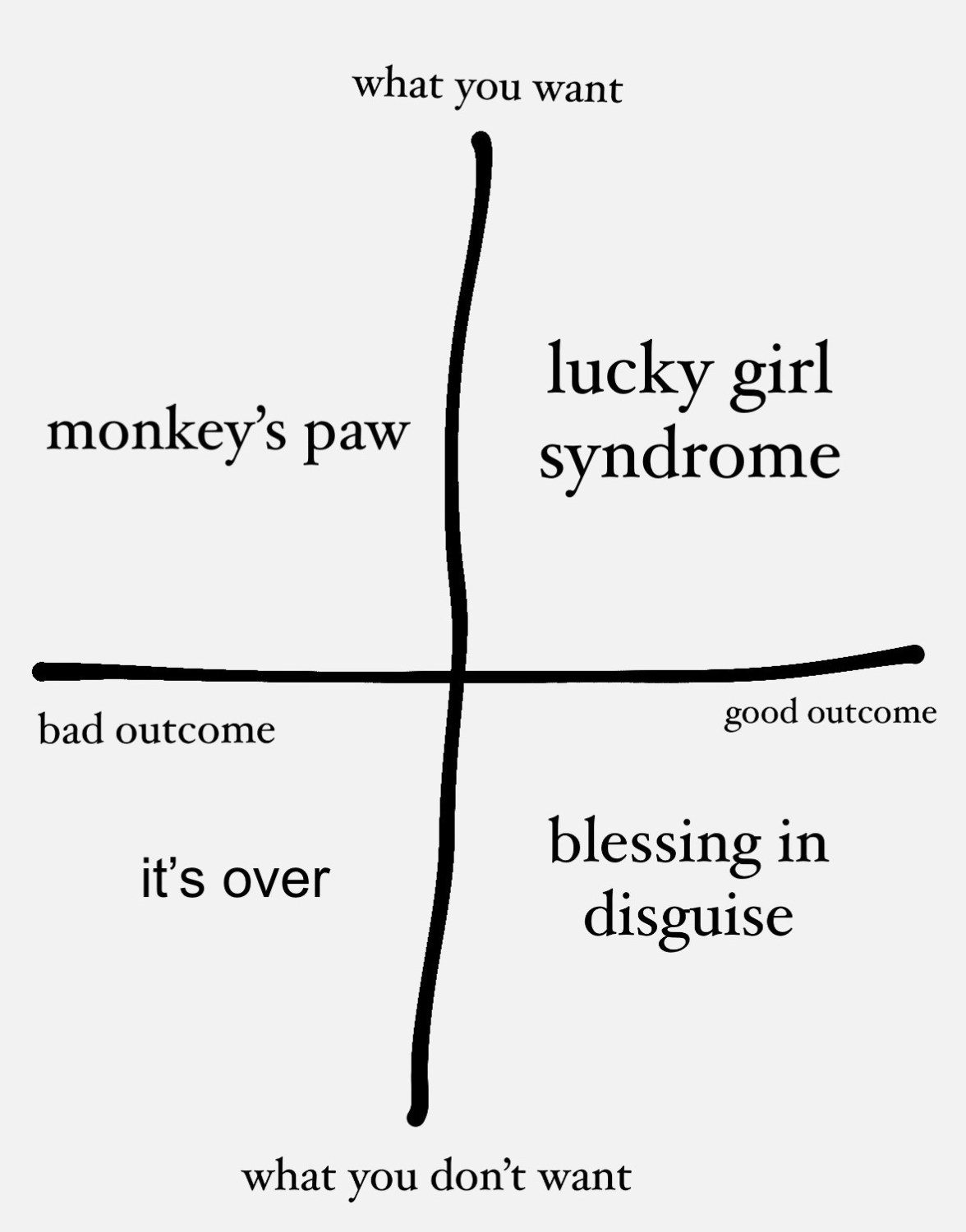
SR: So the last song, We’re Musicians, reminds me of a theory you were workshopping last time we talked, about good outcomes and bad outcomes. Being a musician, stuck in this almost stuck on this thin line, can you find yourself reflected in that theory?
PV: Oh my god [laughs]. Okay, well, if we’re gonna get super real with this, the big tour that I got asked to do a few years ago, that is like getting what you want and it wasn’t a bad outcome. It’s getting exactly what you want, but it’s like, not what you think it is. It is in some ways the monkey’s paw. Like, you get everything you ask for, but then it’s not what you thought it was gonna be at all.
graph made by Victoria Park
SR: What are you most excited for in regards to this album finally being out?
PV: Just to have it out. Yeah. Just to make it exist. Like, of course there’s things I want from it, but I know that’s not a guarantee. I think it’s something that I’ve been harping on in my mind of like, Oh, if X, Y, and Z doesn’t happen, then what happens? It’s like, I don’t know. You wake up. You go to work, I don’t know. That’s what happens. You make more music.. But I am really proud of this record and I think I’m just gonna let it speak for itself the best I can. As hard as that is for me.
SR: I mean, look how far you’ve come. Just earlier in this conversation you were like, I’m so scared of not knowing X, Y, and Z.
PV: The thing is, I am going to leave this question and then go back to my house and be like, ‘I’m scared of X, Y, and Z’ [laughs]. This is what I mean when I’m writing these songs as Pictoria – I would like to be this way. And by pretending that I am this way, that is me trying to be closer to that. The thing is like, part of the reason why I picked bowling as an activity that I was going to get into is because you look like an absolute fool if you are having a bad day and start crying out on the fucking bowling alley that looks like it is 1994. It’s just too goofy to be visibly upset here. Especially alone. You cannot do that. So it does kind of force a cheeriness into you.
See more photos of Pictoria Vark here.
Nothing Sticks is set to be released Friday March 21st via Get Better Records. You can pre-order the album now as well as vinyl or cassette tapes.
With pronounced earnestness and vision, Slake has shared their debut single “bonecollector” with us last week, along with an accompanying music video. Previously writing and releasing songs under their own name, California-based songwriter Mary Claire has unveiled a new moniker and a new sonic direction to embrace. As a DIY solo artist since 2018, with two self-recorded albums to show for it, last summer Mary Claire traveled to Hudson Valley, New York to record Slake’s debut album Let’s Get Married, set to be released June 20th, with Ryan Albert (Babehoven) and a collection of other talents that help bring this new project to life.
As steady guitars lay out ethereal tones and each vocal part motivates the track’s movement with both beauty and empathy, “Bonecollector” becomes a moment of tension and release, as Mary Claire steps out of their comfort zone in more ways than one. We recently got to ask Mary Claire some questions about the new project and to take a deep dive into the single and music video for “Bonecollector”.
ugly hug: “Bonecollector” is your first release under the new moniker Slake. What parts of this song feel like a new beginning to you?
Mary Claire: I feel like everything about this song is representative of a new beginning. I wrote this song after a dream i had. It was kind of scary, kind of prophetic, and it just didn’t let up. it kind of bled out into my real life, all that dream stuff from that time. There was a time before the “bonecollector”, and there was a time after. I was in-between worlds then, I was at a major crossroads of my life. i’m happy i got this song down during that time.
“bonecollector” touches on how we learn skills in order to survive, how we develop ways of being in the world so that our experience can be livable, maybe even bearable, maybe even good. but sometimes, these skills or defenses or attributes we’ve built up and gotten so good at start to become detrimental to us as our lives change – because the war we were fighting is over, the people are all different people, the town is new, the everything has shifted. so, we have to develop some newness, some new useful skills, and likely say goodbye to the old skills. and that unknown can be insanely scary and even feel threatening to the parts of you that desperately want to stay but are holding you back, that aren’t serving you, that are hurting you.
“bonecollector” is a little message in a bottle urging listeners to look at our ways of being and give them a little dusting off, a refresh, or some time in the sun in order to change into something new that aligns with your shifting life. and say thank you to your old skills too. because if you’re like me, the old skills won’t go down without a fight.
“bonecollector” is all about the guardian at the threshold before change. i guess “bonecollector” is entirely about newness. and i feel like the fullness in its production, the additions that come from collaboration, and the richness and rise & fall in its sonic story line are representative of that.
uh: Your previous two releases were both self recorded and self released, but Let’s Get Married brings in a whole cast of collaborators. What was it like shifting this process and what did you learn about yourself as an artist by working with others?
mc: i loved recording, mixing, and mastering this album with other people. bridge oona and lil made me feel very safe and supported and special while we recorded this album. ryan is an incredible producer and engineer. i’d never worked with a producer before and it just makes so much sense to me now – it really works with my brain to have someone like that there. i have a lot of big ideas and big feelings but sometimes i get stuck because i don’t know how to do what im envisioning. trusting others with my little world was very hard and vulnerable and rewarding, and made me more open and trusting to collaborating in general. i tend to have a pretty strict but not always clear vision of what i want to do artistically, so working with everyone on this record made me see better. i can be a little controlling about what i want or what i think i want with my art, but during this experience i just told myself to say yes as much as possible. and it was always always worth it. and so if i didn’t like something, i had to really know why i was saying no. and that is a helpful exercise. i learned how to work with others more efficiently and fully and openly. i’m not perfect at it, but i learn a little bit more every day. i’ve got dreams too big to try and do them alone. i’m glad everyone i worked with believed in my dreams and believed in me and believed in themselves.
uh: What was the vision for the music video and how did it come together?
mc: literally my only motivating factor was to get a bald guy in this video. i had a million different ideas that ranged from getting like one hundred different and unique bald people in a bar to having a super lonely barfly at the jukebox. then i saw this regular at a karaoke bar in san francisco give a very earnest and moving performance, so that was it. i initially thought id just have the video be of him singing in the bar, but talking to seth the DP of the video, he convinced me it needed more. eventually, i warmed up to the idea of including more in the video. i was reluctant at first because i really just wanted my bald man to be the only one. but seth wondered what might be playing on the karaoke TV, and then a world of possibilities opened. we kind of thought we’d do like a shot for shot remake of george michael’s careless whisper to have as the karaoke backing video, but i was walking around berlin on my birthday listening to the song and i thought it’d be more fun to be in tights. so that’s where the jazzercise thing came from. obviously seth was down. there’s so much awesome 80s female bodybuilding stuff that helped inspire the video. and when the day of the shoot came and two of my friends dads and one stranger from craigslist arrived, it felt like a perfect amount of bald men.
i’d never worked on such a professional video before and i felt very taken care of by all the guys on set. once again, i just said yes to as much as i could and opened myself up to being vulnerable.
i often too feel like when you have a big sad song, it can be hard to have a big sad video to go with it – you have a real opportunity to get through to people in a new and entirely different way through the visual medium of your music video. it’s incredible to me. so i wanted to do something funny, because even though i write kind of serious grief-laden emotional music, i would consider myself pretty funny. hopefully my friends think so too. it was a nice opportunity to express myself and my sense of humor, and see if the song could stand up to all we threw at it. i feel like it did, and im proud of it.
uh: What can listeners expect from this new project Slake?
mc: that’s a good question, one i don’t fully have an answer to. it’s changing a lot, but my creative life feels bigger and more alive than it ever was. it’s kind of overwhelming. i really want to push myself and create with discipline and get out of my comfort zone. right now this looks like trusting other people to collaborate with, and it’s been totally awesome and hard and worth it. the band is big and full, and I’m hoping to walk the dynamic line of earnest storytelling and lyrically forward songwriting with a larger louder performance. i like to world-build. Slake listeners can expect to be in my big little world.
You can listen to “bonecollector” out everywhere now. Let’s Get Married is set to be released June 20th via Cherub Dream Records.
Written by Shea Roney | Featured Photo Courtesy of Slake
It’s been a handful of years since Australia’s Olivia’s World shared new tuneage with us. But since their 2019 self-titled and 2021 Tuff 2B Tender EPs, Olivia’s World has functioned as a collaborative rotation of indie-pop charmers, recently landing on a lasting and invigorating lineup of musicians. Now with two singles out, the group is gearing up for their debut LP Greedy and gorgeous out next Friday, March 14th, and with that, Olivia’s World is offering just one more taste test with their new single “Healthy & wealthy” premiering here today on the ugly hug.
“Healthy & wealthy” is a tender rock ripper, balancing docile tones of distorted guitars with vibrant, sweet melodies as Olivia’s World revels through expectations of our most dubious inner and outer displays. “Are you TV ready?” guitarist and vocalist Alice Rezende asks with repeated eagerness, hopping into the momentum laid out by the band on the song’s chorus – the anticipation like the countdown before we run this show live. But as the crew plays out with their collaborative strengths and the melodies become embedded in our noggins, we watch as that camera light turns on, and Rezende makes you ask yourself…who is even watching?
Greedy and grogeous is set to release on March 14th. You can preorder the album now as well as vinyl copies from Little Lunch Records and cassette tapes from Lost Sound Tapes.
Every Wednesday, the ugly hug shares a playlist personally curated by an artist/band that we have been enjoying. This week we have a collection of songs put together by the electronically collaborative duo amigos imaginarios.
Arbol Ruiz (Paris via Columbia) and Caleb Chase (Worcester, MA) have been partners in crime since 2021, with two albums made electronically by sending files back and forth. Their most recent release, their TV-14 Recordings debut called Ice Cream, is a rather engaging and eccentric collection and the first composed in person since the duo’s initial launch. An amigos imaginarios listen is not one made for multi-tasking, as their delipidated ecosystem of trinkety hooks and experimental charisma offer a rewarding experience when you embark into their beautifully bizarreo world that they so graciously have invited us into.
About their playlist, Ruiz and Chase shared;
Our Playlist is Lunatics: Moon Pretty moon that goes around the whole world Tell my love that I still love her Tell her that I still have her photo smiling Streets full of people All alone Roads full of houses Never home Church full of singing Out of tune Everyone’s gone to the moon
Listen to amigos imaginarios playlist here;
Listen to an incomplete version of the LUNATICS playlist here.
You can listen to Ice Cream out everywhere now as well as purchase a cassette tape via TV-14 Recordings.
Written by Shea Roney | Featured Photo Courtesy of the amigos imaginarios



 the ugly hug