Every Wednesday, the ugly hug shares a playlist personally curated by an artist/band that we have been enjoying. This week we have a collection of songs put together by Chicago-based songwriter Sofia Jensen of the project Free Range.
Free Range came into indie favoritism with their debut album Practice, released back in 2023. At the time, and still to this day, Practice is a sharp and discernable release; the marking of a conscious and explorative storyteller like Sofia, who has the ability to write songs with both melodic gratification and lyrical exfoliation, reinforcing the charm and tradition of indie-folk as each song becomes its own moment within a much larger story to be told. Sofia has also recently hinted at new music set to be shared this Friday January 31st.
About the playlist, Sofia shared;
“Here is my list of songs getting me through the winter. best listened to in order and while walking around bundled up in the cold.”
Listen to Sofia’s playlist.
Listen to Practice now on all platforms.
Written by Shea Roney | Featured Photo by Alexa Vicius
Every Wednesday, the ugly hug shares a playlist personally curated by an artist/band that we have been enjoying. This week we have a collection of songs put together by Philly-based composer, multi-instrumentalist, producer and Founder of Dear Life Records, Michael Cormier-O’Leary.
Along with contributions to beloved projects such as Friendship and 2nd Grade, Michael also leads the remarkable chamber folk ensemble, Hour. Following the critically acclaimed release of Ease the Work, Hour recently announced the arrival of Subminiature, a live tour document curating two years of DIY show performances and offering a culmination of the project’s seven years of dynamic work.
The first snippet shared from Subminiature is lead single, “At the Bar Where You Literally Saved Me from Fatal Heartbreak (Live at Philamoca, Philadelphia, PA, 4/12/24”, accompanied by a live concert video directed by Matt Ober. Watch below.
Michael put together a playlist of some of his favorite film music, a lot of which has inspired Hour in many ways. Listen below!
Hour is made up of many familiar faces from the Philly scene and beyond, with Subminiature featuring players such as Jacob Augustine, Jason Calhoun, Em Downing, Matt Fox, Peter Gill, Lucas Knapp, Evan McGonagill, Peter McLaughlin, Keith J. Nelson, Erika Nininger, Abi Reimold, Adelyn Strei
Set to be released on Valentine’s Day of this year, Hour will celebrate Subminiature with an extensive month-long tour across the U.S. You can preorder Subminiature now, including a limited edition cassette and CD run by Dear Life Records.
Written by Shea Roney | Photo by Michael Cormier-O’Leary
As a small music journal, we rely heavily on the work of independent tape labels to discover and share the incredible artists that we have dedicated this site to. Whether through press lists, recommendations, artist connections, social media support or supplying physicals, these homemade labels are the often unsung heroes of the industry. Today, the ugly hug is highlighting the work of our friends over at Bud Tapes.
Bud Tapes is a tape label out of Portland, Oregon, started in 2017 by Emmet Martin, who also leads the free music project Water Shrews and previously the indie project World Record Winner. What began as happenstance for Emmet to release their own music has since grown into a small but mighty collection of recordings from an eclectic roster of artists.
Bud Tapes has become a staple in the Portland DIY music scene- a home for anyone making music for nothing more than the love of making music. The label’s releases are often imperfect in the best way—rough around the edges, experimental, and full of character. Each tape is a little snapshot of someone’s creative journey, and you never really know what you’re going to get with each new release, which is part of the fun.
Bud Tapes is about embracing the weird, and off-beat while still keeping it personal. It’s a label that values the physical side of music—putting the project into your hands in the form of a personalized tape, something you can hold, pop into a deck, and experience over and over again. Whether it’s something from Emmet’s own Water Shrews or another unexpected gem, Bud Tapes is all about capturing music in its purest, most direct form.
This interview has been edited for length and clarity
Emmet Martin | Photo by Kat Curey
KC: What sparked the idea to start a tape label? Was there a particular moment or inspiration that made you take the leap?
EM: Well, I’d always kind of wanted to start a record label, but I thought that you had to do something special to start one like you had to be someone or whatever. I had this record I’d been working on for a while, and I was starting a new band called World Record Winner. I was friends with a lot of people who were signed to labels at the time—people I knew who were kind of popping off—and they said, ‘You should send your record around to places.’ So I did, and everyone either ghosted me or rejected me.
Then I got this one email from Off Tempo, which is a label in Seattle. They put out a lot of stuff that’s kind of indie-adjacent, and it’s run by someone from Slashed Tires, which was a cool project. I was more tapped into the Seattle scene because that’s where I’m from originally. So, I emailed them asking, ‘Do you want to put out my record?’ and they said ‘this is just like a thing we stamp on our friends record’s so we can put it out’ I mean, they phrase it less like that, but that was the gist’.
Basically, they said, ‘You’re at the level where you should just put this out yourself. Make a fake name for your label and release it.’ I was like, ‘Oh, shit, you can just do that?’ So I did. That was kind of the impetus for it—putting out my record when no one else wanted to. And that’s pretty much the case for most people starting labels. They’d rather work with someone else than do it themselves, but in the end, you realize you kind of have to do it yourself. And you find all the joys that come with doing it yourself.
KC: Can you share the story behind the name of the label?
EM: I have a pin that I made at a Cool American show—which is Nathan Tucker’s project, you probably know him- he has so many projects. His partner, Georgia, had a button-making station, and I was in college and I was really stoned and I just wrote ‘bud’ with a little smiley face on a piece of paper and got it pressed into a button. I had it on my fleece all the time for like two years. Then I was like, ‘Oh, that’d be a very fun name for a record label or whatever.’ But it was way after I had made it. So that was also kind of an impetus—it was a fun, weird name that I had in the back of my head for a while.”
KC: Do you have any collaborators that help you run the label, and if so, how does that shape the way the label runs?
EM: I’ve always thought it could be fun to get people involved, but I just don’t know how. I can’t pay people to work and I feel bad asking people to do unpaid labor. So, I just do everything myself. I’ll have help duplicating tapes every now and then for bigger projects, like Greg Freeman’s album or Lily Seabird’s album. But everything else is just me for the most part.
KC: Who was the first artist you worked with and how did that come to be?
EM: Technically, it was just me at first, but I did one release for my friend Isabel. It wasn’t really a ‘real’ thing—she didn’t even want to put out the tape. I kind of made her, since we’d done these recordings together. Anyway, shoutout to Isabel. You can find it on the Bud Bandcamp. We got one write-up on a zine, and it’s a really good tape. She wouldn’t let me put all the songs on it, though, even though there are more that are great.
The first ‘real’ release I did for someone else was from a band called Flipchuck, which is my friend Addie’s band with my friends Leanna and Nikhil, who I went to college with. Right before COVID hit, I was at a show for my friend Jesse’s band, Happy Dagger, and Addie was there. We started chatting, and she had become closer with a lot of my friends, so I was seeing her around more. I asked her what was going on with Flipchuck. She said they were finishing something but weren’t sure if they’d put it out or just post it online. I told her, ‘Well, I’ve got this fake label, and I can make you a few tapes. I’ll give you a couple for free, and I can sell the rest online to pay myself back.’ She was like, ‘Wait, you have a label?’
So we made plans to release a tape in April 2020 and do a release show at my house since I was hosting house shows. Obviously, that didn’t happen because, well, 2020. But I ended up creating an Instagram for Bud and we released the tape in April or May. Since everyone was bored, I started doing live streams on the Bud Instagram, and that’s kind of how we ended up doing the Flipchuck release show.
That was the first time I worked with a ‘real’ band, and it went great. It helped people start to notice what we were doing. It’s a really cool tape, definitely worth listening to.
KC: How do you find the artists you work with? Is there a special connection or vibe you look for?
EM: Those live streams I did on the Bud page started with a group chat I created to schedule them and share the lineup. After each stream, I’d say, ‘Anyone in here can send me music, and I’ll put it out.’ It was kind of like, ‘You’re all my friends, and if you’ve got something, send it to me.’ A lot of people had records they’d been sitting on, waiting for the ‘right time.’ But then we were all stuck inside, and there was no ‘right time’ anymore. So, we just decided to put out music now that we had the time to do it.
That’s how I got a bunch of releases, like the first Babytooth album. Isabel played solo for one of those live streams, and that kind of kickstarted things. Now, people send me stuff randomly, but it’s also a lot of me hounding people, asking, ‘When can you finish that record and send it to me?’ So, it’s a mix of people sending me stuff they’ve been working on and me chasing them down.
I think, for the most part, I’ve always gone for the vibe or the ‘atmo’—I learned that term recently and I’m trying to use it more. It’s an alternative to vibe, you know, atmosphere.
KC: Oh I love that. ‘Vibe’ is so over.
EM: ‘Vibe’ is so overused, but it’s kind of like people who would be doing this regardless of whether there’s an audience or not. I’m usually trying to put out stuff where the artist would be making this music whether or not anyone’s listening.
It’s kind of a true folk approach, like folk music in the traditional sense—music that’s not commercially minded and not trying to fit into any particular scene or chase what’s hot at the moment. It’s really a cultural, community-based way of making music. So I’m usually trying to work with people who are in that realm.
Sometimes, I don’t do that and I put out records that are really good and I know the artist is trying to ‘make it’ or whatever. But for the most part, the artists I seek out and think, ‘Yes, this is something that should be on Bud tapes,’ are people making weird stuff that barely anyone listens to—but I’m like “this shit is fucking awesome”, I’ll make twelve tapes of it.
KC: What’s it like bringing a tape from concept to reality?
EM:When I started out, and still for most of my releases, I do everything myself. For the ones that are more high profile, which rarely happens, it’s different, but for the ones I’m doing from home, it goes like this: someone will make the artwork, and I either adapt it into a J-card or they’ll make one themselves. The artwork is usually square, but I have to adjust it so it fits into a rectangle for the front, and then leave space for the spine and side.
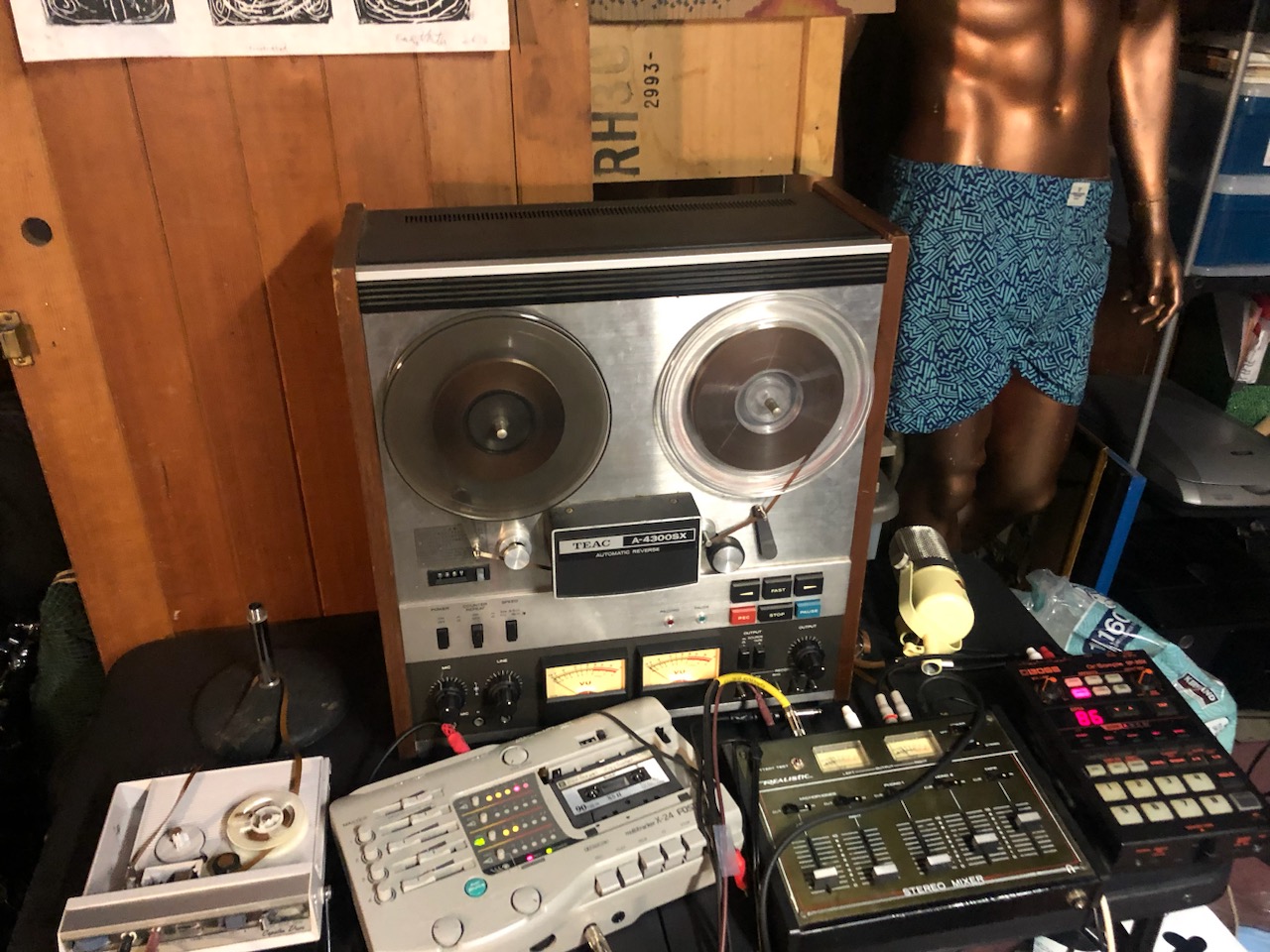
Once that’s done, the artist sends me all the master tracks. If I’m doing it at home, I’ll dub one tape onto my stereo, and then use that tape to duplicate others. I usually have a couple of high-speed double-deck stereo units, so I can put two tapes in at once, and just run them back and forth, hitting high-speed dub.
It’s about twice the speed of the album length, so if the album is 40 minutes, it takes about 20 minutes per tape. I’ll just hang out, watching TV with my partner, while she listens to the whirring of the tape wheels. It’s a specific sound.
Most of the time, I’m just sitting there with my cat on my lap, dubbing tapes and smoking weed. It’s not a bad setup.”
KC: Okay, I love all the band names. You have a good roster.
EM: There’s so many of them, like I’ve honestly done too much [laughs].
It can take a while just to get people to understand what it’s going to look like. We need time to send emails, get everything right, and make sure it’s all set up. It’s mostly about setting people up for when the release is actually coming out and what’s going to fall on the schedule.
But mostly, once I make the tapes, I’ve been trying to announce the release afterward. I’ve done too many times where I announce the release before I’ve made the tapes, and then I’m scrambling last minute trying to get everything done. So I’m trying to give myself more time to get everything ready before announcing.
It’s usually just about making the tapes, making sure the art is ready, maybe planning a release show, and that kind of thing. But honestly, it’s not a lot. I feel like a lot of labels have big rollouts, but for me, it’s not like that. It’s not like I’m doing vinyl or anything, and for the most part, I’m doing stuff that I know will sell a small number of copies—usually no more than 50. So it’s not like I’m ever going to be down and out or anything.
It’s really just about making the tapes and then trying to sell them.
KC: And you taught yourself how to do it all?
EM: Yeah, I had a duplicator I used to use, and it was super janky. Then I bought others, and they were even more janky. My poor partner, Bailey, saw me ripping my hair out, freaking out at these failing machines and trying to replace belts in them.
But it’s always just been me doing it. I eventually figured out a way that works with thrifted double tape decks. They usually make a pretty good copy, and I check every ten copies to make sure they’re okay.
KC: Are there any parts of the process you particularly love—or find challenging?
EM: Oh, I really like just sitting and dubbing the tapes, especially the master tapes. I listen to every record before agreeing to put it out, but then there’s this moment when I go to dub the master tape, and I think, ‘Oh, fuck, I’m stoked to put this out’’ That moment is always really good—like, okay, I’ve got to make these tapes, this is real, I’m dubbing the master tape, this is happening. It’s when I listen to it most in-depth that I get really excited about it.
As for challenges, it’s not so much the process itself, but the hardest part is saying no to people, in any way. Even if I’m putting out their release, and I have to say, ‘I can’t do this right now,’ that’s really difficult for me. But it’s the reality of it. People have all kinds of expectations about what it looks like to put a release out on a record label and setting expectations is hard.”
Photo from Emmet Martin
KC: Can you tell me about the Cosmic Bud series? Where did you get the idea and how do you put each series together?
EM: It was kind of a thing that I failed to do. Initially putting out experimental music seemed so different from Bud that I thought I had to create a separate imprint for it. So, I did a series of three CDs, mostly with experimental stuff happening in Portland—my friend Josh’s band Modern Folk, my friend Matthew Peppitone, and my friends Our Blue Heaven. I did CDs for each of them, like a batch deal.
I don’t know, it just felt weird to keep it separate, and people were confused about what that even meant. Eventually, I just thought, ‘Whatever, Bud is just me, I can do whatever I want.’ So now everything is just under Bud. That was kind of a failed experiment in trying to create something separate for experimental music, like a little imprint. But I realized I could just put everything under Bud, you know? It’s all going to be on the same Bandcamp page anyway.
Handstamp Cassettes of Waves of Higher Bodies by Spiral Joy Band
KC: You’ve done a few reissues or revitalized releases, the Spiral Joy Band that was just announced and the Clovver EP for example. Why are you drawn to this form of preservation and why do you think it is important?
EM: The ones I’ve done have mostly been projects people have asked me to work on, like the Clovver EP, which was super meaningful to me. That was a band I saw a lot back in the day, and the drummer passed away pretty unexpectedly. The singer is my friend Teal, along with my friend Elian. Most of them are in Pileup now—Elian and Grey both play in that band.
Clovver would always play, and it was super cool. The drummer, Andrew, was also in my friend Aaron’s band, Two Moons—I can’t even remember how many projects Aaron’s had over the years. He put out Balloon Club and a bunch of other things. And he also played in Clovver!! Anyway, I would see Clovver all the time, and I’d heard about a record of theirs they were working on. It never came out, so we ended up mixing it years later, after Andrew passed away. It was more of an archival thing.
It was really cool to put that out, but the hardest part about those kinds of releases is that there’s no active band to promote it. So, it’s out there, and I try to sell the tapes, but there’s not much context for it. If you have a media guy, they can lay out the story of how it was made, but I didn’t really know how to do that at the time.
Now, I’m doing a reissue for a band called Spiral Joy, which is a weirdo drone band originally from Virginia, then Wisconsin, and now Texas. I’m reissuing one of their really great records, mostly because I’m also putting out a new release from them. They reached out, saying they had an LP from a European label that only pressed a few copies, and now people have been asking for it. The shipping is so expensive that it’s hard to get it to people. So, they asked if I’d consider doing a US CD reissue to make it more accessible. I thought that sounded great, and it’s perfect because it ties into the new release I’m also putting out, so I can plug both at once.
I also really admire a lot of reissue labels, especially in Portland. Concentric Circles is a classic one. Jed, who’s been in bands like Helen (Liz Harris from Grouper’s band), plays drums in that and has also played in Jackie-O Motherfucker and other great bands. He runs Concentric Circles and also co-runs Freedom To Spend, a reissue label that does incredible archival work, digging through people’s families’ archives and finding amazing stuff. That’s the kind of work I’d love to get into, but I’m not sure how to go about it. Maybe one day I’ll figure it out, but I’ve already done a few reissues, so I’ve kind of broken the seal. I guess I could expand on that in the future.
Show Poster for How Strange it Is Album Release Show w/ Babytooth, Boreen and Tough Boys 3/09/22
KC: How long has Bud Tapes been around?
EM: I started in 2017 and did three releases over three years. Then in 2020, things really took off, and I ended up doing around 20 releases a year.
KC: What keeps you going and excited about what you do, especially on the challenging days?
EM: There are certain things that just happen, like this Spiral Joy Band release, which is really crazy. It features former members of a band called Pelt, who are the reason I got into weird, experimental music and drone music in the first place. They started in the mid-’90s and have been around a long time. One of the original members passed away, but they’ve kept going. Spiral Joy Band is an offshoot of that, and they’ve been releasing a lot in recent years.
I met my friend Rob Vaughn, who runs a label called Sound-O-Mat. He doesn’t put out a lot—just a few 7”s and CDs—but he’s been around for a long time and has worked with Pelt a lot as a sound engineer. When he found out I had a label, he said, “We should hook you up with Michael and do a Spiral Joy Band release.” I was like, “Yes, I do have a label, it’s real, whatever!” That kind of thing keeps me going—the fact that I can say, “I have this label,” and it connects me to more opportunities like that.
Now I’m kind of connecting it more with the Water Shrews world. I used to keep things separate because, with experimental music, people can be judgmental. I didn’t want people to look at it and think Water Shrews was some experimental project, or that we don’t get it. But I’m way more into that world now. I used to play in kind of indie rock, twee bands for a long time, with the whole “heart on your sleeve” thing. But now I’m just like, whatever—I don’t care what people think. I’m putting out stuff that I think fits within the same world I’ve created with Water Shrews, which is really exciting.
When I finally started following people on the Bud Instagram, I never follow anyone unless they follow me first, but I decided to follow all of my weirdo friends. And my friend Al, and a few others, were like, “What the fuck? How did I not know about this? This is so cool!” It was really exciting to see people so stoked on it. It’s a great way to make connections. You get to put on this weird hat like ‘I’m a label, I put out these records, and I could put out your record if you want’.
The Shrews hat is a little different, it’s a little more weird, and less thought-out. It’s like my “freak flag” hat.
KC: Can you share a few personal favorite releases or projects that you’ve worked on and tell us a little bit about them? Whether it’s because you learned something new, the process was enjoyable or you just like the music.
I love Shelter Music. They’re a group of folks who’ve played in a bunch of famous indie rock bands—kind of a supergroup. It’s Travis, who’s the lead of Naomi Punk, my friend Max Nordile (who’s played in a million bands in Seattle, the Bay Area, and New York), Dave, who plays bass in Milk Music (now Mystic 100s), and Steve, who played in Trans FX, a big band in Olympia for a while. Then there’s Anton, who played in Gun Outfit and a bunch of other bands. They’ve all been in so many different groups, but now they play together in Shelter Music, and it’s just this weird, free-form craziness. I always struggle to explain it, but it’s generally free music. They do a bit of hallucinogens and just make music in a park shelter in Olympia that has an outlet, which is why they’re called Shelter Music.
They started as a gathering where they would just hang out, meditate, and play. Max joined later—Max is funny because he’s totally not new agey at all, but some of the others are a little into that vibe. They’re cool about it, though. I recently learned the term SNAG, which stands for Sensitive New Age Guy, and they’re definitely SNAGs in the best possible way. It’s not the kind of weird New Agey stuff where people are trying to sell you things. These people are total SNAGs in the best way possible.
I’m super stoked on the Shelter Music CD I did called Live in a Tree. It’s a 50-minute long jam they did at an art swap in Olympia. I sat in with them before, which was both super exciting and nerve-wracking.
The Greg Freeman album was another huge deal for me. My friend Garrett Linck, who now plays in the band, had seen Greg Freeman’s band at a festival in Burlington. He was totally blown away, texting all of us, like, “You gotta hear this!”. He told me about the song Tower, which was the only song Greg had released at the time. I thought, “Wow, this is really cool.”
I don’t know how, but Greg ended up sending me his record directly—not through Garrett, because they hadn’t connected yet. I think Will from 22 Degree Halo might have helped connect us. Will ran a label called Sleeper Records, and he sometimes refers people to BudTapes when they reach out to him, saying things like, “I don’t do this anymore, but try Bud Tapes.” Greg has never confirmed that, but somehow, the record ended up in my inbox.
I was in New Mexico visiting my partner’s friends when I got the email. Normally, I wouldn’t respond to emails like that while traveling, but I was like, “Wait, this is Greg Freeman’s record!” So I wrote back immediately, saying, “Yes, this record is incredible. My friend Garrett told me about you when he saw you at the festival. I’d love to put this out.” Greg was down, and we set up a phone call to talk.
I always say to people who like Greg Freeman’s music: “He’s gunna be huge. Someone’s going to figure out how good his stuff is.” I’ll always tell people, “I’m happy to be the worst case. If nothing else works out, I’ll make a hundred tapes and we’ll make it happen.” Greg had sent his record to a bunch of places, kind of like I had done with my own stuff.
When Greg said he was waiting to hear back from a few places, I told him, “If something works out and you get a better offer, great! But if not, 100% I’ll put it out.” So that was a huge deal for me. It was the first record I put out where I didn’t know the artist personally, and it wasn’t like building a community type thing at first—but it eventually did.
It was so amazing to see Greg play in Portland and to see so many people come out to support him. It was like everyone I knew who had been involved with the label at some point came out, and it was just such a cool moment. People were so stoked, and it felt so good to see that support.
Cassette Tapes of Greg Freeman’s Debut Album I Looked Out
KC: For those who are looking to start their own tape label, what advice do you have for them?
EM: Just do it. You don’t have to have a big plan or be anyone special—just make a label. Set up a Bandcamp or Big Cartel, or start making tapes and give them to your friends. Then you have a label. Or CDs, or USB sticks with your album on it, or put stuff on streaming. Anyone can do it. It’s just about deciding that you want to do it.
KC: Is there anything you wish you knew before you started?
EM: I started when I was really low on money, so it’s been a bit of trial and error. But it’s all been fun figuring it out along the way. A lot of people go into something like this with a big plan, but I’m just happy that I’ve figured it out as I go. I’ve never been a perfectionist. If you ever get one of my tapes, you’ll see what I mean. This one’s actually a pretty good example, but usually they’re a bit stamped off-center or a little messy. I’ve never worried about making everything perfect.
The magic of doing anything creative is in the process that gets you to that point. Without failing and messing things up—like when your tape players aren’t working or you realize the stamp’s not sticking—the point is it’s a real person making tapes and trying to build community. It’s about being a person, making something, and trying to build a community. You don’t get that by planning everything out with a big team behind you. It’s just a real thing and I think people pick up on that. I’m not trying to be anyone or get anything out of this. I just want to connect with like-minded people and put out cool records. That’s what it’s about for me.
KC: Where are all of your releases out of?
EM: It’s mostly local stuff, but there are a few random releases here and there. Like, I did a couple from this group called Amigos Imaginarios, which is made up of this guy, Caleb who lives in Worcester, Massachusetts, and someone named Arbol, who now lives in France. That was actually a random submission, but it worked out.
Another release I did was for my friend Gabe, who lives in Chicago now but was the bassist in my high school band in Seattle. I did an ambient tape for him a while back. He went on to study sound design at the Art Institute of Chicago and now works in that field. He was in that program with Lula Asplund, who’s now a drone queen in the scene. She’s really popped up recently.
But yeah, most of the stuff is local, with the occasional random submission from other places.
KC: What’s on the horizon for Bud Tapes?
Yeah, there’s always a lot on the schedule. Right now, I don’t have a ton coming out, but I have three releases ready to go. There are also some long-awaited projects that will come out sometime next year. One of them is my friend Garrett Linck’s record.
Garrett’s a great guy—he plays in Greg Freeman’s bands and he’s been an old friend of mine since college. He hasn’t really made his own music in years, except for a few EPs back in college. He’s been playing bass in Hello Shark too, but now he’s finally working on a solo record, something he’s been talking about for over two years. He keeps setting deadlines and then it doesn’t happen. Normally, I wouldn’t be so patient, but Garrett’s one of my oldest friends, and honestly, he’s the reason I do what I do. So I’m just waiting, I really hope this next year is the year we put it out.
There are a few other projects like that—people I’ve told, “Whenever you’re ready, I’ll put it out.” They can cash in that token whenever. Garrett’s record is especially close, though—it’s almost done, just needs a few finishing touches. I really hope it’s out next year. With Water Shrews, we just record everything and put out tapes when we have too much material.
Along with this series, our friends at Bud Tapes are offering a five tape bundle giveaway! The bundle will include Self-Titled (2023) by Canary Room, 5 New Songs of Half Shadow (2023) by Half Shadow, Alas(2024) by Lily Seabird, Waves of Higher Bodies (2024) Spiral Joy Band and Massive Leaning (2023) by layperson, as well as an ugly hug tote bag and sticker.
To enter the giveaway, follow these easy steps below!
Every Wednesday, the ugly hug shares a playlist personally curated by an artist/band that we have been enjoying. This week, we have a collection of songs put together by Ella Williams of the Chicago based project, Squirrel Flower.
Squirrel Flower has become a monumental project in the Chicago scene and beyond, not just in the case of sharing beloved releases like 2023’s critically acclaimed album Tomorrow’s Fire or 2020’s I Was Born Swimming, but also as an example of what community should and can be, including being the first artist to pull out of SXSW due to their ties to the defense industry and in support of the Palestinian people. Ella’s writing has always been one of defiance and accessibility, a precursor to keep moving forward even when everything feels so inhibiting and cruel. Yet, at its core, Squirrel Flower blends this confrontation with curiosity, taking personal confessionals through dynamic instrumentation and haunting melodies to lure out the beauty that still exists all around us in the world.
Along with her playlist, Ella shares;
these are songs that i’ve been listening to a lot over the last few months. mostly gentle, warm music that’ll hug you and help you get through~~~~ peace+love
Listen to her playlist here!
Earlier this year, Squirrel Flower released a cover of Neil Young’s “Cortez The Killer” recorded live in Austin, Texas at an unofficial sxsw showcase. The track includes performances by Alex Peterson (alexalone), Greg Freeman, Dimitri Giannopolous (Horse Jumper of Love), Travis Harrington (Truth Club), Michael Cantella, and Kai Wilde (Teethe). Listen to it here.
Every Wednesday, the ugly hug shares a playlist personally curated by an artist/band that we have been enjoying. This week, we have a collection of songs put together by Philly-based artist Amelia Swain of amelia cry til i die.
Described as queer trans basement emo, amelia cry til i die have become a staple within the homegrown Philly scene and its surroundings as they have accumulated a collection of four track albums, demo compilations and live basement recordings. The sincerity of Swain’s writing puts individuality at the center of any amelia cry til i die album – where moments of absurdity and humor weigh just as heavy as love, heartbreak and promises and each story feels to come from one of our closest friends.
Swain put together a playlist of music all coming out of the West Philly area in the past few years. Enjoy!
You can also find Swain playing drums in Sadurn and bass in Ther
“I think that it is good to want to have a community get together once a week, sing some music together, read together, do all those things,” McKenna acknowledges, a type of grateful reflection across her face as she discussed her approaching EP release show. “I have just had to seek structure and community in different ways, and I think Chicago has been very open to that.”
Edie McKenna is best known for her leading role in the Chicago-based alternative group, Modern Nun, who have spent the last few years dedicated to creating spaces built on acceptance and collective experience through music and community.
With the release of her debut solo EP, For Edie, out everywhere today via Devil Town Tapes, McKenna is leaning more into her folk roots – reliving and repurposing the words she wrote almost a half decade ago. It’s an open letter to her younger self, only four songs long, as For Edie carries past trauma with such confidence – a striking invitation into the life she lived and where she has been headed ever since.
I recently got to sit down with McKenna to discuss the new EP, learning to redefine imprinted expectations and the joy found in mutual congregation.
This interview has been edited for length and clarity
Photo by Cora Kinney
Shea Roney: What was the transition like from St. Paul, Minnesota to Chicago? Where did you find yourself in the music scene here?
Edie McKenna: I graduated in high school in 2016 and moved to Chicago to go to DePaul. I really hadn’t been on my own before and it was really hard. I ended up dropping out of college because I just wasn’t doing well, but I made my core group of friends at DePaul and I fell in love with Chicago. My friend Sophie, whose brother is in the band The Slaps, saw the music that I started posting online and asked if I wanted to open for them. That’s when I had my friend Lee [Simmons], of Modern Nun, come play guitar with me. I think that the music scene was really lacking a lot of non-cis men at the time, so I think we just kept getting asked to play shows. Not to discount any of the non-cis men bands at the time, I just wasn’t aware of them because I was so new. I always was obsessed with indie and folk music, but I thought that I would be, I don’t know, a lawyer or whatever you think you’re going to be when you’re younger. I would just play music for fun, but then it kind of kept going and now I really love it, so I just kept going.
SR: In the past with Modern Nun, your recording sessions were more of what you described as ‘collective experiences of trial and error’. What was it like when you decided to take on these songs?
EM: Maybe this is just for me, but I find recording folk music just a little bit easier because it’s a little more straightforward and I don’t mind being so cheesy. Particularly with these songs, because I wrote them so long ago, the cheesiness is abundant. I don’t care if we’re just playing three chords, that’s fine with me. Whereas, with Modern Nun, it’s just different in that the music is a bit more complicated in a way.
SR: It’s funny because you said you never thought you would put these songs out, claiming that they were ‘too cheesy’ or ‘simple’. Did you find that there came either a motivation or a need for these songs to find daylight?
EM: I don’t know, I felt like I was just sitting on them. I’m lucky to have a really supportive group of friends who knew these songs, particularly “Lava Lamp”, which was one of the first songs I remember ever writing. I just had wanted to work with Seth [Beck] (Rat Future Recordings) for a minute because we were friends outside of this. When we finally got to work together I already had those songs and thought I might as well just try it. It went so well that I was like, why not make it a whole project? This whole thing has been a ‘why not’ sort of situation.
SR: Did the songs go through any changes from when you originally wrote them?
EM: They didn’t really undergo many changes, but I have been really under the influence of distortion, like Neil Young or MJ Lenderman vibe lately. I was just craving to add that to the folk music because I just think it’s so fun. We definitely tweaked them a little bit, because I’m not really a riffer and I wanted Seth, Zack [Peterson] and Eric [Beck] to be able to play off it, so we expanded some of the bridges and the intros and outros, definitely. But the lyrics stayed the same.
SR: Throughout this EP, you write from your own lens of some pretty difficult subject matters, especially on songs like “Kick in the Shin” and “Hail Mary”. What was it like to revitalize those moments and those feelings? Has revisiting these songs sharpened your understanding of your path of healing at all?
EM: I don’t know if I’m there yet, but I definitely have been feeling like I am almost ready to move on from these things. And in order to move on from them, I wanted to put these songs out. I do feel like I have processed these events and feelings and now when I write I don’t talk about them as much anymore. Like this EP was me writing about those experiences. When I named Modern Nun, that was about those experiences. But it is interesting to talk about it and I feel really proud about how far I’ve come. Songs are so specific and I think the best songs in my opinion are really specific moments or stories. It’s like time travel to those moments, but then I get to add something that I’m interested in now, like distortion, and it becomes a merging of two times in my life.
SR: “Swinging” feels like you are cutting yourself some slack, almost a brief grace period on the EP. Can you tell me about that song?
EM: That song is so gay. I’m sure it is definitely something that a lot of queer people experience, like when it’s two people not raised as men trying to make a move on each other. I remember it was impossible, the first date was like a week long and nothing happened, and I was like, ‘okay, that’s kind of the vibe.’ But it gets easier as you get older. That’s kind of what I was writing about. It’s so cute and it’s fun and I’m proud of it. I wanted to release it because I knew it is catchy, but whoa, I cringe. Just a little. Just a little.
SR: There are a lot of instances of longing in these songs – to be accepted, to be loved, etc. Do you feel like you have caught up to those feelings?
EM: No, I don’t think I’ve caught up to those feelings. I definitely think I’ve found my people and I’ve found it in other ways and in moments, but I think that it’s eternal. That feeling was so strong in high school and in early college when I wrote these songs, because, particularly being queer, it was just like, ‘I’m never going to act on these things’, or even, ‘I’m just going to pretend… ’. I also have extreme anxiety, so I get those feelings confused – excitement or yearning with like genuine fear, I get them really confused, so I think it makes the feelings stronger. But I think if you don’t have something to yearn for, what’s the point? It’s like having a crush on life, you’ve got to have something to be excited about it.
SR: While still talking about this longing, did the use of physical placeholders in your writing, such as sunglasses, a lava lamp, or even a malleable prayer make things feel more obtainable, or even just more realistic?
EM: My favorite kind of writing is just very straightforward because I really like someone who respects the intelligence of the reader and the listener. When I was first starting to write songs that I liked, the easiest way to do that is to just be observant and recognize, ‘this is my point of view’. I definitely think that it made the answers more realistic. I think using objects really just grounded me in the present moment because I felt so out of control and in the clouds in my life. They brought my answers into real life and made everything seem real at a time when I was really existing and hiding in my head.
SR: You grew up very religious, and I won’t ask you to dive back into it, but growing up in the foundations of congregation – which at its barebones is people who believe in the same thing/entity – have you found a draw to that same kind of belief when it comes to the local music community here?
EM: Totally, there are a lot of similarities. The things that I grew up doing, in theory, were amazing. Getting together once a week, singing, seeing some art, being with your family, being with other people, reading, talking about the reading, eating together – structure. I think I really struggle because a lot of things in my life I feel like I went from zero to a hundred. I went from not knowing what being gay was and going to private school where you got in trouble for doing the wrong thing always, to immediately smoking weed, etc. I just crave structure and I crave a very rigid routine and seeking that in my adult life has been really complicated. I had to seek structure in different ways through my friends here, which has been a huge learning experience because it’s like, ‘okay, I am living my truth. I am doing what I thought I would be doing just in a different way.’ That’s really nice to think about.
Written by Shea Roney | Feature Photo by Clare O’Mahony
For Edie is out every where today with a limited run of cassettes via Devil Town Tapes
I watched her brave out from under the awning of the Cyclone into a torrential downpour. As I maneuvered keeping my camera safely under an umbrella, a drenched Claire Ozmun sheepishly paused her posing to let a far away family pass by. I found it amusing that even in a massive storm, Claire’s main consideration was pulling too much focus. I wonder if her grunge forefathers would share the same anxiety in the midst of this moment.
I am a photographer and I love working with musicians and getting to know them through my work. A few months ago I reached out to Claire Ozmun about taking artist portraits. In that I stumbled into the fortunate position of becoming her friend and meeting the noble folks of COB, aka Claire Ozmun Band. Everything about her artistic perspective resonated with my desperate need for nostalgic, earnest self-reflection all mixed together with a ripping rock sensibility. I had the honor of shooting her much anticipated Dying in the Wool EP release at the Sultan Room in Brooklyn opened by Hiding Places and Adeline Hotel. They pulled a full house on a Wednesday evening so it was clear that night that we the people were watching COB launch.
I proposed to Claire that we celebrate by doing a photoshoot at Coney Island. When we first arrived at the West 8th street stop and our shoot began, so did a flash flood. Claire said her approach to the rain is to embrace and allow it to do what it will. This connected beautifully to her songwriting; a raw reflection of uncomfortable circumstances. As an artistic director my job is often to interpret the artist’s body of work into visuals that complete their message. I was keen on understanding Claire’s relationship with her visual output from a career standpoint. With a striking soft-grunge aesthetic and a drive to make memories, she aims to document her life authentically. Soaked from the flood we tucked away to a bar on the boardwalk. Claire thought back on arriving in Brooklyn and setting her sights on being a good friend first. With this Midwest sensibility towards friendships and her life-changing experience at School of Song, Claire joined a sturdy community of fellow artists who she continues to build a beautiful life with. She shared that her music, an honest recollection on growing up in Ohio, came to the forefront after she anchored her love in the people around her – the safest kind of love that brings out the best in an artist.
One question I had for Claire was, “what does your music know about you that you want visuals to capture?” She responded, “a non-sugar coated truth, discomfort and rawness. Though there is a silliness, general happiness and appreciation for my life.” We laughed about how the memory-making experience of a flash-flood photoshoot at Coney Island with a buddy embraces all of those qualities. She said, “like when we first got here I was actually so scared and I also wanted to laugh my ass off.” In that spirit, Claire and I left the bar and began hunting for lightning on the beach.
Looking down the road at such a promising career ahead can be so beautiful and daunting. The world of marketing and imagery can be a wild place for musicians. Just because someone is a performer doesn’t mean they are inherently comfortable with their photo taken. Claire is excited to continue into that world though there are reasonable fears around presenting one’s “face and human body.” However, she knows it cannot go wrong while she has her people around her. What better way to express nostalgia than to capture real memories with people you love? I have found in my own life and career that having a trusted community around you easily leads to thriving. It is a rapprochement to get to see yourself in other’s eyes, where that loving safety opens the door for the unknown ahead. Visual translation is very much a game of interpretation and a lesson in knowing. In all of life’s discomfort and hilarity, Claire Ozmun digs into her memories while we get to watch her make more.
To accompany this feature, Claire and Mara put together a supplemental playlist for our listening pleasure.
The untethered project of singer-songwriter Carolina Chauffe – who performs under the name hemlock – has shared two new singles today, “Depot Dog” and “Lake Martin”, premiering here on the ugly hug. This comes as the third group of singles released tandem from their upcoming album 444 set to be self-released on 10/11. Brought to life by the intimate and bountiful friendship of the “Chicago lineup”, composed of Andy “Red” PK, Bailey Minzenberger and Jack Henry, those that have been following the hemlock experience over the years will probably recognize these songs. Previously released within an extensive archive of song-a-day-a-month projects, 444 finds these songs now repurposed, grasping new life, grit and universality as they have grown over time.
Playing to the rush of a windowless drive, “Depot Dog” is consistent, fast and unburdened by the green lights ahead that refuse to break the pace. With a Neil Young-esque sharpness to the sticky guitar tones, the song is determined to the journey as the band falls into a groove of precision. “a throat full of skipping stones / lately lonely, but not alone / windows down cajun music / playin on the bluetooth radio”, Chauffe sings, lamenting the changing seasons and the transitions that follow, relaying to the personal implications of their own shifting surroundings. But building from the wit and charm that has since defined hemlock’s career, Chauffe writes to the peculiar moments of reliability found in the small things that keep us grounded; “unlikely truth like a hot dog from Home Depot / against all odds like a hot dog from Home Depot.”
“Lake Martin” is a rhythmic prayer, a slide show of life’s very construction, as Chauffe romanticizes a swampy south Louisiana sunset in all of its glory. Recorded in one take and putting a cap on the 444 sessions, Chauffe performs with pure sincerity in the midst of an awe inducing stillness. Like the functioning ecosystem of a swamp – “cuz everybody’s someone’s dinner here / the show isn’t for free / I pay my due, I tip my server / generosity reciprocal” – “Lake Martin” is a love letter to the communal harmony we find everywhere we look. Eluding to both our beginnings and ends, the song comes to a close as the backdrop of cars highlight the small, proud exhale from Chauffe, giving the last line the serenity it needs to continue breathing; “What a wonder to be welcomed – full belonging to the beauty of it all.”
On Fridays, a staff member at the ugly hug curates a list of their five favorite new(ish) releases to share with us all. This week, our writer and guitar phenom, Chris, shares with us a list of distorted dancers, apocalyptic stunners and heartfelt folk tunes to take into the weekend.
“Ginger Peachy” by Cheap City
“Ginger Peachy” is one of the tracks off of the Holyoke, MA band’s latest record, Blue Dancers, released in March. Cheap City has played a lot of shows with my band The Leafies You Gave Me over the years, so I’ve had the chance to see how they’ve grown as a band.
This album is by far my personal favorite and showcases them at their best as they blend catchy punk melodies and lush arrangements with experimental noise rock.
This song really captures the live performance spirit of Cheap City – a post-hardcore punk band with dancey riffs that throws you headfirst into the mosh pit with equal parts anxiety and blissful catharsis.
“Your busted heart just spent all night screaming at the moon/ In her reflection against the water against an overcast sky/ In the disappearing memory of the twinkling of an eye,” keyboardist and singer Clover Nahabedian belts with emotional energy that conveys a feeling of heartache mixed with longing. It never fails to draw me back to similar feelings I’ve had over the years.
“Devotion” by Daniel Ouellette
Daniel Ouellette is another artist that I’ve shared a bill with in the past. His music draws from a myriad of sounds – electro/ techno pop, gothy new wave, and new age/ world music. What immediately stands out about him is his iconically deep, intimate and resonant voice paired with synth pop beats that are absolute bops.
Ouellette is a multi-linguistic tour de force and sings in English, French, and Spanish on “Devotion” off his July release Otherworld (When the wolfbane blooms). This song encapsulates all the best of his 80s new wave and electro-pop influences; with shimmering synths parts and a groove-based beat that’s pure pop joy.
“Would you like to have a candlelight supper?/ Would you like a bottle of champagne?/ Is there a devil kind enough to bring you apples?/ Shan’t you learn when it’s time to scream?”
There’s a romantic sensibility that’s paired with a tongue in cheek fey-like playfulness to Ouellette’s music. You can find that among the many classic horror movie references in his songs that shows his love for all things campy and cult.
“Radiate a Smile” by David Keenan
David Keenan is an Irish singer-songwriter that I’ve been following over the years and his latest July release “Radiate a Smile” is a song that cuts through cynicism and annihilates nihilistic thoughts.
Keenan is an indie folk songwriter with a clear vision – a poet who speaks about the world around him. Characters are drawn from everyday life; it’s the people next door or who you meet by chance walking down the street. There’s a clear line that traces Keenan’s work back to literary giants such as James Joyce or Dylan Thomas.
On “Radiate a Smile,” Keenan presents a sprawling narrative on the song’s verses, capturing stream of consciousness, thoughts and imagery of the here and now: “Larry is heavy handed and gets in your space/ A space invader who’s deaf in one ear/ Scudders is still skulling bags Galahad/ oh, I wish I Galahadn’t last night.”
This song is all about living in the moment; all our thoughts, emotions, the people around us (for good or ill) are never static and always fleeting. It’s a good reminder that we’re all going to die someday, so it’s best to find the love and reason for being.
“Radiate a smile cuz we’re only here for a short while and I don’t want to miss a day because I’m missing you.”
“Runaway” by Hannah Mohan
Hannah Mohan (And the Kids) has always had a brilliant mind for melody and capturing emotions in her songs that resonate with listeners. That was clear when I first heard her more than a decade ago at underground venues such as a Western Massachusetts VFW hall and a pop-up DIY festival in the woods in Ithaca, NY called Sweater Vest Sweater Fest.
She’s come a long way since then – releasing three albums as the front person with indie pop band And the Kids. But in 2020, And the Kids ended due to the COVID-19 pandemic, while Mohan also started picking up the pieces from a breakup the year prior.
What emerged from this tumultuous period in her life is Mohan’s debut album as a solo artist “Time Is A Walnut,” which was produced by Alex Toth (Rubblebucket and Tōth).
“Runaway” exemplifies the core of Mohan’s songwriting: an emotionally complex breakup song that’s uplifting as it examines the contradictions of loving and hating someone in the same breath. “You screwed my world/ And then you put it back together/ Now I have to thank you.”
With its lush production, droney synths, breathy backing vocals, punchy percussion, soaring lead vocals, and even a penny whistle, “Runaway” strikes me as a song that cares as much about its pop hooks as it does about its lyrical/emotional impact.
“The Feminine Urge” by The Last Dinner Party
A lot has already been said about The Last Dinner Party – by music writers far more eloquent than I – after the band took the music world by storm earlier this year with their debut album “Prelude to Ecstasy.”
For myself, the UK-based musical ensemble The Last Dinner Party is where all the right elements come together perfectly. There’s expressive and emotional lead vocals and harmonies, a tightly-knit and creative attention to detail in their production/ arrangements, brilliant pop hooks, and lyrics that linger in the mind; begging for repeated listens.
With “The Feminine Urge,” the band’s blend of glam rock, progressive/ baroque pop, and post-punk take the song to grandiose heights. This is a rock anthem on par with the likes of Kate Bush or David Bowie.
“I am the dark red liver stretched out on a rock/ All the poison I convert it and turn it to love/ Here comes the feminine urge I know it so well/ To nurture the wounds my mother held.” Those are lyrics that cut through the bone, driving right to the heart of the band’s ethos of empowering femininity.
Every Wednesday, the ugly hug shares a playlist personally curated by an artist/band that we have been enjoying. This week, we have a collection of songs put together by Travis Harrington and Kameron Vann of Truth Club.
Based in Raleigh, North Carolina, Truth Club released their critically acclaimed sophomore record Running From the Chase late last year, showing both individual and collective growth for a band revitalizing their creative process and collaborative instincts. Through dark interludes and commendable twist and turns, Running From the Chase is patient, building tension from restraint and release from introspection. It’s heavy, smart, fresh and fulfilling – a NC album through and through, embracing both a community and a band at the top of their game.
To accompanying their playlist, Travis shared a statement about how the songs came together;
“I’m pretty uninitiated when it comes to curating playlists and unfortunately am the kind of person who is on my phone in traffic searching for songs, but this was fun to put together! Kam and I are moving in with Yvonne right now, so we’re kind of scrambled. These are some songs we’ve been bumping around the house while lifting furniture and unpacking boxes. Good kinesis embedded within, lots of push and pull.”





 the ugly hug