Highlighting the necessary need for community and advocacy in music, this is how we know music is a new, tender EP byhemlock (Carolina Chauffe) and Tenci (Jess Shoman), released October 3, 2025.
With this project, Chauffe and Shoman emphasize the message that art is not solely about the creation made but the intention and care behind it. Not only do they achieve this with their lyricism, but through creative collaboration and community care. All proceeds of the album are being donated to Palestinian mutual aid funds. In addition, the artists chose to leave Spotify due to their ICE recruitment ads and AI investments, and shared an open letter that invites other Chicago musicians to do the same. The first track about this choice, “bye bye spotify,” is co-written by hemlock and Tenci. They sing in unison all the way through, with impactful lines about community such as “we won’t forget what we’re gathering for,” and imagery of experiencing music in a healing way, through house shows and supporting local bands.
The following songs “Blue Spring” and “autumn” are a song swap between the artists. Both are reminiscent of nature and the seasons, and fade out with mantras such as “I’m good, I’m here” and “don’t let the cat slip out.” They reflect finding peaceful day to day moments in a challenging world.
this is how we know music is a reminder of the ways music is meant to create community rather than destroy it, and how small DIY projects between friends are essential in a world that prioritizes profit at the expense of people.
All songwriting and recording credits go to Shoman and Chauffe. The cover art was designed by Henry Smith, who recorded and mastered the album. this is how we know music is only available on Bandcamp.
“If it meant that much to you, would you say it, would you shy away?” Carolina Chauffe asks this not as a challenge, but as a kind of prayer. Their voice doesn’t seek an answer; it simply opens a clearing for one. This is an invitation anyone who has spent time with hemlock knows well. There is no backing away—only a breath reaching towards you, hands grabbing the warm fabric draped across their body to wipe the fog from your glasses, so you can see how delicate yet beautiful things are when you allow someone else to see you, too. And then, when a hemlock song ends, the wires are tucked behind your ears again. The world feels a little nearer, like you’ve been returned to it. This is the gift they give: revealing precision, refusing possession.
The five songs that make up Orange Streak Glow appear as bursts of light. Sometimes brief, sometimes steady. One may be the extra birthday candle, wedged into the layered sponge. Proof that the laces stayed tied for another lap. The next, a bulb that flickers back on, revived when you jostle the shade. And then it’s a color stretched across the sky, or smeared like a melted popsicle on hot pavement. Or perhaps you’ll see it as the kind of light that lives in storage: a tangled string collecting cobwebs, placed in a box beneath the stairs, until December arrives and the glow is asked to return. And what a miracle it is when you plug that string in, and each tiny spark strikes—ready to be temporarily wrapped and tucked around a tree standing straight and tall. Already dying, but displayed and danced around for a moment, as if it could not be more alive.
There is a glow, too, that arrives in the middle of the night and lights up a screen. A notification that makes you sit up, unplug, and walk over to the fire, letting the flame catch in the corners of your teary eyes. This is how I was introduced to “In That Number,” a song that mixes the familiar, “When The Saints Go Marching In,” with a feeling that pours out like smoke from a chimney. Now awake in a pitch black room, I removed myself from a twin-sized bed that was not mine, scared to be the stranger leaving stains on white pillowcases. Before I knew it I was curled up on the floor with my hands cupped beneath my face, rerouting the tears through the creases so I could watch them disappear down my sleeves. In the background, whistling like a teakettle, I could hear Maya Bon (of Babehoven) confidently coo: “I’m not scared of the water / I’m here comin’ back down / Feel the burn, face the fire,” and every word rang true. I was not scared of the stream coursing through me. Nor was I scared to realize I wanted something to reach out and touch me, unafraid to squeeze my soaked palm.
What does it mean to ask for that contact? What does it mean to offer it? Nestled in the center of the EP, I hear Carolina circle the same sentence, ink digging deeper into the page, “I am a clothespin and you are the laundry line,” and like playing musical chairs, I start looking for my line, wondering if I’ll find it before the music stops. I ask myself: What spool can I wrap around? What ear will hold my voice when I cannot listen anymore? I send a signal (a burst of light) to someone I’ve begun stacking piles of laundry beside: ‘What do you make of this lyric?’ They respond and talk about what provides structure and what provides support. I propose that maybe it’s about how we view our purpose. I am gently reminded that there are clothes involved too and someone must be mindful of the weight as they are hanging them. The spring between my two fragile limbs decides it wants to hold on tighter and longer. Binding is less daunting when you are choosing to endure and weather the same storms together, finding there is light in the shared strain. Or sometimes, there’s no strain at all. Just light.
The songs on Orange Streak Glow echo both the pain and the pleasure that come with admitting you have been altered by something—by someone. They are songs that understand that all communication is an act of faith. That to name something is to risk misnaming it. That in the end, the words that slice us open might also stitch us back together. That we hold the same power that someone holds over us. Because the truth is the safety we find in honesty might someday become the thing that tells us we need to pack up and leave. Taking what is now unburied with us, along with a basket of our deconstructed fragments, eager to hold onto something again.
In the days before hemlock’s latest EP landed like a feather in my lap, I was hiding away in a town near Hudson, NY, not far from 12lb Genius, where it was recorded. I was stumbling and circling the same sentence, tracing the thin lines between my teeth with my tongue. I was looking at a faded ‘You Are Here’ mark on a map, not really sure where ‘here’ was, or where ‘there’ was either, for that matter. The rain followed me and sometimes I was too slow to outrun it. Wet leaves stuck to my socks and became the inner linings of my boots. I found a frozen blue raindrop one morning, after the storms passed, and put it in my pocket. Something told me that even if I were to hang my jacket on the line, that one drop—if it ever thawed and pooled—would not dry. It would stain, it would burn a hole, it would leave a mark. And I wanted nothing more.
So what does it truly mean, to look at something you long to care for and reflect it back, offering structure and support? To say you will choose something even if it doesn’t choose you back? The first time I held the title track in my ear, in those final moments before the engine turns off in the driveway, I thought: This is the hemlock I know. A season returned, a holiday, a solid oak. There are some people who don’t just reach out for you, but remind you that it is possible to place your own finger on the map. They show you that what surrounds you has a pulse—hums—and you are welcome to join its choir, as both a listener and participant. It’s there, somewhere between the glow and the dark, as something you cannot see chirps, that you realize you were never outside of the equation at all. To choose nothing is not an option when every rustle has its own weight. What better choice is there than to take the thing you long for and turn it into a melody of your own? While there’s no knowing, you might just find that someone will push past the branches, look right at you, and sing it back.
Through a type of personal introspection, one which flows with such grace and intuition, Carolina Chauffe of hemlock and Alexandre Duccini of Floating Clouds have always brought words to motion, recentering what matters most in the world with such simple fixations, open hearts and really good tunes. Now partnering up, along with Nick Meigs and Jakob (Dr. Sweetheart) Parsons, today the two share Campfire Singles, a pair of songs written and recorded on tour in Washington in the fall of 2024. As the tale goes, Carolina flew to Seattle to tour with no car and no guitar, “pushing the envelope of human generosity”; and there was plenty of it. Recorded around a campfire on an iPhone, “No One in Portland Says Howdy Anymore” and “Red Breasted Nuthatch” find hemlock and Floating Clouds in their most sincere habitat, as these two songs are a restful gesture that “music is play”.
Photo by Alex Martinez
Upon contagious laughter blending into the crackle of a campfire, the uplifting spirit of a slide whistle brings in “No One in Portland Says Howdy Anymore”, as Alexandre’s rich voice establishes the tune amidst the open air. With a steady demeanor, the two songwriters share tails of drifting heartbreak and lamenting woes as “Howdy’ becomes a space where familiarity blends with presence and courtesy with understanding. The second track “Red Breasted Nuthatch” pushes curiosity into the smallest bits of beauty that surrounds our day-to-days, ushering in a call and response pattern, a dialogue of imagination, hoping to get some answers from a tiny-winged friend they made earlier that day.
These two tracks are less of a practical method and more of a practice in trust and intention. They are sweet and silly and a little rough around the edges, but that’s okay. What else could be more perfect when capturing genuine creativity? It’s a simple, yet powerful reminder of what makes creating such a special part of being human.
You can listen to the campfire singles out everywhere today, as well as check out Floating Clouds latest album With A Shared Memoryas well as 444 by hemlock.
Every Wednesday, the ugly hug shares a playlist personally curated by an artist/band that we have been enjoying. This week we have a collection of songs put together by Chicago-based multi-instrumentalist and songwriter Andy Red PK of the project Red PK.
If you have spent any time in the Chicago music scene, Andy’s face on stage is one of familiarity and comfort. Having been a player in some of the city’s most beloved acts, such as hemlock, free range, Options and Tabacco City, as well as instances of joining touring groups like Sinai Vessel, there is a guarantee of a good show at work when Andy is playing guitar. Earlier last year Andy released two singles, “Bedroom” and “Moving off the Line”, debuting his cleverness and passion as a songwriter as well, with hints of more to come in the future.
To accompany the playlist, Andy shared;
Songs that make me laugh and cry, sometimes unsure which is about to happen. Featuring friends, heroes, inspirations, recent pleasures. Fix yourself a Shirley Temple with extra cherries and cuddle up with your childhood stuffy while listening.
Listen to Andy’s playlist here;
Andy will accompany hemlock for a few shows on their expansive tour crossing eastern U.S. cities beginning on January 24th. Find a show near you HERE.
Listen to “Bedroom” and “Moving off the Line” out on all platforms now.
Written by Shea Roney | Featured Photo by Sofia Jensen
Every Wednesday, the ugly hug shares a playlist personally curated by an artist/band that we have been enjoying. This week, we have a collection of songs put together by Carolina Chauffe of the project hemlock.
Growing up in Lafayette, Louisiana, Carolina has been untethered to one place, letting opportunities decide where they move next as they plant roots from Louisiana to Texas, the Pacific Northwest and Chicago, spooling connections in every direction that their presence and spirit touches. This year brought us two hemlock releases, amen! and 444, each built on their own path of compassion and understanding of what it means to be a human being.
About the playlist, Carolina shared;
i appreciate the center of the venn diagram between the circles of “doves” and “songs”: frequently airborne, sometimes mourning, often stunning, sounding striking, among other things
this collection of songs all contain a dove — in the lyrics, or the song title, or in a few cases, the sound of the bird’s call itself.
i knew i wanted this playlist to be centered around birds, or a specific bird, in honor of shea’s (ugly hug founder’s) deep appreciation for them. playfully combining passions: music and feathered friends.
doves are a symbol i’ve drawn on most every note (“thank you”s and otherwise) that i’ve written, for long enough now that i can’t remember how it started. i draw them so frequently that they’ve become a sort of mascot that i’ve chosen to represent hemlock, as a sort of signature. besides being gorgeous creatures, i think they’re a powerful representation of hope and renewal. and i remember growing up with my dad talking to them in our yard, mimicking or conversing with them by whistling or by simply cupping his hands and blowing through them. how many mornings of mine have been met with the mourning dove’s call?
it’s a fun challenge to create a playlist centered around a single specific word that still has that feeling of flow and cohesiveness. i’ve tried to do that here best i could, with “dove.” there are a couple of double-ups where two versions of the same song felt apt. thanks to the many friends and inspirations who wrote songs with doves within. and many thanks to a few friends’ recommendations that slid their way into this mix as well – glad for community that can see so clearly where my own blind spots can’t.
honorable mentions (unavailable on spotify): “mourning dove” by sleep habits and “time as a symptom” by joanna newsom
The untethered project of singer-songwriter Carolina Chauffe – who performs under the name hemlock – has shared two new singles today, “Depot Dog” and “Lake Martin”, premiering here on the ugly hug. This comes as the third group of singles released tandem from their upcoming album 444 set to be self-released on 10/11. Brought to life by the intimate and bountiful friendship of the “Chicago lineup”, composed of Andy “Red” PK, Bailey Minzenberger and Jack Henry, those that have been following the hemlock experience over the years will probably recognize these songs. Previously released within an extensive archive of song-a-day-a-month projects, 444 finds these songs now repurposed, grasping new life, grit and universality as they have grown over time.
Playing to the rush of a windowless drive, “Depot Dog” is consistent, fast and unburdened by the green lights ahead that refuse to break the pace. With a Neil Young-esque sharpness to the sticky guitar tones, the song is determined to the journey as the band falls into a groove of precision. “a throat full of skipping stones / lately lonely, but not alone / windows down cajun music / playin on the bluetooth radio”, Chauffe sings, lamenting the changing seasons and the transitions that follow, relaying to the personal implications of their own shifting surroundings. But building from the wit and charm that has since defined hemlock’s career, Chauffe writes to the peculiar moments of reliability found in the small things that keep us grounded; “unlikely truth like a hot dog from Home Depot / against all odds like a hot dog from Home Depot.”
“Lake Martin” is a rhythmic prayer, a slide show of life’s very construction, as Chauffe romanticizes a swampy south Louisiana sunset in all of its glory. Recorded in one take and putting a cap on the 444 sessions, Chauffe performs with pure sincerity in the midst of an awe inducing stillness. Like the functioning ecosystem of a swamp – “cuz everybody’s someone’s dinner here / the show isn’t for free / I pay my due, I tip my server / generosity reciprocal” – “Lake Martin” is a love letter to the communal harmony we find everywhere we look. Eluding to both our beginnings and ends, the song comes to a close as the backdrop of cars highlight the small, proud exhale from Chauffe, giving the last line the serenity it needs to continue breathing; “What a wonder to be welcomed – full belonging to the beauty of it all.”
Every Wednesday, the ugly hug shares a playlist personally curated by an artist/band that we have been enjoying. This week, we have a collection of songs put together by singer-songwriter, artist and teacher, Lindsey Verrill of the Texas-based folk project, Little Mazarn.
Lindsey Verrill’s songwriting is bare-bones, building from a skeletal structure that develops and consolidates with each connecting tissue and fiber of real life moments and relationships made along the way. Along with Verrill, Little Mazarn is composed by the characterization and companionship of Jeff Johnston with his singing saw and atmospheric animations that have defined their sound, as well as an occasional appearance by Caroline Chauffe (hemlock) in the full power trio.
Along with the playlist, Verrill shared a little blurb about collecting the songs;
I try to make a playlist once a month of music that comes to me or songs I get obsessed with. It’s kind of a private practice so this is fun I get to share it.
Carolina Chauffe is the creative guide behind the ever evolving project, hemlock. Growing up in Lafayette, Louisiana, Chauffe has been untethered to one place, letting opportunities decide where they move next as they plant roots from Louisiana to Texas, the Pacific Northwest and Chicago, spooling connections in every direction that their presence and spirit touches.
Earlier this year, hemlock released the six-track mini-album, Amen!, off of Hannah Read’s [Lomelda] label Double Yolk Record House. It’s a touching piece of work, a contusion of the heart, as Chauffe and friends create a simple, yet indescribably intense record of placement, connections and the spirit of being.
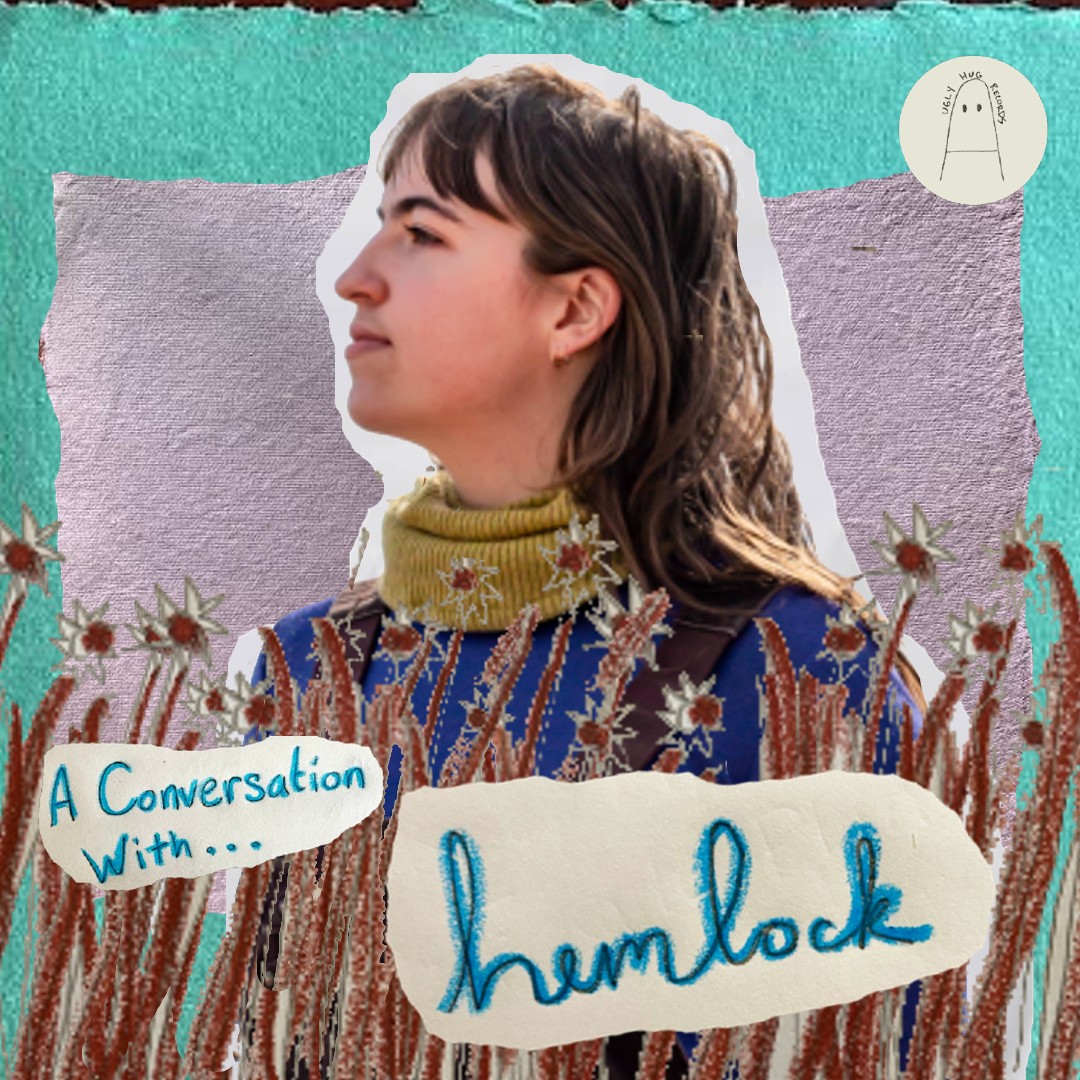
I recently caught up with Chauffe as they house-sit for Lindsey Verrill [Little Mazarn] in Austin, Texas. Having done the classic layered questioning before in a past interview with hemlock, I wanted to try something new this time around. Only preparing one question, what followed became a stream of consciousness, retelling the story of not only how Amen! came to be, but how Chauffe’s patient and stunning observational process creates a clear focus of the artistry and bonds that connect their world.
This interview has been edited for length and clarity.
Artwork by Church Goin Mule
Shea Roney: I felt an emotional connection to Amen! before I even got a chance to listen to it because of the stunning album artwork by Church Goin Mule. In the bottom corner, it reads, “I didn’t know where I was headed – only forward! What a miracle to keep going, keep asking and to keep finding out! Amen!” So my question is, what defines a miracle to you in your life?
Carolina Chauffe: That’s such a beautiful question. In a moment of such dissonance globally, it can seem harder and harder to keep a grasp on magic. You’re also catching me in a very tender moment, where I’ve just come to a brief resting place between tours, and today is the first day that I can even begin to process this past week’s miracles. It’s all hitting me now with how relevant and intense this question is.
On a good day, the question is answered with another question; what’s not a miracle?
This album is a miracle to me. It was, in many ways, a gift of a lot of time and energy and collaboration with some of my heroes, especially in a year where I promised myself I would lean more into collaboration. I think that community is a miracle. To lean into the trust that someone or something or somewhere will always catch you, and to be proven time and time again that that is true. In a lot of ways, a miracle is also a testament to human goodness as well. So I believe it’s equal parts faith and magic and reciprocity and trust. But there’s a difference between man made miracles, which need a conscious amount of intention and a lot of courage and hard work. And then there’s the miracles that are just links that appear from the ether and reinforce that you’re on the right path. I think that for me, making music and just continuing on living requires both of those miracles to meet each other and get really well acquainted, almost blurring the lines between where one ends and the other begins.
Amen! came from that kind of perfect storm. Taking the general upheaval of my life and all of the silver linings that followed from getting out of a partnership and leaving Chicago where I lived for three years. It was so hard, but it was true. I think that can often be the form a miracle takes as well. It was the choice I needed to make.
At the time I was leaving Chicago, moving via tour with Merce Lemon down south and heading back over to Austin, Lindsey caught me in this nest that I return to over and over again, letting me stay in this shed that her and her dad built together in the backyard.
Tommy Read offered to record the album in Silsbee, Texas. We had never met before, but he was going off of the good word of Lindsey and Hannah. All I knew was that we had four days on the calendar blocked out, and I didn’t know what it was gonna be, but I knew what shape I wanted it to take – I had trust in that. I played through the songs the eve before recording, and Tommy was like, ‘those are the ones that we’re gonna do’, and the track list made itself. That was miraculous in its own way, trusting the album to make itself with the help of a lot of really tender hearts.
Amen! also bridged my transformation geographically, as a couple of the songs are from Chicago right before I left, and the other couple are from living in Lindsey’s shed. A couple of the others came from a tour that I was on last summer with one of my best friends, Clara [Lady Queen Paradise], who is one of the deepest and most intense inspirations in my life.
Photo by Oscar Moreno
That connection is miraculous as well. In 2018, Clara was on a double solo tour with Ode (playing under the project ‘bella’) as they came through Louisiana. I was coming back from a road trip and we decided to stop at a house show happening at this spot called Burger Mansion in Baton Rouge. I didn’t know who was on the bill, so we showed up and it happened to be Clara and Ode. I’ve never seen anyone do a double solo tour before. It was not something that I knew could happen. They came all the way down from Providence, Rhode Island to Louisiana in their car with one shared guitar and it blew my mind. My first tour ever ended up being a double solo tour the next year. A year from that date I had taken that dream and taken that vision, and just ran with it, but they were the one who materialized it. I had never observed it before and it obviously changed my life, because I’m still doing it. Flash forward five years later, Clara and I ended up going on tour, and almost to the date, we were doing our own double solo tour. The songs “Eleanor” and “Prayer” were written on a day off between shows. I was just sitting and riffing on my friend’s porch in Portland.
Capturing Amen! felt like a miraculous return to the South for me. It felt important to be recording in Silsbee, which is actually the midpoint between Austin and Lafayette. There’s the connection between everywhere I’ve lived in my life within these songs. There are songs influenced from the Pacific Northwest, from Chicago, from the deep South – it includes and melds so many different places and times – past selves, present selves and future selves.
Lindsey, Kyle and Carolina | Photo by Hannah Read
The only person that I knew in a true way before recording was Lindsey, but we all got to know each other through the making of this very precious and sacred feeling together. We mutually believed in each other so deeply, and that is absolutely priceless. I’d met Kyle Duggar, who plays drums on Amen!, only in passing a few times, but he came to make a record with me in full blind trust. No one knew the songs. I hardly knew the songs. We just played through them a few times each and captured them as they were, and it was exactly what it was supposed to be. The energy of the room was so special and playful and intentional. I felt really in touch with the miracle of trust from every angle of that whole recording session, because so many of us were just meeting for the first time, and we made something so intensely beautiful and straight to the point. Whatever the point is.
While recording, we would look out the window to this field of mules that was outside the studio. I’ve always been such a fan of Church Goin Mule, but at this point, it felt like a very obvious connection and sign that I need to reach out to her. When I asked Mule about collaborating for that beautiful painting that is the cover, I was going to initially commission a new original work, but that ended up falling through because we both ran short on time and energy, – but it really didn’t even matter to me because I knew what piece I wanted. Once the album was recorded, it was just obviously the cover – I finally had consciously put them in the same space. The sentence ends in the bottom right corner with the word “Amen”, and the record ends with the word “Amen” – they just seemed to be married to each other. It’s like the miracle of kinship.
I met Mule years ago in my hometown of Lafayette while she was doing a residency at a gallery. I remember being so stunned by her work. I was probably still in high school, so that’s just another through line to the origin point of inspiration, stretching onward almost half a decade to the point of finally being able to collaborate. I actually just got to see Mule for the first time in so many years this past week. She showed up with a bundle of sketches from the time that we were gonna collaborate on an original commission for the album cover. It was this manila envelope full of sketched mules and phrases that I could tell she jotted down as she was listening through my songs for the first time. I cried.
That was the case for recording with Hannah and Lindsey and having collaboration with Mule for the visual art. All these ties that I had open for so long were now tying themselves into a nice little bow. Lots of full circle moments; miracle moments.
Photo by Jake Dapper
Clara texted me recently and said, “home is something you carry with you.” I think that’s a miracle too. I think it’s true and it takes a lot of people to carry one person’s home. When you’re like me and sleeping in a different bed most nights, it doesn’t feel like a sole weight to bear. It’s shared among many pairs of shoulders. That’s utterly miraculous.
I always wanted a pair of red converse high tops when I was a kid, and I never was able to get a pair. I just played a show in New Orleans at this record store’s last show before they closed (long live White Roach Records!) and they were selling these red chucks there. And I was like, ‘okay, you know, the universe has spoken’ [lifting their foot to show off the new chucks].
The connections that people have had to this record, whether it’s feeling pulled towards the visual art or feeling pulled towards the music, it just never gets any less awe inspiring to me the ways that people can receive the work that I am sharing. I’d be sharing it whether or not anyone listens. And the fact that it does resonate, not only with friends, but on the far ends of that spectrum, total strangers and also my heroes, is such a source of faith and hope for me. It makes me feel like I am where I am meant to be.
I was just in Fayetteville for a weekend playing Old Friends Fest. That whole weekend, we had maybe five drops of rain. I was out of service for three days, and when I re-entered civilization, I had all these texts like, ‘are you okay?’ Apparently there were tornadoes all around the festival, and we were just out on our own little plane ten miles off the gravel road. There’s some miraculous force field that can protect you from the woes of man and the woes of the earth sometimes. But I mean, when the woes do hit you, it just takes the miracle of community to pull you back out.
Carolina and Kyle | Photo By Hannah Read
I’m just thinking about when you say the word miracle, to me the vision that I see in my mind immediately jumps to a sun glint on water. It’s a meeting of elements that creates a perfect image or feeling. All these places where the elements combine to bring observance to what was already there in a different shape, that emphasizes the magic and the wonder and the awe of it all. At the heart of a miracle is collaboration between something, whether that be forces, people, elements, or a combination – miracles take active observation; they require observance. There’s so much to observe right now around us, some of it so heartbreaking and impossible to process consciously. But then there’s also the opposite of that; the weekend at the festival with tornadoes all around us where all we could see was beautiful lightning, or the backyard shed that still has your quilt in it after you return months later. I don’t know. If I didn’t believe in a miracle I wouldn’t be here, right?
hemlock is the swamp-raised and untethered (Chicago / LA / Texas) project of Carolina Chauffe who, as of today, is celebrating the two year anniversary of their album, talk soon. To commemorate the anniversary, hemlock, alongside Ghost Mountain Records, is announcing the release of a limited pressing of talk soon for the first time ever on vinyl as well as a new music video for the song “garbage truck”.
With a brush of gradual guitar, Chauffe begins, “I’ve always been so afraid of the things I can’t control / Like accepting that you couldn’t stay, and the sound of the garbage truck.” This line, opening the song “garbage truck” with a gentle admission, sets both tone and desire in the wake of a relationship while also putting weight on the things that feel inevitable. As the track goes on, with a steady heartbeat behind flourishing instrumentation, the music begins to drive with purpose – Chauffe admitting with sincerity, “I wanna be a better person to you.”
Two years after its original release, “garbage truck” only feels stronger in its deliverance, both towards its confessional imperfections and the confident strides of growth that hemlock has so genuinely crafted in their career. “I’ve always been so afraid of the things I can’t control,” Chauffe repeats one last time, before affirming, “But I am not bound to make the mistakes I did before.” With accountability, reassigning the things that we can control, soon, the conditioned racket of the garbage truck outside begins to feel less harsh in its composition – our unfavorable habits are no more foundational to who we are as is the stuff that is hauled away every week by that same darn truck.
To celebrate the two year anniversary today, hemlock has shared a DIY made music video for “garbage truck” compiled of footage shot back in 2021. With a bike basket full of flowers, Chauffe rides around the city of Chicago in hopes to hand out the beautiful bundles to the people at the helm of these dynamic machines. You can watch the full video for “garbage truck” premiering here on the ugly hug today.
The limited double LP pressing of talk soon is pressed on coke bottle clear vinyl. It also contains the bonus track, “Monarch” added in its original intended position on the track list. Side D has an etch designed by Carolina Chauffe. You can preorder the vinyl on hemlock’s bandcamp or at Ghost Mountain Records.
I met Carolina Chauffe after one of their shows at Chicago’s Sleeping Village. Since then we have kept in touch to put together this interview.
When Carolina and I began our Zoom call, I noticed a painting of a Baltimore Oriole centered on the wall right behind them. As a bird enthusiast, I had to give it a nod of fascination. “Thank you! Yeah, my grandmother painted it” they told me. “I took the painting when she passed, and I’m not an avid birder, so until a friend pointed it out to me I actually thought it was a robin haha!”.
Carolina Chauffe, known as their project hemlock, has become an important facet of not just the Chicago music scene, but a friendly contributor beyond. Being from Lafayette, Louisiana, Chauffe grew up in a pretty condensed scene. Looking to move out of their hometown, the first opportunity that presented itself was an internship at a record label in Seattle. But as the pandemic exhausted that plan, they spent some formative time in Astoria, Oregon before eventually moving to Chicago. “Since then I just kind of heed the signs when a friend, or someone that I care about offers me housing, I just kind of run with it if it feels right” Chauffe explains. “I’m trying not to be in the business of saying no to gifts that are offered.”
I know you grew up in church and chamber choirs. But when did you first start writing songs?
So my dad is a couponer and he got this coupon for guitar lessons at a local Baptist church for one month of free guitar lessons. So he bought a cheap Walmart guitar for me that was pretty much impossible to play, and I went, and I did this month of free guitar lessons. I learned to play a Taylor Swift song I think. And then the coupon ran out, and so we stopped doing the lessons. But even before that, there have always been little diddys that would come to me. I mean, I can remember writing songs about my crushes in middle school and high school. But the first song that I ever performed in full for an audience was at a high school music showcase and I remember some of the lyrics were, ‘I’ve been holding my breath over bridges that I should have burned so long ago.’ It was really teenage angsty, about some fresh heartbreak, and I remember my parents were concerned after which, also, is still a through line, like my parents are always asking, “are you okay? We listen to your music haha”.
With this opportunist mentality, Chauffe has been making lasting connections with people all over the country. As an artist, this is imperative to their work. As someone who claims to be a very solitary song writer, Chauffe pushes themselves into collaboration as a set goal. “Collaboration with different people always opens up these new windows, sonically and emotionally, of what each body of work can be” says Chauffe. It’s not that collaboration is unwanted, it’s more complicated than that. Art is personal and exposed and to place it in the hands of someone else can be uncomfortable. “If I’m being totally honest, I still like to yield a lot of control over the recording process”, Chauffe expresses, but “opening my heart to that deep trust that comes with letting someone into the very vulnerable world that [I’ve] built”, has worked to push personal boundaries.
hemlock’s career has been something different than the commonplace musician. With a catalog consisting mostly of demo-records, Chauffe has been adamant on redefining the idea of what a “finished” song is. Embarking on ambitious ‘song-a-day’ projects, Chauffe has worked sonically and socially to rewrite the limits of what a song can be. “I’ve just allowed myself to break more and more of the “rules”. Or the more time goes by, the less strict I am with myself. because I believe that music is play”, they say. With five ‘song-a-day’ albums representing entire months of time, the songs are purely explorative. They can represent short thoughts (even if not complete), a piece of characterful instrumentation, or field recordings of the world around them. Almost like postcards, these projects represent where they were, who they were with, and what they were going through in the generalist terms.
In a way, a song is never finished. “There’s a short term finish where it feels good in the moment to walk away from,” says Chauffe. “But then, long term speaking, I don’t know that a song is ever finished, cause I just think it’s malleable. It’ll keep shifting”. It’s something that is representative of the moment and the memory of the time it was written. But, over time it can grow and model with you. Even with hemlock’s established songs and professional recordings, Chauffe told me, “none of them are ever finished, because I believe that songs lead their lives, and they keep evolving. If you keep breathing life into them, if you keep playing them, they’re allowed to be whatever form they’ll take in that moment”.
You are headed off to New York tomorrow to do some recording. What do you have in mind going into the process?
I don’t really write a body of work with the idea of it being an album already. I kind of just write as they come, and then if they fit together, then cool. I’m going into it just with a body of work that I want to be captured. And then I trust Ryan [Albert] (of Babehoven) to be able to dream up something that feels really good for us to do together. But we’ll shape it together. I don’t really play my own music around the house very often. I’m bad at practicing which is something that I’m okay with being bad at now. But when I record it it gives me the sort of opportunity to get to know what my songs are a little bit better, and to expand what they can be.
hemlock released their first full-band LP titled, talk soon, in 2022. Written all over the country from 2018 to 2020, the thoughts behind talk soon traveled with Chauffe over those years. With soft exposés of folk tunes, the album is an intimate conversation of change, heartbreak and acceptance that Chauffe trusts in us to share with. When listening to this album, what stands out are the handful of voicemail recordings that Chauffe uses almost as narrators. Hearing the love and support from their pawpaw, a song sung by their mother or just friends calling to check in is, in sorts, representative of people we have in our own lives. Having never met any of these characters before, I still found my heart twisting with what they had to say. It’s this natural drive for intimacy and connection that draws on these voicemails and clings to what it needs to. “In some ways [the voicemails] are the string that ties everything together. Those songs were written in so many different years and so many different places that it helps to track this nonlinear web of memory”.
As humans go, though, I think we take memory for granted until it starts to slip. Memory is more than just remembering our postal code, what we had for breakfast or directions to the nearest convenience store and to buy the toothpaste we need once we get there. It’s also names, faces, laughs, morals, friends, moments of sadness and love and the ability to feel those moments again. What it comes down to, memory is a preservation of our own beings.
Memory, or more this preservation of memory, is not only important to what Chauffe is creating, but it has become something more personal. Memory is instinctive to human nature, but when it becomes fleeting, it easily becomes disposable. That’s fucking scary. As I watch my own grandmother currently lose herself in a world that doesn’t make sense to us, I have had time to watch what slipping memory has the dynamism to do. Finding solace in each other as we talked about our own personal grievances, Carolina opened up about their family history. “My whole family, we are prone to forgetfulness,” Carolina shares with me. “My granny on my dad’s side is a documentarian. She was the first person I saw who constantly had a camera taking family photos” they said with an enthusiasm in engaging with moments. “And then on my mom’s side is where this loss of memory is very prominent”. As they deliberate on what to say next, Carolina’s head couldn’t help but to turn back to that simple, yet incalculably beautiful painting of the Baltimore Oriole centered on the wall.
Song writing to Chauffe is very archival. To them it is “very much with the ethos of trying to capture a moment, capture a memory without smothering it, and being able to let it glow in a way that feels true”. Subconsciously, music, and art in general is a representation of our memories. The time it’s made, the personal state at which it is made, and who may have had a hand in it, all stick with that piece. The meaning can become malleable as time goes on, but the initial identity of the piece stays forever. Chauffe though, makes it a point to acknowledge the full story of their process and continuance. It can be seen in the endless collaborations with the people that they trust and love. It can be seen in the voicemails they furnish talk soon with. It can be seen in the ‘song-a-day’ projects that take the pressure off of honestly capturing a moment in time. It can be seen in the “unfinished” songs that shift and meld into the performative moments they are meant to be. It can even be seen in the simple act of hanging and preserving a painting of a Baltimore Oriole on the wall in the center of their living room. “And yeah, I’m terrified of forgetting and its inevitability” Chauffe confides in me, “but I want to be clear that it’s not that I’m fighting against the forgetting, but coping with it. That’s often what songwriting is for me”.







 the ugly hug