Every Wednesday, the ugly hug shares a playlist personally curated by an artist/band that we have been enjoying. This week, we have a collection of songs put together by Carolina Chauffe of the project hemlock.
Growing up in Lafayette, Louisiana, Carolina has been untethered to one place, letting opportunities decide where they move next as they plant roots from Louisiana to Texas, the Pacific Northwest and Chicago, spooling connections in every direction that their presence and spirit touches. This year brought us two hemlock releases, amen! and 444, each built on their own path of compassion and understanding of what it means to be a human being.
About the playlist, Carolina shared;
i appreciate the center of the venn diagram between the circles of “doves” and “songs”: frequently airborne, sometimes mourning, often stunning, sounding striking, among other things
this collection of songs all contain a dove — in the lyrics, or the song title, or in a few cases, the sound of the bird’s call itself.
i knew i wanted this playlist to be centered around birds, or a specific bird, in honor of shea’s (ugly hug founder’s) deep appreciation for them. playfully combining passions: music and feathered friends.
doves are a symbol i’ve drawn on most every note (“thank you”s and otherwise) that i’ve written, for long enough now that i can’t remember how it started. i draw them so frequently that they’ve become a sort of mascot that i’ve chosen to represent hemlock, as a sort of signature. besides being gorgeous creatures, i think they’re a powerful representation of hope and renewal. and i remember growing up with my dad talking to them in our yard, mimicking or conversing with them by whistling or by simply cupping his hands and blowing through them. how many mornings of mine have been met with the mourning dove’s call?
it’s a fun challenge to create a playlist centered around a single specific word that still has that feeling of flow and cohesiveness. i’ve tried to do that here best i could, with “dove.” there are a couple of double-ups where two versions of the same song felt apt. thanks to the many friends and inspirations who wrote songs with doves within. and many thanks to a few friends’ recommendations that slid their way into this mix as well – glad for community that can see so clearly where my own blind spots can’t.
honorable mentions (unavailable on spotify): “mourning dove” by sleep habits and “time as a symptom” by joanna newsom
The Fruit Trees is the moniker of California songwriter and multi-instrumentalist Johnny Rafter, who upon releasing his debut record Weather in 2023, quickly followed it with We Could Lie Down in the Grass, the hour-long, 24 track sophomore record that rang in the end of summer this year.
Although these tunes feel worn in, The Fruit Trees, and Johnny’s writing in that case, is still a rather fresh journey, but also one of exposure and accessibility – a place to step in and step out and come back around much wiser. Like a small collection of bugs, gently caught and kept in a rinsed out pickle jar, We Could Lie Down in the Grass captures and culminates curiosity towards the most minute details that surround Johnny’s day-to-day. As the glass tinkers and buzzes with life, experimental folk voicings playing amongst warm melodies and memorable structures, this little ecosystem grows with each additional moth or pill bug – each witty one-liner or field recording – as these songs become part of a much larger story.
Through email correspondence, Johnny took the time to answer a few of our questions about We Could Lie Down in the Grass, finding placement in his changing world and embracing all bits of creativity.
Photo by Hannah Ford-Monroe
Shea Roney: We Could Lie Down in the Grass is your second album in just a little over a year. In what ways do you find comfort in your writing process that you can still rely on, as well as where did you find yourself changing course and trying something new when compared to your process on Weather?
Johnny Rafter: My writing and recording practices sort of feed into each other. Usually I find some chords and see what feelings or images they unearth. That leads to maybe a word or two, and then the lyrics spiral out from there. I find it awkward to write words separately and just sing them over chords. It’s nice to feel like the words sort of blossomed out of the music and it feels better to sing words like that for some reason…
My writing seems to naturally go towards simple language, the passing seasons and my own blurry sense of the inner and outer world. Working alone, it can be challenging to record songs in ways that feel organic and have a sense of performance, but I tried to strive for that this time. My lack of musical understanding and skill makes mistakes and messiness inevitable, so I try to embrace it and allow things to be loose.
This time I was a little more competent at recording, so I spent less time digging through the internet trying to figure out what compressors do. There was more of a leisurely flow to the work… I think that helped me access more resonant ideas without getting tripped up on technical stuff… It might be worth saying that my first album Weather was my first time writing songs and recording, so it’s kind of a messy testament of my own learning and curiosity about songs and recording. This new album was a continuation of that but with a little more confidence and momentum. I think the songwriting on this second album is more potent and direct.
SR: We Could Lie Down in the Grass is a rather extensive project, 24 songs and running over an hour long, yet still flows naturally amongst themes and sounds that create a welcoming and unique environment. What do you think this album was able to accomplish in part due to its length?
JR: I’m glad that it comes off as cohesive! And has a flow to it… I didn’t really think about the length… It was just— “Well these are all the songs that came to me over the past year”. It would’ve felt strange to release them separately or never at all. I think it’s good to just release stuff so you can move on and not overthink it. I’ve been trying to embrace “good enough” and “might as well”.
I’ve tried to make writing and recording a casual part of my daily life. Something lightweight I can work on at home after work and on days off (I was inspired by Kieran Hebden’s approach “good music is about ideas not gear”; also I heard the poet CA Conrad suggest trying to write poems at your job— fitting it into the reality of your life and not waiting for some ideal situation). The advantage of that is you can make a lot of work, even if the production value might never compare to studio recordings. I think of the songs more like drawings in a sketchbook or collages — something handmade and imperfect. So this was just a longer sketchbook.
I tried to interweave the lyrics with images, ideas and words across the different songs. At some point I started to see the whole album as one long text, so it made sense to have the songs speak to each other. With the length, I was able to explore lots of approaches to making songs and just try lots of fun stuff. The process is the good part for me, though it’s cool when the fog burns off and you get to look back at everything you made as a whole. Some people told me to cut songs, but honestly it didn’t feel like it mattered. For my own emotional wellbeing, I need to stay in a 100% hobby mindset and put zero pressure on myself. So there’s no right way to go about things. I’d just like to keep writing songs as a lifelong practice/process and be unfettered about it and see where it goes.
SR: The Fruit Trees is taken on as a mostly solo endeavor, although you worked with a handful of others to complete this record. Where did you find your vision for this album enhanced by the people who helped work on some of the parts? How is that different from going fully solo to you and your creative vision?
JR: When I started a few years ago, I didn’t know anyone making music, and I’d never been part of a music scene or anything like that. So just out of necessity I recorded and mixed myself. Naming it “The Fruit Trees” was in hopes that it would turn into more of a collective situation. The hope with the first album was that maybe if I made something interesting enough it would help me find people to make music with.
Luckily that’s been my experience— The songs sort of feel like magic spells or beacons that have brought me closer to people after a pretty lonely chapter of my life. Over the past year new friends and bandmates have sort of come into my life in a beautiful way. I think that’s an awesome thing about sharing your art even if it’s on a casual local level, it opens up life a lot.
But yeah, the collaborations so far have been kind of light, and my intention is that future albums will have deeper collaborations. My awesome friend Ben (who plays bass in our band) and I have a really close friendship that’s slowly turning into a deeper musical collaboration. I’ve realized you can’t rush these things. I think it has to be based in friendship and trust, and also you gotta work with people who make you laugh!
SR: There are a lot of instances where you piece together field recordings, almost making this album sound like a found footage video of the world around you. What did setting mean to you when piecing this album together? Were there any throughlines that you tried to build through themes and environment?
JR: I definitely hope to create some sense of an environment or a space— like an album as a place you can go for a while. For this album I imagined an old house and the songs were in different parts of the house like the kitchen and the yard and the porch and the attic. Some of the songs are down the street.
One way I felt like I could have the world permeate the songs was to include some field recordings from my life. Like opening the windows and letting the wind blow in. I love sounds… Like just sitting in the park and hearing the different sounds— the wind, the birds, the engines, the voices and the ways those are perpetually changing and interacting in new ways. The surrounding environment is sort of always bleeding into my inner experience (or maybe it’s the other way around?) and so I think I try to create a similar sense in my recordings.
SR: Each song feels like its own moment that can be expressed in a million different fleeting feelings, yet your writing is so concise in its expression. Were there any stories or feelings that you found difficult to articulate when writing, and did fleshing them out through the process help define their meaning further in any way? What were some of your favorite stories to tell?
JR: It feels risky to write sincerely and simply. That feels scarier to me than ironic distance and wit, but possibly more important nowadays… That being said, I hope to find a sense of whimsy in the songs, so there’s heaviness and levity happening at the same time.
Honestly writing songs is also just so cathartic and fun, and it does help me make some meaning of my confusing little life. I hope to not only write from that therapeutic place but also imagination and humor and things like that. Not just about me and my turbulent inner life but also about how wonder and pain-filled the world is.
The song Collar was a favorite— it was based on a neighborhood dog I saw that wasn’t looking so good. I was really worried about it, and this little story from the dog’s perspective appeared in my mind. To me it feels like a fairytale or a fable or like a tarot card which I like. I hope that dog’s okay.
Photo by Hannah Ford-Monroe
SR: Continuing, the articulation of singular moments, the feelings and images that you bring a focus to, are often moments overlooked that hold a sense of beauty and an edge to what it means to simply be alive. Do you find that there is a consciousness in your creative worldview that embraces this simple beauty, or does it come from some sort of disconnect that needs to be tied together again to build that clearer picture?
JR: That’s cool it comes across that way. I think perhaps it is branching out from whatever my worldview is and from the way I try to live— appreciating smallness and the mundane everyday life stuff, paying attention to my senses and how we don’t really need that much to be content. How the best things are simple like sharing time with people and eating food, or playing frisbee. Joy is always there underneath. But I also go through waves of horrible feelings of loneliness and disconnection, dissatisfaction, fragmentation, grief, separation, shame… I guess the interplay of those different states creates a lot to explore. There’s a lot of paradoxical things to hold all at once, and I think songs are good for exploring that.
SR: There is an element of timelessness that floats through this record, both in style and writing, that a lot of people gravitate towards when they listen to your music. Do you find any sense of preservation in your work, whether that be of memory, stories, people or places? And if so, do you personally feel a need, or an obligation, to make something that will be long lasting?
JR: Honestly I don’t think about making things long lasting. I guess some people want to make art or achieve greatness or whatever so after they die there’s something left of them? I don’t really care about that, and it seems like a sick pressure to put on yourself. I remember a line from the Tao Te Ching that was like “To live as long as you live and then die is enough”. Plus things I make don’t really feel like “me” anyways.
But on some level I guess I do see it as sort of residual evidence of who I was, what I felt, what I saw, where I was, etc. I think I fear wasting my time, not in a productivity sense, but not living fully enough— dissociating and missing the actual details and reality of my life. Maybe making songs is a way to help me pay attention and ask questions, and a way to stay a little weird. It sort of feels like gathering a bunch of small beautiful things into a basket and then leaving it on a friend’s doorstep. I just enjoy the gathering and the giving… It does seem like an interesting experiment to sustain this as a lifelong practice and then get to look back at all these words and sounds. A lifetime of music and poetry!!
SR: What’s next for The Fruit Trees?
JR: Waking up before dawn; time in and around bodies of water; playing more shows; I’m gonna go see Simon Joyner next week; also Agriculture; an ambient/instrumental album is almost done (a collaboration between me and Ben); two more albums in conceptland— one is a full band sort of indie rock album and the other is a classical guitar based album in a tuning I made up that I’d like to record somewhere with snow; lots of biking around, soaking up the sun and getting as silly as possible; making lots of soup; a small Pacific Northwest tour with our friend Ash’s band Swinging next January; doing chores; baking bread.
You can now purchase cassettes of We Could Lie Down in the Grass via Jon Shina’s label, Flower Sounds out of Greenfield, MA. Find more of their releases and curations here.
Written by Shea Roney | Photos by Hannah Ford-Monroe
Everyday for the last three-ish years my daily routine has been pretty simple. I wake up, make a fried egg, deliberate between sourdough bread and multigrain bread while my egg cooks, scroll through mind-numbing Instagram reels hoping to see some content that depresses me enough to put my phone down and spark a change in my daily routine, listen to music and mope around town until I have to go to work or school. And now that I’ve just graduated I thought I’d have more time in my post college life to create, or write, or at least listen to some new albums but playing drunksketball with friends and waiting for the pool table to open up at the local dive bar takes up a lot of my time.
Really the only thing that keeps me going sometimes is knowing I’m going to make a good breakfast in the morning that lasts me all of five minutes while I listen to Kitchen as the sun shines through my windows and I take my first sips of hot black coffee. Wearing the tape thin on my Breath Too Long cassette is maybe all the structure I need. Kitchen’s music is such a constant in my life that it almost feels impossible to take a step back and reassess why I love his music so much. It’s hard to break down the barriers surrounding his music and him because I hold him on such a pedestal, one that my friends kind of make fun of, and have thought that he was Phoebe Bridgers-level famous based on the way I talk about his music.
For those who aren’t my friend, and haven’t got the “who is Kitchen” spiel in my bedroom as I pick out a record to throw on to alleviate the stress of an awkward silence, Kitchen is the recording project of Rochester based artist, James Keegan. Before Kitchen, Keegan released dreamy bedroom-pop music under the moniker Loner(s) while he was in high school, and the first Kitchen release, the eclectic set of lo-fi pop tunes, Town came out his senior year. He went to SUNY Purchase where he studied Audio and Music engineering and has released a slew of full albums, EPs, and instrumentals consistently since 2017. I often describe him as the songwriter of our generation, adding a tired “he just gets it” at the end when it becomes too vulnerable for me to try and describe how magical his music is. Much like his music, Kitchen feels like a distant memory, and if you’re not there to hold on to the moment, you’ll miss it all.
I started re-reading some features on artists I love to determine how other writers painted them. I’ve read numerous MJ Lenderman articles recently that described whatever basketball jersey or 90s alt-country band-T he was repping to show how “he’s just some dude.” So I tried to describe James Keegan the same way. I pictured him in front of The Burlington Bar in Logan Square, where the rest of his bandmates and touring partners in the Conor Lynch band were grabbing post-show beers, as he stood outside with my brother and I in an oversized Attic Abasement-shirt answering our jumbled questions in a hushed murmur with his hands constantly moving between his pockets and the side of his face. “Intergalactic” by the Beastie Boys played from speakers inside the bar and flooded into the street where we all shared a distracted laugh and a sigh of relief breaking down the awkwardness that separated us a second earlier. I wondered if we were all thinking of that Diary of a Wimpy Kid scene or if we all just needed a minute to acknowledge our surroundings again. I can’t think of James as just some dude, I couldn’t paint him in that light even if I forced myself to. As the three of us shared a “see ya later and get home safe” yell to our friend Nathan as he ran to catch his bus home a few minutes into our interview, I realized that Keegan was so ingrained in my daily routine and life that, standing there, he didn’t even feel real. Minutes before I was thinking about how strange it was to be talking to somebody whose voice follows me everyday in a trail through my earbuds, my tape deck, my car, and then next I was thinking about how oddly in sync we all were.
There’s so much trust, comfort, and nostalgia embedded in his music. Sometimes it almost feels too vulnerable to me, sharing his latest album, Breath Too Long with somebody might be the most intimate thing one could do, and to write that is even more daring. The title track, a song for when you’re lovesick, or sick in bed with COVID as Keegan was when he wrote it, watching the world pass you by from your back flat on your bed staring up at the ceiling, unable to do anything but toss and turn and replay pathetic conversations and moments where you wish you had more to say. It’s in those restless nights where you finally have the time to confront your feelings and actions and recognize that you’re not as poignant or forward as you want to be. Keegan sings on the track, “you always take the leap of faith, I stay where I know it’s safe, a dream, a distant dream.”
Kitchen’s music is simultaneously so bare yet so cloaked in fuzziness that it gives this feeling of a distant daydream. His music quite literally feels like “snow on the dead brown leaves” as he sings on one of his earliest songs “November Prayer.” It’s the moment you hear wind gushing outside your window as you grab your comforter tighter and curl it around your toes. It’s the four step distance you walk behind your friends when you think you sense sparks between them and don’t want to be overbearing. It’s hesitant and it’s bold. It’s pathetic and abashed, yet confident and unashamed. Everytime I felt like I didn’t have the words, I wished I could send somebody a Kitchen song that matched my emotions. Keegan expresses your feelings and takes away the fear of sounding pathetic so you hold it in until the moment has passed and there’s nothing you can do about it now.
In our digital age, we share everything online; even our dumbest thoughts that consist of a new iteration of hawk tuah recalling a Silver Jews or Sparklehorse lyric find a home on Twitter and our most revealing selfies that also show off a new band poster freshly picked out from the local record store to make sure the person you like knows how indie you are can live on Instagram for 24 hours. It almost feels like nobody has a sense of shame anymore, yet we all do. We’re just looking for somebody who will relate to us and make us feel like our words and feelings hold some weight. Everything moves so quickly that we start to lose a sense of ourselves. We live in an age where a like on an Instagram story means more than a wave at a show or a nod at the bar, so we’re always thinking about our next tweet, or what song to post on our story and the most relatable Letterboxd review. I have less and less of an actual person to hold onto and more of a figure of a person, shapeless and malleable, nothing on the inside but a projection of what I think I want to be.
Kitchen’s music is so magical to me because it reminds me of moments and pieces of myself that I forgot existed. While losing yourself in the world he creates within his albums, you somehow become more aware of yourself and your environment. I fear sometimes that if I don’t listen to his music I’ll forget the streets I’ve walked down 100 times because I was always listening to his music while doing so. I’ll forget how the dying streetlight blinks in time with “I Want You” and I’ll miss the people having a fight outside of the bar while Keegan sings “when I was a kid so obsessed with love, a word with permanence, you fall and don’t get up.” Rain doesn’t fall as peacefully when it’s not being soundtracked by “World is Big” and smiles from strangers as I pass the gas station don’t seem as genuine when I don’t have the reassurance of “Already Going Home” in my headphones.
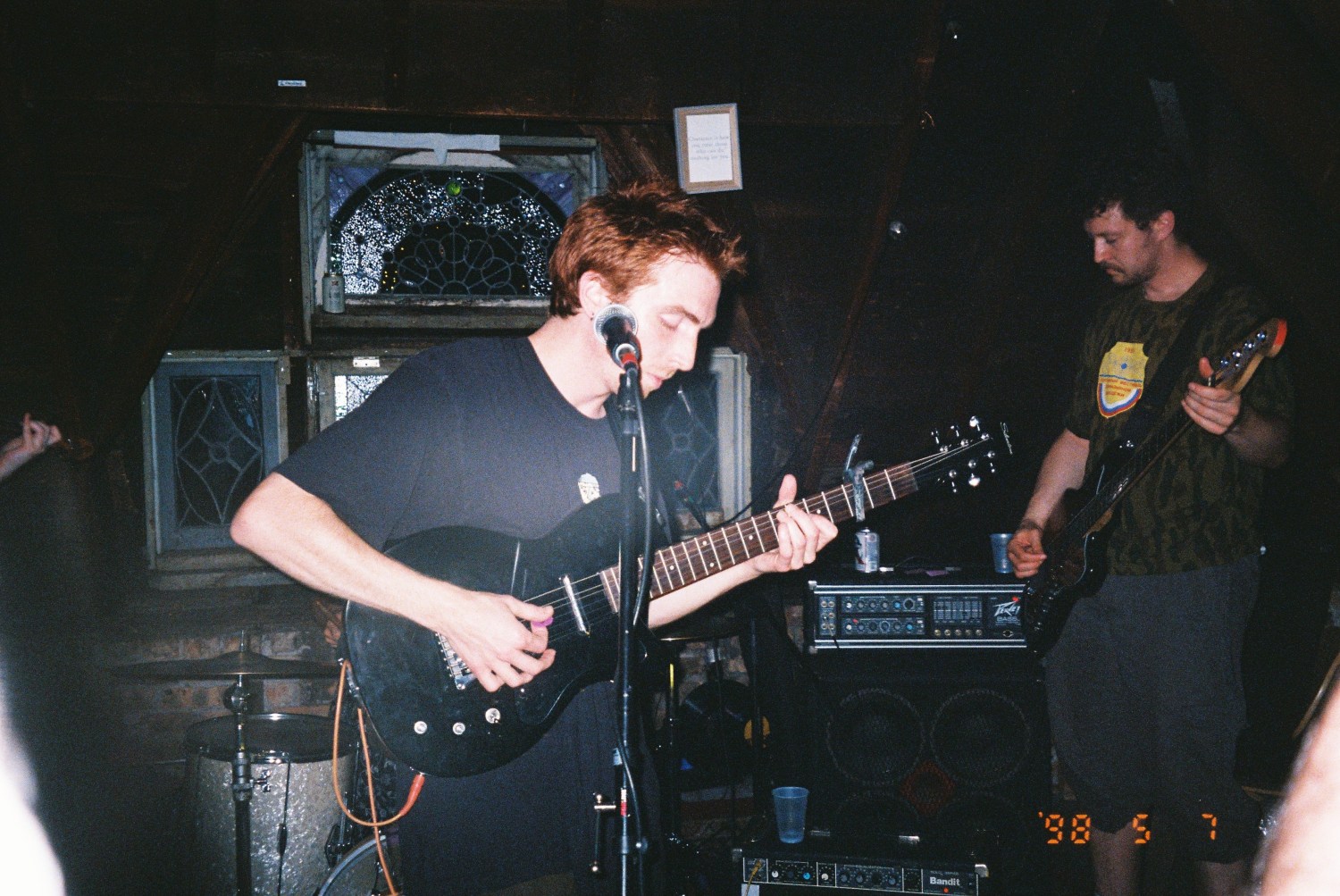
Photo by Eilee Centeno at The Attic in Chicago
During his performance at The Attic, a house venue in Logan Square, Chicago just a few hours before the interview, I felt myself slipping in and out of consciousness. Huddled around the five-piece ensemble framed by beautiful wooden ceilings and stained glass windows overlooking the neighborhood park, dripping sweat from the back of my neck, I wrapped my arm around my brother as tears swelled in my eyes, feeling a sense of belonging and comfort I had thought I’d lost. One moment I was zeroed in on every movement on stage, the next I was completely blacked out singing along to “Domino” and imagining every step I’ve taken mumbling along to that song in my hometown in North Carolina, being reminded of every time I looked up at a stop light and felt my heart sink and long to slip into one of the strangers passing me on the street.
I started thinking about how Hanif Abdurraqib profiled artists, usually making them seem larger than life. It feels like an innate human reaction to obsess over people and hold them up to standards that are above themselves. Maybe it was because I had just read a chapter in his book, They Can’t Kill Us Until They Kill Us, about the Weekend and his superhero-like ability to turn a crowd of thousands of people into sex-crazed animals, and it made me think about the humor in how most people obsess over huge pop stars, people like Taylor Swift or Drake who have big personalities and heaps of charm and charisma, but the person I obsess over is an artist with the posture of Bart Simpson who works at a fast food restaurant, and maybe everyone should make that pivot, too.
Maybe looking up to figures that are larger than life is what’s stopping us from making the changes in our daily routine that will push us towards a realization that we can take small actions to get us out of this mind numbing repetition. If our inspirations are more grounded in everyday life and our peers, then the disconnect between our motivations and our willingness to delve into our passions will disappear.
Even Keegan’s recording process when making a Kitchen album is reflective and representative of how it seems our generation is feeling. There’s tons of kids who are getting into analog recording with the hunger to connect to a creative process that grows with you and naturally takes the shape of your environment. It’s harder to delete or record over a mistake on a tape recording, but it becomes easier to accept and work with it, forming the rest of your recording process around that moment.
“I was really inspired by Spirit of the Beehive for a while and I moved away from tape recordings, but then I stopped doing the computer stuff so much because it’s all MIDI and you can get any sound you want. You can make an instrument play any sound you want. Most of what I like about a lot of the music I listen to is that it feels very natural and feels like things happen almost by accident,” Keegan said when talking about the evolution of his recording process.
There’s a sense of satisfaction that you get when committing to things, whether it’s finally finishing that Cormac McCarthy book that’s been sitting on your shelf for a year, or completing a week of journal entries, or following through on plans to hangout with your friends, sticking to your word is one of the hardest things to do especially when we are constantly distracted by the endless cycle of Instagram reels from friends we have to watch or new Pitchfork articles we have to read and argue about on Twitter. We’ve become so scared to share any imperfection of ourselves or our work that we often lose all strength to do anything at all, but Keegan has learned to embrace imperfections during his recording and writing process and even finds stability in them.
“When I was recording ‘Pike’ years ago I accidentally recorded one second over every track so there was a gap in the song that I couldn’t fix and I ended up having to re-record the whole thing. This was one of the worst mistakes I ever made while recording and the track was shaping up to be exactly how I wanted it, but it ended up being even better when I re-recorded it.”
After years of recording, Keegan has found a method that works well for him, bridging all of his influences into a succinct and memorable writing and recording style. In a short period of time Keegan has been able to create a distinct sound for himself that goes past his abilities to write catchy and relatable pop tunes. From the minute you hear the tape hiss, to the first down stroke of his guitar, to his shaky voice breaking over the track, you immediately settle into the comfortability of his work, allowing yourself to let your walls down as he does in the same breath. The combination of digital and analog recording styles is a reflection of the world he wants to create, full of imperfections, insecurities, and timidness, as well as patience, desire, and care.
Keegan described how his most recent record was made through this process, “You can hear when it’s tape stuff. ‘Fall’ is all digital, but ‘Halloween in August’ is a blend. The first half was recorded on a boombox and the second half was recorded into logic. The vocals were all recorded into the boom box, and then I cut them up and put them on top of the track.”
There’s so much care that goes into Kitchen’s recordings. His music builds upon intense swells, yet they’re never emphasized by crashing symbols or heightened vocals. They’re intensified by the realization of seeing yourself in Keegan’s music more and more. The lyrics become more weighted and backed by the world he creates throughout his albums. While his records may not be conceptually planned, there’s lots of nuance that leads you from song to song. “I Want You” wouldn’t make you cry as hard if it didn’t follow “Halloween in August,” continuing in Keegan’s story pining over someone. He has such a unique way of making you see the beauty in the mundane, and genuinely walk away feeling it. Weaving instrumental interludes between songs carries the feelings over from one place to another, transporting emotional spells from one song to another.
The other night I watched the movie The Lunchbox by Ritesh Batra, and in it the main character passed a street artist who painted the same place every day, but in each painting there were small differences. A kid riding a bike, a guy walking a dog, a couple holding hands would appear somewhere in the painting. The main character thought he saw himself in one of the paintings so he bought it and held the painting to his chest the whole train ride home. Keegan’s music feels like bits and pieces of a larger feeling. Each time I listen to a Kitchen song I see myself in a different world. His music is instantly so familiar that you sink into his world so instantaneously, holding on to your own memories and creating more within his albums. In a time where feelings are so quickly passed through, especially in the way that we’ve become accustomed to consuming and processing feelings, Kitchen’s music is so permanent and tender. His music instills a sort of stillness that feels very important and impactful right now. “Everything I do is cautious, can’t make my arms do what I want.”
“I think I process stuff very slowly. It takes me a really long time to figure out how I feel about something a lot of the time. By the time I figure it out, it’s a little bit too late to do anything about it but write a song. Maybe that sounds fucked up.”
Unknowingly, Kitchen connects rooms full of kids acting like adults based around a sense of hope that while we outwardly try and project how unique we are, we all feel the same sense of desperation, hopelessness, and passion. At his show he closed with one of my favorite songs, “Demon (Yellow)” and it only feels right to me to end this piece by quoting my favorite lines from it because Keegan always has the words for when I don’t, “crossing oceans, desperate phrasing I can’t talk cause I’m too lazy.”
Keegan just announced that you can now pre-order the first Kitchen album, town, on both vinyl and cassette. You can purchase a copy here. Kitchen will also be playing a few upcoming shows with Hello Shark in Troy, NY on November 15th and in Buffalo, NY on the 16th, then in Rochester on the 17th with Spencer Radcliffe, Hello Shark, Attic Abasement and A Wonderful.
Through the faulty wiring and warm hiss of old tape recorders, Chicago’s latest addition, Harrison Riddle, has offered up his latest album, Lo Stereo, taking over the static waves and ecstatic ears of the local scene and beyond. Having performed under the pen name Riddle M since 2018, Lo Stereo finds Riddle in a continuation, arranging episodic moments that live out their own concise lives in the limelight of DIY antiquity and absorbing pop hooks.
Where flying cars and chrome exteriors used to imply happier times ahead, Lo Stereo kicks off with the retro shine of “Keyhead (Outer Space)” – daydreams push through with no intention of landing – “You don’t have to race / Up in outer space”, he sings over laser synths and a pleasant chicken pecked melody. Songs like “Sunset Inn” and “Falling On Off” play out with clunky whimsy, where melodies float through the air with ease above the strength of instrumental voicings that never feel to be restrained by the limitations of lo-fi recording. And to his credit, dusting off the old 4 track recorders, drum machines and synths, these new songs don’t feel weighed down by past sounds or ideas, but rather find Riddle embracing new life in an old and beloved style, bridging the gap between nostalgia and a continuation of homemade pop excellence.
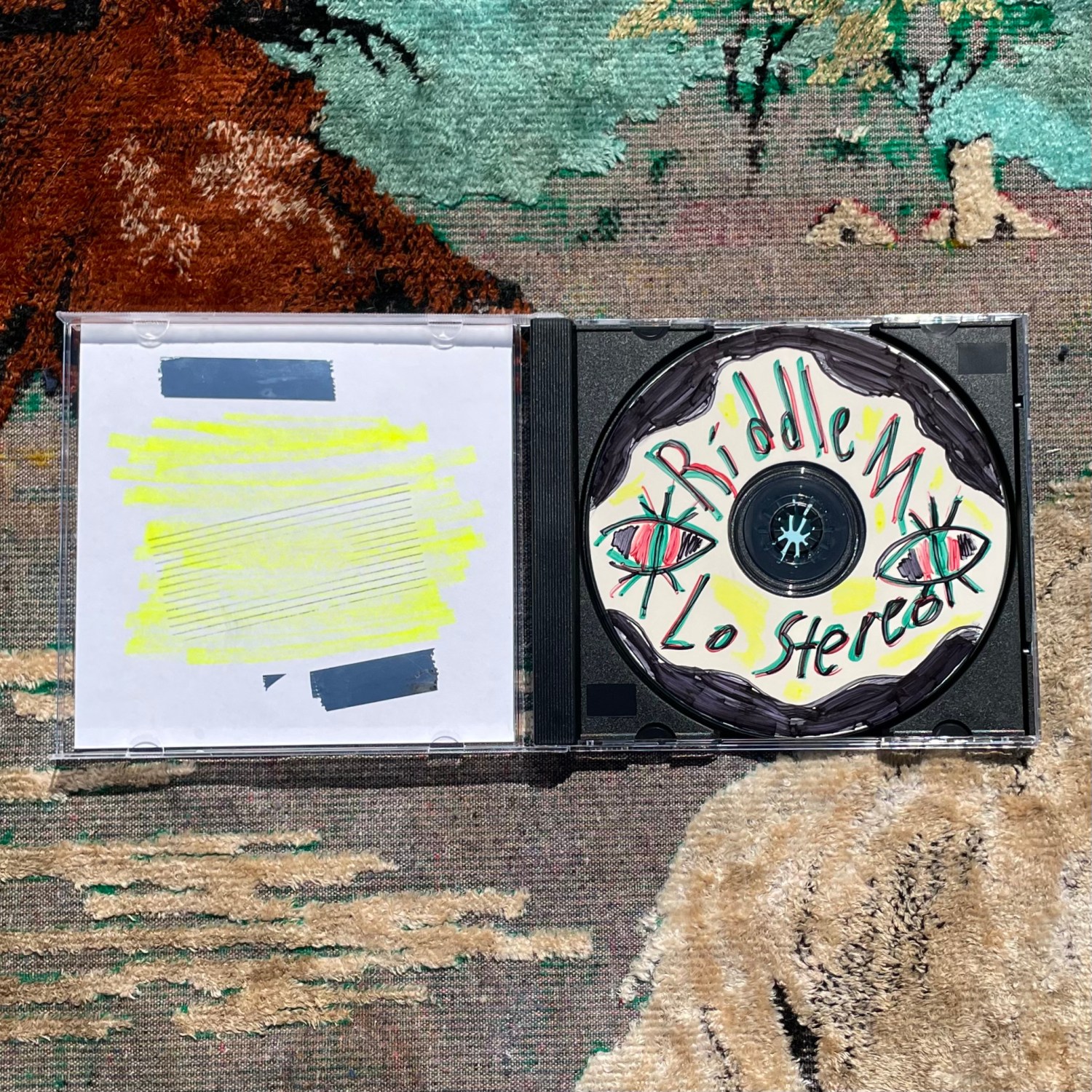
Lo Stereo Limited Edition Homemade CD
Throughout all of the methodical interpretations that each song offers in their own unique way, Riddle’s performance and attitude towards writing becomes a needed reminder of how much fun making music should be – a marvelous feeling of universality that comes when connecting the world around you with silly stories and cordial characters. Songs like the clinky folk ditty of “Peaches and Cream” or the riff spilling of “Scarecrow” exudes charm and personality that sits with you long after the initial listen. “Silver Dollar Queen” jangles and dances along with its vibrato melody and driving hook, while “Bubbles” and “Pin Holder” find the off-center pop sensibilities of lived in new wave classics. There is a soothing pull to the studious electro motives that shine with a rusted sheen throughout the album, where songs like “Sleeping On Earth” and “Modern People” fit neatly between rugged rockers like “Fight Little Truffle” and “Bird Claw” that could easily be a part of the substantial catalogs of bands like Guided By Voices or The Magnetic Fields.
The album takes a turn as the end becomes inevitable – not so much a crash landing, but a quick return to our own atmosphere and the notable gravitational restraints. “Haunt In Bed” vibrates with darkened synths while accolated, ghostly vocals come out to say their brief piece before they are off on their way to complete other ghostly tasks. “Waken (Your Love)” brings a natural ‘down-to-earth’ ending to a rather adventurous collection of songs, as a heavy, somber synth is brought out by a field recording of light waves finding their own, breaking on the shore with a soothing, methodical washing. It’s quite a distance from where the journey began, but considering the care put into this charming little world, becomes one to take over and over again.
You can listen to Lo Stereo everywhere now. You can purchase a limited edition CD of Lo Stereohere.
Grumpy is back! The Brooklyn-based project of Heaven Schmitt has returned to earth with “Protein”, the first new song shared since embarking on a four year side quest, marking a triumphant return and a huge step forward for all things Grumpy. The primarily self-produced track is a beautiful lumpy mass – a body kept alive by electro-pop ligaments and meaty distorted muscles, as they pump blood into an autotuned lament of digital longing.
Echoing a lone drum beat, Schmitt sings, “I got your message and you’re suddenly confessional/ you want to keep things strictly professional” – a chromatic plea of disappointment with the noticeable gap of digital intimacy. The chorus is loose and playful, utilizing the hyper-rock backdrop of heavy guitars and running synth licks as leverage to its dreamy and melodic palette.
“Starving for attention in a protein bar” – Grumpy thrives in the surreal, blending personal insecurities and unfiltered introspections that thrive in the absurd, telling an honest and compelling story of regret and heartbreak – a type of writing that is emotionally applicable, deeply relatable and sticks to your bones with every listen.
“Protein” is best ingested with the accompanying music video directed by Sarah Ritter (Surf Curse, Samia, Cherry Glazer). The video depicts an extraterrestrial story of obsession and longing, with a spout of alien warfare and Martian-like-wonder to highlight this new idea of futuristic vulnerability.
As Grumpy enters a new realm today, it is wise to let them show us the way. “Protein” is sincere, eclectic, introspective and irresistible, showcasing the evolution of Grumpy’s artistry and influences as they learn from, and further build out their craft. You can listen to “Protein” on all streaming platforms now.
Last month, Bloomington-based artist, Amy O (Oelsner), returned to the scene with her charming and heartfelt new record, Mirror, Reflect – her first in almost five years. Embracing captured moments over picked performances, Mirror, Reflect is a return to DIY form for Oelsner. Blending the warmness of lo-fi home sessions and captured field recordings, the looseness of song-a-day exercises and the sheer joy of a sparkling pop tune, Mirror, Reflect plays as a sincere and varied sonic recounting.
As a project, Mirror, Reflect documents Oelsner’s transition into motherhood, embracing both the uncertainty and the beauty of those early days of parenting. It’s a very tender record, written from the feelings of grief and isolation, yet Oelsner cherishes the moments of grace that shine through. Brought to life by her poetic and witty lyricism, Mirror, Reflect is a truly unique and enduring project, marking a prominent return for the artist.
The Ugly Hug recently had the opportunity to catch up with Oelsner, discussing the inspiration for recording Mirror, Reflect and learning to fit music back into her life.
This interview has been edited for length and clarity.
Photo by Justin Vollmar
Shea Roney: Mirror, Reflect was a very highly collaborative project, can you tell me a bit about the people you chose to work with?
Amy Oelsner: I kind of worked separately on it all. I did a portion of the songs with my friend Glenn Myers, who actually lives five minutes down the road from me. It was very relaxed and we would usually get the majority of the song done in just one day when we worked together. And then I also worked with my friend Jon Meador, who was living in Bloomington at the beginning of the project and then he and his wife moved to LA. We happened to visit them last spring, and I was able to finish up the recordings at their house. I did a lot with my husband, Justin [Vollmar], and he also mixed the whole album. I did include one song that was recorded for my old album Shell that I had never used. That was with Ben Lumsdaine at Russian Recording with my old band on it. And I did one song with Will Staler who moved to Australia so we recorded it right before he left, and that was actually what started out the project. He inspired me because he had an ongoing project of recording friends on his 4 track, and I had so much fun that it was what initially jump started this whole thing.
SR: Did you find there to be differences in the song’s outcome when hopping between people and recording processes?
AO: That was part of what I enjoyed about it, being able to curate which song I thought would fit the different vibes of each person. For example, with Glenn, we were kind of casual, so for “Dribble Dribble”, I recorded that song and I just did my one vocal take and that was the take we got. But with Jon, he’s a lot more meticulous, and I worked with him on “Arc”, and we spent a few months just developing the drumbeat for that.
SR: How spread out was the timeline for this album?
AO: I had always been on a pretty tight timeline in the past, and so one of my hopes, and I guess one of the ways I was stretching myself in this project was to allow it to take as long as it needed. I can be a pretty impatient person, so that was challenging for me. I would say I started writing the songs in 2020. I wrote that song “Arc” while doing a song-a-day project that July which I did for four months and then I just kept drawing from them over a three year period. I started recording in January 2022, and that was about a two year process.
SR: You described making this record as a return to your DIY roots. The lo-fi sound of these songs, as well as the field recordings you chose to include, create a very documentary-like feel to it. What was it about this project that sparked this shift in your process?
AO: Yeah, it was sort of an exercise in releasing perfectionism for me. I had definitely approached my previous studio albums with a very perfectionist attitude. I’m really proud of those works, and you know, that’s what I needed at the time, but I just felt like I was in a place where there had just been so much stress and anxiety around the pandemic and my postpartum experience. I just knew I didn’t have room for that anywhere else. Music is supposed to be fun and healing, so I really wanted to free myself up. I think if you’re being perfectionistic, it really cuts off the creative process at a point, so I wanted to just open that up so I could see where it would go. I really wanted to, in terms of making it feel more like a documentary of my life, include more of myself in it. That actually was a large goal for me while finishing the album. I really wanted to have an artifact for myself to look back on this period of my life when I’m older.
SR: During the pandemic and your experience with postpartum, how did you invite music back into your life? Did it help you learn about your own process of grief and healing in any way?
AO: When I became a parent I didn’t know how music was going to fit into my life anymore, and I knew it was going to be a learning process. But I think what I discovered right away was that I immediately went back to songwriting when my daughter was four months old. I decided to do a song-a-day project because that’s something I’ve done to generate material many times over the years. I wasn’t expecting to do something like that when she was so little, but I realized I have to. That’s like therapy for me and it just brings me back to myself when I’m upside down. I think it’s just naturally how I process, I realized. It doesn’t take effort for me, and I’ve just learned that is how I get through grief.
SR: Mirror, Reflect was such a beautiful way for you to document your time defining, and often redefining, the relationships you have in your life. Can you tell me a bit about that?
AO: I think that a lot of it came naturally around learning my new identity as a mother and learning who I am now in that way. And then also my relationship to my daughter, and just kind of working that out through song. I feel really lucky that I already had this relationship with myself as a songwriter, so it felt like a really nice way of bridging my old self with my new self by working that out through songwriting. I think that it’s just a familiar format for me and it’s a way for me to kind of alchemize all these experiences. Especially when you’re in the early part of parenting, it’s so disorienting because you’re not getting sleep and everything that I used to be able to do I can’t do anymore. So I think through the songwriting, even just stealing little moments where I can get a melody out, became a way of putting a stake in the ground, to be like ‘I’m here!’
SR: While reflecting on the harder times and these big changes you experienced in those early days of parenting, you still allowed yourself these little moments of grace. In what ways did you learn to embrace the joy around you when writing these songs?
AO: Something that I’ve been thinking about recently is that it’s very easy for me to identify what’s not working. Especially when things aren’t going well, it’s just very easy for me to do that. But it’s harder to take those moments and really soak them in when you are experiencing joy. A lot of what I was working on in my life was slowing down; removing the feeling of urgency around creative projects and really anything else. I think that parenting has been teaching me that a lot. My daughter’s pace is just so much slower, and she is just down there on the ground looking at every little thing. It’s a microscopic view of life and that can be challenging when you’re used to moving so quickly, but I think it was embracing that helped find the joy in it.
You can stream Mirror, Reflect on all platforms as well as purchase a cassette tape here.
Dallas based musician, actress and visual artist Tex Patrello is an anomaly in many ways. After the release of 2017’s short EP, yellow curse, her musical career has flourished in the celestial outers – but once you discover it, her artistry becomes impossible to look away from. Expanding our comprehension of what a bedroom musician can be, brandishing her own style of dysfunctional and twisted pop music, Patrello has always pushed the boundaries of what we consider capable by an individual.
Last week, Patrello finally released her highly anticipated debut full-length, Minotaur, off of Texas label, View No Country. After spending seven years in the making, Minotaur was conceived with the mindset of a musical, accumulating characters, thematic squirmings, suggestive imagery and the sheer magnitude of interpretations that make for a project of grand proportions. Overt patriotism, body objectification, attentive despondency – the world that Minotaur exudes feels obsessive, sinful, and sexy, yet utterly revitalizing at the same time. Patrello, who embodies herself throughout the album, encounters various characters that direct her decisions; Ricky the football player, Lou the matured suitor, and The Beast. Minotaur, as a whole, is a manipulation of reality, a mere delusion that Patrello has manufactured herself for the pure purpose of understanding where and what she is truly connected to.
Photo by Tex Patrello
With ten engaging songs, some creeping over the six minute mark, Minotaur is reluctant to let up. With a continual build of haunting avant-pop contusions, waltzing, hollowing lows and high spiritual frenzies that fluctuate with Patrello’s throbbing heart, Minotaur squeezes out as much expansive, and oftentimes charmingly offensive, production styles as possible. At its core, songs like “Panda Express”, “Wichita Falls” and “Anything Goes” still seamlessly flow with whimsy over shifting patterns and arcing instrumentation that Patrello bundled into the prog-like folk style of yellow curse. But beyond that, Minotaur is magnetic, clinging to new sounds of ravaging orchestrations, acrobatic vocals and electronic decays as Patrello’s posture wavers through song structures, molding from one idea into the next with such strategic thought and execution.
Breaking down her process, Patrello is patient when shaping melodies. “I find whatever makes me feel a high at that moment. I extract that, and I end up joining those extractions together.” As far as the individual songs go, she continues, “I tend to keep building upon them – making sure I love every corner and turn in it. I just didn’t want to have anything I didn’t love in this album.” In its full construction, “I would say that there is no song on this album that’s under 50 tracks. And there’s some, I think, that are 400 tracks.” She recalls, “it’s two different projects, because it wouldn’t even work if I had it in one. My computer wouldn’t work.”
Spending seven years endlessly working through these configurations, flexing through instrumentations and concepts as well as learning to mix and master on her own, this magnitude of time and intensity is vital in the name of Patrello’s artistry. There are multitudes of shifts and changes, blending patience with needs, as personal tribulations sway her perception of reality. “I knew a story I wanted to tell, but I didn’t want to push anything. I wanted to write a musical, but have every song come naturally – as if I wanted to make a movie, but every scene happens to me before I put it in.”
Patrello’s world is strikingly unique and personal, pulling us in with cartoonish characters and tropes that only further intensify the situations. These characters are structured within convoluted juxtapositions that feel distressed within her own being as she experiences them in real time. “I feel like one of my biggest sources of inspiration comes from things that I have no interest in,” she confesses, something that feels oppositional to what we are often told – “write what you know”. “I don’t know anything about sports but I’ve written like 5 songs about football,” and yet, football becomes a symbol of power, sex and eventually hostility as Minotaur unfolds into its climax.
In the opening track we are introduced to the all-American football star’s son, Ricky. It starts with a white flash, an intense heat, as Patrello demands the car come to a stop, when Ricky first appears and this delusion begins. Changing out of his football pads, she sneaks a look at his perfect athletic body. “I crouch/ It’s some hunk in his backseat now/ He’s undressing/ He lifts his jersey/ It’s Ricky”, she croons, struck with instant infatuation. “Ricky is real in a way. He’s a bunch of different people that I’ve lived with these last seven years,” Patrello admits. He lives on a pedestal in her mind, being the only one who can satisfy her lust for perfection – perfect image, perfect smile, perfect body, perfect lover, perfect sex.
When writing Minotaur, Patrello was very intrigued by the Nelson Family, who, crossing decades, held a looming level of adoration in American culture throughout the 1950’s during their long running sitcom, The Adventures of Ozzie and Harriet. “They were the perfect family of the time,” Patrello says. “The show is literally just about their family,” consisting of Ozzie and Harriet, and their two sons David and Ricky. “The episodes aren’t very interesting. The stories they tell aren’t interesting at all,” but this TV family was meant to portray the very real Nelson family as the perfect, All-American, white picket fence – true patriots of the middle class mirage – that the American narrative forced at the time. But on the contrary, blending this level of perfectionism with real people who were very much not, brought out the inevitable, and quite public, destruction of what was reality to them.
Photo by Tex Patrello
As the most interactive character, Ricky holds a level of control over Patrello, whether he is aware of his powers or not. “I’m kind of using someone as my muse for [Ricky], but most of the time the person I’m writing about is apathetic or rude or uncaring. And so I think that in my head Ricky has a lot of highs and lows in this album.” As Ricky lives his life, strongly on his own terms, Patrello’s relationship to him always feels to be trailing behind in whatever capacity Ricky will allow. “My fluctuations are probably just responses to Ricky’s fluctuations. He’s sort of calling the shots on what I’m thinking and what I’m feeling.”
For as much as the album revolves around Ricky, the real focal point that drives the story is the way that Patrello interprets the distance of their relationship and her own autonomy. “I think in Ricky’s world, I’m not as much of a concern to him. So I think it’s more about my progression than his.” The song “Long Lost Pimp” trails a brief moment of liberation as Patrello tries to push Ricky away, seeking out the compassion of an older man named Lou. “Wichita Falls” feels like a holy communion as Patrello sees Ricky finally committing to her. “That trip to Wichita Falls, I think, is like a baptism for me in that lake. My yoke is being loosened. My sin is being drowned.” Songs like “Slick-Dick’s Baby” show violence in the same vein as sex and passion, as Patrello watches Ricky dominate his football game, becoming unwieldy and lascivious by her love for him. “Love me like you love America/ And when you choke that fucker, call me wife/ And when he’s out, my god, I love my life.” As her character’s direction feels fated from the beginning, “I think I’m just responding to Ricky most of the time,” Patrello admits.
“I would say that The Beast is the opposite of my relationship with Ricky”. To Patrello, The Beast, or for namesake, The Minotaur, can be a culmination of a lot of different things in her day to day surroundings – the things that she overlooks in the name of casualty and routine, though they always offer some supportive ground below her feet. “I feel like I was trying to have Texas speak through me a little bit. When I’m more connected to The Beast, I’m more connected to the Earth and I’m more low to the ground and present in this land – in Texas specifically.” Unlike the uncertainty that Ricky excretes, The Beast, and its many possible representations, feels comfortable in his presence and actions. “I feel as though I’m more a resident of my room than of any city, because I’m not out super often, but when I am, I feel very connected to Texas and this land surrounding me.”
Photo by Tex Patrello
In a lot of ways, Patrello utilizes the Greek origin story of the Minotaur, one of lust, conquer and betrayal, as a source of direction and relation for her own story. As it goes, Theseus is sent from Athens on a mission to slay the Minotaur that lives in the Labyrinth, but arrives wildly unprepared. Ariadne, the mistress of the Labyrinth, sees Theseus and quickly falls in love with him. Fearing that he will be killed in this fateful battle, Ariadne equips him with the tools he needs, but only on the premise that if he succeeds, he must marry her. “I’m connecting myself to Ariadne,” Patrello asserts, mirroring her own story with Ricky – falling helplessly in love until he, almost predictably, abandons her on a whim.
In the end, Patrello is filled with the guilt of neglecting, forfeiting, and having a hand at slaying The Beast – not until he is dead does it become clear the significance he has on her life. The second to last song “Pony Meat” plays as a memory, spent “reconnecting to a past life where I might have been Ariadne,” as she sings,” “Animal, you animal/ So sweet to me/ I didn’t know, how could/ I know/ Just what you mean?” There is desperation in her voice, each line more sobering than the next. Ricky is gone, The Beast is dead, the world she has built is crumbling and her true reality has succumbed to darkness. In its stillness, Patrello admits her realization – “it’s wanting what you can’t have. The Beast is what I’ve had, and it’s hard to see that comfort or beauty in him with how enthralled I am with Ricky.”
In her process of accumulating inspiration, choosing to write about things that she has no interest in, such as Ricky’s All-American football career, there was a distance between Patrello and Ricky from the beginning, where Ricky was always going to be more idolized than truly loved. “I think when writing [“Pony Meat”], the whole time I felt more connected to the Minotaur and that sort of like dirty or freaky side of me that I wouldn’t allow to be seen by Ricky,” Patrello admits, continuing, “I feel that I’m not putting something on as much anymore.” That is where the difference between Ricky and The Beast becomes gripping – in whose claws does Patrello feel most connected and grounded to be her true self.
“The Minotaur is a human body with a bull’s head, of course, and I think that that’s why I’m most connected to him,” she conveys. “I feel similarly, in a way, where I feel like I’m a pretty face on a beast’s body or the other way around.” This duality, half man/half beast perfectly interprets human nature – sinful, lustful, rabid, violent, egregious animals who can put on pants and a tie and call it civilized. Like the Nelson Family, blinded by the lights of Hollywood, the paparazzi and their own ego, their show acted as their own pair of pants and tie (for as silly as that sounds), creating a false and conflicting image of who they truly were, winding up to be their own tragedy.
As an album that grows out of a delusion, fluctuating between realities, worlds and personalities, the finale, “DeKalb” flourishes in its ability to be present. “Dekalb is when I’m really the most lucid, and not only do I feel the most lucid, I feel like that’s the first time I’m lucid in the whole album and the most connected to where I am,” Patrello reflects. “I guess I’m connected to where I am, and I feel like I’m less delusional about things – things like Ricky.” Patrello doesn’t shy away from how much her character has faltered trying to be something that she is not – its her own modern day Greek tragedy, one to be reiterated over and over again in time.
“The conclusion of the album is that I’m still petty,” she says with a slight laugh. “There’s like no lesson really learned, but I think I’m just kind of waking up a little bit in the end.” Although there are moments that feel full circle, there is no clean conclusion, leaving us listeners with some unease. But to its credit, that’s the point. “‘Dekalb” is very aware that I don’t feel like I’m in a resolved place in my real life,” Patrello states with full honesty, firm in the artistic choice she has made. “So with what’s happened in this album I wasn’t gonna end it in a perfect way.” Minotaur is a starting line, the culmination of events that Patrello felt were necessary to experience before real change, growth and sobering realization can begin. And who knows, maybe seven years down the line we will get her next chapter – in the way that only Patrello sees fit.
Tex Patrello has a few shows in Texas that will be announced in the coming weeks. You can stream Minotaur on all platforms now and purchase a CD or tape of the album.





 the ugly hug