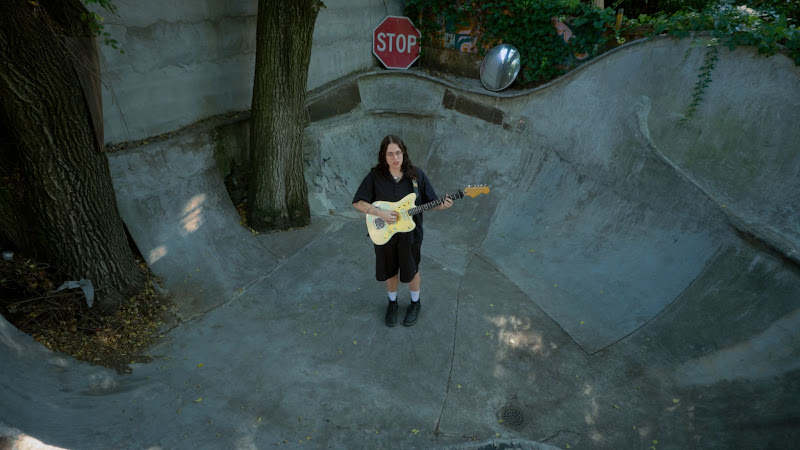
Step aside, OK Go. Claire Ozmun’s “Dying in the Wool” is about to dethrone “Here It Goes Again” for most iconic music video of all time, and it doesn’t even have any treadmills. What it does have is a concrete bowl that skaters have been dropping into since 2014. The Soul Bowl has been well-known and equally as beloved in the skating community for a decade, since it was poured by hand in the backyard of an unassuming Brooklyn apartment building. Multi-talented percussionist Immanuel Pennington of such acts as Poolblood and Captain Tallen & the Benevolent Entities holds it down there now.
On the day of the shoot, the band had just gotten back from the first leg of a two-week tour. Shows in Brooklyn, Philly, Poughkeepsie, shot the video, then left for the second leg 48 hours later. We loaded the car with gear and hit the road west-bound for shows in Cleveland and Chicago. (“We” because I got to play roadie-for-hire. Please hire me.)
To create the effect of the crowd moshing in slo-mo as they played, the band had to learn to lip-sync and play their instruments at double speed. During every take, director Ellie Gravitte reset the song and played back a double-fast sped-up version. While this had potential to feel like a quasi-Speedy Gonzalez cartoon (and it totally did at first), after everyone got used to it two takes in, the overarching crowd-feel quickly shifted from comedic to “Holy hell this is even cooler than we thought.” Seeing the band so tight even at 200% speed was wildly impressive. Keyboardist Catey Esler noted how solid the whole band felt playing “Dying in the Wool” at future live shows after having gotten it down at double-speed for the video.
Gravitte’s visionary, experimental camera angles are the product of insanely impressive balance and athleticism. She and her team balanced perched on top of the skate bowl wielding heavy camera equipment to get these shots. At the same time, Gravitte’s hurling necessary artistic directions like “Can you guys smile less? You all look like you’re having a blast, but this is supposed to be cool,” and “Just mosh like you’re all on ketamine.” (The whole crowd said “ohhhhh.”) Indeed, everyone in the bowl knows each other and loves each other and cares about each other’s lives, and it was a genuine challenge to not over-smile. A few weeks before, the same group chat of friends that sends “what’s poppin 2nite” texts gets a casting call like, “Hey we’re shooting a music video and we want you to all be in it. There’ll be pizza and beer.” And everybody came and it ruled.
Watch the video for “Dying in the Wool” premiering here on the ugly hug!
Ellie Gravitte, the video’s director, shares in a statement, “if you’ve been to a COB show, you know it’s all about community. Claire Ozmun loves her friends harder than anybody I know, so we thought it was only right to make a video with the homies at the center of the action. Throw in some Brooklyn skater vibes and you’ve got yourself a taste of that retro punk scene that this EP so beautifully evokes. We put this together in a single day in a backyard skate bowl in Bushwick, instructed all our pals to wear their best goth looks from 2009, and moshed our little hearts out. We hope it inspires you to do the same.”
Not only can Claire Ozmun write a generational battle cry, but she can also apparently serve face even at double speed. It takes a sturdy person with A Good Song to be able to sing into a camera and make it look not only natural but unbelievably cool. Watching her here feels like the first time a fourteen year old watches Kurt Cobain speak to an interviewer and feels that deep inner stirring. She is the icon this new generation of rock n rollers has been hungry for – assuming the position left empty by predecessors Kim Deal, Chrissie Hynde, and Grace Slick.
This video is an amalgam of supremely talented artists. But, the actual shooting came with minimal direction, because the entire cast had trained for this role with months or even years of method acting. We all knew how to shake ass at a COB show. Attend one show yourself and you’ll find it’s impossible not to start movin. The videographers put us in the bowl and just said “mosh” and we knew what to do. A few takes actually had to be redone because we had to dial it back from the level of enthusiasm that was our natural reaction/instinct to deliver. Everyone wanted to take an elbow to the chin for this band. Months later, everyone on set still refers to this shoot as “dying in the bowl.”
Ozmun’s “Dying in the Wool” video showcases the electric, thriving music community alive in Brooklyn, New York in 2024. This is a truly special, ageless capture of a time and place where a lot is happening and all of it is good – especially COB and their music. Melomaniacs worth their chops (or at least worth their CD collections) should keep their eyes on The Claire Ozmun Band.
As a small music journal, we rely heavily on the work of independent tape labels to discover and share the incredible artists that we have dedicated this site to. Whether through press lists, recommendations, artist connections, social media support or supplying physicals, these homemade labels are the often-unsung heroes of the industry. Today, the ugly hug is highlighting the work of our friends over at Toadstool Records.
Formed by Caroline Gay as a home for her ethereal instrumental project Ghost Crab, Toadstool Records has become a home to a world of other creatives, offering a supportive and inspiring place to expand on their own and create art with those with similar mindsets. With the help of Michelle Borreggine [Dreamspoiler, orbiting] and Jonathan Hom [Mystery Choir], Toadstool has cultivated a collection of artists such as Youth Large, Mystery Choir and superbluesurf, as well as a few compilation projects like Valentines for Palestine, Let’s Be Friends: A Tribute to the Beach Boys or the upcoming 777 Love Songs out on Valentine’s Day, in which all proceeds go towards Women’s Prison Association and Mutual Aid LA.
We recently got to catch up with Caro, Michelle and Jon to discuss the label, blending visual art with music, the importance of jamming and the ethos of sharing moments in music.
Ebb in Toadstool Records Studio | Photo by Caroline Gay
This interview has been edited for length and clarity
Shea Roney: Caro, I know that the idea of Toadstool was brought out with the release of The Garden Album under your project name Ghost Crab. What was the initial inspiration that sparked this idea to start a tape label? What was that process like and what goals did you have in mind when starting?
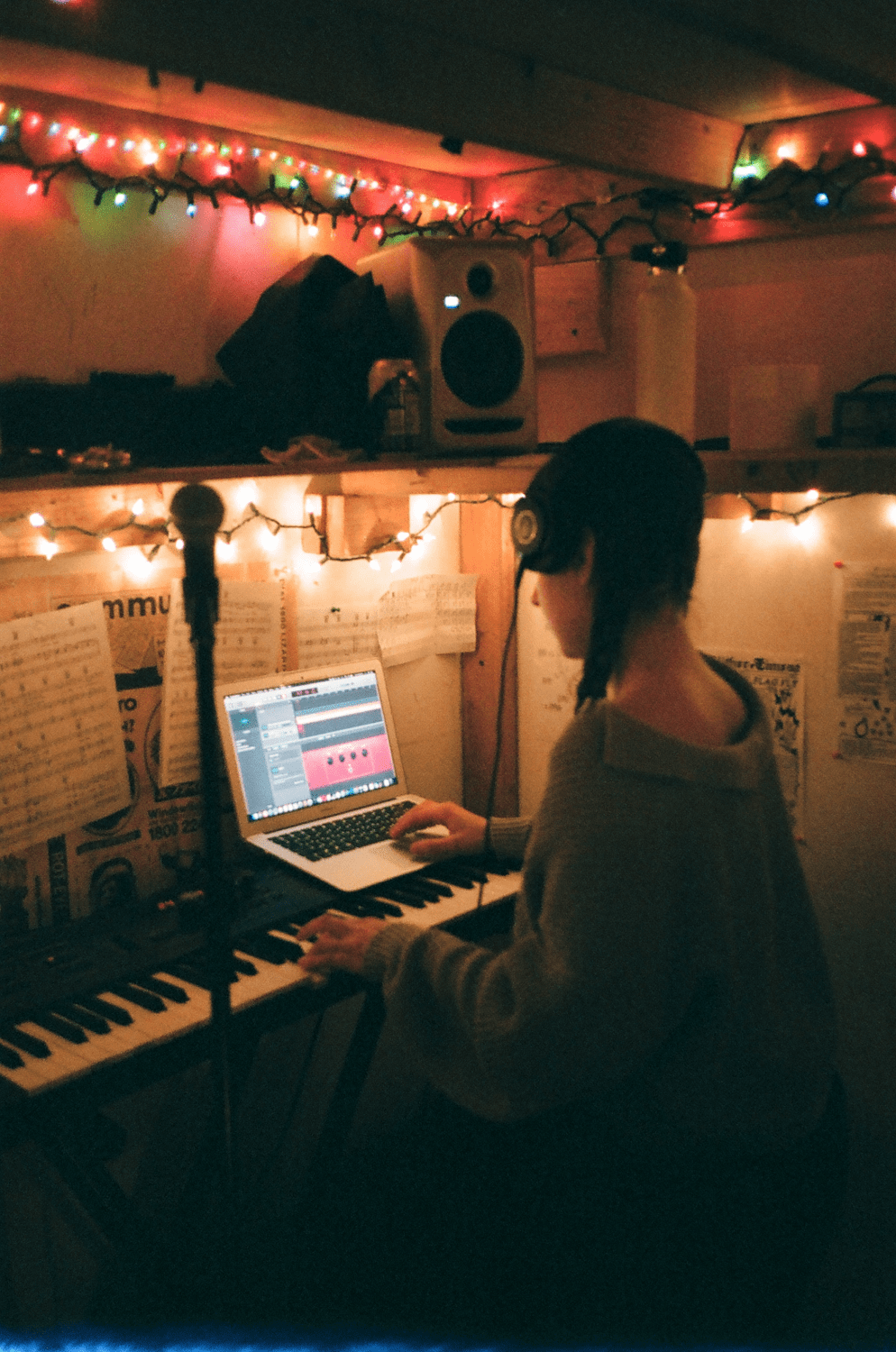
Yes, that was the “Garden Album”, which was the first album that I ever put out through my Ghost Crab project. It was entirely self composed in this basement studio that I had in Bushwick that I got from this guy I found on an online art studio listing in 2021. He told me, ‘oh, Juan Wauters used to have this studio’. He built this little tree house cubby thing and there were all these Christmas lights and all this weird graffiti on the walls, it was so perfect. I got a drum kit from this guy on Craigslist and this beautiful Korg synthesizer (because Rick Wakeman from Yes uses it). It was like my little setup. I basically would just go there and jam by myself after work. Then I started hosting karaoke parties and I would invite people over, and I would use a projector, and we would sing Karaoke, and it was such a blast, and so I started inviting people over to share the studio and we would split the rent. I eventually finished the album and didn’t really know what to do, so I just put it on bandcamp. It was sort of my first quote, unquote release, but eventually I started putting out more stuff, and I was starting to figure out like, ‘okay, this is sort of the correct way to do it.’ I just wanted to put a stamp on my work, basically, and eventually bring other people into the fold.
Ghost Crab in Toadstool Records Studio | Photo by Michelle Borreggine
SR: How did Michelle and Jon come to be a part of Toadstool?
Caro: I first want to say that Michelle makes really incredible music videos. I remember we saw each other at a film screening for a Jonas Mekas documentary she edited.
Michelle: We had known each other for a long time before that, we just hadn’t really crossed paths, I guess. That was when we both were volunteering at 8 ball, which is like an artist community slash library radio collective here in New York.
Caro: Yes, I’ve had a radio show for a long time through 8ball, but I remember I went to the screening and she was like, ‘you started a record label that’s so cool.’ I just posted about it on Instagram and I was like, ‘no one’s gonna care about this’ [laughs].
Michelle: No, I cared a lot! I was like, ‘Caro’s so cool, I can’t believe she came to my screening!’ I was just super pumped to talk to her because I personally have always wanted to play music, but I just never really found anyone who was down to play with someone who is not like, a musician. Caro was the first person that I met who kind of got that, and so I was really psyched to hear that she had this sketchy, weird music studio. There was this mannequin outside the door that was so creepy and the bathroom was terrible, it was deranged. But it was perfect and I felt comfortable to just play whatever. It was a very unpretentious environment which was very nice and just cool to get to experiment in there.
Caro: Oh, and we’re also – should I say this? – We all really love Animal Collective.
Michelle: Yeah, that’s definitely it. All of my Animal Collective friends moved out of New York. I was like, ‘who even still listens to them? I feel so lame.’ But Caro still loves them, so I was like, ‘my gosh, we need to talk.’
SR: Caro and Michelle, you mostly came up in the world of visual art. How did that background expand into the way you approached making music? Jon, what is your experience with making music?
Caro: Oh yeah, I was mostly self taught. I sort of grew up playing flute and I took drum lessons when I was a little bit older. But yeah, it’s mostly just sort of experimental and improvisational stuff. I think people who have good music taste should make music. That’s why it was so exciting to hear Michelle was excited to play.
Jon: I started learning how to record stuff myself, and I took some Berklee College of Music online classes to learn production. I just loved the music that I was listening to enough to go and explore. I’m very taste driven as well, so I’m always trying to achieve a particular sound. Initially I was just trying to figure out how they made those sounds, and then I just wanted to replicate them and figure out how to make my own.
Caro: My goal all along was basically wanting to make other weird friends. I secretly just wanted to make friends with people who would jam with me. Jamming with people is just such a wonderful thing to do. But it’s cool looking back because I have all these recordings on my phone of jams I’ve done with Michelle and my other old studio mates. I think everybody should jam, even if you don’t know how to play an instrument. Sometimes there can be a bit of pretension – people can be weird about it if they maybe have a lot of experience. But it’s speaking a language. Everyone can jam. Everyone should jam. It’s such a beautiful exercise.
Dreamspoiler at the 8ball Community Valentine’s Day Zine Fair 2023
SR: What are some of the things you learned from jamming?
Caro: I’ve noticed it makes me feel like I can trust people. It feels like a very vulnerable thing to do. And when I’ve been able to spend time making music with people who, you know, have never made me feel like less than or just anything like that – my old studio mate Zoë [Pete Ford], at the time when I didn’t know how to play guitar, she would give me a guitar and be like, ‘here. You play the guitar.’ I’d be like, ‘oh, I don’t know how to,’ she would say, ‘it’s easy.’ Then you figure something out, just something simple, even if it’s just using one string. Basically, as long as you’re putting a bit of emotion and a little bit of groove into it, you can still do it. I’ve always loved that attitude.
SR: Community seems to be a big component of what you do, whether in the shows and parties you curate, hosting Secrets of the Sunken Caveson 8 Ball Radio or sharing resources on your website. But one big thing you do are the compilation albums that you put together. Can you tell me about the two that you have put out and how that process from open call to final product goes down?
Caro: It’s definitely a little chaotic, but I feel like the end result manages to look super cohesive. A lot of the inspiration from Toadstool actually comes from a lot of visual art stuff that I’ve done with photography through 8 Ball [aka 8 Ball Community], which is why I got involved in 8ball in the first place. There are all of these artists that I really admire who have done stuff through 8ball, and the guy who sort of was the dad of 8ball would put together these Xerox books maybe once a year with different photographers and different people in the community. When you look at it all together it actually told this really beautiful story of all these people who were somehow attracted to this collective. There were poems, or people would put in selfies, or just, you know, sort of whatever.
One summer I was volunteering through Entrance on Ludlow Street in Chinatown, and they let us do whatever we wanted with the space. I helped put on this open call art show where anybody could come by – it was basically just so people could say they had been at a show at Entrance and could put it on their CV. I know how hard it is, I first moved to New York to be an artist, and it’s just so hard to get your foot in the door – to feel any sort of footing really because no one really wants to let you in. But 8 Ball was the first place that sort of let me in so I’ve always really loved that approach of ‘everybody is welcome’.
That was sort of the idea with the compilations, too. There’s this sort of nice altruistic aspect to it. For the last two that we’ve done, we’ve had more established visual artists contribute artwork who were nice enough to donate it, like Emma Kohlemann and Matt Durkin. They’re more established, so they sort of add this element of legitimacy to the compilations which I think is really cool. But it’s just a really exciting thing. I’ve had people email me, like one time someone submitted a song to me on Tumblr for the last comp, and they were like, ‘can you please put it under this name? I’m trans and this is the first time I’m using this name’. Just like sweet little stuff happens through it.
Mystery Choir with Love Songs & Hallucinations Masters at Tiny Telephone SF
SR: Visual art is a huge aspect of what you guys do, especially with the music videos that Michelle makes. Can you tell me about the video for the Mystery Choir song “Reveillark”?
Michelle: So Reveillark is a Magic card, and Jon and I are both big Magic: The Gathering fans. Jon is like pro status. I’m not on his level, he kicks my ass every time we play. But I was very drawn to it, of course, because of that initially. He would post music up on bandcamp and I would be like, ‘wait, your music is so good. More people need to hear it, this is insane,’ and I sent it to Caro. I had been doing music videos more frequently at that time, so I feel like I just had a lot more practice. I said to Jon, ‘hey, you should come out and we should shoot a video for this’, because Caro was also really into his music and wanted to do an official release and some video stuff.
Every time I make a video, I have a notebook where I draw certain scenes that I want, and then just kind of build off of that and make something up. And because it’s a magic card, I wanted it to be a little kooky. I found this really random ruins on Long Island, and I think I was just really busy because I usually am really good about scouting locations before we commit to shooting at them, and I really should have done that because we all got infested with ticks. It was horrifying. It was like the dead of summer, and I really should have read the reviews because everyone was like, ‘don’t come here in the summer, you’ll get lyme disease.’ I felt really bad, but I think the end result was worth it, in my opinion. I think the idea was to communicate this really playful energy.
I haven’t watched it in a while, because when I make videos I watch them like 60,000 times. So I think the idea was, because this was the first pretty big release that we were doing with tapes and everything, it was this moment of Toadstool where me and Jon and Caro were working together, and just really happy to find people who we felt like got each other in a weird way.
SR: Running a label has a lot of moving parts and obviously can be a tiring ordeal. What keeps you going and excited about what you do, especially on the challenging days?
Caro: I feel like having something to focus on that feels productive I think is really important. I feel like it can be easy to wallow a little bit sometimes, but this label sort of gets me working. For example, I started going to a printmaking studio this past summer, trying to get back into silk screen work which I hadn’t done for a long time, but it has unlocked new friendships and also I’ve gotten better at doing silk screen work. It’s been such a nice creative outlet to have. And you know, every once in a while, when people approach me about the label, it’s so flattering. Sometimes I won’t be as excited about it, and then someone like Em [Margey] approached me to put out the Youth. Large release and it was so good. Em is just so enthusiastic and driven and really talented, and they have a really clear vision for their music project, so that was super inspiring. And Jon sent me some demos he did recently, and that was really inspiring, and to see the work that Michelle continues to do, it’s exciting having it all somehow fall under this umbrella and create this world that wouldn’t have otherwise existed.
Youth Large at Honeysuckle Release Show | Photo by Caroline Gay
SR: Yeah, and I’ll say, everything Toadstool has done and continues to do has been such a driving inspiration for what we do over here at the ugly hug. We just love all the stuff you’re doing and the way that you approach making and sharing art.
Michelle: Well, I think you guys are answering the question. I think it’s just like you find each other, and it’s so important to just help each other make art. That in itself is such a motivator for all of us. Just being able to meet people who you feel like get you on a cosmic level or something. It really does make life easier.
SR: What’s next for Toadstool and your individual endeavors?
Caro: I’m working on our next Valentine’s Day compilation. I’m really, really excited about the artist that I got for this one. I also want to throw a party with DJs. I sort of have one foot in the indie rock scene and one foot in the DJ scene in New York, and they’re totally separate. But I do want to throw a party with Djs, because there’re so many incredible ones in New York who also follow a similar ethos of not being pretentious, sort of like leading with feeling, and friendship and love. I don’t know, I have to get my personal life together first, but I wan to throw more parties [laughs].
Michelle: I just moved in with my partner who I make music with, so we’ll probably start making stuff more regularly I hope. And I would love to do another video for Jon once he makes more stuff. I honestly have been knitting and crocheting so much, that’s all I do now.
Jon: I have some demos from the past few years and I’d like to make a new record and release it on toadstool. I’m super grateful that Caro and Michelle took an interest in my record because it was just sitting on bandcamp, and maybe five of my friends had heard it. But it was like a real studio record that I was trying to make and it’s been really good to have other people to talk to who are interested in what I’m doing.
Caro: Oh, I’m also gonna plug my own stuff. I’m pretty much done with my new Ghost Crab record. So I need another music video from Michelle, even though we’re still working on a music video from my last project.
Michelle: Oh, and wait, Caro! We have something that we’re working on!
Caro: Oh, my God! Michelle and I have a band called DreamSpoiler, [to Michelle] we have to start doing weekly meetings about this [laughs], but we’re working on an Arthur Russell cover album. We’ve shot a video for it and really cool pictures and it’s just a matter of getting our shit together, basically.
Caro/Ghost Crab in the garden | Photo by Michelle Borreggine
SR: For those who are looking to start their own tape label, what advice do you have for them?
Caro: I love it when people reach out to me about putting out music, but I always feel bad because there’s so much stuff I want to put it out, but I can’t put it all out. So I think, for other people who maybe want to get to be a part of another label or feel like maybe their music isn’t legitimate until they’re on a label, they should just start their own. It could really just be like a little doodle, a little logo, and that sort of makes it real. I think everybody should do it, especially if you don’t see yourself reflected in a lot of the mainstream indie world, I think even then, especially, you should start a label.
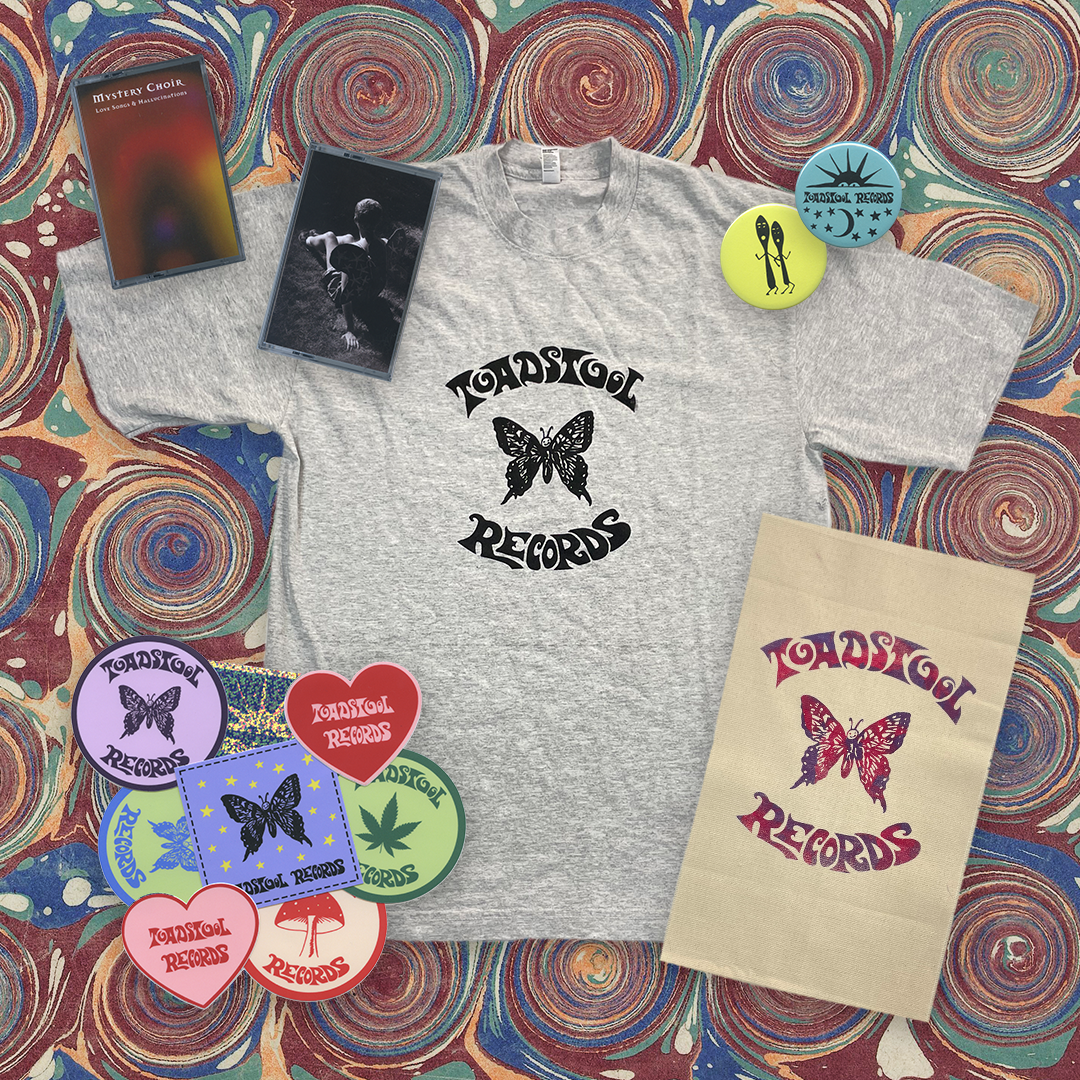
Along with this series, our friends over at Toadstool Records are offering a merch bundle giveaway! The bundle includes a bunch of stickers, cassette tapes of Love Songs & Hallucinations (2023) by Mystery Choir and Honeysuckle(2024) by Youth Large, small banner, t shirt and buttons, as well as stickers and a tote bag from the ugly hug.
To enter the giveaway, follow these easy steps below!
“I’m gonna go off topic for a second” Nara Avakian prefaces before pivoting into a story from their day at work at a school in Elmhurst, Queens. We had been discussing the impact of taking Nara’s Room outside of the physical parameters of ‘Nara’s Room’, and while they assure me the anecdote will circle back to that point, I am hardly worried. Avakian details an art class activity where they prompted students to complete a ten minute automatic drawing followed by a more intentional piece of art on the other side of the paper. “I saw the ways that their subconscious kind of came out. I mean, they’re all twelve, thirteen, so they’re not overtly thinking, but I could see the connections that were being made,” Avakian explains.
One student had drawn a Yin and Yang symbol during the brief ten minutes, explaining to Avakian it was an element of another lesson she had that day. For the second part of the assignment, she drew a chameleon, likely inspired by the cover of a textbook in the classroom. “Because she drew the chameleon in marker, when you flipped it over it bled through and it was perfectly symmetrical with the Yin and Yang symbol. I feel like that instance is how I perceive my own songwriting and performing, it’s my subconscious flowing out and it just ends up almost experimental. I bring it to the boys, and they process it in their own ways. They evolve the meaning and turn something that is very private to me and very singular into something that is so much more nuanced.”
Avakian is the front person of Nara’s Room, a Brooklyn Based band that boasts a grungy catalogue of tracks that fizz in your ears and yank at your chest. Their experimental sound glides over achey introspections like Vaseline, forming this healing liminal space where pain has to be felt, perhaps even danced to, before it can be truly let go. The deeply cathartic essence of Nara’s Room is one of the band’s biggest triumphs, though it was not necessarily intentional from conception. Avakian began Nara’s Room at a time they were still nurturing their own confidence as a musician, initially envisioning something along the lines of “Joni Mitchell, Tim Buckley singer- songwriter”. They found bandmates Ethan Nash and Brendan Jones after posting on Craigslist for ‘non men players’ who liked the Cranberries, Galaxie 500, and the Sundays. “Lo and behold, two of the most boyish of boys responded”, Avakian jokes before tenderly reflecting on the significance of Nash and Jones in their life, “They ended up becoming my chosen family.”
The band fosters an extremely pliable approach to creativity, allowing them to harvest depth from anything. As Avakian reflected on the subsconscious driven exercises of their middle school art class, I thought of a track off Glassy Star that is somewhat centered around a bottle of juice. Recalled amidst the anguish of a parasitic relationship, “Grape Juice” is a standout example of the band’s knack for achieving emotional complexity without a need for explicit articulation. When I asked if the song was based on reality, if perhaps a decayed bodega beverage was a means to reach something darker buried in Avakian’s mind, I tried to resist posing the question in an overtly personal way. In retrospect, I think the times I have dropped what I was doing to vehemently sing along to the agonizing delivery of “a moldy bottle of Welch’s juice, I left in my closet, I forgot to drink” has less to do with me than it does the band’s ability to inject pathos into, well, anything. This dexterity wields songs that beg to be weathered by the relationship of a listener; as the stories told by Nara’s Room are meant to be felt more than understood.
Avakian explains that while the moldy grape juice story was true, it was initially someone else’s, one told via Spongebob voice filter on Instagram Reels. “At the time, I was friends with someone who was the classic case of just taking advantage of a friendship. The moldy bottle of Welch’s juice line came up, and I hate that this is the reference, but I guess it goes to show that you can find that value in anything,” Avakian explains, “I was scrolling through Instagram Reels, I don’t know if you know this guy but he tells these stories through the autotune SpongeBob filter, he has a beard, whatever. He came up, and I don’t watch everything, but for some reason I was just in a mood where I was just kind of rotting, and he talked about this story where his mom wouldn’t let him drink grape juice, so he ended up grabbing a bottle from the fridge and hiding it in his closet. He forgot about it, and then it got moldy, and that kind of just stuck with me. It was not something where I saw the reel and was like, I need to make that into a song, but I took it into my subconscious and it just kind of flowed out and really defining the mood and feelings of the song”
That Reel was just one of the many fragments of life that shaped Glassy Star, mingling in the record alongside a line delivered by Laura Dern in Blue Velvet, a copy of Kurt Vonnegut’s Bluebeard, a vinyl of Fleetwood Mac’s Live Ivory and a light up horse display in a bar in Bed-Stuy. Avakian often refers to these collaged references as “fixations”, though in the context of Nara’s Room, their purpose is ultimately a catalyst for stubborn emotional excavations. The band often knits their individual focuses into one, this creative symbiosis bridging Nash’s fascination with the New York City Transit System’s most elusive train and a poem Avakian wrote on a receipt at a comic shop in LA seven years prior on “Waiting for the z”.
There is also value in the intent behind what they choose to integrate into their art. The approach is deeply unpretentious, focused on exploring the notions that resonate regardless of their cultural weight. “That’s how I process what a fixation meant to me”, Avakian explains on their trust in their own subconscious, and how they rely on music to unravel it. Amongst the slivers of life and media that braided into Nara’s Room, an emphasis on the 2000’s holds a prominent slot in the band’s identity. Glassy Star odes heavily to the cultural landscape of the band’s formative years, the album’s visuals rich with contrast between aesthetics associated with innocence and lyrics that navigate the darker realities of growing up.
“I have this relationship with my childhood, where growing up I genuinely believed that every element in the early 2000’s would be that way forever. Like the idyllic world of a Disney Channel original movie. In my music, or at least with Glassy Star, it’s one of the dimensions. There’s so many. One of them is reconciling with growing up and change”, Avakian reflects on their focus on 2000’s media, “It’s my way of kind of returning back to the room in many ways, returning back to these things that are so foundational to who I am that don’t necessarily have a place in this world anymore.”
Their manipulation of nostalgia becomes particularly powerful in the music video for “Holden”, a standout track that purges identity uncertainties over buoyant guitar and hypnotic reverb. Avakian used various cameras for the video, which features a stop motion animation inspired by Nickolodeon’s Action League Now, and a visual narrative that unfolds in and out of a vintage television set. It exists somewhere between familiarity and fabrication, envisioning an uncanny realm that possibly cautions against stretching naivete into adulthood, though like most aspects of Nara’s Room, it leans into the abstract, holding more emphasis on emotion than rationality.
This sense of ambiguity is a driving force at their live shows. Creating the songs offers the band a means to make sense of their own minds, but through sharing them the music transcends the personal nature of a notes app entry or media fascination. The meaning becomes something entirely new, as their songs knock on the door of someone else’s emotional ruminations. “When you watch something of David Lynch’s, it’s not meant to be overtly understood, but rather experienced and felt,” Avakian reflects on preforming, “I think when I bring something out of the room, I only hope that people can enter this other space with me, and we can all kind of experience and feel something ourselves.”
You can listen to Glassy Star out on all platforms now. You can also order a cassette tape via Mtn. Laurel Recording Co. Nara also creates videos under the name foggy cow. Check it out here!
Written by Manon Bushong | Featured Photo by Mamie Heldman
Today, Spring Onion, the recording project of Philadelphia-based artist Catherine Dwyer, returns with a brand-new song “Anger Acceptance”, marking the first single from her upcoming album Seated Figure set to be released March 14th via Anything Bagel. Having been a player in several Philly favorites, such as 22° Halo, 2nd Grade and Remember Sports, it is now Dwyer’s turn for a full-length endeavor, as Seated Figure is a collection of personal expression six years in the making.
“Anger Acceptance” begins with a very certain two chord progression, one of familiarity that defined a generation of not just youthful angst, but an exhilaration into a rather open and definitive moment of emotional recognition for countless individuals. The track begins clean, but full, as Dwyer sings, “I could have killed the man that told me / And I wish I killed him still,” apt to the gritty undertones that are waiting to be let loose. “We learned a lot about each other / I guess love’s a useful skill / that only matters if I make it / and with all my words I will,” becomes a marker all on its own, as the song erupts into a controlled burn of chaos and clarity, as Dwyer recognizes the beauty that lingers behind no matter how imperfect it may feel. “Anger Acceptance” is not a ploy for nostalgia per se, but rather a moment of gratitude, a recalling of what it was like to be young and angry before life goes on without a say in which direction.
About the song, Dwyer says, “This was the first song I wrote after my dad passed away from lung cancer in October 2020. I was alone, recovering from covid, listening exclusively to Nirvana, and stewing in the anger they say accompanies a great loss.”
Listen to “Anger Acceptance” premiering here on the ugly hug.
Seated Figure is set to be released March 14th with both a vinyl and cassette pressing from Anything Bagel. The album features longtime collaborators Julian Fader (Ava Luna), Carmen Perry (Remember Sports) and Francis Lyons (Ylayali), among others.
Listen to Spring Onion’s last release i did my taxes for free online.
Written by Shea Roney | Featured Photo Carmen Perry
Following the anticipation of their last track “Stop Me If You’ve Heard This Before” released earlier this month, rugh return today with “For Steven”, the final single from the Gainesville, Florida trio before the release of their debut album Rug, out on February 21st. With just a handful of releases prior, Macy Lamers, Liza Goldstein and Sawyer Lamers have upped the ante of their gritty intensity and candid vulnerability as rugh showcase the strengths within their dynamic compositions.
Nestling within a groove of temptatious energy, “For Steven” plays out from the trio’s garnered intuition, unwavering in the pace of a dreamy display as each member exudes their own individual voicings with both precision and unique passion. Combing through frustrations like a thinning bristled broom, lines like, “And the drugs in your blood aren’t going to be there for good”, remain as Macy’s crooning vocals collect up some of the blemishes of impending doom, clearing out a sort of pathway for the weight of the instrumentation to carry this newfound release to the end. “[For Steven is] an existential power anthem about how I don’t know what I’m doing, so naturally I can’t know what you are either,” says Macy. “Each verse is a run-on sentence, and the melody gets all tangled up just to fall into a rudimentary chorus again. I want to draw a stupid parallel to life here, but I’ll leave it.” It isn’t long before the track implodes in a crunchy haze of distortion and blown out amps, but rugh’s ability to play with both conflicting sensations and sheer earnestness make them a band worth keeping an eye on.
“For Steven” is accompanied by a music video conceptualized, directed and edited by Macy. Watch below!
Rug is set to be released on February 21st and will be celebrated with a release show on February 22nd. You can listen to their previously released single “Stop Me If You’ve Heard This Before” below.
Every Wednesday, the ugly hug shares a playlist personally curated by an artist/band that we have been enjoying. This week we have a collection of songs put together by Chicago-based multi-instrumentalist and songwriter Andy Red PK of the project Red PK.
If you have spent any time in the Chicago music scene, Andy’s face on stage is one of familiarity and comfort. Having been a player in some of the city’s most beloved acts, such as hemlock, free range, Options and Tabacco City, as well as instances of joining touring groups like Sinai Vessel, there is a guarantee of a good show at work when Andy is playing guitar. Earlier last year Andy released two singles, “Bedroom” and “Moving off the Line”, debuting his cleverness and passion as a songwriter as well, with hints of more to come in the future.
To accompany the playlist, Andy shared;
Songs that make me laugh and cry, sometimes unsure which is about to happen. Featuring friends, heroes, inspirations, recent pleasures. Fix yourself a Shirley Temple with extra cherries and cuddle up with your childhood stuffy while listening.
Listen to Andy’s playlist here;
Andy will accompany hemlock for a few shows on their expansive tour crossing eastern U.S. cities beginning on January 24th. Find a show near you HERE.
Listen to “Bedroom” and “Moving off the Line” out on all platforms now.
Written by Shea Roney | Featured Photo by Sofia Jensen
Billy Woodhouse and Elliot Dryden finished their latest lots of hands record in a “very messy fucked up student room”. They hurled this description early on in our conversation, my context on the duo limited to that their evening itinerary consisted of rounds of Fortnite and pints of beer. For a moment I found it ironic that they titled the album into a pretty room, although, as they wedged memories of celebratory dance parties in between fond reflections of writing and recording in Woodhouse’s living room, the allegedly “fucked up” nature of the apartment held less and less of a contradictory effect. into a pretty room pursues a sort of haven that cannot be furnished with antique Danish chairs and wallpaper swatches pulled from Architectural Digest. With self-described “squealy chipmunk” vocals, delightfully weird patches of electronic production and lyrics that strip notions of grief right down to the bone, lots of hands’ forthcoming album is a stunning tale of growing up, and a testimony to the extents of beauty found in the unrefined.
In the last four years, Dryden and Woodhouse have continued their journey of stylistic experimentation whilst honing the project’s identity. A chronological listen of the lots of hands catalog corroborates their growth towards a gentler, ambient-folk sound, a progression that hits an exhilarating peak in their latest work. While past lots of hands’ endeavors have been the fruit of remote labor, relying on the modern technological miracles of online demo exchanges, into a pretty room marks their first truly collaborative work, a product of Dryden and Woodhouse thoughtfully collaging old work and writing new songs together in Leeds, UK. into a pretty room fosters an obvious ‘touching grass’ vibe, with lyrics like “breathing the country air” and “talking with the dogs and birdies” offering a glaring manifestation of their experience in the north England countryside. However, the most moving effects of the album’s collaborative nature are far less axiomatic, as their shared vulnerabilities intertwine into one deeply human and emotionally complex coming of age narrative.
Over the course of the 14 track album, twinkling instrumentals coat the achy revelations of growing up. It’s a story of defending ‘laziness’ to your mom before the word depression enters your vocabulary, of experiencing heartbreak and grief not knowing if you will ever feel okay again, of waking up and wishing you could have been born as someone else. While it sounds devastating, the longer you sit with into a pretty room, the more it presents like running your hand over a scar rather than the all-consuming sensation of a fresh wound. “Before we made this album, we were both in transformation phases, different parts of our lives” Woodhouse explains, “[into a pretty room] is reference to doing well for the first in a while, with work and mental health and identity and trying to find out what style of music you want to make and what kind of person you want to be”.
into a pretty room is set to be released as their Fire Talk Records debut on January 17th. I recently met with Woodhouse and Dryden via Zoom, where they spoke about what they’re listening to, the history of lots of hands and what a pretty room looks like to them.
This interview has been edited for length and clarity
courtesy of lots of hands
Manon Bushong: You are about to release your fourth album under lots of hands, but I would love to start by hearing about the project’s roots. How did you two meet, and how did lots of hands come to be?
Billy Woodhouse: I’d been doing it as a solo project until about 2020, when I got Elliot involved, we just met at a really terrible music course in Newcastle and just bounced ideas off each other. It kind of took Elliot a while to get into the scene that I was in. I was probably on the different side of the spectrum, so we kind of met in the middle in terms of style and taste and just started making music as a duo. But before that, it was just an acoustic, ambient project.
Manon Bushong: So you met in the middle… I’m curious about what these ‘opposite ends of the spectrum’ looked like. Can you describe your tastes when you first started?
BW: Elliot was very…
Elliot Dryden: I was very…[laughs] bear in mind we were like, 16. Very Britpop-y
BW: Oasis
Elliot: Those guys… We always had some middle ground, we liked the Beatles, Elliot Smith, Radiohead.
BW: I was listening to a lot of hardcore, and a lot of very heavy math rock that I probably wouldn’t be as interested in now. Eventually we found this sweet spot of folk and ambient that we just really enjoy making together.
MB: How about now, what were your favorite music releases from last year?
BW: Tapir!
ED: Yeah
BW: our good friends in Tapir! dropped an absolute banger of a record this year. It’s like folk music with a little TR 808, electronic drum in the background. I can’t stop pushing that album on every single person I speak to. It’s amazing, it’s kind of a concept album about a pilgrimage that they’re all taking. And, the new Horse Jumper of Love album was amazing, that came out this year.
ED: Mk.Gee, we went to see Mk.Gee
BW: Oh yeah, like a month ago. That shit was awesome. That shit was so awesome.
MB: You mentioned finding a sweet spot of folk and ambient. That is definitely present in your recent work, it has a very cozy, almost outdoorsy feel to it. Where did you write and record the album, and how did that influence the project as a whole?
BW: We recorded it in my living room when I was living in Leeds. I was studying illustration, and Elliot had just got this new job, so he was coming down and splashing his cash every weekend in Leeds. We’d kind of just have a day when we’d sit and write and record. I think just doing it in my house has always been good, but I feel like because it was away from both of our homes, it felt like a new chapter for both of us, and I feel like that translates to the music really well.
MB: It definitely translates well, there is a certain coming of age feel to the album and how you reflect on adolescence, grief and depression. Are the songs and the stories you are telling ones that have accumulated over time?
ED: There’s quite a few that have been around for a couple years, a few of mine that have been around for two, maybe three years, and then some that Bill wrote like two years ago. So half of it is kind of old music that would fit with what we were trying to talk about, and the other half was stuff we came up with recently – reflecting on where we were at the time as well.
MB: You mentioned this idea of ‘what you were trying to talk about’. I would love to hear about the title for this album, and how these tracks fit into your idea of a ‘pretty room’.
BW: With a lot of the songs being from three years ago and a lot of them being new, we tried to encapsulate that sense of moving forward with identity and grief, and just stuff we had been through. It felt like the only time we were able to sit down and work on it was in the living room. With the album, I think we were trying to get a coming of age feel, and a sense of a safe space that we both are in now.
MB: into a pretty room also has more words than your previous albums, though it also includes a few ambient tracks without lyrics. How do you approach creating songs with lyrics versus ones without, and what is the process for tying them all together in one album?
BW: There is, maybe not for the people listening, but in my head, a need for some breathing room because it felt like we were getting quite a lot off our chests in actually making songs with lyrics. I definitely had a lot more ambient tracks on the album on a first draft we created, and then Elliot said “it’s just a bit too much breathing room”. I think in a way, we are just dividing the album into three parts, not because it really changes, but just so you have a chance to breathe. I would really like to do another ambient project that’s just instrumental because that is the sort of music I enjoy making the most.
MB: Would you ever consider creating ambient music for another type of project, perhaps scoring a film?
BW: One of my bucket list goals is to score a film. Maybe when I get old, or whenever the offer comes to me, I’ll take it. For now, and I don’t know about Elliot, but I make music with scenes in my head
ED: I don’t
BW: He doesn’t.
MB: If you could create the music for any existing film, which would you pick?
BW: I would do where the wild things are. I love that Karen O record so much, but I just feel like my music looks like that film. I remember going to see that with my dad when it first came out, and it was actually life changing. All the puppets that they made for the film, it was just everything I needed to be creative in my head, it had all the inspiration. So probably that film, no diss on Karen O’s record though. It’s amazing.
MB: You have used a lovely series of paintings as the cover art for the single releases and the album. Who was responsible for those, and why did you pick them?
BW: I had the idea of barn animals for the cover, because we have the song “barnyard” that was initially going to be the main single. We got kind of caught in that country folk thing, we were listening to a lot of Hank Williams and a lot of country. Our friend Beef, and Harry Principle painted it and so I shot her a quick message and was like ‘please can I steal that for an album?’. It’s actually just one massive painting that she did that she got scanned, but I cut it into pieces because there’s so much going on. They did it by drawing over each other’s artwork, it’s a collaborative piece and then they started dating after, so it also has a cute little story behind it. Shout-out Beef and Shoutout Harry for making that cover, I think it just looks how the album sounds.
MB: Do either of you have a favorite song off of into a pretty room?
ED: There’s one that Bill wrote called “in between”, it’s really good. I like the lyrics, and it’s quite short and sweet and all acoustic, which I like. That one is my favorite
BW: My favourite is “barnyard” because it has everything I like in lots of hands’ songs in it, droning reversed guitars in the background, my squeally chipmunk vocals as well as Elliot’s very baritone, almost grainy vocals. We just kind of wrote it in about ten minutes, just like brainstorming together in my fucked up student room in Leeds. That was a good moment for us when making the record, because we made it, and then we just kind of had a little boogie to it for about half an hour, just being like “we just made this shit, we’re making a record right now”.
MB: What are you most excited for now in the coming months? Aside from album rollout, is there anything else exciting on the lots of hands radar?
BW: I’m really excited to play these shows. We’ve got some really good musicians on board for it, and it’s always good to see the other side of the country. We’re in a very weird place in the UK, it’s beautiful and it has a lot of history, but there’s just not much of a music scene here, so it’s always good to travel about and meet other musicians.
ED: Yeah, same with me. I’m kind of excited that we might be able to travel somewhere else one day, maybe America or just anywhere else. It’ll be quite fun, I’m excited and staying hopeful we’re gonna hit the US.
BW: Elliot, plug, plug, uh, our solo stuff.
ED: No, I’m not.
BW: Elliot’s got some solo stuff coming out at some point. Under Elliot Dryden
ED: So does Bill.
BW: Mine is under Uncle Red. We’re gonna be doing some side projects, mine is more ambient, his is more kind of singer songwriter-y. We’re trying to get the lots of hands universe going.
Today, lots of hands shares “barnyard”, the fifth and final single before the release of into a pretty room. Listen below!
into a pretty room is set to be released this Friday January 17th via Fire Talk Records. You can preorder the album, as well as vinyl, CDs and cassettes.
Written by Manon Bushing | Photo courtesy of lots of hands
Every Wednesday, the ugly hug shares a playlist personally curated by an artist/band that we have been enjoying. This week we have a collection of songs put together by Brooklyn-based artist Dan Poppa of the project People I Love.
People I love exudes an undeniable nostalgic warmth while Dan achieves a level of intensity with the most gentle vocals, crafts profound narratives in very few words, and constructs memorable melodies through minimal and haunting instrumental arrangements. In part because of Dan’s status as a bedroom pop veteran with other projects like waveform* and Lola Star, there is a certain lived-in quality to his voice and a familiar honesty to the way he makes music. Packaging aching lyrics of “hit me like a brick” and “waiting to bleed by you” into melancholic lullabies, the 2024 self titled People I Love album is a tender diary of yearning met with eerie lo-fi chords, balancing raw beauty with a lingering cloud of darkness, and distilling Dan’s thoughts into some of his most vulnerable work yet.
Listen to Dan’s playlist here:
Following the release of the self titled album earlier this year, Dan recently shared a new single called “Trader’s Log”. Check out those releases as well as the rest of the extensive People I Love catalog below.
Written by Manon Bushong | Photo given with permission from Dan Poppa
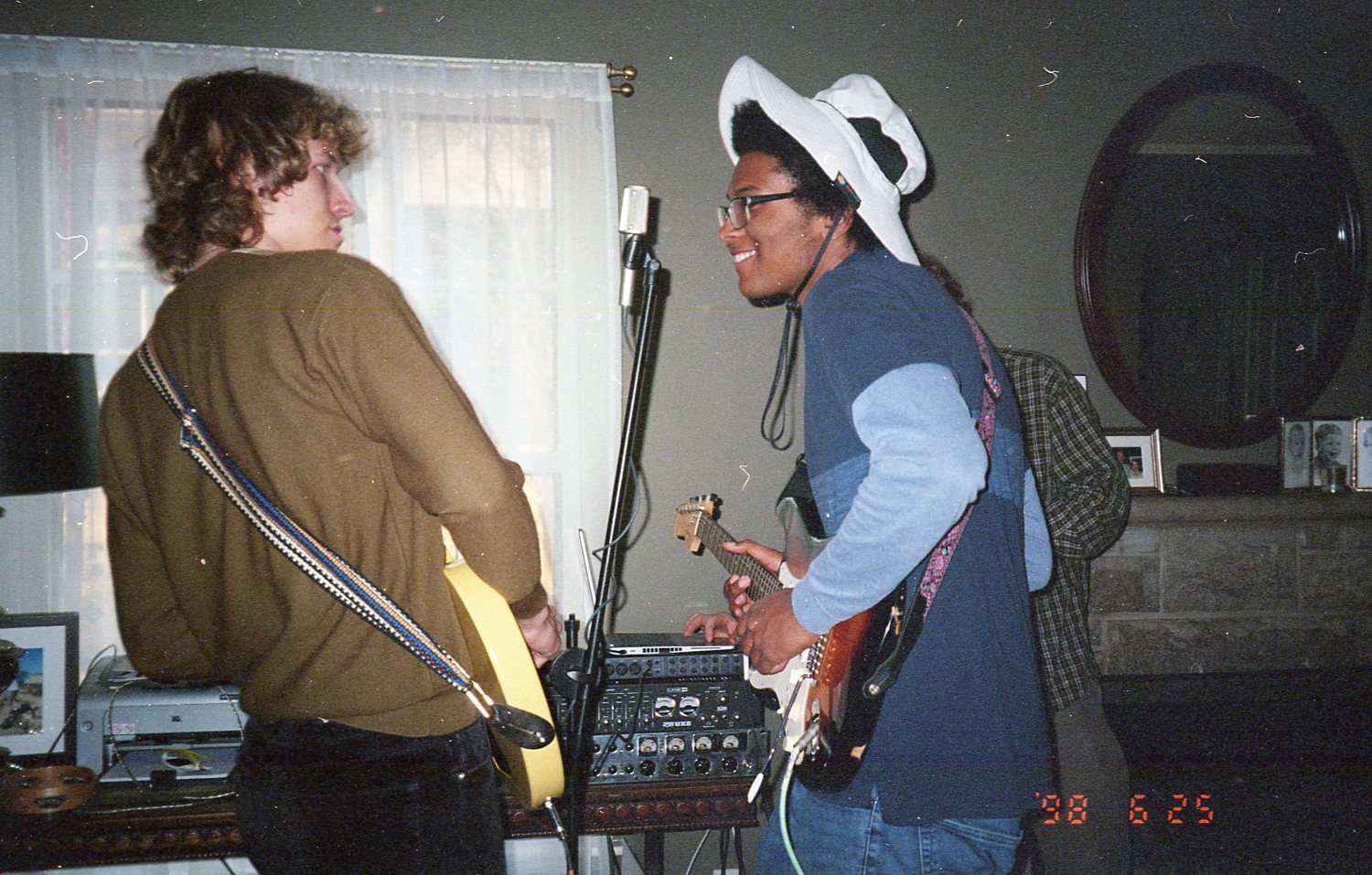
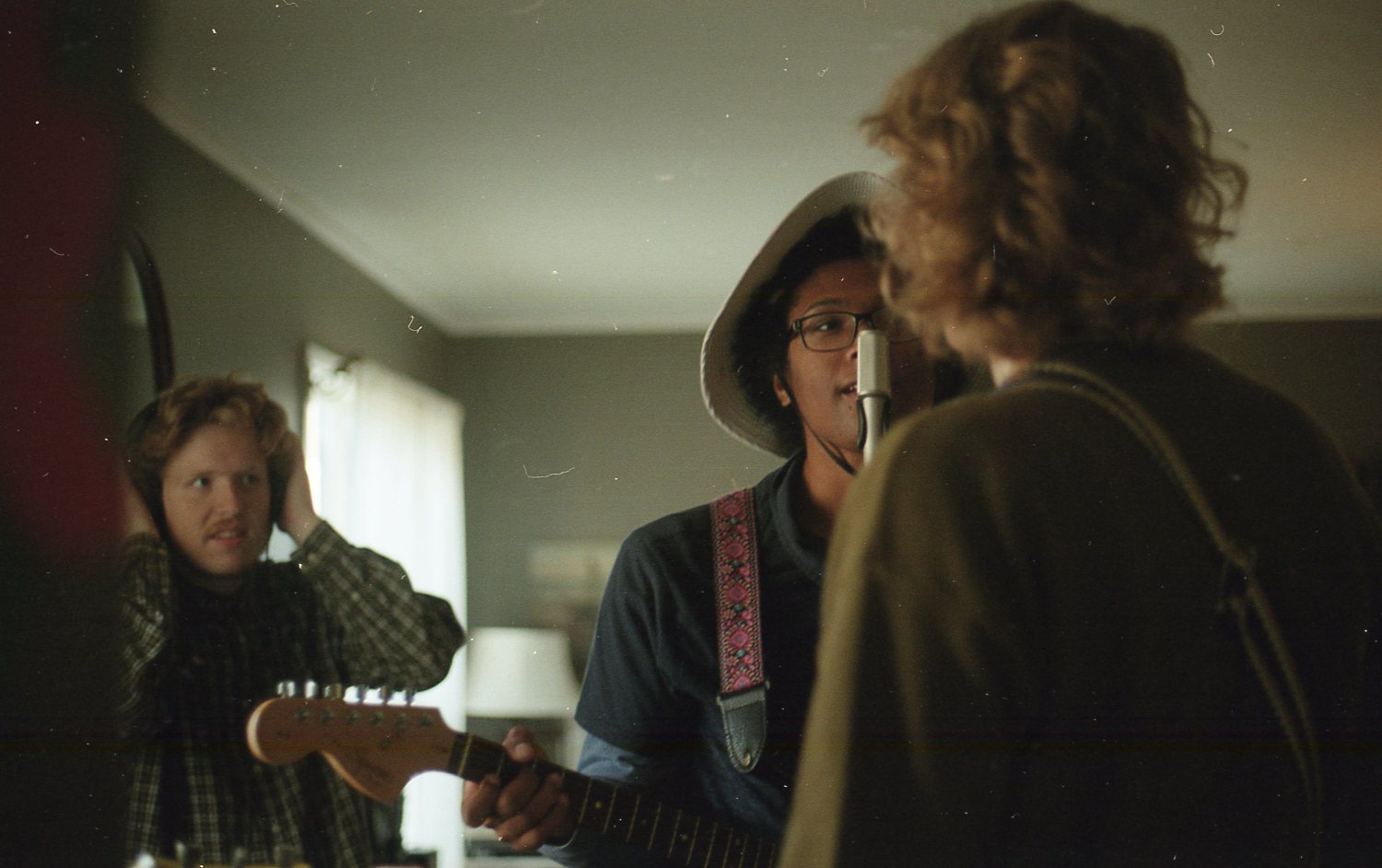
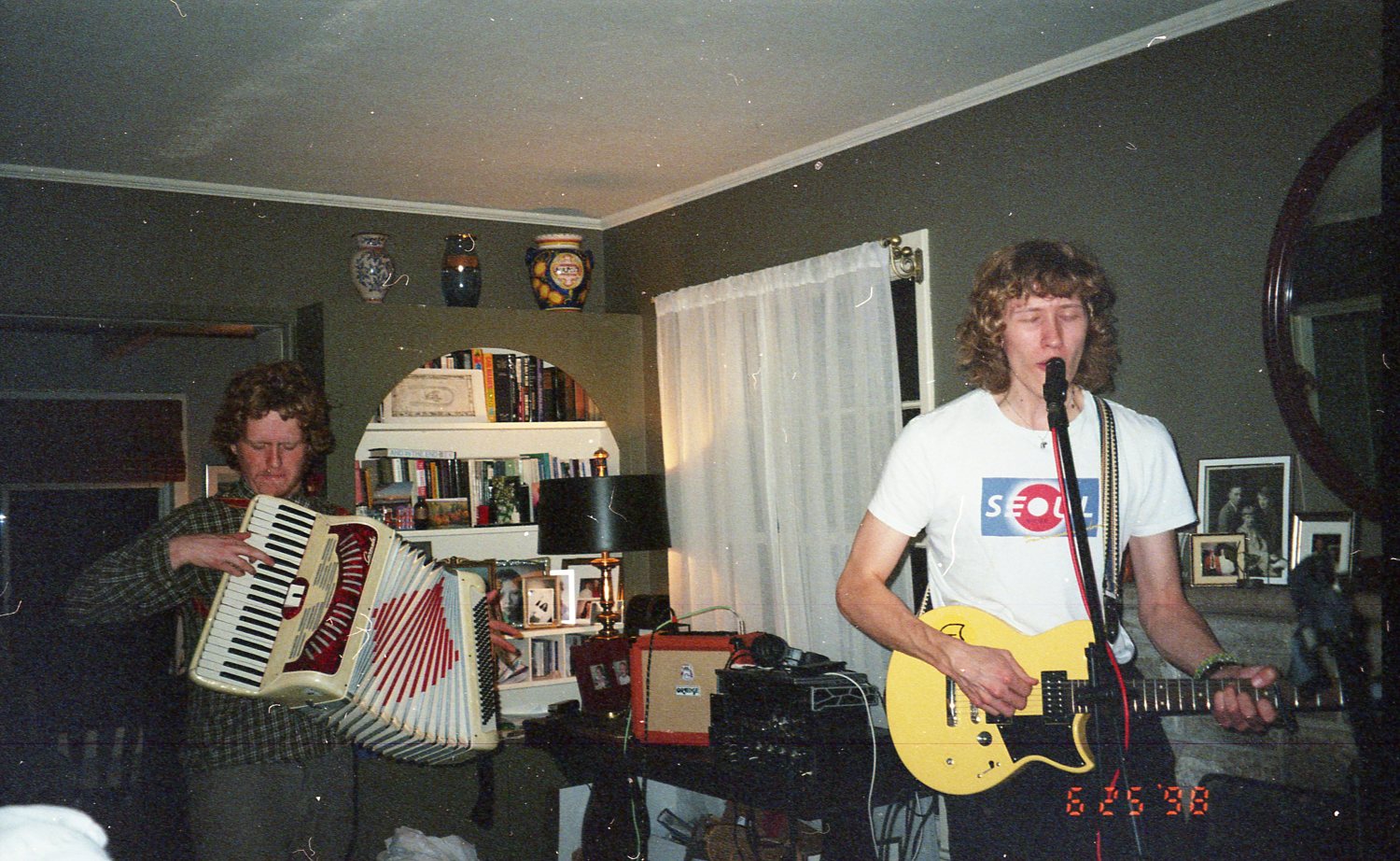
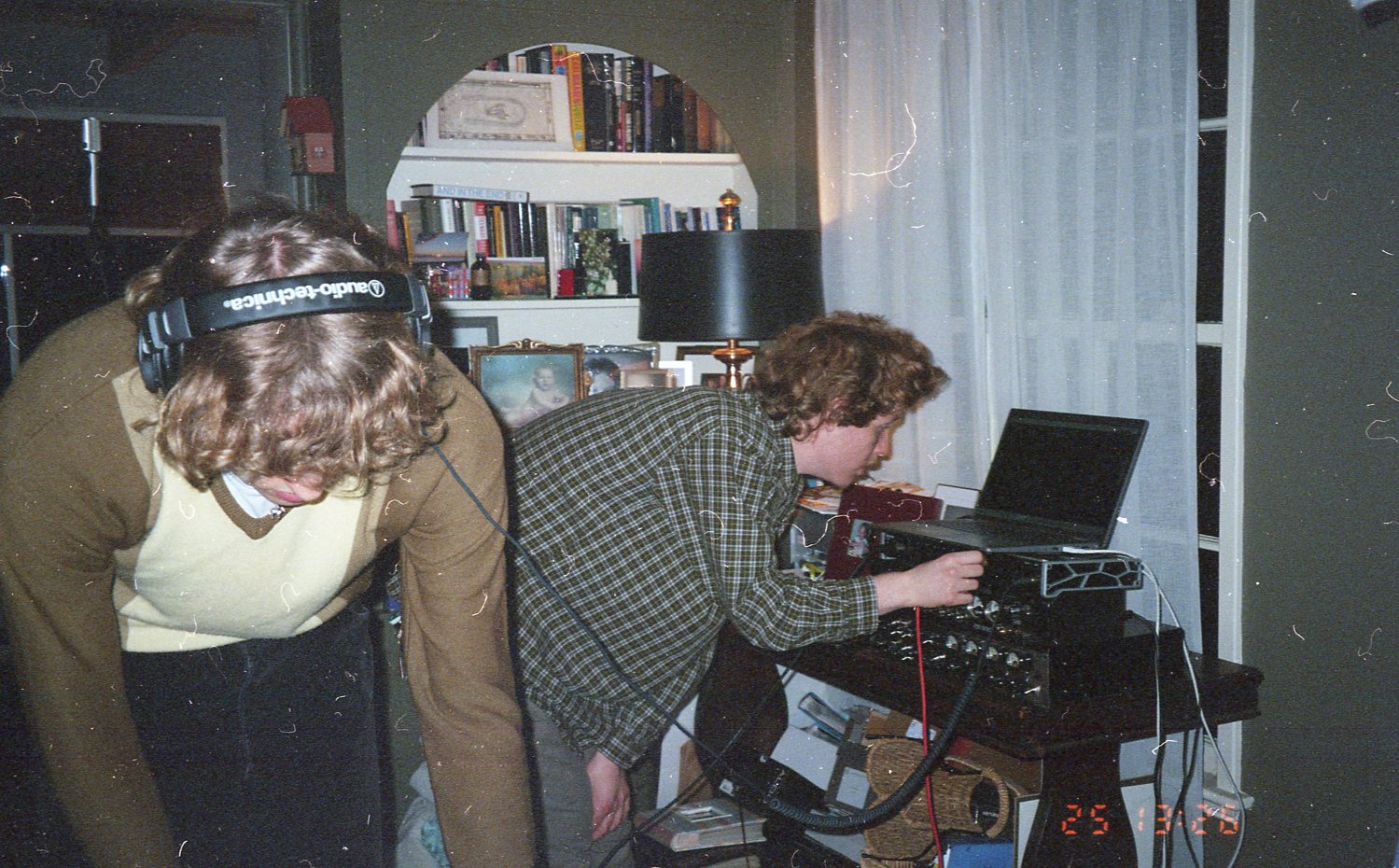
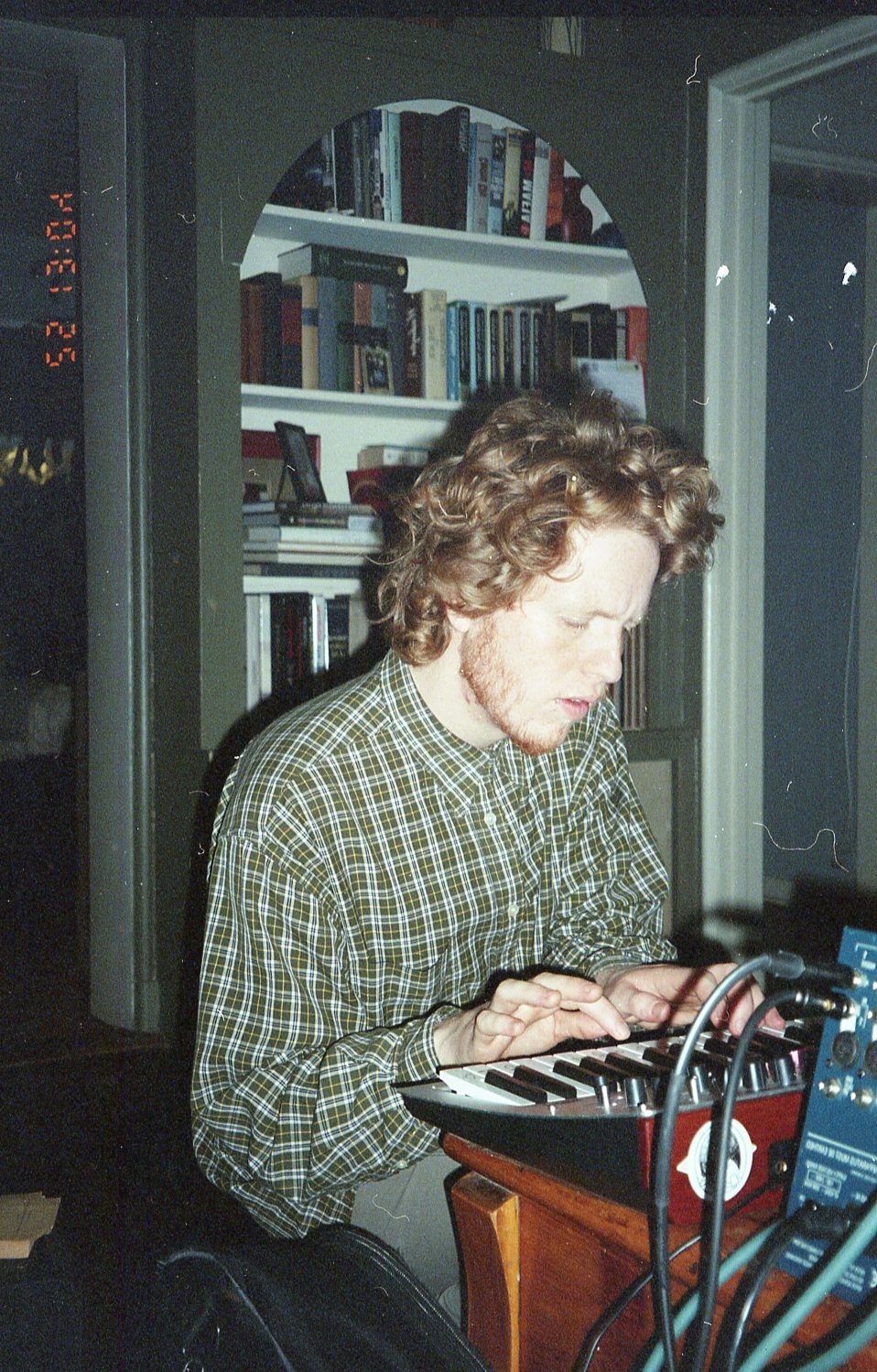
Holding the headphones to his ears so as not to not hear his bandmates talking to each other behind him, Deerest Friends member Nathan McMurray quickly turns around, “This is it! This is the sound, it’s perfect.” Frances Brazas and Ruben Steiner anxiously wait to take the headphones off of each other’s head to hear their recording come together. Huddled around the laptop they all share the same giddy expression, excited to keep recording.
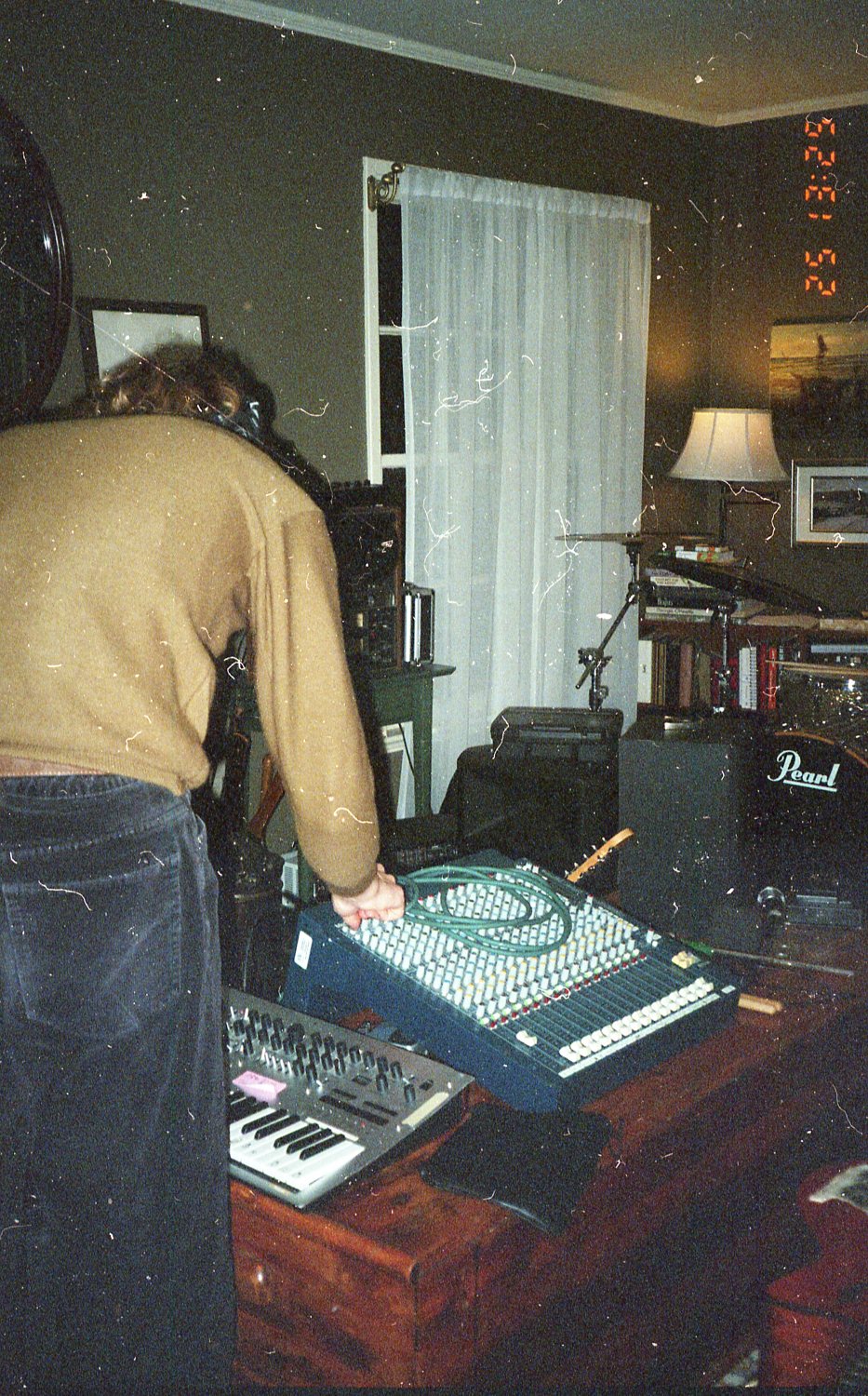
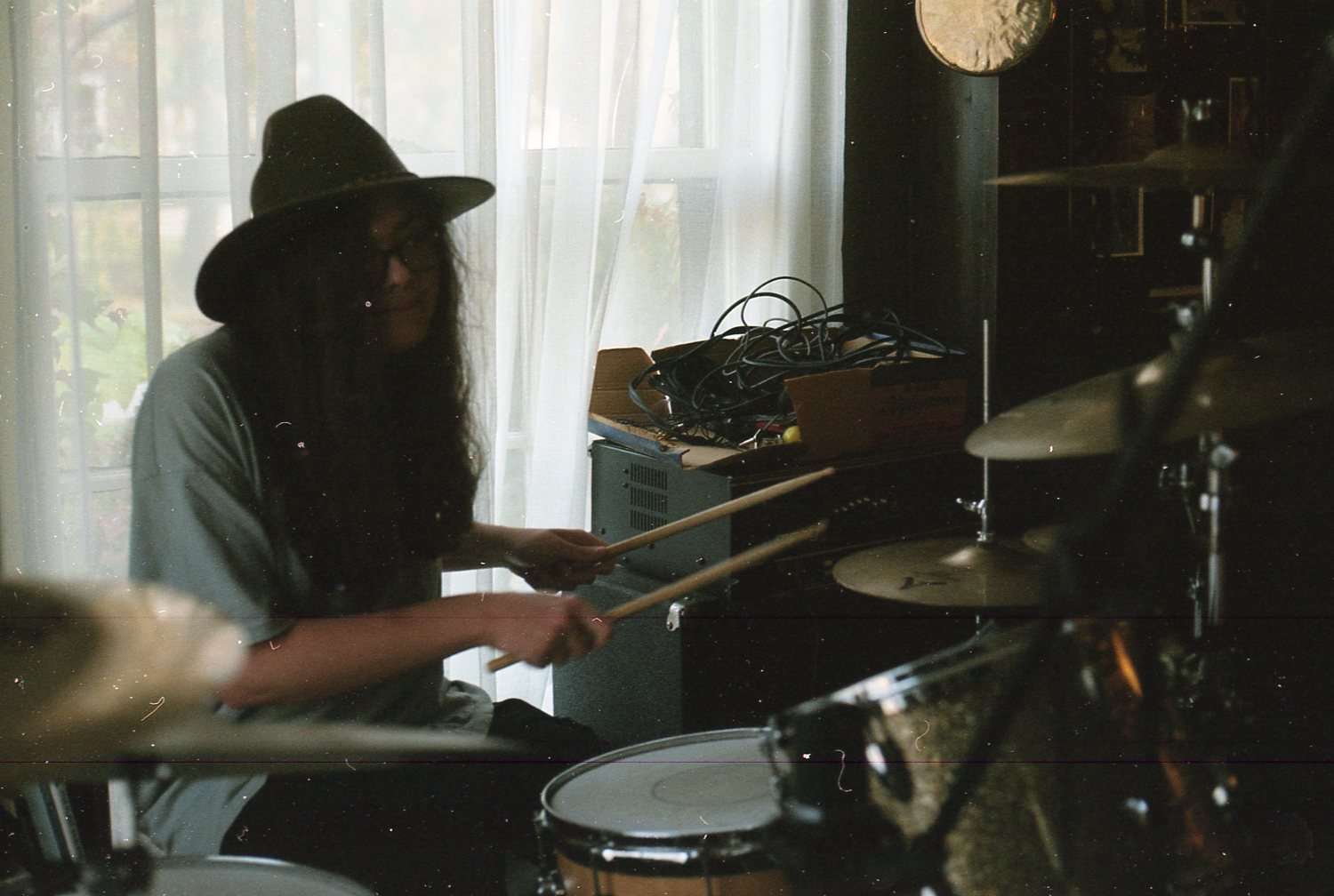
Sitting on an old rocking chair in Brazas’ family’s home in the suburbs of Chicago, observing them minutes and even hours earlier I was unsure of how they were a functioning band. Lost microphones and mic cables left them using their iPhone to record the kick drum and one mic to record both lead and backing vocals live.
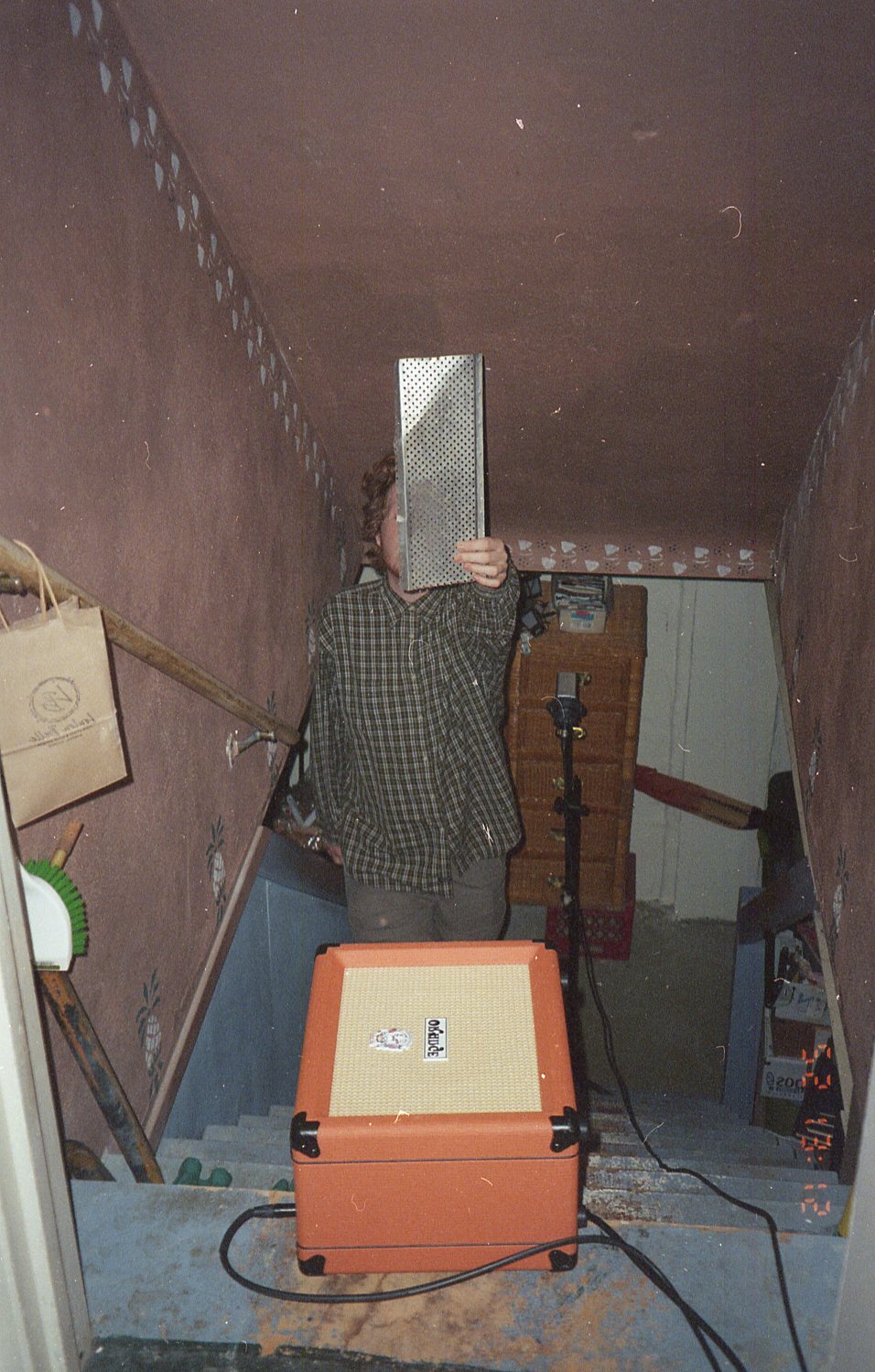
McMurray had the idea to balance an orange tube amp at the top of the staircase and put glass and beads on top to get a rattling effect from the synth as it echoed down the staircase and into the basement. Scared the whole time that the amp would fall down, I tried to look away and focus my attention on the living room where tangled and crossed wires ran through the air and headphone cables pulled at each end. The synth kept randomly turning off, a problem that occurred because the original cable was lost and a knock off was used as the replacement.
“It was completely unnecessary, it probably would’ve made zero difference to record it in a less circuitous way, but that’s what I like about this approach. Recording is very different from playing live. I think in the recording scenario you have theoretically infinite possibilities, and I couldn’t imagine it being enjoyable if you’re not exploring or actively engaging in some level of spontaneity” said Brazas.
Deerest Friends is a Chicago-based band centered around the songs of Nathan McMurray and Frances Brazas, but you’ll find dozens of names of friends from all over credited on Deerest Friends projects. Their songs come alive through the help of their friends, bandmates and rotating members.
On their recorded music, you can hear the voices of Desi Kaercher’s haunting piano and synth lines wavering over the tracks, their drums holding everyone together, Charlotte Johnston and Xochi Cortez’s emotive strings weaving tensely in and out of parts, and Will Huffman’s iconic twee vocals echoing a catchy melody round out the record.
If you’ve seen or get the chance to see Deerest Friends live you’ll probably notice that each time you see them they may be performing with a different lineup. Ruben Steiner of Lund Surk often performs with the band, playing guitar or keyboards, Will Lovell joins in on drums or Trumpet, and Erin Boyle drops in on Cello. Most of the time audience members will find themselves getting swept up in the magic of seeing Deerest Friends live and become an honorary member, singing their favorite parts on stage or jingling their apartment keys when conducted by the band.
“You can engage in the same level of spontaneity live, it’s just completely different because the spontaneity live comes from having these limited things to work with and a limited amount of time. You get a different kind of recorded spontaneity when you have infinite options and time” McMurray said. “When you record, you have the ability to do things with instruments and vocal layering that’s just not possible to do live. If you create this kind of intense or manic energy by doing a lot of layering and getting sounds that wouldn’t typically be allowed, you can get that same idea across live if you just sell it the performance. The manner in which you perform something live is a really big part of the arrangement, and you can capture a lot of what is presented by a recorded arrangement just in how you deliver a live performance.”
Instead of trying to take their recorded music and recreate it perfectly or as close to the recording as they can every time, the band allows their songs to take a completely different form live, using the performance as a way to see all the opportunities of where else the songs can go.
“Even if a song is released, every time we play it live, we’re sort of adding onto it,” Kaercher said. “For some of the new songs, the live versions and recorded versions are very different, and I really like that. Most of the new stuff we played on [our summer] tour didn’t sound anything like the album because we were using entirely different resources.”
The band has become such a tight unit that they don’t even discuss somethings about their live performances, instead they already have an inkling of what each member likes to do or experiment on, and what parts should stay the same, and everything magically syncs up on stage.
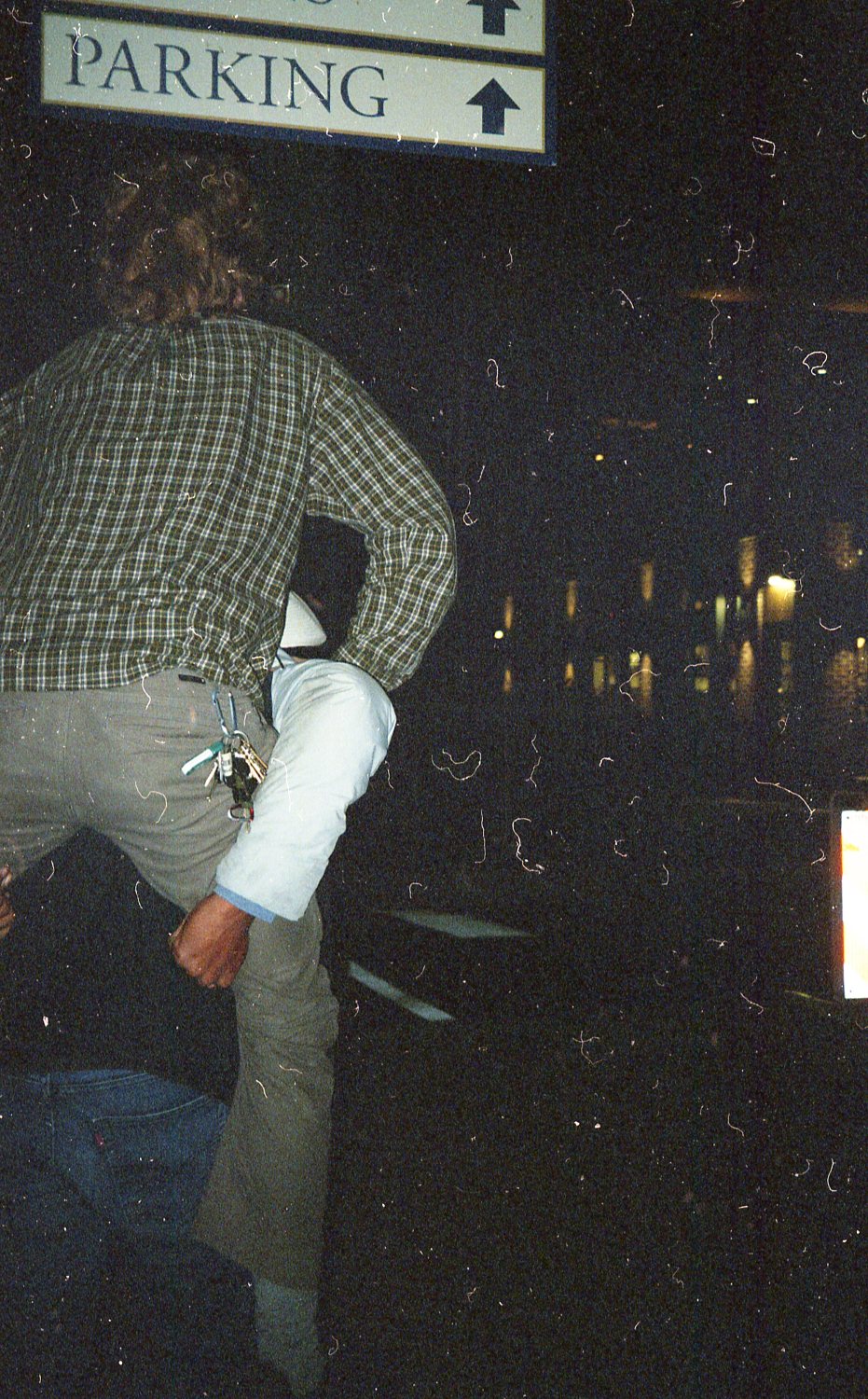
Over the course of the 12 hour day I spent with Deerest Friends, the band went from recording Lund Surk songs, to recording Deerest Friends songs, to practicing Deerest Friends songs for their upcoming tour. Before and in between all of that we made lunch, loaded the car with gear, drove an hour out of the city and to the suburbs, ate dinner at a local fast food place, said goodbye to a member as they had to head back into the city, stood on top of Nathan’s car to try and see the Juice Wrld mural on the second story of a local brewery, picked up another member from the train station, and packed the gear back into the car and drove home.
“I find being a part of Deerest Friends to be really fulfilling because I don’t feel that I can write stuff on my own anymore. It just feels way too unenjoyable. I kind of hit a wall at a certain point, and for most of the last year, I felt like I needed to be around other people, to write with other people, and to make music with other people to really enjoy it” Kaercher said. “I’m a lot less like Nathan and Frances, I’m not really self guided. I can do it alone, but I just don’t have the heart for it. Writing with Nathan during the period Deerest Friends had separated was genuinely really fulfilling, it feels really good which is rare.”
Their days together feel almost as chaotic as their recordings, sounds stitched together by outlandish ideas and the desire to let out lyrics and chord progressions that have been rattling around in their brains for months. Their love for each other, and every person who drops in to help them complete the project keeps them motivated to spend hours upon hours together actualizing their visions for their songs.
“A lot of the way we record has to do with the immediacy of it, too. If we’re practicing or recording, and we decide we need to record a specific percussion part right now, because we’ll never have another opportunity to do it, sometimes the only thing we have is like a box of screws and toy bongos, we make it work, even if it takes hours to get the sound right.”
On December 1st, the band released two singles “Dearest Friend” and “Camaraderie,” bookends to their debut album Lamb Leaves Pasture, and recorded almost exactly one year apart.
“Camaraderie” was the last song they ever recorded in the old studio that Kai Slater had, where most of their first record was recorded. McMurray noted the emptiness he felt in the room on the last day of recording in the studio with Desi as everything but the drum kit, a room mic, and a mixer was all packed away in boxes. This truly solidified “an end of an era” and the end of the Lamb Leaves Pasture era for them.
“‘Camaraderie’ was sort of a post Deerest Friends song. It was written in a period when the band had sort of separated. After the late summer, early fall 2023. It was the first song I had written after Lamb Leaves Pasture and I wrote it in my head and arranged it on my computer in a program initially. I was staying with my uncle and I didn’t have a guitar. I was using this app, but I didn’t really know how to read or write music at that point so I would just drag the notes around until it got sounding right. It’s like a digital score and I sent Desi the sheet music for it. When I had moved back to Chicago after the summer, I was living in my old place, and I drove this little car up from North Carolina so I couldn’t take all too much, and I recorded it in my empty living room, which was just the two acoustic guitar tracks. I had taken it to Desi because I had this whole arrangement written, but I wasn’t able to transcribe the drum part, so I beatboxed it to them.”
“Dearest Friend” was mostly recorded in a practice room in the Reva and David Logan Center for the Arts in Hyde Park. It was before the project or group even existed, “it wasn’t even a prefiguration of Deerest Friends existing” Brazas said. “I would record stuff on my own and be like, ‘I guess I need to be in a band now.’”
“The actual recording process leans into a sort of maximalism, which I like. For better or for worse, that’s what my work process is like. I’m extremely obsessive about recording things. I’ll record 25 tracks of percussion. For one of our newer songs I recorded a percussion track for three hours, hitting a piece of metal in slightly different ways and some of it made it on the song” Brazas added about their recording process.
No matter how much or little time you spend with Deerest Friends, you will leave feeling their shared sense of immediacy and passion for art. You’ll start looking at all of the objects in your room differently, ripping the sheets off of your bed and cutting them up to make funky curtains, you’ll start dancing around your room and write a song only with a tambourine, which seamlessly leads to you slicing up old magazines and books to create your single cover, and reluctantly passing out when you realize you have no more sheets on your bed. Tossing and turning in your bed you might try and figure out what is missing, and you’ll come to the conclusion that you’re missing collaboration and the close community that makes art and creating so beautiful. A strong sense of friendship radiates through Deerest Friends’ music, making it feel so familiar and comfortable right away.
The band asked me to end the interview with some fun questions. We went on a few tangents about our favorite pies, catching allergies from people, our fiber intake, liver health, how we eat apples, and the sexiest era of Leonard Cohen. If you feel like you didn’t get to know Deerest Friends well enough, Desi and Frances agreed on 2010s and Nathan said “he never looked sexier than Paul Simon when he looked like a medieval entertainer.” Feel free to debate them on this topic the next time you see Deerest Friends or ask them about their favorite dubstep songs.
Scroll through for more photos of Deerest Friends.
Deerest Friends released two singles “Camaraderie” and “Dearest Friend” earlier this month. Listen to them now on all platforms.
Built upon a vivid display of collaboration and curiosity, Amigos Imaginarios is an experimental duo composed of Arbol Ruiz (Paris via Columbia) and Caleb Chase (Worcester, MA), whose blend of stylized structures, pressurized electronics and sweet flavored twee had offered quite the impression on their first two records, Pick Flowers (2021) and El Jardin Encantado (2022), both released via Bud Tapes. Now Amigos Imaginarios announce their forthcoming LP titled Ice Cream, and to celebrate have shared the first single from the cycle called “Voy corriendo”.
In just 90 seconds, “Voy corriendo” is both a subtle and sweet affair amongst the electronic tinkerings and unruffled harmonies that Ruiz and Chase use to create a green patch of charm and sustainability within its bizarre, and almost dilapidated presence. With a title that roughly translates to “I’m running” or “I’m on my way”, “Voy corriendo” flows with this whimsy of wonder, remaining both playful yet poignant in its short, and oddly charming life – like a beloved children’s toy at the end of its battery life, whose charisma is wearing down despite remaining true to its colorful demeanor and purposeful responsibility for play.
Ice Cream marks the first Amigos Imaginarios project that was made in person, having been a fully collaborative project only through email up to this point.
Along with the single, Amigos Imaginarios also shared a music video featuring a 2000% saturated video with a collection of adorable dog clipart. Watch “Voy corriendo” here!
Ice Cream will be released January 10th via up and coming Brooklyn tape label, TV-14 Recordings. You can preorder a cassette now. Check out the rest of TV-14’s catalog here.





 the ugly hug