Little clicks recorded on a contact microphone submerged in a jar of water, digitized home movie footage from a gymnastics camp, slivers of early 2000s TV commercials and the ringing of a flower pot are amongst the samples that Patrick Zopff weaved into connect the dots, an album he released today under pity xerox. It is technically a debut for the project, though ‘pity xerox’ has held a role in Zopff’s life for years; a nickname for his visual art practice that eventually bloomed to an encompassing of the scrappier mixed media approach used in all his creative endeavors. It was natural to use the title for his “dream writing project” – given the parallels between a style of visual art meshing digital and physical media, and music that maintains a deeply organic feel amidst a variety of samples and technological elements. In eleven tracks of intentional sampling, twinkling synths and a grounded pop sound, connect the dots, patches growth, grief and love saturated memories into a stunning sonic collage grounded in optimism and acceptance.
“Others say I’m bashful, because I haven’t much to say”, Zopff’s warm vocals flood through in the album’s first track, “golden bough”. The notion finds a place tucked between a laundry list of other peoples’ perceptions, the gravity of which seem to dissolve each time Zopff’s shares his own narrative, manifesting as “I say life is a carousel, and we ride it round and round”, and “I say love is the golden bough, that we’re all hanging on.” It’s a staggering tale of finding comfort in oneself, and exists as the first of many tracks to counter discernments that Zopff has little to say.
“I think poetry is one of the most difficult art forms for me, and without music to ease the writing process, it would be impossible for me. Writing this album was extremely therapeutic for me in a time when i was very unsure of everything. I had no job, I was adrift in the world, and all I could think to do was record music. Many of these songs were written as they were recording their final draft. A few of them were composed and recorded instrumentally before any lyrics, and I think having a heartfelt instrumental makes a person write about some vulnerable things. I had no reason to hold back, I wasn’t sure these songs would ever leave my room.” Zopff explains of his approach to lyricism.
The album is sample dense, honing a variety of sonic texture while maintaining a gentle and warm listen. His use of samples range from a brief, calming swarm of seagulls in “connect the dots”, to a home recording that spans the entirety of “peggy”. Of the track, Zopff explains, “on ‘peggy’ the majority of the track is audio from my little sister Maureen’s baptism video. Later it cuts to audio from a scene with my mom, my sister, and I. Giving these sounds new life in song is really fascinating for me. I hope it’s interesting at least for the listener, but as an artist it’s an immense pleasure to revive these otherwise forgotten sounds as elements in music. Being able to hear my deceased moms voice on my album is huge for me, like I’m continuing our relationship somehow.”
While the bones of connect the dots emerge from deeply personal experiences, the ways in which Zopff seeps his own vulnerability into the innovative nature of his sonic style yields an album larger than one individual. There is a grandness to even the most delicate tracks, part of which can be traced from a slew of contributions made by trusted people in Zopff’s life, such as mastering by Isaac Karns from marble garden studio, drum contributions from CJ Eliasen, Clarinet from Matthew Wallenhorst, and vocals from Zoe Vanasse and Louis Martini. There is also something familiar about the underlying ethos of the record, and how it yearns for comfort amidst waves of uncertainty and doubt. This idea is tethered to the album’s title, of which Zopff explains, “As the themes and the shared sounds across the album began to emerge, it felt like completing a sudoku square, or a crossword, or a connect the dots puzzle. Finally I could see the image formed by the disparate elements in my poems. for the first time I could write about my grief, my heartaches, my uncertainty, with shameless drum machine rhythms and playful synths.”
You can listen to connect the dots on the pity xerox bandcamp below!
“I guess for me personally, I didn’t have any goals for the album or any distinct visions. I was kind of just doing what came out at the time, and we never planned to have any type of sound,” Angie Wilcutt explains of the latest Artificial Go record.
Without much context, the notion could be perceived anywhere from bashful modesty to a major case of ‘too-cool’ slacker nonchalance. However, if you were to watch a video of a live Artificial Go set, of Angie Wilcutt prancing around in a vintage marching band outfit, you would know this band has little interest in diluting themselves, let alone feigning apathy. Though some bands may find comfort in concrete visions or fitting into the confines of a niche, the members of Artificial Go view this sort of structure as artistically suffocating. Their vibrant sound blooms from a deeply intrinsic place, one that can only be achieved when rigidity is rejected. In a fizzling of ambiguous accents, whimsical pop structures and sheer wit, Musical Chairs is the latest triumph out of Cincinnati’s thriving post punk scene, as Artificial Go shrugs off expectations for the sake of genuine, self-guided experimentation.
Composed of Angie Willcutt, Micah Wu and Cole Gilfilen, Artificial Go is a fairly young project, releasing their debut album just under a year ago. “Artificial Go just started as a recording project between Cole, Micah and I. We recorded the album Hopscotch Fever at Cole’s apartment and then when it was finished, we decided we wanted to perform it live. So we found someone to play guitar and then we decided we wanted to tour and did that, then came back and wrote a second album. It’s just been a pretty natural pace,” Angie tells me of the band’s origins. They nurtured this organic approach on Musical Chairs, prioritizing their maturation as artists over any external expectations of the project. “I think our vision for the second record was just to build off the first, just keep growing our skills as musicians and songwriters,” Micah says. “We don’t wanna latch onto something just because people like it at the time, so we’re trying to stick to that if nothing else.”
Though the members of Artificial Go have minimal interest in cementing the project’s identity, Musical Chairs is anything but haphazard. Nimble social commentaries dance in and out of shimmery pop melodies, and the album’s wit grows more prominent with each listen. An emphasis on domesticated pets parallels the band’s ‘free-spirited’ ethos and aversion to being pigeonholed, as Artificial Go cartwheels around the line (or cage) that separates animal from human. There is also a complex thread of fashion imagery, an idea that presents as both empowering in the buoyant “The World is My Runway”, and a burden in “Playing Puppet”, where Angie somberly notes that “no sense of self is always in fashion.”
“That song is definitely a commentary on growing up as a woman,” Angie tells me. “As a child, I always felt like I had to behave a certain way that my brother didn’t. I think that’s an experience for a lot of women, and that song is just touching on the girlhood experience, and of what is expected from you.”
By outlawing external expectations, whether placed on them from an industry or learned from childhood, Artificial Go carves a space for Angie, Micah and Cole to prioritize their own fulfillment above anything else. The safety net this approach offers them exceeds any comfort found in external validations, and the creativity it encourages extends far beyond the contagiously fun songs they put out. From the playful graphics that Angie creates, to the lucky marching band outfit Micah picked out for her on a prior tour and hid in the car trunk, an air of love and acceptance lingers in every crevice of the project. Artificial Go operates unapologetically, and on Musical Chairs, they encourage you to do the same.
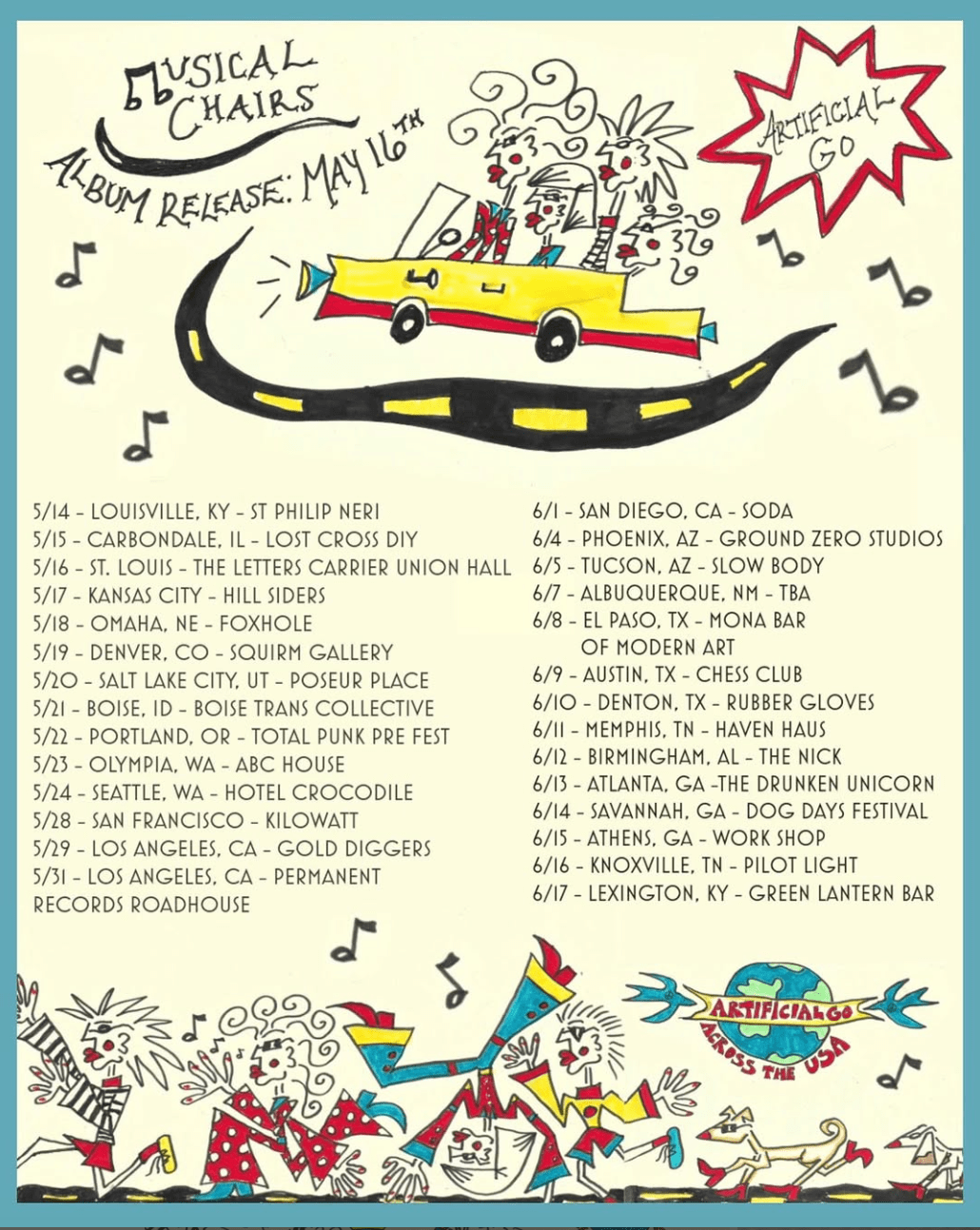
Artificial Go is currently on a five week long tour, fueling themselves with food they cook outside as they share the juices of Musical Chairs at a range of venues and DIY spots across the country. You can catch them on one of the dates above, and purchase a copy of Musical Chairs on their bandcamp.
Written by Manon Bushong / Photo courtesy of Artificial Go
“We’re informed by the dump we play in,” Spencer Morgan amuses towards the end of my conversation with Devils Cross Country. It’s kind of a beautiful sentiment, though in no way a hyperbole – the location where the band currently plays in Cincinnati neighbors a “Recycle America” facility. “It’s just piled sky high.” Connor Lowry explains. “The other day it looked like it was going to spill onto the street. A bunch of washing machines and plane parts.”
It is natural for a band to grow into its sound, and for their discography to reflect shifts as they inch closer to the music they are meant make. This can be a gradual phenomenon, or it could be as radical as a Frank Ocean remix project flourishing into a robust “four and a half” piece indie rock band. Devils Cross Country exists in the latter, and as drastic as that sonic shift may sound on paper, the project’s 2024 debut record affirmed that their current identity is by far their most authentic. Possession is Ninetenths tells a story of desire in its most innate form, the ethos of the album contrasted by a swarming of maximalist sound. The record is a tightly packed nine tracks, warped by a sea of synths and abraded by rusty samples that peel and chip at the ends. The listen is guided by a raw honesty, simulating the complexities of intense inner conflicts and and guilt-drenched longings through experimental song structure.
Amongst the many facets that shaped the current disposition of Devils Cross Country, the most salient was Patrick Raneses’ return to Cincinnati. Home to an animated post-punk scene, it was there that he enlisted drummer Spencer Morgan and bassist Connor Lowry, the three of them planting the project’s early seeds into hardpan Ohio soil. They shifted to a heavier sound – an outcome of existing in an environment where noise is as much a necessity as it is a stylistic choice. “When you’re in these environments, you physically have to play louder because some dude’s doing a Rob Zombie cover underneath us and there are screeching trains just ripping through outside,” Raneses tells me about the city’s impact. It was in these lighthearted moments and deprecating jokes that the members of Devils Cross Country’s relationship to Cincinnati felt the most fervent; as the three of them reflected on cracked foundations, greedy landlords and of course, “Recycle America”, their persistence to create and sheer love for their scene came across the loudest.
We recently sat down with Devils Cross Country amidst their recent east coast tour to discuss the history of the project, “trudge” music and their experience in Cincinnati.
This interview has been edited for length and clarity.
Manon: I know Devils Cross Country began during lockdown, I would love to start by hearing about the project’s initial roots and how it has evolved over the last few years?
Patrick: So I was in a band called Stem Cells at Fordham University with my friend Jake Lee and Frost Children. The last show we played was a day before lockdown, we did an acapella cover of “Numb” by Linkin Park, so we joked that we cursed the world with that one. Jake moved back to Phoenix and after graduation I moved back to Cincinnati, but we had always worked on remixes and that sort of stuff together so through the pandemic I was making music and writing songs that were definitely more indie rock oriented. I’ve known Spencer for a while, we were friends in high school and we started jamming together in 2021.
Spencer: Devils Cross Country became a band in 2022, when [Patrick] moved into our house. We lived in a house venue in Cincinnati, it was called “The Lawn”, it had AstroTurf in the basement that someone had stolen from the football stadium at UC and they kept it in the basement, at least that’s what the landlord told me when I moved in. Pat was looking for a room and then moved into our spot and the project just happened from there.
Patrick: That’s where Lawn came from. It was the perfect practice space and then we recorded that first EP there.
Manon: Do you still live in that house?
Patrick: No, they kept jacking the rent
Spencer: It doubled since we moved in, and the conditions were not worth it. Our house was falling apart and there were cracks in the foundation.
Manon: Okay so now you’re on your first tour since you released Possession is Ninetenths. Your music now has a lot of different layers and samples to it, how have these shows been, and how do you translate your recorded songs into a live format?
Patrick: We don’t feel super tied to like the recorded music, we are flexible and I feel like every show we have played has been different. We used to have two other guitarists in the band, and then we went to a three piece and now it’s kind of back to a five piece. Informally it’s a four and a half piece. I had come up with this plan a year and a half ago called the prosthetic plan, where we just add ’em on like extra limbs and it’s actually worked for the most part.
Our friend Nina, who is in another band in Cincinnati called Spoils, plays violin with us live now. It’s awesome, she was supposed to come on this tour with us but she got Covid on Sunday. I would say the past few months we’ve been working on a lot of new songs, we have a banjo guy too, Patrick number two, he is also named Patrick. It’s cool because we’re not reliant on them, but when they pop in it adds a lot.
Connor: Yeah, Nina and Pat can just jump into whatever we’re doing. Nina will just pick up a new song and instantly play the best she possibly can. It’s awesome, and a lot of what she does is straight improvisation.
Spencer: They need no instruction. Patrick and Nina are in another really cool band called Five Pointed Stars, it’s a slightly experimental dance project.
Manon: You mentioned you are working on some new music?
Patrick: Yeah, we played a couple of our new songs last night actually. I am trying to be more melodic because a lot of the songs on Possessions is Ninetenths are intense, so the new music is a bit happier and has more of a pop center, but still true to Devils Cross Country. I feel like Lawn was this bedroom pop, slacker rock EP and Possessions is Ninetenths went in a completely opposite direction. With the new stuff I want to push hard in both those directions.
Connor: Maybe in the middle somewhere
Patrick: No, other way. Stretch hard on both ends. Sometimes I’m like what genre are we even playing right now.
Spencer: Oh we’re playing trudge. That’s what we call everything, it’s a lax genre so we invented trudge. It’s a weird blend of guitar and electronic music and it sounds kind of blown out.
Manon: I like that, it beats you telling me some hyper-specific ‘-gaze’ with like four words hyphenated before it.
Connor: I feel like I struggle to understand any genre at this point, I just cannot process that information in my mind, so trudge makes it easier.
Spencer: It’s kind of just a lack of any real definition.
Patrick: We had been filming a music video for a song off Lawn called “Fishbone”, and were just driving back and some dude had gigantic boots on.
Spencer: And I was like, “that dude is trudging”
Patrick: Then the word just got stuck in my head.I feel like genre is not super useful anymore, but region can be. Like “Philly” music, that can be kind of trudge.
Manon: How would you describe the music in Cincinnati?
Spencer: There’s a big post punk scene there, a lot of hardcore guys. Corker is the other band I’m in, and a lot of the bands share members. The Surfs are there, Crime of Passing, also Feel It Records just moved there. Also, there are a lot of fresh faces, a lot of young kids making good stuff.
Manon: Do you feel like being in Cincinnati has a big impact on Devils Cross Country?
Patrick: Yeah for sure. When I started the project with Jake Lee, it wasn’t rock music. We were just fucking around, we made Frank Ocean remixes. Then [Spencer] put me on drums and I was in a hardcore band before this. Also, when you’re in these environments, you physically have to play louder because some dude’s doing a Rob Zombie cover underneath us and there are screeching trains just ripping through outside.
Spencer: They sound beautiful
Connor: Yeah they harmonize sometimes, it’s pretty cool.
Patrick: Some dude said it sounded like the studio was burning down where we were.
Spencer: We’re informed by the dump we play in
Patrick: Yeah, there is literally a dump right next to where we play
Spencer: Yeah recycling dump
Connor: Recycle America. It’s just piled sky high. The other day it looked like it was going to spill onto the street. A bunch of washing machines and plane parts.
Spencer: We are just practicing in the most bombed out areas of Cincinnati, but that’s cheap rent so it works. There are so many DIY spaces in Cincinnati, less houses these days but lots of gallery and warehouse spots.
Patrick: When we moved out of the lawn, we didn’t have a place to practice until we moved into this new place. We had to take a weird break, because you need space. I feel like a city’s DIY scene is so dependent on being able to have an affordable spot to make and play music. You need space to be loud.
You can listen to Possession is Ninetenths out everywhere now!
Last month, Devils Cross Country announced their first full length album and shared the fiercely catchy single “San Miguel”, titled after the beloved Filipino beer. The Cincinnati based band nails the divine grit of Midwest post-punk so well you’d never believe the project began in the pristine realms of Zoom mid pandemic, with frenzied hours of Google Drive demo exchanges between initial members Patrick Raneses and James Kennedy Lee. In the last few years, Devils Cross Country graduated the confines of virtual meeting rooms and is now a live constituent in the Cincinnati scene, featuring Spencer Morgan on drums, Connor Lowry on bass, and several rotating collaborators on strings, synths, and stretched samples. Today, they’re back with the second single off Possession is Ninetenths, out via Candlepin on December 7th.
“That person takes again, you let them take again — repetition, a musical act, as an offering. Romantic stuff, weirdly,” Patrick Raneses explains of “Second Sin”, a hazy, slacker rock track that bulldozes notions about ownership. The song explores a relationship with a thief, unfolding a narrative where the act of stealing a possession back and forth yields more fulfillment than possessing it in the first place. Perhaps a commentary on materialism, perhaps an unconventional love song, it’s a maverick of a track both lyrically and sonically.
While its initial melodies have softer edges than the jagged, guitar heavy moments of “San Miguel”, “Second Sin” is sneakily energetic, kindled by surging drum sequences and dense bass lines. Layers of creaky synths, swirling guitars, and warped vocals follow a recipe of twinkling distortion that evokes contemporary Pennsylvania shoegaze, but at its core the track is shaped by local influence, with a grisly sense of Cincinnati post-punk rawness welded into each note.


 the ugly hug