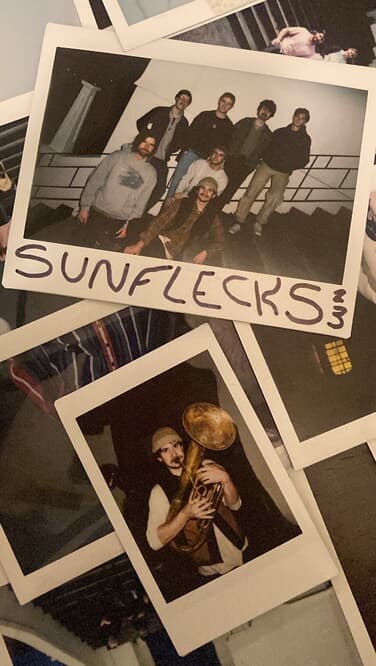
Sunflecks, a folk band based in Bellingham, Washington has created a gentle and comforting examination of the world around them in their album Fools Errand, released with the indie record label bud tapes. Caroline Chauffe of hemlock describes it as “a memory box pulled out from under the bed.” The impressive debut invites listeners to take the long way home and slow down with their cup of coffee in the morning.
The group is fronted by Forrest Meyer, the songwriter and vocalist for all tracks on Fools Errand. The album features bass by Augie Ballew, drums by Amanda Glover, piano by Aiden Fay, violin by Harlow Isham, and pedal steel by Logan Day. It was mixed by Nich Wilbur at The Anacortes Unknown, and mastered by M Deetz. After Fools Errand released on March 28, 2025, the band played a cozy album release show on the 29th at Honeymoon Mead & Cider, in Bellingham, Washington.
“Proximity”, the first single released off the album, is accompanied by a fuzzy, darkly lit music video in a living room, with a projector shifting backgrounds, and duplicating Meyer as he sits in front of it playing guitar. The track feels both hopeful and painful at once, with meaningful lyrics about connection such as “walking in proximity / saying much of anything / relating unfamiliar things” (Proximity.) It features gorgeous instrumentals, with violin and piano blending perfectly.
Meyer recognizes the beauty in simple expression throughout Fools Errand, with lyrics such as “What’s left when all I can say is I love you / and I miss you” (What’s Left.) Although the energy is comforting and hopeful throughout, the songs create a safe space to mourn losses as well. There is beautiful imagery of meaningful conversations with loved ones, light through the window, wishing wells, and the practice of patience, through waiting for tea and the shifting of seasons.
While every song has its own wonderful distinctions, there is a shared pattern of starting simple and building in instrumentation over time. This provides a grounding feeling while listening. Meyer tackles similar situations through different emotional lenses, with the lyrics “now I see new colors / as you hold another” (Sunburst) and “take some space to recognize the space you made” (Take Space.)
Fools Errand is the perfect reminder to accept change, notice daily simple comforts, and always remember your headphones when leaving the house.
It is available to listen and buy as a cassette and digital album on Bandcamp.
With his first release in four years, Morgan O’Sullivan returns with the latest track from his project, Boreen, titled “Don’t Die!”, the first to be shared from his latest album, Heartbreak Hill out November 21 via Bud Tapes. Beginning back in 2015 when he lived in Portland, Oregon, Boreen has always been a project of marked growth and personal hauntings as O’Sullivan’s writing leads with preservation and perseverance within these corroded love songs and tailored tales that he crafts and performs so well.
“Don’t Die” begins with a piano, one that holds weight to the sticky keys like a family heirloom – uneven, simple and fills the room – as it soon grows amongst the colorful instrumentation. “I was in my bedroom / and far away / the words I didn’t say came rushing forward and took my place / I start to see your face”, O’Sullivan sings, his words weighted against the lofty backdrop of instrumentation as he approaches grief and what comes to follow over time. Soon the track bursts with a gritty guitar solo while indiscernible voicings meddle in the back, filling the void of unanswered questions with the warmth in his production and the comfort in its final release.
About the song, O’Sullivan shares, ““Don’t Die!” is the first song I wrote for this album, and the first song I wrote after my uncle’s suicide in April of 2021. In a lot of ways this song shaped the rest of the album, and the themes that I started with here I kept coming back to over the past three or four years. I see this song, and this album as a whole, as a kind of a stubborn determination to survive. I’m thirty years old now. The older you get, the more life kicks you in the teeth. I wrote these songs at the times when I was most aware of that fact— as a way to record that feeling and visualize the better one that will come tomorrow.
Boreen has always been a solo project, but this album has felt the most collaborative. On “Don’t Die!” the piano was played by Garrett Linck, and the drums were played by Stevie Driscoll and recorded by Evan Mersky. The final version of this song was undoubtedly influenced by the way the Boreen live-band played it, so I feel indebted to Emmet Martin, Stevie Driscoll, and Chris Weschler for bringing it to life so many times over the years.
I started Boreen in November of 2015, exactly ten years ago, in Portland, Oregon. I moved away recently and now live in Champaign, Illinois. For me, Boreen belongs back in Portland, so I’m planning on this being the final Boreen album. To everyone that played a role in this project over the years, thank you.”
You can listen to “Don’t Die” here. You can preorder Heartbreak Hill, out November 21, now as well as on cassette and CD via Bud Tapes.
Written by Shea Roney | Featured Photo Courtesy of Boreen
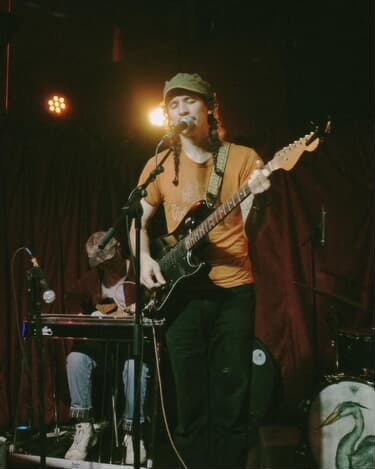
Sunflecks is the project of Bellingham-based artist Forrest Meyer, who earlier this month shared his debut LP under the name titled Fools Errand via Bud Tapes. Living a life pulled by creativity and moved by song, there is a casualty in the way Meyer interacts with music, having been writing, as well as working as a guitar repair hand at Champlin Guitars for some time now. But that doesn’t mean that the music that Meyer makes is lost from any sort of intense intentionality, but rather is as natural as his routine day-to-day, down to the breaths he takes without thought. Fools Errand embraces a collection of voices, a dedication to how music should be communicated between him and the open spaces in which he inhabits.
“And I don’t know what to do, my soul has a hole too, takin’ to leak out. Kettle is on, it’s singing its song, I grab a mug with Garfield on it” – an inherently brief story, but one that brings focus to both lingering pain and a singular moment of personalized characterization. There is something to be said when first listening to Meyer’s writing, where your own minor memories or complex feelings find ways to click with the images and individual lines that he writes such as this one. Sticking to the simple and worn in, Meyer recounts minor moments with clarity, like hanging out with a friend on “Proximity” or tossing a coin into a well on “Toss a Coin”. But this simplicity doesn’t get lost in a cluttered past, or even borrow from what may be in the future as it takes claim on the present, as open as it can be. It’s an album that not only plays with familiarity, but one that asks why these instances become familiar to us in the first place. Where placement and perspective are intertwined with who we’ve become; how much change has this Garfield mug really understood, and how does it see me now? Meyer’s words are experienced and beautiful, a dusty fortune, a prized keepsake to hold on to for when you need it most – and with each stagnant breath of musical instinct offered from his bandmates, Sunflecks paints a picture much larger than we could have ever expected.
We recently got to chat with Meyer about Fools Errand, restructuring collaboration within Sunflecks, and the practice of cone spotting.
This interview has been edited for length and clarity.
Shea Roney: How does it feel to have your debut LP out? You had a nice run of tapes with Bud Tapes too!
Forrest Meyer: Feeling really good. We initially started with a 30 run of tapes, and they all sold out before the album was released, which was great that one single is enough to convince people to order one. So we did another run of 30 or so. I think there’s a couple left on Bandcamp, and I’ve got 12 here. It’s been a smallish run, but it feels like people have received it well and I’ve gotten a lot of nice words about it.
SR: That’s right, it was just one song! How does it feel that one song of yours has the capacity to build enough trust with people?
FM: During the recording of it I never really thought that “Proximity” would be the one. That one was funny, too, because we recorded that song in the session, and then when my drummer [Amanda Glover] and I went back to do the first round of mixing, we decided to fully re-record that song. So it’s just the drums and then I overdubbed the organ on top of it. It’s from a completely different session.
SR: What made you want to start over on “Proximity”?
FM: I felt like certain songs had too much going on in the first recording. The guitar part on it, the picking pattern changes for every chord, so it’s a complex guitar part that takes up a lot of space. But one of the reasons we re-recorded it was it just didn’t need the amount of instrumentation that the rest of the album had. It just worked well as a clean, small thing.
SR: What part of that sparsity do you think helped progress this song into something you were comfortable with?
FM: When you’re in a fun recording studio that has a lot of instruments in it, you’re going to feel like you should try and put melotron on everything. But then one of my bandmates had this idea for the album, because there’s six people in the group total, that we should have a song on the album where someone is not playing. Like, there’s one song with no drums, there’s a song with no piano, there’s a song with no violin, like everything comes in and out, but it’s all kind of equally coming in and out. It’s quite a fun challenge to figure out how to have a lot of instrumentation, but still keep a minimal kind of sound.
SR: How did this configuration of Sunflecks come to be? Have you been playing with these folks for awhile now?
FM: We’ve kept a pretty consistent band. I gathered all these people for that recording session for the most part, and the album’s been kind of a couple of years in the making. But I’ve been playing as Sunflecks as a solo thing for a couple years, and the lineup has been pretty consistent I’d say.
SR: You noted that this is a highly communal piece of work, taking inspiration from the people around you. What was the process of working with others, and in what ways did it push you to bring these songs to their newfound life?
FM: The way that this project has been run, for my part at least, is I write a song, or have something that feels good enough to bring to the group, and then we play with it a little bit and get everyone’s input and ideas on it. More recently, we’ve been going a lot deeper. We call it sectionals, it’s still the whole band, but say we’re orchestrating a violin and clarinet part for example, we’ll go in and all give ideas. It gets challenging when you’re in the group, but you’re working on a single person’s part of a song and then everyone’s just sitting around. But I think [sectionals] is a really cool opportunity to maybe ask Amanda on the drums, as someone who isn’t playing a melodic instrument, what do you think of what the melody’s doing in this part? Communication is always the hardest thing, but we’ve been working really hard on sharing opinions and preferences and ideas. It’s been a really cool and beautiful practice.
SR: What you were saying earlier, taking out voices every once in a while, did those sectionals help lead you guys to understand your sound and the roles of individual voicings, either in their presence or their absence?
FM: When I got the studio dates to record the album, half the band was invited with a two week turnaround to learn all the songs. There wasn’t a whole lot of time between, like, ‘hey, do you guys want to join a band?’ and then, ‘we have studio dates if you want to record?’. We recorded a fair amount of music, there’s a lot of really good stuff, but there’s almost too much really good stuff there. So in the mixing of the album, there were lots of decisions where I was sitting with the engineer, talking about, ‘we probably shouldn’t have pedal steel, piano and violin.all playing at the same time here, right?’. So mixing in and out certain things, depending on where they fit in the song, we wanted to be more intentional on the writing of the song, and then we mess more with harmony, or work out how violin, pedal steel and piano can play the same exact thing, but thirds apart, and maybe that would sound cool. We just wanted to practice more intentionality and listening and even experimentation as well. Especially hearing out everyone’s ideas and running with them to see where they go.
SR: A lot of the narratives you write seem to manage such large themes through such a miniscule and personal lens. What stories were the easiest for you to tell in terms of details, and did challenging yourself to think more locally help bring understanding to them?
FM: A lot of this album is processing. It’s very much using the everyday things that happen, like walking home — there’s a lot of walking on the album. I tend to write lyrics and songs that are very personal for me. It can be hard to talk with someone about complex feelings. So the way that feels better for me is I can sit, and I can use tonality and wordplay, because, like the human experience, it is very rich, but most of the time, you can only say one word at a time. And sometimes there’s emotions where what you’re doing is a happy thing, but there’s a sad undertone to it. It’s hard to communicate those things, so being able to have multiple tools in the toolbox to do that is important. In my head, I’ll toy around with words for a long time until something kind of clicks, and it feels like that’s what I meant. With the song “Proximity”, that song is about an afternoon with my friend Dolores, just listening to music. But the larger metaphorical meaning is thinking back on that time when I was in Olympia. It’s easy to be like, ‘wow! What a nice, beautiful time!’ But then there’s a lot of things around that time that were really challenging, but I’m not thinking about them as much as the nice little thing. A mirror is reflecting everything all the time, but you only see what’s directly in front of you.
SR: And as a listener, listening to your words about what’s in front of you really repositions your presence in a moment. How do you ground yourself and be present in your art and the way you approach storytelling?
It’s fairly automatic in a lot of ways. The way I’ve set my life up, it really surrounds music. I do guitar repair at a music shop, so every day I’m playing different instruments. So in the back of my head, I’m working through the chord progressions and just listening to so much music every day. As a writer and musician, there isn’t a whole lot of super scholarly stuff about my process. The people in my band I play with are all very gifted musicians, and most of them can communicate theory, and I’m starting to get there, but I just don’t think about that stuff. It’s funny when you go up to somebody and say, ‘I wrote this thing’, and then you play it and then they’re like, ‘whoa! That’s really interesting with the blah blah blah!’ I use music as a way to parse out my days. It’s our way of taking the things that I’m thinking and feeling and just trying to understand them – I feel like if I find the right sounds and tempo that make the words feel good and everything clicks, then it’s like, ‘well, maybe that’s how I feel?’ Also there’s so much play in it. It’s just a way to have fun, and I love the weekly excuse to hang out with my best friends and make music together in a scheduled way.
SR: I do want to ask about Champlin Guitars. In what ways has opening the door to your surrounding community impacted you both artistically and personally?
FM: Yeah, it’s a really beautiful thing! At the guitar shop we’ve hosted a lot of really nice shows. It’s kind of my way of giving back to the community. But these shows are also like a touring safety net for friends. A couple months ago, Lily Thomas was on tour, and a bunch of friends drove to Seattle to see her play. But it was when the LA Fires were happening, and they were supposed to go down south for the rest of their tour, but they had to cancel all those dates. So, with a two-day turnaround, we made a poster, found another person to play, and did a Wednesday show at the shop, and still a bunch of friends came out. In my mind, that’s the dream of what the shop shows are for. There’s a lot of trust and I’m eternally grateful for how sweet and thoughtful the Bellingham music scene is.
SR: And then I am curious about Cone spotting on your Instagram. What is this practice?
FM: It’s been going on for about two years now. Cone spotting is, I mean, especially now with the moral debacle of being on social media, it’s a nice thing to have so I can continue to let people know what I’m up to. I don’t have that much going on to please the algorithms, so the cone spotting thing started off with looking through my camera roll and noticing that I’ve taken a lot of pictures of traffic cones in funny situations. I posted those, but then I started seeing more traffic cones in funny situations, and I thought this could be a cool thing. I think there’s a funny aspect to it, and there’s the hunt for it which is really fun. But something I love is the cognitive dissonance of seeing something that’s supposed to be warning, something engineered to be obvious, but when it’s in the wrong environment, or not doing its job, those dissonant things are really fun for me. And it was a great foil to get away with posting semi-regularly without having to be directly personal. And then I started getting submissions and it grew into this thing where I feel like I accidentally trained people — it’s weird how many people think about me when they see a traffic cone. The amount of times that people have gone through the effort of seeing it, taking a picture of it and sending it to me. It became really interesting.
You can listen to Fools Errand out on Bandcamp now, as well as order a tape via Bud Tapes.
Written by Shea Roney | Photos Courtesy of Sunflecks
Floating Clouds is the new recording project of Portland-based artist Alexandre Duccini, who last week shared with us his debut LP under the name titled With A Shared Memory. Adding to the reliability of the Bud Tapes catalog, as well as the ever-impressive PNW scene, what Floating Clouds brings to the table on this debut is facing a deep darkness holding a flashlight with new batteries; a deliberate and intuitive story of navigating life through the unpredictable circumstances of grief and learning how to approach love when it feels so stretched thin.
Having played in many bands and releasing music under his own name for some time now, Floating Clouds embraces the make-up of a band more than a solo project, although these songs are so personally embedded into Duccini’s story. With really no intention to record a full album, taking some songs to The Unknown in Anacortes, Washington just for fun, what came out on the other end was brought to life by contributions from family and friends, old and new, where Floating Clouds as a musical unit explore the need for dire release and ecstatic collaboration, fluctuating within impressive dynamics, searing guitars, well-worn instrumentals and a poised heart.
Healing can be like picking for springs and screws in a patch of grass — a begrudging effort, a task of minuscule factors and massive focus. With each stray blade in your finger, each random stick poking out, it doesn’t matter what you pick up until you find what you set out for in the beginning. With A Shared Memory plays as a delicate reminder, embracing each step forward as a mini success, or if anything at all, a reminder to keep looking. And with each track, Duccini’s collection begins to grow in quantity, and the relief, the joy, the individual finds begin to form a much larger picture, every small addition something that has been lost to him over time. But this isn’t an album that focuses only on the pain, but rather a benchmark of gratitude, understanding the role in which that pain has played in his life and how far he has come ever since.
We recently got to catch up with Duccini to discuss new beginnings, reutilizing memories to heal, and how With A Shared Memory came to be.
Shea Roney: I know you have been recording and releasing under your own name for some time now, but With A Shared Memory is the first piece of music under the name Floating Clouds. What made you want to adapt this new name and did it in any way act as a marking of new beginnings to you creatively and personally?
Alexandre Duccini: It certainly feels that way. I’ve been in bands ever since I was a teenager, and that has always been my lifestyle. But I was always doing solo recordings that was always just a thing in addition to the bands. I moved to Portland in November of 2023, but before I moved, I recorded a solo EP at my friends Eli and Ashley’s recording space next to their house on Whidbey Island. It was the first time solo recording was really thought out and something more than just setting up a microphone in my bedroom. But this project wasn’t even meant to really be an album in my brain when we started recording it. It was my sister Sophia and her boyfriend Alex, who’s a good friend of mine who just started working at a studio in Anacortes, Washington, and we booked two days up there. The thought was basically that it would be fun to book studio time with the two of them and we’ll maybe make a song together. But it went so well that they thought I should just do an album, just keep doing this. Then so many other people ended up playing on it, and I ended up making friends here in Portland who ended up playing on it by the end. It really felt like this is a band, this is not just a solo thing. I was glad that it turned into that and I’m hoping that it continues. The bandmates that I have now are super wonderful and it feels like there’s a lot of really sweet, energized feelings about it.
SR: Having this lifestyle of functioning within a band, but still always centered around making music, what did you begin to focus on differently when you started writing your own songs?
AD: I did get more intentional with the songs I was making and had more of a personally intense relationship to them. I feel like I also just started turning the corner in my life of knowing myself, being at a point with self-love, where I’m actually able to write something real, and it feels okay to sit there and not be distanced by irony, or being a heavy, loud band. I think there’s an aspect, too, though that songs feel really mysterious, and these songs feel really special to me. I think I worked really hard on the songwriting side of it and thought a lot more about what felt important to me to say in music. Songs are kind of like these spells that happen. One moment it never existed, and then some neurons fire in a brain, and then it’s like, ‘Oh, this is it.’
SR: Do you know the Irish term for song?
AD: No, I do not.
SR: This is my one fun fact. They are referred to as ‘airs’, which I learned watching a documentary about Shane McGowan. In it he was talking about how he thinks that term is beautifully representative because songs are mysterious in a way in which they’re all around you, but it takes a specific effort and openness to reach out and grab it.
AD: That definitely resonates with me, that is such a beautiful thing. Songs are just kind of everywhere around us, but you also have to work on yourself to become a person who can hear them. It’s a beautiful thing that everyone can write songs. I think what is special about creativity is that there’s no bar for entry, you just make something.
SR: It feels like the ethos of recording this project was to make music with great people and to just have fun. How did this crew come to be and what did you get out of it creatively and personally while working with these musicians?
AD: They were people I met when I moved here to Portland. They are fantastic musicians who have played in a lot of bands here that I was seeing and really connecting to. I was playing a solo show, and I just asked them if they wanted to play that show with me and they said yes. Then I was like, ‘Oh, by the way, I’m sort of making a record if you wanna play on that, too?’ We recorded over last spring and summer, and I think part of the intention that was set was to just get into the studio with people who seem to be on the same wavelength as me at this moment, and ideally just have a lot of fun while we’re there. I’ve had experiences with recording that were more frustrating, or felt like I won’t be able to live with myself if this goes wrong, you know? I needed, at a point in my life, to shift my way of thinking about this and put less pressure on things turning out a certain way. The focus should be if we’re all laughing and having a good time while we’re at the studio, then it was successful, no matter how much was accomplished. It’s hard to say exactly what I feel like I got out of it other than I feel so happy and excited about the album. I’m so happy with it as a thing that’s done, but there were multiple moments while we were making it where I didn’t want this to ever be done. I feel revitalized about music from this experience. I just wanna ride that wave as often as possible.
SR: It’s also such a beautiful and personal collection of songs. I can only imagine experiencing this constant joy was so reassuring as these songs are coming out.
AD: Any artist has a period of time where they spiral with self-doubt about being creative, if I’m any good at it or if I should continue to do it. I think part of what has felt really significant for me personally is that it just felt like it went so well, from the page to the studio. This was the first time I really ever experienced that throughout the whole process, knowing that this feels right.
SR: This entire album feels like many different, individual points of reflection for you. And like you said, describing the end process as ‘this feels right’, but these songs fluctuate between joy and grief throughout. Was there a thematic progression that was noticeable or was it something that you had to look back at after the fact and realize it then?
AD: That fluctuation will realistically probably exist forever. These songs in this project, I’m riding this highway of excitement, but there is reality, and there’s still plenty of reasons to have a lot of different feelings about life all the time. An idea that was kind of embraced for me personally around the writing of these songs was that no matter what, pain and grief are inevitable. They’re coming, you know? It’s a thing that you will experience. I’m trying to get better at not just borrowing those feelings from the future and letting myself experience the full spectrum of those feelings. That also means really trying to allow joy and love to have their moments as well. I hope that that is reflected in the album, too, that it really has all of that in there. I think all of these songs exist as reminders for myself that this is really happening to me, to look at and sit with and be like, ‘okay, this is real life, and that means a lot.’ Don’t be passive about it.
SR: I mean, the title With A Shared Memory feels crucial to really experiencing it all. A shared memory, whether that be with a loved one, a friend, or the crew you make music with, it’s always between you and another party. But when you go through grief, it feels like you’re split in two, between the healing and then the grieving, like a shared memory between these two split parts of you. As you bring up reflections, and really referring to and experiencing them through this process, what is your relationship to these memories now? Did you find yourself redefining the way in which you approached them as you were writing these songs?
AD: I think sometimes I felt a little bit guilty of the songs potentially portraying myself or my experience of life as a little bit glorified or too pretty. I can feel like one thing, but when you go to the pool of your experience to write something about the process of translating those experiences into songs, it allows me to sit with them in a way where I feel much more gratitude for those experiences. Maybe it’s more than when I was raw, bare, experiencing them as initial feelings, you know? So, like people that maybe once I was angry at, I’m sort of thinking about them when I’m writing, and I start to remember how much I love them, you know? There’s something special, for me at least, that songwriting can do, where it reveals another side of my experiences that maybe allows for more space to be grateful for things that at other times were hard to even want to face.
SR: I mean, it’s just wild how many different angles you can approach a single memory, just as you follow it down the line.
AD: Yeah, for sure. When writing, I feel like there was a cognizant part of me that was thinking, ‘can I be more loving here more than maybe I was, or have been?’ I wanted the songs to feel loving.
SR: Do you have any plans to celebrate the release?
AD: We’re doing the release show Thursday. We actually don’t have any show on Friday, so the band and some friends are gonna do a little listening party ourselves. I’ve been really trying to be better about celebrating and being in the act of celebration. That has been a thing that my therapist advised me to do more, talking about how more traditional lifestyles have these baked in opportunities for celebration, like graduations and things like that. So, it’s good with music to also be like, ‘okay, we’re going to have a celebration’. It’ll be kind of nice to just spend the day outside and all that.
SR: Is the album celebration something you’re looking forward to?
AD: I wonder, I don’t know yet [laughs]. I’m definitely excited for it to be out. I think I’m also bracing for that weird experience when you’ve worked really hard on something, and it means a lot to you, there’s some expectation that builds up, and when you actually share it and it’s different from whatever weird expectation you’ve built up, then the other side of it is feeling disappointment, you know? I think I’ve been unconsciously kind of bracing for some weird feeling of disappointment.
SR: I mean, that’s fair. It’s something so close to you, so it’s definitely going to sway a ton.
AD: That feeling of like, I’ll release it, and then the next week I’ll go back to work. Yeah, okay, that’s right, my whole life didn’t completely rearrange itself because I released an album [laughs].
SR: Yeah, that makes sense. But this one seems special.
AD: Yeah, it feels that way. I am definitely feeling celebratory. It’s really nice, my bandmates have been so amazing, and feeling their excitement about it has been really cool. Also, just having other people be a part of it and be excited about it in that way definitely helps me feel like I got a butterfly’s kind of giddiness.
You can listen to With a Shared Memory out everywhere now, as well as order a cassette via Bud Tapes.
Written by Shea Roney | All Photos Courtesy of Floating Clouds
First Rodeo, the collaborative songwriting project of Tim Howe (Vista House, The Great American Commute) and Nathan Tucker (Strange Ranger, Cool Original, Pontiac Flare), return today with a brand new single called “Nothing”. This track is the first piece of new music from the duo since their previous self-titled LP back in 2022, and also the first glimpse at what they have been working on in that time as they also announce their sophomore LP titled Rode Hard and Put Away Wet, out May 16th via Bud Tapes.
Breaking away from the alt-country-fueled blaze that was their first record, “Nothing” is a drum looped escapade into the tricks attuned by years of collaboration from the well-versed duo. With Howe based in Portland, OR and Tucker in Philly, the songs that make up Rode Hard and Put Away Wet were workshopped through months of sending ideas back and forth through the internet. From the gates, there is a fitted extravagance that lives within the two-chord progression, as Tucker and Howe flip-flop on lengthy and rhythmic verses, playing into that inflection of spoken verse that riddled 90’s rock radio and nostalgic sonic remedies. As the chorus finds the grove, alleviating the rhythmic verses with a ruthlessly catchy melody and a wall of large guitars and a harmonica-ladened atmosphere, “Nothing” makes an unexpected outlier in the preconceived notions of their style, yet acts as a marker of the jovial comradery that occurs when making music that is just flat out fun.
We recently got to ask Tucker and Howe a few questions about “Nothing”, diving deep into the track and the collaboration that makes up First Rodeo.
You described this song as an anomaly within your catalog, but now it is one of your favorites. What were your initial feelings as it began to come together? Any hesitations, or did it just feel right?
TH: I think it’s safe to say Nathan and I were both hesitant throughout the process that a song like “Nothing” could work coming from us. In many ways it’s not only a departure from the rest of the album but also from our songwriting comfort zone. We were really nervous that we weren’t going to strike any kind of balance and the song would tip into a rap-rock zone that we weren’t comfortable with. What I love about this song is that I got to see it through with Nathan from gestation, which is rare, since we live on opposite sides of the country, but I saw Nathan come up with the first few chords, the melody, long before there were words, and then see it slowly develop. In that way, it felt like a microcosm of the band itself, in the way we both had an inkling of what we wanted this First Rodeo thing to be, and slowly got to put arms and legs and toes on it.
NT: Nearly six minutes is also just sort of long for a pop song built around a four second drum loop. That was always the vision but I was worried it would get boring if we weren’t careful with the production. I think when Tim added the acoustic guitar part that happens during the refrain I was like, “OK, we can do a lot of different things with this one basic idea.”
The concept of radio rock plays such a crucial role in a lot of people’s memories and relationship to music. What sort of aspects of this idea did you want to embrace on “Nothing”? Were there any specific memories you were pulling from to achieve this sound?
NT: To be honest that wasn’t really the inspiration for the song, just kind of where it happened to end up. The initial germ of the idea was just the two-chord loop that starts the song and the basic vocal pattern that in my mind was lifted from Isaac Brock or something. But then as the recording started coming together, I realized it was as much Third Eye Blind—or even like LFO or something—as it was anything else. I also just can never resist a big chorus.
TH: The hook feels so quintessentially radio rock to me. I’m always impressed when someone can take a simple phrase that maybe you’ve heard a hundred times in numerous contexts and reorient the listener’s understanding of that phrase. That’s what makes this one feel so big and “radio-y” to me, just the way our verses are long and wordy and specific and the chorus opens up to this arena for everyone.
Working with a country’s worth of distance, how has your relationship as creatives changed since your debut LP? Especially playing together for over a decade now, were there any sort of things were you bringing out of each other or pushing for on this record?
TH: What I really appreciate about Nathan is how he goes in with a ton of vision. I think we both do this to varying degrees; with First Rodeo we’ve been ruminating on how the sound should change album to album since we started passing demos back and forth. Nathan has always had a pretty specific understanding of what this second album should sound like. The first album was a bit more straight-forward alt-country, this one is a bit more chopped and dismantled, a bit more solemn and vast. When it became clear we were going to be making a lot of this one happen cross-country, we wanted to be able to hear the distance in each song.
NT: It’s funny, I think for a lot of people the challenges of doing a cross country band would be a reason to say, “the stakes are low, we can just mess around.” Unfortunately I’m an annoying try-hard and I like to have a plan. Doesn’t mean you have to stick to it—and in some ways the plan on this one involved a lot of recording ten things and deleting 9—but I wanted to see what we could make by at least setting out to explore a more focused sonic and emotional palette.
You can listen to “Nothing” out everywhere now. Preorder Rode Hard and Put Away Wet as well as a cassette tape out May 16th via Bud Tapes.
Written by Shea Roney | Featured Photo by Sam Wenc
As a small music journal, we rely heavily on the work of independent tape labels to discover and share the incredible artists that we have dedicated this site to. Whether through press lists, recommendations, artist connections, social media support or supplying physicals, these homemade labels are the often unsung heroes of the industry. Today, the ugly hug is highlighting the work of our friends over at Bud Tapes.
Bud Tapes is a tape label out of Portland, Oregon, started in 2017 by Emmet Martin, who also leads the free music project Water Shrews and previously the indie project World Record Winner. What began as happenstance for Emmet to release their own music has since grown into a small but mighty collection of recordings from an eclectic roster of artists.
Bud Tapes has become a staple in the Portland DIY music scene- a home for anyone making music for nothing more than the love of making music. The label’s releases are often imperfect in the best way—rough around the edges, experimental, and full of character. Each tape is a little snapshot of someone’s creative journey, and you never really know what you’re going to get with each new release, which is part of the fun.
Bud Tapes is about embracing the weird, and off-beat while still keeping it personal. It’s a label that values the physical side of music—putting the project into your hands in the form of a personalized tape, something you can hold, pop into a deck, and experience over and over again. Whether it’s something from Emmet’s own Water Shrews or another unexpected gem, Bud Tapes is all about capturing music in its purest, most direct form.
This interview has been edited for length and clarity
Emmet Martin | Photo by Kat Curey
KC: What sparked the idea to start a tape label? Was there a particular moment or inspiration that made you take the leap?
EM: Well, I’d always kind of wanted to start a record label, but I thought that you had to do something special to start one like you had to be someone or whatever. I had this record I’d been working on for a while, and I was starting a new band called World Record Winner. I was friends with a lot of people who were signed to labels at the time—people I knew who were kind of popping off—and they said, ‘You should send your record around to places.’ So I did, and everyone either ghosted me or rejected me.
Then I got this one email from Off Tempo, which is a label in Seattle. They put out a lot of stuff that’s kind of indie-adjacent, and it’s run by someone from Slashed Tires, which was a cool project. I was more tapped into the Seattle scene because that’s where I’m from originally. So, I emailed them asking, ‘Do you want to put out my record?’ and they said ‘this is just like a thing we stamp on our friends record’s so we can put it out’ I mean, they phrase it less like that, but that was the gist’.
Basically, they said, ‘You’re at the level where you should just put this out yourself. Make a fake name for your label and release it.’ I was like, ‘Oh, shit, you can just do that?’ So I did. That was kind of the impetus for it—putting out my record when no one else wanted to. And that’s pretty much the case for most people starting labels. They’d rather work with someone else than do it themselves, but in the end, you realize you kind of have to do it yourself. And you find all the joys that come with doing it yourself.
KC: Can you share the story behind the name of the label?
EM: I have a pin that I made at a Cool American show—which is Nathan Tucker’s project, you probably know him- he has so many projects. His partner, Georgia, had a button-making station, and I was in college and I was really stoned and I just wrote ‘bud’ with a little smiley face on a piece of paper and got it pressed into a button. I had it on my fleece all the time for like two years. Then I was like, ‘Oh, that’d be a very fun name for a record label or whatever.’ But it was way after I had made it. So that was also kind of an impetus—it was a fun, weird name that I had in the back of my head for a while.”
KC: Do you have any collaborators that help you run the label, and if so, how does that shape the way the label runs?
EM: I’ve always thought it could be fun to get people involved, but I just don’t know how. I can’t pay people to work and I feel bad asking people to do unpaid labor. So, I just do everything myself. I’ll have help duplicating tapes every now and then for bigger projects, like Greg Freeman’s album or Lily Seabird’s album. But everything else is just me for the most part.
KC: Who was the first artist you worked with and how did that come to be?
EM: Technically, it was just me at first, but I did one release for my friend Isabel. It wasn’t really a ‘real’ thing—she didn’t even want to put out the tape. I kind of made her, since we’d done these recordings together. Anyway, shoutout to Isabel. You can find it on the Bud Bandcamp. We got one write-up on a zine, and it’s a really good tape. She wouldn’t let me put all the songs on it, though, even though there are more that are great.
The first ‘real’ release I did for someone else was from a band called Flipchuck, which is my friend Addie’s band with my friends Leanna and Nikhil, who I went to college with. Right before COVID hit, I was at a show for my friend Jesse’s band, Happy Dagger, and Addie was there. We started chatting, and she had become closer with a lot of my friends, so I was seeing her around more. I asked her what was going on with Flipchuck. She said they were finishing something but weren’t sure if they’d put it out or just post it online. I told her, ‘Well, I’ve got this fake label, and I can make you a few tapes. I’ll give you a couple for free, and I can sell the rest online to pay myself back.’ She was like, ‘Wait, you have a label?’
So we made plans to release a tape in April 2020 and do a release show at my house since I was hosting house shows. Obviously, that didn’t happen because, well, 2020. But I ended up creating an Instagram for Bud and we released the tape in April or May. Since everyone was bored, I started doing live streams on the Bud Instagram, and that’s kind of how we ended up doing the Flipchuck release show.
That was the first time I worked with a ‘real’ band, and it went great. It helped people start to notice what we were doing. It’s a really cool tape, definitely worth listening to.
KC: How do you find the artists you work with? Is there a special connection or vibe you look for?
EM: Those live streams I did on the Bud page started with a group chat I created to schedule them and share the lineup. After each stream, I’d say, ‘Anyone in here can send me music, and I’ll put it out.’ It was kind of like, ‘You’re all my friends, and if you’ve got something, send it to me.’ A lot of people had records they’d been sitting on, waiting for the ‘right time.’ But then we were all stuck inside, and there was no ‘right time’ anymore. So, we just decided to put out music now that we had the time to do it.
That’s how I got a bunch of releases, like the first Babytooth album. Isabel played solo for one of those live streams, and that kind of kickstarted things. Now, people send me stuff randomly, but it’s also a lot of me hounding people, asking, ‘When can you finish that record and send it to me?’ So, it’s a mix of people sending me stuff they’ve been working on and me chasing them down.
I think, for the most part, I’ve always gone for the vibe or the ‘atmo’—I learned that term recently and I’m trying to use it more. It’s an alternative to vibe, you know, atmosphere.
KC: Oh I love that. ‘Vibe’ is so over.
EM: ‘Vibe’ is so overused, but it’s kind of like people who would be doing this regardless of whether there’s an audience or not. I’m usually trying to put out stuff where the artist would be making this music whether or not anyone’s listening.
It’s kind of a true folk approach, like folk music in the traditional sense—music that’s not commercially minded and not trying to fit into any particular scene or chase what’s hot at the moment. It’s really a cultural, community-based way of making music. So I’m usually trying to work with people who are in that realm.
Sometimes, I don’t do that and I put out records that are really good and I know the artist is trying to ‘make it’ or whatever. But for the most part, the artists I seek out and think, ‘Yes, this is something that should be on Bud tapes,’ are people making weird stuff that barely anyone listens to—but I’m like “this shit is fucking awesome”, I’ll make twelve tapes of it.
KC: What’s it like bringing a tape from concept to reality?
EM:When I started out, and still for most of my releases, I do everything myself. For the ones that are more high profile, which rarely happens, it’s different, but for the ones I’m doing from home, it goes like this: someone will make the artwork, and I either adapt it into a J-card or they’ll make one themselves. The artwork is usually square, but I have to adjust it so it fits into a rectangle for the front, and then leave space for the spine and side.
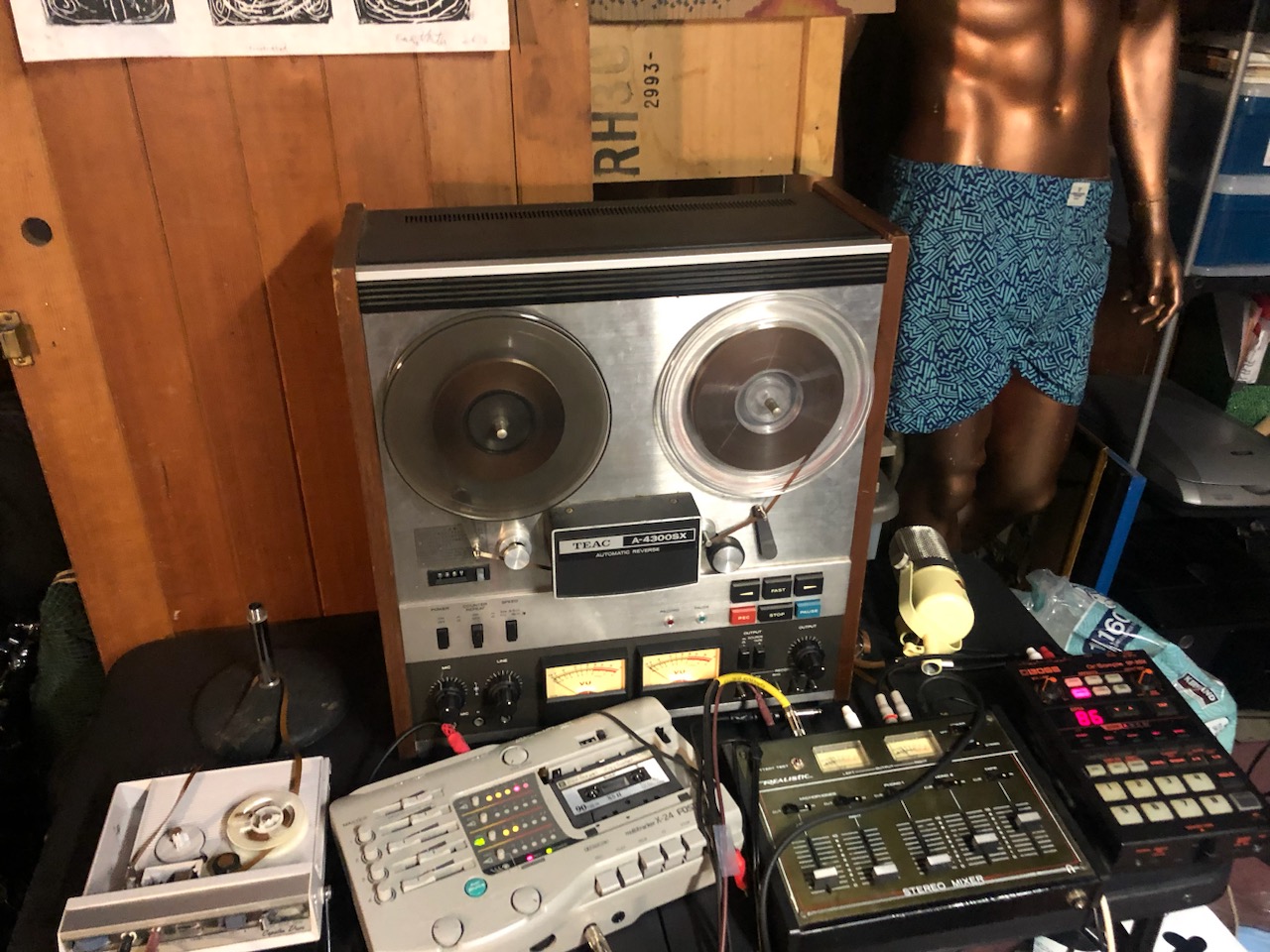
Once that’s done, the artist sends me all the master tracks. If I’m doing it at home, I’ll dub one tape onto my stereo, and then use that tape to duplicate others. I usually have a couple of high-speed double-deck stereo units, so I can put two tapes in at once, and just run them back and forth, hitting high-speed dub.
It’s about twice the speed of the album length, so if the album is 40 minutes, it takes about 20 minutes per tape. I’ll just hang out, watching TV with my partner, while she listens to the whirring of the tape wheels. It’s a specific sound.
Most of the time, I’m just sitting there with my cat on my lap, dubbing tapes and smoking weed. It’s not a bad setup.”
KC: Okay, I love all the band names. You have a good roster.
EM: There’s so many of them, like I’ve honestly done too much [laughs].
It can take a while just to get people to understand what it’s going to look like. We need time to send emails, get everything right, and make sure it’s all set up. It’s mostly about setting people up for when the release is actually coming out and what’s going to fall on the schedule.
But mostly, once I make the tapes, I’ve been trying to announce the release afterward. I’ve done too many times where I announce the release before I’ve made the tapes, and then I’m scrambling last minute trying to get everything done. So I’m trying to give myself more time to get everything ready before announcing.
It’s usually just about making the tapes, making sure the art is ready, maybe planning a release show, and that kind of thing. But honestly, it’s not a lot. I feel like a lot of labels have big rollouts, but for me, it’s not like that. It’s not like I’m doing vinyl or anything, and for the most part, I’m doing stuff that I know will sell a small number of copies—usually no more than 50. So it’s not like I’m ever going to be down and out or anything.
It’s really just about making the tapes and then trying to sell them.
KC: And you taught yourself how to do it all?
EM: Yeah, I had a duplicator I used to use, and it was super janky. Then I bought others, and they were even more janky. My poor partner, Bailey, saw me ripping my hair out, freaking out at these failing machines and trying to replace belts in them.
But it’s always just been me doing it. I eventually figured out a way that works with thrifted double tape decks. They usually make a pretty good copy, and I check every ten copies to make sure they’re okay.
KC: Are there any parts of the process you particularly love—or find challenging?
EM: Oh, I really like just sitting and dubbing the tapes, especially the master tapes. I listen to every record before agreeing to put it out, but then there’s this moment when I go to dub the master tape, and I think, ‘Oh, fuck, I’m stoked to put this out’’ That moment is always really good—like, okay, I’ve got to make these tapes, this is real, I’m dubbing the master tape, this is happening. It’s when I listen to it most in-depth that I get really excited about it.
As for challenges, it’s not so much the process itself, but the hardest part is saying no to people, in any way. Even if I’m putting out their release, and I have to say, ‘I can’t do this right now,’ that’s really difficult for me. But it’s the reality of it. People have all kinds of expectations about what it looks like to put a release out on a record label and setting expectations is hard.”
Photo from Emmet Martin
KC: Can you tell me about the Cosmic Bud series? Where did you get the idea and how do you put each series together?
EM: It was kind of a thing that I failed to do. Initially putting out experimental music seemed so different from Bud that I thought I had to create a separate imprint for it. So, I did a series of three CDs, mostly with experimental stuff happening in Portland—my friend Josh’s band Modern Folk, my friend Matthew Peppitone, and my friends Our Blue Heaven. I did CDs for each of them, like a batch deal.
I don’t know, it just felt weird to keep it separate, and people were confused about what that even meant. Eventually, I just thought, ‘Whatever, Bud is just me, I can do whatever I want.’ So now everything is just under Bud. That was kind of a failed experiment in trying to create something separate for experimental music, like a little imprint. But I realized I could just put everything under Bud, you know? It’s all going to be on the same Bandcamp page anyway.
Handstamp Cassettes of Waves of Higher Bodies by Spiral Joy Band
KC: You’ve done a few reissues or revitalized releases, the Spiral Joy Band that was just announced and the Clovver EP for example. Why are you drawn to this form of preservation and why do you think it is important?
EM: The ones I’ve done have mostly been projects people have asked me to work on, like the Clovver EP, which was super meaningful to me. That was a band I saw a lot back in the day, and the drummer passed away pretty unexpectedly. The singer is my friend Teal, along with my friend Elian. Most of them are in Pileup now—Elian and Grey both play in that band.
Clovver would always play, and it was super cool. The drummer, Andrew, was also in my friend Aaron’s band, Two Moons—I can’t even remember how many projects Aaron’s had over the years. He put out Balloon Club and a bunch of other things. And he also played in Clovver!! Anyway, I would see Clovver all the time, and I’d heard about a record of theirs they were working on. It never came out, so we ended up mixing it years later, after Andrew passed away. It was more of an archival thing.
It was really cool to put that out, but the hardest part about those kinds of releases is that there’s no active band to promote it. So, it’s out there, and I try to sell the tapes, but there’s not much context for it. If you have a media guy, they can lay out the story of how it was made, but I didn’t really know how to do that at the time.
Now, I’m doing a reissue for a band called Spiral Joy, which is a weirdo drone band originally from Virginia, then Wisconsin, and now Texas. I’m reissuing one of their really great records, mostly because I’m also putting out a new release from them. They reached out, saying they had an LP from a European label that only pressed a few copies, and now people have been asking for it. The shipping is so expensive that it’s hard to get it to people. So, they asked if I’d consider doing a US CD reissue to make it more accessible. I thought that sounded great, and it’s perfect because it ties into the new release I’m also putting out, so I can plug both at once.
I also really admire a lot of reissue labels, especially in Portland. Concentric Circles is a classic one. Jed, who’s been in bands like Helen (Liz Harris from Grouper’s band), plays drums in that and has also played in Jackie-O Motherfucker and other great bands. He runs Concentric Circles and also co-runs Freedom To Spend, a reissue label that does incredible archival work, digging through people’s families’ archives and finding amazing stuff. That’s the kind of work I’d love to get into, but I’m not sure how to go about it. Maybe one day I’ll figure it out, but I’ve already done a few reissues, so I’ve kind of broken the seal. I guess I could expand on that in the future.
Show Poster for How Strange it Is Album Release Show w/ Babytooth, Boreen and Tough Boys 3/09/22
KC: How long has Bud Tapes been around?
EM: I started in 2017 and did three releases over three years. Then in 2020, things really took off, and I ended up doing around 20 releases a year.
KC: What keeps you going and excited about what you do, especially on the challenging days?
EM: There are certain things that just happen, like this Spiral Joy Band release, which is really crazy. It features former members of a band called Pelt, who are the reason I got into weird, experimental music and drone music in the first place. They started in the mid-’90s and have been around a long time. One of the original members passed away, but they’ve kept going. Spiral Joy Band is an offshoot of that, and they’ve been releasing a lot in recent years.
I met my friend Rob Vaughn, who runs a label called Sound-O-Mat. He doesn’t put out a lot—just a few 7”s and CDs—but he’s been around for a long time and has worked with Pelt a lot as a sound engineer. When he found out I had a label, he said, “We should hook you up with Michael and do a Spiral Joy Band release.” I was like, “Yes, I do have a label, it’s real, whatever!” That kind of thing keeps me going—the fact that I can say, “I have this label,” and it connects me to more opportunities like that.
Now I’m kind of connecting it more with the Water Shrews world. I used to keep things separate because, with experimental music, people can be judgmental. I didn’t want people to look at it and think Water Shrews was some experimental project, or that we don’t get it. But I’m way more into that world now. I used to play in kind of indie rock, twee bands for a long time, with the whole “heart on your sleeve” thing. But now I’m just like, whatever—I don’t care what people think. I’m putting out stuff that I think fits within the same world I’ve created with Water Shrews, which is really exciting.
When I finally started following people on the Bud Instagram, I never follow anyone unless they follow me first, but I decided to follow all of my weirdo friends. And my friend Al, and a few others, were like, “What the fuck? How did I not know about this? This is so cool!” It was really exciting to see people so stoked on it. It’s a great way to make connections. You get to put on this weird hat like ‘I’m a label, I put out these records, and I could put out your record if you want’.
The Shrews hat is a little different, it’s a little more weird, and less thought-out. It’s like my “freak flag” hat.
KC: Can you share a few personal favorite releases or projects that you’ve worked on and tell us a little bit about them? Whether it’s because you learned something new, the process was enjoyable or you just like the music.
I love Shelter Music. They’re a group of folks who’ve played in a bunch of famous indie rock bands—kind of a supergroup. It’s Travis, who’s the lead of Naomi Punk, my friend Max Nordile (who’s played in a million bands in Seattle, the Bay Area, and New York), Dave, who plays bass in Milk Music (now Mystic 100s), and Steve, who played in Trans FX, a big band in Olympia for a while. Then there’s Anton, who played in Gun Outfit and a bunch of other bands. They’ve all been in so many different groups, but now they play together in Shelter Music, and it’s just this weird, free-form craziness. I always struggle to explain it, but it’s generally free music. They do a bit of hallucinogens and just make music in a park shelter in Olympia that has an outlet, which is why they’re called Shelter Music.
They started as a gathering where they would just hang out, meditate, and play. Max joined later—Max is funny because he’s totally not new agey at all, but some of the others are a little into that vibe. They’re cool about it, though. I recently learned the term SNAG, which stands for Sensitive New Age Guy, and they’re definitely SNAGs in the best possible way. It’s not the kind of weird New Agey stuff where people are trying to sell you things. These people are total SNAGs in the best way possible.
I’m super stoked on the Shelter Music CD I did called Live in a Tree. It’s a 50-minute long jam they did at an art swap in Olympia. I sat in with them before, which was both super exciting and nerve-wracking.
The Greg Freeman album was another huge deal for me. My friend Garrett Linck, who now plays in the band, had seen Greg Freeman’s band at a festival in Burlington. He was totally blown away, texting all of us, like, “You gotta hear this!”. He told me about the song Tower, which was the only song Greg had released at the time. I thought, “Wow, this is really cool.”
I don’t know how, but Greg ended up sending me his record directly—not through Garrett, because they hadn’t connected yet. I think Will from 22 Degree Halo might have helped connect us. Will ran a label called Sleeper Records, and he sometimes refers people to BudTapes when they reach out to him, saying things like, “I don’t do this anymore, but try Bud Tapes.” Greg has never confirmed that, but somehow, the record ended up in my inbox.
I was in New Mexico visiting my partner’s friends when I got the email. Normally, I wouldn’t respond to emails like that while traveling, but I was like, “Wait, this is Greg Freeman’s record!” So I wrote back immediately, saying, “Yes, this record is incredible. My friend Garrett told me about you when he saw you at the festival. I’d love to put this out.” Greg was down, and we set up a phone call to talk.
I always say to people who like Greg Freeman’s music: “He’s gunna be huge. Someone’s going to figure out how good his stuff is.” I’ll always tell people, “I’m happy to be the worst case. If nothing else works out, I’ll make a hundred tapes and we’ll make it happen.” Greg had sent his record to a bunch of places, kind of like I had done with my own stuff.
When Greg said he was waiting to hear back from a few places, I told him, “If something works out and you get a better offer, great! But if not, 100% I’ll put it out.” So that was a huge deal for me. It was the first record I put out where I didn’t know the artist personally, and it wasn’t like building a community type thing at first—but it eventually did.
It was so amazing to see Greg play in Portland and to see so many people come out to support him. It was like everyone I knew who had been involved with the label at some point came out, and it was just such a cool moment. People were so stoked, and it felt so good to see that support.
Cassette Tapes of Greg Freeman’s Debut Album I Looked Out
KC: For those who are looking to start their own tape label, what advice do you have for them?
EM: Just do it. You don’t have to have a big plan or be anyone special—just make a label. Set up a Bandcamp or Big Cartel, or start making tapes and give them to your friends. Then you have a label. Or CDs, or USB sticks with your album on it, or put stuff on streaming. Anyone can do it. It’s just about deciding that you want to do it.
KC: Is there anything you wish you knew before you started?
EM: I started when I was really low on money, so it’s been a bit of trial and error. But it’s all been fun figuring it out along the way. A lot of people go into something like this with a big plan, but I’m just happy that I’ve figured it out as I go. I’ve never been a perfectionist. If you ever get one of my tapes, you’ll see what I mean. This one’s actually a pretty good example, but usually they’re a bit stamped off-center or a little messy. I’ve never worried about making everything perfect.
The magic of doing anything creative is in the process that gets you to that point. Without failing and messing things up—like when your tape players aren’t working or you realize the stamp’s not sticking—the point is it’s a real person making tapes and trying to build community. It’s about being a person, making something, and trying to build a community. You don’t get that by planning everything out with a big team behind you. It’s just a real thing and I think people pick up on that. I’m not trying to be anyone or get anything out of this. I just want to connect with like-minded people and put out cool records. That’s what it’s about for me.
KC: Where are all of your releases out of?
EM: It’s mostly local stuff, but there are a few random releases here and there. Like, I did a couple from this group called Amigos Imaginarios, which is made up of this guy, Caleb who lives in Worcester, Massachusetts, and someone named Arbol, who now lives in France. That was actually a random submission, but it worked out.
Another release I did was for my friend Gabe, who lives in Chicago now but was the bassist in my high school band in Seattle. I did an ambient tape for him a while back. He went on to study sound design at the Art Institute of Chicago and now works in that field. He was in that program with Lula Asplund, who’s now a drone queen in the scene. She’s really popped up recently.
But yeah, most of the stuff is local, with the occasional random submission from other places.
KC: What’s on the horizon for Bud Tapes?
Yeah, there’s always a lot on the schedule. Right now, I don’t have a ton coming out, but I have three releases ready to go. There are also some long-awaited projects that will come out sometime next year. One of them is my friend Garrett Linck’s record.
Garrett’s a great guy—he plays in Greg Freeman’s bands and he’s been an old friend of mine since college. He hasn’t really made his own music in years, except for a few EPs back in college. He’s been playing bass in Hello Shark too, but now he’s finally working on a solo record, something he’s been talking about for over two years. He keeps setting deadlines and then it doesn’t happen. Normally, I wouldn’t be so patient, but Garrett’s one of my oldest friends, and honestly, he’s the reason I do what I do. So I’m just waiting, I really hope this next year is the year we put it out.
There are a few other projects like that—people I’ve told, “Whenever you’re ready, I’ll put it out.” They can cash in that token whenever. Garrett’s record is especially close, though—it’s almost done, just needs a few finishing touches. I really hope it’s out next year. With Water Shrews, we just record everything and put out tapes when we have too much material.
Along with this series, our friends at Bud Tapes are offering a five tape bundle giveaway! The bundle will include Self-Titled (2023) by Canary Room, 5 New Songs of Half Shadow (2023) by Half Shadow, Alas(2024) by Lily Seabird, Waves of Higher Bodies (2024) Spiral Joy Band and Massive Leaning (2023) by layperson, as well as an ugly hug tote bag and sticker.
To enter the giveaway, follow these easy steps below!





 the ugly hug