Every Wednesday, the ugly hug shares a playlist personally curated by an artist/band that we have been enjoying. This week, we have a collection of songs put together by Brooklyn-based artist, Iris James Garrison of Bloomsday.
Earlier this year, Bloomsday put out their critically acclaimed sophomore record, Heart of the Artichoke, an album that lives in its connections, creating an honest and clear silhouette of Garrison’s presence while also documenting a keepsake; the community that Garrison has surrounded themselves with to bring their music to its truest from yet.
Bloomsday, the project of Brooklyn-based artist Iris James Garrison, has released their sophomore LP, Heart of the Artichoke off of Bayonet Records today. Following 2022’s Place to Land, this new project thrives in its deliverance – the lush instrumentations giving Garrison’s poetic phrasings room to breathe, and vice versa, showcases the personal growth and vision that made these performances so fresh and enduring. Heart of the Artichoke is an album that lives in its connections, creating an honest and clear silhouette of Garrison’s presence while also documenting a keepsake; the community that Garrison has surrounded themselves with to bring it to its truest from.
Last month, I grabbed a coffee with Garrison to discuss the importance of community, the significance of revisiting old songs and the momentary inspirations that stuck out when writing Heart of the Artichoke.
This interview has been edited for length and clarity.
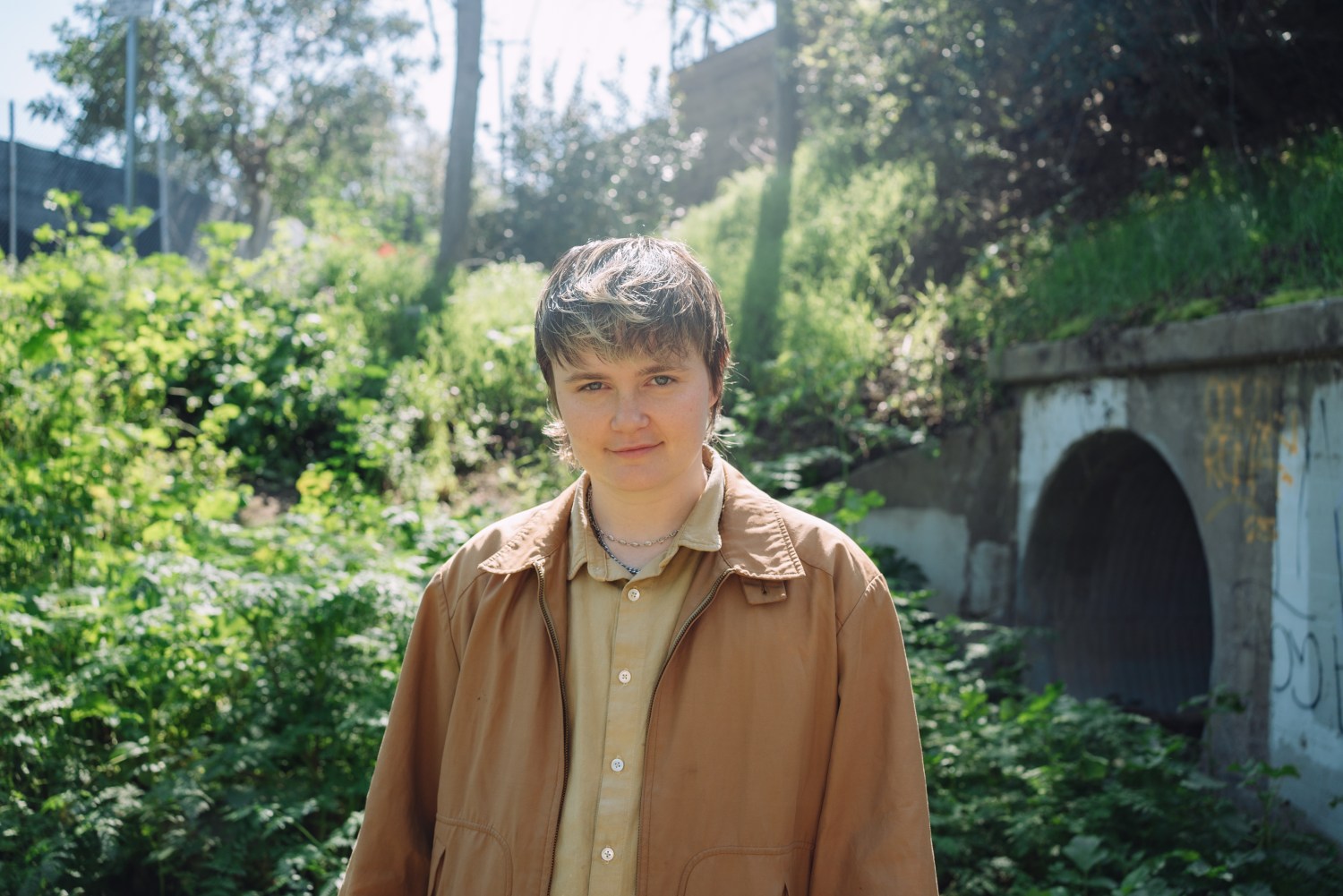
Photo by Desdemona Dallas
Shea Roney: You recorded a lot of Heart of the Artichoke with Ryan Albert at his home studio in upstate New York, which turned into a very community driven and collaborative project over all. Can you tell me about that experience and the people you chose to work with?
Iris James Garrison: I do so much of the writing part alone, and then to find the realized state of the song, I love to hear what my friends and people I admire think would work. So in that process I think the more the merrier. Maya [Bon] and Ryan [of Babehoven], Andrew Stevens (Lomelda, Hovvdy), Hannah Pruzinksky (h. pruz, Sister.), Richard Orofino, Alex Harwood, Chris Daley – they’re all awesome people and I just wanted to feel like we were all able to be really open. I can’t really focus when I’m in New York City, so when Ryan approached me about that, I thought that actually sounded so much better than doing it in a proper studio in New York. As awesome as that is, the pressure is really on to know what we are doing, whereas, exploring the songs and being in a house – going to grab a sandwich, going on the porch for a second, walking in the woods, going in the pond whenever I want. It sounds as dreamy as it actually was. There are very few times in my life where I had no stress. Even my friend Dallas visited us while we were there and halfway through the week, we had a bonfire and they were said, ‘you laughed more that night than I’ve ever seen you laugh.’ I was just very open and it was very special to have so many people I love to be working on my music.
SR: Did you get to work on your own time frame with these songs?
IJG: I gave myself ten days. Ten songs in ten days. We didn’t do the entire thing in that house, we also did three days at the Chicken Shack, which is a really sick studio in upstate New York, with Nick Kinsey to get a lot of the drum sounds and some live band feel. We played a couple of the songs live just to capture what they were like in that environment because some of them I feel like it’s really essential for their sound. So we just did a weekend there and then the rest of it was at Ryan’s house.
SR: Being so comfortable in a collaborative environment and taking in other people’s perspectives on your songs, would there be moments and ideas that would change your own perception of what the song means to you?
IJG: There were some that I was less open than others. The song “Artichoke” is a great example of having an idea, but not a fully fleshed song. I wrote all the melodies, but actually arranging it was a very collaborative process of just figuring out how to make it feel like an arc without there really being many lyrics to work with. That is different for me, because usually I’m really into song structure being pretty classic – verse, chorus, verse. But the instrumentation ended up telling the story a lot more than the lyrics.
SR: “Night Swimming” is fully instrumental. As you talk about perception in instrumentation, was this something that you wanted to focus more on putting meaning into than you have on prior works?
IJG: I think even just the fact that I brought more people in was so starkly different from Place to Land where it was just me and Alex alone in 2020. He was one of the only people I saw that whole year, and that process of working with just two people for a six-month period can be hard. You don’t really get any perspective. It’s hard to get perspective on things that you’ve listened to like a thousand million times. So I guess, yes, I wanted to focus on instrumentation. Ryan, Alex and I were very zeroed in on parts. Now I just write something and think, ‘wow, I can’t wait to work on that with the people that I really love to work with and see what happens.’ Especially with something like “Artichoke” and “Object Permanence”, I was not sure what their form would be. Obviously it’s not like I just hand it over, but it was really fun to be a part of the process and work with everybody.
SR: So obviously you had this great sense of community on this record. When listening to Heart of the Artichoke, it very much focuses on human connection and the many different forms you encounter. Why was this such a natural place to let your songs go?
IJG: I’m not a super conceptual first writer. I’ll have a melody that I like and I’ll just kind of let that ruminate for a long time. I think with human connection I feel I write a lot in second person – a ‘you’ and ‘me’. So I think if I find a pocket of a hook, it’s almost always addressing someone else. I learn everything through my relationships. I need to bounce things off of other people, I think because my unconscious understanding of myself comes through talking to whoever the ‘you’ is. So as the songs come out, I’m learning through ‘you’ and here is a picture of what that feeling is like.
SR: Using that habit to learn from others, what does that say about where you’re at in your life where you’re touching upon all these different connections with such ease and comfort in your writing?
IJG: You know, as we go on in life we get to different spots. I’m much more healed. I feel like my songs when I was younger were so tormented and I had a hard time having perspective on what was going on for me – it just regulates my system and it’s helpful in uncovering the stuff that’s underneath. Some of these songs are my favorite songs I’ve ever written because they take those little moments that I don’t think I would have cared to notice and romanticize when I was younger, instead of thinking I’m tormented and heartbroken and that’s the only way to experience artful romanticism.
SR: I like how you said little moments, because a lot of what your lyrics revolve around are little mundane moments that hold more weight than what we may initially perceive. The song, “Where I Am And You Begin” has some remnants of the first song you ever wrote, bringing us back to those earlier days you mentioned. What was the significance of resurfacing a song that pushes for reliving the sensations of a moment?
IJG: That song is about a person that is from my past and was my super heartbreak. It’s really a song written in hindsight, looking back and sort of being overtaken by that feeling again. I like that song because I’m aware while singing it that the where I end and you begin is actually, in a way, talking about just codependency and not knowing where we are separated. Being aware of that now and then having sort of a flashback to a moment, letting it overcome and then letting it go, that sort of intensity feels so amazing when you’re younger, but it’s also super destructive and can be really addictive and toxic. I think in a way, writing it gives me a place to feel those things instead of actually living in those feelings now.
SR: Because it feels like you’re trying to recreate thesensations of particular memories, using hindsight to kind of resurrect those sensations, what did it feel like to reuse these parts that you wrote such a long time ago?
IJG: I mean the chords I wrote when I was 15 or something. It’s an old song, and when I was sort of going through it again, it almost felt like a ghost coming back into the room. Having a beautiful song that holds space for those feelings, I think there’s less shame involved in desiring them. Desiring them even though you’re older and have grown past certain things. It’s hard to let go sometimes of the teenage angst and the teenage first love – those feelings are a once-in-a-lifetime feeling. You don’t really get to have them again, so I think that yearn was a big part of why that song came through.
SR: This idea of writing about your younger self within the lens of hindsight, especially in songs like “Carefully”, how do you approach working with that reflective voice from who you are right now?
IJG: So “Carefully” came to me while I was on a bus. That was a one-sitting song, but it has a lot to do with sort of the inner voices in my head that are sort of coming back to doubt, feeling worthless or nothing I say will be good enough for the expectations. “Carefully”, the word itself, I think I hadn’t ever touched on that sort of a vulnerable position I often take. I think the way I navigate my art, or life in general, is being extra careful. It’s sort of from an anxious place of not wanting to ruin something. In a way it’s that hesitance where the song is really gripping at that inner tension. It’s a super vulnerable song because this is really a part of my internal self that I have not really shown before.
SR: Do you feel like releasing this song was, in fact, a step to kind of counteract those internal tensions?
IJG: Yeah, and having certain people really connect with it I think also made me feel less alone in those feelings. Also, I think even if people don’t connect with it is fine because I really think I needed the song either way. It’s definitely different from other songs that I’ve written, but I hope to write more like it because I think it was sort of uninhibited, and I didn’t judge it. I really didn’t judge it.
SR: I think the imagery of God buying a dollar slice is perfect. It’s so funny and it just makes sense, almost humanizing the highest being, or like the highest expectations. I know you’re not a religious person, but you’ve brought up this other idea of a higher being – is this something that opens your understanding of yourself or the world around you a little bit more?
IJG: I actually had COVID when I wrote that song and I was very feverish. That was one of those moments where I listened back to a voice memo and I heard myself say, “I saw God buying a dollar slice.” I thought that was so funny and such a weird thing to say. So I could not answer how I got that imagery but maybe that’s part of it, right? Maybe that’s just the higher being delivering me this line from the fucking ether. But the minute I had that image, almost like what if God was one of us? kind of vibe, it really struck me. I think songs sort of live somewhere in that higher-being space. I think there’s a lot of unexplainable kinds of divine experiences, and I feel like they’re most tangible with other people, like that same human connection.
Heart of the Artichoke is out now on all streaming platforms. You can purchase all physical formats here. Bloomsday will be playing a release show for the album on June 10th at TV Eye in New York.
Written by Shea Roney | Feature Photo by Desdemona Dallas
Every Friday, a staff member at the ugly hug curates a list of their five favorite new(ish) releases to share with us all. This week, our writer and photographer Kat put together a list of swooning tin-can laments, indie-folk gems and coarse pensive rockers.
Will Roesner – “Ant”
Will Roesner, based out of New Orleans, LA has been gifting us with singles consistently throughout the year and I always get a dopamine rush when I hear one of his new releases. “Ant” is one of my favorites from the last batch of releases. I’m a sucker for a slow, sad burn and Roesner delivers just that. With a lo-fi guitar, a little twang, layered vocals, and cutting lyrics it checks all the boxes. Every time I listen I imagine the meme of a sad little ant with a sack over its shoulder (if you know you know), so bonus points for that. If you’re into the worlds of Elliot Smith, Alex G, and Greg Mendez, Will Roesner will be a perfect addition. Check out his last albums Farms and Stuff and Spirit, Hello for more lo-fi indie/folk goodness.
meg elsier – “forlyleinsanfrancisco“
Nothing catches my attention quite like an angsty alt-pop song. Thanks to meg elsier my emo alter ego is nurtured. I became a devoted listener with the discovery of last fall’s single “ifshitfuq”. elsier has not failed to impress, putting out one reliable track after another, perfect for singing along to in the car. “forlyleinsanfrancisco” features a driving electric guitar and a nice slow build that results in a noisy and ever-satisfying resolve. Her full-length album spittake, to be released this summer, will undoubtedly be an authentic and vibrant collection of tunes to follow.
True Green – “Buzzerbeater”
“Buzzerbeater” off of Dan Hornsby’s debut album My Lost Decade has been on heavy rotation for the last few months. Hornsby, who is also an author (Sucker, Via Negativa) brilliantly crafts songs through idiosyncratic narratives and character depictions that never fail to engage and beguile. My attachment to “Buzzerbeater” likely stems from my affinity for mathy fingerpicking, an egg shaker, and lyrics that evoke a reflective and nostalgic mood. I recommend enjoying the album in its entirety on a sunny walk in a park to compliment My Lost Decade’s breezy warmth. Fans of Slaughter Beach, Dog, and Trace Mountains might be particularly drawn to this one.
Bloomsday – “Dollar Slice”
Brooklyn-based artist, Bloomsday, has steadily become one of my holy grail artists alongside other East Coast talents in similar taste like Babehoven, Sadurn, and Sister.. Bloomsday always offers crisp, deeply satisfying, tender reflections on the human experience. One of three of their latest singles, “Dollar Slice” has been a welcomed companion to the blossoms of spring. “Dollar Slice”pulls out all the stops with layered vocals of my dreams, perfect touches of twang, and subtle percussive adornments. You’ll likely leave the song with a softened sense of self and a more regulated nervous system. Keep your eyes out for the album release of Heart of the Artichoke off Bayonet Records on June 7th, just in time to complement the soundtrack of your summer.
Sour Widows – “Cherish”
Sour Widows, the trio from the Bay Area, is my go to band for all my alt rock needs; dark guitar tones, slow builds, and pensive contemplations on life. Sour Widows are masters of duality, always simultaneously portraying the tenderness and harshness of life. “Cherish” achieves so much in the matter of 5 minutes. The song slowly builds and eventually crashes into the chorus’ tender harmonic plea, “I wanna be cherished by you, not feared by you”. The song’s clashing resolution provides the catharsis of a good car scream. I love to listen to Sour Widows alongside other melancholic alt-rock bands like Title Fight and Crisman. Don’t miss the release of their first full length album Revival of a Friend, out on June 28 via Exploding In Sound.


 the ugly hug