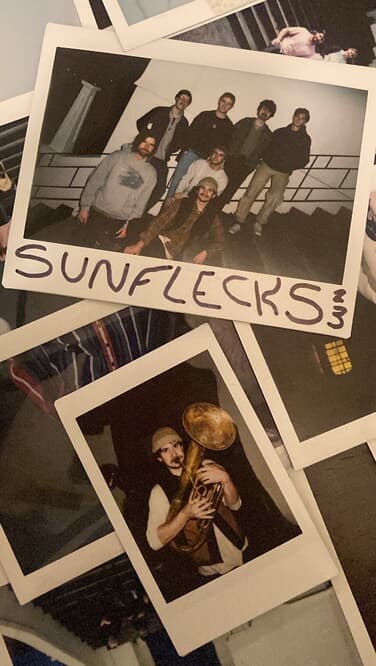
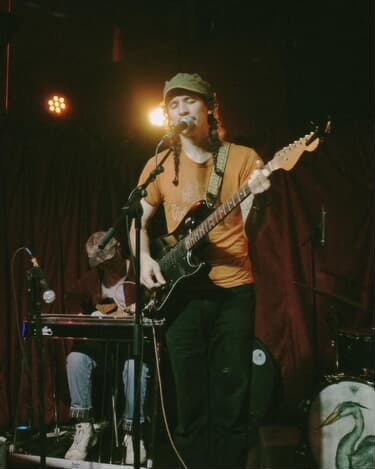
Sunflecks is the project of Bellingham-based artist Forrest Meyer, who earlier this month shared his debut LP under the name titled Fools Errand via Bud Tapes. Living a life pulled by creativity and moved by song, there is a casualty in the way Meyer interacts with music, having been writing, as well as working as a guitar repair hand at Champlin Guitars for some time now. But that doesn’t mean that the music that Meyer makes is lost from any sort of intense intentionality, but rather is as natural as his routine day-to-day, down to the breaths he takes without thought. Fools Errand embraces a collection of voices, a dedication to how music should be communicated between him and the open spaces in which he inhabits.
“And I don’t know what to do, my soul has a hole too, takin’ to leak out. Kettle is on, it’s singing its song, I grab a mug with Garfield on it” – an inherently brief story, but one that brings focus to both lingering pain and a singular moment of personalized characterization. There is something to be said when first listening to Meyer’s writing, where your own minor memories or complex feelings find ways to click with the images and individual lines that he writes such as this one. Sticking to the simple and worn in, Meyer recounts minor moments with clarity, like hanging out with a friend on “Proximity” or tossing a coin into a well on “Toss a Coin”. But this simplicity doesn’t get lost in a cluttered past, or even borrow from what may be in the future as it takes claim on the present, as open as it can be. It’s an album that not only plays with familiarity, but one that asks why these instances become familiar to us in the first place. Where placement and perspective are intertwined with who we’ve become; how much change has this Garfield mug really understood, and how does it see me now? Meyer’s words are experienced and beautiful, a dusty fortune, a prized keepsake to hold on to for when you need it most – and with each stagnant breath of musical instinct offered from his bandmates, Sunflecks paints a picture much larger than we could have ever expected.
We recently got to chat with Meyer about Fools Errand, restructuring collaboration within Sunflecks, and the practice of cone spotting.
This interview has been edited for length and clarity.
Shea Roney: How does it feel to have your debut LP out? You had a nice run of tapes with Bud Tapes too!
Forrest Meyer: Feeling really good. We initially started with a 30 run of tapes, and they all sold out before the album was released, which was great that one single is enough to convince people to order one. So we did another run of 30 or so. I think there’s a couple left on Bandcamp, and I’ve got 12 here. It’s been a smallish run, but it feels like people have received it well and I’ve gotten a lot of nice words about it.
SR: That’s right, it was just one song! How does it feel that one song of yours has the capacity to build enough trust with people?
FM: During the recording of it I never really thought that “Proximity” would be the one. That one was funny, too, because we recorded that song in the session, and then when my drummer [Amanda Glover] and I went back to do the first round of mixing, we decided to fully re-record that song. So it’s just the drums and then I overdubbed the organ on top of it. It’s from a completely different session.
SR: What made you want to start over on “Proximity”?
FM: I felt like certain songs had too much going on in the first recording. The guitar part on it, the picking pattern changes for every chord, so it’s a complex guitar part that takes up a lot of space. But one of the reasons we re-recorded it was it just didn’t need the amount of instrumentation that the rest of the album had. It just worked well as a clean, small thing.
SR: What part of that sparsity do you think helped progress this song into something you were comfortable with?
FM: When you’re in a fun recording studio that has a lot of instruments in it, you’re going to feel like you should try and put melotron on everything. But then one of my bandmates had this idea for the album, because there’s six people in the group total, that we should have a song on the album where someone is not playing. Like, there’s one song with no drums, there’s a song with no piano, there’s a song with no violin, like everything comes in and out, but it’s all kind of equally coming in and out. It’s quite a fun challenge to figure out how to have a lot of instrumentation, but still keep a minimal kind of sound.
SR: How did this configuration of Sunflecks come to be? Have you been playing with these folks for awhile now?
FM: We’ve kept a pretty consistent band. I gathered all these people for that recording session for the most part, and the album’s been kind of a couple of years in the making. But I’ve been playing as Sunflecks as a solo thing for a couple years, and the lineup has been pretty consistent I’d say.
SR: You noted that this is a highly communal piece of work, taking inspiration from the people around you. What was the process of working with others, and in what ways did it push you to bring these songs to their newfound life?
FM: The way that this project has been run, for my part at least, is I write a song, or have something that feels good enough to bring to the group, and then we play with it a little bit and get everyone’s input and ideas on it. More recently, we’ve been going a lot deeper. We call it sectionals, it’s still the whole band, but say we’re orchestrating a violin and clarinet part for example, we’ll go in and all give ideas. It gets challenging when you’re in the group, but you’re working on a single person’s part of a song and then everyone’s just sitting around. But I think [sectionals] is a really cool opportunity to maybe ask Amanda on the drums, as someone who isn’t playing a melodic instrument, what do you think of what the melody’s doing in this part? Communication is always the hardest thing, but we’ve been working really hard on sharing opinions and preferences and ideas. It’s been a really cool and beautiful practice.
SR: What you were saying earlier, taking out voices every once in a while, did those sectionals help lead you guys to understand your sound and the roles of individual voicings, either in their presence or their absence?
FM: When I got the studio dates to record the album, half the band was invited with a two week turnaround to learn all the songs. There wasn’t a whole lot of time between, like, ‘hey, do you guys want to join a band?’ and then, ‘we have studio dates if you want to record?’. We recorded a fair amount of music, there’s a lot of really good stuff, but there’s almost too much really good stuff there. So in the mixing of the album, there were lots of decisions where I was sitting with the engineer, talking about, ‘we probably shouldn’t have pedal steel, piano and violin.all playing at the same time here, right?’. So mixing in and out certain things, depending on where they fit in the song, we wanted to be more intentional on the writing of the song, and then we mess more with harmony, or work out how violin, pedal steel and piano can play the same exact thing, but thirds apart, and maybe that would sound cool. We just wanted to practice more intentionality and listening and even experimentation as well. Especially hearing out everyone’s ideas and running with them to see where they go.
SR: A lot of the narratives you write seem to manage such large themes through such a miniscule and personal lens. What stories were the easiest for you to tell in terms of details, and did challenging yourself to think more locally help bring understanding to them?
FM: A lot of this album is processing. It’s very much using the everyday things that happen, like walking home — there’s a lot of walking on the album. I tend to write lyrics and songs that are very personal for me. It can be hard to talk with someone about complex feelings. So the way that feels better for me is I can sit, and I can use tonality and wordplay, because, like the human experience, it is very rich, but most of the time, you can only say one word at a time. And sometimes there’s emotions where what you’re doing is a happy thing, but there’s a sad undertone to it. It’s hard to communicate those things, so being able to have multiple tools in the toolbox to do that is important. In my head, I’ll toy around with words for a long time until something kind of clicks, and it feels like that’s what I meant. With the song “Proximity”, that song is about an afternoon with my friend Dolores, just listening to music. But the larger metaphorical meaning is thinking back on that time when I was in Olympia. It’s easy to be like, ‘wow! What a nice, beautiful time!’ But then there’s a lot of things around that time that were really challenging, but I’m not thinking about them as much as the nice little thing. A mirror is reflecting everything all the time, but you only see what’s directly in front of you.
SR: And as a listener, listening to your words about what’s in front of you really repositions your presence in a moment. How do you ground yourself and be present in your art and the way you approach storytelling?
It’s fairly automatic in a lot of ways. The way I’ve set my life up, it really surrounds music. I do guitar repair at a music shop, so every day I’m playing different instruments. So in the back of my head, I’m working through the chord progressions and just listening to so much music every day. As a writer and musician, there isn’t a whole lot of super scholarly stuff about my process. The people in my band I play with are all very gifted musicians, and most of them can communicate theory, and I’m starting to get there, but I just don’t think about that stuff. It’s funny when you go up to somebody and say, ‘I wrote this thing’, and then you play it and then they’re like, ‘whoa! That’s really interesting with the blah blah blah!’ I use music as a way to parse out my days. It’s our way of taking the things that I’m thinking and feeling and just trying to understand them – I feel like if I find the right sounds and tempo that make the words feel good and everything clicks, then it’s like, ‘well, maybe that’s how I feel?’ Also there’s so much play in it. It’s just a way to have fun, and I love the weekly excuse to hang out with my best friends and make music together in a scheduled way.

SR: I do want to ask about Champlin Guitars. In what ways has opening the door to your surrounding community impacted you both artistically and personally?
FM: Yeah, it’s a really beautiful thing! At the guitar shop we’ve hosted a lot of really nice shows. It’s kind of my way of giving back to the community. But these shows are also like a touring safety net for friends. A couple months ago, Lily Thomas was on tour, and a bunch of friends drove to Seattle to see her play. But it was when the LA Fires were happening, and they were supposed to go down south for the rest of their tour, but they had to cancel all those dates. So, with a two-day turnaround, we made a poster, found another person to play, and did a Wednesday show at the shop, and still a bunch of friends came out. In my mind, that’s the dream of what the shop shows are for. There’s a lot of trust and I’m eternally grateful for how sweet and thoughtful the Bellingham music scene is.
SR: And then I am curious about Cone spotting on your Instagram. What is this practice?
FM: It’s been going on for about two years now. Cone spotting is, I mean, especially now with the moral debacle of being on social media, it’s a nice thing to have so I can continue to let people know what I’m up to. I don’t have that much going on to please the algorithms, so the cone spotting thing started off with looking through my camera roll and noticing that I’ve taken a lot of pictures of traffic cones in funny situations. I posted those, but then I started seeing more traffic cones in funny situations, and I thought this could be a cool thing. I think there’s a funny aspect to it, and there’s the hunt for it which is really fun. But something I love is the cognitive dissonance of seeing something that’s supposed to be warning, something engineered to be obvious, but when it’s in the wrong environment, or not doing its job, those dissonant things are really fun for me. And it was a great foil to get away with posting semi-regularly without having to be directly personal. And then I started getting submissions and it grew into this thing where I feel like I accidentally trained people — it’s weird how many people think about me when they see a traffic cone. The amount of times that people have gone through the effort of seeing it, taking a picture of it and sending it to me. It became really interesting.
You can listen to Fools Errand out on Bandcamp now, as well as order a tape via Bud Tapes.
Written by Shea Roney | Photos Courtesy of Sunflecks
 the ugly hug