Today, on this very evening, this very Halloween night, Nashville bands Bats and Soot have teamed up to release their new split single “Lift Me Up / Square Donuts”. For Bats, this is the first bit of new music since 2024’s album Good Game Baby, which found Jess Awh grappling with change amongst a smooth blend of nostalgic rust and indie charm. Same goes for Soot, releasing their latest album Wearing a Wire back in 2024 and leaning into the brashness of metal and experimenting with dynamic expression. As partners go, these bands differ in notable ways – but this project, a collaboration that’s been a long time coming for the two Nashville bands, brings out the best of both of their worlds.
From the start, Soot’s presence on “Lift Me Up” is calculated and reserved, but in no way is it timid. Falling down as a roaming guitar grows amongst a light atmosphere tickling the tracks potential release, Micah Mathewson’s voice is so low in register it feels to be dragged through the rough dirt, picking up elements of the environment as the band caries through. Gaining ground and building the tension and texture the Soot in known for, “Lift Me Up” loves the slow burn, finding solace in the accompaniment of Jess Awh’s (Bats) haunting vocals and Nick Larimore’s (Bats) loose pedal steel, each sticking like the dirt and bugs that have latched on for the ride. And when it’s all said and done, Soot’s reserved composit explodes into pounding percussion, brought out by dark layered screams and a strain to the sincere melody, that at last, has broken loose. And as the band holds their own, as Mathewson asks, “how am I supposed to come back down after feeling so high for so long now?”, there is a moment to finally let go of the breath we’ve been holding in this whole time.
“Squared Donuts” starts off in classic Bats fashion, emblematic of the beloved pop facets and responsive traditions of storytelling that Awh uses to piece together a cohesive, sincere and entirely unique profile within a single song. Through glazed guitars and a tight drum beat, Awh’s words become willfully poignant amongst the starry-night landscape, something that Liam Curran (bass), James Goodwin (drums) and Nick have always helped with in connecting the dots. “I know it was a mistake, you were showing off with that gun / Chinese food from the buffet, square donuts,” Awh sings, a collection of thoughts, reflecting on the loss of a friend and the mythologies that arise from memory and grief in a fractured timeline. Amongst discombobulated bits of noise, trinkets collecting in the background, and the accompaniment of Mathewson’s vocals, Bats adds depth to the frustration that lingers in the face of grief.
About “Lift Me Up”, Mathewson shares, “it is exciting to us as a band to keep open the possibility of making maximally spastic, intricate songs and also equally subdued and somber ones. Lift me up has been a song we started writing a few years ago that was always left incomplete. Unfinished lyrics, no structure, but the backbone was there and it was something we did very much so feel like needed to be completed at some point. When a conversation started happening with Jess from Bats about working on a project, it became evident that this was the time to finish this song.”
He continues, “we had an all-star lineup helping us pull this off. Billy Campbell engineering and mixing made recording live so effortless. What you hear in the recording is just the room that day. For this project we wanted to depart from a lot of the production bells and whistles we implemented on Wearing a Wire [Soot’s most recent album] to really just let the song breathe. Jess’ vocals and Nick’s pedal steel playing really pushed it past the finish line and we could not be more proud of what we’ve made together.”
About “Square Donuts”, Awh shares, “Square Donuts is about gun violence. As a kid and as a young adult, I’ve had friends become victims of horrible situations made possible by the gun laws and culture in our country… the song is about those experiences, and what it’s like to know someone who becomes part of a big tragedy, and the tragedy sort of swallows up their identity in the eyes of the world. It’s about friendship, loss, and how we create mythologies. It’s the first song we’ve ever tracked piece-by-piece (not live) as a band, and the first one we’ve ever recorded to tape! The studio experience was a blast; what a privilege to collaborate with Bill (Second Floor Recording) and Micah (Soot).”
You can listen to “Lift Me Up” / “Square Donuts” out now.
“Got home safe / Puttin on tea / Thanks for working on this with me,” Awh sings, almost instinctively; a clear marking – an endcap – no matter how fleeting this moment of calm may seem, there is a sort of closure at hand. This line, as simple as it is, opens the song, “Heart Container”, provoking a story to be told, while simultaneously closing out the album Good Game Baby. The song is an emotionally fostered and well rounded meander through a precarious heart; not necessarily in the right – nor the wrong for that matter. But as the song is escorted to its end, it becomes embedded within a collage of handpicked sounds and field recordings, some familiar, some unknown to us listeners. But the familiarity, although derived from the ethos of nostalgia, adds depth to where we stand; revisiting with a new perspective matured through time and experience to understand the full story.
Jess Awh is the gentle and vivid voice behind the band Bats, who, as of today, has just self-released her third LP, Good Game Baby. Following 2022’s Blue Cabinet, Bats has built a reliable reputation as a sincere lens into Awh’s own growing pains and intimate reflections. Good Game Baby is no different, with her tongue and cheek lyricism, hyper specific anecdotes and country music roots, the album weaves through pop facets and responsive traditions of storytelling to piece together a cohesive and sincere profile of the writer at hand. But as Awh reflects on the past, taking stock of genealogical traits, destructive patterns and influential circumstances, there is deliverance in her fractured timeline, blending nostalgia with confessionals as she looks back on how far she has come.
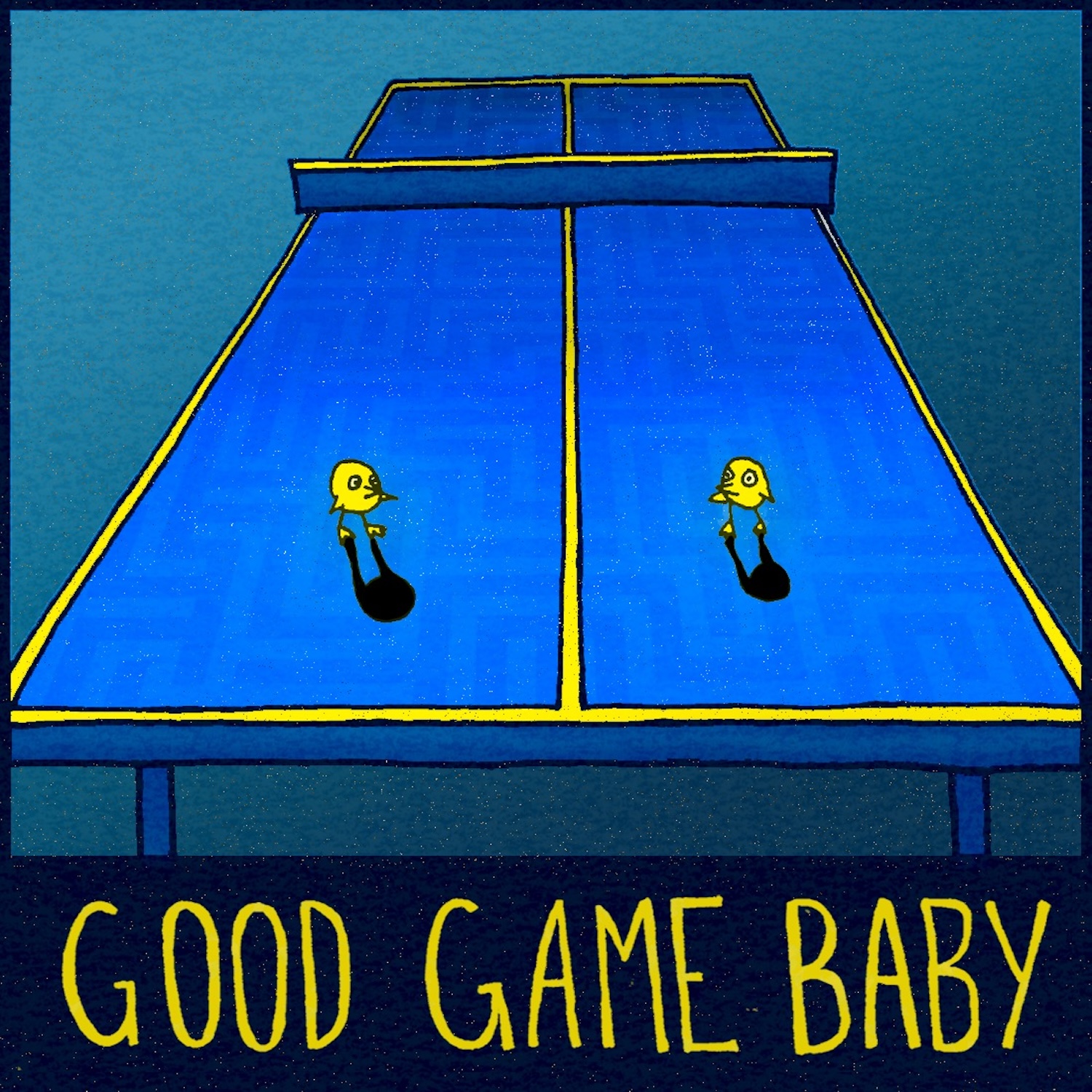
Album Art by Jess Awh
When it comes to recording, skills she has been sprouting since high school, Awh admits, “when I am outside of my own space I feel pressure to act a different way, and then it just never ends up coming out right.” So instead, with help from some friends, Awh turned her Nashville home into a live-in studio, taking advantage of the whole space being of her own. Weaving mics through the entire house – each room dedicated to a specific function; “the drums were in the living room. We had guitar amps in closets and in the bathroom, and we even recorded some of the record outside on the front porch.” As the time came to capture the valuable structure of Good Game Baby, “the whole band took a week off of work to have a little staycation and coop up in my house,” Awh recalls with giddy likeness – familiar with the importance of slumber parties as a kid. “We made breakfast together every morning, and then we would just get to work. It was very non-traditional and very relaxed and communal. That’s how I like to run the band.”
In turn to the accessible environment, Good Game Baby is a collection of songs that don’t sacrifice development due to comfortability, but rather find Bats taking on new sonic risks, while still propping up what makes Awh’s writing so special to begin with. Songs like “Going For Oysters”, “Are you like me?” and “Finger on the Tear” are dedicated to slinging guitar solos and more brash compositions than before, adding a dynamic intensity to Awh’s cunning melodies and cutthroat lyrics. Songs like “Sand Time Machine” and “Oh My God”, melodically fragile and willfully poignant, blend steel guitar, synthesizers and lo-fi drum tracks – a smooth blend of nostalgic rust and indie charm that has become the beating heart of the Bats sound. In all, Good Game Baby finds Awh taking the project from the early bedroom bandcamp days to a full band operation. “I’ve always wanted to make rock music ever since I started writing songs,” she recalls. “I could always hear full arrangements for them, but I just didn’t really have the resources, so this record really feels like a full realization of what I have always wanted Bats to sound like.”
Most of what Good Game Baby is based around thematically is Awh’s experience of growing up in the fast paced and self destructive city of Nashville, Tennessee. Besides leaving for school in New York, Awh has spent her whole life calling the “Athens of the South” her home. As a kid, “I grew up listening to 90s and 2000s mainstream country radio,” she shares; a notion that comes with the territory. “Being surrounded by that really potent pop and melody forward music taught me how to write the stuff that I like to write.” Too big for its own good, though, Nashville has become one of the fastest growing cities in the US. In search of sharing the authentic country music experience, it has fallen into years of demolition and rebuilding, as Awh watched the place that she grew to love become unrecognizable in virtue. Favorite businesses boarded up, parks left to their own efforts, restaurants’ Proust effect too overbooked to even experience; “Bats songs often have an undertone of being about the gentrification that I observe in Nashville,” she says with notable discomfort. “I feel that it runs parallel to my own experience of getting older and changing and grieving what used to be.”
Photo by Abby Johnson
“I think a lot of the turmoil of my early and mid twenties is represented by this desire to be able to identify myself,” she adds, “which is something that becomes harder when you don’t feel like you’re really situated in a place that is constant.” Touching upon stories of death, ambiguous love, losing friends, starting drugs, stopping drugs and terms of sincere guilt and ego, as a narrator, Awh’s defiance in change becomes crucial in experiencing Good Game Baby as a whole. “For some reason I’ve always tried to invite situations that are a little bit on the fringes of society,” she suggests – “a little bit unsafe.” Whether to do with dating an older man, cyclical substance abuse, breaking clarified distance or just simply profiteering self destruction, there is weight in reference that Awh releases in every song. Although it’s not easy to do, when done sincerely, “writing helps me confirm that I’m still me,” she expresses with an appreciative smile. “I’m still here trying my own experiences, putting them on paper and recording them. It helps me to contextualize myself.”
The track “Queen song we will rock you”, a cheeky name Awh will admit, begins to initiate an end to the record – bringing the heart of reflection into the forefront. “Grandpa died standing upright on two feet / Listening to Queen’s song we will rock you on repeat,” she sings with a soft yet forward delivery. “I would say it’s the most important song to me on the record, just because it provides a framework for understanding the rest of the lyrics on the album.” As is used, “We Will Rock You”, the bold and anthemic battle song, becomes self protruded when facing death, as Awh admits, “my family as a whole has this quality of taking the hard way through life and never really being able to give up or compromise their efforts,” leading to, “this realization that it’s in my blood to get up and try again no matter how many times I get fucked.”
Going back to the final track on the album, “Heart Container”, although it is not the beginning of Awh’s story per se, in the process she shares, “I have a desire to contextualize my life narrative as a thread that I can follow from beginning to end, even though in reality it’s not always so linear.” It can be found when blending together a story of a momentary relationship with the wistful sound effects from the cherished game, Legend of Zelda; as parting as a song about death introduced with voice memos from inside a favorite childhood restaurant; as defining as crippling self agency in a fleeting home like Nashville, Tennessee. Starting at the end of a story can give an artist some leverage; with expectations set, the rest of the time is spent filling in the holes that piece together a cohesive and resonating character. “I think juxtaposing my own history with my own present to tell a story of myself is a way to make it all make sense,” she says with a matured confidence. When dealing with a fractured timeline, jumping back and forth in its construction, there is an emotional emphasis brought on by hindsight and inevitable growth that resonates in this depth. But through her deliverance, blending these two narrative paths, there is closure that Awh demonstrates so affably of how things have been and an understanding of where they may go from here.
“Good game”, a form of etiquette passed around at the end of competitions, is meant to acknowledge the effort put in by an opponent. “Good game, baby”, a more personalized message, has a similar effect, yet less diluted by expectational manners. As the album enters the world, a physical project to face, Awh admits, “I think I’m actually a really well adjusted person in real life. Pretty happy and pretty peaceful in the day to day now,” before letting out a laugh, “I know this isn’t really what you’re supposed to say as an artist, so it sounds a little funny.” Through the turmoil and change, familiarity and rooted pleasures, Awh’s demeanor not only rounds out such an intimate and stylistically absorbing record, but marks impressive personal strides and victories as well; deserving of a pat on the back; a rewarding cup of tea; a good game well played.
Bats will be playing an Album Release show at Third Mans Record’s Blue Room March 1st, 2024. They will also be joining Bendigo Fletcher for a few supportive shows April 12 – 18. Listen to Good Game Baby now on all streaming platforms.


 the ugly hug