James Keegan, known under the moniker Kitchen, slowly comes to a quiet realization as he sings the haunting outro of his newest single “Real Estate Agent.” “There is no place of perfect connection, no light on the water sweeping the waves.” His voice, embedded with an aching sense of acceptance, reveals his gradual understanding that the pursuit of an idealized, perfect experience is futile. Through each line of the outro his hesitant sense of acceptance starts to wear down as he acknowledges the impermanence of seeking something that doesn’t truly exist.
A song that starts off with the image of a real estate agent’s headshot on a “for sale” sign and a fake ocean breeze blowing back her hair effortlessly turns into a reflection on indifference and apathy in the face of catastrophe as he challenges himself to sit with the uncomfortable feeling and see if it will force him to “stop sleeping.” After paralleling the disconnect between an image of the natural world disrupted by the commodification of space, Keegan cleverly comments on the way we jokingly process the decimation of our world, “calling disaster like sides of a quarter, unlucky enough to never get bored.”
“This isn’t a concept album but one of the main recurring concerns of the lyrics is the destruction of the natural world and climate change. There is a lot of nature imagery but it’s juxtaposed with imagery of the post-industrial human world,” Keegan says.
Over the past two months Keegan has been sporadically releasing singles on Bandcamp and YouTube leading up to the announcement of his newest album, Blue Heeler in Ugly Snowlight Grey on Gray on Gray on White. Keegan cited the simplicity and directness of Neil Young’s After the Gold Rush as an influence while also finding freedom in the loose and unpredictable nature of Pavement’s Wowee Zowee when pacing his longest record yet, a 20-song double record.
“I haven’t made something this long before and I always operated under the assumption that I would be better off cutting a larger project down to a more direct, more easily digestible scale. But most of these songs are not as emotionally direct as the songs on my past albums. There’s not really a simple emotional arc to these songs in the same way as the songs on Breath too Long.”
While Keegan’s newest material might lack a clear, concise storyline, and the themes feel less deliberate than his previous work, as the influences of each song jump from straightforward rock songs, to lengthy layered and droney pieces, each single desperately deals with the struggle of trying to hold onto what is left of our decaying world.
On “Bike Uphill” he sings helplessly, “I wanna be the one to live outside the world” creating an eerie almost apocalyptic feeling while contemplating a world in flux, where cities “melt away” and familiar spaces shift into surreal, dreamlike landscapes. Keegan reflects a sense of waiting, as though he is unsure whether he will be consumed by the unraveling of the world or find a way to belong within it. He imagines a world of isolation and loss, “is there a dream that i have not let pass through my hands” creating a sense of foreboding as the absence of certainty about our world and his place within it creates a dystopian feeling of being adrift in an unknown, shifting reality.
Keegan builds upon feelings he started to uncover and work through on his previous album, like on the lead single “Fall” where he sings “when the bombs go off, will I be with you.” There’s a cryptic sense of inevitability that led to the budding themes on these four new singles. Through very few words on “Ugly Snow in Ugly Moonlight” Keegan poignantly reflects on disillusionment, as if the purity and wonder of snow and moonlight have not only been tarnished by time and growing up but also tarnished by the post-industrial human world. There’s a feeling of longing for something that can’t be recaptured, a quiet surrender to the inevitability of change and the fading of youthful wonder and naivety.
The first single from the album “Sali” calls upon childish imagery by personifying the Finnish liquorice, Salmiakki, which is flavored with a type of salt that’s a byproduct of a chemical reaction according to Keegan. While it remains a spacious song, the use of textural layering and droning parts creates an overwhelming feeling that connects each of the singles.
“Before I could write songs I was even remotely happy with, I was making noise music and doing little recording experiments on audacity on the family computer and on a little digital four track I had, so making more abstract music is just part of what I do. I definitely think carefully about how ambient and drone pieces fit alongside the songs on things I make that are song oriented. In the case of the last album, Breath too Long, the ambient pieces served a structural purpose and helped to elaborate on the emotional content of the songs. The songs approached emotions in a semi-direct way and the ambient sections took them a little further into abstraction. I felt with this album that there was less of a straightforward arc than with past albums, so there wasn’t really a structural justification for ambient sections.”
Salmiakki’s unique taste might evoke a similar bittersweet nostalgia, where something initially foreign or uncomfortable becomes familiar, even a part of us. Something that may seem innocent and natural to us as children can later be revealed to be harmful and unhealthy. Keegan builds upon this feeling of escapability and a looming omnipresent fear of the future. The salty nature of Salmiakki serves as a metaphor for the bitterness that comes with growing up, where the world transforms from the innocent, carefree days of childhood into something more complex, painful, and ultimately decaying. The “salty swell” could symbolize the encroaching weight of reality, coming in waves — first subtle, then overwhelming.
“Writing lyrics that I’m happy with is hard. At the same time I try not to agonize over them. Usually the lyrics that I’m happiest with didn’t have a lot of conscious thought put into them. I’ll realize a couple weeks or months later what I was getting at. That’s sort of rare though. Mostly I try to be honest and to make sure the words sing. If the words technically work or are cool in writing but they don’t sing naturally I rewrite them. Really good lyrics feel like they arrived with the melody as a unified whole.”
Keegan has an unbelievable ability to craft stillness within his songs, a stillness that lingers even amidst the most driving rhythms. In “Real Estate Agent,” this is particularly evident as he delivers the plantitive second-to-last-line, “I learn how to live as my body decays.” Here he suggests that meaning and understanding are gleaned not in some perfect, transcendent moment but through accepting the slow process of decay and imperfection. It’s in this acceptance of time’s passage and the fragility of life that Keegan’s songs come alive in an almost meditative way.
As he repeatedly asks, “Do I know you?” on the outro, Keegan invites listeners into a reflective space, where the urgency of life slows down. Time seems to stop as his vulnerable voice hangs in the air, allowing listeners to pause and consider their own sense of connection and understanding. It’s this rare ability to create a sense of stillness, even amidst movement, that makes Keegan’s work so powerful. His vulnerability, paired with his ceaseless search for meaning and connection, creates an atmosphere where listeners can feel safe to take their time with their own reflection. Keegan’s music becomes a space in which time stops, and introspection takes precedence, offering a quiet sanctuary for those willing to sit with it.
“Overall the album ended up dwelling a lot on the feeling that I don’t know what to do about the horrible things that are happening in the world. I tried to put a few hopeful things in there but unfortunately it ended up kind of a bummer in some ways,” Keegan said. “One song on the album ‘Song for You’ was previously on a compilation by Bee Sides benefiting the Palestinian Children’s Relief Fund. I wrote the words intending for it to be a sort of hopeful song about trying to do good in the world rather than getting stuck in shame and guilt and fear and all that.”
Blue Heeler in Ugly Snowlight Grey on Gray on Gray on White will be self-released on April 4, 2025. Preorders of the album can be found on Kitchen’s bandcamp, including cassette tapes.
Written by Eilee Centeno | Featured Photo by Steven Coleman
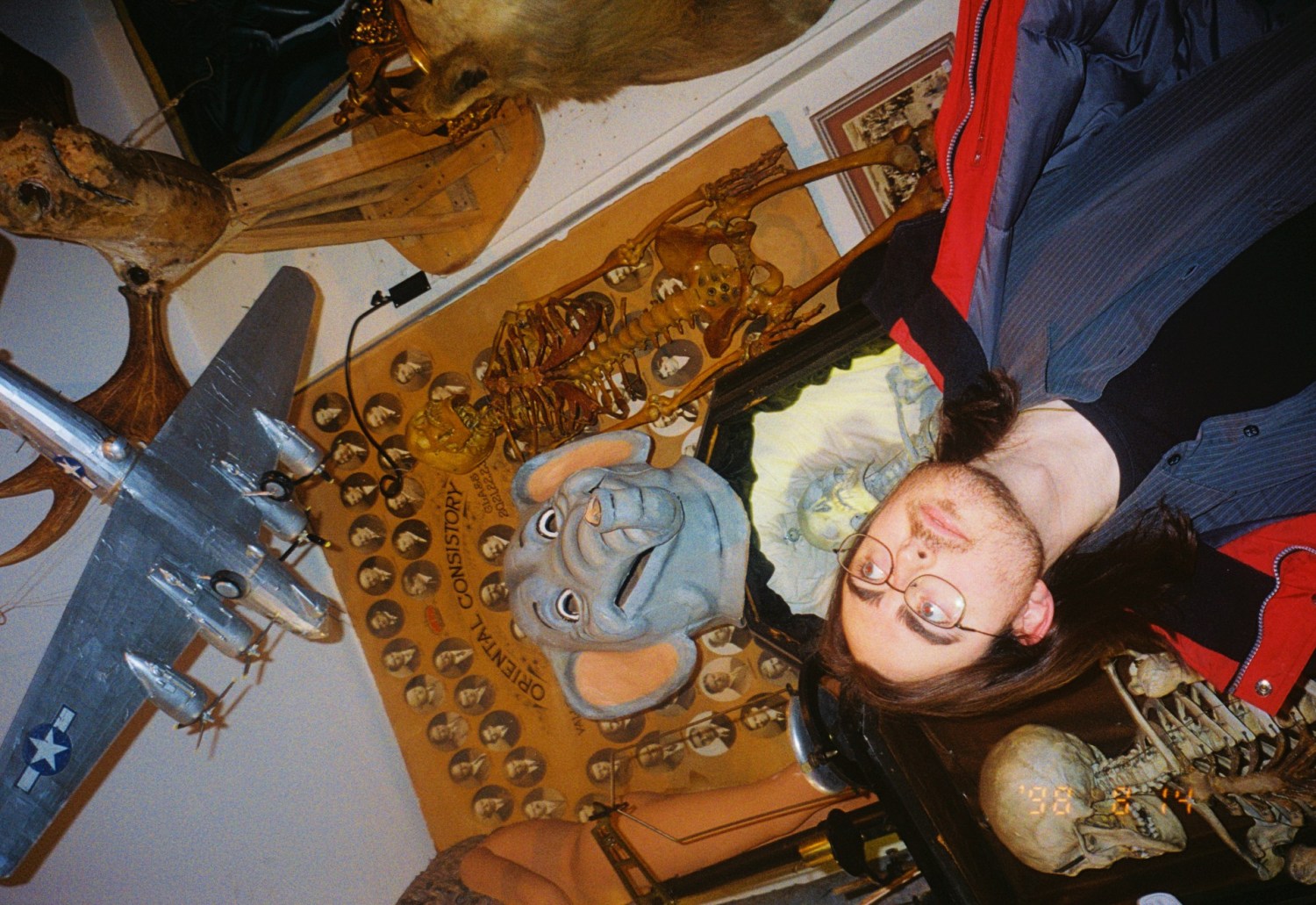
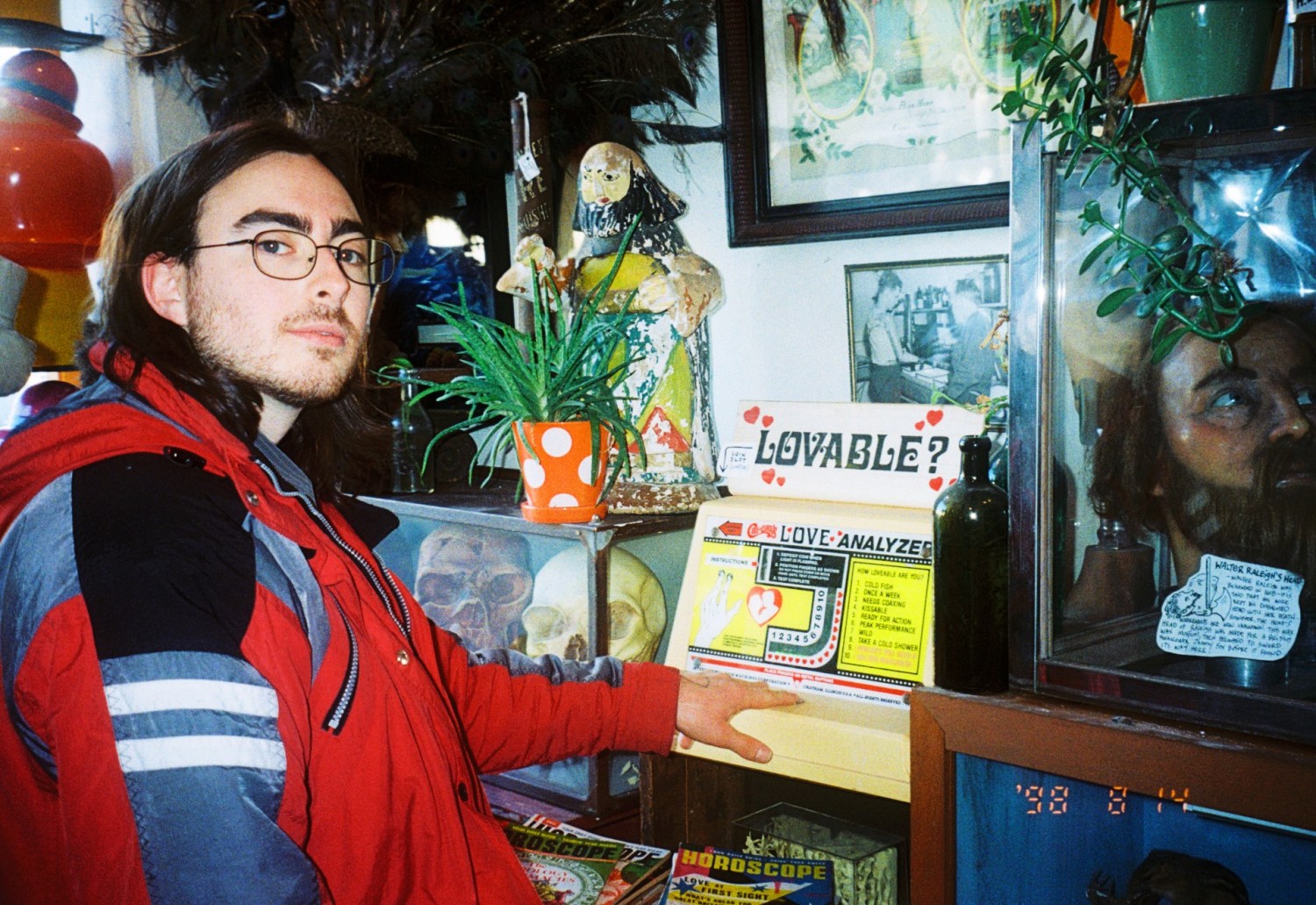
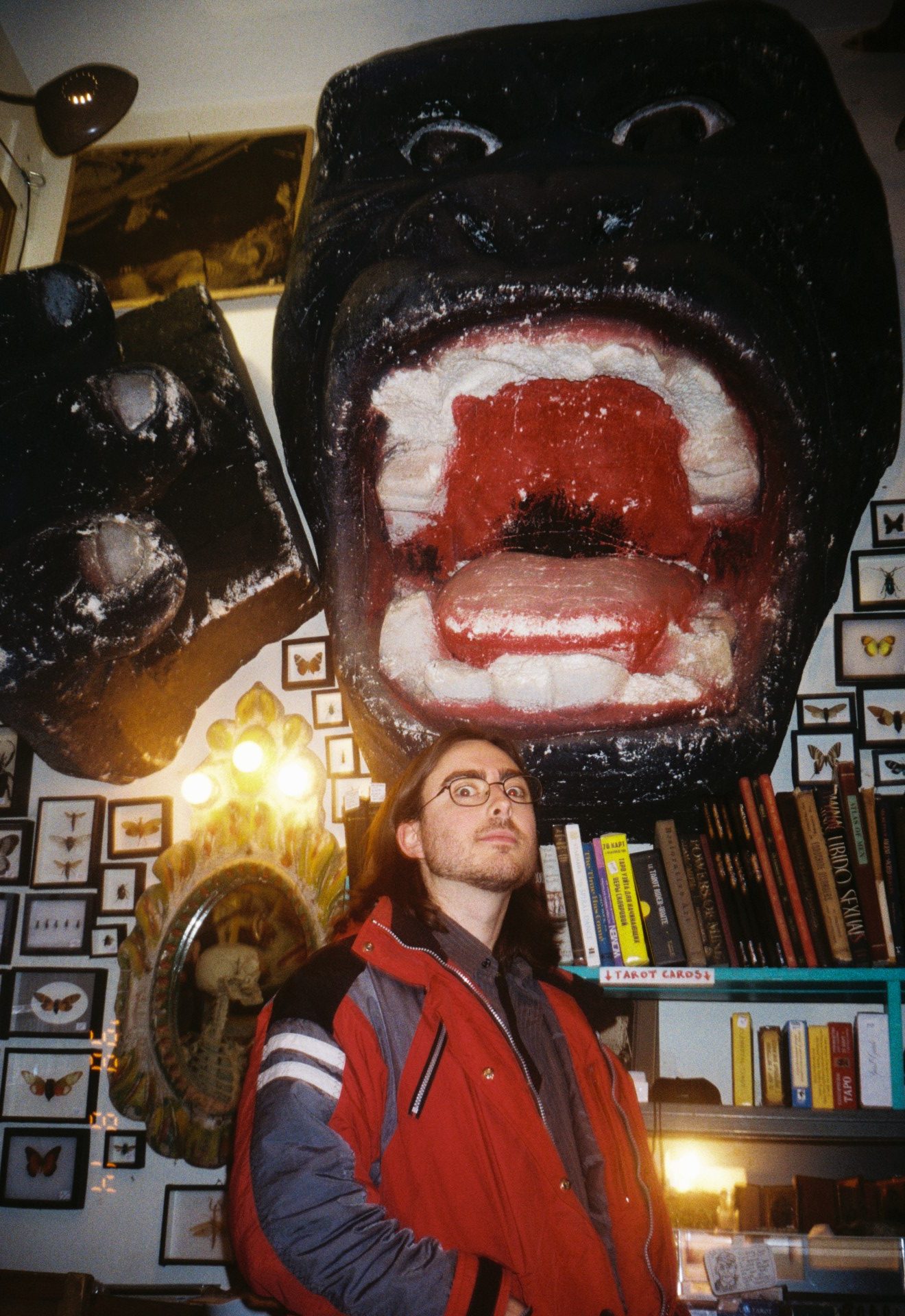
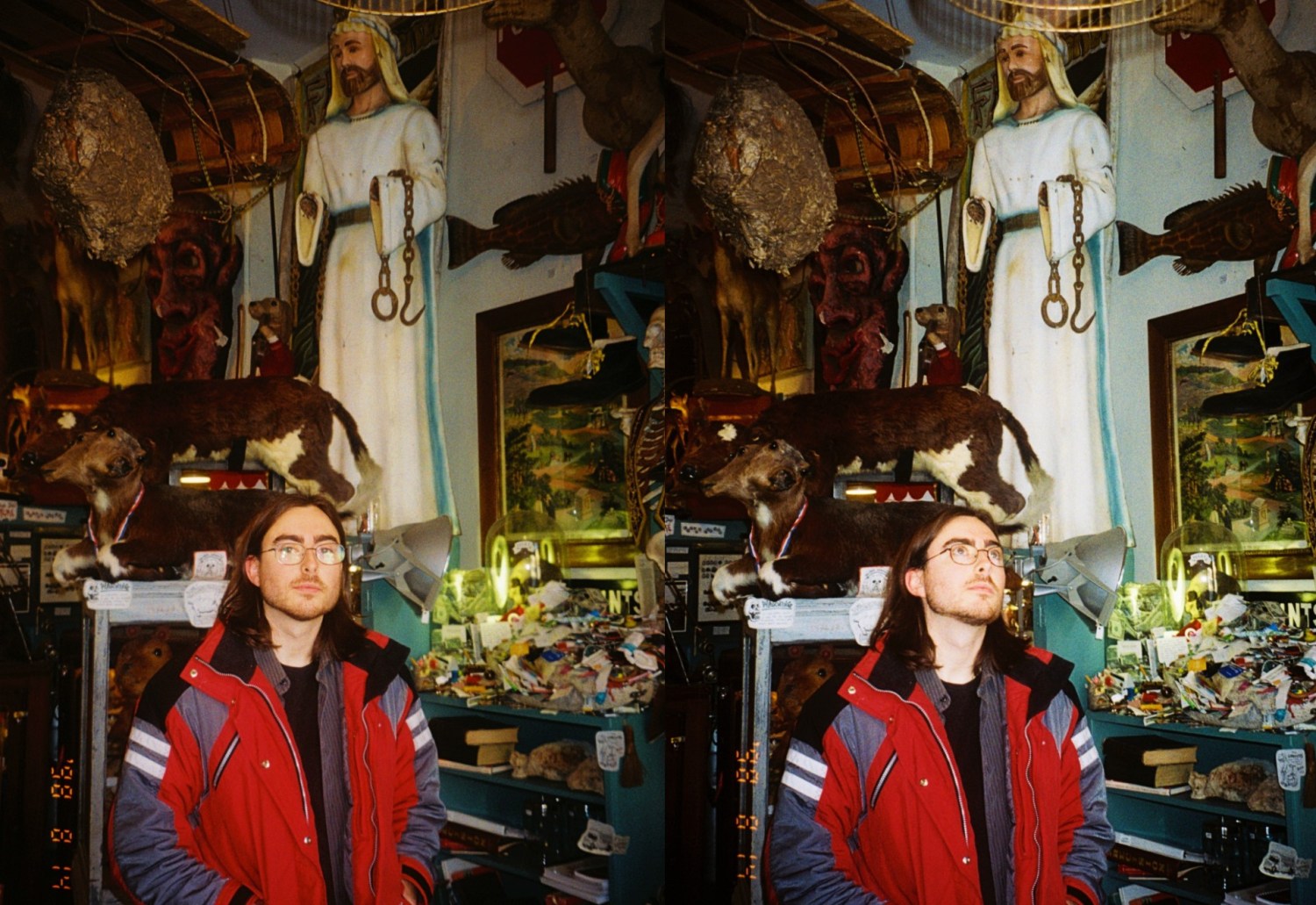
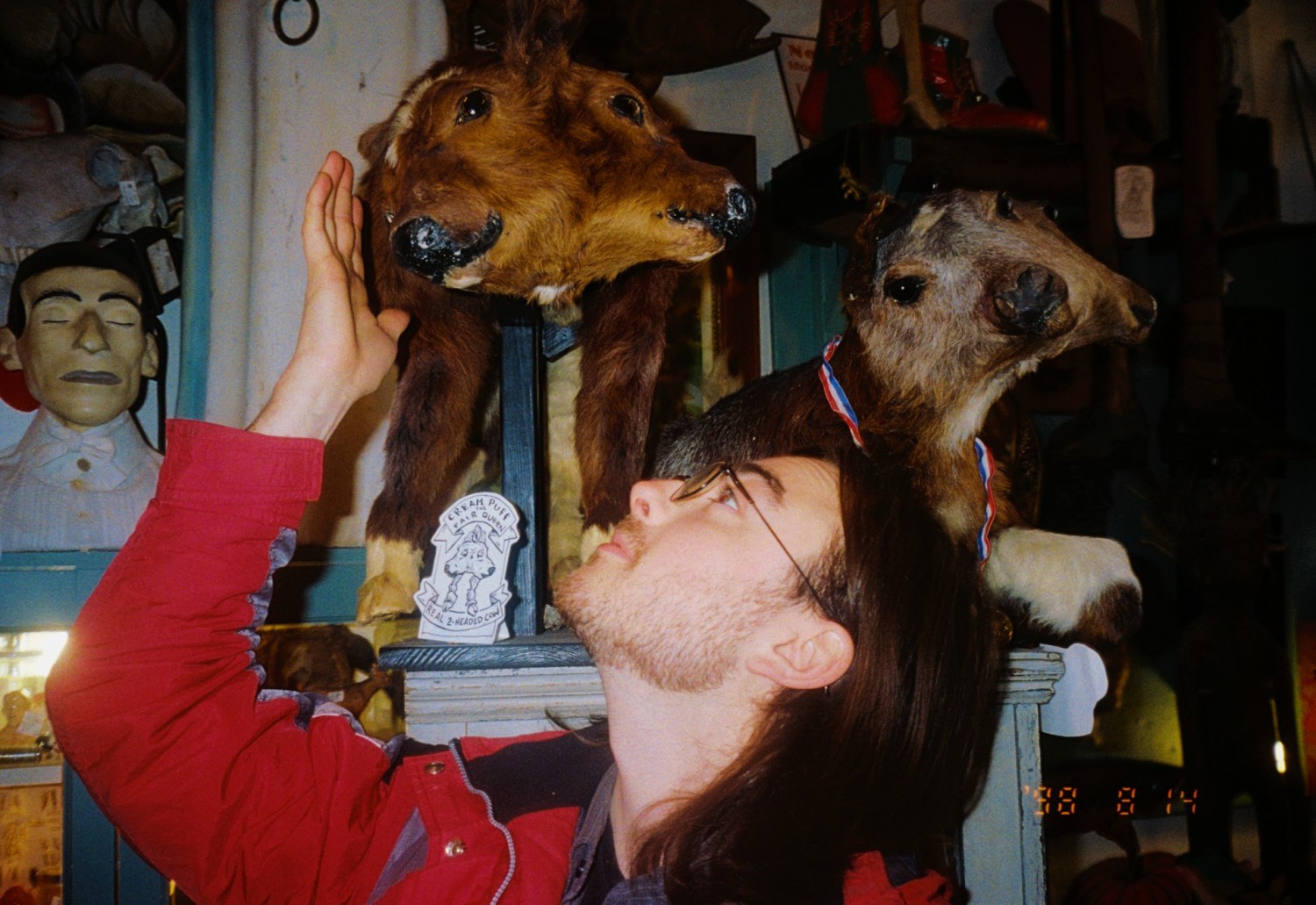
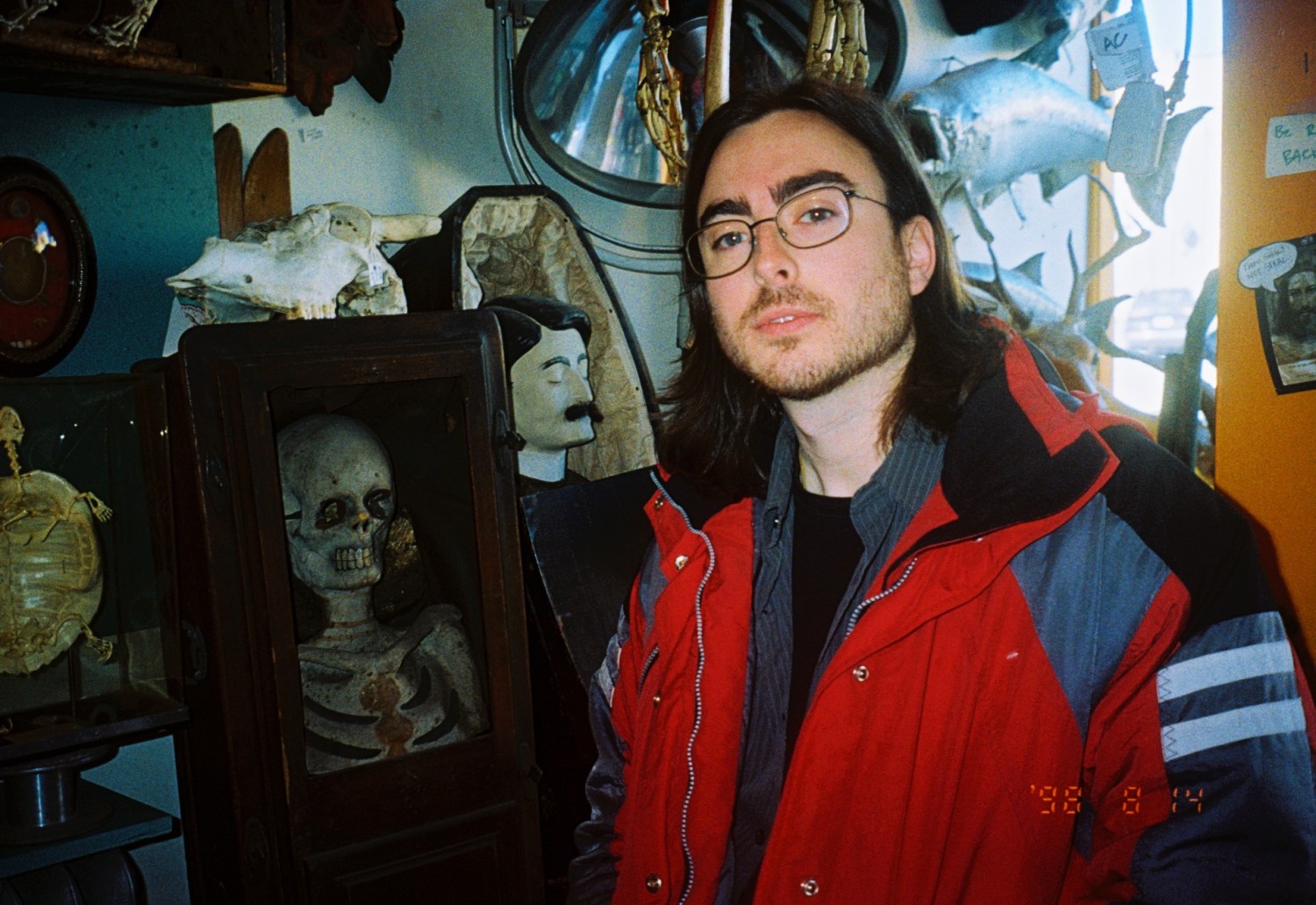
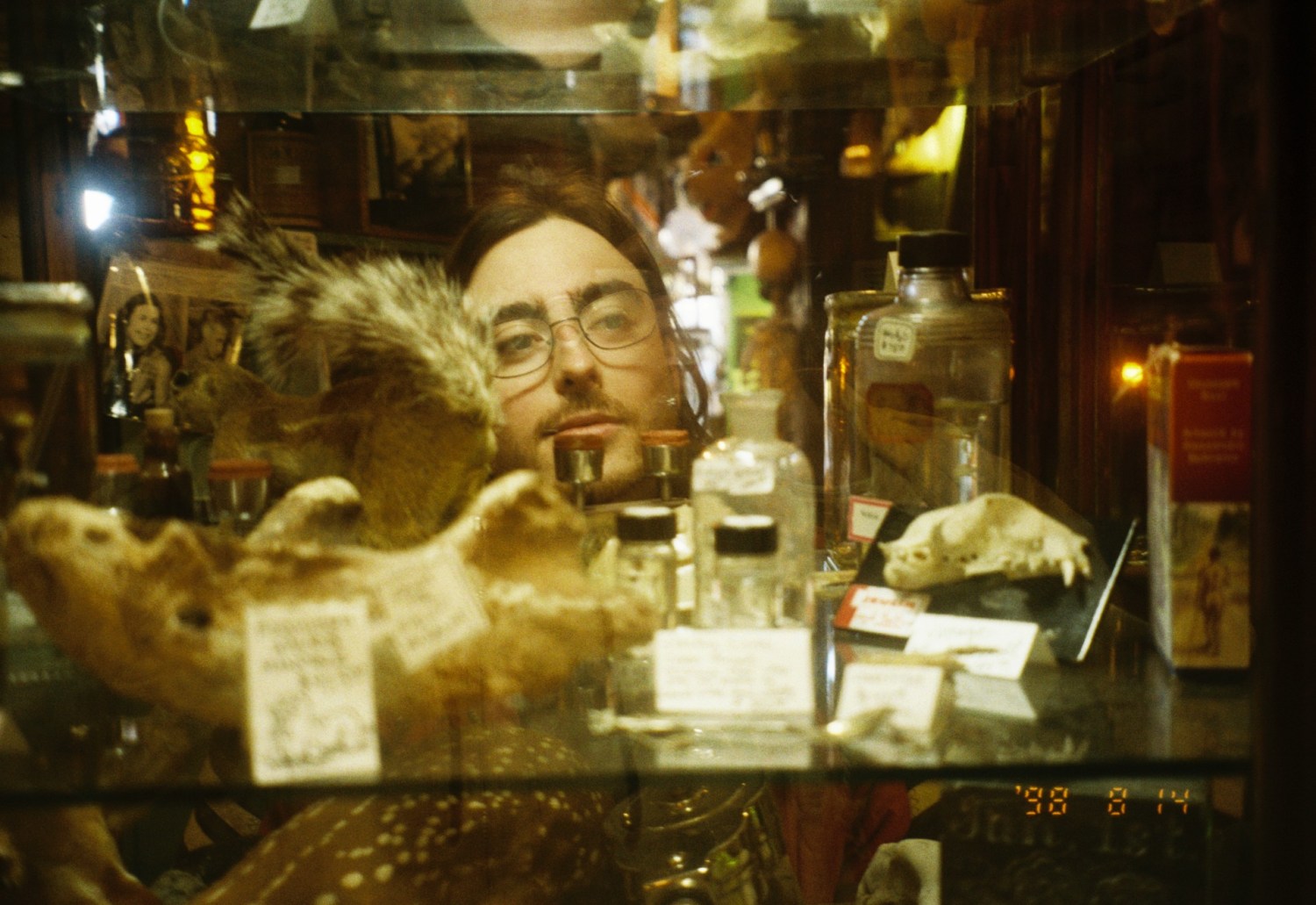
“Is there anything that came into this shop that you had to turn away because it was too fucked up?”, Chaepter asked the employee behind the desk of Chicago’s Woolly Mammoth Antiques and Oddities, the location we chose to photograph in – and one that left us grotesquely curious as to the collectables for sale. The taxidermied cow named “Meatball the Freak”, John Wayne Gacey original paintings, an old, preserved chicken nugget or a gun holster made from a squirrel, there was humor in both the disbelief and surrealism of it all that just barley cut the tension of how dark some of this stuff really was. “Hmmm,” she says, taking the time to give us an answer that would leave us satisfied in our inquiry. “I mean, people will bring in murder memorabilia all the time, stuff used in murders and crimes. But it feels weird putting monetary value to those kinds of things, so we often just trade for it.”
Chaepter Negro is a Chicago-based artist who performs under his first name, marking ground in his own unique and challenging ways with engaging and tactful sounds. Chaepter grew up in Central Illinois, rearing a large Irish-Catholic Midwest upbringing to show for it, where he was first exposed to music through classical training in cello and piano. But with the release of 2024’s Naked Era, a bold, brutalist post-punk album riddled with acute punctuation, searing guitar tones and strict melodic orders that carved out a new vision for the project and a trajectory that Chaepter and co. have fully launched into. Accompanying him are players John Golden on drums, Ayethaw Tun on bass, who have played with Chaepter for years, as well as the newest addition of Shane Morris on lead guitar.
Today, Chaepter shares a new EP called Empire Anthems, a brief and poignant collection of songs that areunwilling to mince words directed towards the fearful, and rather stupid, timeline that we are currently residing. Although gripping tightly to our being, blending punk antiquity and rage against the system with the absolute fear of what is unfolding in front of our own eyes, Empire Anthems plays out with urgency and condemnation, of course, but the purpose of its creation is a remnant of preservation. The kind of preservation you get from making art with the people you care about. The kind of preservation you get from engaging with and looking out for the community that you are a part of. The kind of self-preservation you get when you choose what has monetary value in your life, no matter how fucked up it is. Chaepter isn’t searching for fix-all answers here, but rather ways in which we can all push back when the things that matter the most are exploited.
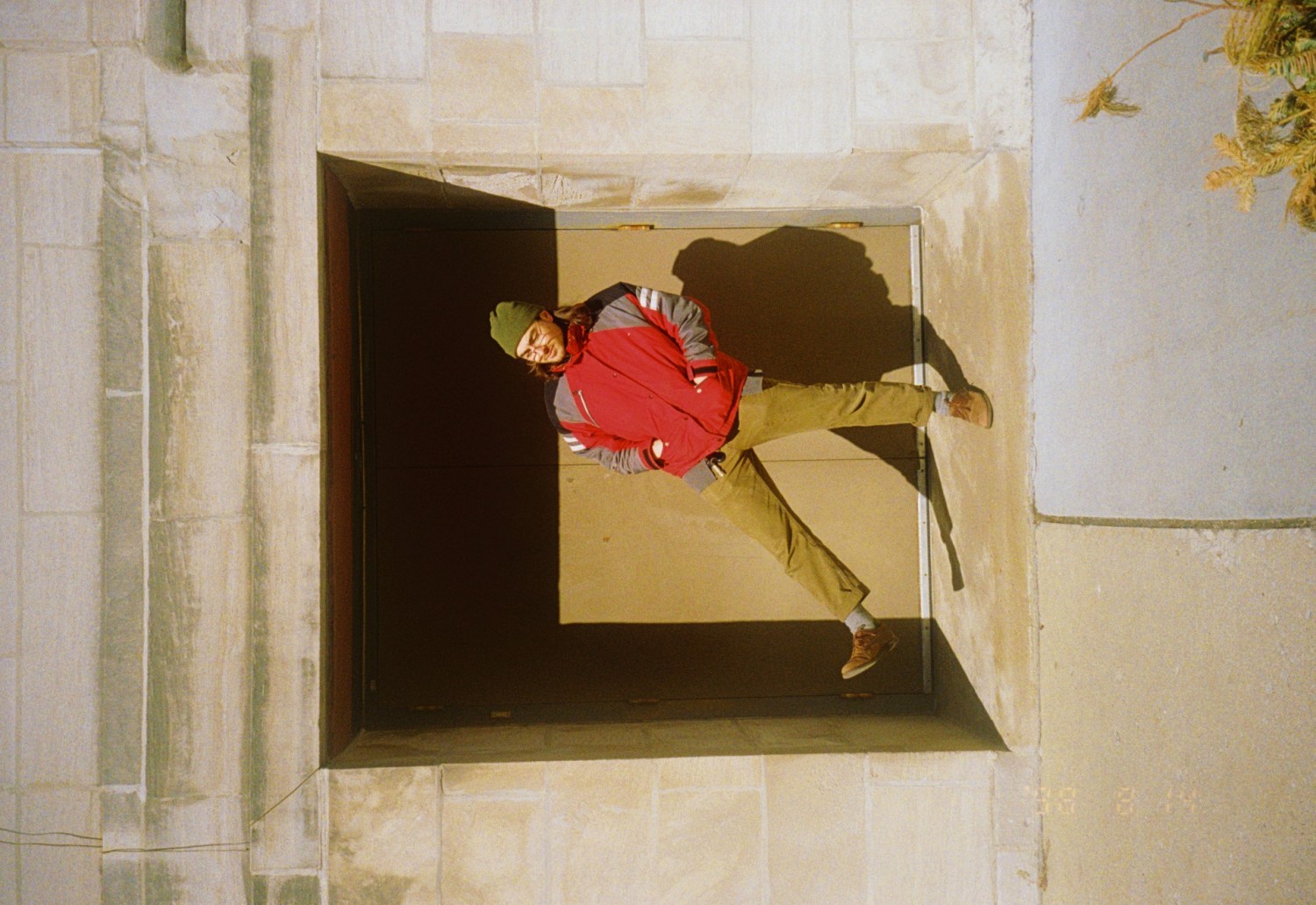
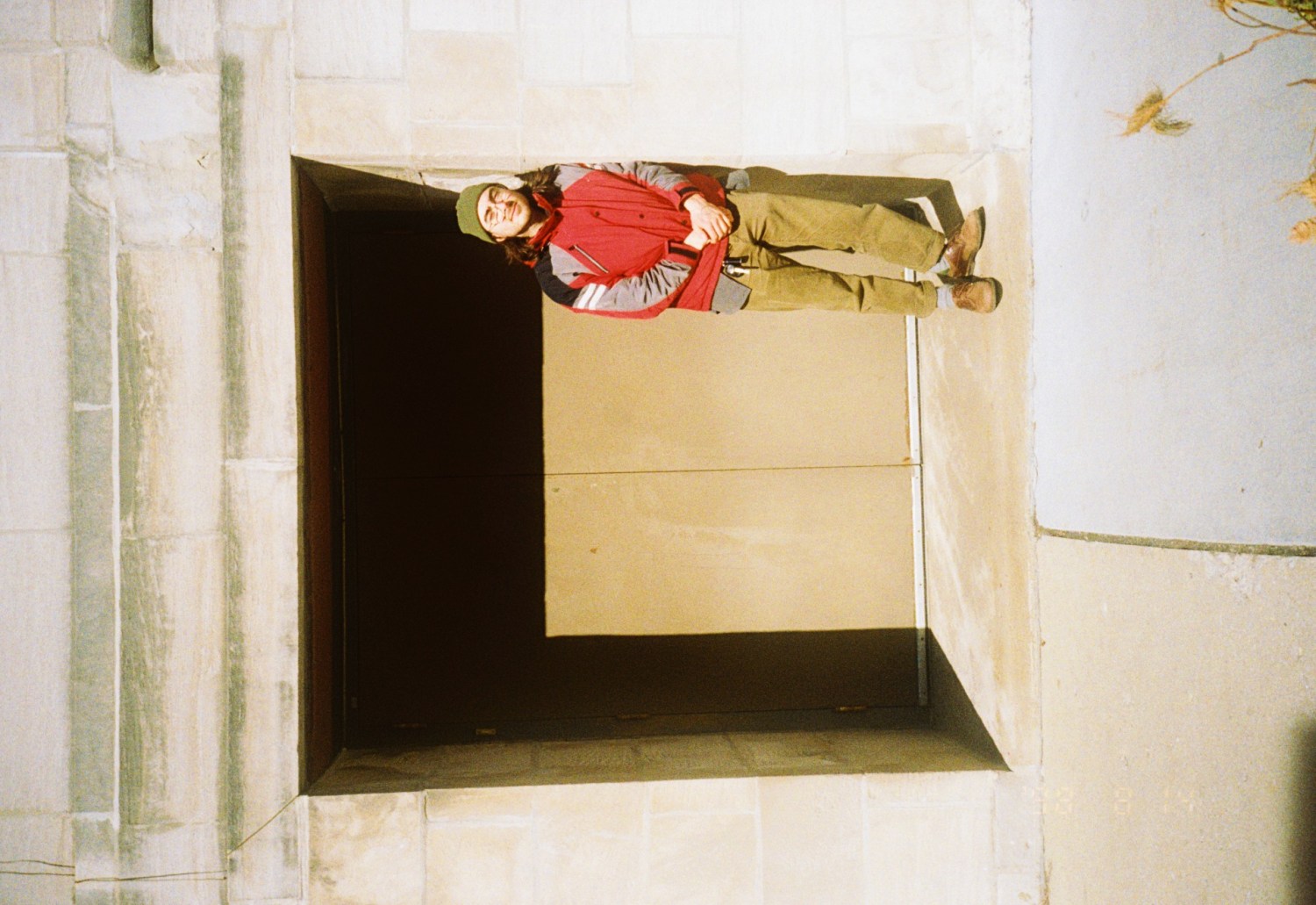
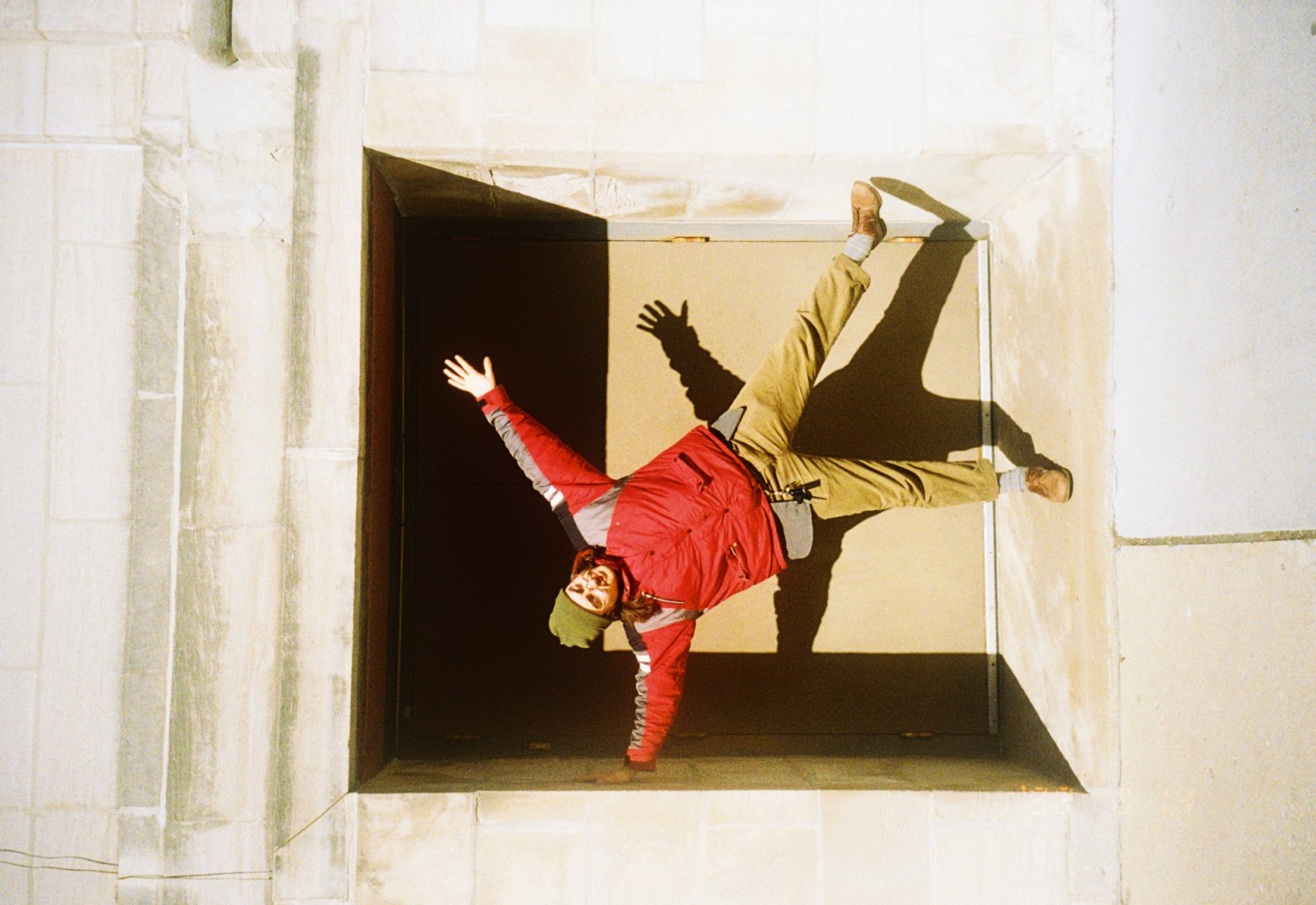
We recently spent the day with Chaepter, first taking photos in the Woolly Mammoth before we got to discuss Empire Anthems, having creative freedom in community and suffering from choice-poison.
This interview as been edited for length and clarity.
Shea Roney: So, you have an EP coming out soon called Empire Anthems.
Chaepter: Yes, we’re doing this EP with Pleasure Tapes. Honestly, it was kind of weird, the past year we’ve been touring the Naked Era record, and then I’ve been writing this other album and we just spent the last four months rehearsing and recording it – different from the EP. I just had a bunch of songs that didn’t really fit that, so we just spent a couple days in our practice space pushing through these songs. It’s like what would be the B-sides of an album or something, but we’re going to release it first while we search for a home for the bigger record.
SR: This EP is a continuation of that raw and bold sound that Naked Era fully embraced. As you venture more into this genre, exploring the techniques and sounds, what did you gravitate towards when fleshing out these songs?
C: I think for me it was just writing on guitar, and in this way, electric guitar. At the end of the day, I used to always write songs on piano, so I was always writing songs like that. It wasn’t until a couple years ago that I started structuring songs on guitar, and then also experimenting with pedals and stuff. I’ve always been doing quieter stuff, a lot of folk songs and stuff like that, but for whatever reason, it just kind of felt right to be part of a band. I’ve been in other bands, but I think what kind of led to that shift is I really like playing like this, where we can get loud and get aggressive, but also have those soft moments and have the dynamics, which we really try to do.
SR: Wanting to play louder, did you feel like you knew how to go into it, or was there trial and error?
C: Oh, definitely trial and error. I don’t actually even know guitar chords. I’ve just been doing my own tunings and my own chords, and just writing songs that way. I don’t know a C chord. I don’t know any of that shit. Everything’s been self-taught with guitar, and I think that’s been kind of nice because it’s forced me to do things a little differently. We were joking about that, because me and the band were at a show last night, and we were looking back at old videos of us playing and were like, ‘what the hell were we doing? What the fuck was that?’ [laughs] When I first started playing frontman and then playing guitar at the same time, I had just never done that, so it was a lot of trial and error, but we’re starting to kind of get to know each other a bit.
SR: When you bring a song to the group, how do you translate it to them? If you’re not referring to old music theory and stuff like that?
C: It really depends. We’re more collaborative now than when we first started. The Chaepter project was just kind of a solo project, and then I had friends that were playing with me, and we’ve gone through some iterations. But now we’re pretty much locked in as a band, and there’s a lot more collaboration. So I’ll bring in a song idea, and sometimes I’ll have a bass part written, sometimes not, sometimes I’ll have half of it. It’s just things like that. Oftentimes we’ll just do it as a three-piece. We’ll start fleshing it out, and my drummer, John, writes all his drum parts and helps with structuring. Unless we’re collaborating with someone who’s doing lead, we keep it pretty open. Sometimes I’ll come in with a song and it’s pretty much all done. Sometimes I’ll just have a riff, and we’ll see where that goes. It’s just been really good for my brain, and just us as a unit to push and pull.
SR: Do you feel like this freedom in your abilities, and lack of quote-unquote musical structure, has helped you explore and start writing in different ways?
C: Yeah, for guitar music at least. I was raised playing classically on cello and piano since I was six. I have that experience in theory and stuff, but in terms of guitar, just not knowing what I’m doing has been honestly really cool. Anytime I kind of figure something out, it feels very fresh to me, or naive in a way that I feel comfortable in. I would naturally play this way for whatever reason as opposed to feeling like I have to do something because someone taught me since I was a little kid to do it like that.
SR: So now as you gear up to release Empire Anthems, referring to these songs as almost B-sides to an album, was there a connective tissue or theme that runs throughout them all?
C: They were kind of just existing in their own kind of space. I’m also working on another record, too, so I’ve kind of had three or four records, or at least collections of songs, working off in different places. These songs were just in their own sort of world – its own darker kind of space. I was in a weird spot post-album. Whenever I’m done making a record, I get a little depressed, so I was just kind of thinking a lot about the relevance and utility of making art in a fading empire that we are currently residing in, and how that intersects with our cultural identity, and this idea of ‘Empire Anthems’ being these cultural signifiers that kind of lulls us into complacency and reaffirms the dominant American culture and rationalizes irrational American terror. You know, you turn on the radio and some pop song that’s making you not really think about something, but allowing you to continue to sleepwalk through life. How does art exist in that kind of way? These anthems just keep pulling you back into the Matrix or wherever the fuck we’re in [laughs].
SR: Yeah, I was very intrigued by the word ‘anthem’ in the title, because there is such a notable heaviness to the word. But also repeating the word ‘signifier’, can you talk about these songs as signifiers and this plane that you created?
C: The idea of art as a cultural signifier in general, being something that in music’s case, if you’re living in a certain culture, you’re going to produce certain cultural products that reaffirm what it means to live in American culture, which is this blood-sucking empire that’s on its last legs. How dominant art might be shifting, just to keep the dream alive even though it’s not there anymore, that’s just what I was thinking about. Art is obviously what I’m doing, it’s my life, and sometimes it’s the most important thing in the world to me. And other times, I gotta focus on my family. It’s this sort of oscillation back and forth of being a ‘god-like’ thing in my life pulling me towards something, but also something I’m just doing. It can feel kind of silly just writing songs in the state it is right now, but it is deeply important at the same time. I guess that’s all things.
SR: I would argue it’s always important, especially with all that comes with it, especially community, which is something that you are very vocal on. This was huge for you with Naked Era and that press, you’re very keen on giving your surroundings voice and appreciation. Thank you. What bits of this relation and respect for your surroundings sticks with you when making art?
C: I feel like in my brain, what comes out is pretty much a debris, just kind of an after. So if making art is a fabric, it’s that community that comes with it that I think matters the most. It’s kind of reflexive – it’s a mirror. So if you’re involved in a really active art scene, you’re inherently going to be injecting that into what you’re making. Whether you’re doing it explicitly or tacitly, it’s always going to be part of it. That’s something my band and I try to focus on, that process and journey mattering more than the song that comes out of it. Because at the end of the day, as artists and creatives, that’s what you have. Once you let that song go, it’s out there, but you have that journey with you forever. So inserting yourself in something and allowing yourself to be part of a scene or some sort of artistic collective fabric is the best part of doing all this shit. I spent so many years of my life making songs alone in a bedroom. It was fine, but you get out what you put in. There’s nothing wrong with writing in an isolated manner at all, but nowadays, I’ve been feeling so good about being around other people that are making stuff, and part of this greater thing.
SR: Even to the stories you tell in your songs, there is this level of presence and characterization regardless of if it’s told from your eyes or not. There is always this presence. So when it comes to dealing with conflicting imagery, you know, with this failing empire, what kind of emotions went in and came out of these songs in the process?
C: Yeah, I mean, post-album with these songs, I felt like I was just steering a ship in the dark, into the fog. It’s getting foggier and it’s very confusing – I get overstimulated. I was kind of in that space where I was just like, ‘what the fuck am I doing?’ Not in any way that’s rooted in that much reality, but I was getting very existential. I think that’s where these leftover songs and how they kind of form into this EP. It’s a weird thing, once you’ve given life to a new project. For me, it’s kind of an obsession. I’m obsessed with something for a long time, and then you finally put it to tape, and then, ‘dang, here it is’. That’s kind of the headspace I was in putting this record together. And then, you know, watching all the systems around us degrade at an even more accelerated rate than they have been doing so previously – there’s a lot going on to say the least. And again, it can seem so silly to be writing a little song, but it’s serious. And I think being able to balance both is important.
SR: Sorry, are you blinded? This window is brutal.
C: I am cooking. Part 2 on the bench out there?
*change of scenery
SR: I can’t remember what we were talking about
C: I was saying anything I needed to. I was in survival mode [laughs].
SR: [laughs] How long have you lived in the city for?
C: Since October of 2019. I moved here after I was in Madison for a little bit after college working and then moved here. Then COVID happened.
SR: Hell yeah. You have described your project in the terms of Midwest Gothic, which I really appreciate having lived here all my life. I feel like in a way that really helps make this Empire Anthems a little bit more credible, growing up in the heart of America with a big classic big family. Looking at the world you grew up in and then the world you are in now, does that live in these songs at all?
C: I feel like everyone who grows up in the Midwest has this sense of space because we are just in this plane. When I’m writing songs, I do try to channel that a lot. I grew up in Central Illinois in the country. It was really lovely being able to grow up around nature and be exposed to animals and having that big family, but there is sort of a Midwest existentialism, I guess I will call it, that feeling of living sort of nowhere all the time. Illinois in particular, and what happened to this state and what it looks like now with industrial agriculture and losing the prairie, is something I’m always thinking about and trying to channel into the music. There’s a big history of lost connection to our land here in Illinois and the Midwest in general because of industrial agriculture and what that’s done to farming communities. There’s a lot of ruins around here. You can go over to Michigan, or go to Gary, Indiana you know, an hour from here, and see with your own eyes what that looks like when people just get left behind. I was thinking about that a lot with these songs, just that expansiveness that we’re looking across. We can see everything in front of us in the Midwest.
SR: Did you find any hope buried within these songs? Or are we.. are we pre-hope?
C: [laughs] I feel like these were probably my least hopeful in a minute. These songs were kind of like a shot, you know, these five songs, just like an injection. I don’t know what’s going to happen after the injection. Whereas with a full record, I feel like I tend to be able to have emotional arcs with them and I’ve never been a huge fan of writing EPs. I’ve always felt I’ve struggled with encapsulating a full concept in them that I can do in a record. But that’s why I kind of view it as a shot, it’s just one big injection. There’s maybe not the catharsis that a full record has.
SR: I mean, to call back to before we were recording, we were talking about exposure therapy, and it’s kind of ripping off the bandaid in all aspects. Do you find yourself taking too much on at times?
C: These songs, and just a lot of the music I have been kind of consuming as of late, fall into that sort of ‘rattle ya a little bit’ category. Not in one particular sort of ideology, but just like this idea of like, things are not right per se, and if you’re feeling like something’s off, that’s not probably innate to just you, you know, it’s a fully human thing. It’s like, if you’re ill, you’re mentally ill because of this or, you know, the sort of individualized blame that it’s really easy for us to go into and to sink into that shame, you’ve got to give yourself a little bit of grace, you know? Recognize that to some degree we’re doing what we can, don’t be so hard on yourself. Maybe it’s growing up with Catholic guilt, I find myself doing so much, and I’m trying to be better about it. I don’t think we should have to be able to keep up with everything that’s going on, especially, in terms of new technology and productivism and feeling like we have to be this well-oiled, perfect little production machine as a human. It’s like, ‘nah, man, this shit is so confusing’. It’s hard to keep up and it’s not normal for the human brain to have all this fucking stupidness all the time
SR: What constitutes a break for you?
C: Oh, I’m so bad at trying to just chill out. I have a lot of family stuff that’s always going on. Eight siblings, very dysfunctional, and trying to balance that with making money and doing music, booking tours and doing this music thing, it’s just so much work. I love it, it’s an obsession, but it’s a lot of unpaid work, so it’s hard to do and balance a job. I’m reading more, which has been good. I deleted Instagram from my phone last week, I was like, ‘this shouldn’t be that big of a deal’, but it was. It’s really difficult because I use it to book tours, so I’ll message a band, and then like an hour later, I’m like watching fucking videos of AI squids being cleaned off. That’s why I deleted my Instagram. I saw this AI video of someone washing off a giant squid in a boat and I couldn’t tell if it was real or not. I was like, ‘this is fucked up. I got to get rid of this’. I was sleeping better and when I wake up, I felt just a little bit better about how much time I’m spending consuming things that don’t affect me. Obviously, we’re veering towards absurdism, but at some point, I just need to disconnect and be like, ‘okay, I’ve got friends in front of me, family, people I love that I talk to and talk back to me’. I also got rid of streaming, which has been fine, but I don’t have a lot of money to buy records so I’ve been doing YouTube and bandcamp and buying friends stuff that I really, really love.
SR: How has that been? Did it bring out anything with your relationship to listening or something?
C: I’m trying to find a balance with music because we’ve kind of been conditioned to view it all as free. Even as someone who makes stuff, I grew up with CDs – I first fell in love with music with CDs; buying CDs, getting CDs from the library, burning them, getting them from friends – it was a little more precious back then at least. I got streaming in 2018, and whether you think about it explicitly or not, it does reshape how we interact with and appreciate art, you know? I’ve just been trying to make some small changes where it’ll force me to go a little slower with stuff. Because otherwise I can be kind of overstimulating myself. Something I always think about is choice. I think historically, humans aren’t actually that good with choice, which is why I think the capitalist idea of choice in terms of products and things you consume is like a mirage. We’re good at looking back and rationalizing stuff, but when I have all these choices in front of me, I just get choice-poison – I just don’t know what to do. So I feel like limiting myself a little bit and being like, ‘okay, I can listen to this today’. I remember one summer driving my mom’s car, she had a Feist CD, and you know, I was like, ‘I don’t know what this is’, but I fell in love with it. For that whole summer, that’s the only CD I had in the car, and every song I got to love.
Scroll for more photos with Chaepter
You can listen to Empire Anthems out everywhere now via Pleasure Tapes. Chaepter will be playing an EP release show this Thursday 3/20 at Empty Bliss in Chicago and then will embark on a short tour working their way out east. Look for dates and cities here.
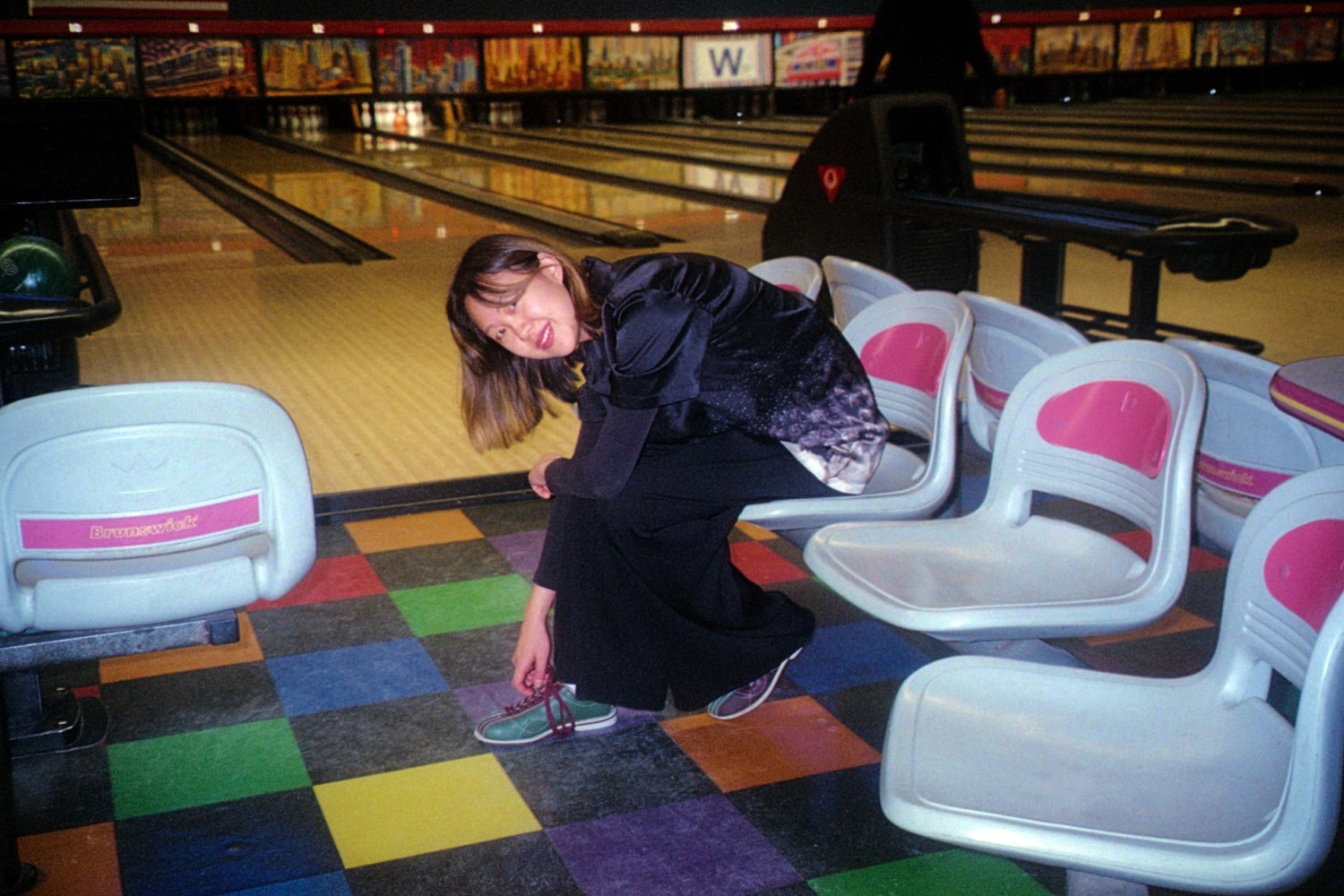
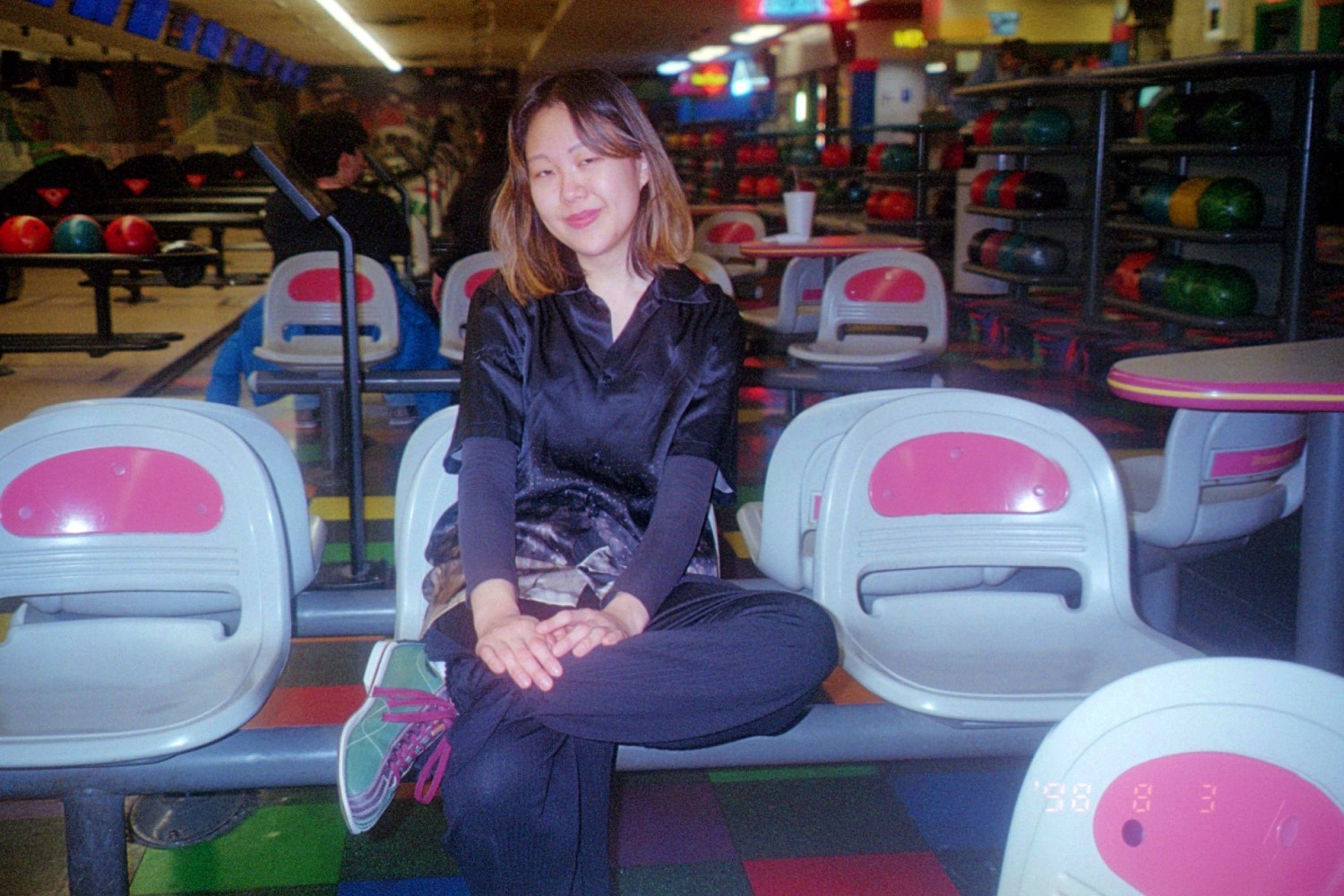
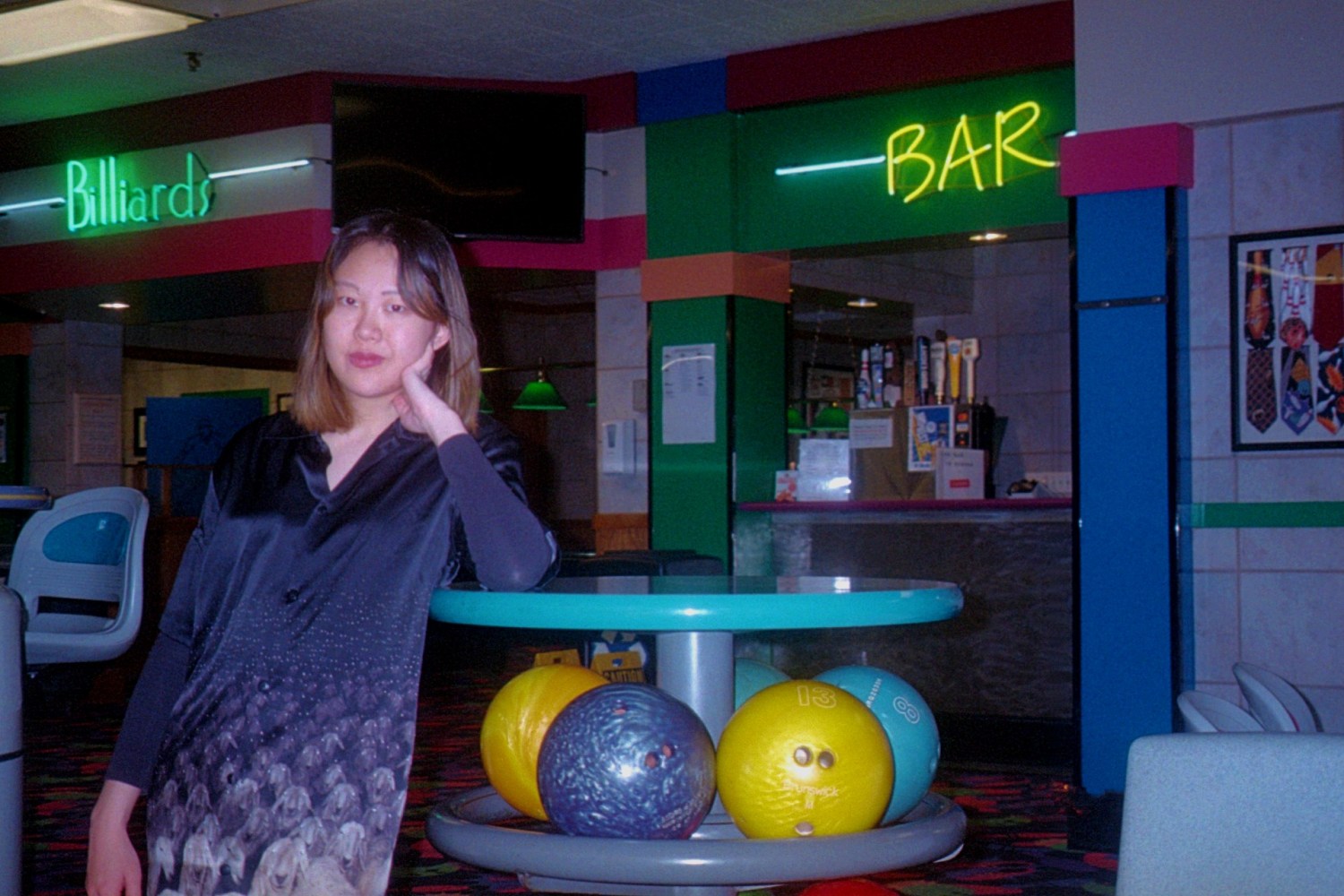
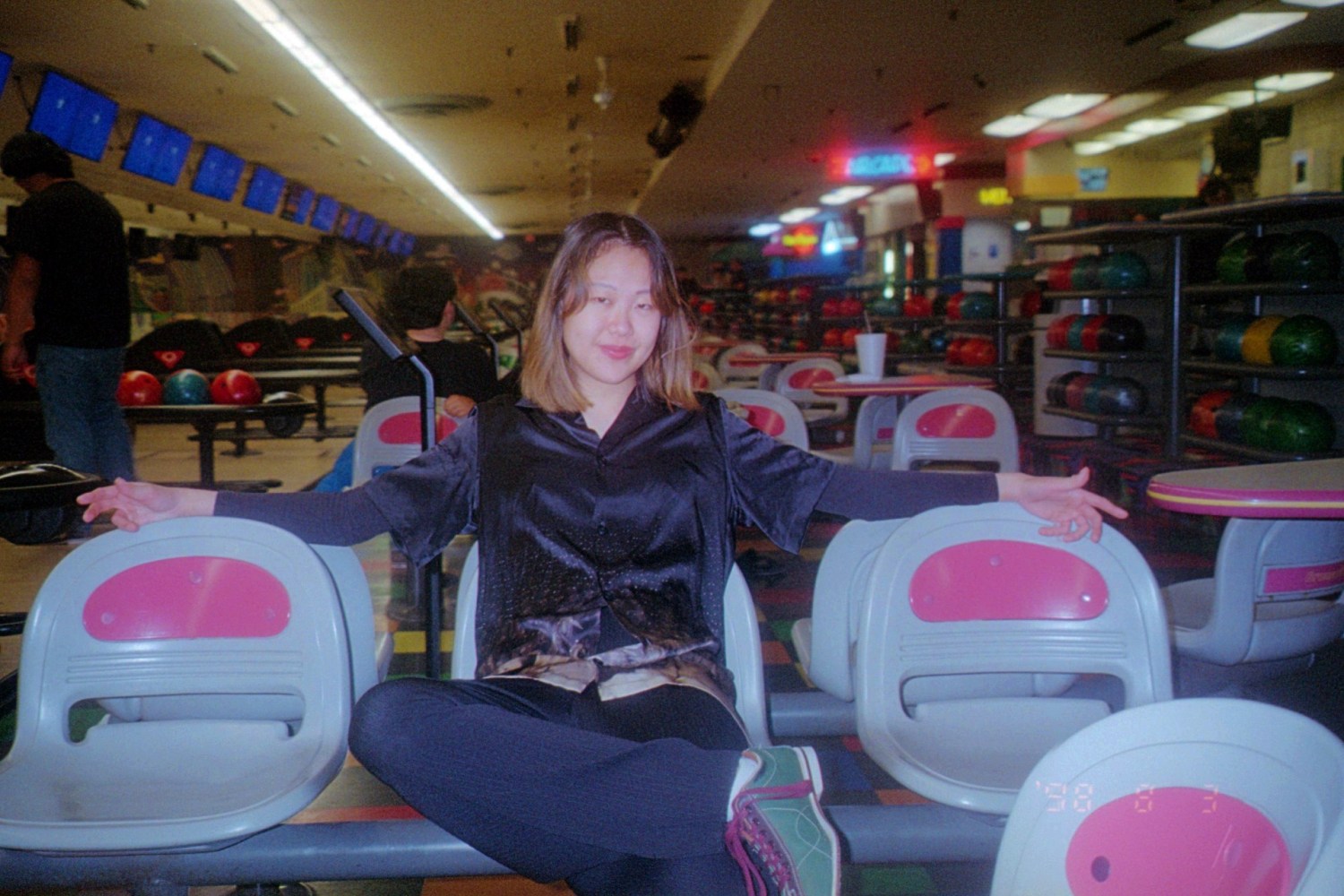
“The thing is, part of the reason why I picked bowling as an activity that I was going to get into is because you look like an absolute fool if you are having a bad day and start crying out on the fucking bowling alley that looks like it is 1994,” Park says, wavering between the need for a joke and a contempt for understanding. “It’s just too goofy to be visibly upset here. Especially alone. You cannot do that. So, it does kind of force a cheeriness into you.”
Victoria Park is a Chicago-based songwriter, who for the past few years has been performing under the moniker Pictoria Vark. With just a slight shift in the nomenclature, there is a differentiation there that even Park herself has set out to understand since the project’s initial founding. Now gearing up for her sophomore record Nothing Sticks via Get Better Records out on March 21st, this album has been a part of a longtime-coming-esque journey. After going through life changes and embarking on a tour that lasted 150 days, Park’s demeanor became ill fitted, relying on the ability to be present when she knew she couldn’t be.
Nothing Sticks is as vivid as it needs to be, rearing an earnest delivery that dares to challenge the fronts that become habit to us all. But where Nothing Sticks becomes most poignant is in Park’s focus in her own sense of self through her experience within the music industry, navigating the relentless expectations and learning how easy it is to lose yourself along the way. But in the end, Park has proven herself to be emboldened by it, embracing a rigorous, empathetic and more in-depth approach to writing these songs. And as they trickle out with each single, rearing with sincere melodies and indie rock bliss that PV and co. have brought to life, there is a sentiment built around momentary lapses of reflection that Park makes so vulnerable and engaging throughout.
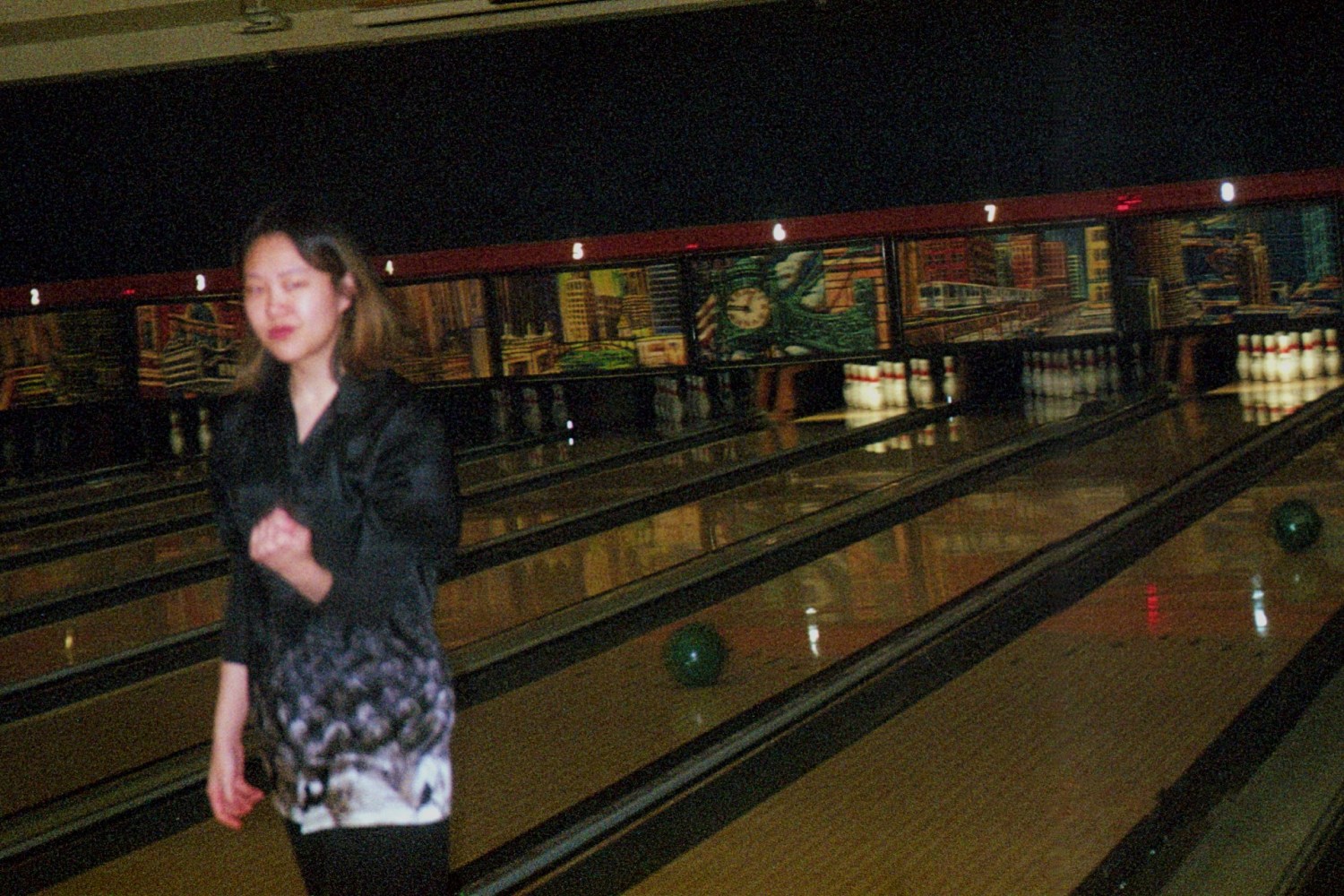
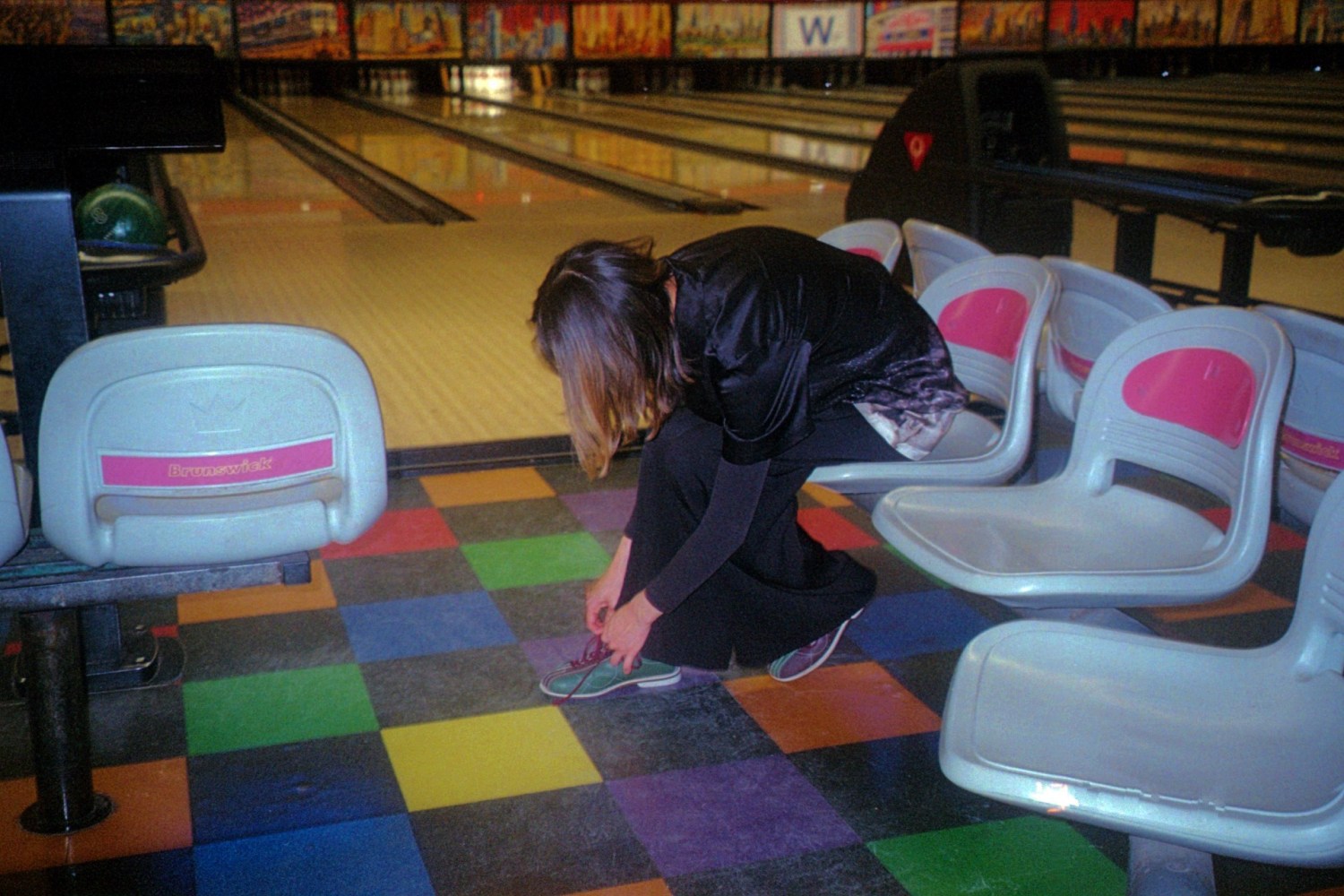
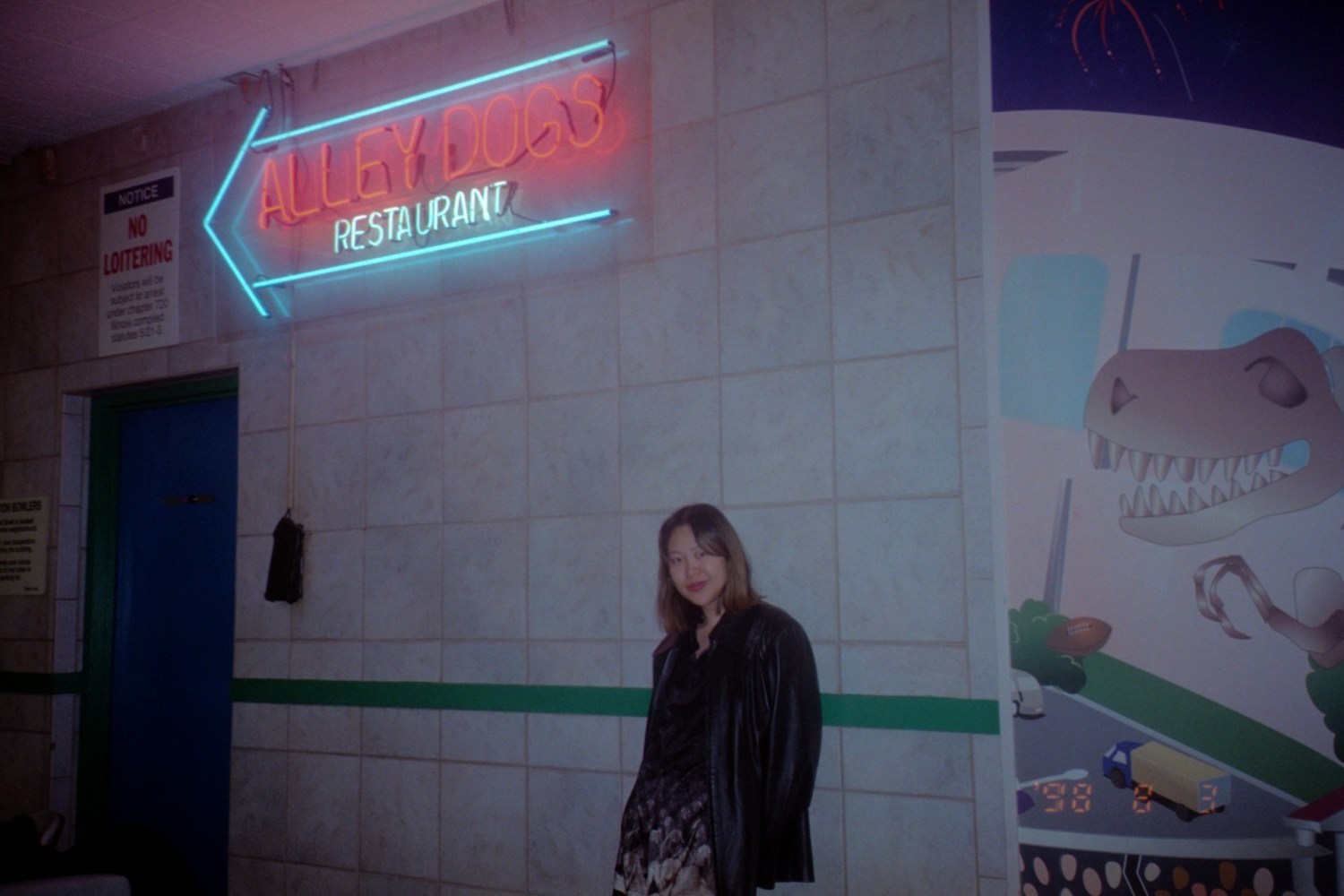
We recently took to the Waveland Bowling Lanes on a below freezing day in Chicago to talk with Park about balancing expectations, breaking habits and the making of Nothing Sticks.
This interview has been edited for length and clarity purposes.
Shea Roney: I am very intrigued about this 150 days of touring, and this is kind of where the generalized theme of the record came from. What was that experience like and what sticks with you now as you have taken time off?
Pictoria Vark: I was enjoying being on tour for that long, but it was also because I was running away from myself and my life. I didn’t want to confront the lack I felt at my home because I didn’t have the time to put energy into making it feel like home, to building friends and making it a real place I wanted to be. And so, instead, I would be like, ‘okay, when am I going back on tour?’ I just kept running away, being like, ‘I want to be here as little as possible.’ I haven’t really toured that much where it felt like I was running towards something. And I think the toughest part of walking away from that, or what the album is about, is when you spend time developing experiences when you spend time and money, the experience comes and goes. It just becomes a memory. So, it was just me kind of building memories and not anything material with it. I’m kind of just taking away the memories, and sometimes I call looking back on that time as “remembering the horrors” [laughs]. Which is partially me being dramatic about it and partially kind of real. Other people have different horrors they remember in their life, just like, ‘oh, that was a fucked up time’, and when you’re looking back on it, that’s remembering the horrors. So, because I have “the horrors” to remember, I’ve been trying to help my friends who are just starting to tour for the first time or want to know more about that to impart that wisdom so that they don’t crash and burn in the same way I did. I also didn’t have a lot of people at that time that I could talk to about these experiences because I didn’t have a lot of peers that were doing that much or were touring to that degree at all. So, it’s nice to be able to be that for other people, or try to be.
SR: You have mentioned in the past that there is a Victoria Park and there is a Pictoria Vark. Where do you draw the line between these two and has one taught the other anything?
PV: I think with the second record, something that I was thinking about is that I have these opportunities to be on stage, to share my music and some people will listen to it. Rather than think about the songs that I’m writing as like, I need this diary, I need to put my demons somewhere on a page and then I share that, but more like, if you were on a microphone in front of an audience of people, what would you want to say? What is the thing that I actually want to share with other people? What is something that I think is a useful message or something? So, it was made kind of intentionally and I think that’s something anybody can do or think about. All those crazy YouTube interviews of just like, ‘we’re just talking to ordinary people’ – that’s kind of like the same thing as that. If you were stopped on the street, what would you say?
With Victoria and Pictoria, I’m trying to do a better job at drawing a line between the two. Online, it’s honestly been really tough because I feel like I am only really using my social media to promote my music. And then it becomes a skewed image of like, ‘wow, you’re really busy’ or like, ‘how’s the music stuff?’ People don’t really know what’s going on in my personal life. One thing I am trying to do for the new record is have a stage costume so that it’s like when I’m on stage, I am in my persona, and then when I take that off, that’s like a different person – to create more of that delineation in a physical realm.
SR: Wow, that’s a great idea! What do you have in mind for the stage costume?
PV: Okay, early drafts, I wore these angel wings at Outset and I kind of want to keep sticking with them for the new record. It’s both a play on the like the halo effect, which is kind of a type of bias that I think happens to a lot of musicians. It’s like you literally put them on a pedestal. So I think that’s funny, angel wings, halo effect, yeah. And also because I love Wings of Desire by Wim Wenders. What if I was just like an angel on earth? That sounds so fun and it’s also, you know, kind of about forever.
SR: You say that these are just better songs in many aspects from writing and recording than your previous release. What did you find yourself focusing on more this time around? Anything out of your comfort zone?
PV: Yeah, I really wanted to push myself as a songwriter to make my craft better, to make stronger choruses or make stuff with more than three chords. When we got to the studio, the biggest challenge was working on a lot of the vocals, because we didn’t do a ton of vocal takes and there was like a whole eight hour day where it’s like Brad and I were just running through vocals and just being like, ‘oh, did we like how I said this word better?’ So by the end of that day, we were so fried. But overall, the studio time went really smoothly I think because we had so much preparation going into it. We were making really complex demos. I felt so bad, I was asking so much of Gavin and Tori because in my head I was like, ‘we don’t have time to like mess up.’ But I think it was like that initial thought and working out that way allowed us to have a smoother experience in the studio. It set a precedent, if I work with these same people for the next record, we can keep things a little bit more relaxed. I don’t really know how much we expected to go wrong, you know, but it was really exciting. It was just so many more people and so fun to watch it happen. There were some times where it’s like Brad and Gavin and Tori were just kind of like cooking and I was like, ‘I’m here’ [laughs]. It was really cool to just let them take the reins a little bit. My main job is assembling the task force.
SR: Do you think next time you will be more comfortable?
PV: Yeah, next time I want to leave it just more open, you know? Like maybe we don’t have to make the demos quite as intense, we can play or leave a little more room in the studio to figure things out. Finding a good balance of preparation and being open to improvising.
SR: And because everything was so tense with time and the demos, do you feel like there’s some parts of the recording process that you really wish you could have focused more on?
PV: Honestly, no, I think the time crunch felt really good, because it made us not overthink things. And we didn’t. We didn’t have time to redo things, we just had to let it live as is. And even if there’s a vocal performance or two that I would like to have done another take, it’s almost nice to think that that’s just room for improvement for next time.
SR: So at the point of this conversation, you only have two singles out. But you just wrote a really nice piece in your substack about balancing expectations, especially about the singles. You crowdsourced friends about which songs should be singles and there were some different ideas. When it comes to songs that are so personal to you, what does that balance of expectations look like as you go forward?
PV: It’s not easy [laughs]. I don’t think I do a great job at it. In all honesty, if you talk to some of my closest friends, I’ve driven them nuts over the last year just by going through the same kind of thought circles I can’t get out of. I think what I struggle with is the uncertainty rather than if something were to perform badly. I just don’t really handle not knowing in a lot of areas of my life, for various different reasons. It’s like more than being in this gray space where anything could happen and only like one thing will. It makes me crazy, makes me unwell – just in terms of like, I don’t know what my life will look like in three months, six months. I think the singles, weirdly, when I polled people on what song should be singles, I was not expecting “I Pushed It Down” to be the number two one that people would pick after “Make Me A Sword”. But to have that reflected by the Spotify algorithm is super weird. This reflects a taste of people, whatever it is. I thought that was really weird and interesting.
SR: One of the major themes of this album is understanding that nothing lasts forever. What did it mean to you, when talking about the fleeting implications of life, to come to this conclusion? Although bleak, did it offer any clarification or justification to you?
PV: I think it was the result of causing myself so much suffering by trying to keep things together in my life. Before this 150 days was started, I was dumped for going on tour for too long. And then four days later, I was on the road for three months. I had centered so much of my life around him unknowingly – it was part of the reason I decided to stay in Iowa an extra year, which became two years and didn’t move to Chicago sooner. And then with different bands or friendships, when there’s those falling outs, it left a really big emotional mark. I think in writing this record, it’s helped me be like, ‘okay, if this person doesn’t want to be friends with me or doesn’t want to repair things, that’s kind of not my problem. That’s not mine to hold.’ I can see that as an opportunity for more space for something else to come in, and I think that reframe has been really, really helpful because of the amount of like, almost a scarcity mindset of, if I want this thing and this thing feels good, it has to stay. I have to be the one to force it to stick in my life.
SR: Has this changed the choices you make when it comes to both your career or personal life?
PV: You know the meme of like, ‘I did X,Y, and Z and all I got was this t-shirt?’ That is kind of what going on tour felt like – I don’t know what happened. It’s like that thing happened, it was a blip in my life, and you know, now I wake up and I go to work and I still make music. I have a hard time not being able to make a clear and straightforward narrative from it. And so I think the ‘nothing sticks’ ethos is to try to enjoy the present as much as possible. Have the memories, but to not expect life to follow in a logical way like X,Y, and Z and be ok with things slowing down or ending because they eventually will. I don’t know if that’s a good answer for that question, but that’s what I got. I think with music, it’s made me change my approach, like, if this thing is going to cost time and money and energy to do, what are the things that I actually want to do in it? Because playing to 20 people, 100 miles away from home is like, I’ve done that, you know, I’ve done that enough now where I don’t feel like that’s an additive experience. So everything that I want to do moving forward, I want to feel really purposeful and really meaningful during the process of doing it, so that the end result doesn’t quite matter.
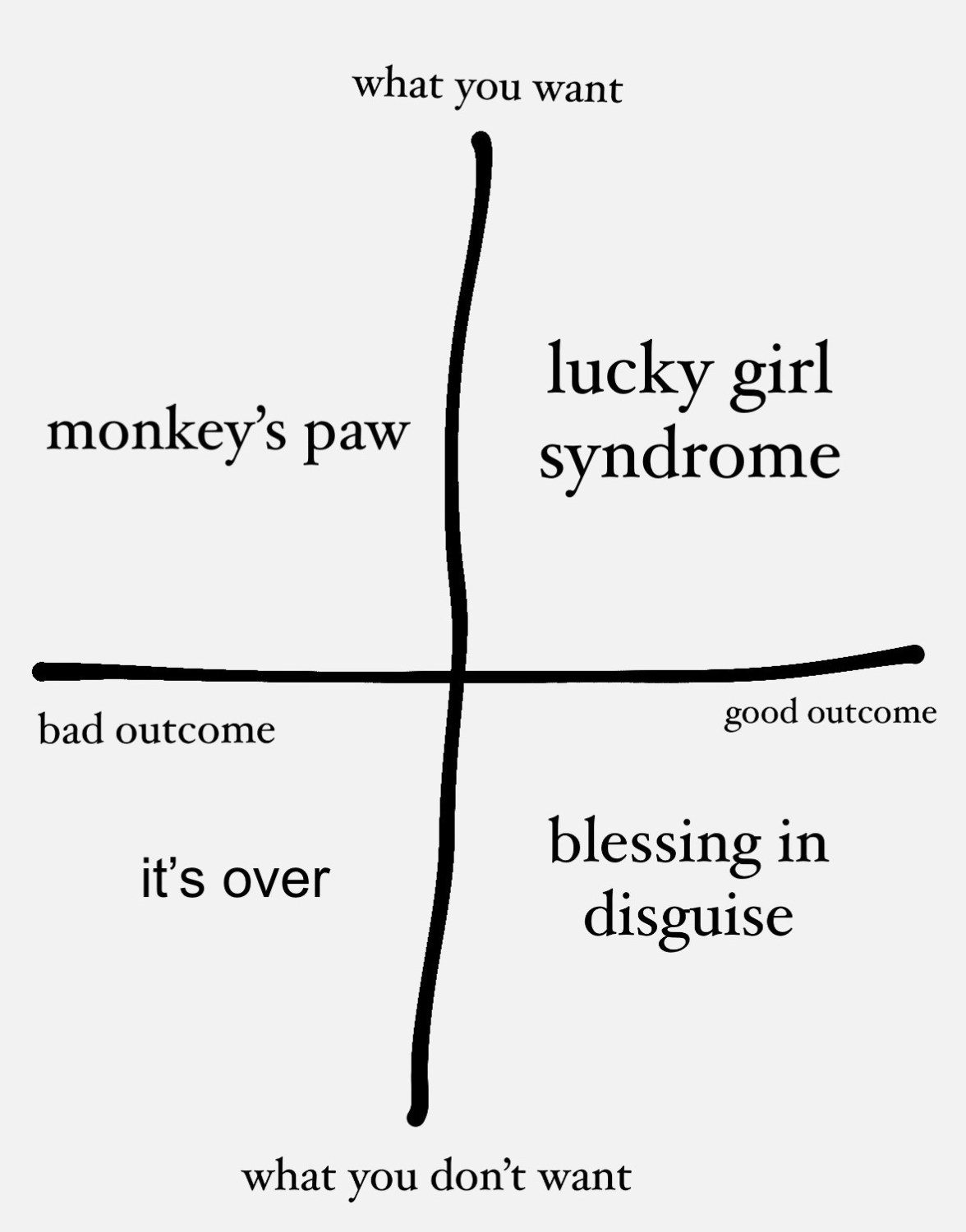
SR: So the last song, We’re Musicians, reminds me of a theory you were workshopping last time we talked, about good outcomes and bad outcomes. Being a musician, stuck in this almost stuck on this thin line, can you find yourself reflected in that theory?
PV: Oh my god [laughs]. Okay, well, if we’re gonna get super real with this, the big tour that I got asked to do a few years ago, that is like getting what you want and it wasn’t a bad outcome. It’s getting exactly what you want, but it’s like, not what you think it is. It is in some ways the monkey’s paw. Like, you get everything you ask for, but then it’s not what you thought it was gonna be at all.
graph made by Victoria Park
SR: What are you most excited for in regards to this album finally being out?
PV: Just to have it out. Yeah. Just to make it exist. Like, of course there’s things I want from it, but I know that’s not a guarantee. I think it’s something that I’ve been harping on in my mind of like, Oh, if X, Y, and Z doesn’t happen, then what happens? It’s like, I don’t know. You wake up. You go to work, I don’t know. That’s what happens. You make more music.. But I am really proud of this record and I think I’m just gonna let it speak for itself the best I can. As hard as that is for me.
SR: I mean, look how far you’ve come. Just earlier in this conversation you were like, I’m so scared of not knowing X, Y, and Z.
PV: The thing is, I am going to leave this question and then go back to my house and be like, ‘I’m scared of X, Y, and Z’ [laughs]. This is what I mean when I’m writing these songs as Pictoria – I would like to be this way. And by pretending that I am this way, that is me trying to be closer to that. The thing is like, part of the reason why I picked bowling as an activity that I was going to get into is because you look like an absolute fool if you are having a bad day and start crying out on the fucking bowling alley that looks like it is 1994. It’s just too goofy to be visibly upset here. Especially alone. You cannot do that. So it does kind of force a cheeriness into you.
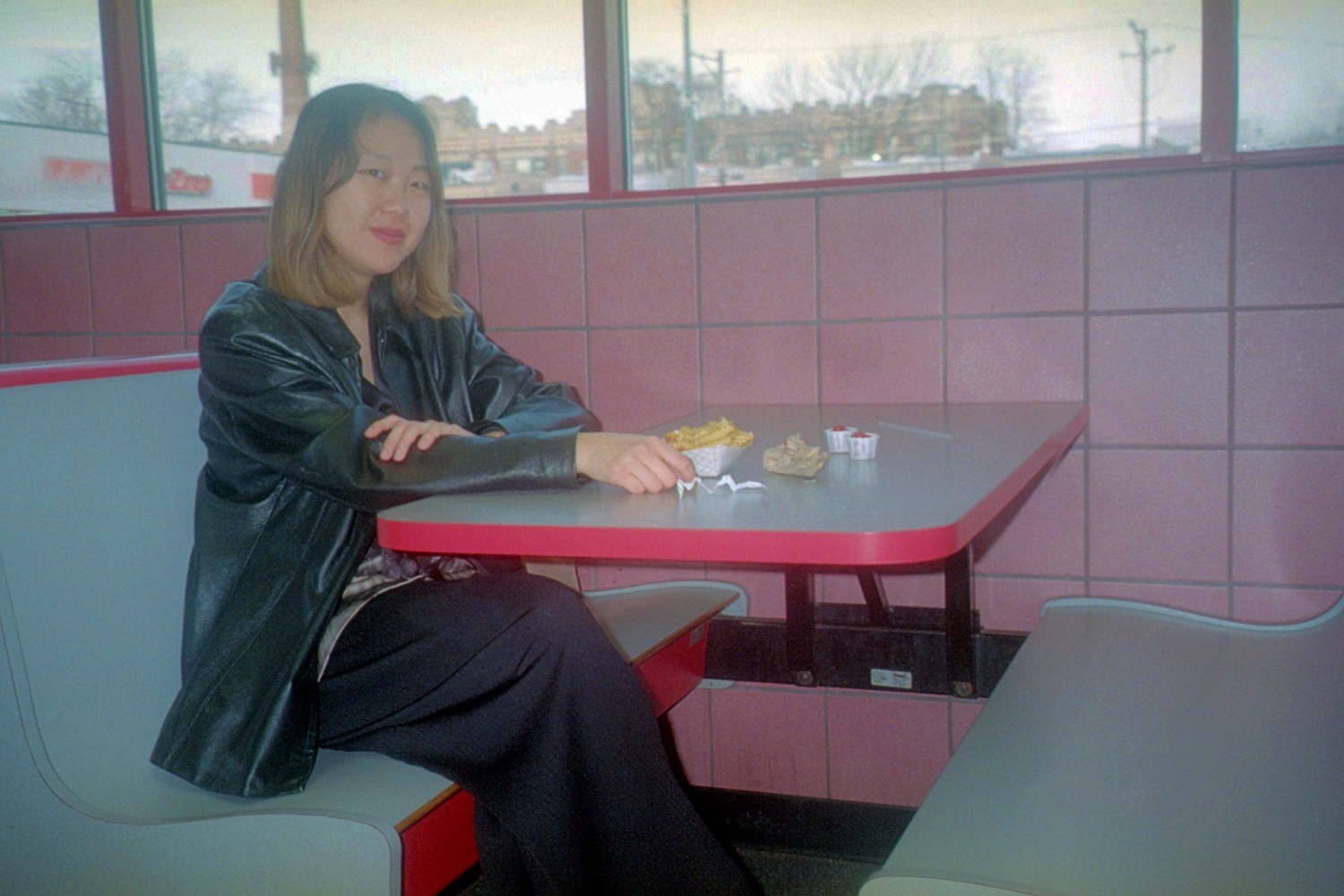
See more photos of Pictoria Vark here.
Nothing Sticks is set to be released Friday March 21st via Get Better Records. You can pre-order the album now as well as vinyl or cassette tapes.
With pronounced earnestness and vision, Slake has shared their debut single “bonecollector” with us last week, along with an accompanying music video. Previously writing and releasing songs under their own name, California-based songwriter Mary Claire has unveiled a new moniker and a new sonic direction to embrace. As a DIY solo artist since 2018, with two self-recorded albums to show for it, last summer Mary Claire traveled to Hudson Valley, New York to record Slake’s debut album Let’s Get Married, set to be released June 20th, with Ryan Albert (Babehoven) and a collection of other talents that help bring this new project to life.
As steady guitars lay out ethereal tones and each vocal part motivates the track’s movement with both beauty and empathy, “Bonecollector” becomes a moment of tension and release, as Mary Claire steps out of their comfort zone in more ways than one. We recently got to ask Mary Claire some questions about the new project and to take a deep dive into the single and music video for “Bonecollector”.
ugly hug: “Bonecollector” is your first release under the new moniker Slake. What parts of this song feel like a new beginning to you?
Mary Claire: I feel like everything about this song is representative of a new beginning. I wrote this song after a dream i had. It was kind of scary, kind of prophetic, and it just didn’t let up. it kind of bled out into my real life, all that dream stuff from that time. There was a time before the “bonecollector”, and there was a time after. I was in-between worlds then, I was at a major crossroads of my life. i’m happy i got this song down during that time.
“bonecollector” touches on how we learn skills in order to survive, how we develop ways of being in the world so that our experience can be livable, maybe even bearable, maybe even good. but sometimes, these skills or defenses or attributes we’ve built up and gotten so good at start to become detrimental to us as our lives change – because the war we were fighting is over, the people are all different people, the town is new, the everything has shifted. so, we have to develop some newness, some new useful skills, and likely say goodbye to the old skills. and that unknown can be insanely scary and even feel threatening to the parts of you that desperately want to stay but are holding you back, that aren’t serving you, that are hurting you.
“bonecollector” is a little message in a bottle urging listeners to look at our ways of being and give them a little dusting off, a refresh, or some time in the sun in order to change into something new that aligns with your shifting life. and say thank you to your old skills too. because if you’re like me, the old skills won’t go down without a fight.
“bonecollector” is all about the guardian at the threshold before change. i guess “bonecollector” is entirely about newness. and i feel like the fullness in its production, the additions that come from collaboration, and the richness and rise & fall in its sonic story line are representative of that.
uh: Your previous two releases were both self recorded and self released, but Let’s Get Married brings in a whole cast of collaborators. What was it like shifting this process and what did you learn about yourself as an artist by working with others?
mc: i loved recording, mixing, and mastering this album with other people. bridge oona and lil made me feel very safe and supported and special while we recorded this album. ryan is an incredible producer and engineer. i’d never worked with a producer before and it just makes so much sense to me now – it really works with my brain to have someone like that there. i have a lot of big ideas and big feelings but sometimes i get stuck because i don’t know how to do what im envisioning. trusting others with my little world was very hard and vulnerable and rewarding, and made me more open and trusting to collaborating in general. i tend to have a pretty strict but not always clear vision of what i want to do artistically, so working with everyone on this record made me see better. i can be a little controlling about what i want or what i think i want with my art, but during this experience i just told myself to say yes as much as possible. and it was always always worth it. and so if i didn’t like something, i had to really know why i was saying no. and that is a helpful exercise. i learned how to work with others more efficiently and fully and openly. i’m not perfect at it, but i learn a little bit more every day. i’ve got dreams too big to try and do them alone. i’m glad everyone i worked with believed in my dreams and believed in me and believed in themselves.
uh: What was the vision for the music video and how did it come together?
mc: literally my only motivating factor was to get a bald guy in this video. i had a million different ideas that ranged from getting like one hundred different and unique bald people in a bar to having a super lonely barfly at the jukebox. then i saw this regular at a karaoke bar in san francisco give a very earnest and moving performance, so that was it. i initially thought id just have the video be of him singing in the bar, but talking to seth the DP of the video, he convinced me it needed more. eventually, i warmed up to the idea of including more in the video. i was reluctant at first because i really just wanted my bald man to be the only one. but seth wondered what might be playing on the karaoke TV, and then a world of possibilities opened. we kind of thought we’d do like a shot for shot remake of george michael’s careless whisper to have as the karaoke backing video, but i was walking around berlin on my birthday listening to the song and i thought it’d be more fun to be in tights. so that’s where the jazzercise thing came from. obviously seth was down. there’s so much awesome 80s female bodybuilding stuff that helped inspire the video. and when the day of the shoot came and two of my friends dads and one stranger from craigslist arrived, it felt like a perfect amount of bald men.
i’d never worked on such a professional video before and i felt very taken care of by all the guys on set. once again, i just said yes to as much as i could and opened myself up to being vulnerable.
i often too feel like when you have a big sad song, it can be hard to have a big sad video to go with it – you have a real opportunity to get through to people in a new and entirely different way through the visual medium of your music video. it’s incredible to me. so i wanted to do something funny, because even though i write kind of serious grief-laden emotional music, i would consider myself pretty funny. hopefully my friends think so too. it was a nice opportunity to express myself and my sense of humor, and see if the song could stand up to all we threw at it. i feel like it did, and im proud of it.
uh: What can listeners expect from this new project Slake?
mc: that’s a good question, one i don’t fully have an answer to. it’s changing a lot, but my creative life feels bigger and more alive than it ever was. it’s kind of overwhelming. i really want to push myself and create with discipline and get out of my comfort zone. right now this looks like trusting other people to collaborate with, and it’s been totally awesome and hard and worth it. the band is big and full, and I’m hoping to walk the dynamic line of earnest storytelling and lyrically forward songwriting with a larger louder performance. i like to world-build. Slake listeners can expect to be in my big little world.
You can listen to “bonecollector” out everywhere now. Let’s Get Married is set to be released June 20th via Cherub Dream Records.
Written by Shea Roney | Featured Photo Courtesy of Slake
In the dimly lit basement bar of Neptune’s in downtown Raleigh, the crowd fell into a hushed reverence as the band began to play. Cramped onstage even more than the audience, they filled the room with Andrew Dowdy’s distinctive vocals, carried by a rich composition of pedal steel and fiddle—country-soaked tones that swelled beautifully with each song. It was an intimate, immersive moment, and I was hooked. Though I had heard Fust’s name mentioned in conversations about North Carolina’s music scene, this show, a part of last fall’s Hopscotch Festival, was my true introduction—and it couldn’t have been a better one.
Since discovering them, I have been immersed in their music. Their latest release, a collection of demos titled Songs from the Rail earned a spot on my most memorable list of 2024, while their last true album, Genevieve, is one of my favorite records of recent. Led by singer Andrew Dowdy, of Durham, NC, Fust is deeply rooted in the Appalachian Mountains of Virginia and West Virginia where Dowdy’s origins lie. He draws from these roots to explore what it means to be from the American South—more specifically Appalachia. On Big Ugly, Fust expands their sound, reaching louder and greater heights, while the album’s themes plunge into deeper lows than any of Dowdy’s previous work. Each song reads like the journal of some lost author, peering deeply into Dowdy’s mind and memories. Continuing the region’s rich and integral storytelling tradition, this album takes the form of modern-day folk ballads, preserving local history and passing down the gritty realities of Appalachian life to future generations.
Joining Dowdy on Big Ugly are Avery Sullivan (drums, percussion), Frank Meadows (piano, percussion), John Wallace (guitar, vocals), Justin Morris (guitar, pedal steel, vocals), Libby Rodenboug (fiddle, vocals) and Oliver Child-Lanning (bass, vocals, dulcimer, synth).
Together, they craft a dynamic sound on Big Ugly spanning from fuzz-filled tracks like “Mountain Language”—where producer Alex Farrar also sits in on guitar and lap steel to complete the arrangement—to driving drum tracks and roaring guitars reminiscent of Drive-By Trucker songs. On the other end of the spectrum is “Sister”, one of the album’s most haunting tracks. Its more stripped-back composition brings the fiddle and pedal steel guitar to the forefront, with the fiddle scratching along as Dowdy’s vocals drop to a lower register, delivering devastating lyricism. Further expanding the album’s sonic landscape are the contributions from Dave Hartley of the War on Drugs on synths and John James Tourville of Deslondes on pedal steel.
Throughout the album, Dowdy’s distinctive vocals are augmented as they are layered over with his own voice, as well as those of his bandmates, creating a haunting, almost choral-like effect. Dowdy’s vocals are complemented by a deep, resonant bass and the higher-pitched harmonies of Libby Rodenbough on many tracks, along with a duet with fellow Appalachian artist, Merce Lemon, on “What’s-His-Name”. The album’s ethereal vocal quality feels fitting for songs that deal with memory—like ghosts lingering in the past. Real people and places from Dowdy’s life come to life through lyrics about gas stations, demolished hospitals, and highways, all while grappling with the reality that these things have been lost to time. The songs are a testament to Dowdy’s love for the kinds of things that make up who we are, while they are with us and once they’re gone. The things that now exist only in memory, like a worn-out photo carried close, fading yet never forgotten.
Songs like “Mountain Language”lament the poverty of Southern life while yearning for a time when home was untouched by that pain. Dowdy sings, ‘But if we can make it up the mountain again / We’ll be back with country friends / And there’ll be language on the mountain again / Oh what country, friends, is this?’ The final line is a direct reference to Shakespeare’s Twelfth Night, where Viola, shipwrecked in an unfamiliar land, speaks the play’s first words: ‘What country, friends, is this?’ Like Viola, Dowdy channels a sense of disorientation, searching for a return to the familiar past he once knew. Yet, the ever-changing reality of Appalachia renders this impossible—what was once home has become an unrecognizable landscape.
On “Gateleg”, Dowdy further shows off his songwriting and storytelling ability further, with a Hemmingway-like restraint in its lyrical content. He references Bob Dylan’s Maggie’s Farm for the chorus taking “I ain’t gonna work on Maggie’s Farm, no more/No, I ain’t gonna work on Maggie’s Farm, no more” flipping it to say “You ain’t gonna work on the line, no more/You’re gonna work for Maggie’s store”. Dowdy paints a picture of a relationship in the face of poverty, defined by the backdrop of wood burning stoves, convenience stores, and broken-down cars, propped up on cinder blocks.
Fust captures the contradiction of rural Appalachia—the stark contrast between poverty, drug abuse, and environmental devastation, brought on by exploitation of the region, and the enduring beauty of green rolling mountains, deep-rooted traditions, and the resilience of its people. The album takes its name from a community located in one of the poorest census tracts in one of the poorest counties in West Virginia. Its cover art features a photograph of a mural from the Big Ugly Community Center, originally painted as a backdrop for a student play that told the stories of local families. The image serves as a perfect accompaniment to the record’s themes— a testament to both the ability and the necessity of creating beauty in the face of ‘ugliness’.
Given that Fust’s last two albums were among the best releases of the past two years, I was admittedly apprehensive about whether Big Ugly could live up to its predecessors. It has—and then some. With this record, Andrew Dowdy has firmly established himself as one of today’s great songwriters. As Fust embarks on tour, I would highly recommend seizing the opportunity to experience their music live—I know I definitely am.
Big Ugly is out on all platforms now. You can order a vinyl or CD copy of Big Ugly via Dear Life Records.
It’s been a handful of years since Australia’s Olivia’s World shared new tuneage with us. But since their 2019 self-titled and 2021 Tuff 2B Tender EPs, Olivia’s World has functioned as a collaborative rotation of indie-pop charmers, recently landing on a lasting and invigorating lineup of musicians. Now with two singles out, the group is gearing up for their debut LP Greedy and gorgeous out next Friday, March 14th, and with that, Olivia’s World is offering just one more taste test with their new single “Healthy & wealthy” premiering here today on the ugly hug.
“Healthy & wealthy” is a tender rock ripper, balancing docile tones of distorted guitars with vibrant, sweet melodies as Olivia’s World revels through expectations of our most dubious inner and outer displays. “Are you TV ready?” guitarist and vocalist Alice Rezende asks with repeated eagerness, hopping into the momentum laid out by the band on the song’s chorus – the anticipation like the countdown before we run this show live. But as the crew plays out with their collaborative strengths and the melodies become embedded in our noggins, we watch as that camera light turns on, and Rezende makes you ask yourself…who is even watching?
Greedy and grogeous is set to release on March 14th. You can preorder the album now as well as vinyl copies from Little Lunch Records and cassette tapes from Lost Sound Tapes.
Last week, FRANK/IE CONSENT and The Spookfish shared a collaborative recording titled no bottom pond, 34 minutes of ethereal folk experimentations from a series of sessions that took place in upstate New York where Dan Goldberg of The Spookfish was living last summer. Pieced together by The Cradle’s Paco Cathcart, the duo made use of a tape recorder and a camcorder, traveling between Goldberg’s house overlooking a pond to the heights of Harvey Mountain, where the two artists embraced pure moments of improvisation and collaboration.
Although one piece, no bottom pond can be split into different movements upon listening, like a collection of extremities that coerce the natural world in which this duo finds themselves expressing its creation. Passing a guitar back and forth, FRANK/IE CONSENT and The Spookfish spent these sessions improvising with whatever they had on hand. The clanking of porcelain, the crinkling of leaves, a melodic dance of looming guitars and breathy vocals, bits of laughter over folkish whimsy – at times these awakened expressions peel off from the vibrant backdrop, only to return as one – a return to the very presence of its makers as they too take into account the beauty of their surroundings.
You can listen to no bottom pond out on FRANK/IE CONSENT’s bandcamp page now.
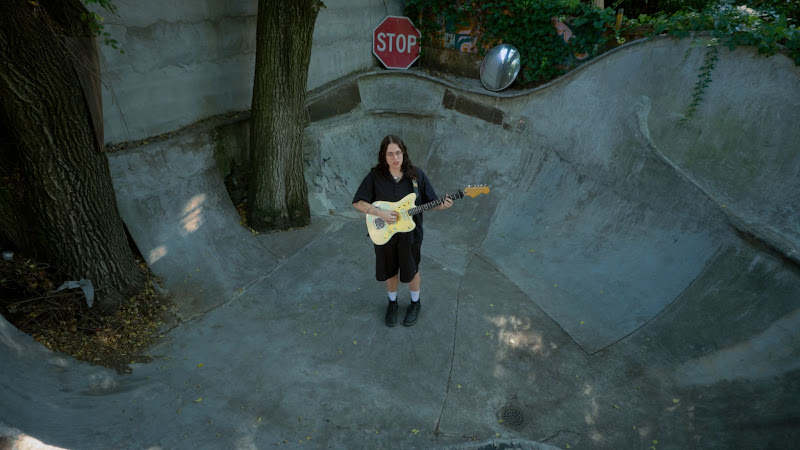
Step aside, OK Go. Claire Ozmun’s “Dying in the Wool” is about to dethrone “Here It Goes Again” for most iconic music video of all time, and it doesn’t even have any treadmills. What it does have is a concrete bowl that skaters have been dropping into since 2014. The Soul Bowl has been well-known and equally as beloved in the skating community for a decade, since it was poured by hand in the backyard of an unassuming Brooklyn apartment building. Multi-talented percussionist Immanuel Pennington of such acts as Poolblood and Captain Tallen & the Benevolent Entities holds it down there now.
On the day of the shoot, the band had just gotten back from the first leg of a two-week tour. Shows in Brooklyn, Philly, Poughkeepsie, shot the video, then left for the second leg 48 hours later. We loaded the car with gear and hit the road west-bound for shows in Cleveland and Chicago. (“We” because I got to play roadie-for-hire. Please hire me.)
To create the effect of the crowd moshing in slo-mo as they played, the band had to learn to lip-sync and play their instruments at double speed. During every take, director Ellie Gravitte reset the song and played back a double-fast sped-up version. While this had potential to feel like a quasi-Speedy Gonzalez cartoon (and it totally did at first), after everyone got used to it two takes in, the overarching crowd-feel quickly shifted from comedic to “Holy hell this is even cooler than we thought.” Seeing the band so tight even at 200% speed was wildly impressive. Keyboardist Catey Esler noted how solid the whole band felt playing “Dying in the Wool” at future live shows after having gotten it down at double-speed for the video.
Gravitte’s visionary, experimental camera angles are the product of insanely impressive balance and athleticism. She and her team balanced perched on top of the skate bowl wielding heavy camera equipment to get these shots. At the same time, Gravitte’s hurling necessary artistic directions like “Can you guys smile less? You all look like you’re having a blast, but this is supposed to be cool,” and “Just mosh like you’re all on ketamine.” (The whole crowd said “ohhhhh.”) Indeed, everyone in the bowl knows each other and loves each other and cares about each other’s lives, and it was a genuine challenge to not over-smile. A few weeks before, the same group chat of friends that sends “what’s poppin 2nite” texts gets a casting call like, “Hey we’re shooting a music video and we want you to all be in it. There’ll be pizza and beer.” And everybody came and it ruled.
Watch the video for “Dying in the Wool” premiering here on the ugly hug!
Ellie Gravitte, the video’s director, shares in a statement, “if you’ve been to a COB show, you know it’s all about community. Claire Ozmun loves her friends harder than anybody I know, so we thought it was only right to make a video with the homies at the center of the action. Throw in some Brooklyn skater vibes and you’ve got yourself a taste of that retro punk scene that this EP so beautifully evokes. We put this together in a single day in a backyard skate bowl in Bushwick, instructed all our pals to wear their best goth looks from 2009, and moshed our little hearts out. We hope it inspires you to do the same.”
Not only can Claire Ozmun write a generational battle cry, but she can also apparently serve face even at double speed. It takes a sturdy person with A Good Song to be able to sing into a camera and make it look not only natural but unbelievably cool. Watching her here feels like the first time a fourteen year old watches Kurt Cobain speak to an interviewer and feels that deep inner stirring. She is the icon this new generation of rock n rollers has been hungry for – assuming the position left empty by predecessors Kim Deal, Chrissie Hynde, and Grace Slick.
This video is an amalgam of supremely talented artists. But, the actual shooting came with minimal direction, because the entire cast had trained for this role with months or even years of method acting. We all knew how to shake ass at a COB show. Attend one show yourself and you’ll find it’s impossible not to start movin. The videographers put us in the bowl and just said “mosh” and we knew what to do. A few takes actually had to be redone because we had to dial it back from the level of enthusiasm that was our natural reaction/instinct to deliver. Everyone wanted to take an elbow to the chin for this band. Months later, everyone on set still refers to this shoot as “dying in the bowl.”
Ozmun’s “Dying in the Wool” video showcases the electric, thriving music community alive in Brooklyn, New York in 2024. This is a truly special, ageless capture of a time and place where a lot is happening and all of it is good – especially COB and their music. Melomaniacs worth their chops (or at least worth their CD collections) should keep their eyes on The Claire Ozmun Band.
Today the Chicago-based songwriting duo of Samuel Aaron and Noah Roth share a music video for their most recent single “Squirrels in the Walls.” This track comes from their new collaborative EP titled Two of Us out this Friday. Each with their own respective songwriting projects, Aaron and Roth sat down to write and record this EP in one day, offering a refreshing project lost amongst the intimacy, intuition and grace of collaboration and friendship.
Like the lingering ring on the table from a warm cup of coffee lifted for a sip, “Squirrels in the Walls” is a sign of life. Rambling with reserved rhythmic joviality, the duo bring out the best in each other, playing to their strengths with endearing lyricism and the definitive characteristic of storytelling that brings a lasting charm to this track. “Once I read that lyric out loud, the rest of the song “Squirrels in the Walls” poured out like water from a faucet,” Aaron shares about the song, continuing, “we wrote the whole thing on Noah’s couch in that one sitting, giggling to ourselves about how delightful it was to sing so plainly about life, love, and rodents.”
Watch the music video directed by Devon Thomas below!
Two of Us is set to be released this Friday February 21st via Austin-based label Happen Twice. Aaron and Roth will be hosting a release show on Friday February 21st at The Hideout in Chicagoand then will depart on a brief Midwest tour. Check for dates and locations here.
Today, Massachusetts-based duo Taxidermists return with a new single, “Does The Wind Know”, the second track from their upcoming record 20247 out March 7th via Danger Collective Records. As childhood best friends who first met on Myspace in 2007, Cooper B. Handy (aka LUCY) and Salvadore McNamara have since expanded their relationship into building their own unique world of DIY creativity and label pushing sounds as they continue to look ahead into what is possible.
With the click of the drumsticks, Taxidermists barge in with brash tones and a running progression as the duo drives forward with simplistic coverage and a charming intensity – pushing their gear to the limit with a type of reciprocating dance brought out by the heart of the song. With short, choppy chants, a repetition of the very question, “does the wind know”, bouncing between verse and chorus with charged excitement, the duo takes on this post-punk antiquity with the grace of two friends who are in it for the love of the game.
Listen to “Does The Wind Know” below!
20247 is set to be released on March 7th via Danger Collective Records. You can pre-order the record now as well as a vinyl and CD copy.
Written by Shea Roney | Featured Photo by Harry Wohl
 the ugly hug