It would be difficult for me to write about a Nara’s Room remix EP without referencing the feature I wrote on Nara Avakian earlier this year. We spoke about three months following the release of Glassy star; the 2024 record offering up a foundation for a more comprehensive conversation on the project’s ethos and ever-expanding nature. When discussing their songwriting, they enthused about their bandmates ability to contort or enhance music they wrote from a personal and sometimes even guarded place.
“They evolve the meaning and turn something that is very private and singular into something much more nuanced”, Nara told me in January – a quote I think back on each time I listen to Glassy was the sky.
Last month, Nara’s Room shared Glassy was the sky – a remix EP of Glassy star and the latest feat to stem from the project’s emphasis on the potential for art to evolve. It consists of seven tracks and features contributions from Sister., fantasy of a broken heart, Hausholding, good.will, Brendan Jones, and Shallowater.
“Sister., fantasy of a broken heart, Shallowater, and Hausholding are some of my favorite bands currently”, Nara explains, “good.will, aka Will Fisher, our Ambient Duty player, and Brendan , our drummer contributed as well to the EP which was special because I loved hearing their own interpretations of the songs outside of their roles in arranging them. Will wasn’t a part of the project when we recorded ‘Glassy star,’ so it was special to have him on too.”
Glassy was the sky houses two versions of “Glassy star”, the original record’s emotional closing track. On Glassy star, it takes a coarser form than the tracks that precede it, stripping down the fuzz and sonic eccentricities to end on a moment of uninhibited vulnerability. In doing so, “Glassy star” perfectly captures the moment between naivety and what comes next, as Nara sings “Nineteen’s a funny time to be, the world’s only just started.” These layered and complex feelings pour onto both renditions on Glassy was the sky, though both projects manage to do so in a way that feels authentic to their own sound.
“Sister. and Shallowater’s wildly different interpretations of ‘Glassy star’ only expanded the universe of the song and it was special to hear the way the raw emotions in the original were interpreted by them”, Nara says of both “Glassy star” versions.
Glassy was the sky also contains a version of “Teeth” by Hausholding that Nara deems “so freaky, in the best way”, an exhilarating fantasy of a broken heart rendition of ‘Grape juice’, and a version of ‘Holden’ by Brendan Jones that honors the tracks original ballad form. It ends with “Like ivory – duo version” ft. good.will, a track that Nara describes as an “epilogue of sorts”, adding, “hearing his rendition almost gave me closure.”
Little clicks recorded on a contact microphone submerged in a jar of water, digitized home movie footage from a gymnastics camp, slivers of early 2000s TV commercials and the ringing of a flower pot are amongst the samples that Patrick Zopff weaved into connect the dots, an album he released today under pity xerox. It is technically a debut for the project, though ‘pity xerox’ has held a role in Zopff’s life for years; a nickname for his visual art practice that eventually bloomed to an encompassing of the scrappier mixed media approach used in all his creative endeavors. It was natural to use the title for his “dream writing project” – given the parallels between a style of visual art meshing digital and physical media, and music that maintains a deeply organic feel amidst a variety of samples and technological elements. In eleven tracks of intentional sampling, twinkling synths and a grounded pop sound, connect the dots, patches growth, grief and love saturated memories into a stunning sonic collage grounded in optimism and acceptance.
“Others say I’m bashful, because I haven’t much to say”, Zopff’s warm vocals flood through in the album’s first track, “golden bough”. The notion finds a place tucked between a laundry list of other peoples’ perceptions, the gravity of which seem to dissolve each time Zopff’s shares his own narrative, manifesting as “I say life is a carousel, and we ride it round and round”, and “I say love is the golden bough, that we’re all hanging on.” It’s a staggering tale of finding comfort in oneself, and exists as the first of many tracks to counter discernments that Zopff has little to say.
“I think poetry is one of the most difficult art forms for me, and without music to ease the writing process, it would be impossible for me. Writing this album was extremely therapeutic for me in a time when i was very unsure of everything. I had no job, I was adrift in the world, and all I could think to do was record music. Many of these songs were written as they were recording their final draft. A few of them were composed and recorded instrumentally before any lyrics, and I think having a heartfelt instrumental makes a person write about some vulnerable things. I had no reason to hold back, I wasn’t sure these songs would ever leave my room.” Zopff explains of his approach to lyricism.
The album is sample dense, honing a variety of sonic texture while maintaining a gentle and warm listen. His use of samples range from a brief, calming swarm of seagulls in “connect the dots”, to a home recording that spans the entirety of “peggy”. Of the track, Zopff explains, “on ‘peggy’ the majority of the track is audio from my little sister Maureen’s baptism video. Later it cuts to audio from a scene with my mom, my sister, and I. Giving these sounds new life in song is really fascinating for me. I hope it’s interesting at least for the listener, but as an artist it’s an immense pleasure to revive these otherwise forgotten sounds as elements in music. Being able to hear my deceased moms voice on my album is huge for me, like I’m continuing our relationship somehow.”
While the bones of connect the dots emerge from deeply personal experiences, the ways in which Zopff seeps his own vulnerability into the innovative nature of his sonic style yields an album larger than one individual. There is a grandness to even the most delicate tracks, part of which can be traced from a slew of contributions made by trusted people in Zopff’s life, such as mastering by Isaac Karns from marble garden studio, drum contributions from CJ Eliasen, Clarinet from Matthew Wallenhorst, and vocals from Zoe Vanasse and Louis Martini. There is also something familiar about the underlying ethos of the record, and how it yearns for comfort amidst waves of uncertainty and doubt. This idea is tethered to the album’s title, of which Zopff explains, “As the themes and the shared sounds across the album began to emerge, it felt like completing a sudoku square, or a crossword, or a connect the dots puzzle. Finally I could see the image formed by the disparate elements in my poems. for the first time I could write about my grief, my heartaches, my uncertainty, with shameless drum machine rhythms and playful synths.”
You can listen to connect the dots on the pity xerox bandcamp below!
To the likes of being awakened by your sleep paralysis demons – used to the routine of these spooky encounters by now – only to be shown the surprise birthday party they have thrown for you, there are elements of mui zyu’s music that stick out as odd, borderline conflicting, yet from the center of its beating hearts, there is a tender sweetness that becomes irresistible to partake in.
mui zyu is the creative project of Hong Kong/UK artist and experimentalist, Eva Liu, who as of today, has unleashed her sophomore record nothing or something to die for out into the world via Father/Daughter Records. Over the past few years, Liu has molded her expansive, yet incredibly intimate project as mui zyu into something that is both emotionally refining and sonically addictive when ingested by earthlings. But fifteen songs in and out, nothing or something to die for is a rehabilitation of what it means to be a human, and the things we must hold on to when existence begins to feel radical and nihilism becomes a choking hazard when left out in arms reach.
With a production style that’s made through a clenched jaw and an expansive mind, Liu has thrived in brewing and boiling her sonic landscapes from within her home studio with co-producer and fellow Dama Scout bandmate, Luciano Rossi. But when it came time to create nothing or something to die for, with help from PRS Foundation funding, Liu was able to take her ideas to Middle Farm Studios in Devon, England. “The engineer came and picked us up from the station and took us to a farm shop to get supplies,” she recalls as the week of recording began. “Once he dropped us off at the studio, he left us to it – we were stuck there for a week and had no way of leaving unless we walked for hours.” Besides a hairless cat named Dust, Liu and Rossi were left to their own curiosity.
Photo by Tia Liu
“I feel like our approach to making this album was a lot different in that we had more time to experiment and mess about with new equipment,” she adds. Through their interwoven brain paths and love of textured earworms, Liu and Rossi thrived in these moments of uninterrupted exploration. “If I’m wanting a particular sound or feeling, I would just describe it, and [Rossi] would be able to manipulate the certain thing to sound exactly like what’s in my head,” she shares, showcasing their strengths as a creative duo.
Going beyond the classic build up of instruments and mui zyu stylings, there are multitudes of little sound bites and recording tricks that live amongst the record’s landscape – something that Liu takes a lot of pride in. “As soon as we want to explore something, we’ll explore it to the max, even if we chuck it in the end.” Most memorable, to her excitement, was the chance to use a fanfare horn that hung on the wall of the studio “It was my first ever experience using a brass instrument – I had no idea what I was doing, and I think it literally only plays one note on the album,” (found in the depths of the song “sparky”). “But that’s what I enjoy mostabout our process and I wish I could do that every time I record – it was just such a nice experience being so removed from the world and solely focused on what I love doing.”
nothing or something to die for also features a handful of collaborations with outside artists – something that Liu has always wanted to do, but never felt confident enough in her abilities to ask for. “I used to be so terrified – I just had that inner imposter syndrome screaming at me all the time.” But spending years working with Rossi and other bandmate, Danny Grant, in countless creative environments, Liu now admits, “I feel like Dama Scout definitely gave me the confidence to approach other people and collaborate more with other artists I love.” With songs like the dissolving “sparky” featuring lei, e (formerly Emmy the Great), the darkly meditative “in the dot” featuring Lukas Mayo (Pickle Darling) or the industrial-strength muscle relaxer that is “please be okay” featuring Miss Grit, the features only enhance the sonic experience of the album, pushing Liu’s writing to new depths that she never thought were possible before.
Opening with “satan marriage”, an instrumental that plays out from an array of stringed instruments, the album comes to life like body parts shaking off their tingly slumber and unconnected nerves. Soon a drum machine accumulates and introduces our surroundings, as “the mould” kneads our physical being to fit inside this fantastical world of dilapidated characters that Liu has created – one that emboldens the horrors of very human-centric qualities of destruction, apathy, misogyny and greed through the lens Liu’s own individuality.
Following her 2023 debut LP, Rotten Bun for an Eggless Century, which followed a lone warrior exploring concepts of identity and healing, nothing or something to die for goes beyond Liu’s conception of her own character as she observes how mankind, as a species, have both a hand in, as well as are concurrently fighting off, this dying world. “As humans, we’ve kind of messed up a lot of things,” Liu will say with visible weight. “With this album I’ve left my story behind and I’m now looking more outward at my understanding of the world.”
Photo by Tia Liu
“I think a lot of the album has to do with embracing chaos in the many forms it comes in,” she adds, in the name of betterment. Dealing with serious grief on songs like “please be okay” and “the rules of what an earthling can be”, reckoning with the pressures of appeasing others’ standards, while “in the dot” gives a voice to our most destructive humanly habits, being an earthling can feel impossible at times. The sugar-coated, cavity filled track, “donna likes parasites” refers to a family member who is, as Liu puts it, “overly worried about everything. The strive for perfectionism is actually damaging their health – it’s actually ruining their life.” Like a parasite, these manufactured stressors begin to eat you from the inside out. “I find a lot of people I know are always trying to find a way to better themselves, or I guess in their eyes, quick ways to find happiness,” she says. “But it’s not lasting.”
“After the pandemic, a lot of my friends were exhausted and very disheartened with everything that’s going on in the world,” primarily noticing, “people were just not looking after themselves.” In response, Liu’s artistic theme became one of perception; creating new ways to look at, perceive and carry our trauma alongside our need for harmony and hope. “It’s just amazing how our perception of things can change all the time – whether it’s true or not,” she admits, going on to explain, “sometimes we look at memories and we can interpret them differently at times and you’ll start to feel differently towards it.” Utilizing this idea of perceptions as a new challenge – “it’s just deciding what to do with it that can change how you feel.”
“Follow the mould through portals/ Looking at memories wrong/ Take tiny sips through their lips”, rattles through the pop sensibilities and slo-mo palpitations of “the mould” as Liu views decay with a new manner of optimism. The idea of portals, as she explains it, “ represent a sort of opportunity to rethink something or to look at something differently for the positive.” “the mould” celebrates that idea, warts and all, as she embraces the caste that only she can fit in – no longer living in regret of what she’s not, but rather cherishing what she has become on her own.
Taking inspiration from the the classic 1986 David Lynch film Blue Velvet, the standout track, “sparky” honors the dog that plays in the hose as his owner dies. Although dark in its depiction, it comes down to instincts – what is Sparky capable of controlling in the moment and where is Sparky at his purest form? Although it is often warped by societal expectations of what Sparky should be doing in that moment, Liu lays it out on the chorus, “Does it feel cute biting the water, Sparky?/ Does it feel good trying to be happy?,” she sings, almost with envy towards its simplicity.
“In a way, the portals do represent an escape, but they also represent the next level, the next chapter or the next world that you’re about to embark on.” This sounds like a huge concept, but Liu knows it doesn’t need to be overly complicated. As she embarked on this treacherous journey, mirroring the complexities of manufactured rules and utilizing chaos as a benchmark of capabilities, she found there are slivers of grace amongst these songs that hold a purpose. “We need to take time to look and realize and reflect that things are actually really good and you are lucky to be where you are.” In no way is this an album of defeat, but rather one of self rehabilitation against the odds of what an earthling can be. “I like absurdity, but I think overall, this album is about hope, and as cliché as it sounds, not giving up.” As portals open and close, allowing momentary lapses in reality, Liu embraces that first step through, knowing it can make all the difference.
Brooklyn-based musician Frances Chang’s second album, “Psychedelic Anxiety,” is a metaphysical take on experimental indie pop that’s about navigating the psyche — bringing complex, and oftentimes, clashing emotions to the surface.
It’s a slow burn of an album with diametric contrasts; Chang’s etheral vocal melodies float around kaleidoscopic rhythms while a lurking specter of existential dread hides in the peripheral.
The sonic offerings on this eight track album are diverse; grungy pop, psychedelic-infused indie folk, self-described “slacker prog” as well as ventures in lo-fi experimental improv and sound poetry. And through this tapestryof musical stylings, Chang reinforces the idea to listeners that you never quite know what to expect next.
Released on Feb. 16, Frances Chang (guitar, synths, vocals, programmed drums, voice memo) primarily spearheaded the album via home-recorded tracks. The project was partially engineered by Andrea Schiavelli (Eyes of Love), who also mixed the album.
The rhythm section is composed of Liza Winter (Birthing Hips) on drums and Schiavelli on bass, while other contributions include Michael Sachs (woodwinds on “First I Was Afraid”) and guitarist Nick Llobet on “Rate My Aura.”
As the opening track on Psychedelic Anxiety, “Spiral in Houston ” is unexpected; it’s not a sweeping grandiose opener that’s meant to impress. Chang’s vocals are wispy, but densely layered; paired with an acoustic guitar, electronic drums, and experimental sound textures, building tension to carry across its surreal foreboding narrative. It evokes the feeling of being stuck in an old memory that you try to shut out of your mind.
“What’ve I done?/ In a sagging bed in Houston/ on the highway/ next to a psychic’s house/ lit up in yellow possibility/ I call you … exactly when you’re least mine/ It’s telepathic/ I know just how to find/ all the airy knives.”
Meanwhile, “Eye Land” is an example of Chang’s excellent use of contrast. There’s a dichotomy of loud and soft musicality at play. Quiet introspective moments are shaken back to reality with catchy grunge riffs, and then settle down to become contemplative once again.
This song was written while Chang was on tour; traveling through the Irish and English countryside with a friend, according to her Bandcamp page. It’s a love song that’s pining and nostalgic, complicated by an uncertain relationship.
“I may not see Rose again for a long time/ But I won’t go swimming/ Today I’m bathing in music/ lying around your spare room/ sky is cloudy here in June/ waking up under a sandy moon/ you fall out of your tent/ saying my blindness wrung you out.”
But the memory turns painful and moves with a devastating turn: “I can feel ya here with me, like oily water/ subduing me – I think maybe you’re/ thinking of me too/ It doesn’t feel light …/ It’s ugly, clawing at my gut.”
“Ya A Mirage,” is a song about being interrupted with intrusive thoughts while trying to meditate. With a slacker rock/ grunge pop sound, it’s a window into the subconscious that relies on a stream of consciousness style lyricism.
A departure point on the record is, “Sci Fi Soap Opera”, a sound poem where Chang’s spoken words blend with a dream pop synth wall of sound.
It transports listeners to a dream within a dream; full of ruminations on relationships: “I struggle to fix the problem in you that is really in me/ I confess, I take full responsibility.”
“First I Was Afraid” takes pieces of its melody from the soul classic “I Will Survive,” made famous by Gloria Gaynor. It’s a dark reflection on past childhood trauma manifesting in present day relationships. Chang’s singing is heartbreaking and plaintive while accompanied by a backing chorus of woodwinds.
“Body of the Lightning” takes homemade field recordings of thunder and rain from Schenctady, NY and melds it with feelings of longing amidst expansive layers of wave-like synths.
And on “Rate My Aura,” an impromptu jam of synthesizers, electronic drums and poetry that was recorded on an iPhone voice memo closes out the record. This moment in time was captured during a morning in an empty house to an audience of one — a cat named Grayson — and encapsulates the searching and improvisational nature of Psychedelic Anxiety to find some semblance of peace of mind.
“I’m all for trying as best you can …/ It’s all there is to do/ that and try to find it within yourself/ to wish love upon you and everyone/ and everything there is.”
Throughout her second album, Chang pairs otherworldly sound textures and bedroom pop hooks with surreal lyrical imagery to contrast with mundane everyday moments. There’s a magical realist approach to her songwriting that’s like a funhouse mirror — reflecting reality back through a distorted view to gain new perspectives. Sometimes strange. Sometimes beautiful. But always enlightening.
Debut album, I’m Green from Nashville based singer/songwriter, Mali Velasquez welcomes you into her inner world of grief, heartache, and shame. You’ll find your own sorrows conjured up alongside Velasquez’s, uncover some of the wisdom that lay beneath suffering, and leave with a sense of solidarity that is rare to find in a world that often feels so disconnected.
I first listened to this album last fall when I had just moved to Portland, Oregon, greeted by skies draped in a perpetual grey. As winter’s chill settled in, the poignant motifs woven through I’m Green became a comforting presence amidst the city’s collective sense of gloom. Now as spring emerges, and the city teems with blossoming trees and flowers, I resonate more with the transformative nature of this album, turning anguish into wisdom, and shame into acceptance.
Opening track “Bobby” invites us into Velasquez’s world of loss and contemplation and ends with instrumentals that bleed seamlessly into the second track, “Shove”, as she delves into interpersonal turmoil driven by fuzzy guitar tones and a droning drumline. Velasquez’s swaying vocals capture the depth of feeling that she offers throughout the entirety of I’m Green.
This album never fails to engage and evoke with palpable pain throughout each song and Velasquez’s knack for creating vivid imagery inviting the listener into a fully fleshed out and deeply aware world. “Medicine”, is one of many stand out tracks that opens with subtle instrumentals, allowing the listener to connect to the demanding emotion expressed in Velasquez’s warbling voice. You’ll feel this depth in lyrical moment’s like “your mom seems so proud of you, well mine’s in the ground” on “Medicine” and “Did I bite a hole in your neck and then drain you dry?” on “Shove”.
I’m Green has a knack for evoking emotions that sometimes lay dormant in a way that fosters productive introspection. I was fortunate to catch her and her band live, opening for A. Savage at Mississippi Studios in Portland, OR earlier this month. They opened with Decider, a moving ode to living in the depths of hopelessness and despair, setting the tone for a particularly impactful live show. The band shared three new songs that surely won’t disappoint when released.
Discovering an artist who courageously invites you into the intricacies of their experience is a privilege – one of many qualities that have left me completely smitten with Velasquez’s work. With finely crafted indie folk compositions seamlessly harmonizing with Velasquez’s narrative, the album offers profound solace found in the shared experience of suffering and creative expression.
For me, I’m Green turned out to be more than just an album; it became an affecting exploration of life’s trials and uncovering one’s capacity for acceptance and compassion – building on reflections that are all at once brutal, tender, and empathic. It’s a rare gift to leave an album with a deeper sense of connection and greater understanding of the human experience and I’m Green gives the gift of deliverance and catharsis you won’t want to miss out on.
Grief is a needle and thread that weaves its way through the seven tracks of Chicago-based singer-songwriter Hannah Frances’ third full length album, Keeper of the Shepherd. Soft and contemplative moments burn as solitary candles in the dark, while rising tides of emotion reverberate to carve out a lasting impression.
This is a record that buries itself into the subconscious mind. It’s like recalling a dream, only to discover deeper meaning upon closer examination. Keeper of the Shepherd reveals its truths slowly with patience and insight. Simply put — it contains multitudes.
Frances — a vocalist, guitarist, composer, poet and movement artist — draws upon a mélange of influences ranging from avant-folk to progressive rock and jazz. This is evident on the album’s opening track, “Bronwyn,” a song with a vocal melody that wraps around itself — an ouroboros with teeth of angular guitars and haunting strings.
There’s a Whitman-esque quality to Frances’ lyrics on “Bronwyn” with its sing-song sense of rhythm and cadence. It evokes longing and loss as a timeless element of the human experience:
“Bronwyn, I lost the way home where I knew/ the ground smokes as it burns to hell/ release me from this sweltered land I stand/ holding to the shepherd’s hand/ the man praised and punished me too/ bronwyn I lost the song/ gone when I sang/ bronwyn, I lost the way home where I knew how to love you and/ be loved too.”
The album’s title track is where Frances’ vocals shine – soaring to magnificent heights on the chorus, while a driving and folksy waltzy guitar rhythm is paired with unearthly pedal steel. The song takes a hard left turn towards the end with an avant-garde breakdown that sounds like Syd Barrett era Pink Floyd meets John Coltrane.
“Woolgathering” is a song that’s like a paper origami boat gently meandering across deep dark and mysterious waters. There’s stark grief hidden behind Frances’ heartachingly beautiful vocals.
“Meet me where the heart beats/ where the shadows shade the heat/ love me wounded/ hold me where my edges soften/ give me time to free my lungs/ the ribs are loosening/ the life breathes in/ the life breathes in.”
She evokes the best of folk singer-songwriters such as Nick Drake or Connie Converse, with a subtlety and nuances in her vocals that grabs hold, bringing a bevy of emotions to the surface.
Meanwhile, “Floodplain” blends folk melodies with avant-garde string arrangements for a pairing that’s like Joan Baez with Radiohead’s Jonny Greenwood as composer.
There’s a subtle dark humor at play here that draws on morbid imagery to exhume the corpse of a relationship. “The birch tree bark stripped bare/ the bones and the bodies decay there/ naked as the moss grows over in time/ as the loss goes through the dam to loosen you in my heart.”
“Husk” is a stark place — a meditation on death with only an acoustic guitar and Frances’ bittersweet melody on display at first. Vocal harmonies swirl around this once bare soundscape, growing the song into an apex complete with lush strings. It’s one of the highlights of Keeper of the Shepherd, and it’s easily one of Frances’ most soul stirring songs.
An example of perfect contrast is found with “Vacant Intimacies,” an anthemic folk song that transforms grief into emotional release. It’s almost a shame that this wasn’t the closing track, as it feels like a final chapter of the album’s emotional trajectory.
But with “Haunted Landscape, Echoing Cave,” Frances takes all of the musical elements that preceded it to close with a song that digs up the ruins and unflinchingly re-assembles the bones. “I laid down as the field burned/ quarry of origin stories born before me/ i listen for voices vanishing/ life in petrified wood.”
On Keeper of the Shepherd, Frances is an artist at her peak. This is an album of evocative imagery, themes with emotional depth, and musicality that’s unique and wondrous to behold. It’s a supernova — finding the pain and the beauty in death; with the hope to begin anew.
Last Friday, Brooklyn based labelHATETOQUITand the band Hiding Places teamed up to release a compilation titled Merciless Accelerating Rhythms: Artists United for a Free Palestine. All proceeds made from sales on Bandcamp and streaming royalties will be donated directly to Palestine Children’s Relief Fund (PCRF) and Palestine Legal.
The compilation features 55 contributions from artists across the U.S. and U.K., spanning genres from ambient electronic to jazz. Artists featured on the compilation include Mount Eerie, Little Wings, John Andrews & The Yawns, Magnolia Electric Company’s Jason Evans Groth, Mipso’ Libby Rodenbaugh, and more.
Cover art for the release was created by Rebecca Pempek, who has organized a print sale of the cover art and other pieces for release the same day on their site.
Based on anti-apartheid artist, leader and poet, June Jordan’s poem, “I Must Become A Menace to My Enemies,” dedicated by Jordan to Agostinho Neto, former President of The People’s Republic of Angola, the album’s title “Merciless Accelerating Rhythms” encapsulates a form of political organizing beyond “walking politely on the pavements,” and emphasizes “becom[ing] the action of [our] fate,” acting in a form of “retaliation.”
“I plan to blossom bloody on an afternoon
surrounded by my comrades singing
terrible revenge in merciless
accelerating
rhythms”
We as Artists United for a Free Palestine see retaliation as a diversity of tactics; as mutual aid; as solidarity with the people of Palestine; as direct action, if necessary; as an immediate end to the Israeli Occupation Force and a Free Palestine, forever; as a liberated world. Our duty as artists has – and always will be – radical acts of care; the least we can do is send aid to those facing/fighting genocide in Palestine, and those organizing access to lawyers and legal support for those who need it.
Linnea Siggelkow, who performs under the dream-pop project Ellis, independently released her sophomore record no place that feels like last week. The Hamilton, Ontario based artist is no stranger to movement, having shifted and reallocated all over Canada as she was growing up. Ellis, as a creative project, has become a way for Siggelkow to work in configuration with her innermost thoughts of existence and belonging, something that has become overbearing the past few years. Within this new collection of songs, told through booming alternative displays, lasting pop hooks and deliberate patience, Siggelkow gives the floor to her most intrusive thoughts as she tries to answer what it means to belong.
Whether the songs are rooted in their patience and subtlety or strung out by souring melodies and brooding distortion, no place that feels like takes despondency in hand, finding beauty in the sanctuary that Siggelkow has built herself. Songs like “obliterate me” and “it’ll be alright” feel more in place on a sunny car ride to nowhere rather than in a place of desolate wallowing, regardless of how sobering her lyrics may be. The leading single, “forever” feels free of any debt that the word’s very real meaning can carry. “Now forever is passing me by”, she sings, relishing in the release of permeance through heavy guitars and an airy reprieve of spirit. Songs like “taurine” flow within a liberating shoegaze-esque style while “what i know now” is a bouncy folk lament, as the chorus loosens up, singing “and it was too good to be true”.
Photo by Stephanie Montani
The beauty of no place that feels like is most notable when answers are not rushed, rather endured through a patient and cathartic dive into what it is that is holding Siggelkow down. In that sense, some of the most moving and impactful moments on the LP come from a delivery that understands why this waiting room exists. The opener, “blizzard” is a story split into several different scenes, holding onto cinematic subtlety in its pauses as she walks from verse to verse with deliberate contemplation. “Emptied out on the balcony/A distant hum in the quiet street”, opens “balcony hymn”, a growing song of second guessing, marking space in time and story where Siggelkow has room to listen to her own worries. The standout track, “home” perfectly sums up the theme of belonging, most notably when Siggelkow sings “no place that feels like”, purposely withholding the title word, replacing its absence with an outro that erupts into a warm and cathartic release.
For an album that relies on tension, confusion and doubt to drive the theme, there is an unmistakable sense of relief that we walk away with after listening to no place that feels like. Ellis has always been able to make oblivion feel approachable – where it begins to feel less like a burden, but rather an opportunity for repurpose, growth and understanding. Although frank in her delivery, giving a voice to dark personal struggles, Siggelkow’s soaring melodies, blooming walls of sound and new explorations fill the album with compassion and patience, until no place that feels like is a home in and of itself.
“For such a long time I think we’ve been defined by our proximity to being teenagers,” Peppet admits. This is clearly a thought that has been on her mind for some time now, bearing visible weight with its built in expectations. Spencer Peppet is the singer and songwriter for the Cincinnati band, The Ophelias, who released their first LP, Creature Native back in 2015, now almost 9 years ago. “We were 18 when we started. Mic was only 16”; all of them still attending high school. “We were very young and that was part of our thing.”
Today, The Ophelias have released their self produced EP, Ribbon; a five song collection that marks a big turning point for the band. It’s their first bit of new material since 2021’s full length album, Crocus, one that followed a narrative path encircled within a toxic relationship. Now on Ribbon, Peppet takes back autonomy, not only redefining the expectations of a band trapped in youth, but one that puts the responsibility of redefining themselves into their own hands.
Album Art by Jo Shaffer and Spencer Peppet
As a four piece, Peppet (guitar/vox), Mic Adams (drums), Andrea Gutmann Fuentes (violin), and Jo Shaffer (bass), The Ophelias have referred to themselves as an “all girl band” upon the their formation, but over the years, they now call themselves a joyfully queer and trans band. Being spread out across the country, it feels like they are the broken mold for collaboration, regardless of the distance between them. With three albums amongst their nine years, with fairly large gaps of time in between, there have always been identifiable points of transition when it come to their sound. But in their foundational spirit, the four members have found a way to reinterpret dynamism, each playing to their own stamina, colorfully animating a blend of sounds; yarn-tied folk tunes, glittery bedroom pop ballads and peeled cinematic clementines that feel rich in flavor, often picking out the bitter pith from between their teeth.
But when it came time to track Ribbon, “I think we realized the music we have recorded and released doesn’t sound like what we sound like live,” Peppet describes, which takes on a much heavier, much more sodden sound than what’s perceived of the band. “It’s funny, Jo always jokes, ‘call me chill one more time,’” she says, wagging her fist in the air with cartoonish irritation. “But I think when played live it translates differently and we’ve really leaned into that recently. The new music that we have on both this EP and other stuff that we’re working on kind of solidifies that and we now can say, ‘okay, this feels accurate.”
Alas, earlier this year The Ophelias released “Black Ribbon”, the first single dedicated to this cycle and the most sonically contrasting song in their catalog as of yet. Starting off in their classic melancholy meander, the song settles into a moony night drive, picking up speed and tension as it hits the straightaways, only prompted by the line, “What do I do now / Will you kiss me again / Am I doing well?” to be blanketed by the plumage of static distortion and pounding drums. This ravenous climax is head turning to say the least, but it doesn’t compare to its final release – leaving a pounding heart to catch up with the stillness upon the songs closure.
Comfortable in its mere three minute run time, “Black Ribbon” marks a huge step forward for Peppet, not just in redirecting the band’s sound, but it freely explores topics of identity and intimacy as the song is a relic to her journey of coming into her queerness; a time that simultaneously occurred with her partner [Jo] Shaffer’s transition. “I honestly didn’t know if I was ever gonna put that song out,” she shares. “I had to check with Jo, of course, before I did, because I was like, ‘this is not only personal about me, it’s also personal about you. Are you cool with that?’”
With two thumbs up from Shaffer, “Black Ribbon” was a chance for Peppet to present her authentic self as she navigated not only a new relationship, but a healthy one as well. “I’ve been with the same person for 7 years now so break ups aren’t really the topic anymore,” she says with reflection. “Of course you’re going through teenage heartbreak and teenage angst, but as I’ve gotten older, you know, in this long term relationship, I’ve been very excited to see that [my songwriting] has not just stopped and that wasn’t the only thing I could write about.”
“I have a tendency to think of things as very black and white. That’s something that I need to work on, because it turns out everything lives in the middle,” Peppet says, stepping back and taking into consideration a much more full picture of her life. “Everything is in the gray area.” As a thematic through line, she defines this “gray area” as the in-between places; “the moments that feel like they don’t fit into good or bad, friend or foe,” as she explains them. “The stuff where it’s like, ‘okay, why does that feel weird?’”
Peppet currently resides in Brooklyn, having propagated herself since moving away for school. “This is where I have my full adult life,” she explains; a nice little community with her partner, her work, and a sustained life of neighborly interest. But in regards to her Middle America roots, she will easily admit, “I also still feel deeply connected to Cincinnati” – best put as a slogan you can slap on a t-shirt; “you can take the girl out of the Midwest, but you can’t take the Midwest out of the girl.”
The percussive and externally gratifying track, “Soft and Tame”, feels like a lump in your throat, casually inept to go down with each persistent swallow of Peppet’s lyrics as she narrates a time she took a post-grad visit to Cincinnati after a significant absence. The song organically and exceptionally shifts between anger, apprehension, and clarity, while its poignancy is clearly towards one individual; “there are people I don’t want to see,” obviously, “but I’m not gonna scream ‘get the fuck away from me’ at them in person, you know. That’s why the song exists.” But in the end, those emotions begin to feel like a sincere level of displacement that bleeds into Peppet’s own life as she juggles this shifting idea of home. “I don’t belong / I’ll make my own / Giving up love in the south of Ohio,” she sings, sifting through the breadcrumbs and pebbles left behind in hopes they go the right way.
There is a certain infatuation that comes with homesickness that holds both time and place on a pedestal – a habit to use memories that feel true to its only existence. But as she grows up, changing into who she needs to be, Peppet has found that Cincinnati has come to represent a piece of her that no longer exists. “I remember in either late 2021 or early 2022,” she begins, “I went back to Cincinnati and realized that I didn’t know any of the bands playing. There were restaurants that were gone, and new things that I hadn’t gone to. You know, the little things, but also they’re the things that I felt were reflective of my larger experience of still considering this home.”
In no way, though, has the city become a point of contempt for the songwriter, but a unique impression to understand the functionality of her adulthood. “There’s a lot of history in that city for me, and sometimes I’m there and I get to experience it with everybody. And then sometimes I’m watching from afar and being like, ‘okay, why does this feel weird? Especially in the couple years right after college, I had this feeling of like, ‘okay, life is happening in Cincinnati and I’m not there for it, because I don’t live there anymore.” But as she grows and builds upon her life in New York, Peppet still travels back to Cinncinatti every so often. “I’m still in the same place, but it’s me now, right? It’s not high school me. I don’t have to be her anymore and I’m thankful for that. That’s the comforting part.”
Ribbon is less about rebranding The Ophelias as a teenage band that has become an adult band, but rather an opportunity to redefine themselves on their own terms, both as an undeniably strong and creative group as well as maturing individuals. Although they are in the midst of completing their next LP, these songs on Ribbon had to enter the world first. “I mean, Nick transitioned, Jo transitioned. We all graduated, and there was a lot of stuff that’s happened since our last release. This just felt like a good time to reintroduce ourselves.”
Through it all, Peppet wants to be clear that not all of these “in-betweens” are inherently bad, but a spectrum to consider when the time comes. “These songs are me kind of wiggling around in there,” she says while mimicking a very determined worm of sorts – one either destined to seize its opportunity and make it to the other side of the stretch of wet sidewalk or be left to dry up in the sun, imprinting the concrete in the name of effort and betterment. “I think just by the nature of time I guess it has to be in hindsight,” Peppet describes this bit of sincere wiggling. “I’m not as chaotic as I was as a teenager. I feel much more settled in myself, and now I just look at the world and think, ‘okay, what’s going on here?’” she laughs. “I highly recommend it.”
Late last year, the ugly hug had the honor of featuring a new single called “Crown of Tin” by the Asheville/Brooklyn group Hiding Places. The first time I listened to that song, linked to its protected SoundCloud file, I was pressed up to the window of the express train from Chicago headed to my hometown of Aurora, IL. As the train pulled in, exhausted from its own journey, I immediately called my best friend of seventeen years – not necessarily to discuss the song, but to shoot the shit as we haven’t done for a while. He brought up this game that we made up when we were ten called “Bob” – a tag style game that included a museum and a tour guide who was in cahoots with a monster named, predictably, Bob. The tour guide, creating a cohesive exhibition of our woody backyards, would give us a tour that inevitably led the unsuspecting gallery goers to Bob’s hiding spot. Then all hell would break loose. Caught up in the movement, a combination of the loose direction my life was headed, the staunch unpredictability of the locomotive’s lurches and the eerie familiarity I absorbed from “Crown of Tin”, hearing my friend’s voice again was the liable push towards contentment that I didn’t know I needed.
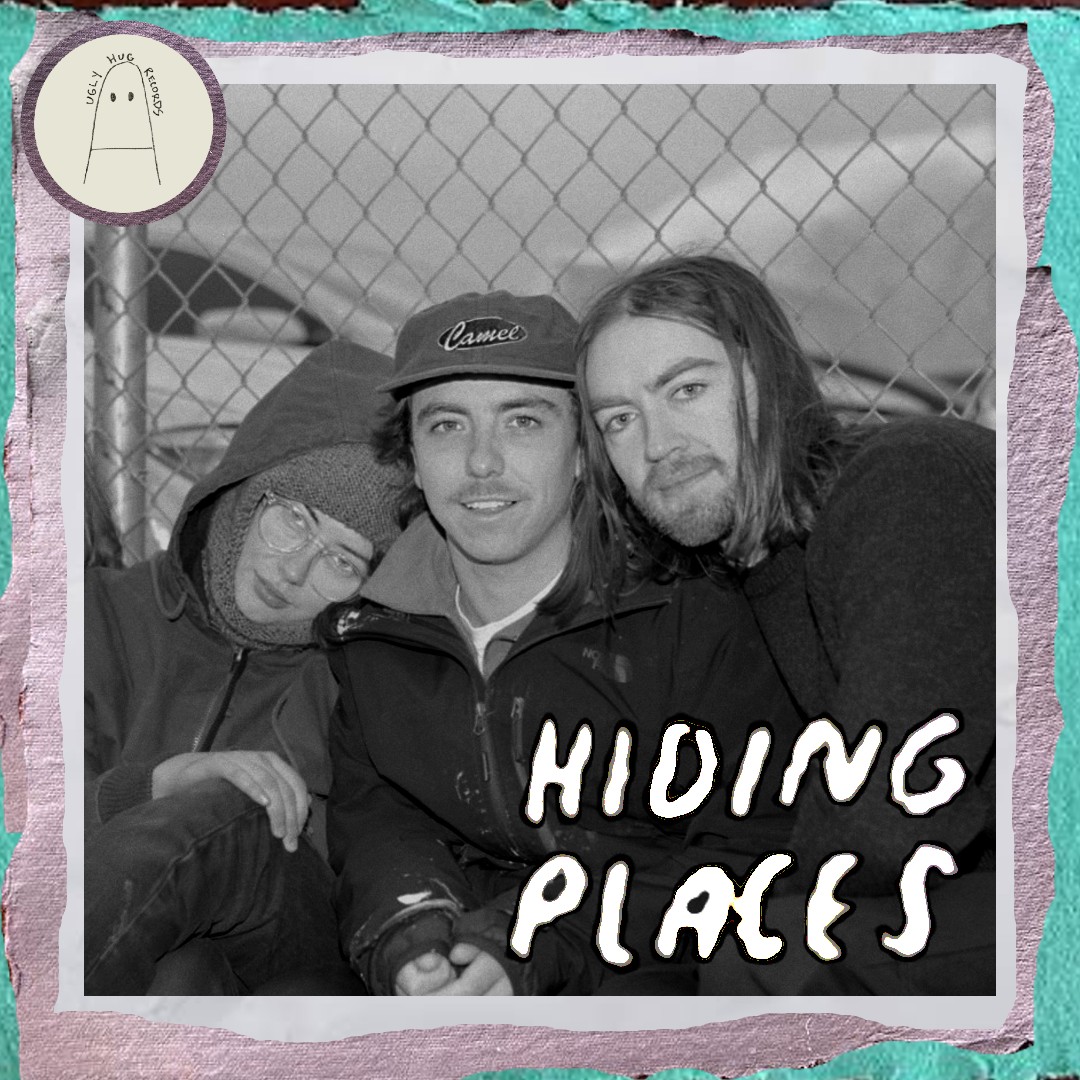
Today, Hiding Places have released their third EP, titled Lesson, off of the independent Brooklyn-based label HATE TO QUIT. Since forming, the band has cultivated and perfected a unique blend of hushed folk melodies along with the crushing subtlety of Elephant 6 style production across two EPs and a handful of one off singles; taking a cult classic poise amongst the most taught folk knots and rock n’ roll softies alike. As they have come to release these new songs, most of which were recorded in London at Angel Studios, Lesson reflects on the teetering compromises of adulthood, showing a young band embracing their imaginative and collaborative spirit to confront the duality of getting older, both through immense individuality and as a excitingly new and creative group.
Cover art: Matthew Reed (TV Beaches) and Kristen Kershaw
As a three piece, made of Audrey Keelin Walsh (guitar/vox), Henry Cutting (drums) and Nicholas Byrne (guitar/vox/synths), Hiding Places’ initial lore comes from UNC Chapel Hill’s student-run radio, WXYC. Their story, to be told through the style of on-air lingo; DJ Arts + Crafts (Byrne) and DJ Silicon Based Life Form (Cutting) needed a photographer for a party they were throwing, to which they found DJ Tidy (Walsh) in the radio listserv. Quickly building a professional relationship – strict artistic business – they inevitably became good friends, and, soon enough, Byrne was offering to record some of the demos that Walsh had been piecing together. With the addition of Cutting on drums, the three recorded and eventually released Homework and Heartbreak Skatepark as the first Hiding Places singles in 2021.
Since leaving Chapel Hill in recent years, the members of Hiding Places have never lived in the same place at one time. While Byrne and Cutting moved to Brooklyn, Walsh stayed in North Carolina before heading to London to study abroad. “It definitely is an adjustment,” Cutting was the first to admit. “You get used to a lifestyle where you’re hanging with these people all the time and then they leave.” Going long distance, a struggle enough for young lovers migrating to different colleges, it is a profound geographic feat of sorts for a young band honor-bound to create something genuine and collaborative. Though they make the most of it; planning to write and record in quick trips to predetermined destinations, something in which Walsh considers to have only enhanced their creative relation; “there’s the intentionality, and the comfort, and this element of trust that happens that is just so rare,” they articulate sincerely. Managing that kind of creative relationship, though any relationship for that matter, distance – as Walsh continues, “just reflects a commitment to each other. A commitment to knowing what we are hearing, what we have to say, and being curious about what we each have to say.”
Photo by Alec Peyton
That sentiment rings true as Hiding Places has only ever functioned as a fully collaborative group, dividing amongst them royalties, recording say and especially writing responsibilities – utilizing three different perspectives for each and every project. While living separately offers a unique and sequential opportunity for individuality, the band has come to embrace the perspectives of localization into a cohesive synthesis of style and story. “I feel like for the entire existence of Hiding Places we’ve had geographical influences from multiple places at the same time,” Byrne says, continuing, “I think that has allowed us to really explore different kinds of sounds as far as how they relate to our daily lives.” While Wash was in London, recalling, “I got to see a lot of local artists who made music that sounded much more grim than the local music of the South that I had grown up going to see,” at the same time, Byrne and Cutting were experiencing their first harsh New York winter – northern environmental standards when vitamin D deficiency feels like seasonal betrayal; “I just wasn’t used to feeling sad in that way;” Byrne admits.
Lesson, as a whole, does have a much darker, much more contemplative deliverance than past projects, leaning into more serious topics of fate, grief and the the new responsibilities that come with aging. Though, the band’s approach has not changed. What sticks out in a Hiding Places song is the ability to comprehensively build upon a perception, pinpointing the exact feelings that sprout in our gut rather than force it’s hand to be present. For instance, “after image” was written by Byrne during that first winter in New York. In its nature, the track plays with the idea of stillness as the guitars flurry down in uncoordinated patterns like snowfall on a windless night whilst Byrne and Walsh’s harmonies grow and deplete like a series of deep breaths – a clear play of dynamism built with trust and accents built from pure addiction. The title track “Lesson” blooms from an outburst of love and genuine benevolence, as an overt sense of warmth ebbs and flows where it sees fit (reminiscent of songs like “Sun Was” and “Skatepark Heartbreak”). The track soon revolts into a second act; grim, dynamic and hopeless as Walsh witnesses joy, so distant through the lens of grief and vice versa. The band doesn’t see it as a depressing matter, but rather an opening to new opportunities of expression, as Walsh responds, “feeling allowed to make sad music, or to make music that is honest and runs the whole landscape of emotions is very cool,” they say, before finishing, “I feel like we are kind of low key going in an Evanescence direction in some sort of way;” said only half jokingly.
At the time of our call, Walsh was currently diving into the novel, Lapvona, the most recent work of author Ottessa Moshfegh – notorious for the light reading material of My Year of Rest and Relaxation. Taking place in a corrupt medieval fiefdom, Walsh explains, “in the book, humans use imagination to lie, steal, murder and do really hurtful things.” But to their point, they share, “imagination is a gift that as a human I have the privilege to access, one that my dog does not have in the same way, so I might as well use it for something good.” With everything that Walsh finds creatively moldable, whether that be songs, stories, photographs, the arts and the crafts, even their doodled car has become synonymous with the band’s image. With this rich and lovely DIY aesthetic blended with hints of fantasy and natural exploration, there is a pure wonderment that the band omits. On the track “Elephant Key”, the story explores the capacities of different animals’ self agency while also referring to Walsh’s own accountability as a human. There is no thought of what is realistic or probable, playing with references to a “fish king” and a clairvoyant elephant, but Walsh’s approach to songwriting isn’t based in the grips of reality, but how far can we utilize imagination to push the novel feelings and experiences, those singular to being human, into a more comfortable place of understanding?
“Crown of Tin” was written in 2019 during Walsh’s first year at Chapel Hill. The song spent years being recorded and scrapped, just never feeling to have been done justice. Until Cutting suggested using the original vocal and guitar demos that Walsh had made underneath their lofted dorm bed, it may still have never been completed. But in its finalized form, it’s a simple track, a meandering verse to verse style, as Walsh narrates their experience with homesickness. It’s not a song that grapples with being physically alone, but more of drifting through a changed environment; new people, places, and things that haven’t been defined yet. But that simplicity of production allows the demo tracks to excel in their significance, as Walsh expresses, “I think that the sentimentality behind it is very much rooted in honoring the exploration and the wonder that comes from just realizing that you can make something.”
On its own, “Crown of Tin” is a lullaby of Walsh’s own vocation; setting boundaries between real expectations unmet and those that we create – made to be resourceful to our wellbeing. “I have been thinking a lot recently about how most of my emotions either fall under joy or grief in some form, and usually at the same time,” Walsh explains. “Often if I am angry, I am grieving an expectation I imagined.” It’s not out of convenience or habit that these feelings arise, but an effort to revert back to a sense of self that feels in control. The opening verse of the song sets the scene; “Counting down the seasons till I see you again/Winter is me singing in my room it never ends/Taking a short dance under the sun when I can/Going on some picnics with all of my new friends”, a relic of a blushed and lonely reality of a first year student. As the song comes to an end though, the last verse takes a turn; “I wanna live inside a cabin or a tent/Animals will smile at me, will make conversation/I’ll climb trees and look around and wear my crown of tin”.
As I sat with this song for a few days, overwhelmed with this stunning sense of nostalgia it left me with, I was reminded of my childhood bedroom that I shared with my two younger brothers; three parallel twin beds – every night in the fashion of a structured summer camp (or juvie) – as my mom read us the book, Where the Wild Things; not intimidated to use the grumbly voices, but rather encouraged by her three baby boys. Maurice Sendak, the author and illustrator of that book once described, “children do live in fantasy and reality; they move back and forth very easily in a way we no longer remember how to do.” To get older, when imagination isn’t just for kids, but extended to those who have to live by the rules of capitalism, heartbreak, apartment leases, catalytic converters, sell-by dates and homesickness, why not make the reality of it all just a little bit easier? “[Crown of Tin] was a very momentous song for me,” Walsh conveys with sincere recognition. “It was the first song that I recorded on my own and it’s a reminder to myself that the reason I like to make music is because I like to explode my imagination everywhere.” As simple as that.
At the time that this piece is published and Lesson is pushed out into the wild, Walsh will have moved and settled down in Brooklyn, joining Byrne and Cutting; all together for the first time in a handful of years. “We’re excited about increasing the pace in which we’re writing and recording and releasing songs,” Byrne says. “I think we’re in a really good position to do that because we’ve already figured out how to collaborate when it was much more difficult.” With more songs already recorded, full band shows in the works and the excitement of just being together again, it could be safe to assume that Hiding Places is just getting started, yet it feels like they are already so timeless.
Lesson also features Anthony Cozzarelli (bass/guitar/vox), Malik Jabati (saxophone on “Lesson”), Lucas F Jordan (flute on “Elephant Key”) and Frankie Distani (clarinet on “Elephant Key”).






 the ugly hug