Singer-songwriter Caleb Jefson, best known as Marble Teeth, has always made music that sounds like it could fall apart at any second – that’s exactly why it matters. there was a huge crowd of people gathered in the street reads small, uneven, and at times uncomfortable. Yet, it’s one of the clearest statements from a project that has built a world on imperfection.
Five songs, acoustic at their core – this EP extends the small central Illinois artist’s commitment to small-scale intimacy while pulling harder on collage and interruption. Memory fragments, incidental noise, disjunction; it’s a continuation of the lofi folk lineage that runs through Phil Elverum’s The Glow Pt. 2 and the early Alex G. cassettes – but also belongs to the current ecosystem of Bandcamp folk that refuses polish as a matter of principle.
“Celebration Story” plants its feet in a space that feels domestic and immediate: guitar and voice in close proximity, neither heightened nor diminished. The voice reads in a tone reminiscent of Shel Silverstein, folk stripped to its infrastructure. Following into “Power Bill Blues”, the EP’s stakes are made clear: everyday life not as metaphor but as material. Like Daniel Johnston or Jeffrey Lewis, it insists that the banal is narratively significant.
The center of the record – “Sudden Remembrance, Unfinished Business” – stretches the form outwards. The intrusion of collage, half-baked thoughts, disruptions of fidelity, places Marble Teeth closer to the restless experimentation of Told Slant or Lomelda than to any cleanly defined folk category. “When the Water Broke the Dam” serves as an interruption to the streamlined melodic twang that follows through the record, dropping octaves into a sharp, decisive burst that may or may not land with the listener – yet packs that punch necessary at the core.
Closer “Big Glass… The Lousy Lifetime of a Lowly Cog (icantseemyfaceinthemirror)” sprawls without release. It circles the anxieties with no exit strategy, pulling the listener into its own sense of exhaustion. It fully embodies the EP’s refusal of resolution, staying raw, unadorned, uncomfortable.
This is music less designed for playlists and more designed for personal archives – the kind of record that gets passed from hand to hand on blogs and reviews sites, accruing weight through repetition rather than reach. Marble Teeth isn’t making folk to scale up; they’re refining its scale down to the point of friction.
You can listen to there was a huge crowd of people gathered in the street anywhere you find your music and you can purchase the album now on bandcamp.
It’s the end of the summer. The moon is uncomfortably warm, the air is stale and still, and it’s so thick you could cut right through it. The late August nights bleed together with machine-like efficiency, and in the atonal drone of the remaining cicadas’ final chirps, an intangible feeling of intense dread swarms all daring enough to step out into this unforgiving night. The drive home is white-knuckled. The hypnotic glare of oncoming traffic engulfs the reddened retinas of the late-night travelers. The machine whirs. It feels as though everything might come crashing in at any given moment.
PORTRAiTS, the debut full-length from Kentucky-based art-rockers PARKiNG, captures this unforgiving sense of dread, unease, and mania with haunting accuracy. Its sprawling and oftentimes politically charged sound is a perfect fit for the ledge, for the cusp of collapse, and for the dreadful isolation of twenty-first-century America. Spanning ten tracks and clocking in at nearly forty-five minutes, ‘PORTRAiTS’ features pulsating post-punk explosions, haunting orchestral abstractions, and fresh takes on the last half century of art and noise rock.
‘Siren’ starts the record with Frankie T. Moore and Lizzie Cooper’s hypnotic, driving rhythm section. They’re accompanied shortly thereafter by Boss Benson’s guitar, which dances in the nostalgia of late 70s UK post-punk. Moore exhales over the sprinting track as he shouts one of the album’s defining decrees, “Feed into the sirens/Everyone knows the silence.” As the song chugs, it grows more manic, more disjointed. Benson’s guitar growls and shrieks in feedback, Moore’s wails grow more pressing, and Cooper’s bass never relents. The song crescendos into a swirling wall of sound around Moore’s non-lexical vocables.
Immediately following is ‘Thirds,’ a quasi-sung-spoken art-rock track that features the first of Moore’s manic, drowned-out narrators. Moore rambles his dissatisfactions and disillusions over Cooper’s stabs and Benson’s beautifully shambolic guitar. The monologue wanders and backtracks through conversations about the plausibility of a higher power, distressed linens piling up, poor reading material, and frustrations with socially constructed hierarchies. Its verses read like a dejected manifesto on disillusionment with the general state of well—just about everything. The singular glimmer of hope amidst the disillusionment is shouted in the chorus; Moore empathizes with our collective frustrations and isolation as he shouts, “It’s not your fault you’re out of place.”
These frustrations are further explored in ‘Lantern’ and ‘Mike Johnson is a Mechanic,’ two of the album’s most politically driven songs. ‘Lantern’ drives and bounces like a lost Joy Division track. Moore’s frantic drums are reminiscent of Stephen Morris, and Benson’s jagged guitar reads like an amped-up Bernard Sumner riff. ‘Mike Johnson is a Mechanic’ is one of two songs with leading vocals by Cooper (the other being ‘Statements’). Her blasé delivery paired with the
dancey instrumentation creates the record’s catchiest song and one of its best. She encapsulates the recurring thesis of frustration, taking political aim at our inherited issues and apathetic leaders, saying, ‘Once more/I’ve grown so tired.’ Moore maniacally shouts beneath her, and Benson shreds the record’s catchiest riff.
‘DSGN’ and ‘Observation’ are two more extremely well-crafted songs. The band proves that not only does it have something to say, but it can also produce extremely catchy and well-engineered tracks. ‘People Running Madly to Some Kind of Monolith’ is the first of two orchestral tracks. The ghastly whines of Moore’s violin, cello, and bass haunt the three-minute runtime until it dies out into swirling static and feedback. The white noise bleeds crimson into ‘Monolith,’ a seven-minute post-rock exploration of mania, dread, and delusion. This is the record’s defining piece.
Chains rattle, Cooper’s bass stalks, Benson’s bowed guitar screeches, and Moore begins his sleep-deprived, haunted narration. Moore begins speaking of his premonitions, ones so vile and so filled with dread and hatred that he “can’t bear to watch.” Benson’s guitar moans in eerie notes, and Moore pounds his drums as his narrator grows evermore paranoid: “The lies brought to attention by no one of importance. Lies that I have brought to my own attention.” He stands beneath a nauseating night facing an unknown crowd, putting us face-to-face with one of his delusions, “The wind is dark/Their eyes all glistening in the rather unpleasant but warm moonlight.” He reads this exhausted and indifferently as if trying to justify and cling to his remaining sanity.
Moore’s mania grows, and the instrumentation follows; it feels as if everything might collapse in on itself. With one final attempt to retain his sanity, he shouts the thesis for the album’s mania, “I fear/I fear what I fear might not be real.” It’s not enough clarity, and the hysteric instrumentation—the mania—overtakes Moore. Benson’s guitar screams as he bludgeons it, the drums frantically sprint in every direction, and Cooper’s bass and backing vocals loom over the volatility like the “dark wind.” Moore shouts nondescriptly, but he’s silenced by his own mania.
It plays like the score to a lost Edgar Allen Poe text. Perhaps much of the record does. ‘PORTRAiTS’ deals in mania, but the issues its narrators face are very real and very pressing. In a culture and country where isolation and extremism have spread like a common virus, ‘PARKiNG’ offers a complex take on 21st-century America that is uncompromising and blunt in its horrors yet hopeful in its anthemic refrains. Maybe amidst all this dread and unease there is comfort; maybe that comfort is simply that it isn’t all our own faults. ‘PORTRAiTS’ is the announcement of a band that can craft intelligent, ornate, and catchy songs. Their voice is distinct, urgent, and sincere.
PORTRAITS is now available anywhere you find your music. Tapes are available on the band’s Bandcamp.
Deja Vu can be quite the restless feeling. When moments of wracking the brain for memories becomes a dialogue; longing for answers and building mistrust in any bit of reason as to why this feeling is so intense. But what herbal tea does on this debut album Hear as the Mirror Echoes is build upon this space; one that feels achingly familiar, but you can’t seem to pin down why. herbal tea is the project of British artist Helena Walker, who has spent the last several years crafting songs in solitude and playing with artists such as Gia Margaret and Advance Base on their UK tours. Now she shares her long-awaited debut album via Orindal Records and Gold Day. Recorded entirely DIY with her long-time collaborator and childhood friend Henry C. Sharpe, the two brought these songs to life out of various rented living rooms and bedrooms, filling each corner of the space with their intuitive folk-laden dream pop.
Like watching a line of geese cross the road, the stories that Walker entrusts in us take time, but there is comfort in the practice. One by one, each song disrupts the bustle of the outside world and marks her path through these intimate landscapes. The opening track “seventeen” toys with time as a coping tool, as Walker sings, “I’m inventing life again at seventeen / Dancing in a drawing room / like in a dream”, opening up to the struggles of trauma through shifting layers of cinematic synths and cutting distortion. This sentiment is carried through on tracks like “Grounded” and “Kitchen Floor (4A.M.)” as they become sobering moments of stillness, balancing how to effectively ground yourself while also longing for someone else to rely on in times when you can’t rely on yourself. “I don’t know what I’m worth, but I want someone like an old friend,” Walker sings on the latter track, allowing the melodies to wash over with such gentle motion.
Although these songs feel heavy, what Walker creates is a place to lean into this undeniable familiarity with both validity and inquiry; a piece of work that is just as much about discovery as it is about understanding why these feelings are here in the first place. “Submarine” creates depth amongst the many voicings that Walker and Sharpe explore, threatening to strain each choice as she becomes buried by intense longing. The standout track “Garden” revels in the delicate harmonies that seem to flow whichever way the breeze blows. Soon Walker’s singular voice becomes the benchmark for retainment and release. Growing out from planted guitars and light piano chords, the dream stops in its tracks as Walker sings, “I was born in a garden, when I liked being me, before the burden of my body.” The song speaks to the difference between growing wild and getting clipped from the stem to fit into a handpicked vase, but herbal tea refuses to be restricted as the instrumentation blooms in full color and variety.
Hear as the Mirror Echoes becomes a space in which themes of dissociation, longing and emotional anxiety are written about with such care. Where stories are rooted by intuitive soundscapes and ethereal vocal performances that each become empathetic to the other’s expressional deliverance. It’s easy to get lost in the malaise of self-doubt, but herbal tea gives voice to thought and comfort to dissonance. It’s a collection that moves at its own pace, and to its credit, the album’s greatest strengths come from those little individual blossoms of patient voicings and unconventional instrumentals that make this record feel so deeply human.
You can listen to Hear as the Mirror Echoes anywhere you find your music as well as order cassette and vinyl put together by Orindal Records and Gold Day.
There is something innately natural about a Lisa/Liza song, the project of Portland, Maine based artist, Liza Victoria, whose self-made path of intimate folk music has been creating a presence where much often goes unnoticed in this fast paced world. In 2023, Victoria released Breaking and Mending, an enduring collection of songs that grew from grief and found a home amongst an extensive and true journey of healing. But last week, Lisa/Liza shared Ocean Path, an EP consisting of some of her earliest recordings she made in her teens and early twenties, now put directly on tape via Chicago’s Orindal Records. Although these songs were pocketed for years, serving as a measure of time for Victoria, in its own way, Ocean Path was always meant to be shared with the world, it just needed to feel like the right moment.
The basis of Victoria’s intuitive storytelling lies within her guitar playing, where thought and feeling almost become a deliberation of a moment – transparent in the motion of feelings and capturing the environment entirely in which it was recorded in. Often tracked in open spaces, such as her kitchen or backyard, these songs fit just right in those places we deem as safe for our own being. “Summer Dust”, the opening track, plays with that same meaning of intimate stillness, the acute pieces of collective thoughts, mental dust, that begin to build when left alone for some time. “Love for two-becoming / Love for yourself / finally running through you”, Victoria sings with such acching care, sometimes almost to a whisper, as if saying it loud enough for only her to hear it. “Gamble”, one of Victoria’s earliest recordings, is a story of nature and nurture, following our inherent need for connection, and the responsibility we feel to offer it to others. “Gamble, my Father’s dog, was born in a mountain fog / Followed me through the dark, Searching for the dawn”, she sings through a striking progression of stunning vocals and vivid imagery.
There are also many ghosts that we haven’t been introduced to yet that align on “Shark Teeth” and “Then You Shall See”, bidding for their piece to be heard before going off to complete their other ghostly tasks. The word ‘haunting’ holds an authentic meaning when writing about Victoria’s work, where it often feels to be tapping into the presence of a soul which lives amongst these delicate and intrinsic soundscapes. But whatever that soul may be, whatever we feel it represents, it’s not there to cause alarm on this earthly plane, but rather to make that connection between what we see and what we feel – being that direct line between a deep longing and a deep understanding of our own place in this world.
Ocean Path is a remarkable sense of self, tracking a linear path of growth that can often be hard to visualize when you are the one laying the groundwork. These songs aren’t immediate, but it’s in the trust that Victoria has always held true to her artistry that is representative of a journey you take on your own time. It’s the dirty fingernails, the layer of dust, and a broom in the corner that becomes such a personalization of storytelling from Lisa/Liza, yet has always been beautifully universal to those who are welcomed in. As the project is now getting the chance to be shared with others, it’s best said in Victoria’s own words, “this cassette leads down paths of memory, reminding me we are always becoming and growing into who we are and what will be.”
You can listen to Ocean Path out everywhere now as well as order a limited edition cassette tape via Orindal Records.
On Half Gringa’s latest album, Cosmovisión, Isabel Olive harnesses her voice as a writer and builds herself up to present her audience with big ideas and their even bigger mythologies and implications. Each song on her third effort feels ever-expanding as we catch a glimpse into Olive’s psyche through these ten striking tracks. These songs are often times abstract, touching on the gravitas of feelings and places that aren’t always rooted in tangibility, but convey the bigger feelings of the human condition. These are ideas that Olive states are often, “too hot to touch, too huge to hold.”
Soundtracked by pianos, strings, and Olive’s higher register, the opening track, “Anywhere You Find Me,” leaves us with a sonic impression that sets the scene for the album’s general sound. Cosmovisión’s musical palette is filled with twangy electric guitars, drums, and strings that highlight the record’s most poignant moments and highest emotional points, like the climax of the aforementioned album opener. She muses, “How can I free myself from despair? How can my despair free me?” Sometimes a song’s instrumentation drops off, only to include these strings and Olive’s vocals, giving us more space to absorb the words with more clarity.
One of the album’s highlights is the track, “Where You Ride,” which displays some of Olive’s strongest lyricism. This honestly is saying a lot, considering each track on this album contains highly focused, sharp writing that’s often almost literary at times, as the lyrics drive and command the listener’s attention throughout the album’s runtime. With lyrics at the helm, the album’s instrumentation melds around Olive’s words, as they fill the runtime and space of each track fully. In “Where You Ride,” the music bends at her will, binding to the words, as they lead us to the next movement. Towards the middle of the track’s runtime, the song becomes hushed, filled with finger-plucked strings and guitar feedback as Olive delivers the line, “They said my soul was anted eluvium. They ordered their usual and then I replied, ‘that might be true but it only sounds negative coming from you.’” Olive maintains a deep awareness about herself, her surroundings and her emotional interpretation of them. Hearing her rhetorical thoughts throughout the album is a continued treat through lyrics that feel like an immediate, but fully realized response to the forces that attempt to shake her sense of self.
Even when Olive doesn’t have the words to describe her exact emotion, like she details on “What’s The Word,” she never sounds unsure of herself. The track picks up its pace to a jaunt as she sings overtop electric guitar lines and percussive drum rhythms, “I thought someday it would hurt less, direct address to myself in the mirror.” This song also showcases the bilingual writing of the Venezuelan American singer, as she switches to Spanish for a few of the track’s lines. We also see this on songs like “Supervisión” and the album’s closer, “The Optimist.” Olive’s usage and switching of languages always enhances the song it occurs in, creating a mirror image and an almost call and response aspect to the songs and their structures. The Spanish lines are not simply a translated repetition of the English lines, but entirely separate thoughts that continue the poetry of her writing.
Cosmovisión as an album gives Isabel Olive the ability to bask in big questions, feelings, and do so utitlizing larger, almost orchestral arrangements that cling to her words and allow them to take the spotlight. It’s an artful and expressive record that allows every feeling to be accounted for and every feeling to be considered, no matter how daunting it may seem. Half Gringa knows the illuminating power of her words, and it’s an honor to witness her showcase them in real time.
You can listen to Cosmovisión out everywhere now, as well as purchase a vinyl or CD via Olive’s own label Teleférico Records.
Innocents in Babylon doesn’t always work. Maybe it’s an extension of the fact that all of your reporter’s favorite musicians in the local New York City music scene right now just happen to be in their mid-twenties or mid-thirties (Renny Conti is such a Brooklyn-based musician). Either way, Conti’s self-titled is a refreshingly human record. It’s a well-timed, heat-seeking missile to the grown-up adolescent who’s just a few years past being able to relate to their favorite coming-of-age films anymore, and acutely aware of that distance/separation/isolation. For this cosmically stultified demographic, Renny Conti is solace.
Conti’s musky, different lyrics are delivered with intention and purpose, but not eagerness. Our singer brings a slightly chilly air to this record that keeps it cool instead of overly jejune. More akin to Pavement’s “Slanted and Enchanted” or, if things go poorly for all of us, Purple Mountains in fifteen years. Walk-with-you lyrics rip in on “South Star”: “It could’ve never been this way. I mean, it could’ve been this way, but it’s not.” Later, on “Room to Room,” Conti confides, “I feel your pain, I too want everything, wanting the world to stop, or just for life to change.”
On “I Find It Hard” (which might be the star track for your reporter), Conti brings a unique vocal delivery that doesn’t appear anywhere else on the album. Conti is singing differently here and it works. This New Voice is backed by an unconventional chorus, a few voices loosely strung together in a melancholic drone. Like if the Greek chorus in a Homeric drama repeated every line after Falstaff’s soliloquy, it’s surprising in a way that makes you smile, but it’s a bitter smile. The lyrics are bleaker and more honest on this track than any other on this dimensional, all-seasons record – self-conflicting like its just-past-ripened audience.
With Renny Conti, the artist rides the neo-wave of Neil Young worship, but not with such piety that it’s a faithful adaptation or in any way lacks originality. Not unlike MJ Lenderman, but tougher on the ears, toothy with dissonant key chords, especially on “Room to Room,” which ends in a broken mirror guitar solo that belongs on “Metal Machine Music.” Conti’s album is all about tension and release, but a release that doesn’t let you off the hook entirely. If “Manning Fireworks” found a place in your Best Albums of 2024 roundup, but you want it darker, Conti brings the flame.
This, as aforementioned, is a human record – not a perfect record – but that doesn’t stop it from being a masterpiece. The prickly-world-weary gauntlet has been thrown down and Renny Conti has answered. A rare and welcome reprieve from the fear panic white noise of Modern Life On Mars (a volume his track “Life on Earth” aptly points out). If you partake in general anesthetics or arylcyclohexylamine derivatives, put on “Life of Earth” and lie face-up on the rug (and thank us later).
This new voice on the indie scene is marked by a lived-in feel. Although not his musical debut, it feels fitting that this album is the artist’s self-titled. Still, “Andrew Plays” is arguably the most important song in this collection, and Conti’s voice isn’t on it at all. It’s an instrumental track less than two minutes long. If music has the power to move you – or, more accurately, if you’ve managed to stay un-soul-hardened enough that the power of music is still able to reach you in 2025 – to not give this one a listen is to cheat oneself. “Andrew Plays” is on-par with such powerful, wordless movers as Cobain’s “Letters to Frances” and Ed Harcourt’s “Like Sunday, Like Rain.”
Renny Conti is a mature evolution from the artist’s 2020 “Figurines.” Five years later, this is that record’s older brother, who went away and got cooler and a little wiser and tucked some more experience and technical mastery under his belt. Now, he’s back in town, and everyone at the dive’s tugging on their friend’s shirt sleeves in a whispered chorus of “Do you know that guy? Who’s that guy over there?” Lookin good. Renny Conti is detail-oriented down to the cryptic, evocative cover art, promising subtle magic and mood swings that can give you jet lag. Cloudy romanticism meets eyelash-searing realism. Happily, the album totally delivers on that promise. Expect to hear more of the name Renny Conti.
You can listen to Renny Conti out on all platforms now!
Alice Rezende wants you to enter Olivia’s World. Inside this world, you’ll find that almost anything goes, and you’ll also encounter multiple characters embodying traits of complete debauchery, where people react on their most primitive self-destructive instincts that come off as either crude or cringeworthy, but also fighting your damnest to retrieve your sense of self while battling the obstacles that life has to offer.
As a native Australian, Rezende is a part of the Dolewave music scene that is heavily popular down under. Dolewave can be best described as Australia’s response to jangle pop with more of an edgy twist with some tongue-in-cheek sarcasm thrown in for good measure. It’s a scene that birthed bands the likes of the Twerps, The Goon Sax, and Rolling Blackouts Coastal Fever. Rezende’s rendition is part Dolewave, part romantic pop punk with a twinge of garage rock thrown in for good measure.
Rezende’s debut record Greedy & Gorgeous is a loosely based concept album about self-discovery. The themes are further illustrated as the record progresses on topics of self-care, inferiority, and authenticity. Rezende’s ingredients are put through a blender of angsty lyrics mixed with a bubblegum-sweet delivery that is engaging in a way that keeps getting better with every listen. I am reminded of another concept album TotallyCrushed Out! by That Dog, which is a mid-90s cult classic that is a supremely underrated collection of songs that is ever rarely mentioned.
The new supporting characters entering Oliva’s World are drummer Daan Steffens and lead guitarist Jordan Rodger who greatly contribute to the lively and crunchy sounds that live in Greedy & Gorgeous. They make themselves heard loud and clear on the punchy lead single “Sourgum” which flies out the gates at breakneck speed with pop punk-charged guitars that would have kept even Jason Statham’s adrenaline flowing at an all-time high in the film, Crank. Rezende’s sugary-sweet chorus matches the energy of the riffs to a tee, creating pure unadulterated entertainment.
“Empresario” is a song about an imaginary Brazilian band manager who’s not quite the best at his job; the manager should probably be headed to the unemployment line for their negligence. The song is fun as hell, with a groovy riff that I imagine Herman Monster doing the twist while wearing Bermuda shorts. The guitars have a proper 90s fuzz that gives the song a vintage sound. As the song comes to a close, Rezende has a conversation in Portuguese, and as a fellow speaker of the language, I felt like the Leonardo DiCaprio meme pointing at the television during the outro.
There are moments sprinkled throughout the album that remind me of another Dolewave superstar Tell Me How You Feel era Courtney Barnett. Most specifically on “Baby’s Bathwater” and “Chemlab,” with the former turned up with wailing, forceful guitars and the latter being a breezy, careful sonic experience. Both songs display a richly diverse, yet colorful array of sounds Rezende is capable of delivering. But also her quirky vocal style sticks out similarly to that of Barnett’s at her best.
“Healthy & wealthy” has a sonic influence that makes me think about what if The Breeders somehow got a hold of a Slanted & Enchanted Pavement era demo. The song has a fun-loving melodic chorus with a guitar sound that lies in the middle of the Venn diagram where slacker and garage rock merge. Rezende’s witty lyrics center on that adage of people preaching “just say no” and all will be cured, and is one to think about as she sings, “they say to level up don’t drink to get a buzz/all the while the morale is seriously low.”
The final two songs deal with internal and external social destruction. “Weird guy” is laden with noisy guitar riffs on the creepy male adults ruining the vibes of the surrounding women who just want to enjoy the simpler things in life. While “Beauty bar” is the slowed-down closer that vacillates between self-loathing and despair being around high-ranking people in the industry, singing “climbing to some lofty heights/giving off some awkward vibes/am I just a peasant here.”
After listening to Greedy & Gorgeous it’s easy tovisualize a scenariowhere your cool older sibling has just come back home from their freshman year away at college to nonchalantly bestow upon you an awe-inspiring album they found tucked away in a vintage record store. This is Alice Rezende’s world and we all are just living in it.
In the dimly lit basement bar of Neptune’s in downtown Raleigh, the crowd fell into a hushed reverence as the band began to play. Cramped onstage even more than the audience, they filled the room with Andrew Dowdy’s distinctive vocals, carried by a rich composition of pedal steel and fiddle—country-soaked tones that swelled beautifully with each song. It was an intimate, immersive moment, and I was hooked. Though I had heard Fust’s name mentioned in conversations about North Carolina’s music scene, this show, a part of last fall’s Hopscotch Festival, was my true introduction—and it couldn’t have been a better one.
Since discovering them, I have been immersed in their music. Their latest release, a collection of demos titled Songs from the Rail earned a spot on my most memorable list of 2024, while their last true album, Genevieve, is one of my favorite records of recent. Led by singer Andrew Dowdy, of Durham, NC, Fust is deeply rooted in the Appalachian Mountains of Virginia and West Virginia where Dowdy’s origins lie. He draws from these roots to explore what it means to be from the American South—more specifically Appalachia. On Big Ugly, Fust expands their sound, reaching louder and greater heights, while the album’s themes plunge into deeper lows than any of Dowdy’s previous work. Each song reads like the journal of some lost author, peering deeply into Dowdy’s mind and memories. Continuing the region’s rich and integral storytelling tradition, this album takes the form of modern-day folk ballads, preserving local history and passing down the gritty realities of Appalachian life to future generations.
Joining Dowdy on Big Ugly are Avery Sullivan (drums, percussion), Frank Meadows (piano, percussion), John Wallace (guitar, vocals), Justin Morris (guitar, pedal steel, vocals), Libby Rodenboug (fiddle, vocals) and Oliver Child-Lanning (bass, vocals, dulcimer, synth).
Together, they craft a dynamic sound on Big Ugly spanning from fuzz-filled tracks like “Mountain Language”—where producer Alex Farrar also sits in on guitar and lap steel to complete the arrangement—to driving drum tracks and roaring guitars reminiscent of Drive-By Trucker songs. On the other end of the spectrum is “Sister”, one of the album’s most haunting tracks. Its more stripped-back composition brings the fiddle and pedal steel guitar to the forefront, with the fiddle scratching along as Dowdy’s vocals drop to a lower register, delivering devastating lyricism. Further expanding the album’s sonic landscape are the contributions from Dave Hartley of the War on Drugs on synths and John James Tourville of Deslondes on pedal steel.
Throughout the album, Dowdy’s distinctive vocals are augmented as they are layered over with his own voice, as well as those of his bandmates, creating a haunting, almost choral-like effect. Dowdy’s vocals are complemented by a deep, resonant bass and the higher-pitched harmonies of Libby Rodenbough on many tracks, along with a duet with fellow Appalachian artist, Merce Lemon, on “What’s-His-Name”. The album’s ethereal vocal quality feels fitting for songs that deal with memory—like ghosts lingering in the past. Real people and places from Dowdy’s life come to life through lyrics about gas stations, demolished hospitals, and highways, all while grappling with the reality that these things have been lost to time. The songs are a testament to Dowdy’s love for the kinds of things that make up who we are, while they are with us and once they’re gone. The things that now exist only in memory, like a worn-out photo carried close, fading yet never forgotten.
Songs like “Mountain Language”lament the poverty of Southern life while yearning for a time when home was untouched by that pain. Dowdy sings, ‘But if we can make it up the mountain again / We’ll be back with country friends / And there’ll be language on the mountain again / Oh what country, friends, is this?’ The final line is a direct reference to Shakespeare’s Twelfth Night, where Viola, shipwrecked in an unfamiliar land, speaks the play’s first words: ‘What country, friends, is this?’ Like Viola, Dowdy channels a sense of disorientation, searching for a return to the familiar past he once knew. Yet, the ever-changing reality of Appalachia renders this impossible—what was once home has become an unrecognizable landscape.
On “Gateleg”, Dowdy further shows off his songwriting and storytelling ability further, with a Hemmingway-like restraint in its lyrical content. He references Bob Dylan’s Maggie’s Farm for the chorus taking “I ain’t gonna work on Maggie’s Farm, no more/No, I ain’t gonna work on Maggie’s Farm, no more” flipping it to say “You ain’t gonna work on the line, no more/You’re gonna work for Maggie’s store”. Dowdy paints a picture of a relationship in the face of poverty, defined by the backdrop of wood burning stoves, convenience stores, and broken-down cars, propped up on cinder blocks.
Fust captures the contradiction of rural Appalachia—the stark contrast between poverty, drug abuse, and environmental devastation, brought on by exploitation of the region, and the enduring beauty of green rolling mountains, deep-rooted traditions, and the resilience of its people. The album takes its name from a community located in one of the poorest census tracts in one of the poorest counties in West Virginia. Its cover art features a photograph of a mural from the Big Ugly Community Center, originally painted as a backdrop for a student play that told the stories of local families. The image serves as a perfect accompaniment to the record’s themes— a testament to both the ability and the necessity of creating beauty in the face of ‘ugliness’.
Given that Fust’s last two albums were among the best releases of the past two years, I was admittedly apprehensive about whether Big Ugly could live up to its predecessors. It has—and then some. With this record, Andrew Dowdy has firmly established himself as one of today’s great songwriters. As Fust embarks on tour, I would highly recommend seizing the opportunity to experience their music live—I know I definitely am.
Big Ugly is out on all platforms now. You can order a vinyl or CD copy of Big Ugly via Dear Life Records.
Philly-based folk guitarist Kristin Daelyn’s songwriting feels just as effortless as it does emotionally intoxicating on Beyond the Break, her Orindal Records debut out today. A short yet fully settled curation of songs rifling through the in-betweens of longing and recovery, Beyond the Break flows so naturally out from Daelyn’s presence, unhindered by the cruxes of grief in which they stem from and the self-realization and love for which they are headed.
Recorded live at home by mostly Daelyn herself, Beyond the Break defines its spirit very holistically, built out from her intuitive guitar playing and steady vocal performances, each empathetic to the other’s expressional deliverance and playing towards her ultimate strengths as a songwriter. Although sparse in complexion, this graceful deliverance wields a gravitational draw, further brought out by additional tracking from Dan Knishkowy (Adeline Hotel), Danny Black (Good Old War) and Patrick Riley who offer stirring arrangements to these already moving compositions. Songs like the album’s opener “Patience Comes to the Bones” or “White Lilies” flow amongst layered harmonies that soothe the setting, trickling with loose and enduring melodies that bring an aching familiarity, like the feeling we get hearing the voice of a loved one after a hard day.
Substantively, this musical cohesion only further exposes the fervent tenderness of these songs to the still air, restoring our hope in the simple saying of “time heals all wounds”. “And do I break my heart to open it up,” she sings with a particular infliction on “An Opening”, annunciating the balance between what we want and what we need. And as the album goes, her use of language, pained yet unrushed and honest, lives within these little moments that blossom with unguarded trust. “Like a moon that hides its darker side behind a crescent smile,” illustrates those voices we often push aside on “Longing”, remaining precarious and heavy in the back of our mind. “It came to me then/How we will live/And live again,” she laments on the album’s closer “It Came to Me Then”, building courage from the layers of musical clarity rising up from below, before the movement settles, “With river in my palms/I drink and know what it’s like to be loved” – what a wonderful feeling.
You can listen to Beyond the Break out everywhere today as well as order a vinyl or CD copy from Orindal Records.
Interlay does not want to play nice. Alexandria Ortgiesen tells you this on the second track of Hunting Jacket, amidst waves of abrasive instrumental collisions, but by then she doesn’t have to. Rather than treading a fine line between dissonance and harmony, Interlay embraces extremes recklessly, cultivating a rich and indulgent sound like some sort of ‘all you can eat’ buffet of the varying noise-driven genres they touch. Their songs lean heavy, but their structure is smart, understanding that the loudest arrangements can’t sustain impact by sheer volume alone. Hunting Jacket carves out soft pockets, teasing enough delicacy to lower your heart rate before a storming of dense drumming can kick you in the stomach. In six tracks, Interlay invites you into their game but does not tell you the rules, their clever melodies simulating the highs of reckless sound as they nail the gnarly beauty of raw Midwest noise in a recorded format.
Hunting Jacket functions as both a fitting addition to Interlay’s catalogue and a debut of its own. It marked their first release after relocating to Chicago from Madison, where the band had been based since its start in 2018. Ortgiesen is the only remaining member from Interlay’s roots, and is now joined by Henry Ptacek on drums, Kayla Chung on bass, and guitarist Sam Eklund, who also makes his vocal introduction on the 2024 EP. The band has never been known to ease in, following commanding start of “Rot” on their 2020 release Cicada with an even stronger intro track on Hunting Jacket , as standout “Virgin Mary” fills the first thirty seconds of the EP with abrasive riffs and formidable percussion. Throughout their latest work, Interlay takes the dense sonic textures and brooding nature of their past projects and stretches their potential, demonstrating how Interlay’s recent shifts are nourishing their identity rather than thwarting it.
One of the many successful feats of Hunting Jacket is the way it disputes notions that emotion and weakness are synonymic. Ortgeisen’s vocals are also volatile, offering no warning in their turns from gentle to abrasive. Yet, even at their most benign moments, when her deliveries are tender and lyrics spill with vulnerability, her performance is laced with assertion rather than docility. It helps that Hunting Jacket is a guitar heavy listen, creating an environment where instruments carry equal weight in navigating the feel of the tracks as vocals do. Interlay embraces their own emotion as much as they embrace raw post-punk noise, and their ability to blend the two bulldozes sonic expectations on “sad girl” music to make space for a reality where yearning, paranoia, and insecurity can and should exist at the same volume as bitter rage.
The EP wraps with the title track, where Interlay breaks free from the fervent tug of war between heavy and tender to explore a more climactic style of songwriting. Surpassing the prior songs in length, “Hunting Jacket” mimics the bodily effects of walking a lap after a sprint. In a stirring buildup, the band counters any whims that the rapture of the EP lies in party tricks of all consuming noise and distortion tactics, as their ability to write suspenseful and controlled melodies amounts to an equal level of auditory catharsis.
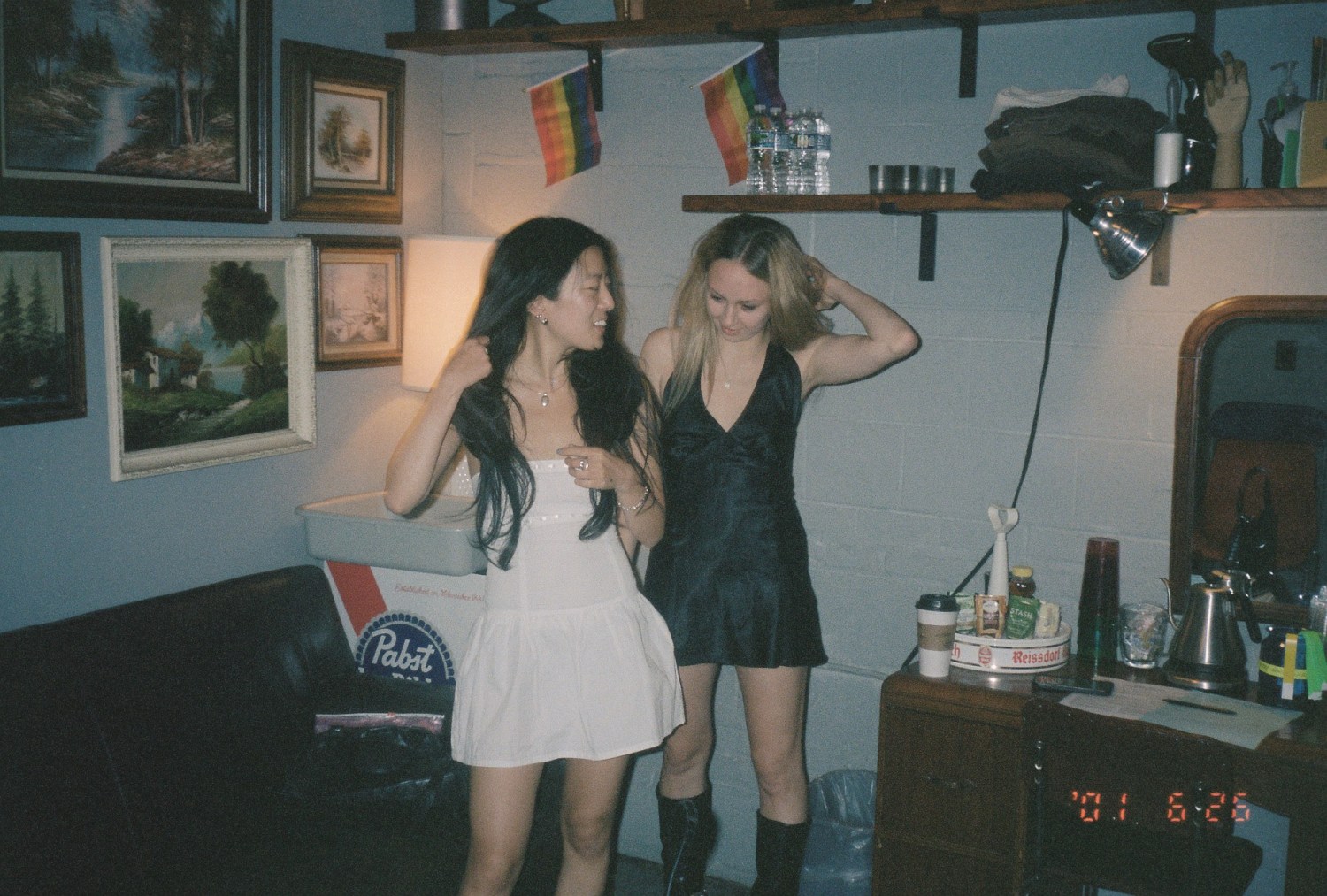
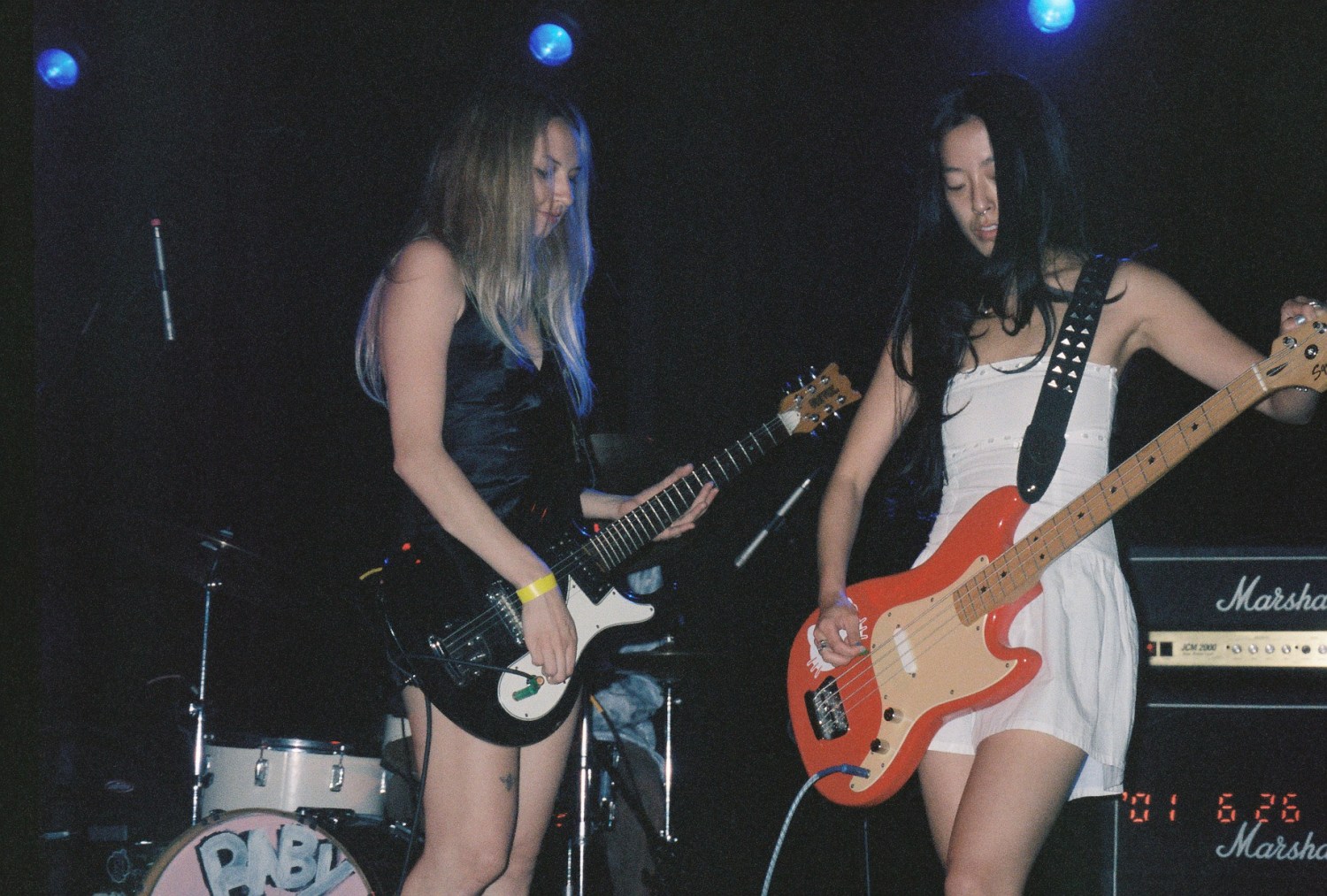
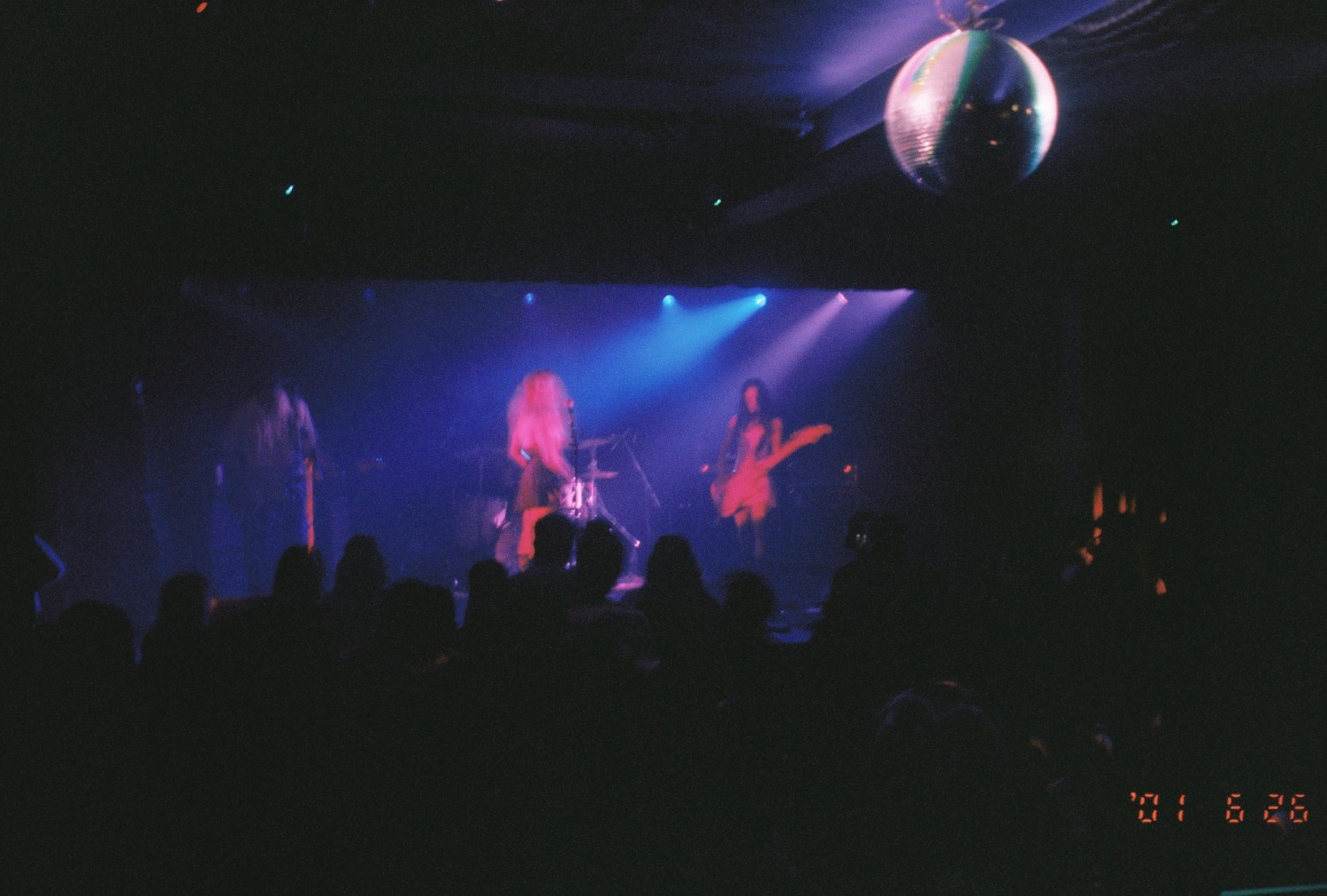
Scroll through photos from Interlay’s EP release show July 5, 2024, at The Sleeping Village in Chicago, IL.
Today we are celebrating six months of Interlay’s Hunting Jacket. Listen on all streaming platforms as well as order a cassette or CD via Pleasure Tapes.








 the ugly hug