
As a small music journal, we rely heavily on the work of independent tape labels to discover and share the incredible artists that we have dedicated this site to. Whether through press lists, recommendations, artist connections, social media support or supplying physicals, these homemade labels are the often unsung heroes of the industry. Today, the ugly hug is highlighting the work of our friends over at Devil Town Tapes.
Devil Town Tapes is a deeply rooted indie tape label run by Jack Laurilla, based out of Leeds, UK. With a focus on the found community that comes with sharing music, Devil Town Tapes has not only established themselves as a spearhead in the UK, but continues to grow in pockets of the U.S. as well. With an expansive set, focused on the niche creative corners that the label handles, Devil Town has housed the work of artists such as lots of hands, Greg Mendez, Snowhore, Conor Lynch, Dilary Huff, boxset, Noah Roth and many more, all differing in styles and sounds but connected by a through line of the people that help make it so special.
We got to catch up with Jack to talk about how Devil Town Tapes came to be, what he sees in the growing community and what keeps him in the game to release physical music.
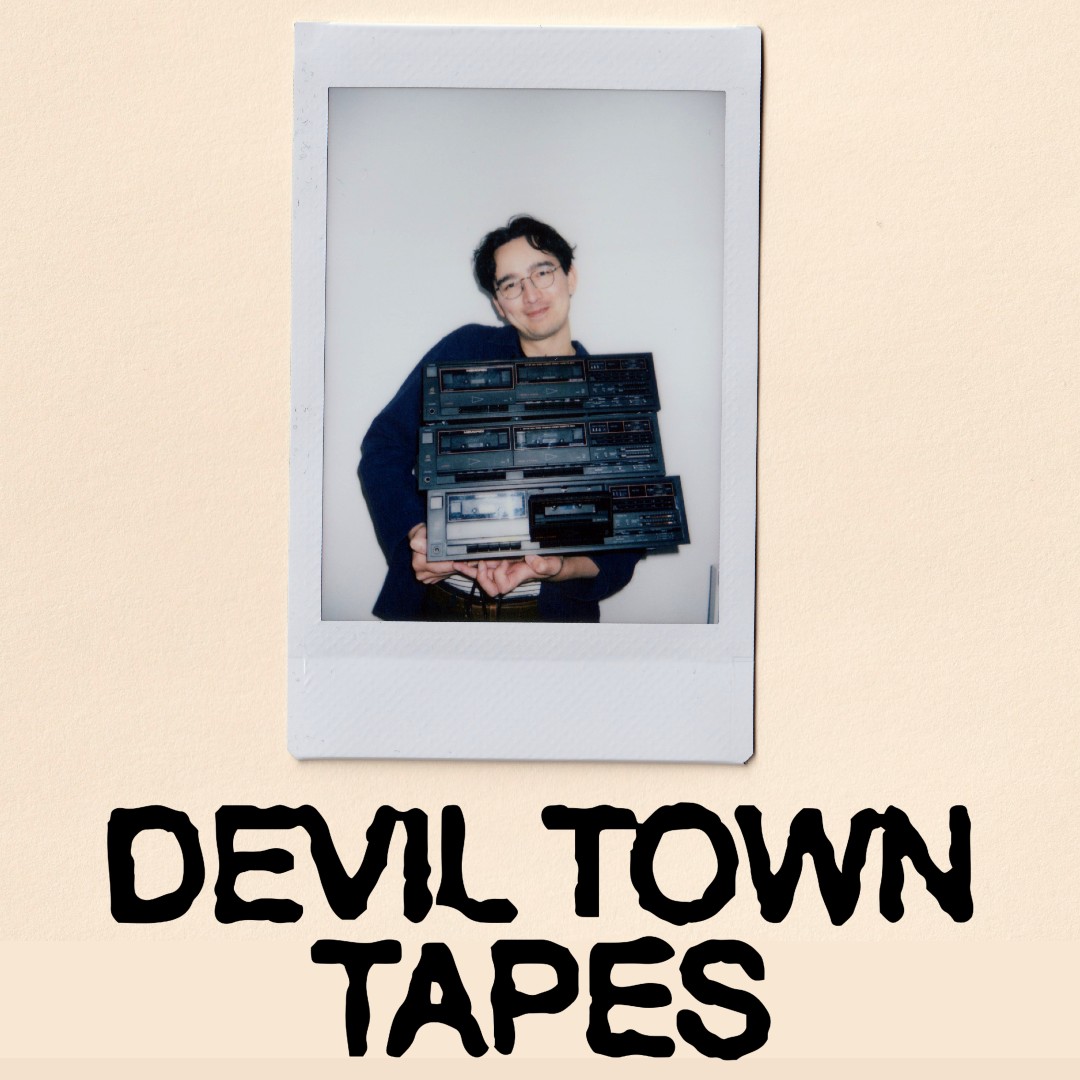
This interview has been edited for length and clarity
Shea Roney: What made you want to start a label? Did you have a clear vision from the beginning, or goals you were hoping to accomplish?
Jack Laurilla: It officially started in 2019, I’d wanted to do the label for a long time before then, but I didn’t really know how. I mean, I still don’t really know how to do it [laughs]. I started seriously getting into music as a listener when I went to university in Kingston, which is just outside London. There was a really great record store there called Banquet Records, and that really shaped a lot of how I listen to music. That’s when I started collecting music physically as well on CD and vinyl. I started to see the same [label] stamps on every single record – a lot of stuff from Topshelf, Run For Cover and all those guys, and I kind of didn’t really realize how much these labels were shaping my tastes. I would go away and see what records that they had released, then I’d go to Banquet the next day and get them, and invariably I’d always like them. That idea of a record label being able to shape taste in that way was something I’d never really considered and that was kind of the start of thinking like, ‘oh, this is an interesting way of communicating to people.’
At the time, the only way I knew how to release music physically in that way would have been through vinyl, which, as a student, was just impossible for me to do. So I completely parked my idea while I was doing my degree. When I finished Uni, I moved back to Bournemouth, which is kind of a small, retirement town down South. Going from Kingston, where music was everywhere, crazy bands like The Hotelier and Foxing would be playing small pubs all around, all of this really formative music to me, to then going back to Bournemouth, where there were only a few people doing gigs, felt like more of a hostile environment for being involved in DIY music. I was really kind of craving that sense of music community which I had back when I was at Uni, and that’s when I started thinking about how I could start making that happen myself, rather than just complaining about it.
SR: When did the cassette tape become a feasible format for you?
JL: Around that same time as well I discovered Bandcamp. There were no record stores in Bournemouth so it really filled that void for me, particularly finding Z Tapes. The kind of music that was being released by them was really inspiring, and the idea of tape as a format was just not on my radar before. I mean, it was a format I loved when I was a kid, the first music that I owned was on cassette tape, but I didn’t realize that was still happening, particularly in the DIY space. It’s just so much more accessible and it felt like it was, as a medium, more democratic, so all of those things combined kind of gave me the push to be like, ‘this is something that I can do’.

SR: When it came to the point where you could start releasing music, what kind of artists did you look for?
JL: At the time, because I was trying to seek that community more locally, a lot of it was local. There wasn’t an abundance of gigs going on in Bournemouth. A lot of it was just scouring through Bandcamp and Soundcloud, just trying to find stuff tagged to Bournemouth or neighboring cities. I was very lucky that I was able to stumble across some artists who happen to live nearby and were also making the exact kind of music that I was interested in. I mean at the time, although they were local to me, they only seemed to exist online, so it was kind of a happy accident how the first few artists I worked with came about.
SR: Who were some of those first artists you worked with?
JL: The very first one was Cult Film [Chapman Lee], who I just stumbled upon on Soundcloud. I just felt like I could immediately relate to it. I reached out to him over Facebook, and he was very, very gracious, and agreed to let me release his music. Looking back, retrospectively, I was just a complete stranger, reaching out to say, ‘I would like to put your music out on tape, please,’ with no track record of doing that before, so it was amazing that he took what I was offering in good faith. I think the success of that first release is still kind of the motivation to keep releasing stuff. Starting off with just a selection of tracks, and then taking it through to something that people can hold in their hands. We also did a launch gig as well, and seeing so many people share that space around music that you’ve had a small part in bringing to them was really, really special to me. I’m constantly chasing that feeling with each and every thing that comes out on the label.

SR: After you put out that first release and began looking for more artists, did you continue to search out music that you could relate to?
JL: Definitely, I feel like a lot of the music I release is always reflecting my taste at the time. I would never want there to be like a house style or sound to be expected, you know what I mean? I see the artist’s as kindred spirits in a way, and that’s how I like to approach deciding what to release on the label . Whether that’s through the emotion that they’re conveying through their music, or a shared DIY ethos. Stylistically the music can be really different from the last release, but it still shares that throughline, in a way.That’s what keeps it fun.
SR: With those first handful of releases being UK artists, you’ve since expanded to the U.S. putting out great music from artists like Edie McKenna, Greg Mendez, Conor Lynch and a few others. How did you discover this music and how did you connect with these artists?
JL: Yes, the first two were very local. Cult Film and omes [Omar De Col], who is also from Bournemouth. After those I kind of just naturally started finding artists from further afield. It was a healthy mix between people reaching out to me and me approaching them. I guess the label exists, not only in the physical space, but also online as well, so it only made sense that I was interested in music from outside my postcode. But there has always been this throughline of people feeling connected to others on the label, particularly with artists like Bedtime Khal, Conor Lynch and Edie McKenna. Bedtime Khal is good friends with Conor, Edie has sung on Conor’s records, and, Conor has also supported Greg Mendez in the past. So even though they’re far away from me geographically, I still feel like there’s that sense of community, and all the artists are still connected in a way that doesn’t feel scattered, you can still see the connective tissue between all of them, which is really important to me.

SR: Can you share a few personal favorite releases or projects that you’ve worked on that left some sort of impact on you, whether that be the experience, something you learned or just from pure enjoyment.
JL: There are quite a few, and all for different reasons. The compilation that we put out, which was our 11th release, was a special project for me to work on, as it featured the first five artists that we’d worked with. They had original songs on side A and covers of each other’s tracks on side B. And just the idea of them having mutual admiration for each other’s music and covering each other’s tracks was really cool to me. It was also an opportunity for me to collaborate with my friend Bo, who did all the artwork for it. He’s always done the Devil Town Tapes logos and he did all of the artwork for this as well. It just felt like every single person who’d been involved in the label up to that point was involved in this thing and it just kind of commemorates that period of time that started everything.

There is also a record that we reissued from Snowhore, the solo name for Veronica Mendez, who is now playing as Mary Saint Mary. That was a great record to be involved in because I’ve never reissued anything before, and it got me excited about the idea of, how by releasing music, I can archive it. Being able to do that for a record that I loved, which hadn’t been released physically before but one that I think is a classic, brought on this realization of what the role of a label can be in preserving music as well. I’m always acutely aware that the online spaces that we inhabit aren’t going to be arond forever. But once something exists physically, you’ve got an archive of it, whether it’s the 30 or 40 copies like one of our releases, or whether it’s a thousand copies, they’re always going to be there. I’ve always liked the idea that the tapes will end up somewhere really weird, and someone will find them in a car boot sale or something like twenty years down the line and rediscover them all over again.
SR: Talking about the digital landscapes, as someone who cherishes the physicality of community that comes with sharing music, what keeps you in the game and excited to keep working with physical music?
JL: I feel like great music deserves to be remembered. So if I can help to preserve the legacy of a record, I want to do that. That’s what keeps me motivated to keep going for sure, and it will never not be exciting to hold a tape in my hands, especially with something I’m so involved in, like the physical products. I’m dubbing all the tapes at home, I’m printing out the sleeves and cutting and folding them. It’s a privilege to be involved in other people’s art in that way.
SR: How does collaboration shape the way the label functions?
JL: Although I’m kind of there to drive it, I do need that collaboration to keep it interesting. Each release is definitely a collaboration, it’s always a conversation between myself and the artist. If I have ideas for things that might work well with the physical release I will offer up my opinion, but it’s their music so I always want to be in service to the record and to their vision. Every relationship is built from a mutual respect for each other as well, so the whole process is always a conversation. Also my partner Tas does a million different things with the label as well, she’s an illustrator and graphic designer, and is always helping to advise me on the visual side of the label. It’s really important for me to have that second opinion, because I can definitely get lost in the weeds and obsessed over tiny details.

SR: You brought up how the label is a conversation in practice. Do you ever feel like it becomes a conversation with yourself, in that you are trying to find that balance between your work and life and something you deeply care about.
JL: Yeah, a hundred percent. My release schedule can be either really intense or non-existent and that’s kind of just depending on my energy at the time, because I’m always like trying to just find windows when I’m busy at work, and when it’s quiet. But sometimes when I’m emailing all day at work, the idea of coming home and looking at a screen again for a few hours is the last thing I want to do. I’m always trying to keep a healthy and fun relationship with it all, allowing myself to feel like it’s okay to take a step away from it. The label is a constant and will always be there to return to when I’m ready, just existing [laughs].
SR: For those who are looking to start their own tape label, what do you wish you knew when you were starting out and do you have any advice for them?
JL: I didn’t necessarily know what I was doing when I started, which is okay. The main thing was being motivated to do it, and I feel like if you’re motivated to do it, then you’ll seek out those answers quite naturally and find people who can give you those answers. There’s nowhere to read a ‘how to’ on releasing a tape, but if you’re inspired to release a tape then that’s the most important thing. So much of DIY is operated in good faith as well, and being able to remain in dialogue with people and being honest is really important as well.
SR: Do you have anything on the horizon for Devil Town Tapes?
JL: Yes! We have the debut album from Bedtime Khal, which has been really, really cool to work on, because he was one of the first few artists that I worked with. I’ve released one of his EPs and reissued a couple of his releases and this debut album is really sick.
Interview conducted and written by Shea Roney

Along with this series, our friends at Devil Town Tapes are offering a five tape bundle giveaway in celebration of this collaboration! The bundle will include For Edie (2024) by Edie McKenna, Slow Country (2024) by Conor Lynch, Don’t Forget to Remember (2023) by Noah Roth, Hard to Find / Wake Up (2021) Bedtime Khal, batch_six (2020) by boxset and a Devil Town pin badge.
To enter the giveaway, follow these easy steps below!
- Follow both Devil Town Tapes and the ugly hug on Instagram
- Tag a good music buddy
- Comment your favorite horror movie below!
The winner will be picked next Thursday November 7th and will be contacted through Instagram.
All of these releases can be found on the Devil Town Tapes bandcamp in limited quantities.
 the ugly hug